



The cast vs forged wheels difference starts with how the metal is shaped: a cast wheel is poured as molten aluminum into a mold, a forged wheel is pressed from a solid block of aluminum, and a flow formed wheel starts as a preformed blank whose rim barrel is spun and rolled thinner. That process sets weight, strength and price.
Scope: this guide covers one-piece aluminum wheels for passenger cars, SUVs and light trucks. It compares manufacturing processes, not aluminum versus steel; that material comparison is in alloy wheels vs steel wheels. Multi-piece and magnesium wheels are mentioned only briefly. Load ratings and test marks depend on the market, so always check the rating for the exact wheel and vehicle.
How are cast, flow formed and forged wheels made?
All three types usually end up as aluminum alloy wheels that look alike once painted. The difference is in the route the metal takes before machining, and that route decides how much metal is needed for a given strength.
Cast wheels are by far the most common: according to European Aluminium’s automotive manual, cast aluminum wheels hold more than 80% of the market in North America, more than 90% in Europe and close to 100% in Japan, while forged wheels are about 15% in North America and 5% in Europe 1.
Cast wheels
Casting means filling a mold with molten aluminum and letting it solidify in the shape of the wheel. There are several ways to fill the mold. Low-pressure die casting is the main one: the metal is pushed up into a multi-part mold at a relatively low pressure of around 2 bar, which fills it quickly and gives a denser structure.
It is the standard process approved for wheels sold to carmakers 1. Gravity casting, where the metal is simply poured, costs less but usually leaves more porosity, so gravity-cast wheels need more metal, and more weight, to reach the same strength 1. Squeeze casting and a few other variants are used only in small volumes.
After casting, wheels made to automotive standards go through X-ray inspection, heat treatment, machining and a pressure-tightness test before the valve and bolt holes are drilled 1. Then they are painted or finished, and samples go through dimensional, balance, fatigue and impact tests.
Flow formed wheels
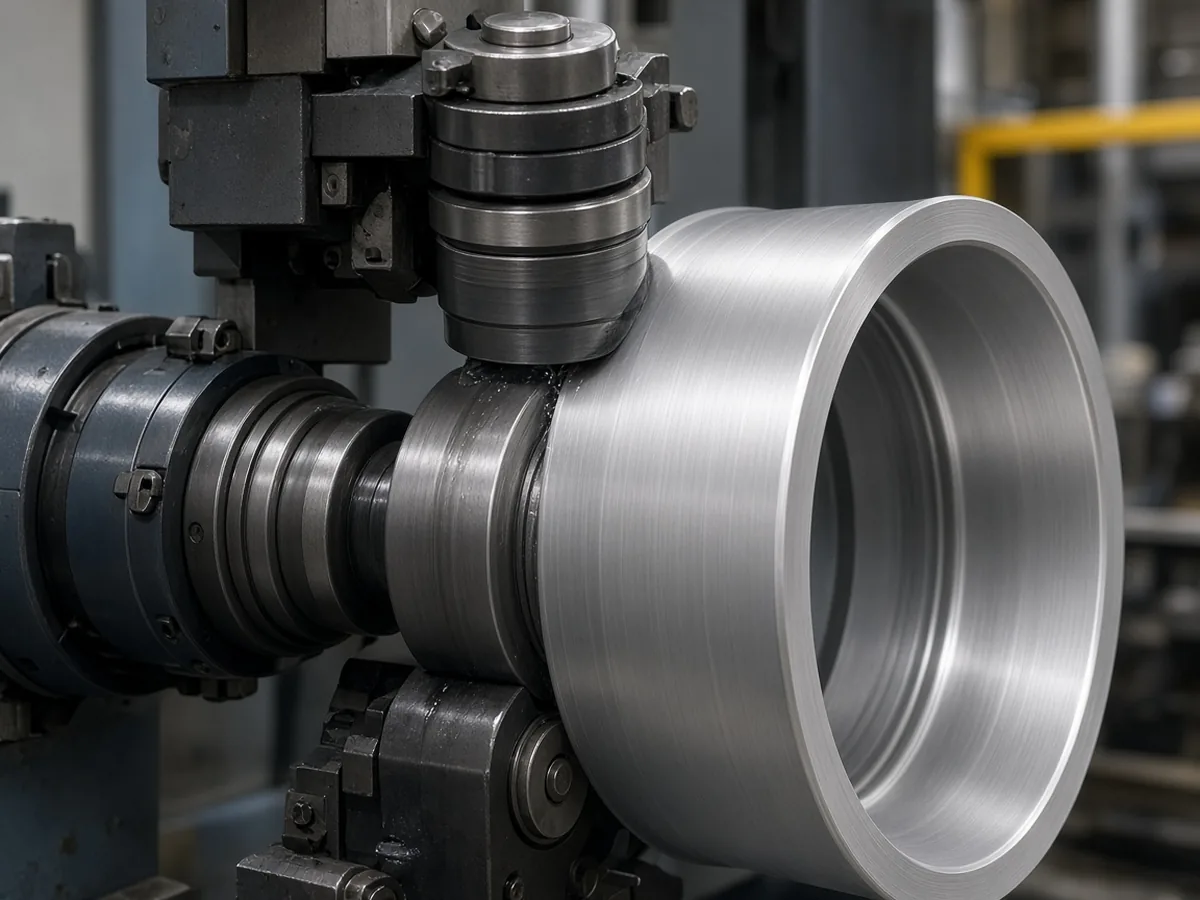
Flow forming, also sold as rim rolling, starts with a preformed wheel blank. A machine spins the blank, heats the outer part to between 300 and 350 °C and presses steel rollers against the rim area to pull it out to its final width and shape 1. The heat, pressure and spinning give a thinner rim wall with properties close to forged metal in the barrel, while the center and spokes are not roller-worked.
The result is lighter than a fully cast wheel of the same size, at a lower cost than forging.
Forged wheels
A one-piece forged wheel starts as a solid block of aluminum alloy. The block is hot forged under very high force into a rough wheel shape, the rim is then spun to width, and the final design is machined out 1.

The standard forging alloys are 6082 in Europe and 6061 in North America, both heat-treatable aluminum-magnesium-silicon alloys 1. Forging lines up the grain of the metal with the shape of the wheel and leaves no casting porosity, which is why forged wheels can use less material for the same strength. Because so much of the final shape is cut by CNC machines, forging also allows a wide range of spoke designs, sizes and offsets.
Cast vs flow formed vs forged: side by side
The table sums up how the three processes compare for a one-piece aluminum wheel of the same size and design intent. Exact numbers depend on the design, so treat these as direction, not as figures for a specific wheel.
The weight figure comes from European Aluminium, which puts forged wheels at about 25% lighter than cast wheels, and potentially more 1. The same source notes that even well-designed cast wheels with flow-formed rims cannot reach the weight saving of forged wheels, and that forged wheels outperform cast wheels in impact and fatigue tests 1.
Weight matters because a wheel is unsprung, rotating mass: less of it helps the suspension follow the road and takes less energy to speed up and slow down.
Cost runs the other way. Casting makes many wheels from one mold quickly, so it is the cheapest per wheel. Flow forming adds a machine step. Forging needs large presses and much more machining time, which is why forged wheels cost the most and often have longer lead times.
What does flow forming change, and what does it not?
Flow forming is often sold as “almost forged.” That is true for the rim and not for the rest of the wheel. A 2026 SAE technical paper that studied flow forming on cast aluminum wheels found that the process allowed a 30% reduction in rim thickness, with a slight increase in yield and tensile strength and a significant increase in elongation along the direction the metal was rolled 2.
The paper also reports that the spoke and hub areas are not affected by the process 2.
That has two practical meanings. First, most of the weight saved by a flow formed wheel is in the rim barrel, the outer part of the wheel where saving weight helps most. Second, the spokes and hub of a flow formed wheel are still cast metal. If a hard pothole impact lands on the spokes, the wheel behaves like a cast wheel in that area.
Higher elongation in the rim means the rim is more likely to bend than crack, which is the behavior most drivers prefer.
So a flow formed wheel is a good middle choice when you want a lighter rim and better rim toughness than cast, at a cost far below forged. It is not the same as a forged wheel, and a seller who claims otherwise is using marketing language.
Rotary forged, flow forged, hybrid forged: what do the names mean?
Wheel marketing uses many names for the same few processes. These are the ones buyers ask about most:
- Flow formed, rotary forged, spun forged, flow forged: usually all the same idea, a preformed center with a rim that is spun and rolled. The word “forged” here refers to the rim working, not to a forged wheel.
- Hybrid forged: also used for flow formed wheels by some brands, and by others for a wheel whose rim is formed in a more complex process. Ask which one is meant.
- Fully forged or monoblock forged: a one-piece wheel made from a forged block, with the design machined out.
- Multi-piece forged: forged parts, such as a forged center and spun rim halves, joined by bolts or welds.
- Cast and “cast-forged”: a few processes combine casting and forging steps on the same part. They are niche, and the name alone does not tell you the properties.
Because the words are not regulated, the only reliable way to know is to ask for the process route and the test reports, as explained in the verification section below.
Which wheel type fits which use?
Match the process to how the wheel will be used and what the buyer will pay:
- Daily driving and OEM-style replacement: a good low-pressure cast wheel that meets the load and test requirements is fine. This is what most new cars leave the factory with.
- Enthusiast street cars and lighter performance use: flow formed wheels give a lighter, tougher rim for a moderate price increase.
- Track, high-performance and premium builds: forged wheels give the best strength-to-weight ratio, the most design and size freedom, and the best impact and fatigue results.
- Heavy trucks and towing: the load rating matters more than the process. A forged truck wheel can save weight, but a correctly rated cast wheel is also acceptable.
- Show builds with unusual sizes or offsets: forged, because machining from a forged blank makes custom sizes possible without a new mold.
Whatever the process, fitment still decides whether the wheel works on the car. Check the bolt pattern and center bore with our guide on how to measure bolt pattern, and check clearance with wheel offset. If you are still deciding between aluminum and steel, see alloy vs steel wheels.
Risks and exceptions: damage, repair and multi-piece wheels
Stronger does not mean unbreakable. Any wheel can bend or crack in a hard pothole or curb impact. What changes between processes is how much load it takes to cause damage and how the wheel fails.
Cast metal tends to be less ductile, so a severe hit is more likely to crack it. Forged and flow formed rims tend to bend before they crack, and forged wheels generally do better than cast wheels in impact tests 1.
Repairing a damaged wheel is a judgment call. Small cosmetic damage can usually be refinished. Straightening a bent rim is common for forged and flow formed wheels, but welding cracks or heating the metal can change its heat treatment and strength, so many wheel makers advise against it. If a wheel has a crack in a spoke or near the hub, replace it.
Multi-piece wheels add another risk. European Aluminium notes that the joints of multi-piece wheels act as stress concentrators where fatigue cracks can start, and that fasteners can loosen with vibration 1. That does not make them unsafe if they are designed and assembled well, but it does mean regular checks of bolt torque and seals.
Finally, porosity is a known issue in cast wheels, which is why automotive cast wheels are 100% X-ray inspected 1. A cheap wheel from a supplier that skips this step is a real risk, whatever the process name on the box.
How can you verify a cast, flow formed or forged claim?
You cannot tell a forged wheel from a good cast wheel just by looking at the paint. Weight compared with a known wheel of the same size is a useful hint, and machining marks on the back of the spokes can suggest forging, but the reliable route is paperwork. Ask for:
- Process route: a short description of each step, from casting or forging to rim forming, heat treatment, machining and coating.
- Material certificate: alloy and temper, such as 6061-T6 for a forged wheel.
- Test reports for cornering fatigue, radial fatigue and impact, with the load used and the standard named.
- Inspection records: X-ray or porosity checks for cast and flow formed wheels, dimensional and runout results, and balance.
- Markings: load rating, size, offset and the test mark the wheel claims.
Test marks are not all the same. In North America, SAE J2530 is the recommended practice for aftermarket wheels on passenger cars, light trucks and multipurpose vehicles. It covers performance requirements, sampling, certification, test procedures and marking 3.
In Japan, the JWL mark for passenger car wheels and JWL-T for truck and bus wheels are self-certification marks under the transport ministry, while the VIA mark shows that the wheel passed a verification test by a third party, the Japan Vehicle Inspection Association, and was registered with JWTC 4.
JWTC also states that the VIA mark may not be shown unless the wheel is registered, even on wheels made for export 4. So a VIA stamp is worth checking: ask for the registration, not just the stamp.
What should B2B buyers put in a wheel specification?
Wheel brands, distributors and tire shops that buy in volume need a spec that leaves little room for interpretation. A useful set of items:
- Process: cast, flow formed or forged, written as a process route, not only a name.
- Fitment: diameter, width, bolt pattern (PCD), center bore, offset, and brake clearance for the target vehicles.
- Load rating: per wheel, matched to the heaviest vehicle on the list.
- Tests and marks: which standard, which tests and which mark the wheel must carry for the sales market.
- Finish: color, coating type, and a sample panel or reference wheel for approval.
- Inspection: appearance, balance and runout, PCD and offset checks, with sampling levels agreed in advance.
- Accessories and packing: center caps, valve type, lug seat type, and carton protection for the face.
Typical production for forged and flow formed wheels involves forming the blank by forging or flow forming, then machining and coating. Inspection covers appearance, balance and runout, and PCD and offset. For center caps that match a private-label wheel, see our guide to wheel center caps. If the program is for a new model or a size that is not in a catalog, vehicle-specific development starts from the fitment data and the target load.
Lead time also differs by process. Cast and flow formed wheels from existing tooling can ship faster, while forged wheels made to a custom design need more machining time. Agree the lead time and the sample approval steps at the start, together with how the first-article test results will be shared.
Conclusion
Cast, flow formed and forged wheels can look identical, but they are made in very different ways. Casting is the cheapest and most common route, and a well-made low-pressure cast wheel is what most cars use. Flow forming works the rim of a preformed wheel, saving weight in the barrel, while the spokes and hub are not roller-worked. Forging gives the best strength-to-weight ratio and the most design freedom, at the highest cost.
For buyers, the process name on a box matters less than the process route, the material, the test reports and the marks behind it. Ask for those documents, check the load rating against the vehicle, and confirm the fitment before ordering.
Next step
Yirox makes forged and flow formed wheels, and we check drawings, your vehicle list and the wheel specs with you before sampling. See our alloy wheels or send us your fitment list and target load.
Frequently asked questions
Are most OEM wheels cast or forged?
Most are cast. Cast aluminum wheels hold more than 80% of the market in North America and more than 90% in Europe, and low-pressure casting is the standard process for wheels supplied to carmakers.
Is flow forged the same as forged?
No. A flow forged or flow formed wheel has a rim that is spun and rolled thinner after the blank is formed. A forged wheel is made entirely from a forged block of aluminum.
How can you tell if a wheel is forged or cast?
Not reliably by looks. Compare the weight with a known wheel of the same size, and ask for the process route, material certificate and test reports.
Can forged wheels be repaired?
Bent forged rims can often be straightened by a specialist, and cosmetic damage can be refinished. Cracked wheels should be replaced, because welding or heating can weaken the metal.
Are flow formed wheels good for daily driving?
Yes. They are lighter and tougher in the rim than cast wheels of the same size and cost much less than forged wheels, which suits most street use.
References
[1] European Aluminium. “The Aluminium Automotive Manual – Applications – Chassis and Suspension – Wheels.” 2011.
[2] SAE International. “Effect of Flow Forming Process on the Mechanical Properties and Microstructure of GDC & LPDC Cast Aluminium Alloy Wheels.” Technical Paper 2026-26-0298, January 2026.
[3] SAE International. “J2530: Aftermarket Wheels – Passenger Cars and Light Truck – Performance Requirements and Test Procedures.” December 2024.
[4] Japan Light Alloy Wheel Testing Council (JWTC). “Frequently Asked Questions about the VIA Mark.”