





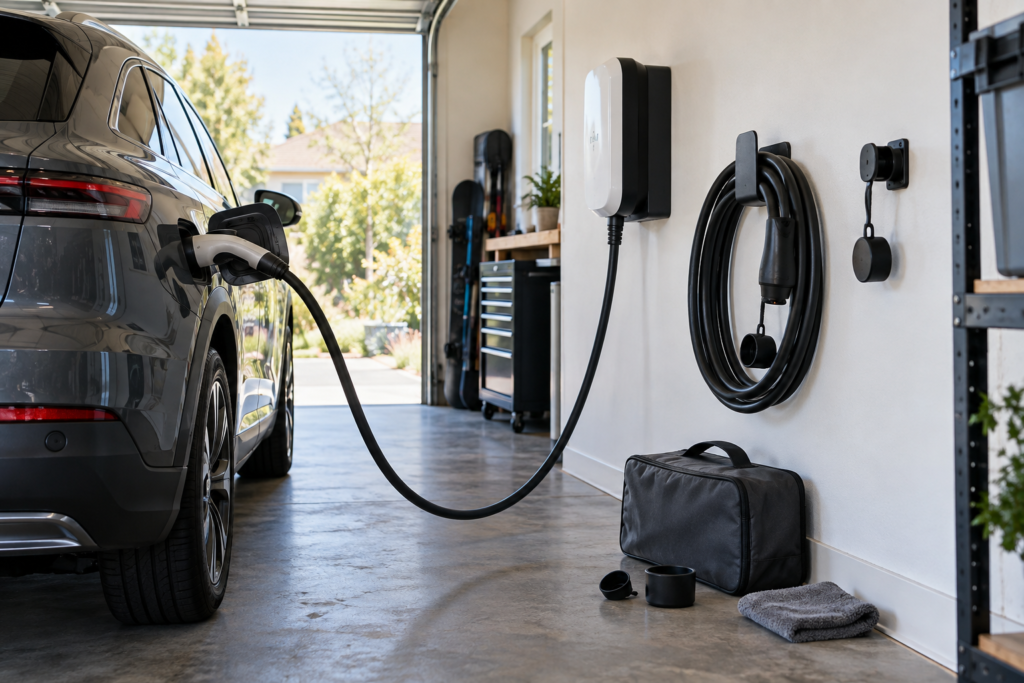
EV charging accessory types by function support five practical jobs: connecting compatible equipment, protecting connectors and cables, storing and routing them, mounting charging equipment, and supporting inspection or maintenance. The right accessory depends on the charging setup, site, environment, and product evidence—not on a product label or connector shape alone.
That functional view is useful because “EV charging accessory” can describe very different items. A connector cap is not selected in the same way as a cable assembly. A wall holster solves a different problem from a mounting plate, while a cleaning and inspection routine protects the value of all of them. Start with the job, then define the equipment, conditions, and evidence required for that job.
This guide gives home users, installers, fleet teams, distributors, and private-label buyers a shared vocabulary for the category. It is a taxonomy and first-pass decision tool; detailed product selection still requires the exact vehicle, charger, outlet, location, market, and applicable documentation.
Table of Contents
- What does an EV charging accessory do?
- How do accessories support connection and fitment?
- How do accessories protect connectors and cables?
- How do accessories support storage and cable handling?
- How do mounting accessories support installation?
- What supports inspection and maintenance?
- Which accessory function fits each buyer and site?
- What should buyers verify before ordering?
- Conclusion: Choose the Function Before the Product
- Frequently Asked Questions
- References
What does an EV charging accessory do?
An EV charging accessory supports a charging workflow without necessarily being the charger or EVSE itself. The five useful function groups are connect, protect, store, mount, and maintain; one item can serve more than one group, but its primary job should still be clear.
| Function | Typical items | The problem it addresses | First question to ask |
|---|---|---|---|
| Connect | Cables, adapters, connector extensions, inlet-side or outlet-side accessories | The vehicle, charger, and supply do not share the required interface or reach | Does the item match the exact interface, rating, and permitted use? |
| Protect | Connector caps, covers, strain-relief parts, cable-jacket protection, weather guards | Dirt, water, impact, abrasion, or repeated handling can damage exposed parts | What exposure is expected, and what evidence supports the protection claim? |
| Store | Holsters, hooks, docks, reels, bags, cable clips, trays | A loose cable becomes a trip, bend, contamination, or vehicle-contact risk | Where will the cable and connector rest between charging sessions? |
| Mount | Wall plates, brackets, posts, backing plates, glands, supports, fasteners | The charger or accessory needs a stable, serviceable location | Can the surface, hardware, load, clearance, and cable route be verified? |
| Maintain | Inspection aids, cleaning tools, replacement caps, labels, spare parts, records | Wear and configuration changes can go unnoticed | What condition, traceability, and replacement checks are required? |
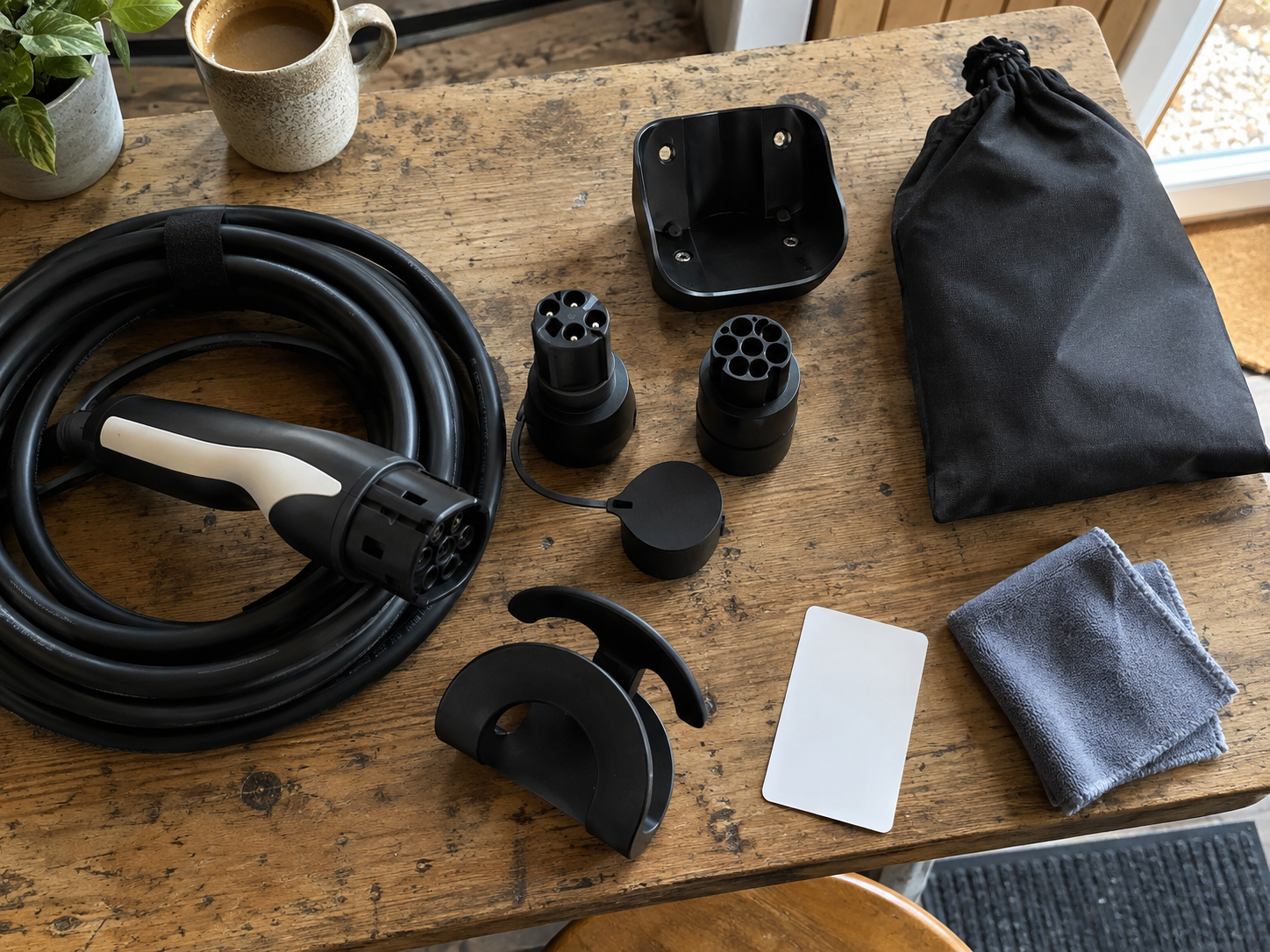
The groups also help prevent a common buying error: choosing a visually similar item without defining the job. A connector may look compatible but still fail a mechanical, electrical, communication, environmental, or market requirement. A holder may fit the handle but not the cable bend radius or mounting surface. Function is the starting point, not the final approval.
How do accessories support connection and fitment?
Connection accessories work only when the vehicle, cable, charger, outlet, and operating mode are considered as one system. Fitment therefore includes the interface shape, electrical limits, communication requirements, mechanical clearance, and target-market expectations.
For consumer charging, the U.S. Department of Energy describes Level 1 and Level 2 charging as commonly using SAE J1772 equipment, while public DC fast charging may use CCS, CHAdeMO, or NACS depending on the vehicle and network 1. That is a useful orientation, not a universal purchase rule. The vehicle manual, charger documentation, and local market configuration should control the final match.
Readers who are still separating the equipment roles can use the cable-versus-charger explainer before deciding which accessory belongs at the vehicle, supply, or station side.
Think of connection fitment as four checks:
- Interface: Identify the vehicle inlet, charger connector, wall outlet, station-side socket, and any adapter interface. Record whether the accessory is intended for the vehicle side, supply side, or station side.
- Electrical: Confirm AC or DC use, voltage, current, phase, temperature range, and the rating of every connected component. An adapter does not increase the safe rating of the system around it.
- Communication and control: Some charging arrangements depend on signaling or control functions. Confirm that the accessory is approved for the intended charging mode rather than assuming that a passive-looking part is always neutral.
- Mechanical and market fit: Check mating dimensions, locking or retention features, cable diameter, bend radius, labels, language, and the requirements of the country or network where the product will be sold.
When a fleet, installer, or distributor needs a repeatable fitment process, the EV charging accessories compatibility checklist helps turn these questions into a vehicle, connector, charger, and market reference matrix before samples are ordered.
Do not treat “fits Type 2,” “works with EVs,” or a connector photo as complete evidence. The useful record is a traceable combination of exact SKU, interface references, electrical limits, intended charging mode, drawings, and test or declaration documents.
How do accessories protect connectors and cables?
Protection accessories reduce exposure and handling damage, but they do not make an unsuitable charging setup safe. The correct choice depends on whether the part protects a parked connector, a cable in storage, a wall entry, or an assembly exposed to outdoor conditions.
Connector caps and covers are used to keep contact areas cleaner when a cable is disconnected. Cable jackets, strain-relief areas, glands, clips, and guards address different risks: abrasion, repeated bending, pulling, sharp edges, water entry at an interface, or accidental contact with the ground. The EV charging connector caps and covers guide is most useful when the immediate decision is about cap fit, retention, protection, and maintenance rather than charger output.
For outdoor charging, ask four practical questions:
- Is the accessory itself rated and documented for the expected rain, UV, dust, temperature, cleaning, and corrosion exposure?
- Does it keep the connector or cable off the ground without trapping moisture or creating a sharp bend?
- Does the material remain flexible and mechanically stable across the expected temperature range?
- Does the protection claim apply to the complete installed arrangement, or only to the individual part under a defined test condition?
The U.S. Department of Energy notes that outdoor home charging requires equipment suitable for outdoor use and that an electrician can assess the installation’s electrical capacity 2. That distinction matters: a weather-resistant cap cannot compensate for an indoor-only charger, poor cable routing, an unsuitable outlet, or an installation that has not been evaluated.
For technical buyers, ask for the material specification, environmental rating or test basis, dimensional drawing, retention method, cleaning instructions, and replacement guidance. IEC 62196-1 covers plugs, socket-outlets, vehicle connectors, vehicle inlets, and cable assemblies, with general requirements and tests addressing mechanical, thermal, and contaminant-related conditions 4. Use the applicable edition and market requirements for the exact product rather than applying a standard name as a blanket claim.
How do accessories support storage and cable handling?
Storage accessories keep the cable and connector in a controlled location between sessions. The right solution reduces ground contact, excessive bending, vehicle contact, and clutter while keeping the connector easy to pick up and return.
Common storage options include a connector holster, a cable hook, a combined dock, a wall-mounted cradle, a reel, a carrying bag, and small clips or trays. They are not interchangeable. A holster mainly supports the connector handle; a hook supports a cable loop; a reel manages reach and slack; a bag supports transport and contamination control; a dock may combine connector retention and cable routing.
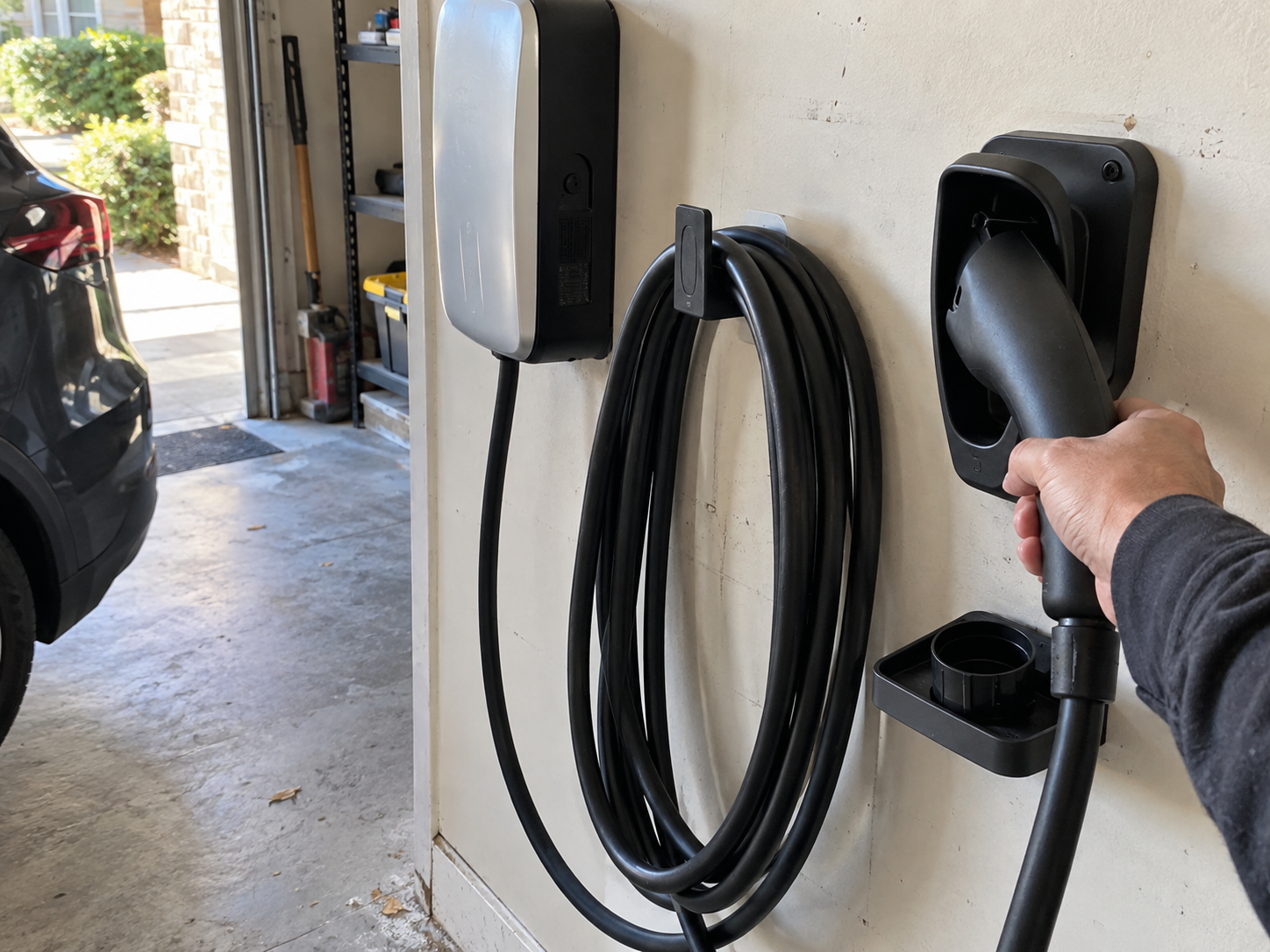
Choose storage by the site routine rather than by appearance:
| Site condition | Useful storage priority | What to verify |
|---|---|---|
| Single-car home garage | Easy return, compact wall storage, protected connector rest | Reach to the vehicle, wall position, cable loop size, and clearance from doors or tools |
| Shared apartment or workplace | Clear ownership, low trip risk, robust repeated handling | Mounting security, user access, cleanability, and whether several cable types share the station |
| Fleet depot | Fast reset between vehicles, repeatable parking position, visible condition | Cycle frequency, cable weight, bend radius, operator gloves, spare parts, and inspection records |
| Distributor or service inventory | Compact packaging and consistent bundle contents | SKU differentiation, labels, barcode, bag or carton protection, and replacement availability |
Buyers comparing a free-standing hook with a wall-mounted cradle can use the cable holder versus wall-mount site guide to connect the storage choice to surface, load, user movement, and installation conditions. This is especially helpful when the same cable must work in a garage, service bay, or fleet parking lane.
Storage is also a maintenance control. A cable that always rests on a holder is easier to inspect than one left on a wet or dirty floor. A connector that returns to a fitted holster or cap is easier to count, clean, and replace when a part is damaged.
How do mounting accessories support installation?
Mounting accessories create a stable, serviceable interface between a charger or cable-management part and the building, post, cabinet, or vehicle-side structure. They must be selected from the charger model, mounting surface, fasteners, cable route, load, and service clearances—not from a generic bracket photograph.
Typical mounting items include wall plates, model-specific brackets, pedestal or post mounts, backing plates, cable glands, conduit supports, anchors, spacers, and protective edge parts. Some support the charger body; others only manage the cable. Mixing those roles can create a load or service-access problem.
Before ordering, document:
- The charger make, model, mounting-hole pattern, body dimensions, weight, and cable exit position.
- The surface type and condition, such as concrete, masonry, stud, metal frame, or a purpose-built post.
- Fastener size, embedment or engagement, spacing, corrosion resistance, and tool access.
- Cable diameter, bend radius, entry direction, strain relief, and separation from moving doors or vehicle paths.
- Working clearance, ventilation, drainage, inspection access, and the expected static or handling load.
The station mounting and installation accessories guide is the better next reference when a buyer has moved beyond “which function?” and needs a charger-model drawing, hardware schedule, or installation validation plan. For electrical work, the site should be evaluated by a qualified installer under the rules applicable to that market. IEC 61851-1 describes general requirements for conductive EV charging systems, including operating conditions, connection, and electrical safety considerations 3; it does not replace the installation instructions or local approval process for a specific site.
What supports inspection and maintenance?
Maintenance accessories and routines keep the other four functions working over time. The basic loop is visual inspection, cleaning according to the product instructions, controlled storage, documented replacement, and escalation when damage or abnormal heating is observed.
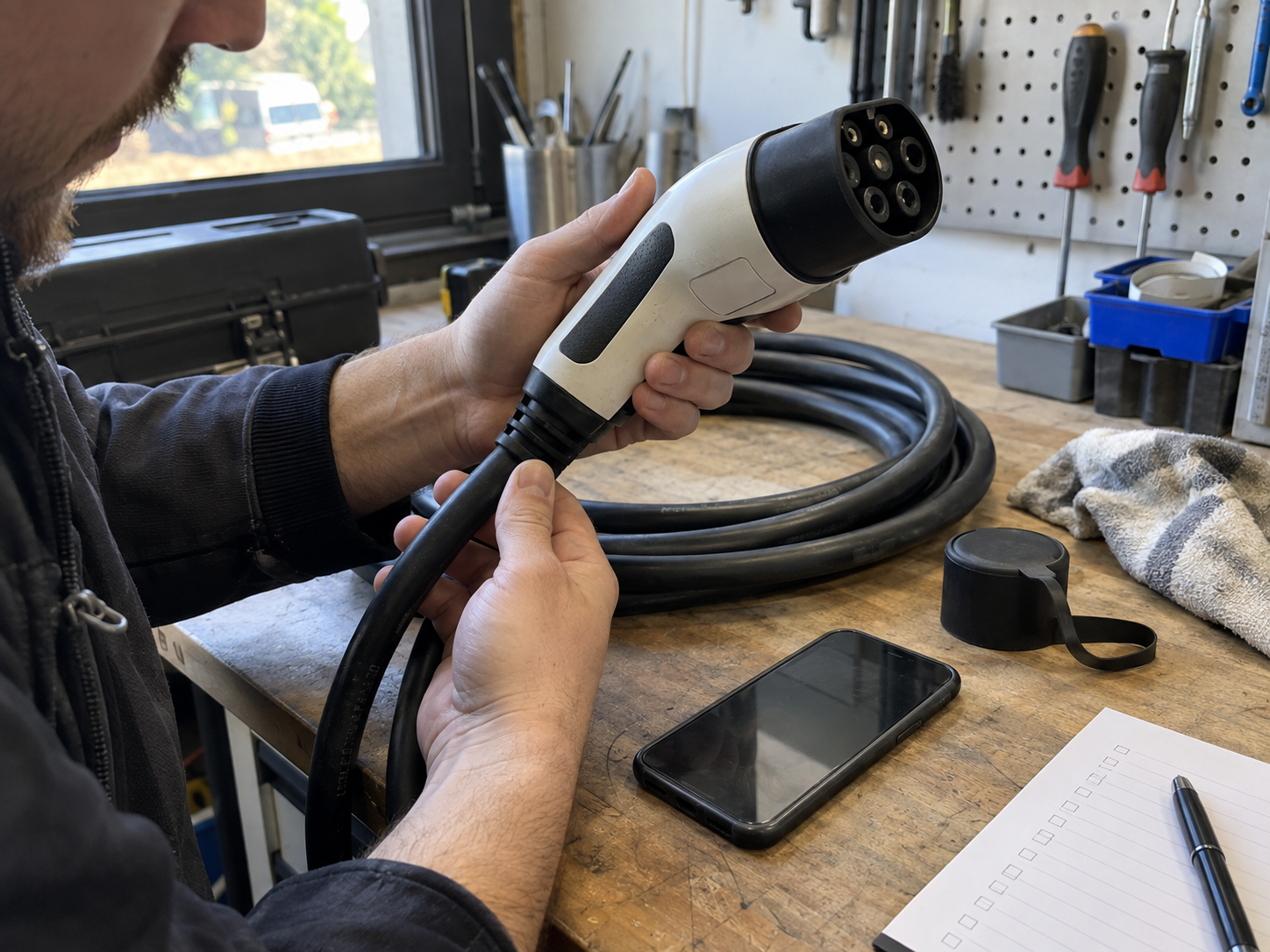
At a minimum, inspect the connector body, pins or contact area, locking features, cable jacket, strain relief, cap or cover, holder, mounting points, labels, and any signs of heat, cracking, deformation, contamination, or water entry. A clean exterior does not prove that an internal electrical fault is absent; do not open energized equipment or bypass a protective function as part of routine inspection.
If an inspection finds heat, visible damage, moisture, or a poor fit, use the warning-sign guide to distinguish routine maintenance from a stop-use or escalation decision.
For a sample or incoming-goods program, record the exact SKU and revision, sample quantity, inspection conditions, dimensions, fitment result, visible defects, packaging condition, label content, and disposition. The EV charging cable quality inspection checklist helps buyers turn “looks good” into repeatable fit, durability, and sample-approval evidence.
For commercial programs, maintenance also includes supply continuity. Keep a replacement map for caps, holsters, brackets, fasteners, labels, and other wear parts. Ask what happens when a material, mold, connector source, or artwork changes. A simple revision record can prevent an apparently identical replacement from creating a new fitment or documentation gap.
Which accessory function fits each buyer and site?
The best starting function changes with the buyer’s immediate risk. A homeowner often starts with storage and protection, while a fleet or distributor usually needs a complete functional set tied to fitment, documentation, and replacement planning.
| Buyer or site | Most important functions | Typical accessory set | First verification |
|---|---|---|---|
| Home garage | Store, protect, mount | Holster, cable hook, connector cap, wall plate or bracket | Vehicle inlet, charger model, reach, wall surface, and indoor/outdoor exposure |
| Apartment or shared parking | Protect, store, maintain | Retained cap, shared holster or dock, cable-routing parts, inspection label | User access, tamper resistance, cleaning, cable ownership, and local installation rules |
| Workplace or public site | Connect, protect, store, maintain | Approved cable or adapter where permitted, caps, holsters, bollard or routing protection, spare parts | Networked equipment instructions, user frequency, exposure, signage, and service process |
| Fleet depot | Store, mount, maintain, connect | Heavy-duty cable management, model-specific mounts, caps, labels, spare kits, inspection records | Vehicle groups, duty cycle, cable weight, turnaround time, and replacement stock |
| Distributor or private-label buyer | All five functions | Assorted cables/connectors, caps, holders, brackets, packaging, labels, document pack | SKU architecture, target markets, bundle contents, MOQ, evidence, and change control |
This table is a starting point, not a universal bundle recommendation. The same accessory can be appropriate in one site and wrong in another because the vehicle group, connector family, electrical limit, mounting surface, weather exposure, or service routine changes.
What should buyers verify before ordering?
Buyers should convert the chosen function into a short evidence request before comparing price. A supplier response is easier to evaluate when every quotation uses the same scope, exact SKU, inclusions, exclusions, and acceptance conditions.
| Buyer question | Evidence to request |
|---|---|
| What exactly must connect, protect, store, mount, or maintain? | Functional description, use case, intended side of the system, and complete bundle contents |
| Will it fit the actual equipment? | Vehicle groups, inlet/outlet/charger references, connector dimensions, mounting drawing, and compatible model list |
| What are the electrical and environmental limits? | AC or DC mode, voltage, current, phase, temperature range, outdoor/UV/rain/dust/corrosion information, and test basis |
| Can it survive the mechanical routine? | Cable diameter, bend radius, weight, load, retention, fastener details, mounting surface, and repeated handling assumptions |
| What documents travel with the product? | Datasheet, labels, manual, declaration, certificate or listing where applicable, test report, revision, and traceability record |
| How will samples be approved? | Sample quantity, test conditions, fitment photos or measurements, defect criteria, packaging checks, and signed approval record |
| Can the program be replenished consistently? | MOQ, first-order quantity, annual or reorder forecast, lead-time stages, spare parts, warranty, and change-control process |
| Is the product ready for the target market? | Language, barcode, packaging, branding, bundle contents, importer or distributor information, and market-specific documentation |
For a commercial request, record the chosen function, exact interface, site exposure, and visible acceptance criteria before requesting a sample.
A practical functional accessory map can be copied into a sourcing brief:
- Connect: exact vehicle, charger, outlet, connector, mode, voltage, current, and communication references.
- Protect: exposure, cap or cover fit, material, retention, cleaning, and replacement requirements.
- Store: cable loop, connector rest, bag or reel, user reach, floor clearance, and site traffic.
- Mount: charger model, dimensions, surface, fasteners, load, bend radius, cable entry, and service access.
- Maintain: inspection points, labels, spare parts, revision control, records, and acceptance criteria.
This map gives a supplier less room to choose an unspecified configuration on the buyer’s behalf. Request a catalog or quotation against the completed fields, then compare evidence and samples—not only the lowest unit price.
If this functional map is part of a product or sourcing decision, share the charging mode, vehicle or charger references, site environment, preferred storage or mounting function, and target market. We can help you identify a practical accessory set without replacing the fitment and installation checks above.
Conclusion: Choose the Function Before the Product
EV charging accessories become easier to compare when the buyer first identifies the job: connect the right interfaces, protect exposed parts, store the cable, mount equipment securely, or maintain the installed set. From there, the decision should progress through fitment, electrical and communication limits, environment, mechanical requirements, evidence, operations, and supply continuity.
For a complete selection sequence, use the EV charging accessories buying guide. If you already know the site and connector family, request a functional accessory map or a matched catalog so options can be compared by vehicle group, charger reference, intended function, and target market.
Frequently Asked Questions
What are the main types of EV charging accessories?
The main types can be grouped by function: connection accessories such as cables and adapters; protection items such as caps and covers; storage items such as holsters and hooks; mounting hardware such as brackets and plates; and maintenance items such as inspection aids, labels, and replacement parts.
Do EV charging accessories fit every EV?
No. Fit depends on the vehicle inlet, charger or outlet, charging mode, electrical rating, mechanical dimensions, communication requirements, and market configuration. Confirm the exact vehicle and equipment references before buying an adapter, cable, connector, or mounted accessory.
What accessories are useful for outdoor charging?
Outdoor setups commonly need equipment and accessories documented for the expected rain, UV, dust, temperature, corrosion, cable routing, and cleaning conditions. A cap or cover can protect a disconnected connector, but it does not make indoor-only equipment or an unsuitable installation outdoor-safe.
Are EV charging accessories the same as EVSE?
Not always. EVSE is the equipment that controls or supplies the charging connection, while accessories may support connection, protection, storage, mounting, or maintenance around that equipment. Product descriptions should state the item’s exact function and whether it contains active charging or control components.
How should businesses choose accessories for fleets?
Fleet teams should map vehicle groups and charger models, then select accessories for repeated handling, rapid reset, storage, mounting, inspection, spare parts, and traceability. Approve samples under stated conditions and make the supplier document any later component, material, or artwork change.
References
[1] U.S. Department of Energy, Alternative Fuels Data Center. “Electric Vehicles for Consumers.” n.d.
[2] U.S. Department of Energy, Alternative Fuels Data Center. “Charging Electric Vehicles at Home.” n.d.
[3] International Electrotechnical Commission. “IEC 61851-1:2017, Electric vehicle conductive charging system — Part 1: General requirements.” 2017.
[4] International Electrotechnical Commission. “IEC 62196-1:2022, Plugs, socket-outlets, vehicle connectors and vehicle inlets — General requirements.” 2022.







