





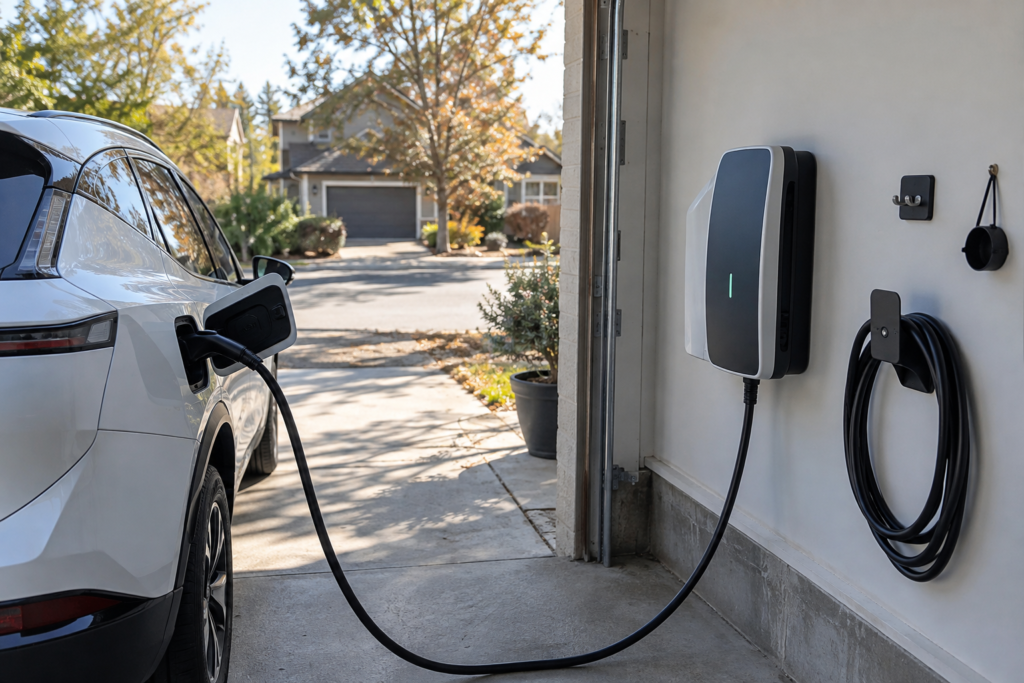
The EV charging cable vs EV charger vs charging station distinction is simple: an EV charging cable carries power and may include control components, while the charger or EVSE manages the charging connection and safety functions. A charging station is the installed equipment and site setup; accessories support these parts with fitment, protection, mounting, routing, storage, or maintenance.
The confusion comes from everyday language. A retailer may call a wall-mounted EVSE a “charger,” a vehicle owner may call a detachable cable a “charger,” and an installer may use “station” to mean everything from the enclosure to the parking-space connection. Those shortcuts are understandable, but they can cause buyers to request the wrong part or assign the wrong installation responsibility.
This guide separates the terms by job, location, and control function. It is useful for homeowners, installers, facility managers, distributors, and new EV accessory buyers who need to understand what they already have before choosing a cable, adapter, holder, cap, bracket, or replacement component.
Table of Contents
- What is an EV charging cable?
- What is an EV charger and what is EVSE?
- What is a charging station?
- Where do EV charging accessories fit?
- What controls power and communication?
- Which terminology mistakes create buying problems?
- What should beginners check before buying or specifying accessories?
- Conclusion: Name the Equipment Before Choosing the Accessory
- Frequently Asked Questions
- References
What is an EV charging cable?
An EV charging cable is the cable assembly that carries energy and, depending on the design, control or signaling conductors between a supply, charging device, and vehicle. It may be detachable, permanently attached to EVSE, or supplied as part of a portable charging product.
The word “cable” describes the connection assembly, not the complete charging function. A cable normally includes conductors, insulation, a jacket, strain relief, and one or more connectors. Its specification may include connector type, current and voltage rating, length, temperature range, flexibility, bend radius, and environmental conditions. Some assemblies also include an in-cable control and protection box, which is why two products that look like “just cables” can have different functions.
There are three common cable contexts:
| Cable context | What it connects | What to verify |
|---|---|---|
| Portable or detachable cable | A vehicle inlet to an EVSE socket, or a supply outlet to a portable charging unit | Both ends, charging mode, current/voltage rating, length, temperature, and use conditions |
| Tethered EVSE cable | A wallbox or station enclosure to the vehicle | Connector type, cable weight, strain relief, bend radius, holster, and replacement compatibility |
| DC charging cable assembly | A DC charging station to the vehicle inlet | Connector family, station output limits, cooling or thermal design where applicable, communication, and market documentation |
The U.S. Department of Energy identifies SAE J1772 as common for Level 1 and Level 2 charging in the United States, while public DC fast charging may use CCS, CHAdeMO, or NACS depending on the vehicle and network 1. That is useful background, but it is not a universal compatibility promise. Confirm the exact vehicle inlet, station connector, and manufacturer instructions.
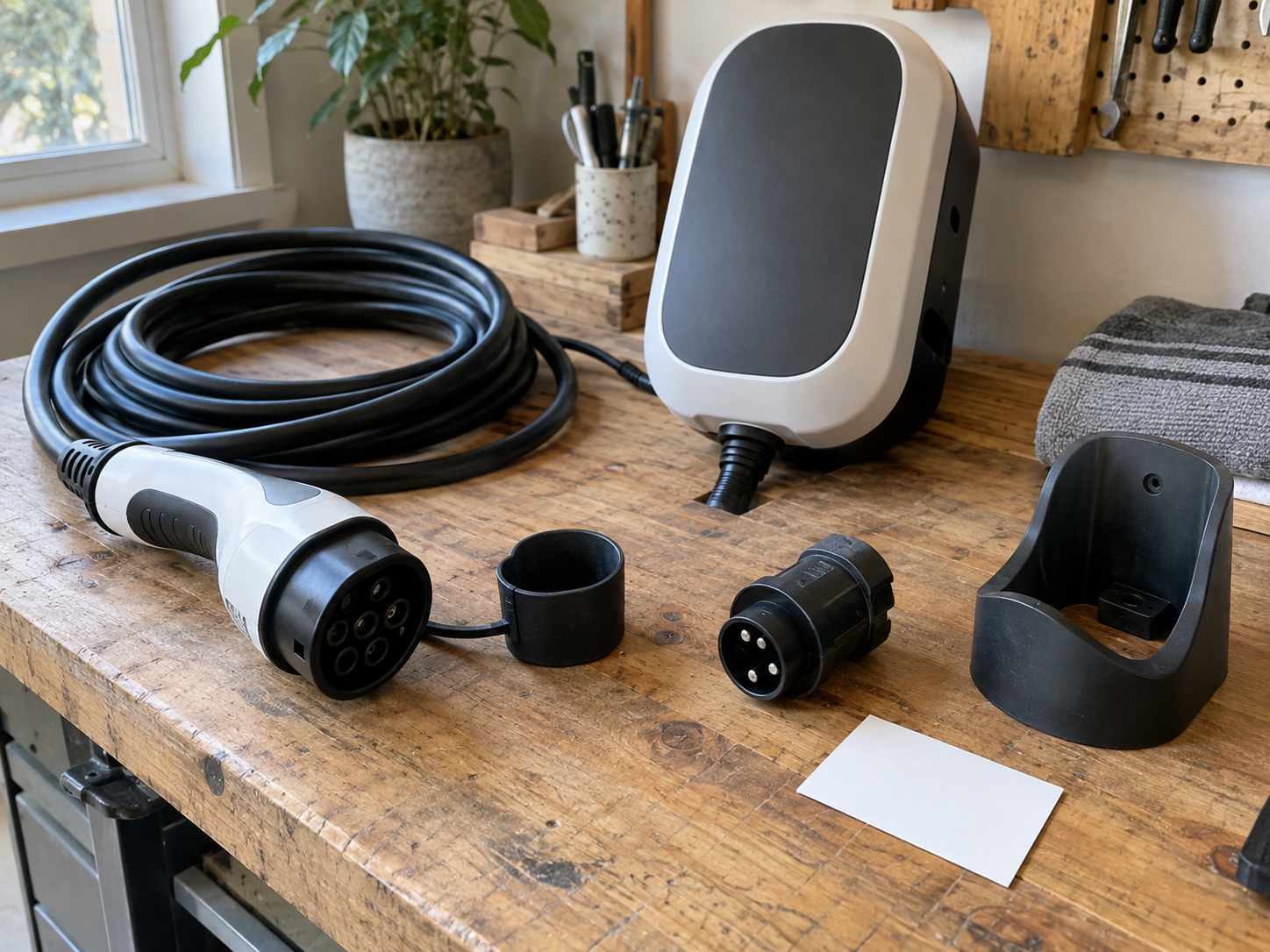
Accessories around the cable can improve handling without changing its fundamental rating. A holder stores the handle, a cap protects a disconnected interface, a bracket supports equipment, and a bag supports transport. The EV charging cable quality inspection checklist is useful when the question changes from “what is this part?” to “what condition and evidence should this cable have before approval?”
What is an EV charger and what is EVSE?
“EV charger” can mean different things, while EVSE generally refers to equipment that controls and delivers a managed connection between the electrical supply and the vehicle. Always ask whether a supplier means the vehicle’s onboard charger, a wall-mounted EVSE, a DC charging cabinet, or a complete product.
The most important distinction is where energy conversion and charging control happen. In typical AC charging, the vehicle’s onboard charger converts incoming AC power into DC power for the battery. The EVSE controls the connection, communicates the available current, and provides protective functions according to the equipment design. In DC fast charging, the conversion equipment is generally outside the vehicle and the station supplies controlled DC power to the vehicle.
In product listings, “wall charger,” “home charger,” and “AC charger” are often used for a wall-mounted EVSE. That wording is common, but it should not hide the exact scope. A buyer should confirm whether the item includes a cable, connector, control box, enclosure, mounting hardware, protection device, or only a component for an existing system.
| Term | Usually means | Do not assume |
|---|---|---|
| Onboard charger | The vehicle-side equipment that handles AC-to-DC charging for the battery | That it is included in a wallbox or detachable cable |
| EVSE | Supply-side equipment that manages the charging connection and protective/control functions | That every EVSE has the same connector, power, communication, or weather rating |
| Wallbox or home charger | Common retail language for a fixed AC EVSE | That it is the complete installation, including wiring, protection, bracket, and site approval |
| DC charging cabinet or dispenser | Offboard equipment that supplies managed DC power, sometimes through a separate dispenser | That the cable, cooling, connector, and station controls can be substituted independently |
IEC 61851-1 covers general requirements for conductive EV charging systems, including operating conditions, connection, and electrical safety considerations 3. The applicable product documentation and market requirements still determine what a specific charger or EVSE includes.
What is a charging station?
A charging station is the installed, site-level arrangement that enables charging at a particular location. It may include one or more EVSE units, cables or connectors, electrical protection, mounting, communications, signage, parking-space routing, and service access.
“Station” therefore describes a system context more than one universal physical object. A home station may be a wall-mounted EVSE with a tethered cable and a holster. A public station may combine a cabinet, dispenser, payment or network connection, multiple ports, bollards, cable management, and a defined operating area. A fleet depot may add vehicle staging, spare cable storage, inspection points, and replacement stock.
This distinction matters when ordering accessories. A buyer asking for a “station cable” should specify whether they need a vehicle-side cable, a supply-side cable, an adapter, a replacement tether, or a cable-management part. A buyer asking for “station mounting” should identify the charger model, mounting-hole pattern, body dimensions, surface, fasteners, load, cable exit, and service clearance.
The station mounting and installation accessories guide helps with that second question because the installation scope depends on the actual charger model and site, not only on the word “station.” For home charging, the U.S. Department of Energy also notes that outdoor equipment must be suitable for outdoor use and that an electrician can assess electrical capacity 2.
Where do EV charging accessories fit?
EV charging accessories support the cable, EVSE, vehicle interface, or site without automatically becoming the charging system itself. Their role is usually to connect, protect, store, mount, route, identify, inspect, or maintain the primary equipment.
Examples include:
- Connection: adapters, detachable cables, replacement connectors, and interface-specific parts.
- Protection: connector caps, covers, cable-jacket guards, strain-relief parts, and edge protection.
- Storage and routing: holsters, hooks, docks, reels, clips, trays, bags, and cable-management supports.
- Mounting: wall plates, brackets, posts, backing plates, glands, spacers, and fasteners.
- Maintenance and control: cleaning tools, inspection aids, labels, spare parts, and revision records.
An accessory can be physically important without controlling power. A holster can prevent a connector from hanging on the floor, but it does not make the connector electrically compatible. An adapter can change the physical interface, but it does not automatically increase current capacity, add missing communication, or authorize a charging combination. A bracket can stabilize a wallbox, but it does not replace the electrical installation.
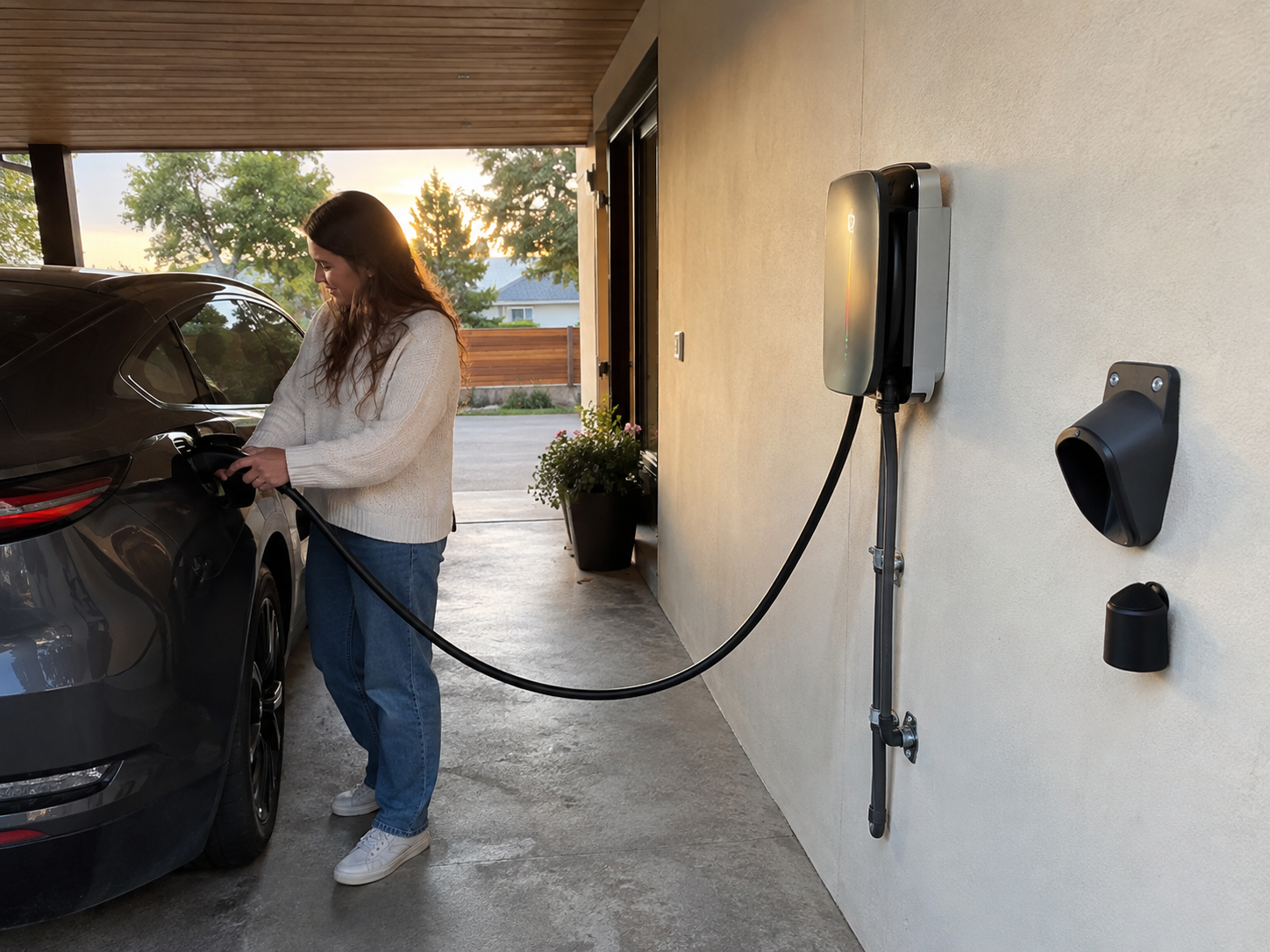
Readers who want to see the five functions in one taxonomy can use the EV charging accessory function map. It helps separate the immediate job from the product name before a buyer compares a cable, cap, holder, adapter, or mount.
What controls power and communication?
Power is controlled by the complete charging system, not by a cable label or accessory shape alone. Voltage, current, phase, charging mode, connector design, protection functions, communication, and installation conditions all affect what the system can safely do.
At a basic level, volts describe electrical potential, amps describe current, and kilowatts describe power. A simple relationship is power = voltage × current, but real charging behavior also depends on AC or DC architecture, vehicle limits, EVSE settings, thermal conditions, and site supply. A cable marked for a certain current does not force the vehicle or station to deliver that current.
Communication and control can also be part of the charging path. Depending on the equipment, the system may use signaling to identify connection status, available current, or charging permission. That is why a passive-looking adapter or replacement cable should not be treated as interchangeable solely because the pin arrangement appears similar.
Use this evidence order when a product description is unclear:
- Identify the vehicle inlet and the station, EVSE, or outlet interface.
- Record AC or DC mode, voltage, current, phase, cable length, and temperature limits.
- Ask whether the cable or accessory carries control or communication functions.
- Check mechanical fit, locking or retention, cable diameter, bend radius, and clearance.
- Match the exact SKU to its drawing, datasheet, labels, declarations, test evidence, and target-market requirements.
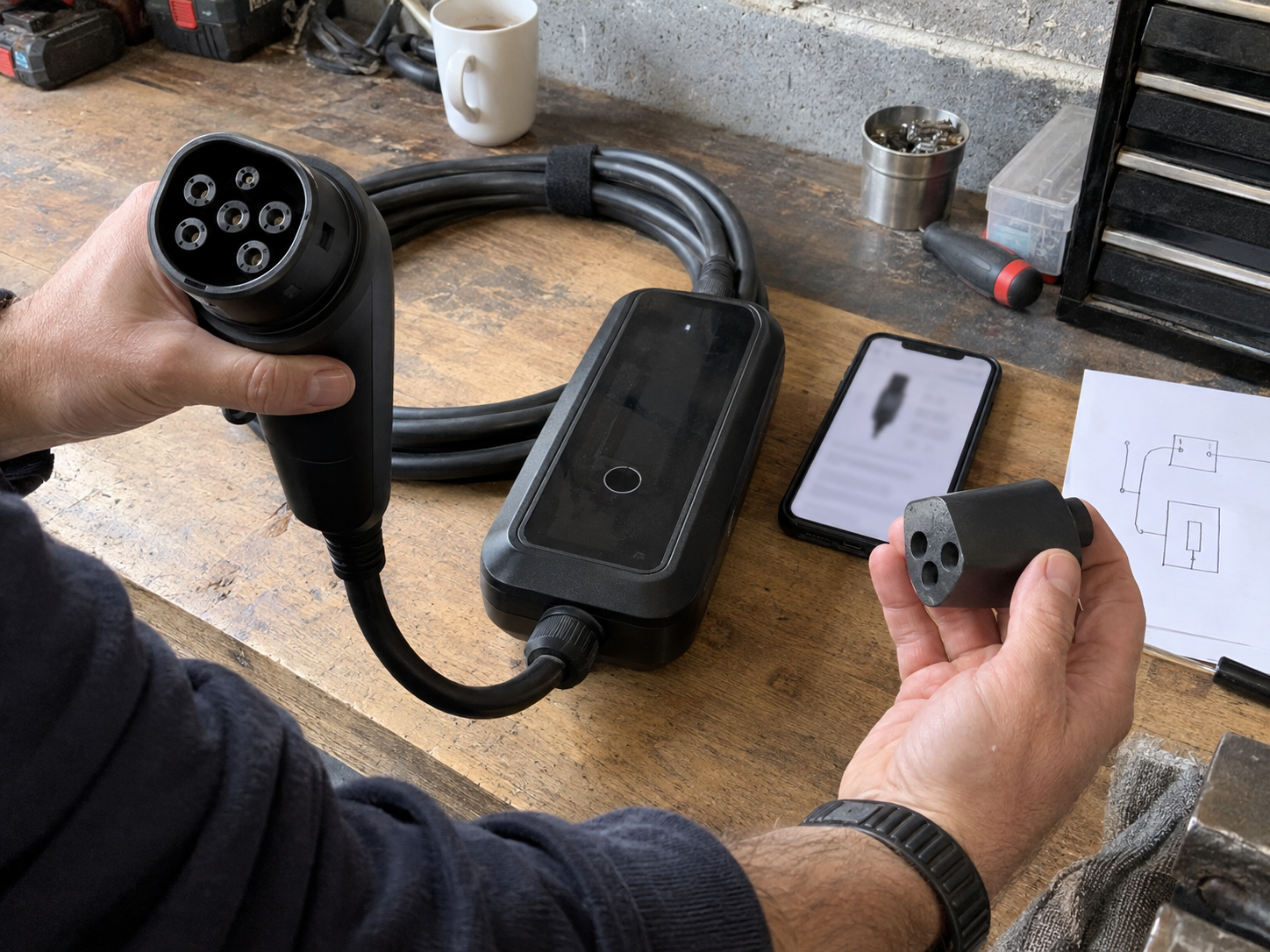
The EV charging accessories compatibility checklist is the right next tool when a definition question becomes a fitment question. For adapter-specific decisions, the EV charging adapter compatibility guide helps keep physical interface, electrical limits, communication, and market use in the same review.
Which terminology mistakes create buying problems?
Most terminology mistakes happen when a familiar retail label is used as a technical specification. The fix is to describe the part by location, job, interfaces, and limits before asking for a quote or replacement.
| Common shortcut | Why it causes trouble | Better wording |
|---|---|---|
| “I need an EV charger cable” | It may mean a detachable cable, tethered EVSE cable, or portable EVSE product | “I need a detachable AC cable from this connector to that connector, at this rating and length” |
| “This adapter works with EVs” | It does not identify the vehicle inlet, source interface, charging mode, or control behavior | “Confirm this exact adapter between these two interfaces for this vehicle and station” |
| “The wallbox is the station” | A wallbox is only one part of the installed site arrangement | “Confirm the EVSE, wiring scope, mounting, protection, cable management, and service access” |
| “A higher-amp cable gives faster charging” | Charging speed is limited by the vehicle, EVSE, supply, settings, and complete system | “Compare the complete electrical path and the lowest-rated relevant component” |
| “The connector shape matches” | Mechanical resemblance does not prove electrical, communication, environmental, or market fit | “Verify interface, rating, signaling, dimensions, documents, and permitted use” |
This is why product pages should separate a cable’s physical construction from the function of the EVSE or station. It also explains why a supplier should return an exact SKU and a clear inclusions/exclusions list rather than a generic product photo.
What should beginners check before buying or specifying accessories?
Beginners should first draw the charging path, then name each component and accessory by its position in that path. A short checklist prevents a cable, adapter, mount, or protection part from being evaluated in isolation.
1. Draw the energy path
Write the sequence from supply to vehicle: utility or outlet, protection and wiring, EVSE or charging cabinet, cable or connector, vehicle inlet, and battery-side charging equipment. Mark which part is existing and which part is being purchased.
2. Name the exact equipment
Record vehicle make/model or vehicle group, inlet reference, charger or EVSE make/model, outlet or station-side reference, connector family, and whether the cable is detachable or tethered. For a distributor, record the target market and language or labeling requirements as well.
3. Define the electrical and communication scope
State AC or DC, voltage, current, phase, cable length, temperature range, and any relevant control or communication requirement. Do not use “fast,” “universal,” or “heavy-duty” as a substitute for a rating or test condition.
4. Define the accessory job
Choose one primary job: connect, protect, store, mount, route, or maintain. Then specify what success looks like. For example, a holder may need to retain a handle, support a cable loop, keep a connector off the ground, and fit a stated mounting surface.
5. Check the site and operating routine
Note indoor/outdoor exposure, UV, rain, dust, corrosion, cleaning, temperature, vehicle traffic, user frequency, cable weight, bend radius, and service access. For a home installation, the EV charging accessories buying guide can take this system definition into a wider buying sequence.
6. Request evidence before approval
Ask for the datasheet, label or marking example, manual, drawing, declaration, certificate or listing where applicable, test report, revision, and traceability information. For a sample, agree on fitment checks, visible-defect limits, test conditions, packaging, and acceptance records before placing a larger order.
7. Confirm the commercial scope
Request the exact SKU, included and excluded items, MOQ, sample cost, lead-time stages, warranty, spare parts, packaging, barcode, language, branding, and change-control process. This keeps the cable, EVSE, station, and accessory responsibilities visible in one quotation.
If the purchase is replacing a cable or connector that already shows heat, moisture, damage, or poor fit, review the warning signs and stop-use checklist before treating the issue as a simple terminology or accessory-selection problem.
If you are mapping a home, workplace, public, or fleet charging setup, share the vehicle or vehicle group, EVSE or station model, connector references, charging mode, site environment, and accessory function you need to clarify. We can help you identify the correct component boundary without replacing the fitment and installation checks above.
Conclusion: Name the Equipment Before Choosing the Accessory
An EV charging cable is a connection assembly. The vehicle’s onboard charger, an EVSE, and a DC charging cabinet can perform different control or conversion jobs, while a charging station describes the installed site arrangement. Accessories support those parts through connection, protection, storage, mounting, routing, inspection, and maintenance.
The safest buying habit is to replace vague product language with a short system description: what connects to what, where power conversion and control occur, which limits apply, what the site requires, and which evidence proves the match. Once that boundary is clear, the right cable, adapter, cap, holder, bracket, or replacement part is much easier to specify.
Frequently Asked Questions
What is the difference between an EV charging cable and an EV charger?
An EV charging cable is the connection assembly that carries power and possibly signaling between equipment. “EV charger” may mean the vehicle’s onboard charger or may be retail shorthand for EVSE. Confirm the exact product scope, location, rating, and control function before comparing them.
Is an EVSE the same as an EV charging station?
No. EVSE is a piece of charging equipment that manages a controlled connection. A charging station is the installed arrangement at a site and may include EVSE, cables, protection, mounting, communications, parking-space routing, and service access.
Does an adapter make any EV charging cable compatible?
No. An adapter may change a physical interface, but compatibility also depends on electrical limits, charging mode, communication, mechanical fit, environmental conditions, and the permitted use for the vehicle and station. Review the exact adapter and equipment references together.
Does a higher-rated cable charge an EV faster?
Not by itself. Charging speed is limited by the complete system, including the vehicle, EVSE or station, supply, settings, connector, cable, and installation. A cable with a higher rating does not increase the capability of lower-rated equipment.
What should installers call out in an accessory scope?
Installers should identify the vehicle and EVSE references, connector and cable requirements, electrical mode and ratings, mounting surface and hardware, cable routing and bend radius, environmental exposure, service clearances, and the documents or approvals required for the target market.
References
[1] U.S. Department of Energy, Alternative Fuels Data Center. “Electric Vehicles for Consumers.” n.d.
[2] U.S. Department of Energy, Alternative Fuels Data Center. “Charging Electric Vehicles at Home.” n.d.
[3] International Electrotechnical Commission. “IEC 61851-1:2017, Electric vehicle conductive charging system — Part 1: General requirements.” 2017.
[4] International Electrotechnical Commission. “IEC 62196-1:2022, Plugs, socket-outlets, vehicle connectors and vehicle inlets — General requirements.” 2022.







