


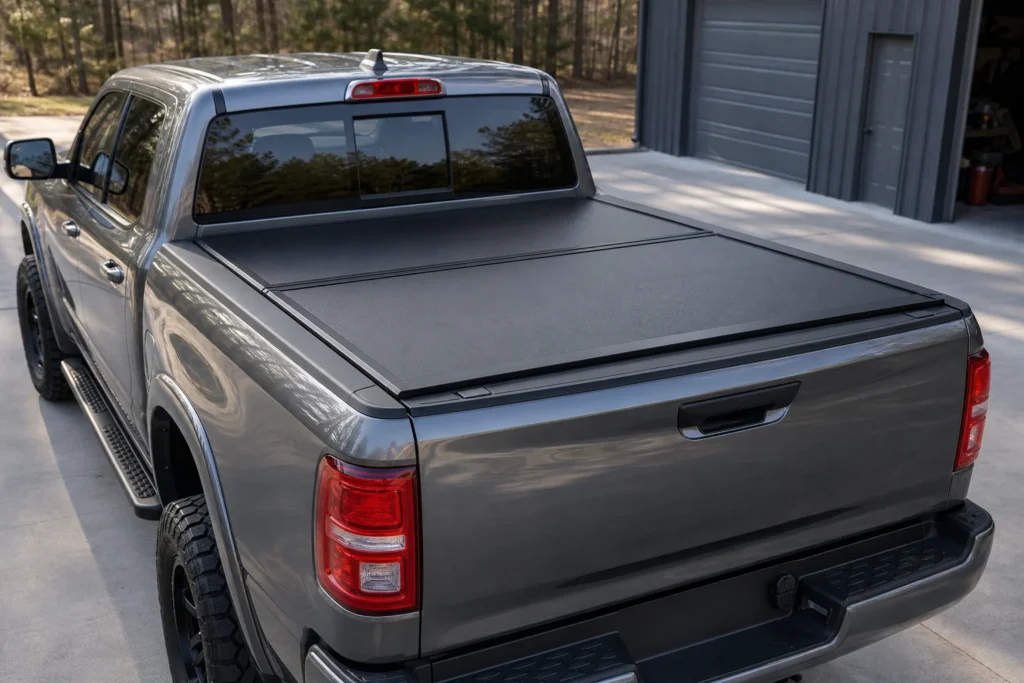
Most tonneau covers are built from PVC- or vinyl-coated fabric, aluminum panels or slats, fiberglass-reinforced plastic, ABS, polycarbonate, or another composite structure. The cover also needs rails, a frame, seals, latches, hinges, and sometimes drainage parts, so the visible skin is only one part of the product.
Vinyl is usually the lightest and most economical option. Aluminum provides a useful balance of rigidity, weight, and security. Fiberglass gives a smooth one-piece finish, while ABS, polycarbonate, and sandwich composites can be molded or engineered for specific weight, impact, and styling requirements.
Table of Contents
- What are tonneau covers usually made of?
- How do tonneau cover materials and structures differ?
- What are ABS, polycarbonate, and composite tonneau covers?
- Which material specifications should buyers put on a quote?
- How can buyers test tonneau cover material quality?
- When does a vinyl tonneau cover make the most sense?
- Why do many hard tonneau covers use aluminum?
- What makes fiberglass tonneau covers different?
- What other parts matter besides the main material?
- Conclusion: Choose the construction, not only the material name
- Frequently Asked Questions
- References
What are tonneau covers usually made of?
A tonneau cover is usually a layered system rather than one sheet. Soft covers use a coated woven fabric over rails or bows. Hard covers may use aluminum skins, interlocking slats, molded plastic, fiberglass laminates, or a sandwich panel with a rigid core. Rubber or elastomer seals then control water and dust at the rails, tailgate, and front bed edge.
The opening style narrows the likely construction. A soft roll-up needs a flexible outer sheet; a tri-fold needs panel cores and hinges; a retractable cover needs slats that can track through rails and a canister; and a one-piece hinged lid needs a rigid shell with reliable lifting and latch hardware. The related hard vs soft tonneau covers comparison explains why material and opening style should be evaluated together.
For readers who are still choosing the cover family, the complete tonneau cover guide maps hard/soft construction separately from roll-up, folding, retractable, and hinged opening mechanisms.
This distinction matters because the same label can describe different products. “Aluminum cover” might mean a thin aluminum skin over a core, an aluminum frame with a vinyl top, or solid interlocking slats. “Composite cover” could mean a molded ABS panel, a glass-fiber laminate, or a sandwich panel. A buyer needs the construction details, not only the marketing name.
How do tonneau cover materials and structures differ?
The useful comparison is not simply “soft versus hard.” Before approving a sample, ask what the outer surface, load-carrying core, frame, seal, and opening mechanism are made of.
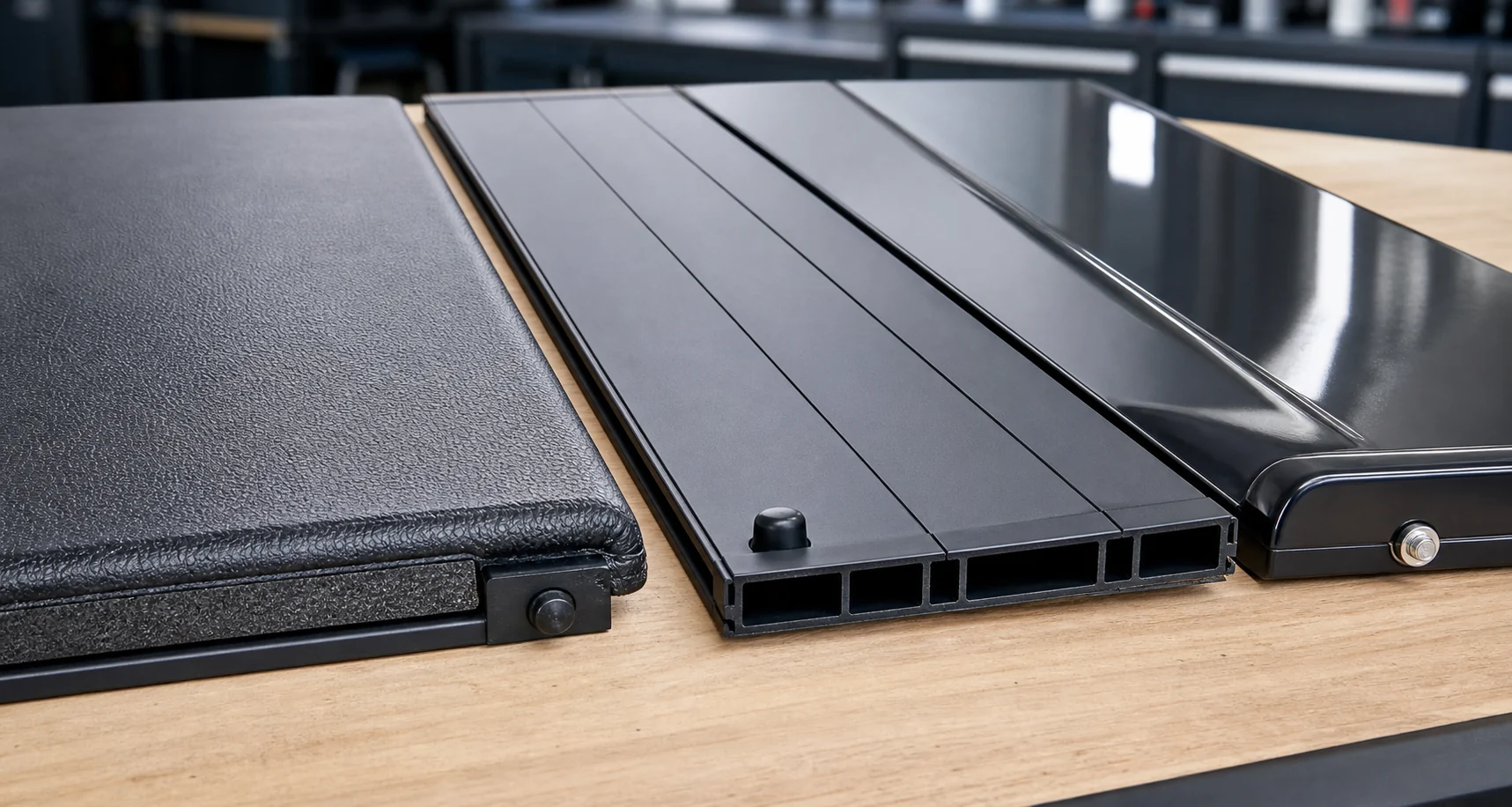
| Construction | Outer material | Core or structure | Frame and rails | Seal and drainage | Common opening styles | Main risk to verify |
|---|---|---|---|---|---|---|
| Soft coated fabric | PVC/vinyl-coated polyester or fabric | Woven scrim, bows, or flexible supports | Aluminum rails, bows, clamps | Bulb or flap seals; tailgate gaps need control | Soft roll-up, soft tri-fold | Stretching, UV cracking, seam or edge failure |
| Aluminum panel or slat | Powder-coated, textured, or vinyl-skinned aluminum | Sheet, bonded core, or interlocking slats | Aluminum side rails and hinges | Compression seals, channels, drain tubes where required | Hard tri-fold, hard roll-up, retractable | Dents, coating failure, rattling, joint wear |
| Fiberglass/FRP shell | Gelcoat or painted fiberglass-reinforced plastic | Glass fiber and resin with underside bracing | Hinges, struts, perimeter frame | Continuous perimeter seal and tailgate seal | One-piece hinged lid | Cracks, surface waves, excess weight, paint damage |
| ABS, polycarbonate, or composite panel | Molded thermoplastic or composite skin | Ribs, honeycomb, foam, or laminated core | Molded edges or aluminum support rails | Compression seals and designed drainage paths | Hard folding, hinged, retractable, specialty panels | Hidden core variation, heat distortion, impact or scratch damage |
What are ABS, polycarbonate, and composite tonneau covers?
ABS and polycarbonate are thermoplastics; fiberglass-reinforced plastic is a fiber composite; and a sandwich panel combines skins with a separate core. They should not be grouped under one vague word such as “plastic.”
ABS is often used for molded skins, end caps, and rigid panels where impact resistance, shape, and manufacturing repeatability matter. The buyer should verify the grade, wall thickness, rib layout, UV stabilization, and whether the visible surface is painted, textured, or covered.
Polycarbonate can be selected where impact resistance and molded geometry are important. It may have different scratch, UV, heat, and cost behavior from ABS, so “polycarbonate” alone is not a complete specification.
Composite or sandwich construction may use fiberglass, carbon-like cosmetic layers, aluminum skins, foam, honeycomb, or molded polymer ribs. Its stiffness depends on the skin thickness, core density, adhesive bond, and edge design. Ask for a cross-section or material stack-up instead of accepting “composite” as the full description.
For retractable products, the retractable tonneau cover guide is a useful next step because slat material, rail alignment, canister space, and drainage affect the ownership experience as much as the polymer or metal itself.
Which material specifications should buyers put on a quote?
A useful quotation should identify measurable properties and the test method, not just say “heavy duty” or “marine grade.” The exact acceptance value depends on the truck model, climate, cover style, and target price, so the buyer should agree the threshold before sample approval.
| Area to specify | What to request | How to verify |
|---|---|---|
| Coated fabric | Total mass, thickness, coating type, fabric base, breaking/tear strength, seam construction | Supplier data sheet plus sample measurement and coated-fabric testing |
| Aluminum | Alloy or material designation, panel/slat thickness, coating system, surface finish, mass per cover | Mill or supplier certificate, caliper checks, coating inspection |
| ABS/polycarbonate | Resin name or grade, wall thickness, rib pattern, UV treatment, color/finish | Material declaration, thickness mapping, molded-sample inspection |
| FRP/composite | Fiber/resin system, skin thickness, core type and density, edge reinforcement | Cross-section sample, mass check, flexural comparison |
| Rails and frame | Material, profile, wall thickness, clamp points, fitment range | Installed sample on the target bed |
| Seals and drainage | Seal material, section profile, compression behavior, drain-tube size and route | Compression check, water test, drain-flow inspection |
This specification sheet creates a useful record for repeat orders. If a supplier changes the fabric coating, panel core, seal profile, or frame wall thickness, the buyer can identify the change before it becomes a return problem.
How can buyers test tonneau cover material quality?
Testing should combine material coupons, finished panels, and an installed cover. A laboratory result cannot replace a fitment check, and a good-looking sample cannot prove long-term weather performance.
For soft coated fabric, ASTM D751 covers dimensions and mass, breaking strength, elongation, puncture, tearing, hydrostatic resistance, coating adhesion, low-temperature behavior, heat aging, and seam strength 2.
For UV and moisture exposure, ASTM G154 provides a controlled fluorescent-UV practice, but it does not create one universal pass/fail number. The report should identify the lamp, irradiance, temperature, wet/dry cycle, exposure duration, number of specimens, and the changes in color, gloss, cracking, adhesion, and strength 3.
For coated aluminum or painted plastic, ASTM D3359 can be used to rate coating adhesion by tape test 4. Record the substrate, coating system, test direction, rating, and any flaking or delamination. A good adhesion result does not prove corrosion resistance or impact resistance, so those should be separate requirements.
For ABS, polycarbonate, and rigid composite panels, ASTM D790 measures flexural properties of unreinforced and reinforced plastics and can support a material or panel comparison 5. The report should state whether the specimen came from a molded coupon, an extruded sheet, or the finished panel, because construction and orientation affect the result.
The finished-cover inspection should also include:
- Fitment: install the cover on the intended bed length and rail profile; record gaps, clamp position, tailgate clearance, and seal compression.
- Operation: open and close the cover repeatedly according to a written acceptance plan; record latch force, hinge alignment, slat tracking, panel rattle, and any interference.
- Water control: spray or wet the installed cover under a defined procedure, then inspect the rails, corners, tailgate, and drain exits. Call the result water-resistant unless the design has a documented basis for a stronger claim.
- Packaging: inspect corners, painted surfaces, hinges, clamps, instructions, labels, and replacement parts after a representative shipping simulation or approved carton test.
The important point is traceability: keep the sample ID, material declaration, test method, test conditions, photos, and acceptance decision together. That is much more useful than saying a cover “feels strong.”
When does a vinyl tonneau cover make the most sense?
Vinyl-coated fabric makes sense when low weight, low cost, fast access, and basic weather protection matter more than high theft resistance. It is common on soft roll-up and soft tri-fold covers.
The buyer should specify fabric construction, total mass, coating thickness, surface grain, edge binding, seam strength, and UV expectations. The related roll-up tonneau cover guide shows why flexible material works well when the driver needs nearly full bed access.
Vinyl is not a safe. A knife can defeat it, and poor tension or weak stitching can lead to flapping, stretching, or water entry. For high-value tools stored outside overnight, a rigid construction deserves closer consideration.
Why do many hard tonneau covers use aluminum?
Aluminum is common because it can provide a rigid, low-profile cover without the full mass of a one-piece fiberglass lid. It appears in folding panels, hard roll-up covers, and retractable slats.
Ask whether the aluminum is the load-carrying panel, a thin outer skin, or only part of the frame. Check panel thickness, coating adhesion, edge finishing, hinge alignment, end caps, and surface dents. For panel access, the related tri-fold tonneau cover guide explains how folding construction changes bed access.
Aluminum improves structure, but it does not automatically guarantee security or weather resistance. Weak latches, gaps, poor drainage, and damaged coatings can still create complaints.
What makes fiberglass tonneau covers different?
Fiberglass-reinforced plastic is usually molded into a rigid one-piece shell with a smooth paintable or gelcoat surface. It suits buyers who value a body-color appearance, a substantial barrier, and a clean perimeter seal.
The specification should identify the fiber/resin construction, underside bracing, finished mass, surface finish, hinge or strut system, and packaging protection. Inspect for waves, corner cracks, uneven paint, flex around the latch, and pressure marks after shipping. The related hinged tonneau cover guide covers the access and hardware trade-offs.
Fiberglass is less convenient for tall cargo and can be more expensive to repair. A buyer should choose it for the use case, not because “fiberglass” sounds stronger than every alternative.
What other parts matter besides the main material?
Rails, clamps, seals, hinges, latches, and drainage often decide whether the cover performs well. The material may pass a coupon test and still create a poor product if the rails do not fit the truck or the seal cannot compress evenly.
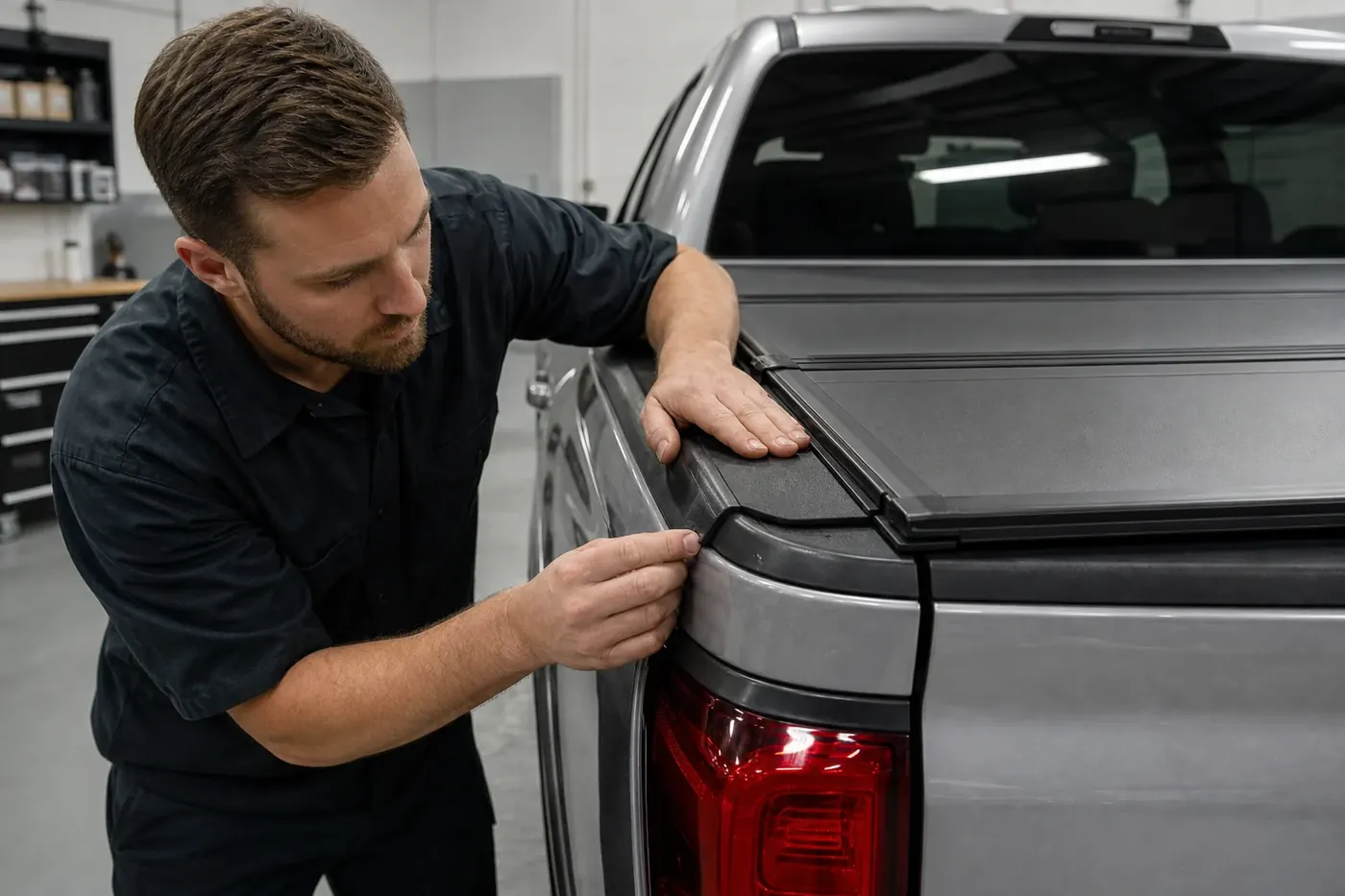
For a sourcing project, Yirox Team sample checks should record surface finish, panel stiffness, material stack-up, latch alignment, seal placement, carton protection, labeling, and batch consistency. The next step for comparing available cover styles and construction options is the pickup tonneau cover product category.
Conclusion: Choose the construction, not only the material name
Vinyl, aluminum, fiberglass, ABS, polycarbonate, and composite panels can all be appropriate. The right choice depends on the full construction: outer skin, core, frame, seal, opening style, climate, cargo, and repair expectations.
For buyers, the most useful upgrade is a written specification and test plan. Request the material stack-up, measurable dimensions, relevant test methods, installed fitment checks, and packaging evidence before approving a sample. That process creates a more reliable product than a brochure claim such as “premium,” “waterproof,” or “heavy duty.”
Frequently Asked Questions
Are vinyl tonneau covers waterproof?
They are usually water-resistant rather than completely waterproof. Fabric tension, stitching, rail seals, tailgate gaps, and installation quality all affect the result.
Is aluminum better than fiberglass for a tonneau cover?
Aluminum is often easier to handle and works well for folding or retractable designs. Fiberglass is often preferred for a smooth one-piece appearance, but it brings more weight and less flexible cargo access.
Are ABS and polycarbonate the same as fiberglass?
No. ABS and polycarbonate are thermoplastics, while fiberglass-reinforced plastic uses glass fibers in a resin matrix. A composite or sandwich panel may combine several materials, so the supplier should provide the construction stack-up.
What should be tested on a vinyl tonneau cover?
At minimum, define mass and thickness, breaking or tear strength, coating adhesion, seam strength, low-temperature behavior, water resistance, and UV exposure. ASTM D751 is one recognized reference for coated-fabric test methods.
What is the most important tonneau cover material specification?
There is no single specification that predicts the whole product. The most useful record combines the material stack-up, thickness or mass, finished-cover weight, seal and rail design, fitment result, and agreed test conditions.
References
[1] Leonard USA. (2024). Aluminum, Vinyl & Fiberglass Covers & Tonneau Covers.
[2] ASTM International. (2026). Standard Test Methods for Coated Fabrics, ASTM D751-26.
[3] ASTM International. (2023). Standard Practice for Operating Fluorescent Ultraviolet (UV) Lamp Apparatus for Exposure of Materials, ASTM G154-23.
[4] ASTM International. (2023). Standard Test Methods for Rating Adhesion by Tape Test, ASTM D3359-23.
[5] ASTM International. (2025). Standard Test Methods for Flexural Properties of Plastics, ASTM D790-25.