



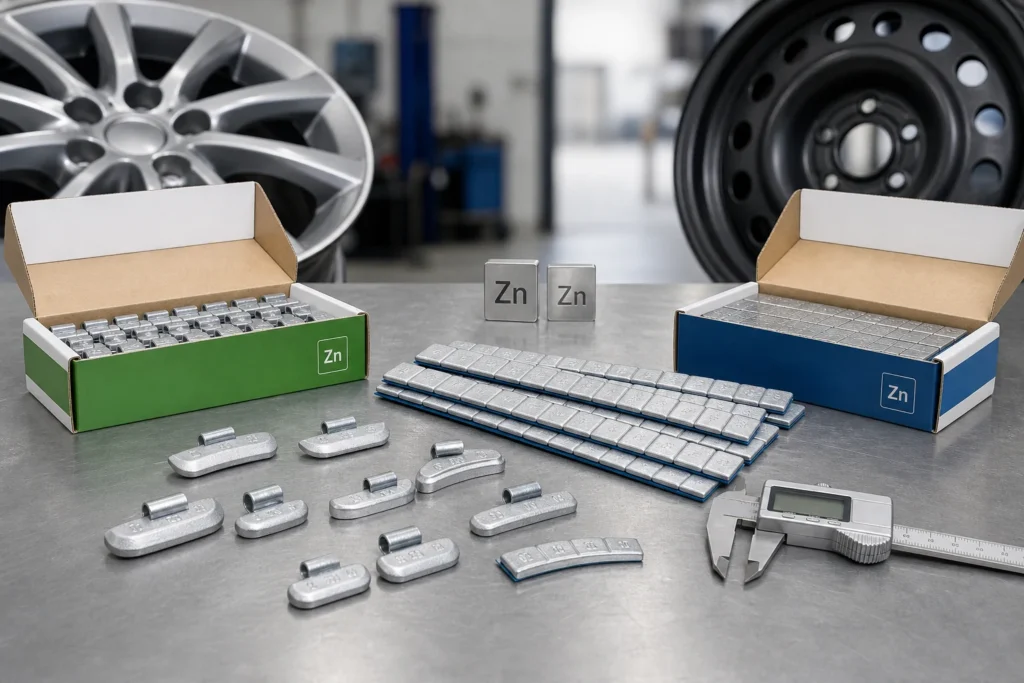
Las pesas de rueda de zinc son pesas de equilibrado sin plomo fabricadas con zinc o aleación de zinc para corregir el desequilibrio de neumáticos y ruedas. Funcionan mejor cuando los compradores necesitan un material sin plomo claramente identificado con apariencia compacta, buena conformabilidad y ajuste confiable, pero aún requieren verificaciones de densidad, recubrimiento, tipo de rueda, rango de tamaño, cinta, embalaje y aceptación del mercado local.
Para importadores, distribuidores y compradores del canal de servicio, el zinc generalmente no se elige de forma aislada. Se sitúa entre tres preguntas prácticas: ¿Qué mercados están abandonando el plomo? ¿Qué aplicaciones de ruedas necesitan formatos de clip o adhesivos? ¿Qué material ofrece la mejor combinación de posicionamiento de cumplimiento, costo, control de corrosión y eficiencia de stock? El marco de planificación de la gama de contrapesos de rueda ayuda a los compradores a conectar el zinc con el resto de la gama en lugar de tratar la elección del material como una especificación de una sola línea.
Tabla de contenido
- ¿Qué son las pesas de rueda de zinc?
- ¿Qué beneficios hacen útiles las pesas de rueda de zinc?
- ¿Qué limitaciones deben entender los compradores antes de elegir zinc?
- ¿Cuándo encajan mejor las pesas de rueda de zinc?
- ¿Cómo se comparan las pesas de zinc con el acero y el plomo?
- ¿Qué deben verificar los compradores antes de pedir pesas de rueda de zinc?
- ¿Qué aplicaciones no son ideales para las pesas de rueda de zinc?
- Conclusión: elija zinc cuando el material se ajuste al programa
- Preguntas frecuentes
- Referencias
¿Qué son las pesas de rueda de zinc?
Las pesas de rueda de zinc son pesas de equilibrado fabricadas con material a base de zinc y formadas en formas de clip o adhesivas. El zinc es el elemento químico Zn, y los compradores a menudo usan la marca Zn para separar las pesas de zinc del acero, plomo o alternativas de material mixto en cotizaciones y etiquetas de cartón 1.
En la práctica, las pesas de rueda de zinc se utilizan para el mismo propósito de equilibrado que otras pesas de rueda: un técnico añade la masa requerida al conjunto de la rueda para que el neumático y la rueda giren con mayor suavidad. La diferencia es la elección del material. El zinc ofrece a los compradores una opción sin plomo que tiene sensación metálica y un perfil compacto, aunque todavía requiere una visión clara del estilo de fijación, recubrimiento y disponibilidad de tamaños.
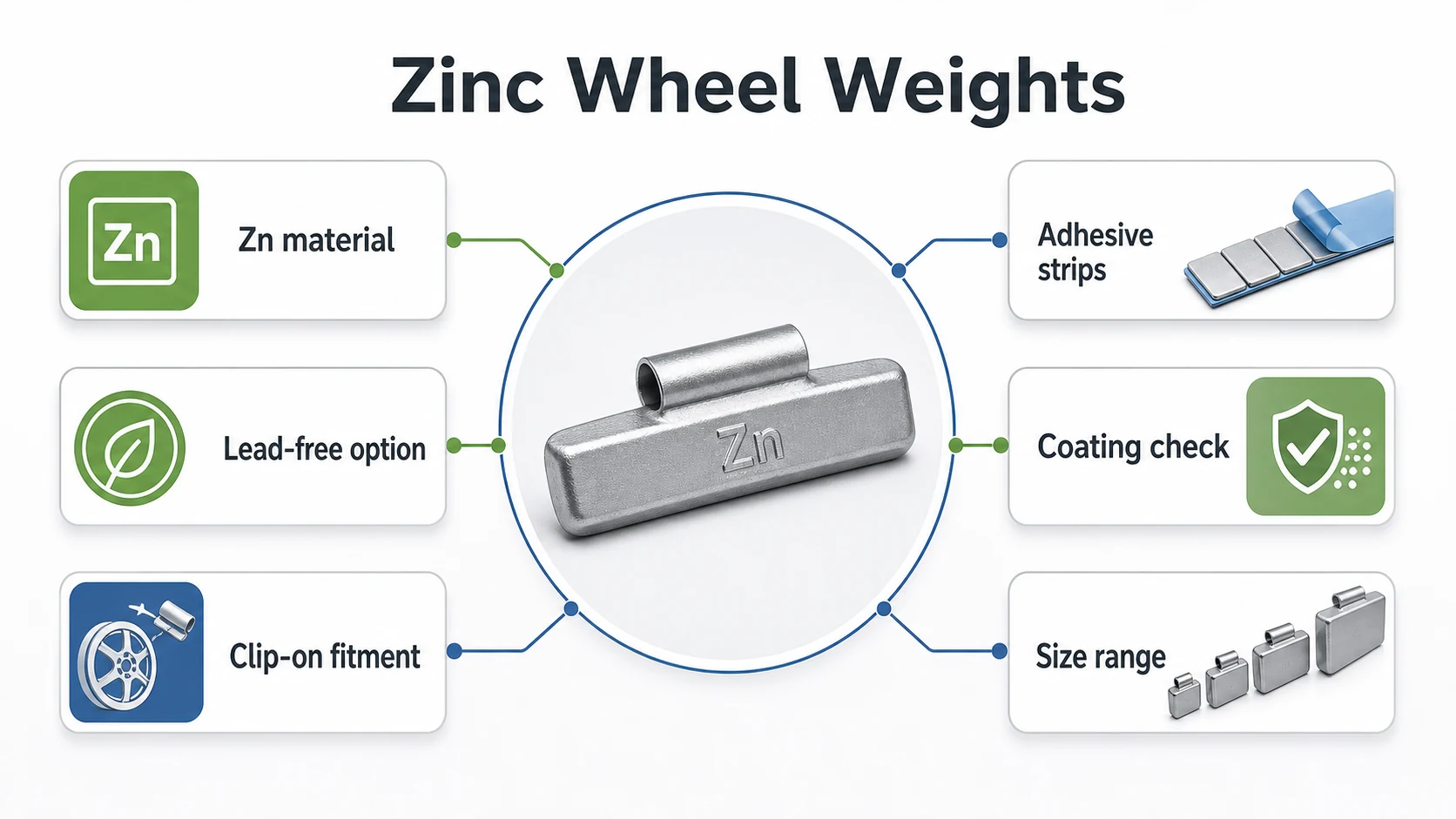
La primera decisión no es simplemente "zinc o no zinc". Los compradores necesitan decidir si el programa de zinc cubrirá pesas de clip para ruedas de acero, pesas de tira adhesiva para ruedas de aleación, o ambos. También necesitan saber si los canales de reparación locales esperan tamaños en gramos, tamaños en onzas, tiras precortadas, formato de rollo, clips recubiertos, acabado simple o cartones de marca privada.
| Decisión sobre pesas de rueda de zinc | Por qué importa antes de una RFQ | Qué preguntar al proveedor |
|---|---|---|
| Identidad del material | Evita confusión entre Zn, Fe y afirmaciones sin plomo mixtas | Confirmar marcado de zinc o aleación de zinc, declaración y etiquetado de muestra |
| Formato de fijación | Determina la aplicación de la rueda y el flujo de trabajo de instalación | Solicitar perfiles de clip, formatos de tira adhesiva, o ambos |
| Rango de tamaño | Afecta la cobertura de servicio y la planificación de inventario | Confirmar gramos, onzas, tamaños de segmento y cantidad por cartón |
| Acabado superficial | Influye en la apariencia de corrosión y las quejas de los clientes | Solicitar expectativas de recubrimiento, galvanizado, pintura y niebla salina |
| Embalaje | Controla el manejo del distribuidor, la preparación de pedidos en almacén y la presentación para reventa | Confirmar peso de caja, cajas interiores, etiquetas, código de barras y cartón de exportación |
¿Qué beneficios hacen útiles las pesas de rueda de zinc?
Las pesas de rueda de zinc son útiles porque ofrecen a los compradores una opción de equilibrado sin plomo con identidad de material clara y formatos de producto prácticos. Pueden apoyar programas de reducción de plomo, etiquetado limpio de productos y manejo familiar de pesas metálicas cuando el diseño seleccionado coincide con la aplicación de la rueda.
El beneficio más obvio es el posicionamiento sin plomo. Las pesas de rueda de plomo han sido objeto de programas ambientales porque las pesas de plomo perdidas o desechadas pueden entrar al medio ambiente. La guía de mejores prácticas de la EPA de EE. UU. fomentó pasos voluntarios para reducir el uso de pesas de rueda de plomo y promover alternativas 2. Eso no significa que cada mercado tenga la misma regla legal, pero sí explica por qué los compradores a menudo evalúan zinc y acero al reemplazar el plomo. El artículo sobre por qué el acero y el zinc se consideran en programas sin plomo es útil cuando un equipo de compras está separando la presión ambiental del ajuste diario del producto.
El zinc también tiene una identidad clara en la comunicación con el comprador. Las etiquetas de cartón, las marcas de producto y las cotizaciones pueden usar "Zn" para distinguir el material de las pesas de acero Fe o las pesas de plomo Pb. Esto importa cuando un distribuidor maneja varios materiales en el mismo almacén. Si el equipo de recepción, el equipo de ventas y el cliente final usan el mismo código de material, ocurren menos errores en la preparación de pedidos, el reabastecimiento y la gestión de quejas.
Otro beneficio es que el zinc puede sentirse más cercano a las pesas de equilibrado metálicas tradicionales de lo que algunos compradores esperan de un reemplazo sin plomo. Para las pesas de clip, una pieza de zinc bien fabricada puede proporcionar una experiencia de instalación familiar cuando el perfil del clip se ajusta al borde de la llanta. Para las pesas adhesivas, las tiras de zinc se pueden suministrar en diseños de segmentos que se asemejan a otros formatos adhesivos, lo que facilita su integración en las rutinas existentes del taller.
El beneficio para el comprador es más fuerte cuando el zinc se especifica como parte de un programa de producto completo:
| Beneficio | Con qué ayuda | Precaución del comprador |
|---|---|---|
| Identidad de material sin plomo | Posicionamiento ambiental, requisitos del cliente, etiquetado de material | Confirmar el requisito legal real del mercado; no asumir que una regla se aplica globalmente |
| Marcado Zn reconocible | Clasificación en almacén, cotizaciones, embalaje y comunicación de ventas | Mantener códigos de material consistentes en producto, caja, cartón y factura |
| Sensación de producto metálico | Familiar handling for installers used to metal wheel weights | Check actual shape, clip spring behavior, and adhesive performance |
| Suitable for selected formats | Clip-on and adhesive programs can both be developed | Do not assume every zinc size is available in every profile |
| Useful in material comparison | Gives buyers another option besides lead and steel | Compare cost, density, coating, and market acceptance before switching |
¿Qué limitaciones deben entender los compradores antes de elegir zinc?
Zinc wheel weights have limits in density, cost, size availability, corrosion appearance, and market preference. They are not automatically better than steel or lead-free alternatives, so buyers should treat zinc as a fit-for-purpose material rather than a universal replacement.
Density is the first practical issue. Zinc is less dense than lead, so a zinc weight normally needs more volume than an equivalent lead weight. That does not make zinc unsuitable, but it affects part shape, strip length, and the space available behind spokes or along a rim flange. In tight applications, especially low-clearance alloy wheel areas, buyers must check whether the weight height and length will interfere with calipers or wheel styling.
Cost and supply strategy are also important. In many programs, steel weights are chosen because they are widely accepted, cost-efficient, and easy to source in large ranges. Zinc may be selected for certain customers or markets, but it can be less attractive where the buyer's main goal is low unit cost across a high-volume assortment. When a project is cost-sensitive or needs a very wide replacement range, the steel Fe alternative to zinc wheel weights can help buyers decide whether Fe material is a better baseline.
Zinc also needs realistic corrosion expectations. Zinc itself is commonly associated with corrosion protection in many industrial uses, but a wheel weight is still a working automotive part exposed to moisture, salt, brake dust, installation abrasion, and storage conditions. A poor coating, damaged clip, weak plating process, or damp carton can still create visible finish complaints. Buyers should ask how the supplier evaluates coating consistency and whether any salt spray test is used as a comparative quality control method; ASTM B117 describes a standard salt spray apparatus practice often referenced for this type of corrosion exposure testing 3.
Finally, market acceptance matters. Some shops are familiar with steel weights, some still know older lead formats, and some customers request zinc for specific programs. If installers dislike the clip profile, if adhesive strips are hard to remove from the liner, or if the cartons do not match local size conventions, the material advantage will not save the program.
¿Cuándo encajan mejor las pesas de rueda de zinc?
Zinc wheel weights fit best when a buyer needs a lead-free material, clear Zn labeling, controlled product appearance, and a manageable size range for a defined service channel. They are especially suitable when the purchasing team can test samples before committing to a full assortment.
A strong zinc program usually starts with a defined application rather than a broad replacement promise. For example, a distributor may introduce zinc adhesive strips for alloy wheel service in a market where lead-free positioning matters to retailers. A repair network may use zinc clip-on weights for selected passenger-car steel wheel applications where the profile and coating have already passed shop testing. An importer may carry zinc beside Fe steel weights so customers can choose by market requirement and price point.
| Best-fit application | Why zinc can work | Qué verificar |
|---|---|---|
| Passenger car service ranges | Common balancing sizes can be covered without excessive assortment complexity | Gram or ounce coverage, popular increments, and packaging count |
| Lead-free retail programs | Zn labeling supports a clear non-lead material message | Local compliance expectations and customer documentation needs |
| Alloy wheel adhesive strips | Zinc can be supplied in familiar segmented stick-on formats | Tape grade, liner release, strip height, and surface preparation |
| Selected steel-wheel clip-on programs | Zinc clip-on parts can match common rim flange profiles when tooled correctly | Clip profile, retention, coating, and installation force |
| Distributor mixed-material catalogs | Zinc gives customers a material option beside steel | SKU naming, carton labels, and sales training |
Zinc is less attractive when the buyer has no defined market reason for it. If the only goal is to replace lead at the lowest possible total cost, steel may win. If the shop needs extremely thin adhesive profiles behind tight wheels, the buyer should compare actual sample height and tape thickness rather than relying on material name. If the channel needs dozens of niche clip profiles, zinc availability may be narrower than the broader steel range.
¿Cómo se comparan las pesas de zinc con el acero y el plomo?
Zinc sits between lead and steel in many buyer discussions: it is lead-free like steel, more compact than many steel shapes at the same mass, and more acceptable than lead where lead reduction is a priority. The right choice depends on market rules, wheel application, price target, and supplier capability.
Lead is dense and easy to form, which is why it was historically common. The problem is environmental pressure and regulatory or voluntary phase-out activity in many markets. Buyers who still see lead in older product lines should verify whether it can be sold, installed, transported, or promoted in their target markets before placing any repeat order.
Steel, often labeled Fe, has become a mainstream lead-free material because it is cost-effective, widely available, and familiar in large-volume replacement programs. Its lower density compared with lead can require larger physical shapes, but good design and coating can make steel a practical everyday choice. Zinc offers another lead-free option with a different cost, appearance, density, and market-positioning profile.
For buyers comparing all three, the material comparison behind zinc wheel weight choices helps separate the basic material trade-offs before a team locks a catalog strategy. The real decision is not which material sounds best on paper; it is which material can be supplied consistently in the sizes, profiles, coatings, and cartons your customers will actually use.
| Material | Ventaja principal | Main limit | Best buyer use |
|---|---|---|---|
| Plomo | High density and traditional handling | Environmental and regulatory pressure in many markets | Legacy comparison only unless verified as acceptable |
| Steel / Fe | Cost-effective lead-free replacement with broad supply | Larger volume for same mass, coating quality matters | High-volume lead-free programs and broad service assortments |
| Zinc / Zn | Lead-free identity, compact metal appearance, clear material marking | Cost, availability, and coating expectations must be checked | Defined lead-free programs where Zn is requested or preferred |
¿Qué deben verificar los compradores antes de pedir pesas de rueda de zinc?
Buyers should check the material declaration, attachment format, size range, coating, tape, clip fit, carton labels, and sample performance before ordering zinc wheel weights. A good RFQ makes these details visible before price comparison, because the cheapest zinc quote may not match the application.
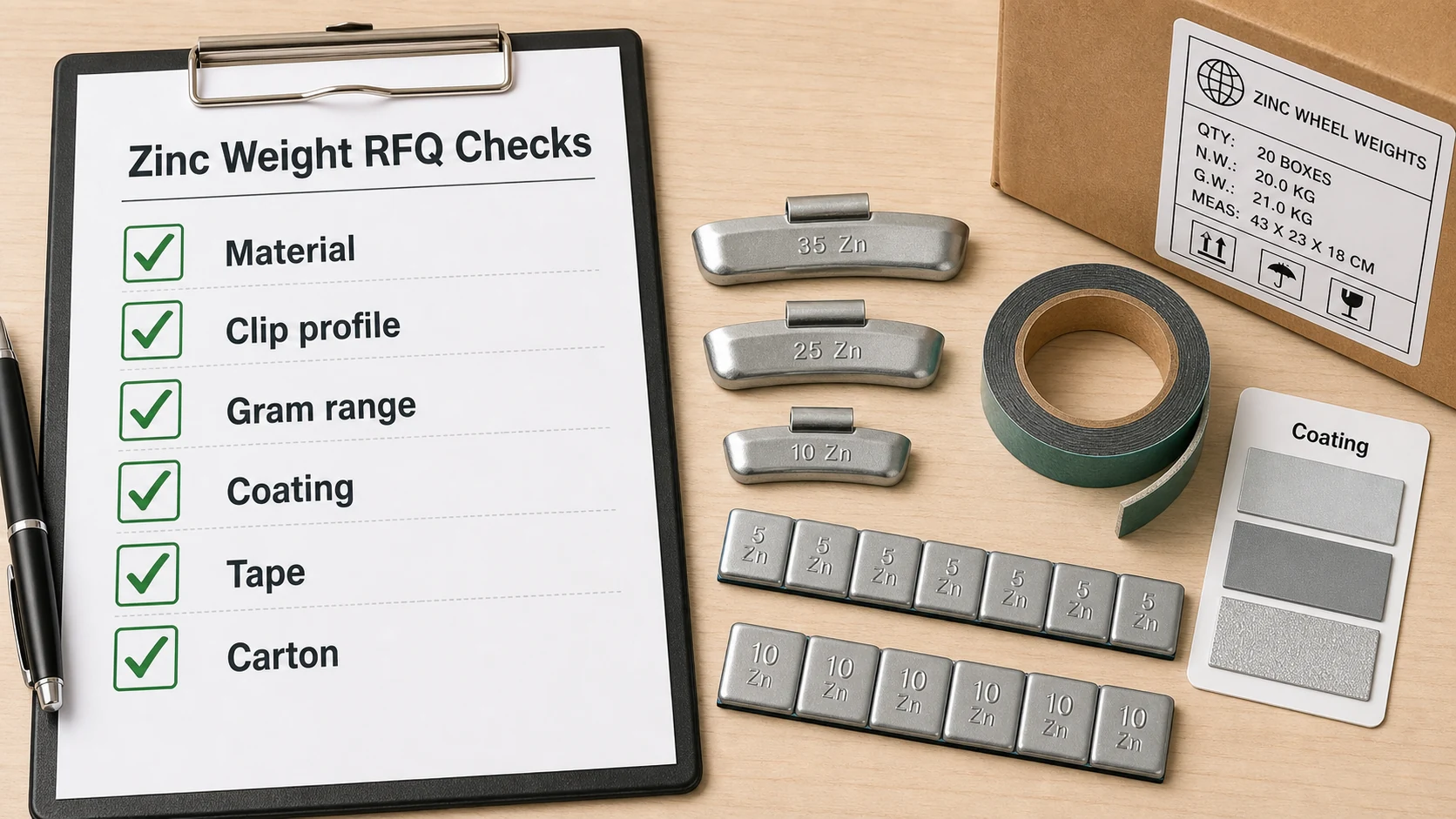
Start with material and labeling. Ask whether the product is zinc or zinc alloy, how it is marked, and whether the supplier can keep Zn visible on samples, inner boxes, export cartons, and invoices. If your customers compare Fe and Zn options side by side, inconsistent labeling can create unnecessary complaints even when the parts themselves are correct.
Next, define the attachment format. For clip-on zinc wheel weights, request the rim flange profile, intended wheel type, coating, clip material if separate, installation force expectations, and retention testing method. For adhesive zinc wheel weights, request the segment size, total strip weight, tape type, liner behavior, shelf-life guidance, and recommended surface preparation. Tape performance depends heavily on clean, dry, prepared surfaces; 3M's surface preparation guidance for VHB tapes is a useful reminder that bonding depends on surface condition, contamination control, and pressure, not tape brand alone 4.
Size planning deserves its own line in the RFQ. A buyer building a zinc assortment should not simply ask for "all common sizes." Instead, list gram or ounce increments, strip layout, pieces per box, box weight, carton quantity, and barcode requirements. The size coverage for zinc wheel weight programs can help a purchasing team connect common mass increments with the wheel applications and service channels they intend to cover.
Coating should also be handled as a buyer requirement, not a vague promise. Ask for the finish type, color, visual standard, corrosion-test target if applicable, and acceptable appearance after storage. Buyers who already receive complaints about rust, white corrosion, peeling paint, or chipped surfaces can use coating and corrosion checks for zinc wheel weights to turn those complaints into clearer inspection points before the next sample round.
| RFQ item | Zinc-specific question | Why it protects the buyer |
|---|---|---|
| Material | Is it Zn or zinc alloy, and how is it declared? | Prevents wrong-material substitution and unclear claims |
| Perfil del clip | Which rim flange or wheel type is it designed for? | Reduces installer rejection and poor retention |
| Cinta adhesiva | What tape construction and liner are supplied? | Helps avoid lift, hard removal, or poor bonding |
| Rango de tamaño | Which grams, ounces, strip lengths, and carton counts are available? | Keeps the range practical for real inventory |
| Recubrimiento | What finish, color, and corrosion expectation are offered? | Reduces visible finish complaints |
| Embalaje | What inner box, export carton, label, and barcode are included? | Makes warehouse and resale handling easier |
| Muestras | Can samples be tested before bulk order confirmation? | Finds fitment and handling issues before MOQ commitment |
¿Qué aplicaciones no son ideales para las pesas de rueda de zinc?
Zinc wheel weights are not ideal when the buyer needs the lowest possible cost, the broadest commodity range, extremely thin clearance, or a market that already prefers steel. They may also be a poor fit when the supplier cannot document material, coating, tape, and packaging consistently.
The first weak fit is a purely price-driven program. If the distributor's customers buy only by lowest cost per box, zinc may be difficult to position unless the market specifically requests Zn material. In that case, steel weights often provide a more practical lead-free baseline, especially for high-turnover service sizes.
The second weak fit is a channel with unclear wheel applications. Clip-on weights are profile-sensitive. If the buyer cannot identify the rim flange, wheel type, or target vehicle mix, any material can fail in the field. Zinc does not remove the need for fitment testing. It only changes the material and product behavior.
The third weak fit is uncontrolled adhesive installation. Stick-on weights depend on wheel surface cleaning, temperature, pressure, and tape quality. A zinc adhesive strip with poor surface preparation can still lift. Before blaming the material, shops should check whether wheels are clean and dry, whether the tape liner releases properly, and whether the installer applies enough pressure after placement.
The fourth weak fit is an order placed without supplier review. Buyers comparing zinc quotations should ask about tooling, inspection, sample approval, packaging control, and batch consistency. When a purchasing team is qualifying a new source, the manufacturer checks before sourcing zinc wheel weights provide a useful way to evaluate whether the factory can support repeated shipments, not just a single attractive sample.
If you are evaluating zinc for a real wheel-weight program, share your target material, attachment format, size range, coating, and packaging requirements. We can help you turn those checks into a sample request before you commit to an order.
Conclusión: elija zinc cuando el material se ajuste al programa
Zinc wheel weights are a useful lead-free option when the buyer has a clear reason to specify Zn, a defined wheel application, and enough sample testing to confirm fitment, coating, tape, size range, and packaging. They are not a universal upgrade over steel or a simple one-for-one replacement for lead.
For a practical sourcing decision, treat zinc as part of a complete balancing-weight program. Compare the material against steel and legacy lead expectations, confirm the intended wheel applications, then request samples before finalizing cartons and labels. Buyers preparing a zinc range can review zinc wheel weight samples for material and fitment checks once the required material, size range, attachment format, coating, and packaging details are clear enough for a meaningful sample discussion.
Preguntas frecuentes
Are zinc wheel weights lead-free?
Zinc wheel weights are generally used as a lead-free alternative, but buyers should still confirm the exact material declaration with the supplier. Ask whether the product is zinc or zinc alloy, how it is marked, and whether the material statement matches carton labels, invoices, and any customer documentation.
¿Son los contrapesos de llanta de zinc mejores que los de acero?
Zinc is not automatically better than steel. Zinc may offer a compact metal appearance and clear Zn material identity, while steel often wins on cost, range breadth, and broad lead-free availability. The better choice depends on market requirements, wheel application, size coverage, coating quality, and target price.
Can zinc wheel weights be used on alloy wheels?
Yes, zinc adhesive wheel weights can be used on alloy wheels when the strip height, segment size, tape, and installation process match the application. Buyers should test clearance behind spokes and confirm that installers clean and prepare the wheel surface before applying adhesive weights.
Can zinc wheel weights be used on steel wheels?
Zinc clip-on wheel weights can fit steel wheels when the clip profile matches the rim flange. Buyers should not order by material only. They need to confirm wheel type, rim flange style, clip retention, coating, and size range before approving bulk production.
What should be included in a zinc wheel weight RFQ?
A zinc wheel weight RFQ should include material identity, attachment format, gram or ounce range, clip profile or tape details, coating, carton quantity, label format, sample requirements, and any market documentation needs. Clear RFQs reduce mismatched samples and make supplier quotations easier to compare.
Referencias
[1] Royal Society of Chemistry. “Zinc.” 2026.
[2] United States Environmental Protection Agency. “Mejores Prácticas de Gestión para Pesos de Rueda de Plomo.” 2015.
[3] ASTM International. “ASTM B117-19 Standard Practice for Operating Salt Spray Apparatus.” 2019.
[4] 3M. “Boletín Técnico de Preparación de Superficies para Cinta 3M VHB.” 2019.