




El MOQ de los pesos de rueda depende de si el pedido utiliza productos estándar o personalizados, el formato de fijación, el material, el perfil del clip o el diseño de la tira, el embalaje, el etiquetado y la configuración de producción. Los compradores pueden reducir el riesgo del MOQ separando los SKU estándar probados de las partes del programa que realmente necesitan personalización.
La cantidad mínima de pedido no es una regla universal de fábrica y no es automáticamente una señal de que un proveedor sea inflexible. Es el punto en el que un proveedor puede fabricar, controlar, empaquetar y enviar una configuración definida de pesos de rueda sin crear un número antieconómico de cambios de producción, cajas sueltas o sobrantes no rastreables. La tarea del comprador es aprender a qué se aplica el MOQ cotizado antes de usarlo en una comparación de precios.
Tabla de contenido
- ¿Qué significa realmente el MOQ de los pesos de rueda?
- ¿Por qué varía el MOQ de los pesos de rueda entre pedidos?
- ¿Cómo cambian el mínimo los pesos de rueda estándar y personalizados?
- ¿Qué elecciones de material y fijación influyen en el MOQ?
- ¿Cómo cambian el MOQ las opciones de embalaje y marca privada?
- ¿Cómo pueden los compradores reducir el riesgo del MOQ sin hacer que la especificación sea vaga?
- ¿Qué debería incluir una solicitud de MOQ antes de la comparación de precios?
- Conclusión: hacer del MOQ una variable comercial definida
- Preguntas frecuentes
- Referencias
¿Qué significa realmente el MOQ de los pesos de rueda?
El MOQ de los pesos de rueda es la cantidad más pequeña que un proveedor está dispuesto a aceptar para un alcance de producto y un paquete comercial declarados. Puede aplicarse a un SKU, un material y acabado, un perfil de clip, una tira con respaldo adhesivo, un diseño de caja, un surtido mixto o todo el pedido de compra. Esos son compromisos muy diferentes, por lo que “¿Cuál es su MOQ?” está incompleto por sí solo.
Por ejemplo, un proveedor puede aceptar un pedido modesto de tiras adhesivas regulares que ya están en su plan de producción, pero exigir un mínimo mucho mayor para una longitud de tira exclusiva, una nueva construcción de cinta, cajas impresas personalizadas o una mezcla poco común de incrementos. Otro proveedor puede cotizar un mínimo por SKU porque debe configurar un perfil de clip o una celda de embalaje en particular. Ninguna respuesta puede entenderse sin el alcance.
Antes de discutir un número, dé al equipo de compradores una definición breve del rango. La vista de planificación de rangos antes de establecer un mínimo de pedido ayuda a identificar las aplicaciones de rueda, las familias de fijación, los materiales, los incrementos y las necesidades del mercado que deben fijarse primero. Eso evita que un proveedor tenga que cotizar un programa indefinido de “pesos de rueda” como si todos los formatos estuvieran incluidos.
Use esta tabla de primera pasada para hacer específica la conversación sobre el MOQ.
| Pregunte al proveedor | Por qué es importante | Una respuesta útil suena así |
|---|---|---|
| ¿El MOQ es por SKU, por color o acabado, por caja, por familia de productos o por pedido? | Define qué puede combinarse y qué debe mantenerse por separado | “Esto es por perfil de clip y acabado; los valores dentro de ese surtido aprobado pueden empaquetarse juntos.” |
| ¿El MOQ utiliza una configuración de producto estándar? | El inventario, los utillajes y los formatos de empaque estándar pueden reducir el trabajo de configuración | “El mínimo indicado utiliza nuestro material, cinta y caja simple habituales.” |
| ¿Qué característica solicitada crea el mínimo? | Muestra si el factor determinante es el producto, el embalaje o la gestión comercial | “La caja interior impresa y la versión con etiqueta separada crean el mínimo adicional.” |
| ¿Se pueden mezclar los SKU, y en qué proporción? | Una mezcla puede resolver una necesidad de canal, u ocultar una línea difícil de tirada baja | “El total puede mezclarse entre los incrementos listados, pero no entre familias de perfiles de clip.” |
| ¿Qué ocurre con el stock o los componentes restantes? | Expone riesgos relacionados con cintas especiales, artes gráficas, etiquetas o piezas | “Las etiquetas personalizadas se producen solo para el pedido; cualquier saldo no utilizado necesita un acuerdo escrito de arrastre.” |
Un MOQ es, por lo tanto, un límite en torno a una configuración definida, no una táctica de negociación de precios. Trátelo como un campo de especificación junto con el material, la fijación, el incremento y la unidad de empaque.
¿Por qué varía el MOQ de los pesos de rueda entre pedidos?
El MOQ varía porque cada pedido crea una cantidad diferente de configuración, asignación de material, trabajo de embalaje, inspección y riesgo de stock residual. Cuanto más se aleje una solicitud de un flujo establecido de producto y empaque, más probable es que el mínimo esté vinculado a una partida concreta en lugar del total del pedido.
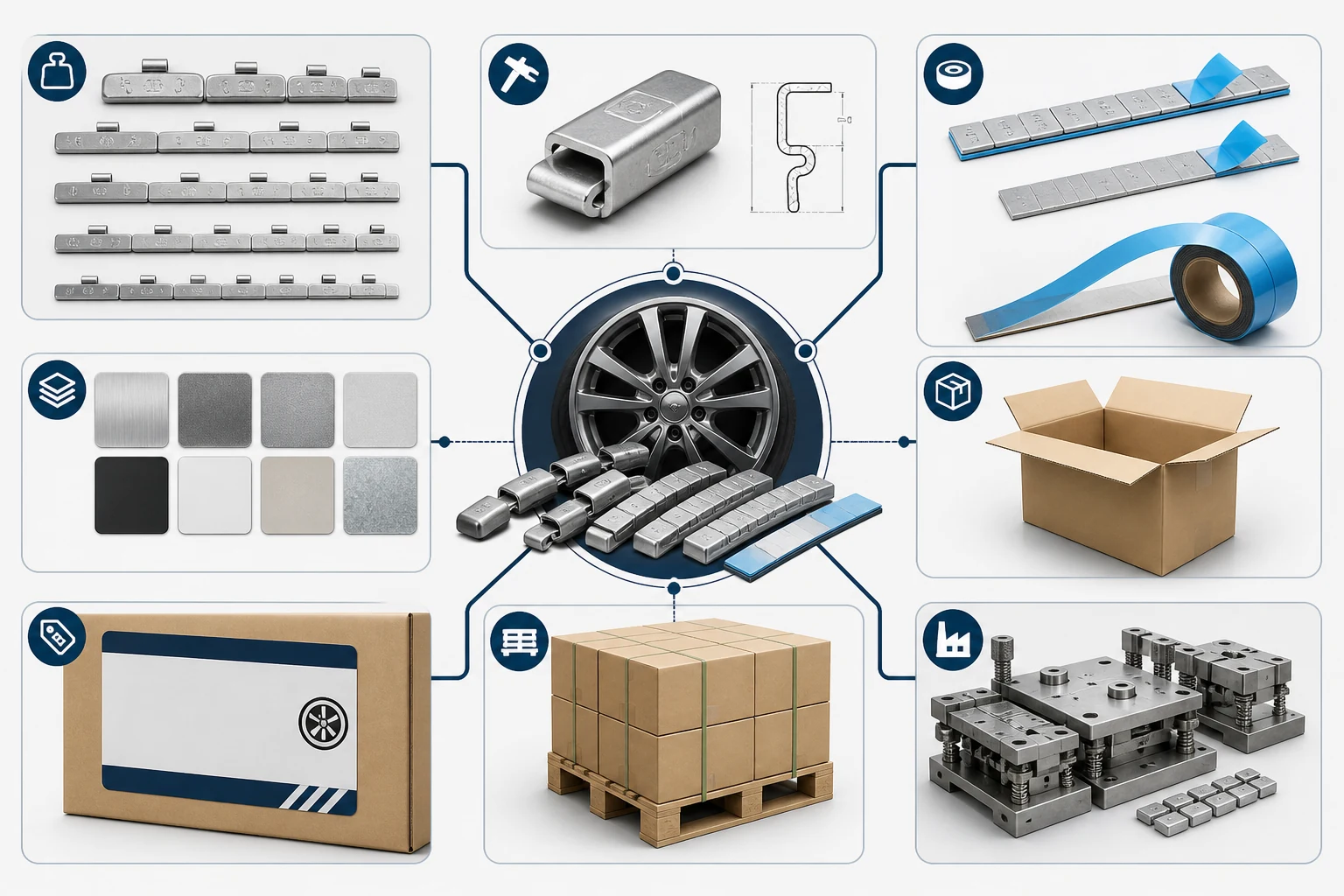
Los principales factores no siempre son visibles en un catálogo. Un producto puede parecer estándar y, sin embargo, requerir un clip especial, un recubrimiento poco común, un rollo de cinta con un mínimo del proveedor, una secuencia de incrementos no estándar o artes gráficas nuevas. A la inversa, un pedido que parece grande puede ser relativamente fácil de atender cuando utiliza configuraciones de producción existentes, cajas regulares y una mezcla de valores de alta rotación.
| Factor del MOQ | Por qué puede elevar el mínimo | Qué puede hacer un comprador |
|---|---|---|
| Configuración de producción | Se debe preparar una herramienta de prensa, estación de conformado, lote de recubrimiento, tirada de aplicación de cinta o configuración de inspección para una variante definida | Pregunte si la solicitud puede usar un proceso existente y apruebe su versión estándar exacta |
| Material o acabado | Un grado de material, acabado, color o tratamiento de protección contra la corrosión separado puede necesitar un lote o batch distinto | Mantenga estándar el material base y el acabado a menos que el destino o la aplicación requieran un cambio |
| Perfil o diseño de tira | Una geometría de clip, forma del cuerpo, tamaño de tira o patrón de segmentación puede requerir utillaje o conversión dedicados | Separe los requisitos de ajuste indispensables de las preferencias estéticas y valide las muestras con antelación |
| Mix incremental | Los valores de baja rotación pueden dejar inventario residual o necesitar una operación de empaque separada | Establecer una proporción de surtido basada en el consumo realista en lugar de cantidades iguales de cada valor |
| Cinta y forro | Los productos adhesivos pueden depender de una cinta elegida, un liner, un protocolo de almacenamiento y un formato de conversión | Confirmar si la cinta preferida es stock regular y si el liner y el formato del rollo son estándar |
| Packaging and labels | Una caja interior especial, idioma de etiqueta, código de barras, impresión de cartón o patrón de pallet agrega materiales y trabajo de cambio | Comenzar con un cartón estándar y una etiqueta controlada cuando eso aún cumpla con la necesidad de lanzamiento |
| Documentación y aprobación | Las nuevas muestras, planos, puntos de inspección y registros de liberación requieren trabajo antes de la producción repetitiva | Enviar una especificación concisa una vez y usarla para todas las comparaciones de proveedores |
El conteo de cartones importa, pero no es toda la respuesta. Un comprador podría cumplir con un mínimo de cartones mientras aún queda por debajo del mínimo para una tira adhesiva especial o una caja interior impresa personalizada. Cuando la lista de productos ya está definida, la planificación de cartones y mix de SKU para un pedido a granel puede ayudar a distinguir una cantidad de reposición lógica de un mínimo de configuración de producto de fábrica.
¿Cómo cambian el mínimo los pesos de rueda estándar y personalizados?
Los pesos de rueda estándar generalmente tienen un MOQ más bajo y más flexible porque el proveedor puede usar utillaje establecido, materiales aprobados, métodos de inspección existentes y empaque regular. Los pesos de rueda personalizados generalmente elevan el MOQ porque el proveedor debe proteger el costo y el control de una configuración que puede no ser reutilizable para otro comprador.
“Estándar” aún debe definirse. Puede significar un perfil de clip regular en la gama establecida del proveedor, una tira adhesiva común con un sistema de cinta actual, una serie de incrementos normal, un acabado conocido y un cartón liso o con etiqueta estándar. No significa que el artículo sea automáticamente adecuado para la población de rines del comprador, las reglas del mercado o el flujo de trabajo de empaque.
“Personalizado” también tiene niveles. Un comprador puede solo necesitar una etiqueta de cartón que lleve su propio SKU y código de barras. Otro puede requerir diferentes dimensiones de caja interior, arte impreso nuevo, una proporción de mix única para un programa de taller local, un recubrimiento especial o un utillaje nuevo. Cada solicitud debe cotizarse como una variable separada en lugar de agruparse en un “MOQ personalizado” opaco.”
| Cambio solicitado | A menudo más cercano a | Efecto en el MOQ a esperar | Mejor primera pregunta |
|---|---|---|---|
| SKU existente con una etiqueta exterior proporcionada por el comprador | Variación de empaque comercial | A menudo más bajo que un programa de cartón impreso, pero aún confirmar el mínimo de etiqueta | ¿Se pueden aplicar etiquetas al cartón regular y cómo se controla la versión de la etiqueta? |
| Peso y acabado existentes con un cartón de SKU mixto | Variación de empaque | Depende del trabajo de pick-and-pack y la proporción de artículos de baja rotación | ¿Qué SKUs pueden compartir un cartón y cuál es el mínimo por línea incluida? |
| Diferente cinta, liner o longitud de tira | Configuración del producto | Puede aumentar si la cinta o el proceso de conversión no es stock regular | ¿Ya se usa esta construcción de cinta y tira en producción regular? |
| Nuevo perfil de clip o geometría de cuerpo modificada | Configuración de utillaje o perfil | A menudo más alto porque el ajuste y la producción repetitiva deben establecerse | ¿Existe un perfil existente que se ajuste físicamente al rin objetivo? |
| Nuevo color, recubrimiento o arte impreso | Programa de acabado o empaque | Depende del tamaño del lote, el proceso de impresión y los materiales restantes | ¿Qué parte de la solicitud requiere un lote separado o una compra de material? |
Esta división importa en un primer pedido. En lugar de aceptar un MOQ total alto para un programa parcialmente personalizado, los compradores pueden solicitar dos alternativas: una cotización para una configuración estándar aprobada y otra para el elemento personalizado. La diferencia muestra dónde reside realmente la exposición comercial.
¿Qué elecciones de material y fijación influyen en el MOQ?
Las elecciones de material y sujeción influyen en el MOQ cuando requieren un lote de compra diferente, una ruta de producción, un utillaje, un sistema de cinta, un plan de prueba o un método de empaque diferentes. Deben tratarse como decisiones de control de producto, no como descriptores que se agregan después de acordar el precio.
Para pesos de clip, las preguntas relevantes incluyen el perfil del clip, el material del cuerpo del peso, el material del clip cuando es separado, el recubrimiento, la serie de incrementos y la familia de rines objetivo. Un perfil solicitado puede ser común dentro de la gama de un proveedor pero inusual para otro. Una muestra física en un rin representativo suele ser un paso temprano más útil que asumir que se puede sustituir un clip de aspecto similar.
Para pesos adhesivos, el comprador debe aclarar el material, el recubrimiento, el grosor de la tira, el patrón de segmentos, la cinta, el liner, la longitud de la tira y las condiciones de almacenamiento. Un proveedor puede ejecutar rutinariamente una combinación particular de tira y cinta; otro puede tener que comprar un lote de cinta especial o cambiar la configuración de conversión. Los compradores pueden usar requisitos de cinta y tira que deben fijarse antes de cotizar un MOQ adhesivo para definir las variables que hacen que dos ofertas adhesivas sean materialmente diferentes antes de solicitar un mínimo más bajo.
El mismo principio se aplica a la evidencia de fabricación. Las etapas de producción que un programa de pesos de rueda repetitivo tiene que controlar ayudan al comprador a preguntar dónde entra un cambio de material, recubrimiento, clip, cinta, inspección o empaque en el proceso. Después de hacer clic, el comprador puede identificar qué característica solicitada necesita un punto de control separado antes de tratarla como una variación inofensiva.
No tomar decisiones de material y sujeción solo desde una perspectiva de MOQ. Un mínimo más bajo no es un ahorro si usa un perfil inadecuado, una configuración de cinta no aprobada o un acabado que no se adapta a la aplicación. El mejor enfoque es declarar los requisitos técnicos no negociables, luego hacer concesiones comerciales solo entre las características que no cambian el ajuste o el uso previsto.
¿Cómo cambian el MOQ las opciones de embalaje y marca privada?
Las elecciones de empaque y marca privada cambian el MOQ porque pueden introducir compras separadas de cajas, etiquetas, placas de impresión, insertos, códigos de barras o pallets, así como trabajo adicional de empaque y verificación. Deben planificarse como parte del SKU, pero no todo primer pedido necesita cada elemento de marca.
Un cartón simple normal con una etiqueta de comprador controlada puede ser viable para una prueba de mercado. Una caja de venta al por menor impresa, varios idiomas, un separador personalizado, un kit especial de SKU mixtos y una etiqueta de palé dedicada pueden crear cada uno un mínimo diferente. El comprador necesita saber si el MOQ del proveedor se aplica al producto interior, al embalaje impreso, a la tirada de envasado o a los tres.
La guía de etiquetas logísticas de GS1 ilustra por qué importa la jerarquía de embalaje: se espera que las etiquetas de recepción y logística comuniquen la identidad de la unidad de manipulación. Para un pedido de contrapesos para ruedas, eso convierte las etiquetas de cartón y de palé en información operativa, no en decoración; la cantidad, el SKU, el campo de lote o partida y la unidad de manipulación deben permanecer claros durante el almacenamiento y el envío.1
Los compradores que consideran un lanzamiento de marca pueden usar decisiones de embalaje y aprobación para una gama de contrapesos para ruedas de marca para separar la aprobación del producto del arte, la etiqueta, el cartón y los controles de pedidos repetidos. Eso les ayuda a decidir si comenzar con un cartón estándar más etiqueta, o si un paquete personalizado es esencial para el lanzamiento.
Solicite un desglose del embalaje en lugar de un solo número:
- MOQ para el SKU del producto regular antes de cualquier marca.
- MOQ para cada caja interior impresa, cartón exterior, idioma de etiqueta, versión de código de barras o inserto.
- Cantidad mínima de cartones, peso bruto del cartón y configuración del palé.
- Si los materiales impresos pueden conservarse para pedidos repetidos, quién es su propietario y cómo se registra su cantidad restante.
- Punto de aprobación para el arte, el paquete de muestra, los datos de la etiqueta y el primer cartón de producción.
ISO 9001 incluye el control de la información documentada como requisito de gestión de la calidad. En este contexto, respalda una práctica sencilla del comprador: identificar la versión de embalaje aprobada y cambiarla solo mediante un registro visible. Una nota genérica de “igual que la muestra” es débil cuando las etiquetas, el contenido del cartón o los números de pieza pueden cambiar entre pedidos.2
¿Cómo pueden los compradores reducir el riesgo del MOQ sin hacer que la especificación sea vaga?
Los compradores pueden reducir el riesgo del MOQ preservando los requisitos técnicos que protegen el ajuste y el rendimiento, mientras posponen o simplifican las variaciones comerciales que no lo hacen. El objetivo no es pedir un producto vago; es aislar qué cambios son esenciales para el mercado y cuáles pueden esperar hasta que se demuestre la demanda repetida.

Use esta secuencia:
- Construya una lista corta de lanzamiento en torno a formatos probados. Elija los pocos perfiles de clip o tiras adhesivas que cumplan con las aplicaciones de rueda previstas y use materiales, incrementos y unidades de paquete regulares donde sean adecuados.
- Clasifique cada característica solicitada. Márquela como crítica para el ajuste, crítica para el cumplimiento, crítica para el servicio, crítica para la marca u opcional. Un acabado especial del cartón puede ser crítico para la marca; un perfil de clip puede ser crítico para el ajuste. No deben negociarse de la misma manera.
- Solicite una alternativa estándar y una personalizada. Pida a los proveedores que coticen el SKU regular, luego enumeren el MOQ y la implicación de costo de cada personalización por separado. Esto expone el verdadero factor impulsor en lugar de obligar a un proveedor a hacer suposiciones.
- Use la aprobación de muestras antes de pedir materiales exclusivos. Confirme el perfil, la tira, la cinta, el acabado, el incremento y la lógica de empaque en muestras identificadas antes de comprometerse con cartones impresos o componentes especiales.
- Establezca una proporción de surtido realista. Ponga más de los valores y formatos que el mercado consumirá, en lugar de distribuir el pedido de manera uniforme entre variantes de uso poco frecuente.
- Acuerde qué sucede en el pedido repetido. Aclare si el MOQ cambia después de la primera tirada aprobada, si el embalaje personalizado permanece en stock y cómo se controla una revisión del producto o de la etiqueta.
Una vez que la base del MOQ esté clara, los compradores pueden usar puntos de comparación de proveedores una vez que la base del MOQ esté clara para evaluar cotizaciones en cobertura de gama, lógica de empaque, documentos, control de calidad y estabilidad de reorden, en lugar de tratar el mínimo más bajo como la única ventaja.
Para un proyecto inicial, comience con familias de muestras estándar de clip y adhesivas para una lista corta inicial de SKU que coincidan con las aplicaciones definidas. Las muestras no eliminan el MOQ, pero reducen la posibilidad de comprometer material o embalaje personalizado con un producto que no ha sido verificado físicamente.
¿Qué debería incluir una solicitud de MOQ antes de la comparación de precios?
Una solicitud de MOQ debe indicar el alcance del producto, las cantidades y unidades de paquete, la personalización solicitada y la información necesaria para comparar alternativas. Esto le da permiso al proveedor para cotizar una ruta estándar viable mientras hace visible cada excepción.
Incluya lo siguiente en la solicitud:
| RFQ item | Qué indicar | Por qué mantiene comparables las respuestas de MOQ |
|---|---|---|
| Mercado y aplicación | País o canal, tipos de rueda, uso de servicio previsto y necesidad de ajuste relevante | Evita que el proveedor ofrezca una línea estándar atractiva pero inadecuada |
| Familia de productos | Clip o adhesivo, construcción de perfil o tira, material, acabado, incrementos y cualquier condición no negociable | Identifica a qué parte de la configuración se aplica el MOQ |
| Base de cantidad | Piezas, tiras, cartones, kilogramos o surtido mixto solicitados y proporción esperada | Distingue una cantidad total del pedido de un mínimo por SKU |
| Embalaje | Empaque interior, cartón exterior, campos de etiqueta, necesidad de palé y requisitos de marca | Separa el MOQ del producto de los mínimos de material impreso y envasado |
| Muestras y aprobación | Muestras necesarias, llantas o superficies de prueba previstas, momento de aprobación y evidencia solicitada | Evita producir componentes especiales antes de que el comprador confirme la configuración |
| Alternatives | Solicite una opción estándar y una opción personalizada identificada por separado | Permite al comprador ver qué cambio realmente eleva el mínimo |
| Supuestos de reorden | Rango de previsión, frecuencia de repetición y si el embalaje sobrante puede conservarse | Ayuda al proveedor a proponer un programa de repetición comercialmente realista |
Los requisitos del International Automotive Task Force para proveedores de niveles inferiores enfatizan la transmisión de los requisitos del cliente, el control de cambios y la trazabilidad. Un comprador no necesita imponer una auditoría de sistema automotriz para aplicar esa lección: un brief de un SKU nombrado y un registro de aprobación controlado hacen que el MOQ, las muestras, el embalaje y los pedidos posteriores sean mucho más fáciles de gestionar.3
Si el MOQ está afectando tu decisión de abastecimiento de contrapesos para ruedas, comparte el rango de SKU objetivo, la previsión, el embalaje, la personalización y el calendario de lanzamiento. Podemos ayudarte a separar los requisitos fijos de configuración de las cantidades de pedido negociables antes de que te comprometas.
Conclusión: hacer del MOQ una variable comercial definida
El MOQ de contrapesos para ruedas está determinado por el producto y el alcance comercial detrás de la cifra: configuración estándar versus personalizada, diseño de clip o tira, material y acabado, cinta, mezcla de incrementos, embalaje, etiquetas, muestras y configuración de producción. El número más bajo solo es útil cuando se aplica al producto que el comprador puede realmente vender y soportar.
Define primero la lista de SKU de lanzamiento, mantén claros los requisitos de ajuste y aplicación, y pide a los proveedores que separen las alternativas estándar y personalizadas. Solicita orientación sobre el MOQ para la lista de SKU propuesta junto con el plan de empaque y la necesidad de muestras. Eso le da al comprador un pedido inicial viable sin ocultar las decisiones que importarán en el pedido de repetición.
Preguntas frecuentes
¿Cuál es un MOQ típico para contrapesos para ruedas?
No existe un MOQ típico único que se aplique de forma segura a todos los contrapesos para ruedas. El mínimo puede indicarse por SKU, perfil, material, configuración de cinta, caja, paquete impreso o pedido. Pide a un proveedor que identifique el alcance exacto antes de comparar cualquier cifra.
¿El MOQ de los contrapesos adhesivos para ruedas suele ser diferente del MOQ de los contrapesos con clip?
Puede serlo. El MOQ de los contrapesos adhesivos puede verse afectado por la construcción de la tira, la cinta y el forro, el patrón de segmentos y el embalaje; el MOQ de los contrapesos con clip puede verse afectado por el perfil, el material, el recubrimiento, la variedad de incrementos y el tipo de paquete. El mínimo real depende de si esos artículos son configuraciones de producción habituales.
¿Puedo mezclar SKU de contrapesos para ruedas para alcanzar un MOQ?
A veces, pero el comprador debe confirmar la mezcla permitida. Un proveedor puede permitir diferentes incrementos dentro de un rango establecido, pero no diferentes perfiles de clip, materiales, acabados o programas de embalaje. Solicita por escrito la mezcla de SKU permitida y la proporción requerida.
¿El embalaje de marca privada aumenta el MOQ de los contrapesos para ruedas?
A menudo puede hacerlo, porque las cajas impresas, las etiquetas, las versiones de códigos de barras, los insertos y el empaque personalizado pueden tener mínimos separados de material y configuración. Solicita un desglose entre el MOQ del producto estándar y cada requisito de embalaje o etiqueta.
¿Cómo puede un comprador primerizo reducir el riesgo de MOQ?
Usa SKU estándar y apropiados para la aplicación en el rango inicial, aprueba muestras identificadas antes de pedir componentes personalizados, solicita una cotización estándar y una personalizada, mantén el embalaje práctico e indica qué puede trasladarse a los pedidos de repetición. No elimines los requisitos de ajuste o control de producto solo para obtener un mínimo más bajo.
Referencias
[1] GS1. “Directriz de etiqueta logística GS1.” n.d.
[2] Organización Internacional de Normalización. “ISO 9001:2015 – Sistemas de gestión de la calidad – Requisitos.” 2015.
[3] Grupo de Trabajo Automotriz Internacional. “Requisitos mínimos del sistema de gestión de la calidad automotriz para proveedores de subnivel.” 2017.