


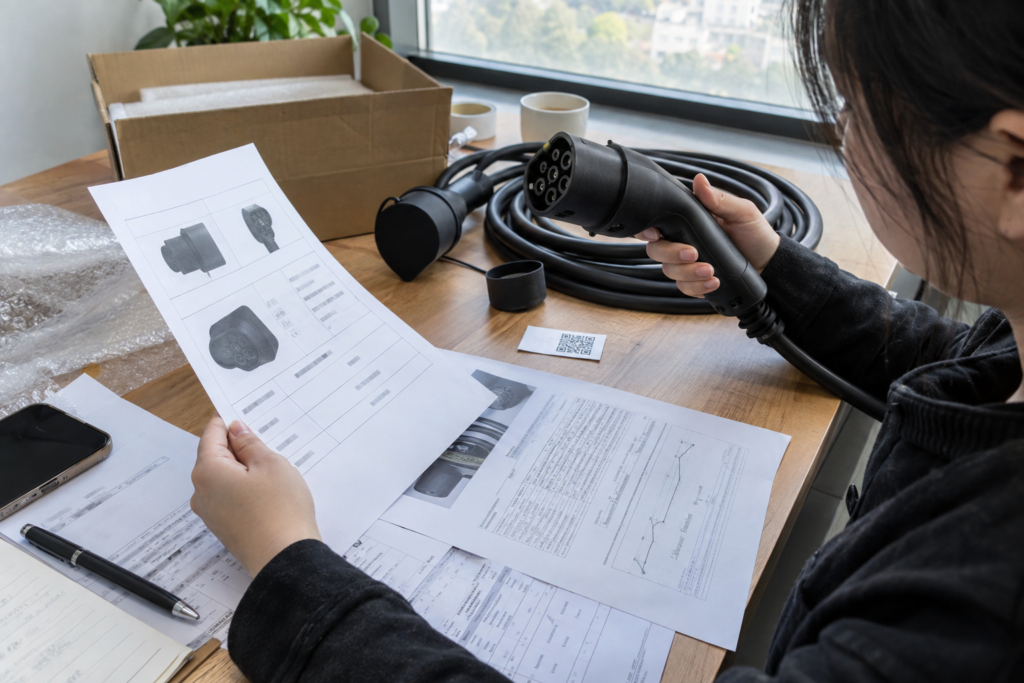
EV charging accessories certification is not a single universal approval. Buyers should match the exact accessory and SKU to its electrical function, connector, intended market, applicable standard or regulation, test scope, declaration, label, manual, and revision history. A logo or generic certificate is not enough evidence for approval.
When a buyer compares guía de compra de accesorios de carga de VE recommendations with supplier quotations, the document pack should be treated as part of the product specification. It helps show what was tested, what was claimed, and what will actually be shipped.
Tabla de contenido
- What Is the Difference Between a Certification, Declaration, and Test Report?
- Which Documents Apply to Cables, Adapters, and Support Accessories?
- How Should Buyers Verify IP and Environmental Claims?
- Which Market-Specific Documents Are Needed?
- How Do You Match a Report, Label, and Exact SKU?
- What Should You Request Before Approval?
- EV Charging Accessories Document-Control Checklist
- Conclusion: Approve the Evidence Chain, Not the Logo
- Preguntas frecuentes
- Referencias
What Is the Difference Between a Certification, Declaration, and Test Report?
A certification usually indicates that an identified product or product family was assessed under a defined scheme or standard. A declaration is the manufacturer or responsible economic operator's formal statement of conformity. A test report records test methods, samples, results, and limitations. These documents support one another, but they are not interchangeable.
Certification or listing
A certification, listing, or third-party approval normally needs an identifiable certification body, scheme, standard, product family, and scope. For EV charging equipment, UL Solutions lists standards that may be relevant to different boundaries, including plugs, receptacles and couplers, adapters, and complete EVSE. That distinction matters: a document for a complete EVSE assembly should not automatically be presented as proof for every replacement connector, cable, adapter, holder, or mounting component. 5
Ask the supplier to identify:
| Campo | Qué verificar |
|---|---|
| Issuer | Certification body, laboratory, listing organization, or manufacturer |
| Scheme | Certification, listing, declaration, inspection, or factory test |
| Standard | Exact standard edition, scope, and clauses covered |
| Product boundary | Cable, connector, adapter, EVSE, holder, cap, bag, bracket, or kit |
| Identification | Model, SKU, family, rating, revision, and critical components |
| Estado | Current, expired, withdrawn, superseded, or conditional |
Declaration of conformity
For CE-marked products, the European Commission explains that the manufacturer is responsible for the conformity assessment, technical file, EU Declaration of Conformity, and CE marking. CE is not an EU-issued blanket safety approval, and not every product is required to bear the mark. 1
The declaration should identify the responsible company, product or model, applicable legislation, relevant standards or normative documents, and the signatory or authorized representative where required. A declaration with only a product category and no exact model is weak evidence for a buyer approving a specific SKU.
Test report
A test report is useful only when the test sample and test boundary match the product being quoted. Review the laboratory identity, accreditation or competence statement where relevant, report number, date, sample description, test standard, test conditions, results, deviations, photographs, and conclusion. A passed report does not automatically cover later design changes, a different cable length, a different connector assembly, or a private-label revision.
Which Documents Apply to Cables, Adapters, and Support Accessories?
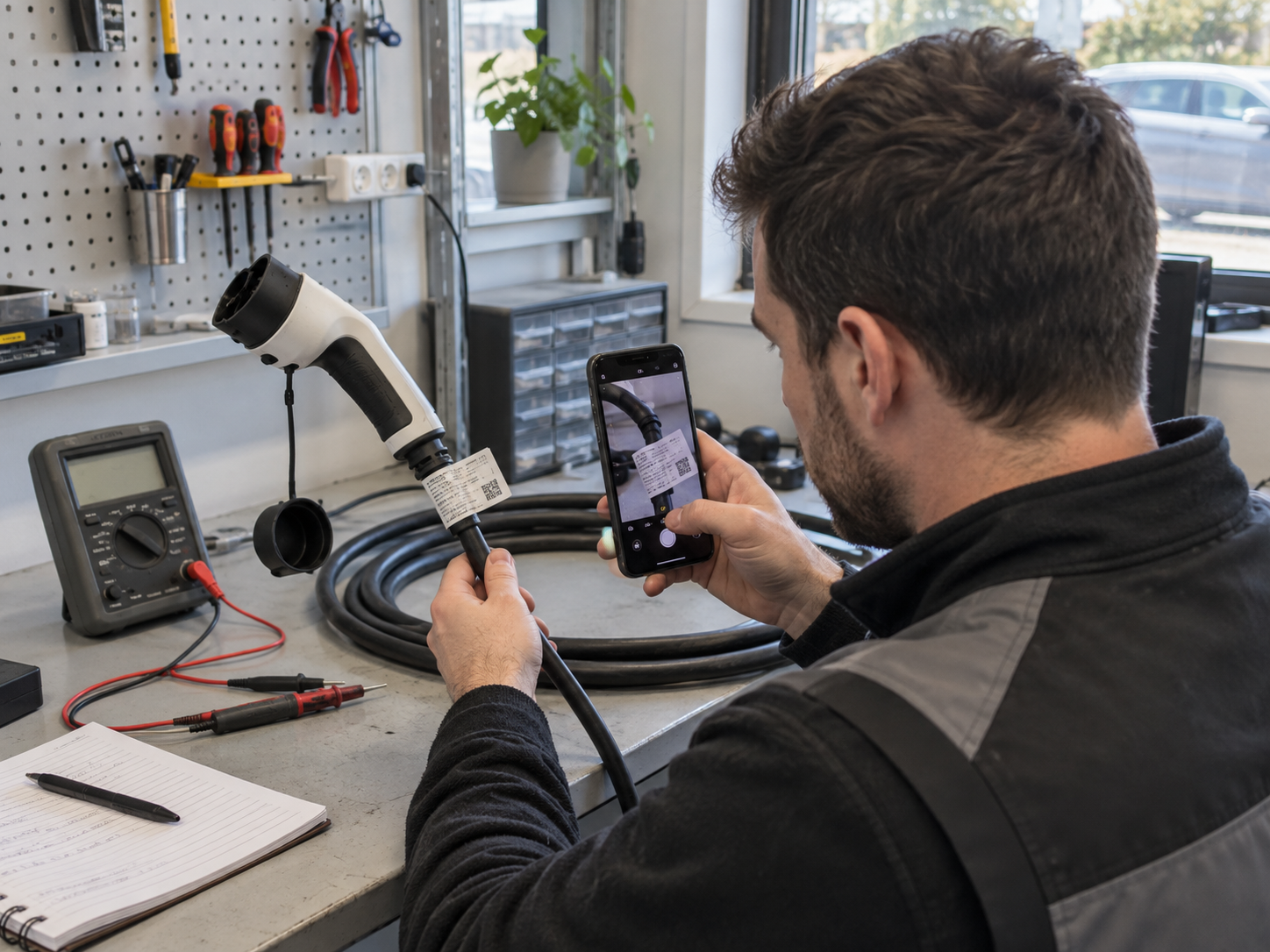
Document requirements follow the accessory's function and risk boundary. A live charging cable or adapter needs evidence for electrical insulation, current handling, mechanical endurance, connector construction, temperature, and intended charging mode; a passive holder or storage bag needs a different evidence set focused on materials, dimensions, load, environment, and stated claims.
Electrically active accessories
For charging cables, replacement connectors, inlet or outlet components, adapters, portable control boxes, and accessories that switch, protect, sense, or communicate, request a product-specific pack that may include:
- datasheet with voltage, current, phase, temperature, cable construction, and connector configuration;
- applicable standard list and edition, with the test boundary stated;
- certification, listing, or assessment record when the target market or customer requires it;
- full test report or an acceptable report summary with a traceable report number;
- declaration of conformity or other market-specific declaration where applicable;
- insulation, dielectric, continuity, protective-earth, temperature-rise, mechanical, ingress, and functional test evidence as relevant to the product;
- label artwork, rating plate, warning information, manual, and installation or use instructions;
- change-control and component traceability for contacts, terminals, cable, housing, sealing parts, and control electronics.
Do not demand the same document bundle for every SKU, but do not accept a reduced bundle without recording the reason. The buyer should know which requirements are not applicable and who made that determination.
Passive support accessories
For wall holders, cable hooks, holsters, caps, dust covers, storage bags, protective sleeves, brackets, and mounting hardware, the key evidence may be different:
| Accessory type | Typical evidence to request |
|---|---|
| Wall holder or holster | Dimensions, load rating, mounting instructions, material, UV and corrosion claim, sample fit check |
| Cable hook or bracket | Load and bend-radius guidance, fastener or substrate limits, environmental claim, installation manual |
| Protective cap or dust cover | Connector fitment, sealing or ingress claim, material compatibility, temperature range, retention test |
| Storage bag or sleeve | Material, dimensions, abrasion and temperature claim, cleaning guidance, labeling and packaging |
| Adapter | Exact inlet and outlet, electrical rating, locking behavior, intended use, safety evidence, market restrictions |
| Replacement cable or connector | Pinout, conductor size, termination method, rating, fitment, test boundary, revision traceability |
Document Evidence Matrix
Use this matrix as a buyer baseline when a quotation covers several accessory types. It is not a legal determination of what every market requires; it tells the supplier which evidence boundary must be identified before the buyer can decide whether a document is applicable, missing, or unnecessary.
| Accessory type | Electrical or claim boundary | EU/EEA evidence to request | U.S./Canada evidence to request | Evidence that must match the physical SKU | Release gate |
|---|---|---|---|---|---|
| AC charging cable or replacement cable | Power transfer, conductor size, connector assembly, temperature, mechanical endurance | Applicable declaration, standard and test scope, RoHS scope where applicable, datasheet, label, manual, and report or listing evidence | Applicable certification or listing path, exact model coverage, test report or assessment, datasheet, label, and manual | Cable length, conductor construction, connector ends, current and voltage, temperature, contacts, strain relief, and revision | Condicional until the tested cable and quoted SKU are identical |
| Adapter | Defined inlet-to-outlet direction, current limit, locking, communication, and approved equipment combination | Declaration or applicable assessment, standards, instructions, market restrictions, and exact model coverage | Listing or assessment status where required, conditions of use, exact vehicle and station coverage, warnings, and label | Adapter direction, connector geometry, ratings, locking behavior, enclosure, firmware or control parts, and revision | Retenido when the supplier proves only physical fit or supplies a generic family document |
| Portable EVSE or in-cable control accessory | Switching, protection, signaling, temperature monitoring, enclosure, and user safety | Applicable conformity route, declaration, technical evidence, environmental scope, manual, label, and current test file | Applicable EVSE certification or listing, model coverage, critical components, conditions of acceptability, manual, and label | Control box model, protection functions, cable and plug configuration, ratings, firmware or component revision, and test sample | Aprobado only when the EVSE boundary and market approval are explicit |
| Replacement connector or vehicle inlet | Contacts, insulation, termination, pinout, mating, locking, and environmental boundary | Applicable declaration or assessment, dimensional and electrical test evidence, material or RoHS scope, drawing, and manual where relevant | Applicable certification or listing evidence, exact component coverage, ratings, installation instructions, and test file | Contact layout, keying, terminal material, wire termination, sealing, latch, dimensions, and revision | Retenido if the report covers a connector family but not the quoted contact or termination variant |
| Wall holder, holster, hook, or bracket | Passive load, mounting, cable support, UV, corrosion, and installation claim | Datasheet, material and environmental evidence, load or sample test, mounting instructions, and claim scope | Customer or installation requirements, load and environmental evidence, mounting instructions, and claim scope | Dimensions, load, fasteners, substrate, cable diameter, bend radius, material, and revision | Condicional until the mounting surface and outdoor claim are confirmed |
| Protective cap or dust cover | Connector fitment, retention, sealing or IP boundary, temperature, and material compatibility | Fitment evidence, applicable IP test boundary, material or RoHS scope where applicable, label, and instructions | Fitment and environmental evidence, exact connector coverage, warnings, and label | Mating interface, retention, sealing condition, material, temperature, and revision | Aprobado only for the connector and closed or mated condition actually tested |
| Storage bag, sleeve, or packaging accessory | Material, dimensions, abrasion, cleaning, temperature, branding, and bundle claim | Material declaration where applicable, dimensions, cleaning guidance, label, language, and packaging file | Material and customer-channel requirements, dimensions, warnings, barcode, and packaging file | Material, size, artwork, barcode, bundle contents, language, and revision | Condicional until artwork, bundle contents, and market labeling are approved |
The matrix prevents a common failure mode: treating every item in a product family as if it needs the same certificate, or treating one certificate as if it covers every item in the family. The buyer should record the document owner, revision, expiry or surveillance status, and re-test trigger beside each row.
La EV charging accessory product range should therefore be organized by function and evidence needs, not just by product photograph. A passive holder should not inherit the compliance claims of the charger that sits in it.
How Should Buyers Verify IP and Environmental Claims?
An IP claim describes a defined degree of protection provided by an enclosure under the applicable test method; it does not prove that an entire charging installation is weatherproof in every use. IEC 60529 is the reference standard for the IP Code, so buyers should ask what enclosure, orientation, condition, and test boundary the rating covers. 4
Check the first and second IP digits
Record the exact marking, such as IPxx, and identify what each digit represents. Then ask whether the claim applies to:
- the connector body only;
- a mated connector pair;
- a cap or cover when closed;
- a holder or wall-mounted assembly;
- the complete accessory in its installed position;
- a sample before or after cable bending, latch cycling, cleaning, UV exposure, or thermal conditioning.
Avoid rewriting a component-level claim as a system-level promise. A connector may have an IP claim only when mated or capped, while the exposed cable, junction, wall box, or mounting surface has a different risk.
Verify the environmental boundary
Ask suppliers to state the test or engineering basis for outdoor, UV, rain, dust, salt, corrosion, cleaning chemicals, oil, impact, temperature, and condensation claims. A marketing phrase such as “weather resistant” is not a substitute for a rating, test method, duration, sample condition, or installation limitation.
For B2B approval, capture the following in the RFQ or sample record:
| Afirmación | Evidence question |
|---|---|
| Outdoor use | Is the complete accessory intended for outdoor use or only one component? |
| UV resistance | What material and exposure basis supports the claim? |
| Water or dust protection | Which IP code, test boundary, and closed or mated condition apply? |
| Corrosion resistance | Which parts were tested, under what environment, and for how long? |
| Temperature range | Is the range for storage, operation, charging, flexing, or all of these? |
| Limpieza | Which chemicals, concentration, contact time, and wiping method are allowed? |
Which Market-Specific Documents Are Needed?
The required file set depends on the destination market, product function, importer role, and claims made in the listing or packaging. A CE declaration for an EEA-bound product does not replace U.S. listing requirements, Canadian requirements, or customer-specific approval rules; buyers must map the destination before asking for a certificate.
European Economic Area
For products within the scope of applicable EU harmonization legislation, the manufacturer or responsible party must complete the required conformity assessment and prepare the technical documentation. The European Commission notes that the Declaration of Conformity should identify the product, legislation, manufacturer or representative, notified body if applicable, and referenced standards or normative documents. 2
RoHS is a separate environmental compliance dimension for electrical and electronic equipment. The European Commission describes restrictions on hazardous substances and notes that the scope and exemptions need to be checked rather than assumed. 3 Request the applicable RoHS declaration, material or supplier evidence, exemption basis if relevant, and product scope instead of treating a CE mark as proof of RoHS compliance.
United States and Canada
North American buyers may require a recognized certification or listing for the specific equipment boundary, installation context, and customer channel. The mark alone is not enough: request the listing number, product category, model coverage, conditions of acceptability, critical components, and current status. If a supplier presents UL, ETL, TÜV, or another mark, verify the listing or certificate through the issuer's own database or official confirmation route.
Other export markets
For the United Kingdom, Australia, New Zealand, Japan, the Middle East, or other markets, ask for the destination-specific conformity route, local marking or declaration needs, plug and outlet requirements, language requirements, importer details, and any customer or utility approval. Do not copy a European or North American document set into another market without a written applicability review.
Buyers that need help turning a market list into a SKU-level file set can use product-specific certification and compliance support as a starting point for the document request. The useful output is not a folder of logos; it is a list of applicable requirements and missing evidence.
How Do You Match a Report, Label, and Exact SKU?
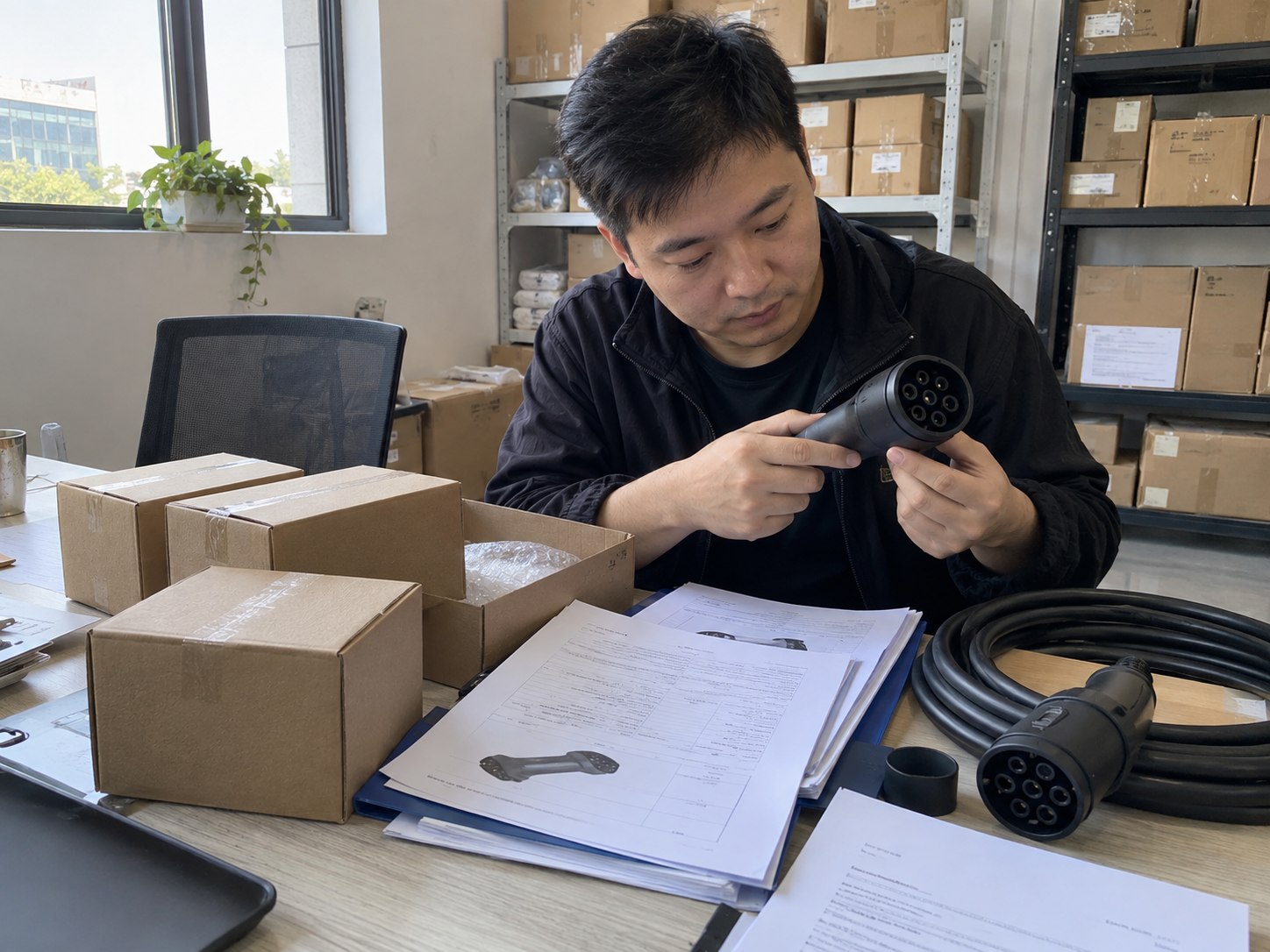
The strongest review closes the loop between the document, the tested sample, the production SKU, and the final label. If any one of these is different, mark the item Hold until the supplier explains the relationship and updates the evidence.
Use a traceability table
| Traceability field | Approval question |
|---|---|
| Exact SKU | Is the report or declaration issued for the quoted model, not only a similar family? |
| Revision | Does the document revision match the drawing, label, firmware, cable, connector, and sample? |
| Clasificación | Do voltage, current, phase, temperature, and IP values match the datasheet and label? |
| Conector | Are inlet, outlet, contacts, keying, locking, and pinout identical to the approved sample? |
| Critical components | Are the cable, terminals, sealing parts, housing, protection device, and control parts covered? |
| Test sample | Can the supplier identify sample quantity, batch, date, and configuration? |
| Production unit | Is there a first-article or outgoing inspection record tied to the approved configuration? |
| Market file | Does the declaration, label, manual, and packaging carry the correct destination-market information? |
Watch for family-level shortcuts
A product family certificate may be valid, but the supplier should show which variants are included and what differences are allowed. Cable length, conductor size, connector supplier, contact plating, sealing geometry, control electronics, over-temperature protection, and enclosure design can affect the test boundary. A family name without an inclusion list leaves the buyer to make an unsupported assumption.
Reconcile labels and manuals
Compare the label and manual with the report and declaration line by line. Check model number, rated voltage, rated current, frequency or phase where applicable, temperature range, IP claim, warnings, manufacturer or importer details, certification mark, and revision. A correct report attached to the wrong label can still create a market and customer complaint problem.
What Should You Request Before Approval?
Before approval, ask for a controlled document pack and a response table that makes missing evidence visible. Suppliers should state whether each item is included, not applicable, pending, or available only after a sample or order milestone.
Copyable document request
| Campo de solicitud | Supplier response required |
|---|---|
| Proyecto y caso de uso | Target country, market channel, installation context, and intended accessory function |
| Exact product | SKU, model, variant, cable length, connector pair, accessory bundle, and revision |
| Electrical boundary | Voltage, current, phase, AC or DC mode, temperature, and protection functions |
| Mechanical boundary | Dimensions, material, load, bend radius, mounting surface, latch, retention, and mating condition |
| Applicable requirements | Standards, regulations, customer specifications, and items judged not applicable |
| Certification or listing | Issuer, certificate or listing number, model coverage, status, and conditions of use |
| Test reports | Report number, laboratory, date, sample description, methods, results, deviations, and conclusion |
| Declarations | Declaration type, signatory, legislation, standards, product identification, and issue date |
| Environmental evidence | IP, UV, corrosion, temperature, cleaning, impact, and outdoor-use basis |
| Labels and manuals | Artwork, rating plate, warnings, language, importer details, revision, and packaging match |
| Trazabilidad | Batch code, component list, change-control process, retention period, and re-test trigger |
| Commercial control | Sample cost, first-order quantity, annual forecast, lead time, warranty, and quotation validity |
Set approval gates
Use simple statuses to prevent an attractive certificate from bypassing unresolved questions:
- Pass: exact product and market boundary are identified; required evidence is current and consistent.
- Conditional: the product may fit, but a missing report, label, sample, translation, or market confirmation must be closed before shipment or listing.
- Hold: SKU, test boundary, rating, certification status, or critical component cannot be reconciled.
- Reject: the supplier makes a universal claim, supplies unverifiable documents, or refuses to identify the tested product and limitations.
For supplier comparisons, buyers can use an OEM EV charging accessories supplier overview to frame the product range, then require each quoted SKU to return the same evidence fields. Comparable responses expose missing assumptions earlier than a lowest-price comparison.
If a document question starts with an uncertain vehicle, connector, or charging mode, return to the Lista de verificación de compatibilidad de accesorios de carga de VE before judging the evidence. When the evidence is tied to an electrical cable sample, use the Inspección de calidad del cable de carga de VE process to connect the report to the physical assembly. For the final commercial release, route the approved document pack through the lista de verificación de proveedores de accesorios de carga para VE so compliance, traceability, packaging, and change control are compared together.
EV Charging Accessories Document-Control Checklist
Use this checklist before sample approval, online listing, first shipment, and any product revision.
Identidad del producto
- [ ] Exact SKU, model, variant, and revision are stated.
- [ ] The accessory function and electrical or passive boundary are defined.
- [ ] Vehicle, connector, outlet, cable, adapter, or mounting references match the approved use case.
- [ ] Critical components and approved alternates are identified.
Evidence scope
- [ ] Applicable laws, standards, customer requirements, and exclusions are recorded.
- [ ] Certification, listing, declaration, and test report roles are separated.
- [ ] Report number, issuer, laboratory, date, and sample configuration are traceable.
- [ ] Family certificates include an explicit variant and component coverage list.
Ratings and claims
- [ ] Voltage, current, phase, AC or DC mode, temperature, and protection claims agree across files.
- [ ] IP and outdoor claims identify the enclosure, mated or capped condition, and test boundary.
- [ ] UV, corrosion, cleaning, impact, and load claims have a stated basis or are removed.
- [ ] Label, manual, packaging, product page, and quotation use the same claims.
Market and change control
- [ ] Destination-market marking, declaration, language, importer, and packaging requirements are confirmed.
- [ ] RoHS or other environmental declarations are scoped to the actual electrical product where applicable.
- [ ] Change-control, re-test triggers, batch traceability, and document retention are agreed.
- [ ] Sample approval is linked to the production SKU and first-article or outgoing inspection plan.
Liberación comercial
- [ ] Missing documents have an owner and due date.
- [ ] Conditional approvals are not treated as unrestricted shipment approval.
- [ ] Warranty, spare parts, replacement components, and field-failure reporting are defined.
- [ ] The buyer has a final document index with revision and storage location.
Conclusion: Approve the Evidence Chain, Not the Logo
EV charging accessories certification review works best as a traceability exercise. Start with the exact product function and destination market, identify the applicable requirement, examine the test boundary, match the report to the sample and SKU, and reconcile the declaration, label, manual, and final claim. This approach reduces the risk of buying a technically different product under a familiar certification name.
Before sample approval or listing, ask for a product-specific document pack and mark every file Pass, Conditional, Hold, or Reject. Buyers can request a product-specific document pack covering certifications, test reports, declarations, labels, manuals, and traceability rather than accepting a generic compliance folder.
Preguntas frecuentes
Is CE certification the same as a CE declaration?
No. CE marking is a conformity marking used under applicable EU rules, while the EU Declaration of Conformity is the manufacturer's formal statement supported by the required conformity assessment and technical documentation. Buyers should request and match the declaration to the exact product and applicable legislation. 1 2
Does a UL or ETL logo prove an EV charging accessory is approved?
No. Verify the issuer, listing or certificate number, product category, exact model coverage, conditions of acceptability, current status, and critical components. A logo copied into artwork is not equivalent to a searchable or verifiable approval.
Do passive EV cable holders need the same certification as charging cables?
Usually not. A holder, hook, cap, or storage bag has a different product boundary and may need evidence for load, material, mounting, fitment, environment, or stated claims rather than the electrical tests required for a live charging cable. The supplier should document what is applicable and why.
What should an EV charging cable test report include?
At minimum, request the report number, laboratory, date, exact sample description, cable and connector configuration, rated conditions, test methods, results, deviations, photographs where available, and conclusion. The report should be traceable to the quoted SKU and revision.
Can an IP rating be copied from the connector to the complete accessory?
Not automatically. Confirm whether the rating applies to the connector body, mated pair, cap, holder, enclosure, or complete installed assembly. The test condition and exposure boundary should be stated before the rating is used in a listing or purchase specification. 4
Is RoHS evidence required for every EV charging accessory?
Scope depends on whether the product is electrical or electronic and whether an exclusion or exemption applies in the destination market. Ask for a product-specific RoHS declaration or material evidence and record the scope instead of assuming that a CE mark covers it. 3
How long is a certification or test report valid?
There is no single universal validity period. Status may depend on the certification scheme, standard edition, product revision, critical-component changes, market rule, or surveillance process. Ask the issuer or responsible manufacturer how status is maintained and what triggers re-testing.
What should a buyer do when a supplier refuses the full report?
Ask for an acceptable report summary, certificate or listing record, declaration, sample evidence, and a written explanation of restricted information. If the remaining files cannot identify the product boundary, test scope, or current status, keep the item on Hold rather than approving it on price alone.
Referencias
[1] European Commission. “CE marking.” 2026.
[2] European Commission. “Conformity assessment.” 2026.
[3] European Commission. “RoHS Directive.” 2026.
[4] International Electrotechnical Commission. “IEC 60529: Degrees of protection provided by enclosures (IP Code).” 2013.
[5] UL Solutions. “Electric Vehicle Charging Infrastructure Services.” 2026.