



La inspección de calidad del cable de carga para vehículos eléctricos debe comparar la muestra aprobada con el ajuste real del conector, los terminales, la funda del cable, la flexibilidad, el alivio de tensión, las marcas, las declaraciones de clasificación, el embalaje y los documentos suministrados. Los criterios de aprobación deben estar vinculados al producto exacto, al mercado y a la evidencia de prueba, en lugar de una vaga afirmación de calidad superior.
La calidad del cable no es una sola impresión visual. Un cable puede verse limpio y aún tener el pinout incorrecto, un terminal flojo, un alivio de tensión débil, un marcado incompleto o una revisión de documento que no coincide con la producción. Use esto guía de compra de accesorios de carga de VE para la decisión de categoría más amplia, luego use esta secuencia de inspección para aprobar el cable físico y controlar los envíos futuros.
Tabla de contenido
- ¿Qué deben inspeccionar primero los compradores?
- ¿Cómo se verifica el ajuste del conector y la condición de los terminales?
- ¿Cómo se inspecciona la funda del cable, la flexibilidad y el alivio de tensión?
- ¿Cómo coinciden las marcas, las clasificaciones y las etiquetas?
- ¿Qué evidencia de temperatura y ambiental es importante?
- ¿Cómo se deben revisar el embalaje y los manuales?
- ¿Cómo se aprueba una muestra y se conserva una muestra de control?
- Lista de verificación de entrada y previa al envío del cable de carga para vehículos eléctricos
- Conclusión: Apruebe el cable como un producto completo
- Preguntas frecuentes
- Referencias
¿Qué deben inspeccionar primero los compradores?
Comience con la identidad, la configuración y la condición física obvia antes de dedicar tiempo a las pruebas de rendimiento. La primera inspección debe demostrar que la muestra frente al comprador es el mismo cable que fue cotizado, documentado, etiquetado y destinado al vehículo, cargador, modo de carga y mercado objetivo.
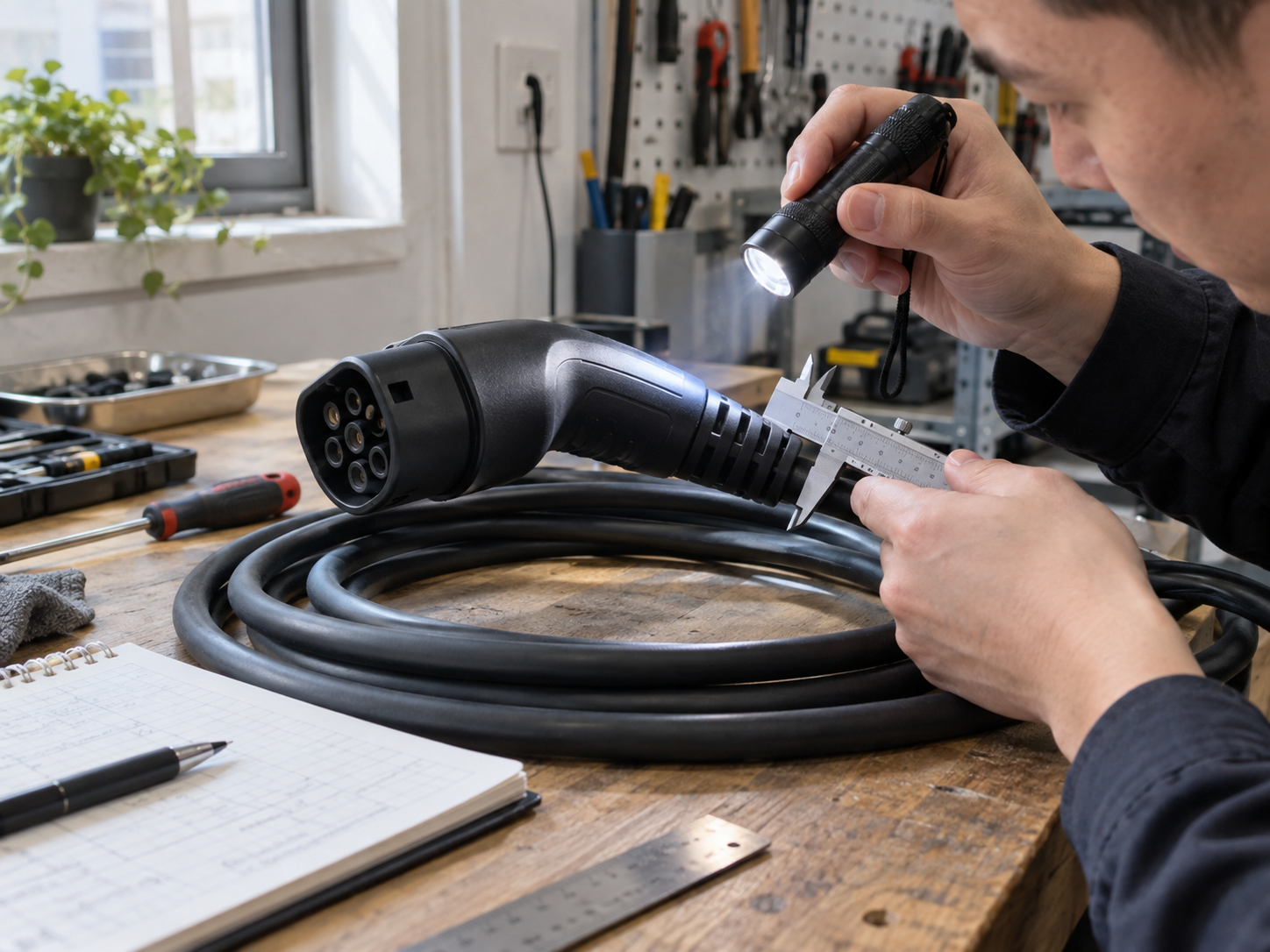
La secuencia de inspección
| Etapa | Qué confirmar | Resultado típico |
|---|---|---|
| Identidad | SKU, modelo, revisión, longitud del cable, extremos del conector, lote y fecha de la muestra | Registro de identidad de la muestra |
| Configuración | Dirección del lado del vehículo y del lado del cargador, modo AC o DC, fase, clasificación y accesorios | Fila de configuración aprobada |
| Condición visual | Carcasa, contactos, sellos, funda, marcado, color, contaminación y daño | Fotos de aprobación o defecto |
| Ajuste y función | Acoplamiento, inserción, pestillo, alineación de terminales, pinout, continuidad y liberación | Registro de ajuste/función |
| Durabilidad | Flexibilidad de la funda, doblez, alivio de tensión, ciclado del pestillo, abrasión y límites de manipulación | Registro de prueba y observaciones |
| Clasificación y evidencia | Hoja de datos, etiqueta, manual, informe, declaración, listado y revisión | Registro de coincidencia de evidencia |
| Paquete y liberación | Caja de cartón, código de barras, idioma, accesorios, estado de la muestra y disposición de inspección | Registro de liberación o acción correctiva |
No comience con una prueba eléctrica de alto nivel si la identidad del cable o la configuración del conector es incorrecta. Un resultado de prueba en la variante incorrecta no es evidencia útil para el producto cotizado.
Defina los criterios de aceptación antes de las pruebas
Escriba lo que significan Aprobado, Condicional, Retenido y Rechazado antes de que llegue la primera muestra. Use criterios medibles cuando sea posible, pero no invente un límite universal cuando la norma aplicable, la especificación del cliente o el diseño del producto definen el valor correcto.
| Estado | Significado para la aprobación del cable |
|---|---|
| Aprobado | La configuración, el ajuste, la condición física, las pruebas, los documentos y el embalaje cumplen con los criterios acordados |
| Condicional | Un elemento limitado permanece abierto, como el arte, la traducción, el registro de lote o un detalle comercial que no es de seguridad |
| Retenido | Una pregunta de seguridad, ajuste, clasificación, evidencia o revisión no está resuelta |
| Rechazado | El cable es materialmente diferente, falla un criterio definido, o el proveedor no puede explicar el defecto o el alcance |
¿Cómo se verifica el ajuste del conector y la condición de los terminales?
La inspección del conector debe cubrir ambos lados del cable, la trayectoria de acoplamiento físico y la condición de contacto eléctrico. Un conector que se inserta en un vehículo o EVSE no prueba automáticamente la asignación de pines correcta, la calidad de los terminales, el bloqueo ni la compatibilidad del modo de carga.
Verificaciones de ajuste físico
Inspeccione el conector contra el plano aprobado, la muestra de referencia o el registro de montaje:
- familia de conectores, codificación, orientación y dirección del lado del vehículo o del lado del cargador;
- dimensiones de la carcasa, geometría de la envolvente, posición del pestillo y holgura;
- inserción y extracción sin fuerza anormal, raspado, balanceo ni acoplamiento parcial;
- pestillo correcto, retención, liberación y acoplamiento audible o visual cuando corresponda;
- alineación de contactos, profundidad de pines, posición del sello y ausencia de rebabas o daños de moldeo;
- dirección de salida del cable, transición del manguito, radio de curvatura y alineación del alivio de tensión;
- compatibilidad con la entrada, toma, estación o adaptador objetivo solo según lo aprobado específicamente.
La Lista de verificación de compatibilidad de accesorios de carga de VE puede proporcionar los campos de vehículo, lado del cargador, mercado y revisión que deben vincularse a este registro de ajuste físico.
Verificaciones de terminales y contactos
Los contactos merecen su propia inspección porque la apariencia superficial puede ocultar holgura, recubrimiento deficiente, posición incorrecta o un problema de terminación.
| Punto de control | Qué inspeccionar | Evidencia a conservar |
|---|---|---|
| Material y recubrimiento del contacto | Material, acabado, color, daño, oxidación y consistencia correctos | Plano aprobado o registro de material, foto de primer plano |
| Posición del pin | Ubicación, profundidad, codificación y retención del contacto correctas | Asignación de pines o plano del conector |
| Engarzado o terminación | Inserción del conductor, forma del engarzado, evidencia de tracción o sección cuando se especifique | Registro de inspección de terminación o prueba |
| Sello y aislamiento | Juntas, barreras, aislamiento, contaminación y daños | Registro visual y resultado de prueba aplicable |
| Continuidad y asignación de pines | Mapeo correcto de conductor a contacto y ausencia de conexión no intencional | Resultado de prueba vinculado al ID de muestra |
| Resistencia de contacto o temperatura | Método definido, corriente de prueba, puntos de medición y valor de aceptación | Registro medido e ID del equipo |
Para pruebas energizadas o de alto voltaje, use personal calificado, equipo apropiado, protecciones y el método de prueba aplicable. La inspección visual de un comprador no sustituye una prueba de seguridad o cumplimiento calificada.
¿Cómo se inspecciona la funda del cable, la flexibilidad y el alivio de tensión?
La funda y la transición de terminación deben permanecer intactas mientras el cable se manipula, dobla, almacena, conecta y desconecta bajo las condiciones aprobadas. Inspeccione el material y la construcción, luego use un plan de prueba definido que refleje el uso real en lugar de una prueba casual de flexión manual.
Inspección de la funda
Revise toda la longitud del cable para detectar:
- cortes, poros, burbujas, ampollas, grietas, aplanamiento, marcas de hundimiento, variación de color y material extraño;
- diámetro consistente, concentricidad, acabado superficial, flexibilidad e impresión o grabado en relieve;
- cantidad correcta de conductores, elementos de blindaje o comunicación, relleno, aislamiento y construcción de la vaina donde la especificación del producto los requiera;
- compatibilidad con la temperatura, aceite, limpieza, UV, humedad, abrasión y entorno de instalación declarados;
- daños creados por enrollado, desenrollado, compresión en caja, transporte o almacenamiento.
IEC 62893-1:2017 especifica construcción, dimensiones y requisitos de prueba para ciertos cables flexibles de carga de VE usados en condiciones severas, y vincula el uso de cables de carga con los requisitos de IEC 62196 e IEC 61851. Los compradores deben usar la especificación particular de cable aplicable y el requisito de mercado en lugar de tratar una descripción genérica de cable como universal. 2
Flexibilidad y comportamiento de flexión
Registre el radio de curvatura mínimo del cable, el rollo de almacenamiento, la posición de operación, la condición de temperatura y el número de ciclos antes de la prueba. Un cable puede pasar una sola flexión suave y aún fallar después de flexiones repetidas cerca del manguito del conector.
Use el método de prueba aprobado por el comprador para evaluar:
| Área de durabilidad | Qué observar |
|---|---|
| Flexión repetida | Agrietamiento de la funda, continuidad del conductor, cambio de contacto y movimiento del manguito |
| Cable twisting | Torsion marks, connector rotation, seal movement, and strain transfer |
| Coil and uncoil | Flattening, kinks, memory, jacket damage, and recovery |
| Pull or strain relief | Cable movement at the boot, termination damage, and retention |
| Abrasion | Surface wear at vehicle, station, floor, holder, or guide contact points |
| Latch cycling | Release force, latch return, housing wear, and secure engagement |
The acceptance number of cycles, force, angle, temperature, and fixture should be written into the purchase or inspection specification. “Flexible” and “heavy duty” are claims; they are not test criteria until the supplier defines the condition behind them.
Strain relief and boot transition
The cable should transition into the connector without a sharp stress concentration, loose boot, exposed conductor, or unsupported heavy section. Check whether the cable is allowed to hang from the vehicle inlet, whether a holder is required, and whether the instruction manual limits bending near the connector.
Buyers reviewing a cable bundled with an adapter can use the guía de compatibilidad y uso seguro de adaptadores de carga de VE to separate cable durability from adapter direction, locking, and approved-use conditions.
¿Cómo coinciden las marcas, las clasificaciones y las etiquetas?
Every rating claim should match across the cable jacket, connector marking, label, datasheet, manual, quotation, test report, and final packaging. If the same cable is described with different current, voltage, mode, temperature, length, or market claims, stop the approval until the discrepancy is resolved.
Rating fields to reconcile
| Campo | Compare across these items | Common failure |
|---|---|---|
| Modo de carga | Datasheet, label, manual, report, listing, and sample | AC cable described as DC capable |
| Voltaje | Cable marking, connector, report, and product page | Maximum value confused with nominal value |
| Corriente | Cable, contacts, connector, label, and charger boundary | Cable number used without duty or temperature condition |
| Phase | Product description, wiring, plug, and intended station | Single-phase and three-phase variants mixed |
| Temperatura | Datasheet, label, report, and manual | Storage range presented as operating range |
| Length and construction | Quotation, drawing, sample, carton, and SKU | Tested length differs from shipped length |
| Connector ends | Drawing, photo, sample, label, and listing | Vehicle-side and charger-side direction reversed |
| Revision | Report, label, artwork, drawing, and change record | Old evidence used for a changed assembly |
IEC 62196-1:2022 applies to EV plugs, socket-outlets, vehicle connectors, vehicle inlets, and cable assemblies used in conductive charging systems within its stated voltage and current scope. The standard also addresses contact materials, temperature-rise measurements, thermal stresses, mechanical wear and abuse, and contaminant exposure. The buyer still needs to confirm the exact product scope and applicable edition. 1
IEC 61851-1 is useful as the system-level reference for conductive charging connection, control, safety, marking, and user information; it does not replace cable-specific evidence. 3
Build an evidence match record
La EV charging accessory certification and test documents article provides the document-control sequence. For cable inspection, add the physical sample ID, cable length, connector serial or batch reference, photo set, test equipment, test date, and inspector to the record.
UL Solutions describes several deliverables for EV charging cable programs, including certification, type-test reports, research testing, and witnessed testing, with standards and market alignment varying by region. That distinction is useful for buyers: a report type, certificate, or witnessed test should be recorded with its exact scope rather than reduced to a generic “certified cable” statement. 4
When the inspection will be used to approve a supplier or repeat an order, route the completed record to the lista de verificación de proveedores de accesorios de carga para VE. That step connects cable fit and durability evidence with MOQ, packaging, traceability, change control, spare parts, and lead-time requirements.
¿Qué evidencia de temperatura y ambiental es importante?
Temperature and environmental inspection should connect the cable material, connector assembly, exposure, and use instructions. A cable rated for one laboratory condition may have different limits when coiled, exposed to sunlight, dragged over rough surfaces, or connected in a wet environment.
Environmental checkpoints
| Claim or exposure | What to request or inspect |
|---|---|
| Temperatura | Operating range, storage range, conductor or contact temperature, derating, and test condition |
| Water and moisture | IP boundary, mated or capped condition, seal design, and test evidence |
| Dust and contamination | Contact covers, seal condition, cleaning instructions, and contamination limits |
| UV and weather | Jacket material, exposure basis, outdoor-use limit, and color or surface change |
| Oil and chemicals | Approved cleaning agents, exposure duration, swelling, softening, and marking durability |
| Abrasion and impact | Test method, contact surface, drop or impact condition, and damage criteria |
| Cold flexibility | Temperature, bend condition, cracking, stiffness, and recovery |
| Storage | Coil diameter, weight, hanger, moisture protection, carton compression, and shelf conditions |
UL Solutions notes that automotive cable and connector testing can cover a wide temperature range depending on the application, while cable programs may also include environmental exposures such as moisture, chemicals, ozone, weathering, UV, and flame-propagation conditions. Buyers should request the actual test boundary and not copy a general laboratory capability into a product claim. 5
Sample environmental observations
Record before-and-after photographs for any environmental or durability sample test. Look for jacket cracking, swelling, color change, sticky surface, exposed conductor, seal movement, terminal oxidation, marking loss, housing distortion, latch failure, or a change in insertion and removal force.
If a supplier provides only a marketing phrase such as “outdoor grade,” request the material, test condition, exposure duration, and installation limitation. If those details are unavailable, keep the claim out of the listing or mark the evidence as Conditional.
¿Cómo se deben revisar el embalaje y los manuales?
Packaging and instructions are part of cable quality because they control identification, handling, storage, safe use, and customer expectations. A physically good cable can still fail release if the carton contains the wrong variant, the barcode identifies another SKU, or the manual states a different rating.
Lista de verificación de empaque
- carton and inner packaging protect connectors, contacts, latch, jacket, and cable exit;
- cable is coiled at the approved diameter without sharp kinks or compression;
- caps or protective covers are fitted where required;
- SKU, length, connector ends, rating, batch, barcode, language, and destination market match;
- bundle contents, accessories, spare parts, and exclusions are listed correctly;
- cartons remain traceable to the sample approval and production batch;
- artwork revision and private-label information match the approved file.
Manual and label checklist
Confirm that the manual explains connection direction, charging mode, rating limits, temperature or environmental limits, cleaning, storage, inspection, damage rejection, strain relief, locking, and disposal or service instructions where applicable. The rating plate or cable marking should not promise a broader use than the manual or test evidence supports.
For a supplier comparison, buyers can use the EV charging cable product range to keep cable length, connector ends, packaging, label, and document fields consistent across the quoted assortment.
¿Cómo se aprueba una muestra y se conserva una muestra de control?
Sample approval should create a controlled reference for future production, not just a one-time email approval. Keep the physical sample, inspection record, photos, test results, document revision, packaging artwork, and approval decision connected under one sample ID.
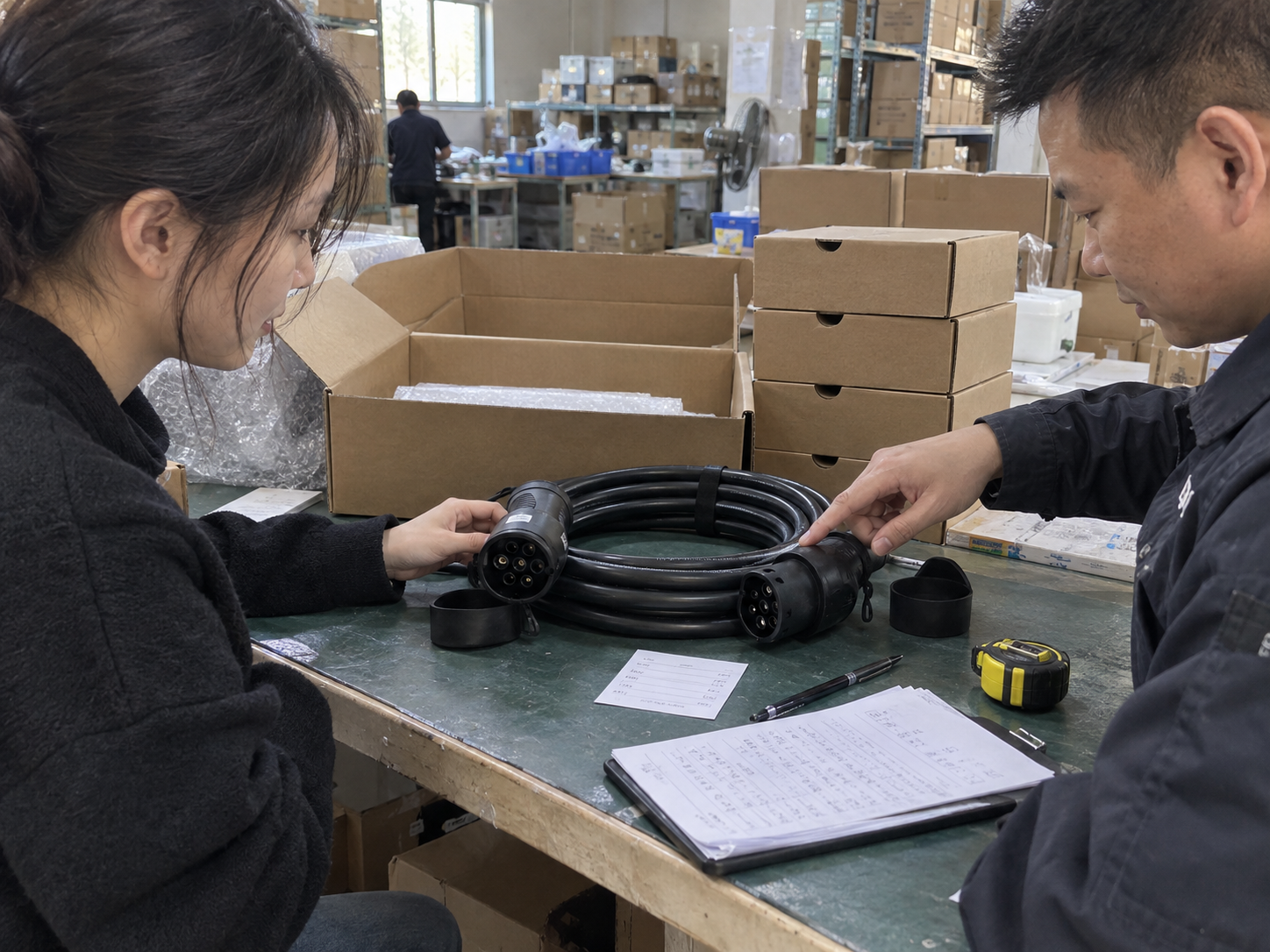
Registro de aprobación de muestras
| Approval field | Required information |
|---|---|
| Identidad de la muestra | Supplier, SKU, model, revision, length, connector ends, batch, and date |
| Intended use | Vehicle group, charger or station, AC/DC mode, market, and customer channel |
| Physical inspection | Dimensions, weight, connector fit, terminals, jacket, boot, latch, and photos |
| Performance checks | Continuity, pinout, insulation or dielectric test where applicable, temperature, and durability |
| Document match | Datasheet, report, declaration, label, manual, drawing, and revision |
| Packaging match | Carton, barcode, language, artwork, bundle contents, and storage instructions |
| Defects and actions | Defect code, severity, correction, owner, due date, and re-sample requirement |
| Disposition | Pass, Conditional, Hold, Reject, or approved with stated limitations |
| Muestra retenida | Location, storage condition, owner, review date, and replacement trigger |
Retained control sample
Keep at least one clearly identified control sample from the approved configuration when the purchase volume, product risk, or customer requirement justifies it. Protect the sample from UV, moisture, contamination, unauthorized use, and uncontrolled modification. Store the approval record with the sample, not only in a supplier email chain.
Reopen approval when the supplier changes connector source, contact material, cable conductor, jacket compound, length, strain relief, control component, label, packaging, or manufacturing location. The change-control trigger should state whether the buyer needs a document review, first article, partial test, full re-test, or new retained sample.
First article and pre-shipment relationship
The retained sample is the reference; the first article proves the new production batch matches it; the pre-shipment inspection checks the order being packed. These are different controls and should not be collapsed into one generic “QC passed” statement.
Lista de verificación de entrada y previa al envío del cable de carga para vehículos eléctricos
Use the following checklist for incoming samples, first articles, and pre-shipment inspection. Mark each item Pass, Conditional, Hold, or Reject and attach evidence for every exception.
Incoming sample checklist
- [ ] Sample SKU, revision, length, connector ends, batch, and intended market are identified.
- [ ] Vehicle-side and charger-side connector direction matches the approved configuration.
- [ ] Housing, latch, seals, contacts, pin position, plating, and cable boot pass visual inspection.
- [ ] Mating and release are checked against the approved vehicle, socket, station, or reference fixture.
- [ ] Cable diameter, jacket surface, flexibility, bend radius, coil, and strain relief are recorded.
- [ ] Continuity, pinout, insulation, dielectric, contact, or temperature tests are completed where applicable.
- [ ] AC/DC mode, voltage, current, phase, temperature, and environmental claims match the documents.
- [ ] Marking, label, manual, packaging, barcode, language, and bundle contents match the approved files.
- [ ] Defects have photos, severity, owner, due date, and disposition.
- [ ] Approved sample and retained control sample are linked to the same revision.
Pre-shipment checklist
- [ ] Production lot and quantity match the purchase order and approved SKU.
- [ ] Sampling plan and acceptance criteria are agreed before inspection.
- [ ] Connector fit, terminal condition, jacket, boot, latch, marking, and carton checks are repeated.
- [ ] Critical test records and calibration or equipment references are available where required.
- [ ] Any change since sample approval is declared and reviewed.
- [ ] Defective or mixed-revision products are segregated and traceable.
- [ ] Final photos, carton labels, barcode, manuals, and packing list are archived.
- [ ] Release decision is signed by the responsible inspector or buyer.
Conclusión: Apruebe el cable como un producto completo
EV charging cable quality inspection should connect fit, terminals, jacket, flexibility, strain relief, ratings, environmental evidence, documents, packaging, and sample control. The most useful inspection is not the longest checklist; it is the one that ties every Pass or Hold decision to the exact cable configuration that will be produced and shipped.
Before ordering, listing, or approving a first shipment, request the inspection scope, sample-approval form, retained-sample process, and pre-shipment checklist. Buyers can request a cable QC and sample-approval review with the cable ends, mode, ratings, length, market, annual quantity, packaging, and required evidence.
Preguntas frecuentes
What should be inspected first on an EV charging cable?
Confirm the exact SKU, revision, length, connector ends, charging mode, rating, batch, and intended market before checking physical condition or performance. Testing the wrong variant creates false confidence and does not approve the quoted production cable.
How do you check EV charging cable connector fit?
Use the approved vehicle, EVSE, station, socket, or reference fixture. Check keying, orientation, insertion, removal, latch, contact alignment, pin depth, seal position, clearance, cable exit, and strain relief. Record the test condition and any abnormal force or partial engagement.
What are common EV cable jacket defects?
Common defects include cuts, cracks, bubbles, blisters, flattening, kinks, inconsistent diameter, sticky or swollen material, color variation, surface contamination, damaged printing, and jacket damage near the connector boot. Photograph and classify defects before deciding whether they are acceptable.
How should strain relief be tested?
Use a defined method that states force, direction, angle, temperature, cycle count, fixture, and acceptance criteria. Inspect cable movement, boot separation, conductor continuity, jacket damage, and connector retention afterward. A casual hand-pull is not a repeatable strain-relief test.
Does a cable certificate replace a sample inspection?
No. A certificate or test report supports a product and test boundary, while sample inspection confirms that the quoted cable, connector, label, packaging, and production revision match the approved evidence. Both controls are needed for responsible B2B approval.
What should a retained control sample include?
Keep the approved cable with its SKU, revision, length, connector ends, batch, photos, inspection record, documents, packaging artwork, and approval decision. Store it under controlled conditions and define when a supplier change or damage requires replacement or re-approval.
How often should EV charging cables be inspected?
Inspect incoming samples and first articles before approval, then use a defined incoming or pre-shipment sampling plan based on product risk, order volume, customer requirements, and supplier performance. Reopen inspection after a critical component, process, factory, label, or design change.
What documents should accompany a cable QC checklist?
Request the datasheet, drawing, applicable standard or certification scope, test report, declaration, label and manual, packing specification, inspection record, change-control record, and sample or batch traceability. The document revision should match the physical cable and retained control sample.
Referencias
[1] Comisión Electrotécnica Internacional. “IEC 62196-1:2022 General requirements for EV plugs, socket-outlets, connectors, inlets, and cable assemblies.” 2022.
[2] Comisión Electrotécnica Internacional. “IEC 62893-1:2017 Charging cables for electric vehicles – Part 1.” 2017.
[3] Comisión Electrotécnica Internacional. “IEC 61851-1:2017 Sistema de carga conductiva para vehículos eléctricos – Parte 1.” 2017.
[4] UL Solutions. “Electric Vehicle Charging Cable Testing and Certification.” 2026.
[5] UL Solutions. “Safety and Performance Testing for Automotive Cables and Connectors.” 2026.