



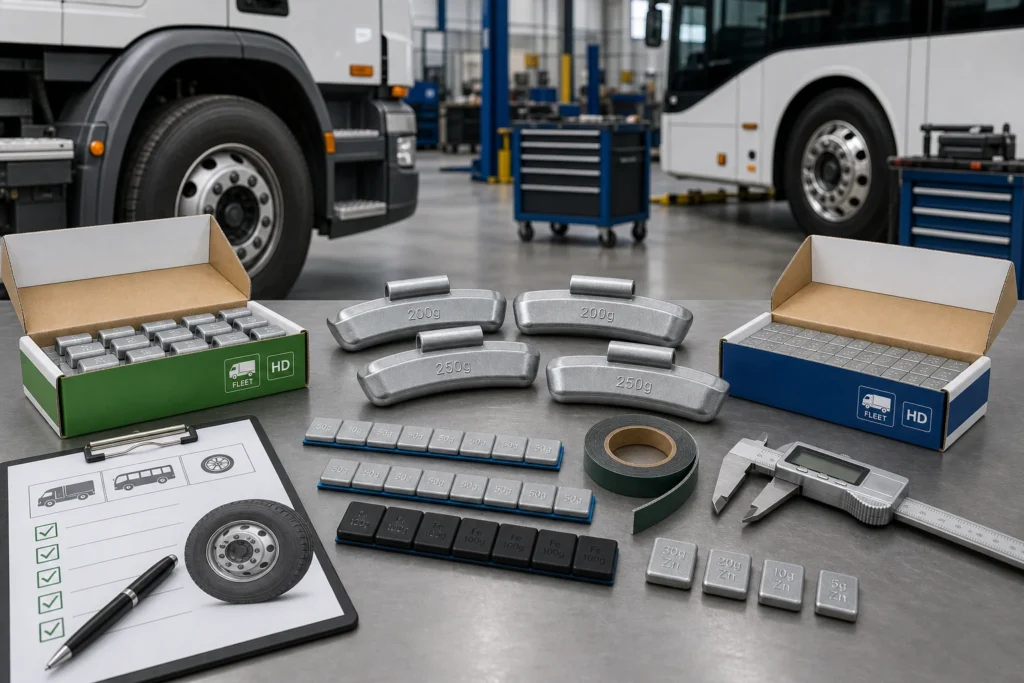
Los contrapesos de rueda para vehículos comerciales son contrapesos de equilibrado especificados para furgonetas de flota, camiones de servicio medio, camiones pesados, autobuses, remolques y otros vehículos de trabajo. Los compradores deben elegirlos según la combinación de vehículos, el tipo de rueda, el rango de corrección, el formato de fijación, el material, el recubrimiento, el embalaje y las necesidades de suministro repetido, en lugar de copiar un surtido para automóviles de pasajeros.
Para flotas, distribuidores y redes de servicio de neumáticos comerciales, una gama de contrapesos de rueda es una pieza pequeña con un gran efecto operativo. La gama incorrecta puede crear vacíos de stock, retrasos de los técnicos, quejas sobre el acabado o un ajuste deficiente. El marco de planificación de la gama de contrapesos de rueda ayuda a los compradores a conectar el material, el estilo de fijación, la cobertura de tamaños y los requisitos de abastecimiento antes de construir un programa para vehículos comerciales.
Tabla de contenido
- ¿Qué son los contrapesos de rueda para vehículos comerciales?
- ¿Por qué los programas de flotas, camiones y autobuses necesitan una planificación separada?
- ¿Qué aplicaciones necesitan decisiones diferentes sobre los contrapesos de equilibrado?
- ¿Cómo deben los compradores planificar una gama de contrapesos de rueda para vehículos comerciales?
- ¿Cómo deben los compradores comparar materiales y recubrimientos?
- ¿Qué deben incluir los compradores en una solicitud de cotización de contrapesos de rueda para vehículos comerciales?
- ¿Cómo deben los compradores calificar a los proveedores?
- Conclusión: adaptar la gama de contrapesos de rueda a la combinación de vehículos
- Preguntas frecuentes
- Referencias
¿Qué son los contrapesos de rueda para vehículos comerciales?
Los contrapesos de rueda para vehículos comerciales son contrapesos de clip o adhesivos utilizados en vehículos de trabajo como furgonetas, camiones, autobuses, remolques y vehículos de servicio de flota. Corrigen el desequilibrio de la rueda y el neumático después del montaje, la reparación o el reemplazo, pero la lógica de compra es más amplia que la del mercado de automóviles de pasajeros.
Las gamas de servicio para automóviles de pasajeros suelen priorizar una amplia cobertura de vehículos ligeros, incrementos pequeños, embalaje minorista y rutinas comunes de ruedas de aleación o de acero. Los programas para vehículos comerciales necesitan un enfoque diferente. El comprador puede estar apoyando a una flota con vehículos conocidos, a un taller de neumáticos que atiende a muchas flotas, a un distribuidor que abastece a múltiples clientes comerciales o a un exportador que construye gamas encartonadas para diferentes mercados.
El propósito del contrapeso sigue siendo simple: añadir la cantidad correcta de masa en la ubicación correcta para que el conjunto de rueda gire con mayor suavidad. El desafío de compra no es simple. Una furgoneta de flota, un autobús de tránsito, un camión de caja, un tractor de larga distancia y un remolque pueden todos caer bajo "vehículo comercial", pero no crean el mismo requisito de equilibrio, método de fijación o patrón de stock.
| Tipo de comprador comercial | Objetivo principal de compra | Error común que se debe evitar |
|---|---|---|
| Equipo de mantenimiento de flota | Mantener los vehículos conocidos en servicio con stock repetible | Comprar una gama demasiado amplia y inmovilizar inventario |
| Taller de neumáticos comerciales | Cubrir rápidamente los vehículos comunes de los clientes | Omitir tamaños de alto uso mientras se almacenan variantes de baja rotación |
| Distribuidor | Construir una gama vendible en los canales de flotas, camiones y autobuses | Tratar todos los vehículos comerciales como camiones pesados |
| Importador exportador | Adaptarse a los tipos de rueda, etiquetas y expectativas de cartón locales | Pedir solo por material sin verificar el ajuste y el embalaje |
| Red de servicio de autobuses o municipal | Controlar la calidad del servicio repetido y el acabado visible | Ignorar el recubrimiento y las condiciones de almacenamiento |
¿Por qué los programas de flotas, camiones y autobuses necesitan una planificación separada?
Los programas de flotas, camiones y autobuses necesitan una planificación separada porque los ciclos de trabajo de los vehículos, los tipos de rueda, los tamaños de neumático, los hábitos de servicio y el comportamiento del inventario difieren. Una gama de contrapesos de rueda comerciales debe construirse a partir de la demanda real de servicio, no de una etiqueta genérica de "servicio pesado".
Las furgonetas de flota pueden necesitar una gama más ajustada y ligera que los camiones pesados. Los autobuses pueden requerir una apariencia limpia, procedimientos de taller repetidos y stock de reemplazo predecible. Los remolques pueden crear una demanda de alto volumen para un conjunto más estrecho de aplicaciones de rueda. Los camiones pueden necesitar valores de corrección más pesados y una planificación más cuidadosa de la posición de la rueda. Estas diferencias afectan el rango de tamaños, la profundidad de stock, el tamaño del cartón y si se deben priorizar los formatos de clip o adhesivos.
El contexto de seguridad también importa. El servicio de ruedas comerciales puede implicar conjuntos más grandes y una manipulación de llantas o neumáticos de mayor riesgo. La regulación de OSHA para el servicio de ruedas de llanta de varias piezas y de una sola pieza cubre la capacitación y los procedimientos de servicio seguros para el trabajo con ruedas 1. Un comprador que elige contrapesos de rueda no está escribiendo el manual de servicio, pero la decisión de compra debe apoyar una práctica de taller capacitada y consistente en lugar de fomentar una instalación improvisada.
La pregunta práctica de planificación es: ¿Qué vehículos pasan realmente por el canal de servicio? Una flota con mayormente furgonetas de reparto podría necesitar una gama diferente a la de un distribuidor que abastece paradas de camiones y depósitos de autobuses. Un operador de autobuses puede preocuparse por la apariencia del recubrimiento y la repetibilidad. Una cadena de servicio de remolques puede preocuparse más por los tamaños de alta rotación y la durabilidad del cartón.
¿Qué aplicaciones necesitan decisiones diferentes sobre los contrapesos de equilibrado?
Diferentes aplicaciones de vehículos comerciales necesitan decisiones diferentes para el rango de contrapesos, el formato de fijación, el material y el embalaje. Los compradores deben separar las furgonetas de flota, los camiones medianos, los camiones pesados, los autobuses y los remolques antes de comparar cotizaciones de proveedores.
Las furgonetas de flota y los vehículos comerciales ligeros pueden acercarse a los patrones de servicio de automóviles de pasajeros en algunos mercados, pero aún requieren una planificación cuidadosa de SKU. Estos compradores a menudo necesitan stock diario confiable, etiquetas unitarias claras y embalaje que los técnicos puedan usar rápidamente. El objetivo no es la máxima amplitud de gama; es menos retrasos de servicio en una base de vehículos conocida.
Los camiones de servicio medio y pesado a menudo necesitan valores de corrección más grandes, embalaje más robusto y confirmación de ajuste en los tipos de rueda utilizados por el cliente. Los compradores que necesitan una explicación más profunda sobre servicio pesado pueden usar selección de contrapesos de rueda para camiones para servicio pesado para separar el ajuste específico de camiones de la planificación más amplia de la gama comercial.
Los autobuses traen otro tipo de presión. El servicio municipal, de transporte y de autocares puede implicar inspecciones repetidas, ruedas visibles y mantenimiento centralizado. La apariencia del recubrimiento, las etiquetas del cartón y la consistencia de los lotes repetidos pueden importar tanto como el precio. Los programas de remolques pueden tener una combinación de vehículos más estrecha pero una mayor rotación de stock en ciertos tamaños.
El formato de fijación debe decidirse por el diseño de la rueda, no por costumbre. Las pesas de clip necesitan la pestaña de rueda y el perfil de clip correctos. Las pesas adhesivas necesitan una superficie de montaje limpia, suficiente espacio libre y un comportamiento fiable de la cinta. Los compradores que deciden entre formatos pueden usar la comparación de formatos de fijación para ruedas comerciales para confirmar cuándo el método de fijación, el tipo de rueda y el proceso de instalación se alinean.
| Aplicación | Tendencia de gama | Enfoque de fijación | Prioridad de compra |
|---|---|---|---|
| Furgonetas de flota | Tamaños de servicio más estrechos y de alta rotación | Clip o adhesivo según el tipo de rueda | Repetibilidad y uso rápido en taller |
| Camiones de servicio medio | Rango de corrección de medio a pesado | Ajuste específico para rueda con clip o adhesivo | Cobertura de tamaños y resistencia del cartón |
| Camiones pesados | Valores más pesados y supuestos de servicio más exigentes | Pruebas de ajuste en ruedas de camión reales | Aprobación de muestras y durabilidad del recubrimiento |
| Autobuses | Rango repetible con control visible del acabado | Tipo de rueda y rutina de instalación | Recubrimiento, etiquetado y consistencia por lote |
| Remolques | Tamaños repetidos de alto volumen con frecuencia | Flujo de trabajo práctico en taller | Profundidad de stock y planificación de reposición |
¿Cómo deben los compradores planificar una gama de contrapesos de rueda para vehículos comerciales?
Los compradores deben planificar un rango de contrapesos de rueda para vehículos comerciales mapeando grupos de vehículos, tipos de ruedas, unidades de balanceo, tamaños de alto uso, cantidades por cartón y patrones de reposición. El mejor rango no es el más amplio; es el rango que cubre la demanda real de servicio con un inventario manejable.
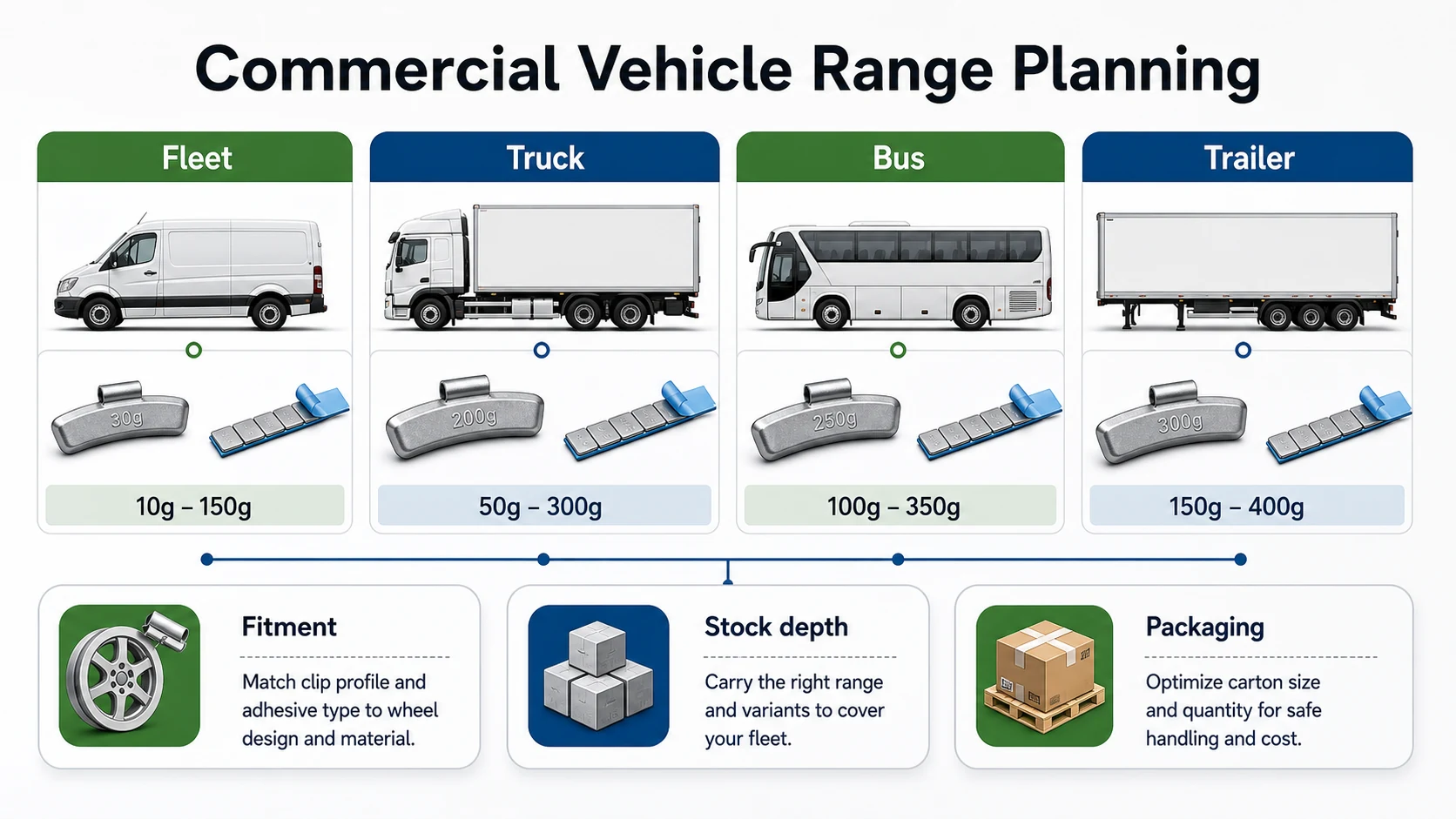
Comience con la combinación de vehículos. Si el comprador atiende principalmente autobuses urbanos, el rango debe reflejar ese tipo de rueda y el proceso del taller. Si el comprador atiende flotas mixtas, el rango puede necesitar líneas separadas para furgonetas, camiones, remolques y aplicaciones de autobús. Si el comprador es un distribuidor, el rango debe construirse en torno a pedidos repetidos, no solo a un catálogo que parezca completo.
A continuación, decida el sistema de unidades y la estructura de tamaños. Algunos mercados esperan gramos, mientras que otros esperan onzas o etiquetado dual. Algunos talleres prefieren formatos de tira precortada; otros almacenan tamaños de clip en cajas. Antes de establecer la primera orden de compra, los compradores pueden usar planificación de tamaños de contrapesos de rueda comerciales para conectar los sistemas de gramos y onzas con una cobertura práctica de stock.
La profundidad de stock es diferente del ancho del rango. Un distribuidor puede necesitar stock profundo en un número menor de tamaños comerciales de rápida rotación, mientras que una red de servicio puede necesitar menos SKUs pero una disciplina de reposición más fuerte. Manejar demasiados tamaños de baja rotación puede hacer que un rango parezca impresionante pero débil en el uso diario.
| Paso de planificación | Pregunta del comprador | Output |
|---|---|---|
| Mapa de vehículos | ¿Qué grupos de vehículos debe soportar el rango? | Flota, camión, autobús, remolque o programa mixto |
| Tipo de rueda | ¿Qué materiales y diseños de ruedas aparecen con más frecuencia? | Estrategia de fijación con clip, adhesivo o mixta |
| Sistema de unidades | ¿Qué unidad espera el canal de servicio? | Estructura en gramos, onzas o etiquetado dual |
| Profundidad de stock | ¿Qué tamaños rotan más rápido? | Tamaños principales, tamaños secundarios y puntos de reposición |
| Embalaje | ¿Qué tan pesado puede manejarse cada cartón de forma segura y económica? | Caja interior, cantidad por cartón, etiqueta y plan de código de barras |
| Muestras | ¿Qué ruedas reales se usarán para la aprobación? | Lista de pruebas de ajuste, acabado, cinta y embalaje |
¿Cómo deben los compradores comparar materiales y recubrimientos?
Los compradores de vehículos comerciales deben comparar los materiales de contrapesos de rueda por requisito libre de plomo, costo, densidad, ajuste, rendimiento del recubrimiento y aceptación del mercado. La calidad del recubrimiento es especialmente importante porque los vehículos de trabajo pueden enfrentar sal de carretera, polvo de frenos, productos químicos de lavado, humedad de almacenamiento e intervalos de servicio prolongados.
Los contrapesos de rueda de plomo se han ido eliminando o desalentando en muchos programas debido a preocupaciones ambientales. La guía de mejores prácticas de la EPA de EE. UU. alentó a reducir el uso de contrapesos de rueda de plomo y usar alternativas donde sea práctico 2. Los compradores aún deben verificar las reglas de su propio mercado objetivo, porque los requisitos relacionados con el plomo pueden variar según el país, estado, cliente o contrato de servicio.
El acero suele ser un material práctico libre de plomo para programas de vehículos comerciales porque es rentable y está disponible en rangos más amplios. El zinc puede solicitarse para ciertos clientes o mercados. El mejor material es el que se adapta a la aplicación, el objetivo de precio, la necesidad de documentación y la disponibilidad del rango. La elección del material no debe anular el ajuste a la rueda.
El recubrimiento debe tratarse como una especificación, no como una decoración. Un rango para vehículos comerciales puede permanecer en almacenamiento, viajar en cartones de exportación, manipularse repetidamente y luego trabajar en condiciones de carretera húmedas o saladas. Los compradores pueden usar verificaciones de recubrimiento para programas de contrapesos de rueda de flota para definir el tipo de acabado, color, expectativa de corrosión y puntos de inspección antes de aprobar muestras. ASTM B117 describe una práctica estándar para operar aparatos de niebla salina y a menudo se cita cuando los compradores comparan el comportamiento de exposición a la corrosión bajo condiciones de prueba controladas 3.
Para formatos adhesivos, la cinta es parte de la decisión del material. El rendimiento de la cinta depende del estado de la superficie de la rueda, la limpieza, la presión, la temperatura y el almacenamiento. La guía de preparación de superficies VHB de 3M es un recordatorio útil de que el rendimiento adhesivo depende de superficies limpias y preparadas y de la presión de aplicación, no solo de la etiqueta de la cinta 4.
| Elección de material o acabado | Dónde se ajusta | Qué deben verificar los compradores |
|---|---|---|
| Acero recubierto | Amplias gamas comerciales sin plomo | Recubrimiento, resistencia a la oxidación, abrasión del cartón, disponibilidad de tamaños |
| Zinc | Programas de Zn especificados por el cliente o mercados seleccionados sin plomo | Declaración de material, costo, rango de tamaño y etiquetado |
| Respaldo adhesivo | Ruedas de aluminio o rutinas de servicio adhesivas | Tipo de cinta, liberación del liner, vida útil, proceso de instalación |
| Acabado pintado o recubierto | Ruedas visibles y mercados sensibles a la corrosión | Estándar de acabado, condiciones de almacenamiento y apariencia de la muestra |
| Gama de materiales mixtos | Distribuidores que atienden diferentes requisitos de clientes | Nomenclatura de SKU, etiquetas de material y claridad para reordenar |
¿Qué deben incluir los compradores en una solicitud de cotización de contrapesos de rueda para vehículos comerciales?
Una RFQ de contrapesos para ruedas de vehículos comerciales debe incluir la combinación de vehículos, el tipo de rueda, el formato de fijación, el rango de peso, el material, el recubrimiento, la cantidad por cartón, el formato de etiqueta, las necesidades de código de barras, las muestras y cualquier documentación del mercado objetivo. Las RFQ claras ayudan a los proveedores a cotizar el mismo requisito de producto en lugar de solo igualar una línea de precio.
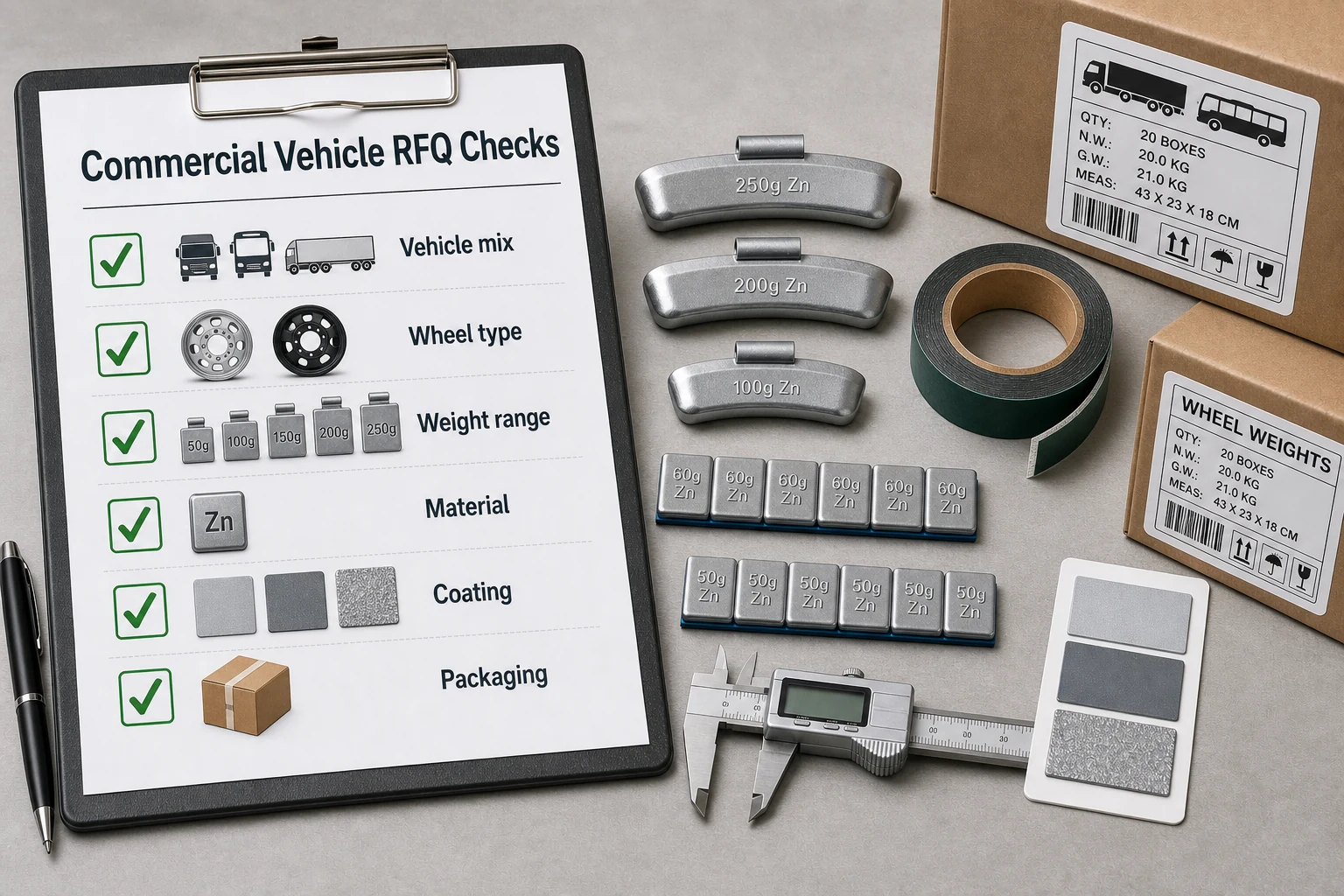
Comience con la combinación de vehículos. Una RFQ útil no dice solo "contrapesos para ruedas de vehículos comerciales". Explica si el comprador atiende furgonetas de flota, camiones medianos, camiones pesados, autobuses, remolques o un canal mixto. Ese contexto le indica al proveedor qué rango de tamaño, embalaje y plan de muestras será significativo.
A continuación, enumere el tipo de rueda y el formato de fijación. Si el rango incluye contrapesos de clip, solicite el tipo de rueda previsto, el perfil de la llanta, el diseño del clip, el recubrimiento y el ajuste de muestra. Si el rango incluye contrapesos adhesivos, solicite el tamaño de la tira, el peso del segmento, la longitud total de la tira, la construcción de la cinta, el comportamiento del liner y la guía de instalación.
El embalaje merece una línea separada en la RFQ. Los contrapesos para vehículos comerciales son más pesados que muchos rangos de vehículos ligeros, por lo que la resistencia del cartón, la disposición de la caja interior, el peso bruto, la claridad de la etiqueta, la paletización y los requisitos de código de barras importan. Los compradores que planifican pedidos más grandes pueden usar embalaje a granel de contrapesos para ruedas y planificación de SKU para decidir si el MOQ, el peso del cartón y la profundidad del rango son realistas antes de negociar el precio final.
| Campo de la RFQ | Qué escribir | Por qué es importante |
|---|---|---|
| Combinación de vehículos | Furgonetas de flota, camiones, autobuses, remolques o servicio mixto | Evita que se cotice un surtido genérico |
| Tipo de rueda | Acero, aluminio, diseño de rueda comercial o datos de rueda de muestra | Guía el perfil del clip y el ajuste adhesivo |
| Rango de peso | Unidades, incrementos, valores máximos, disposición de la tira | Alinea el suministro con la demanda real del servicio |
| Material | Acero, zinc, requisito sin plomo o material especificado por el cliente | Evita afirmaciones de material incorrecto |
| Recubrimiento | Color, tipo de acabado, expectativa de corrosión, estándar de muestra | Reduces visible finish complaints |
| Embalaje | Piezas por caja, caja interior, peso del cartón, etiqueta, código de barras | Apoya el manejo en almacén y reventa |
| Muestras | Cantidad, rueda de aprobación, ajuste, cinta, recubrimiento, revisión del cartón | Encuentra problemas antes de la producción en masa |
¿Cómo deben los compradores calificar a los proveedores?
Los compradores deben calificar a los proveedores de contrapesos para ruedas de vehículos comerciales verificando la precisión de las muestras, la consistencia del utillaje, el control del recubrimiento, la resistencia del embalaje, la precisión de las etiquetas, el plazo de entrega y la estabilidad de lotes repetidos. Un proveedor que puede hacer una buena muestra también debe demostrar que puede enviar el mismo rango de manera consistente.
La primera verificación es si el proveedor entiende las aplicaciones de vehículos comerciales. Si la cotización trata furgonetas de flota, autobuses, remolques y camiones pesados como una categoría idéntica, el comprador debe ir más despacio. Un buen proveedor preguntará sobre el tipo de rueda, el formato de fijación, el rango de tamaño, el material, el embalaje y el canal de servicio previsto.
La segunda verificación es la consistencia por lotes. Los rangos de vehículos comerciales a menudo implican pedidos repetidos, cartones más pesados y SKU de alto uso. Un comprador debe preguntar cómo controla el proveedor la precisión del peso, la geometría del clip, la colocación de la cinta adhesiva, el grosor o la apariencia del recubrimiento, el etiquetado del cartón y el marcado del producto. Cuando un rango se usa en varias ubicaciones de servicio, la inconsistencia crea confusión rápidamente.
La tercera verificación es la documentación y el etiquetado. Los importadores pueden necesitar declaraciones de material, declaraciones sin plomo, etiquetas de cartón, códigos de barras, fotos de productos o informes de pruebas según el mercado y el cliente. Los compradores deben solicitar documentación realista en lugar de aceptar afirmaciones amplias que no puedan coincidir con un lote de producto.
La cuarta verificación es la confiabilidad de producción y envío. Los canales de servicio comercial no toleran los desabastecimientos porque interrumpen el trabajo. Los compradores que evalúan una nueva fuente pueden usar verificaciones de proveedores para pedidos repetidos de contrapesos para ruedas de vehículos comerciales para revisar la capacidad de fábrica, el flujo de QC, el control de empaque y la comunicación de pedidos repetidos antes de realizar un pedido de programa más grande.
| Verificación del proveedor | Qué solicitar | Warning sign |
|---|---|---|
| Conocimiento de la aplicación | Preguntas sobre la combinación de vehículos, el tipo de rueda y el método de fijación | El proveedor cotiza solo por precio por kg o por caja |
| Control de muestras | Muestras reales con etiquetas y embalaje | La muestra difiere del material o tamaño cotizado |
| Control de recubrimiento | Estándar de acabado y método de inspección | El proveedor solo dice "buen recubrimiento" |
| Resistencia del embalaje | Caja interior, cartón, peso bruto y maqueta de etiqueta | El plan de cartón no está claro o es demasiado pesado para manipular |
| Suministro repetido | Plazo de entrega, MOQ, marcado de lote, proceso de reorden | Sin seguimiento claro de lote o reorden |
Si está buscando contrapesos de rueda para camiones, flotas o autobuses, comparta la combinación de vehículos, tipos de rueda, rango de peso, recubrimiento, embalaje y volumen de servicio que necesita cubrir. Podemos ayudarle a construir una gama de muestras para vehículos comerciales basada en el uso real en lugar de una lista genérica.
Conclusión: adaptar la gama de contrapesos de rueda a la combinación de vehículos
Los contrapesos de rueda para vehículos comerciales deben planificarse en torno a los vehículos y canales de servicio que el comprador realmente atiende. Las furgonetas de flota, camiones, autobuses y remolques pueden compartir la misma categoría de producto, pero no siempre necesitan los mismos tamaños, formatos de fijación, materiales, recubrimientos, cartones o profundidad de stock.
El proceso de compra más sólido comienza con un mapa de vehículos, luego pasa al tipo de rueda, rango de tamaño, formato de fijación, material, recubrimiento, embalaje y muestras. Los compradores que preparan un programa comercial pueden revisar muestras de contrapesos de rueda para vehículos comerciales para verificar el ajuste y el embalaje una vez que la combinación de flota, la aplicación de rueda, el rango requerido, las etiquetas de cartón y el plan de prueba de muestras estén claros.
Preguntas frecuentes
¿Qué son los contrapesos de rueda para vehículos comerciales?
Los contrapesos de rueda para vehículos comerciales son contrapesos de equilibrado utilizados en furgonetas de flota, camiones, autobuses, remolques y vehículos de trabajo similares. Corrigen el desequilibrio de ruedas y neumáticos después del servicio, pero los compradores deben elegirlos según la combinación de vehículos, tipo de rueda, rango de tamaño, formato de fijación, material, recubrimiento y embalaje.
¿Son los contrapesos de rueda para vehículos comerciales lo mismo que los contrapesos de rueda para camiones?
No siempre. Los contrapesos de rueda para camiones son una parte de la categoría de vehículos comerciales. Un programa comercial más amplio también puede incluir furgonetas de flota, autobuses, remolques y vehículos de servicio mixto. Estas aplicaciones pueden requerir diferentes rangos de tamaño, profundidad de stock y decisiones de embalaje.
¿Deberían las flotas usar contrapesos comerciales de rueda con clip o adhesivos?
La elección depende del tipo de rueda y del proceso de instalación. Los contrapesos con clip necesitan el perfil correcto de brida de rueda y clip. Los contrapesos adhesivos necesitan suficiente espacio libre, cinta adecuada y preparación de superficie limpia. Las flotas deben probar muestras en sus ruedas reales antes de estandarizar una gama.
¿Qué especificaciones son más importantes para los contrapesos de rueda para vehículos comerciales?
Las especificaciones más importantes son la aplicación del vehículo, el tipo de rueda, el rango en gramos u onzas, el formato de fijación, el material, el recubrimiento, la cantidad por cartón, el formato de etiqueta, las necesidades de código de barras y el método de aprobación de muestras. El embalaje y la profundidad de stock son especialmente importantes para los distribuidores y las redes de servicio de flotas.
¿Cómo pueden los compradores evitar el exceso de stock de contrapesos de rueda para vehículos comerciales?
Los compradores pueden evitar el exceso de stock separando los tamaños principales de alto uso de los tamaños secundarios, mapeando la combinación real de vehículos y revisando el historial de reorden cuando esté disponible. Una gama más estrecha con mayor stock en los tamaños correctos suele ser mejor que una gama amplia con baja rotación.
Referencias
[1] Administración de Seguridad y Salud Ocupacional. “Servicio de ruedas de rin de varias piezas y de una sola pieza.” 2026.
[2] United States Environmental Protection Agency. “Mejores Prácticas de Gestión para Pesos de Rueda de Plomo.” 2015.
[3] ASTM International. “ASTM B117-19 Standard Practice for Operating Salt Spray Apparatus.” 2019.
[4] 3M. “Boletín Técnico de Preparación de Superficies para Cinta 3M VHB.” 2019.