



A smart portable EV charger is portable AC EVSE with supported controls such as current adjustment, scheduling, session records, or app access. Verify the exact hardware, firmware and app: Bluetooth does not guarantee remote access, a charging timer does not provide dynamic site load management, and a basic AC connection does not give the EVSE the vehicle’s battery percentage.
Choose the safe electrical configuration first, then verify the functions needed at home, while travelling, or in a managed operation. The guía de cargadores EV portátiles explains outlet, circuit, connector and control-box selection. A detachable cable for a socketed AC station is a different product.
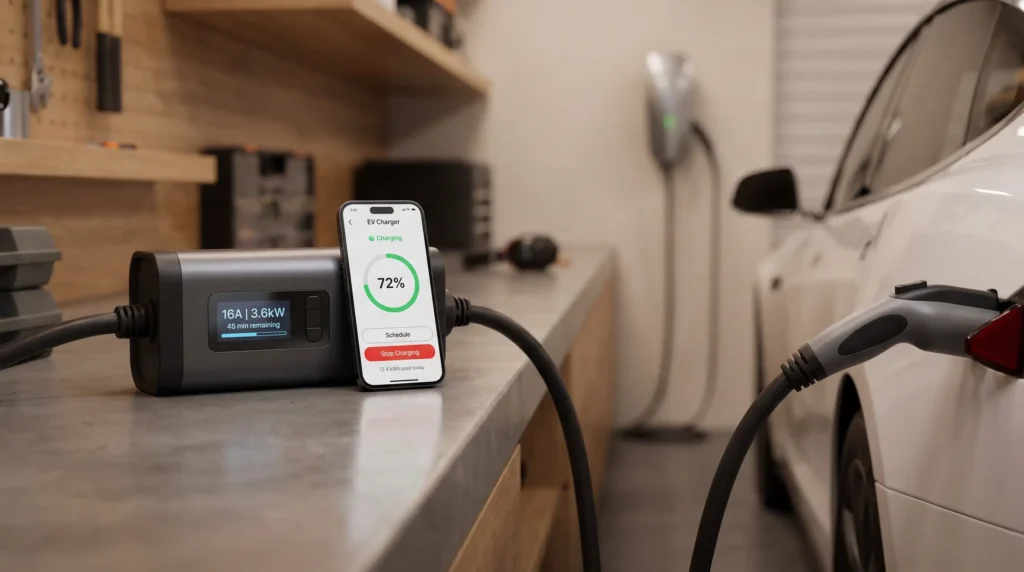
6 características principales de una app de cargador inteligente para VE
These are functions to check, not guaranteed features of every smart product. App permissions never increase the approved current of the outlet, circuit, plug, cable, or vehicle.
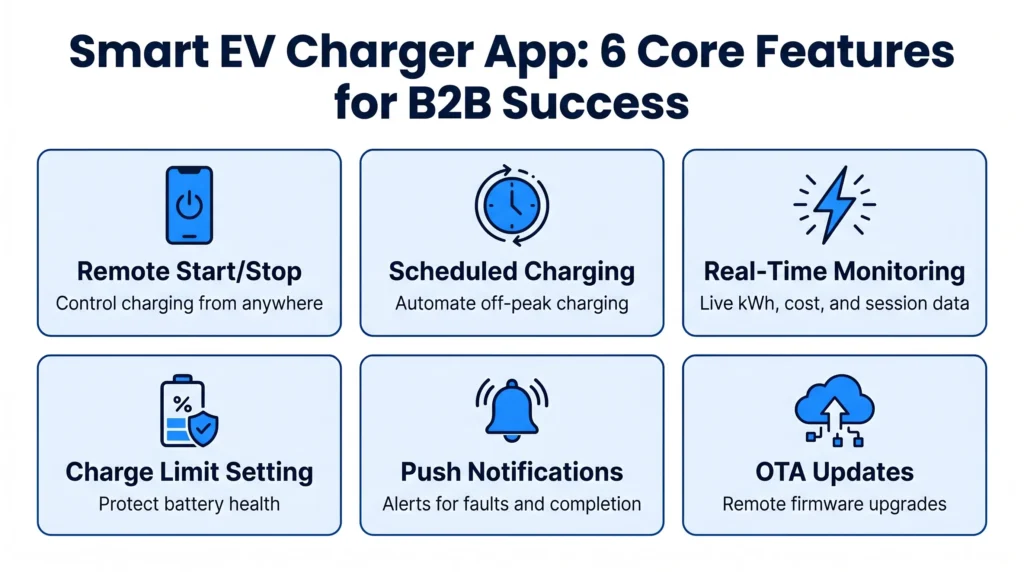
Control remoto de inicio/parada
Separate nearby Bluetooth control from internet-based remote control. Ask whether a command is acknowledged by the EVSE and whether the displayed status is live or stale. A start command authorizes available power; the vehicle still decides whether it can accept charging.
Carga programada para ahorrar en horas valle
Check the actual tariff and departure window. A schedule can move energy into a cheaper period but cannot guarantee savings on a flat-rate plan. Emporia provides a product-specific time-of-use scheduling example; its behavior should not be assumed for another portable unit.1 Choose whether the vehicle or EVSE owns the schedule to avoid conflicting timers.
Monitorización energética en tiempo real y seguimiento de costes
Identify whether values are measured by the EVSE, estimated, or supplied by another service. Record update interval, session/reset behavior, export format, and the tariff used for cost estimates. Energy delivered at the supply is not identical to energy added to the battery. An app kWh display does not establish billing-meter approval.
Configuración del límite de carga para la salud de la batería
A current cap or delivered-energy stop is different from a vehicle state-of-charge limit. Do not advertise an 80% battery stop unless the product has a verified vehicle data/control integration that supports it. Follow the vehicle’s battery and charge-limit instructions; chemistry and use vary. An EVSE energy limit alone cannot infer the starting battery percentage or precisely replace the car’s charge-limit setting.
Notificaciones push y alertas de fallos de seguridad
Check which faults the hardware detects and how it responds locally. Notification delivery depends on the app, network and permissions; an alert may be delayed or absent. Protective action must follow the product design without relying on a phone notification. Test the documented behavior rather than assuming every smart charger monitors every wall socket’s temperature.
Actualizaciones de firmware por aire (OTA)
Confirm update authentication, release notes, support duration and the behavior of an interrupted update. Ask whether charging is suspended and how the device recovers. An update facility is not a guarantee of permanent cloud support, future vehicle compatibility, or new hardware capabilities.
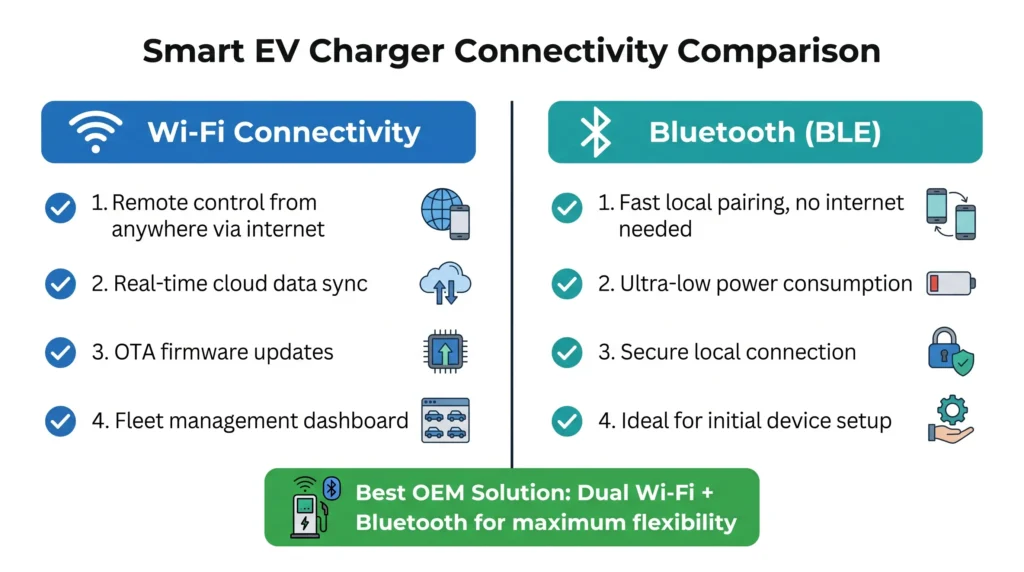
Comparativa de conectividad: Wi-Fi vs. Bluetooth (BLE)
Choose the connection for the control location. Bluetooth usually provides a nearby path; Wi-Fi may provide a local network or a cloud path, depending on the product. Neither radio name specifies the complete service or its offline behavior.
| Required function | Evidence to check |
|---|---|
| Nearby control | Supported phone/app, pairing and measured practical range at the intended location |
| Control away from site | Remote service, network coverage, authentication and status freshness |
| Offline charging | Charging authorization, retained current limits and fault handling without internet |
| Scheduling | Where the timer is stored; restart, clock, time-zone and daylight-saving behavior |
| Connection loss | Whether local control remains available and how status/commands recover |
A dual-radio unit may use Bluetooth only for onboarding; it does not necessarily fall back to full local control. Verify this with the exact manual and a sample. Keep the adjustable-current sample checks with the connectivity record.
El cambio de juego B2B: Cumplimiento del protocolo OCPP
Require OCPP when the intended management system needs it, rather than making it mandatory for every portable charger. OCPP connects a charging station and a CSMS; 1.6, 2.0.1 and 2.1 are distinct versions. OCA states that 1.6 and 2.0.1 are not compatible.2
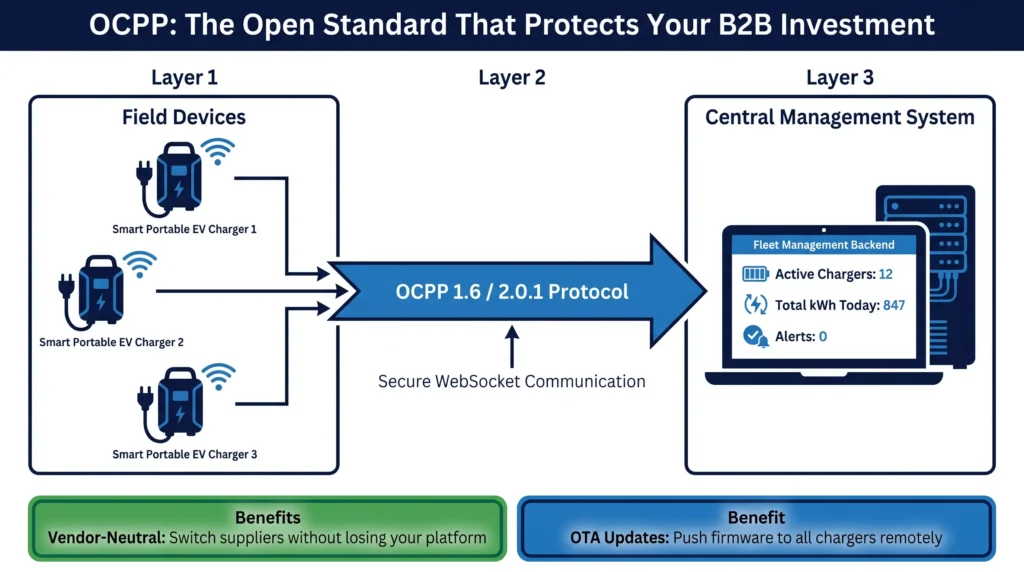
Check the certificate identity, product/firmware and implemented profiles. OCA lists Smart Charging as optional for an OCPP 1.6 charging station; Core certification alone is not proof of that function.3 Then verify the chosen charger with the intended backend. Do not assume a protocol logo guarantees every third-party integration, revenue-grade metering, or safe whole-building load control.
For dynamic site management, record the compatible meter or gateway, protected service/feeder, limit commands and communication-loss response. Phone connectivity and a configurable current setting do not measure spare building capacity. The load management worksheet separates those requirements. Tesla’s documented power-management example also distinguishes static, meter-based dynamic and group functions.4
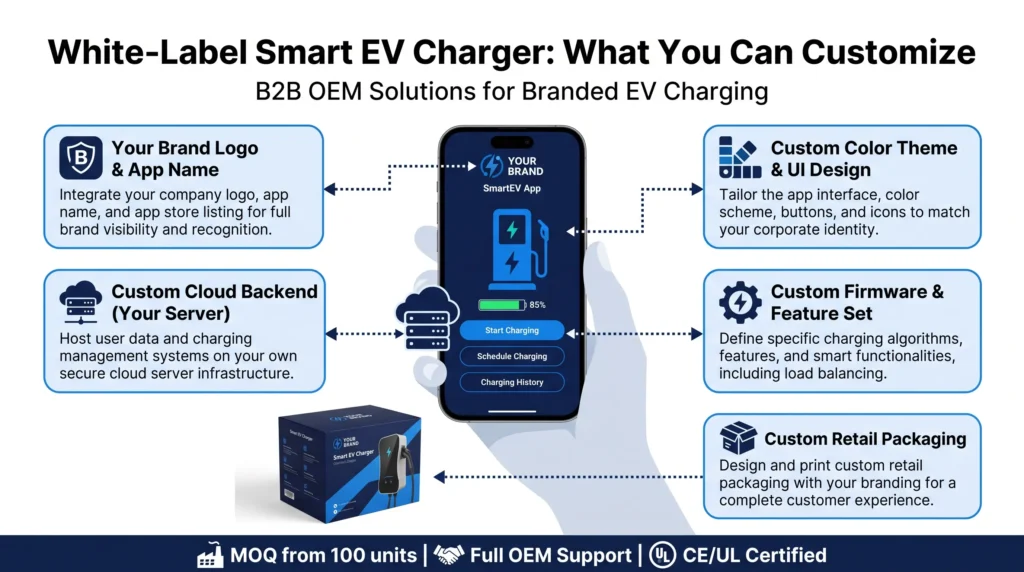
Personalización de la app de marca blanca: Construyendo tu ecosistema de marca
Agree on deliverables and responsibilities before branding a connected product. A logo change does not establish ownership of source code, developer accounts, hosting or customer data, and hosting in a named cloud does not itself establish privacy compliance.
| Contract field | Confirm in writing |
|---|---|
| App release | Store publisher, developer-account owner, supported phones/regions and review responsibility |
| Hardware and software scope | Product/firmware revisions, functions, integrations and acceptance build |
| Service operation | Hosting, service availability, recurring fees and what remains functional offline |
| Accounts and data | User access, deletion/export, ownership transfer and retention responsibilities |
| Mantenimiento | Security updates, vulnerability reporting, support duration and end-of-service plan |
| Commercial terms | Quoted MOQ, engineering/tooling fees, samples, release approval and lead time |
Request a demonstration build and record the results against the agreed functions. Leave unverified capabilities out of the listing. For a product inquiry, provide the target market, connector, outlet/current configuration, required app functions and intended backend through Yirox’s contact page.
Conclusión
Select portable EVSE for its approved electrical configuration first, then confirm each smart function on the exact product and software release. Distinguish local from remote access, schedules from site load management, delivered energy from vehicle state of charge, and OCPP branding from verified implementation.
For a branded program, record app/service ownership, recurring costs, updates, offline operation and acceptance criteria before ordering. Keep the approved sample and configuration with repeat orders; no market-growth or margin forecast can substitute for that evidence.
Preguntas Frecuentes (FAQ)
¿Necesito Wi-Fi para usar un cargador EV portátil inteligente?
Wi-Fi is not required for every smart function or for every charging session. Some units use Bluetooth for nearby setup or local control; others need an internet-connected service for particular controls. Check the actual manual rather than assuming most products use both radios. Remote access needs a supported network path and backend, which may use Wi-Fi or cellular. Bluetooth range depends on the device and installation. Verify whether charging and saved schedules continue when the phone, router, internet, or cloud is unavailable, and whether firmware can be updated locally or only online. Test these states on the supplied hardware and app revision before advertising offline operation.
What exactly is a white-label EV charger app?
A white-label EV charger app is existing software offered with agreed branding and customization. It may be supplied by the hardware maker or a separate platform provider. Branding does not automatically give your company ownership of the code, cloud service, developer account, or customer data. Specify the publisher shown in the app stores, account ownership, supported features and regions, recurring fees, hosting arrangements, update responsibility, and the process for transferring a device to a new owner. Request a working build and support terms before treating a logo change as a complete independent software ecosystem.
What does OCPP compliance mean for a portable charger?
OCPP is an open protocol between charging equipment and a charging management system. A portable charger needs it only when the intended operation requires that connection. Compliance should name the protocol version, exact product and firmware, and implemented functions. OCPP 1.6 and 2.0.1 are not directly compatible; an OCPP label does not guarantee connection to every backend. Check certificate scope, including Smart Charging and security profiles where required, then test authorization, transactions, meter values, remote commands, and offline behavior with the chosen CSMS. It does not replace product electrical-safety evidence or prove suitability for billing.
Can a smart EV charger actually save me money on my electric bill?
Scheduling can reduce cost when your tariff charges different rates at different times and the available low-rate window can deliver the required energy before departure. Savings depend on the actual tariff, charging demand and subscription or service fees; a flat-rate tariff does not become cheaper just because an app schedules the session. Check which device controls the timer, the time zone and daylight-saving behavior, and whether schedules persist offline or after a restart. Compare billed energy and rates rather than relying on a universal annual savings promise, and avoid conflicting vehicle and EVSE schedules.
How secure are Wi-Fi enabled EV chargers from hacking?
Security depends on the complete product, app and service, not Wi-Fi alone. Ask how devices and users are authenticated, how credentials are stored and changed, how transport encryption and certificates are managed, and how unauthorized remote commands are prevented. Verify signed or otherwise authenticated updates, recovery from an interrupted update, vulnerability reporting, security support duration, and ownership-transfer/reset behavior. OCPP security-profile evidence applies to its documented implementation and is not proof that every app or cloud path is secure. Local hosting can change responsibilities, but it does not by itself establish privacy compliance or remove the need for access controls and updates.
¿Cuál es el MOQ típico para un cargador inteligente y una app totalmente de marca blanca?
There is no verified universal MOQ for a fully branded smart charger and app. The supplier’s written quotation should separate hardware quantity, branding, software engineering charges, tooling if needed, cloud fees, maintenance and launch support. A logo change, a separately published app, custom backend integration and a new hardware design can have very different terms. Ask which deliverables are included, which accounts your company controls, the sample and release process, recurring obligations, lead time, and support after the first production batch. Do not use an unsupported industry range as a confirmed Yirox offer; request terms for the exact specification.
Referencias
[1] Emporia Energy. “Time-of-use scheduling: a product-specific example.”
[2] Open Charge Alliance. “Open Charge Point Protocol: versions and functions.”
[3] Open Charge Alliance. “OCPP 1.6 certification: Core, Smart Charging and Advanced Security.”
[4] Tesla. “Wall Connector Power Management: static, dynamic and group functions.”
[5] U.S. DOE Alternative Fuels Data Center. “Charging Electric Vehicles at Home.”