
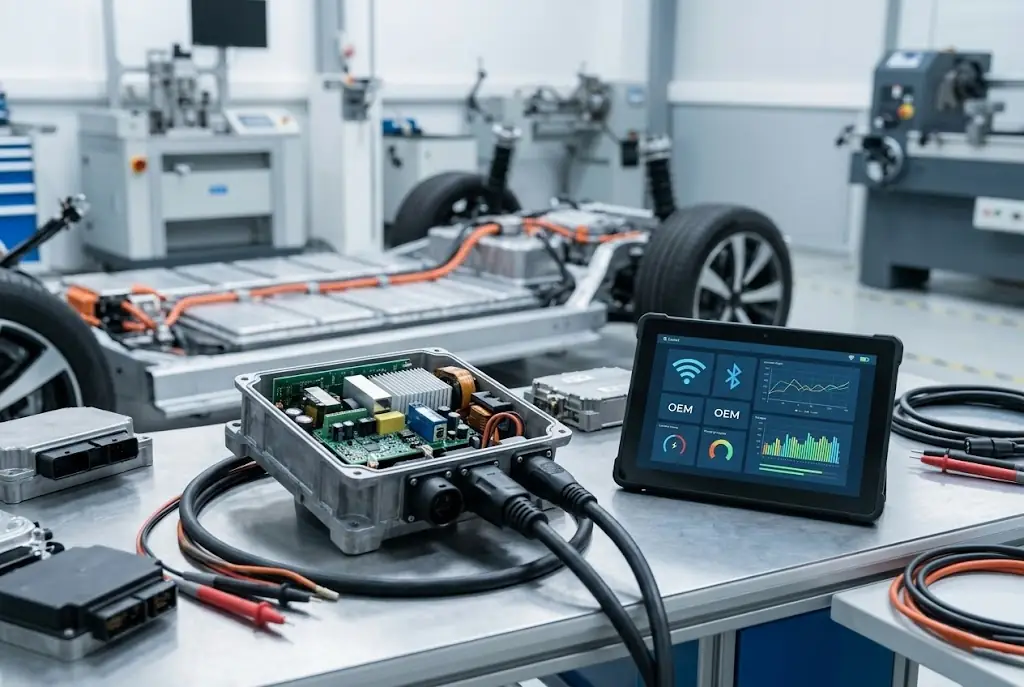
The short answer: For B2B distributors, fleet managers, and automotive accessory brands, transitioning from “dumb” charging cables to intelligent, smart portable EV chargers is the most critical product portfolio upgrade of the decade. By integrating Wi-Fi, Bluetooth Low Energy (BLE), and strict OCPP protocol compliance, these smart chargers offer remote app control, automated off-peak scheduling, and highly accurate real-time energy monitoring. Partnering with a capable, engineering-focused OEM/ODM manufacturer allows you to white-label both the physical hardware and the companion mobile app, creating a premium, high-margin product ecosystem that modern EV owners and commercial fleet operators actively demand in today’s connected world.
The era of the basic “plug and pray” electric vehicle charger is rapidly coming to an end. As electric vehicle adoption shifts dramatically from early tech enthusiasts to mainstream consumers, expectations regarding daily charging convenience, energy cost management, and long-term battery health have skyrocketed. According to industry analysts, the global Smart EV Charger market was valued at a substantial USD 45.6 billion in 2025 and is projected to explode to USD 262.9 billion by 2034, representing a massive Compound Annual Growth Rate (CAGR) of 21.5% [1].
For wholesalers, distributors, and private label brands looking to capture market share, this data sends a very clear message: the future of EV charging is unequivocally connected, intelligent, and software-driven. This comprehensive guide explores the core features that define smart portable EV chargers, compares the vital technical differences between Wi-Fi and Bluetooth connectivity, explains the critical importance of the OCPP protocol for scaling B2B applications, and provides a strategic roadmap for customizing your own white-label smart charging app.
6 Core Features of a Smart EV Charger App
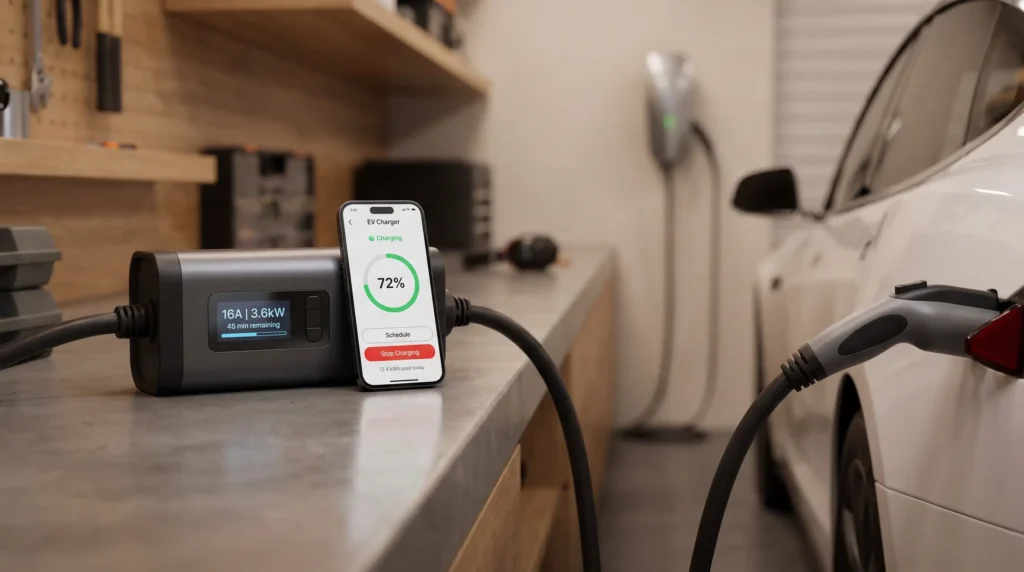
What exactly makes an EV charger “smart”? While a traditional, unmanaged charger simply acts as a dumb conduit for electricity when plugged into the wall, a smart charger acts as an intelligent energy management node within a broader connected ecosystem. The true value of a smart portable EV charger is unlocked entirely through its companion mobile application.
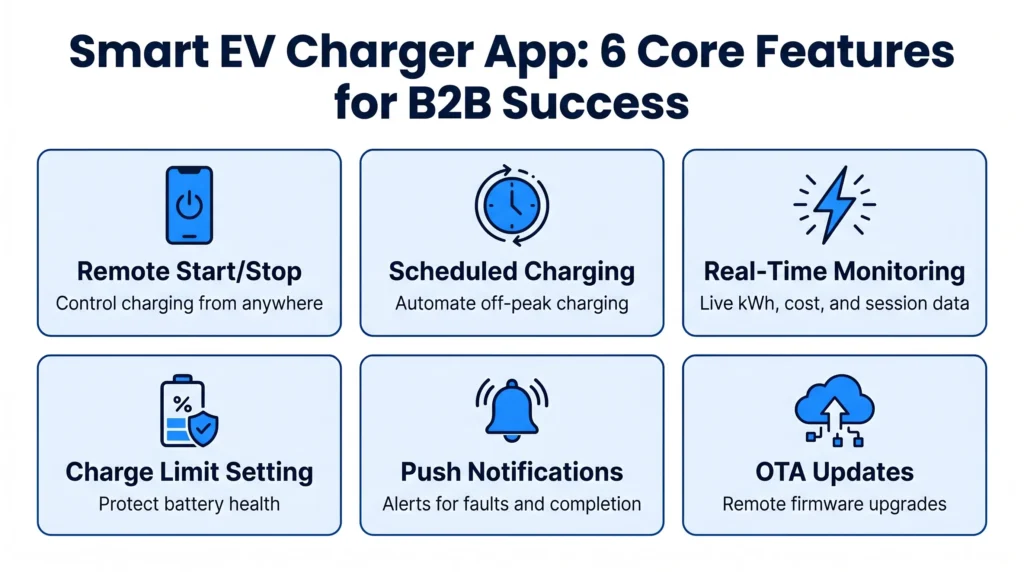
When evaluating a potential OEM supplier for your brand, you must ensure their software ecosystem natively supports these six essential, highly sought-after features:
1. Remote Start/Stop Control
The most fundamental smart feature is the ability to control the charging session remotely. Whether the user is sitting comfortably on their living room couch, working at their office desk, or traveling abroad, they can open the app to initiate or halt the flow of electricity instantly. This completely eliminates the inconvenience of needing to physically walk out to the garage, driveway, or parking lot in bad weather simply to unplug the vehicle.
2. Scheduled Charging for Off-Peak Savings
Electricity prices fluctuate significantly based on utility time-of-use (TOU) tariffs. Smart chargers allow users to plug in their vehicle at 6:00 PM when they get home from work, but precisely schedule the actual charging to begin at 1:00 AM when grid demand is at its lowest and electricity is cheapest [2]. For daily commuters who drive long distances, this single automated feature can easily save hundreds of dollars annually on utility bills without requiring any change in daily habits.
3. Real-Time Energy Monitoring and Cost Tracking
Transparency in energy usage is a massive selling point for consumers. A well-designed, intuitive app will display real-time data, including the current amperage, voltage, instantaneous kilowatt output, and the total kWh consumed during the current session. Advanced white-label apps will go a step further by translating this raw data into estimated financial cost metrics, allowing users to track exactly how much money they are spending to “fuel” their vehicle on a daily, weekly, or monthly basis.
4. Charge Limit Setting for Battery Health
Continuously charging a lithium-ion EV battery to 100% capacity every single day can significantly degrade its long-term health and overall lifespan. Smart apps allow users to set precise, automated charge limits—either by a specific battery percentage (e.g., automatically stop at 80% for daily driving) or by total energy delivered (e.g., stop after delivering exactly 20 kWh). This crucial feature protects the vehicle’s expensive battery chemistry and prevents unnecessary energy waste.
5. Push Notifications and Safety Fault Alerts
If a sudden power outage occurs, or if the wall socket begins to overheat dangerously due to old wiring, a smart charger will automatically pause the session and instantly send a push notification to the user’s phone. It will also notify the user when the vehicle has successfully reached its target charge level, providing total peace of mind that the car will be ready for the morning commute.
6. Over-The-Air (OTA) Firmware Updates
The EV landscape is constantly evolving, with new vehicle models, updated charging standards, and shifting software protocols emerging regularly. A smart charger connected to the internet can receive OTA updates directly from the manufacturer’s cloud servers. This ensures the hardware remains fully compatible with future vehicles, patches any security vulnerabilities, and continuously improves its feature set without ever requiring the user to buy new physical equipment.
Connectivity Showdown: Wi-Fi vs. Bluetooth (BLE)
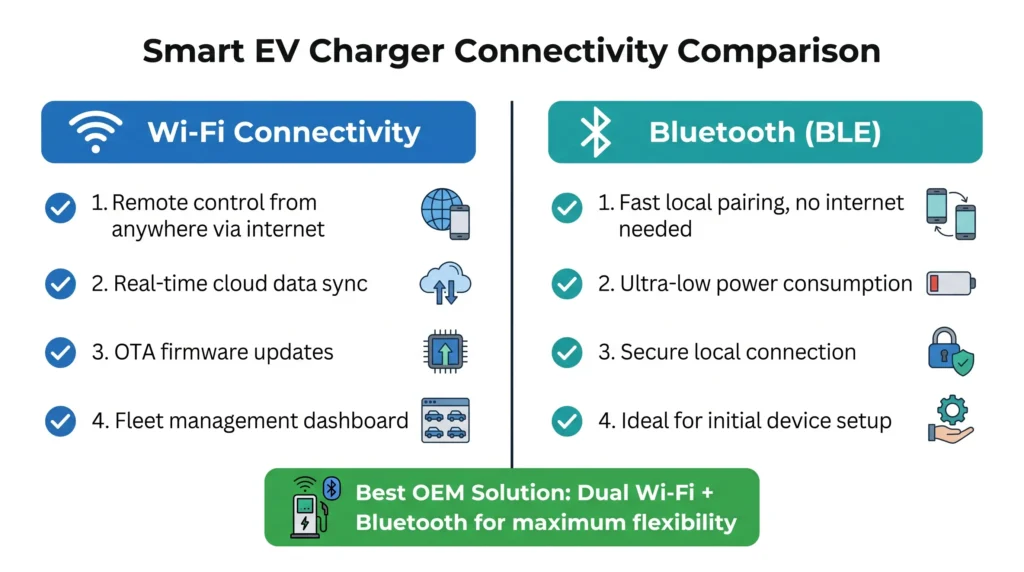
To reliably enable these advanced smart app features, the portable charger must communicate flawlessly with the user’s smartphone. Manufacturers typically utilize Wi-Fi, Bluetooth Low Energy (BLE), or a combination of both protocols. Understanding the technical strengths and practical limitations of each protocol is vital when designing your product specifications and selecting an OEM partner.
The Case for Bluetooth (BLE)
Bluetooth Low Energy is a highly efficient, short-range wireless technology. Its primary advantage is that it operates completely independently; it does not require an active internet connection or a functioning home router to work.
- Pros: Extremely fast local pairing out of the box, ultra-low power consumption, and it works perfectly in challenging environments like deep underground parking garages or remote rural areas where Wi-Fi or cellular signals simply cannot reach.
- Cons: Range limitations. The user must be physically within 10 to 30 meters of the charger to control it or view data. You cannot check your charging status from the office if the car is plugged in at home.
The Case for Wi-Fi
Wi-Fi connects the EV charger directly to the user’s home network router and, by extension, the global internet cloud.
- Pros: Enables true remote control and monitoring from absolutely anywhere in the world. It allows for continuous, real-time data synchronization to cloud servers, makes OTA firmware updates seamless and automatic, and is absolutely essential for integrating the charger into broader smart home ecosystems (like Amazon Alexa, Google Home, or Home Assistant).
- Cons: Strictly requires a stable home Wi-Fi signal in the garage or driveway. If the home router goes offline or the signal is weak, remote functionality is temporarily lost until the connection is restored.
The Best OEM Solution: The undisputed industry gold standard for premium devices is a Dual-Module System (Wi-Fi + Bluetooth). In this sophisticated setup, Bluetooth is used exclusively for the initial, frictionless setup process (pairing the phone to the charger without entering complex network passwords), while Wi-Fi seamlessly takes over for long-term remote management and cloud connectivity. If the Wi-Fi network drops, the system intelligently falls back to Bluetooth for uninterrupted local control.
The B2B Game Changer: OCPP Protocol Compliance
If you are selling portable EV chargers to commercial B2B clients—such as large fleet management companies, apartment building homeowner associations, or commercial Charge Point Operators (CPOs)—a simple consumer-grade app is nowhere near enough. You must ensure your OEM supplier builds chargers that strictly comply with the Open Charge Point Protocol (OCPP).
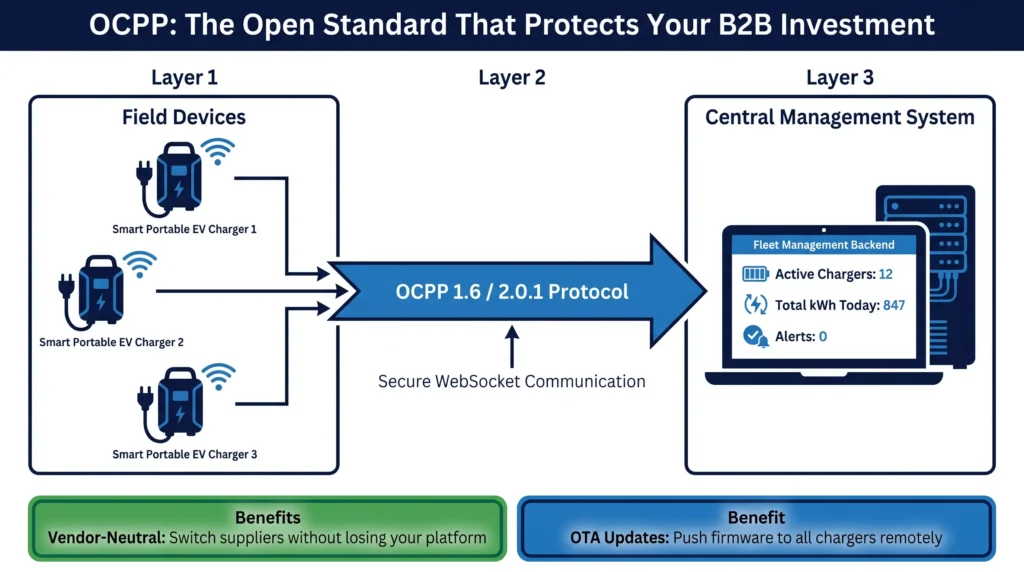
OCPP is the universal, open-source communication language spoken globally between EV chargers and central Charging Station Management Systems (CSMS) [3].
Why OCPP Matters for Your Brand’s Success
Without OCPP compliance, a smart charger is permanently locked into the manufacturer’s proprietary software ecosystem. If a corporate fleet manager buys 50 portable chargers from your brand, they would be forced to use your specific, isolated app to manage them, which is a logistical nightmare for large operations.
With OCPP (specifically version 1.6J or the newer, more advanced 2.0.1), those 50 chargers can securely connect via encrypted WebSockets to any third-party fleet management software the client is already using.
Key B2B benefits of OCPP include:
- True Vendor Neutrality: Clients are never locked into a single software provider. This makes your hardware exponentially more attractive to enterprise buyers who demand flexibility and interoperability.
- Centralized Load Balancing: A central OCPP server can dynamically and intelligently adjust the power output of dozens of chargers simultaneously to prevent overloading a commercial building’s electrical grid during peak hours.
- Billing and Monetization: OCPP allows chargers to transmit exact, timestamped kWh usage data directly to accounting and billing software. This enables companies to charge employees, guests, or tenants accurately for the exact amount of electricity they consume.
When vetting an OEM manufacturer in China, explicitly ask for their official OCPP certification documents and inquire whether they support OCPP 1.6 JSON over both Wi-Fi and cellular networks.
White-Label App Customization: Building Your Brand Ecosystem
Sourcing high-quality, reliable smart hardware is only half the battle. To truly differentiate your brand in a highly competitive, crowded market, you must offer a cohesive, premium software experience. Top-tier OEM/ODM manufacturers offer extensive “White-Label” customization options for the companion mobile app, allowing you to build a software ecosystem that feels entirely proprietary.
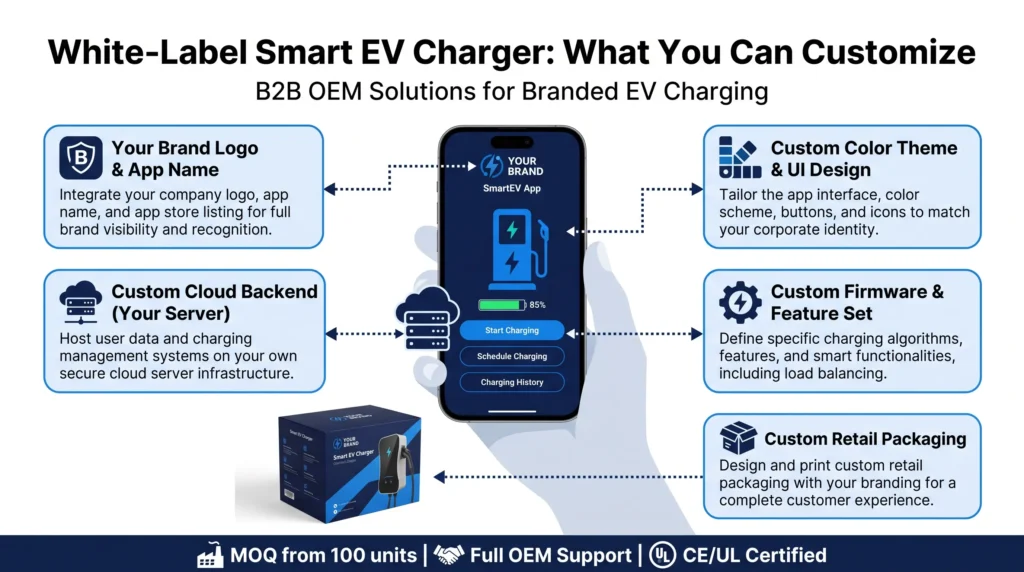
A professional white-label software package allows you to deeply customize the following elements:
1. Brand Identity Integration: The manufacturer will completely recompile the app with your company’s logo, brand name, and custom app icon. Crucially, the app will be published on the Apple App Store and Google Play Store under your own developer account, ensuring complete brand ownership and customer trust.
2. Custom UI/UX Design: You can dictate the specific color schemes, typography, and button layouts to perfectly match your corporate identity. A sleek, modern, bug-free interface significantly boosts the perceived value of the hardware and reduces customer support inquiries.
3. Custom Cloud Backend Deployment: Instead of routing sensitive user data through the manufacturer’s generic, shared servers, premium suppliers can deploy the backend database entirely on your own secure AWS, Google Cloud, or Microsoft Azure servers. This is absolutely crucial for complying with strict data privacy laws like GDPR in Europe or CCPA in California.
4. Tailored Feature Sets: Do you want to simplify the app by removing complex fleet features for a strictly consumer-focused product? Or do you want to add custom API integrations to connect the charger to a specific regional energy provider for grid-balancing rewards? A strong ODM partner with an in-house software team can modify the firmware and app logic to meet your exact, unique specifications.
To explore how a professional manufacturer structures their connected product offerings and handles complex customizations, you can review the extensive catalog at Yirox Auto Parts. Their dedicated EV charging accessories demonstrate the high level of engineering required to support smart, app-controlled charging solutions at scale.
Conclusion
The rapid market transition to smart portable EV chargers represents a massive, highly lucrative opportunity for forward-thinking distributors and B2B brands. Consumers and fleet managers are no longer satisfied with simple, unmanaged cables; they demand intelligent energy management, remote app control, and seamless connectivity to their digital lives.
By prioritizing dual Wi-Fi and Bluetooth connectivity for maximum flexibility, insisting on strict OCPP compliance for commercial viability, and investing in a fully customized white-label mobile app, you can position your brand at the premium, high-margin end of the market. The key to long-term success is selecting an OEM manufacturing partner who possesses not just basic hardware assembly capabilities, but deep, proven software engineering expertise to support your brand’s digital ecosystem for years to come.
Frequently Asked Questions (FAQ)
Do I need Wi-Fi to use a smart portable EV charger?
Not necessarily. Most modern, high-quality smart chargers utilize a dual-module system. If you do not have a Wi-Fi signal in your garage or parking area, you can still connect to the charger locally using Bluetooth to adjust settings, view real-time data, and set schedules. However, an active Wi-Fi connection is strictly required if you want to control the charger remotely from outside your home or receive Over-The-Air (OTA) firmware updates.
What exactly is a white-label EV charger app?
A white-label app is a fully developed software application created by the hardware manufacturer, but customized extensively to look like it was built entirely by your brand. The manufacturer replaces their logos, colors, and branding with yours, and the app is published in the App Store under your company’s name. This allows distributors to offer a premium software experience without hiring an expensive in-house software development team.
What does OCPP compliance mean for a portable charger?
OCPP (Open Charge Point Protocol) is the universal industry-standard communication language for EV chargers. If a portable charger is OCPP compliant, it can connect to and be securely managed by third-party central software systems. This is highly important for commercial B2B buyers (like fleet managers or property owners) who need to monitor multiple chargers from different brands on a single, unified dashboard.
Can a smart EV charger actually save me money on my electric bill?
Yes, significantly. Smart chargers feature advanced scheduling capabilities that allow you to program the charger to only operate during off-peak hours (usually late at night). Because many utility companies charge much lower rates during these hours, automating this process ensures you are always buying electricity at the cheapest possible price, which can save hundreds of dollars annually.
How secure are Wi-Fi enabled EV chargers from hacking?
Security depends heavily on the manufacturer’s software architecture. High-quality OEM suppliers use encrypted WebSockets (WSS) and TLS 1.2/1.3 encryption to secure all data transmitted between the charger, the app, and the cloud. When sourcing products, always ask the supplier about their data encryption standards and whether they support local server hosting for data privacy compliance.
What is the typical MOQ for a fully white-labeled smart charger and app?
For basic white-labeling (which includes your logo on the hardware and a branded version of their standard app), most premium Chinese manufacturers require a Minimum Order Quantity (MOQ) of 300 to 500 units. If you require deep software customization, custom cloud server deployment, or new hardware molds, the MOQ typically starts at 1,000 units to cover the engineering costs.
References
[1] Custom Market Insights. Global Smart EV Charger Market 2025 – 2034.
[2] Emporia Energy. Smart Scheduling: Time of Use.
[3] Open Charge Alliance. OCPP (Open Charge Point Protocol).
[4] Lectron EV. 8 Smart EV Charger Features That Matter in 2026.
[5] ChargeTronix. White-Label EV Chargers & OEM Solutions.