




Una tarjeta de puntuación de proveedores de contrapesos para ruedas debe comparar a los candidatos preseleccionados con una lista de requisitos: idoneidad del producto, calidad de la muestra, documentos, evidencia de procesos, capacidad de embalaje, términos comerciales, calidad de respuesta y riesgo de entrega. Puntuar a los candidatos después de elegir el modelo de abastecimiento evita que un precio inicial bajo enmascare una mala idoneidad para el programa real.
La tarjeta de puntuación no es una forma de hacer que una decisión subjetiva parezca matemática. Es un registro de lo que el comprador necesita, lo que cada candidato puede demostrar, qué brechas quedan y por qué la lista corta final es adecuada para el producto y el mercado. Comience con los requisitos que no se pueden negociar, luego puntúe las diferencias significativas entre los candidatos que los cumplen.
Tabla de contenido
- ¿Qué decide una tarjeta de puntuación de proveedores?
- ¿Cómo deben los compradores construir una tarjeta de puntuación de proveedores de contrapesos para ruedas?
- ¿Cómo debe puntuarse la idoneidad del producto?
- ¿Cómo deben puntuarse la evidencia de las muestras y la calidad de la respuesta?
- ¿Cómo deben puntuarse el soporte comercial y el riesgo de entrega?
- ¿Cómo debe la tarjeta de puntuación ponderar el riesgo?
- ¿Cómo se ve una comparación completa de proveedores A B C?
- ¿Cómo deben los compradores seleccionar la lista corta?
- Conclusión: use la tarjeta de puntuación para explicar la decisión
- Preguntas frecuentes
- Referencias
¿Qué decide una tarjeta de puntuación de proveedores?
Una tarjeta de puntuación decide qué candidatos reales merecen una cualificación, muestras, negociación o aprobación más profundas. No decide si el comprador debería abastecerse a través de un fabricante, comerciante o distribuidor en primer lugar. Esa elección ya debería haberse hecho usando la ruta de abastecimiento seleccionada antes de puntuar a los candidatos.
Antes de puntuar a cualquier candidato, establezca los requisitos del producto. Los requisitos del producto que deben establecerse antes de la lista corta ayudan a definir la aplicación, la fijación, el material, los incrementos, el embalaje y las necesidades del canal. Un proveedor no puede puntuarse de manera justa frente a una idea no formada de “contrapesos para ruedas”.”
Use primero los requisitos umbral. Los ejemplos incluyen una familia de productos adecuada, la capacidad de proporcionar una muestra representativa, el alcance requerido de material o documentos, un embalaje viable y una ruta de entrega aceptable para el mercado. Un candidato que no cumple un umbral no es necesariamente malo; pertenece a un grupo alternativo o de aclaración en lugar de a una lista corta clasificada por precio.
¿Cómo deben los compradores construir una tarjeta de puntuación de proveedores de contrapesos para ruedas?
Construya la tarjeta de puntuación con el requisito del comprador en la primera columna y una puntuación separada basada en evidencia para cada candidato. Asigne ponderaciones solo después de que el equipo acuerde qué factores son importantes para este programa.
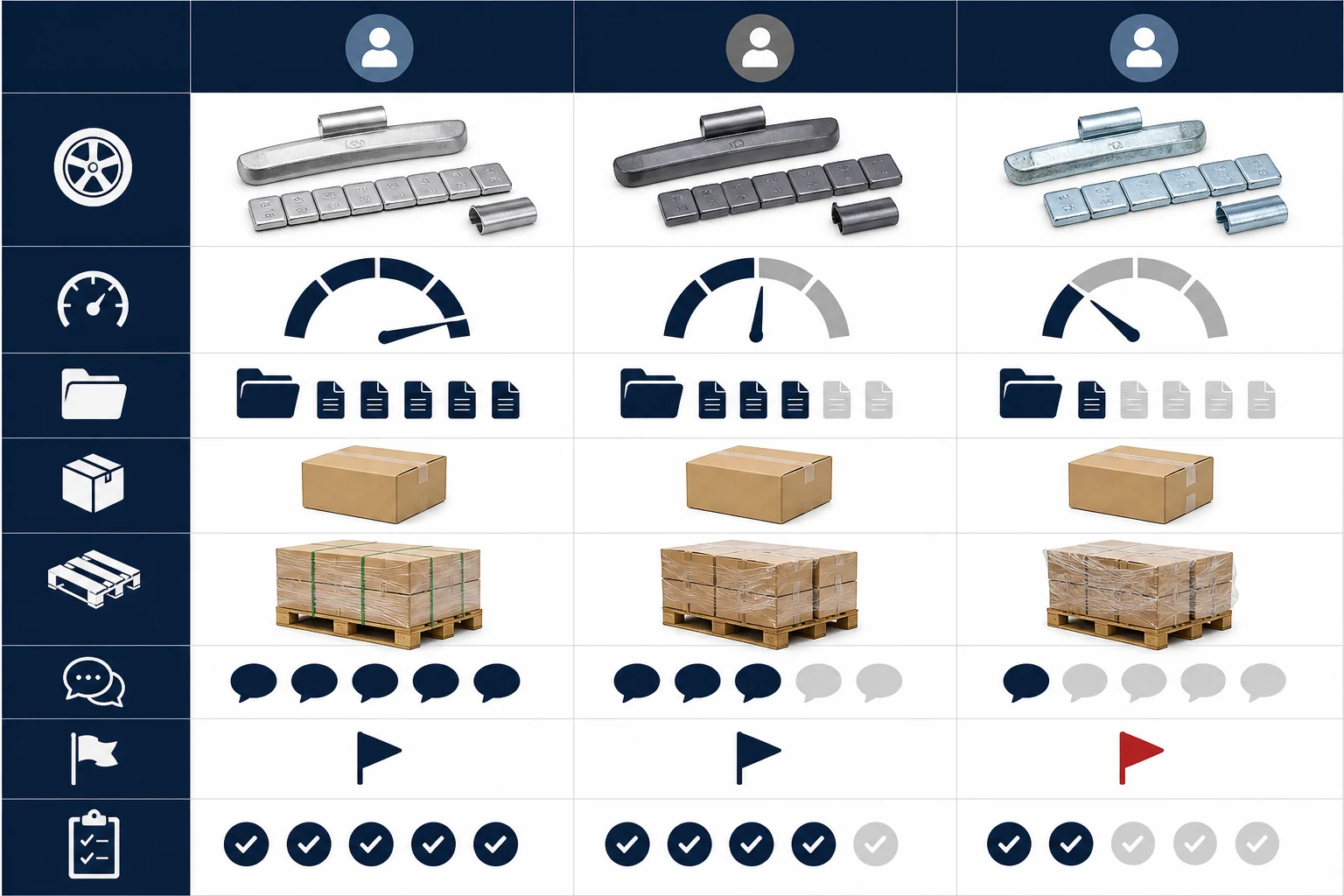
La primera pasada debe usar el mismo brief para cada empresa. Los compradores pueden comenzar con verificaciones iniciales del fabricante antes de la revisión de la tarjeta de puntuación, luego registrar la respuesta y la evidencia de respaldo, no simplemente una afirmación de marketing del proveedor.
| Área de puntuación | Pregunta sugerida | Evidencia a registrar |
|---|---|---|
| Idoneidad del producto | ¿Puede este candidato suministrar el SKU solicitado de tipo clip-on o adhesivo para las ruedas previstas? | SKU identificado, dibujo o declaración de aplicación, disponibilidad de muestra |
| Material y acabado | ¿Indica el material y acabado solicitados, y cualquier alcance de documentos? | Configuración por escrito y declaración relevante |
| Muestras y verificaciones | ¿Puede proporcionar muestras representativas y explicar la inspección? | Código de muestra, registro de medición o prueba, respuesta a preguntas |
| Evidencia de procesos | ¿Puede identificar las etapas que afectan al artículo solicitado? | Descripción relevante del proceso, punto de control o evidencia de fábrica |
| Embalaje | ¿Puede cumplir con las necesidades de embalaje interior, caja, etiqueta y palé? | Datos de embalaje, caja de muestra, campos de etiqueta |
| Soporte comercial | ¿Están claramente indicados el MOQ, la cotización, el plazo de entrega y las alternativas? | Términos por escrito, excepciones y supuestos válidos |
| Entrega y riesgo | ¿Define la responsabilidad, la documentación y el proceso de pedidos repetidos? | Alcance de entrega nombrado, proceso de cambio, ruta de reclamación |
No fuerce a todos los programas a usar las mismas ponderaciones. Un lanzamiento de marca puede ponderar altamente el embalaje y el control de cambios; un distribuidor de talleres de neumáticos puede ponderar la cobertura de gama, la lógica de cajas y el reabastecimiento. Registre la razón de la ponderación para que la decisión siga siendo comprensible.
¿Cómo debe puntuarse la idoneidad del producto?
Puntúe la idoneidad del producto frente a la aplicación real, no el número de páginas del catálogo o la experiencia automotriz general del proveedor. El candidato debe demostrar que comprende la fijación solicitada, el material, el perfil o la tira, los incrementos y la familia de envases.
Dé una puntuación alta solo cuando el producto solicitado esté identificado y el proveedor pueda explicar cualquier diferencia. Una puntuación más baja puede ser apropiada cuando un candidato tiene una alternativa plausible pero aún no puede demostrar el ajuste o una muestra coincidente. Trate las afirmaciones “universales” no respaldadas como necesidades de aclaración.
La idoneidad del producto también debe considerar la estructura de pedido prevista. Un proveedor con un único SKU adecuado pero sin un surtido, caja o plan de reabastecimiento viable puede no encajar en un programa de distribuidor. Por el contrario, un proveedor con una gama amplia pero evidencia débil para el perfil crítico no debería obtener una puntuación alta solo por su amplitud.
Las gamas directas de productos de contrapesos para ruedas muestran por qué la amplitud y la idoneidad deben puntuarse por separado. Plombco enumera productos para turismos y camiones en familias de clip-on, adhesivos, surtidos, materiales y aplicaciones, mientras dirige a los usuarios a una tabla de aplicaciones o a un medidor de llanta para la selección del perfil.4 Por lo tanto, un candidato puede recibir crédito por cobertura de gama relevante solo cuando también identifica qué producto real se ajusta a las aplicaciones solicitadas por el comprador.
¿Cómo deben puntuarse la evidencia de las muestras y la calidad de la respuesta?
Puntúe las muestras, la evidencia y la calidad de la respuesta según qué tan bien conectan la respuesta del candidato con el SKU solicitado y la ruta de aprobación del comprador. Una respuesta rápida es útil, pero no equivale a una respuesta clara respaldada por una muestra relevante, un registro de configuración, información de empaque y limitaciones declaradas.

La evidencia del proceso detrás de la configuración solicitada del peso de la rueda ayuda a los compradores a preguntar sobre las etapas relevantes de fabricación y control, mientras que controles de empaque y aprobación para un programa de proveedor de marca ayúdelos a ver si un candidato puede preservar la etiqueta, el cartón y la versión de aprobación correctos.
Para los criterios de liberación reales, puntúe si el candidato puede proporcionar evidencia del proveedor para la aprobación de QC del peso de la rueda: un SKU identificado, plan de muestreo, método de tolerancia o retención, evidencia de cinta y acabado, verificaciones de empaque, registro de lote y disposición clara para una excepción.
El principio de información documentada de ISO 9001 respalda una regla práctica de tarjeta de puntuación: otorgue crédito por la evidencia que identifica el producto, no por un certificado genérico separado del SKU cotizado.1
¿Cómo deben puntuarse el soporte comercial y el riesgo de entrega?
Puntúe el soporte comercial y el riesgo de entrega según si el proveedor deja claros los términos, el empaque, el límite de entrega y las condiciones de pedido repetido. Un precio bajo o un MOQ no son una ventaja completa si el candidato no puede explicar qué está incluido, qué se puede mezclar o quién es responsable de un problema después del envío.
Para la planificación de pedidos repetidos, use capacidad de cartón, palé y mezcla de SKU para suministro repetido y la rango y necesidades de reorden detrás de una decisión de proveedor distribuidor para evaluar si la oferta del proveedor funciona después del primer envío.
Revise el MOQ por SKU o cartón, la validez de la cotización, el plazo de entrega, los términos de pago y entrega, los documentos de exportación, el alcance de muestras e inspección, las etiquetas de paquete, la ruta de reclamaciones y la notificación de cambios. La guía de etiquetas logísticas de GS1 es un recordatorio de que las etiquetas de unidad de manejo tienen valor operativo; la identidad del cartón y del palé debe ser lo suficientemente clara para la recepción y la investigación.2
¿Cómo debe la tarjeta de puntuación ponderar el riesgo?
Pondere el riesgo según el costo de equivocarse para este programa específico. Un comprador que lanza una gama de marca puede dar más peso al control del cartón, la aprobación de muestras y la notificación de cambios; un distribuidor regional puede dar más peso a la cobertura de SKU, la confiabilidad de entrega y la flexibilidad de reabastecimiento. Los pesos deben decidirse antes de puntuar a los candidatos individuales.
Un método práctico es usar una puntuación de evidencia de cinco puntos para cada categoría, luego multiplicarla por un peso específico del programa. Por ejemplo, la adecuación del producto, la evidencia y el riesgo de entrega pueden tener pesos más altos que la velocidad de respuesta o la calidad de la presentación. Agregue un campo de notas junto a cada puntuación: “muestra identificada recibida”, “datos de cartón no proporcionados”, “solo alternativa estándar” o “plazo de entrega basado en una mezcla no confirmada”. Las notas evitan que una puntuación total oculte por qué un candidato está adelante o atrás.
No use el total ponderado para anular un fallo de umbral. Un proveedor puede alcanzar un número general fuerte mediante el precio y la calidad de respuesta mientras aún carece del perfil, la declaración de material, la capacidad de empaque o el límite de entrega requeridos por el programa. Mantenga las puertas de aprobado/reprobado separadas de la comparación ponderada, y registre el responsable y la fecha límite para cada riesgo abierto.
Revise la tarjeta de puntuación con las personas que recibirán, venderán, instalarán o darán soporte a la gama después de la compra. Un líder de abastecimiento puede ver una cotización competitiva, mientras que un equipo de almacén ve un conteo de cartones inutilizable y un equipo técnico ve un perfil de clip no probado. Llevar estas observaciones al mismo registro convierte la lista corta en una decisión operativa en lugar de una elección solo de compra.
Finalmente, ponga fecha a la tarjeta de puntuación e indique qué documentos del proveedor, revisiones de muestras y cotizaciones se revisaron. Una puntuación solo sigue siendo útil mientras su evidencia subyacente esté vigente; una cotización revisada, un plan de empaque diferente o una nueva muestra deben desencadenar una actualización en lugar de tratarse como la misma respuesta del candidato.
¿Cómo se ve una comparación completa de proveedores A B C?
Una comparación completa muestra el resultado del umbral, los pesos específicos del programa, la puntuación de evidencia, el total ponderado, las acciones abiertas y la disposición final para cada candidato. El ejemplo a continuación es ilustrativo y no representa proveedores reales ni pesos universales de categoría.
Suponga que un distribuidor necesita un programa sin plomo que contenga tiras adhesivas identificadas y perfiles de clip seleccionados, muestras representativas, cartones controlados, un pedido viable de SKU mixtos y una ruta de entrega declarada. Tres candidatos responden al mismo brief.
Paso 1: aplicar umbrales de aprobado/reprobado
| Umbral | Supplier A | Supplier B | Proveedor C |
|---|---|---|---|
| Familias adhesivas y de clip solicitadas identificadas | Aprobado | Aprobado | Aprobado |
| Muestra representativa vinculada al SKU cotizado | Aprobado | Aprobado | Reprobado: la muestra de clip no tiene identidad de SKU/perfil |
| Declaración de material sin plomo solicitada | Aprobado | Aprobado | Reprobado: solo afirmación general |
| Cartón viable y ruta de entrega | Aprobado | Aprobado | Aprobado |
| Resultado del umbral | Continuar | Continuar | Excluir hasta que se corrija |
El Proveedor C aún no debería entrar en una lista corta normal clasificada por precio. Su fallo no es que el catálogo sea demasiado pequeño o el precio demasiado bajo; el comprador no puede conectar la muestra crítica de clip y la afirmación de material con la configuración cotizada.
Paso 2: puntuar a los candidatos que aprobaron
Use una puntuación de evidencia de 1 a 5, donde 1 significa no respaldado o materialmente débil y 5 significa que el requisito está claramente respaldado para el programa solicitado. Multiplique cada puntuación por su peso y divida entre cinco. Los pesos del ejemplo suman 100%.
| Área de puntuación | Peso | Supplier A | Supplier B | Proveedor C* |
|---|---|---|---|---|
| Idoneidad del producto | 25% | 5 | 4 | 5 |
| Muestras y evidencia | 20% | 4 | 5 | 3 |
| Capacidad de empaque | 15% | 4 | 3 | 5 |
| Quality and traceability | 15% | 4 | 4 | 2 |
| Claridad comercial | 15% | 3 | 5 | 5 |
| Entrega y reabastecimiento | 10% | 4 | 3 | 4 |
| Total ponderado | 100% | 82 | 82 | 81* |
Total del Proveedor A = (5 x 25 + 4 x 20 + 4 x 15 + 4 x 15 + 3 x 15 + 4 x 10) / 5 = 82
El Proveedor A y el Proveedor B empatan numéricamente, pero no presentan la misma decisión. A tiene la adecuación de producto más fuerte y evidencia más estable de cartón estándar, mientras que su MOQ y flexibilidad comercial necesitan negociación. B tiene las muestras identificadas más fuertes y la cotización más clara, mientras que su cartón personalizado y el tiempo de reabastecimiento necesitan confirmación.
La puntuación teórica del Proveedor C se muestra solo para demostrar por qué importan los umbrales. Permanece excluido a pesar de un total de 81 porque el precio, el embalaje y la amplitud del catálogo no pueden compensar una muestra crítica para la aplicación no identificada y una declaración de material no respaldada.
Paso 3: registrar evidencia y disposición
| Candidato | Evidencia que impulsó el resultado | Acción pendiente | Disposition |
|---|---|---|---|
| Supplier A | Se identificaron muestras de clip y adhesivas; registros de materiales y procesos; datos estándar de cartón | Aclarar el MOQ de SKU mixtos y la validez del precio | Preseleccionar para aclaración comercial |
| Supplier B | Paquete de muestras sólido; cotización clara; material documentado; rango de productos viable | Aprobar el mockup del cartón y confirmar el plazo de reabastecimiento | Preseleccionar para confirmación de empaque |
| Proveedor C | Amplia gama y oferta comercial atractiva, pero la evidencia crítica no está vinculada al SKU | Suministrar muestra de clip identificada y declaración de material específica del SKU | Excluir; volver a puntuar solo después de que llegue la evidencia umbral |
La tarjeta de puntuación debe conservar esta explicación junto al total. Sin las notas de evidencia y la disposición, un empate de 82 a 82 no le dice casi nada al siguiente revisor sobre lo que debe suceder antes de la aprobación.
¿Cómo deben los compradores seleccionar la lista corta?
Seleccionar la lista corta eliminando los candidatos que no cumplen los requisitos umbral, luego comparar las puntuaciones ponderadas y los riesgos no resueltos de los candidatos restantes. Una puntuación alta no debe borrar una brecha grave en ajuste, material, documentación o responsabilidad de entrega.
Los requisitos del subnivel IATF enfatizan comunicar los requisitos del cliente, controlar los cambios y mantener la trazabilidad. Un comprador puede usar esa lección sin imponer una auditoría: preguntar si el candidato puede vincular la muestra aprobada, el SKU cotizado, el lote empacado y el proceso de cambio.3
Registrar los candidatos seleccionados, su puntuación, evidencia clave, acciones abiertas y responsable. Solicitar familias de muestras que coincidan con la especificación para un proveedor preseleccionado solo después de que el requisito y la tarjeta de puntuación identifiquen qué muestras reducirán genuinamente un riesgo de decisión.
Antes de la aprobación, usar verificaciones de auditoría de fábrica para un proveedor preseleccionado de contrapesos de rueda para convertir las acciones abiertas en una revisión enfocada de producción, control de materiales, QC, empaque y evidencia de trazabilidad.
Si está preseleccionando proveedores de contrapesos de rueda, comparta sus criterios indispensables, aplicaciones objetivo, requisitos de evidencia, volumen y cronograma. Podemos ayudarle a organizar una revisión enfocada de muestras y proveedores en torno a los riesgos que más importan.
Conclusión: use la tarjeta de puntuación para explicar la decisión
Una tarjeta de puntuación de proveedores de contrapesos de rueda brinda a los compradores una forma repetible de comparar candidatos después de elegir la ruta de abastecimiento. Comienza con un producto y un brief comercial, elimina a los candidatos que no cumplen requisitos críticos, luego puntúa el ajuste del producto, la evidencia, el empaque, el soporte y el riesgo.
Solicite una hoja de trabajo de tarjeta de puntuación de proveedores para su lista corta y mantenga la evidencia junto a cada puntuación. La decisión final entonces mostrará no solo quién ofreció un precio atractivo, sino quién puede respaldar el programa exacto de contrapesos de rueda a través de la aprobación, el envío y el suministro repetido.
Una vez que el candidato ganador esté listo para la aclaración comercial, una hoja de trabajo de RFQ copiable para el producto exacto y el alcance comercial ayuda a mantener alineados la especificación aprobada, el empaque, los documentos, la cantidad y los supuestos de cotización.
Preguntas frecuentes
¿Qué debería ser un requisito de aprobado/reprobado en una tarjeta de puntuación de proveedores de contrapesos de rueda?
Use requisitos de aprobado/reprobado para el ajuste del producto crítico para la aplicación, requisitos de material o documentos, disponibilidad de muestras representativas, empaque viable, alcance de entrega aceptable y cualquier requisito del comprador que no pueda intercambiarse por un precio más bajo.
¿Cómo deberían puntuarse los proveedores cuando ofrecen alternativas?
Registrar la alternativa por separado, indicar en qué se diferencia de la configuración solicitada y puntuarla contra el requisito solo después de que el comprador decida que es aceptable. No tratar silenciosamente un material, perfil, cinta o cartón alternativo como equivalente.
¿Debería el precio tener el mayor peso?
No automáticamente. El precio debe compararse solo después de que el producto, el paquete, los documentos, el alcance de entrega y el riesgo estén normalizados. El peso correcto depende del programa; un precio bajo no puede compensar un producto que no ajusta o un proveedor que no puede respaldar pedidos repetidos.
¿Qué evidencia es más útil antes de preseleccionar a un proveedor?
La evidencia útil identifica el SKU solicitado y explica su material, fijación, empaque, muestra, inspección y ruta de control de cambios. Los certificados genéricos y catálogos pueden apoyar una conversación, pero no deben reemplazar respuestas específicas del producto.
Referencias
[1] Organización Internacional de Normalización. “ISO 9001:2015 – Sistemas de gestión de la calidad – Requisitos.” 2015.
[2] GS1. “Directriz de etiqueta logística GS1.” n.d.
[3] Grupo de Trabajo Automotriz Internacional. “Requisitos mínimos del sistema de gestión de la calidad automotriz para proveedores de subnivel.” 2017.
[4] Plombco. “Contrapesos de balanceo de ruedas Plombco.” 2026.