






O MOQ do peso da roda depende se o pedido utiliza produtos padrão ou personalizados, o formato de fixação, material, perfil do clipe ou design da tira, embalagem, rotulagem e configuração de produção. Os compradores podem reduzir o risco de MOQ separando SKUs padrão comprovados das partes do programa que realmente precisam de personalização.
A quantidade mínima de pedido não é uma regra universal de fábrica e não é automaticamente um sinal de que um fornecedor é inflexível. É o ponto em que um fornecedor pode fabricar, controlar, embalar e enviar uma configuração definida de peso de roda sem criar um número antieconômico de trocas, caixas soltas ou sobras não rastreáveis. O trabalho do comprador é aprender a que se aplica o MOQ cotado antes de usá-lo em uma comparação de preços.
Índice
- O que o MOQ do peso da roda realmente significa?
- Por que o MOQ do peso da roda varia entre os pedidos?
- Como pesos de roda padrão e personalizados alteram o mínimo?
- Quais escolhas de material e fixação influenciam o MOQ?
- Como as escolhas de embalagem e marca própria alteram o MOQ?
- Como os compradores podem reduzir o risco de MOQ sem tornar a especificação vaga?
- O que deve constar em uma solicitação de MOQ antes da comparação de preços?
- Conclusão: torne o MOQ uma variável comercial definida
- Perguntas Frequentes
- Referências
O que o MOQ do peso da roda realmente significa?
O MOQ do peso da roda é a menor quantidade que um fornecedor está disposto a aceitar para um escopo de produto e pacote comercial declarados. Pode aplicar-se a um SKU, um material e acabamento, um perfil de clipe, uma tira com adesivo, um design de caixa, uma assortimento misto ou todo o pedido de compra. Esses são compromissos muito diferentes, então “Qual é o seu MOQ?” é incompleto por si só.
Por exemplo, um fornecedor pode aceitar um pedido modesto de tiras adesivas regulares já em seu plano de produção, mas exigir um mínimo muito maior para um comprimento de tira exclusivo, uma nova construção de fita, caixas impressas personalizadas ou uma mistura incomum de incrementos. Outro fornecedor pode cotar um mínimo por SKU porque precisa configurar um perfil de clipe ou célula de embalagem específicos. Nenhuma das respostas pode ser entendida sem o escopo.
Antes de discutir um número, dê à equipe de compradores uma definição de faixa curta. A visão de planejamento de faixa antes de definir um mínimo de pedido ajuda a identificar as aplicações de roda, famílias de fixação, materiais, incrementos e necessidades de mercado que devem ser fixados primeiro. Isso evita que um fornecedor tenha que precificar um programa indefinido de “pesos de roda” como se todos os formatos estivessem incluídos.
Use esta tabela de primeira passagem para tornar a conversa sobre MOQ específica.
| Pergunte ao fornecedor | Por que é importante | Uma resposta útil soa como |
|---|---|---|
| O MOQ é por SKU, por cor ou acabamento, por caixa, por família de produtos ou por pedido? | Define o que pode ser combinado e o que deve ficar sozinho | “Isto é por perfil de clipe e acabamento; valores dentro desse assortimento aprovado podem ser embalados juntos.” |
| O MOQ usa uma configuração de produto padrão? | Estoque padrão, ferramentas e formatos de embalagem podem reduzir o trabalho de configuração | “O mínimo declarado usa nosso material regular, fita e caixa simples.” |
| Qual recurso solicitado cria o mínimo? | Mostra se o fator é produto, embalagem ou manuseio comercial | “A caixa interna impressa e a versão com etiqueta separada criam o mínimo adicional.” |
| Os SKUs podem ser misturados, e em qual proporção? | Uma mistura pode resolver uma necessidade de canal, ou ocultar uma linha difícil de baixa produção | “O total pode ser misturado entre os incrementos listados, mas não entre famílias de perfil de clipe.” |
| O que acontece com o estoque ou componentes restantes? | Expõe riscos relacionados a fita especial, arte, etiquetas ou peças | “Etiquetas personalizadas são produzidas apenas para o pedido; qualquer saldo não utilizado precisa de um acordo de transferência por escrito.” |
Um MOQ é, portanto, um limite em torno de uma configuração definida, não uma tática de negociação de preço. Trate-o como um campo de especificação junto com material, fixação, incremento e unidade de embalagem.
Por que o MOQ do peso da roda varia entre os pedidos?
O MOQ varia porque cada pedido cria uma quantidade diferente de configuração, alocação de material, trabalho de embalagem, inspeção e risco de estoque residual. Quanto mais um pedido se afasta de um produto e fluxo de embalagem estabelecidos, mais provável é que o mínimo esteja vinculado a um item de linha específico em vez do total do pedido.
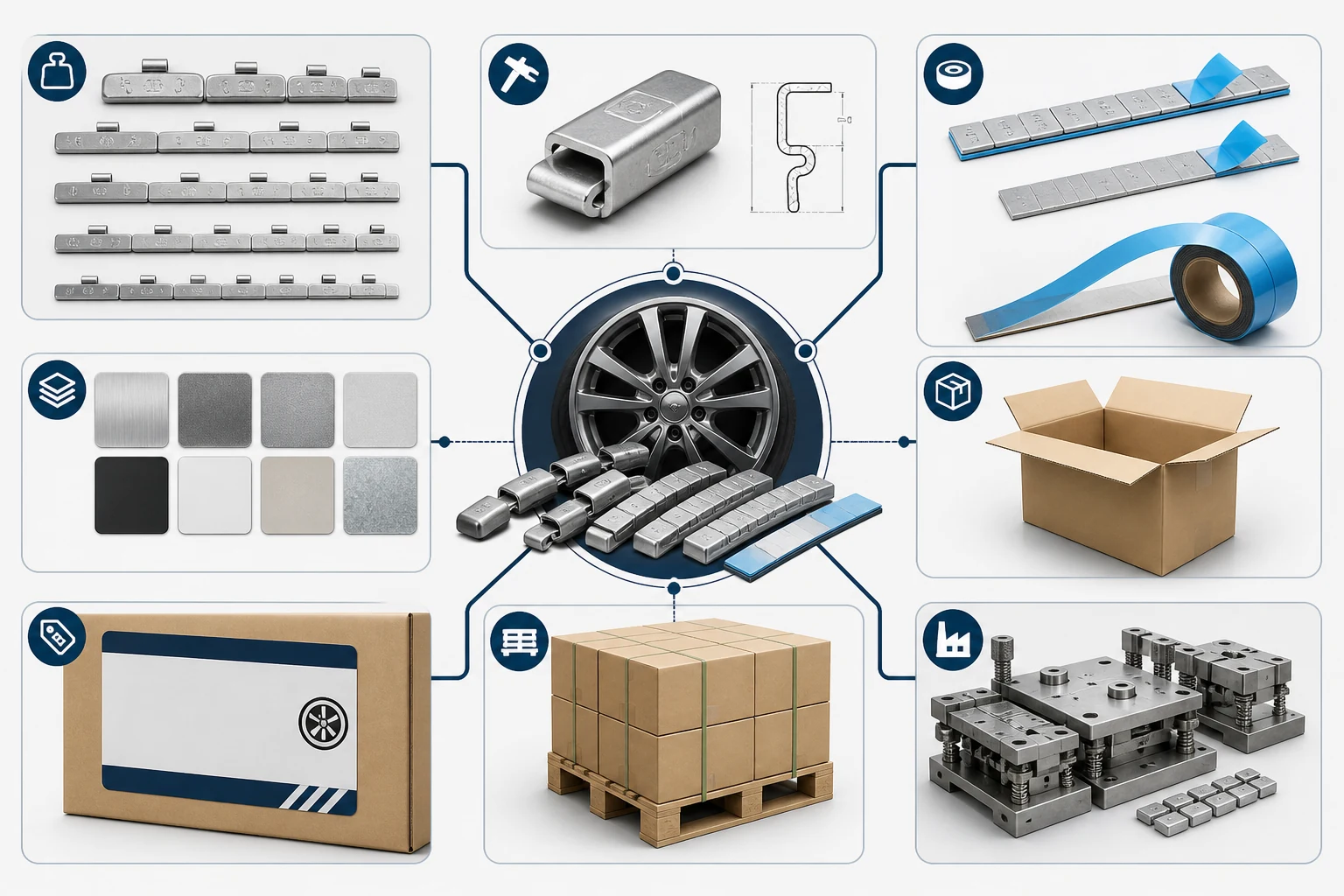
Os principais fatores nem sempre são visíveis em um catálogo. Um produto pode parecer padrão, mas exigir um clipe especial, revestimento incomum, um rolo de fita com mínimo do fornecedor, uma sequência de incrementos não padrão ou arte nova. Por outro lado, um pedido aparentemente grande pode ser relativamente fácil de acomodar quando usa configurações de produção existentes, caixas regulares e uma mistura de valores de alta rotatividade.
| Fator de MOQ | Por que pode aumentar o mínimo | O que um comprador pode fazer |
|---|---|---|
| Configuração de produção | Uma ferramenta de prensa, estação de conformação, lote de revestimento, execução de aplicação de fita ou configuração de inspeção deve ser preparada para uma variante definida | Pergunte se o pedido pode usar um processo existente e aprove sua versão padrão exata |
| Material ou acabamento | Um grau de material, acabamento, cor ou tratamento de proteção contra corrosão separado pode precisar de um lote ou batelada distinto | Mantenha o material base e o acabamento padrão, a menos que o destino ou a aplicação exija uma mudança |
| Perfil ou design da tira | Uma geometria de clipe, formato do corpo, tamanho da tira ou padrão de segmentação pode exigir ferramentas ou conversão dedicadas | Separe os requisitos de encaixe indispensáveis das preferências cosméticas e valide amostras precocemente |
| Mistura de incrementos | Slow-moving values may leave residual inventory or need a separate packing operation | Set an assortment ratio based on realistic consumption rather than equal quantities of every value |
| Tape and liner | Adhesive products may depend on a chosen tape, liner, storage protocol, and conversion format | Confirm whether the preferred tape is regular stock and whether the liner and roll format are standard |
| Packaging and labels | A special inner box, label language, barcode, carton print, or pallet pattern adds materials and changeover work | Start with a standard carton and controlled label where that still meets the launch need |
| Documentation and approval | New samples, drawings, inspection points, and release records require work before repeat production | Submit a concise specification once and use it for all supplier comparisons |
Carton count matters, but it is not the whole answer. A buyer might meet a carton minimum while still falling below the minimum for a special adhesive strip or a custom printed inner box. When the product list is already defined, carton and SKU-mix planning for a bulk order can help distinguish a logical replenishment quantity from a factory's product-configuration minimum.
Como pesos de roda padrão e personalizados alteram o mínimo?
Standard wheel weights usually have a lower and more flexible MOQ because the supplier can use established tooling, approved materials, existing inspection methods, and regular packaging. Custom wheel weights usually raise MOQ because the supplier must protect the cost and control of a configuration that may not be reusable for another buyer.
“Standard” must still be defined. It can mean a regular clip-on profile in the supplier's established range, a common adhesive strip with a current tape system, a normal increment series, a known finish, and a plain or standard-label carton. It does not mean that the item is automatically suitable for the buyer's rim population, market rules, or packaging workflow.
“Custom” also has levels. A buyer may only need a carton label carrying its own SKU and barcode. Another may require different inner-box dimensions, new printed artwork, a mix ratio unique to a local workshop program, a special coating, or a new tool. Each request should be quoted as a separate variable rather than bundled into one opaque “custom MOQ.”
| Requested change | Often closest to | MOQ effect to expect | Better first question |
|---|---|---|---|
| Existing SKU with a buyer-supplied outer label | Commercial packaging variation | Often lower than a printed-carton program, but still confirm label minimum | Can labels be applied to the regular carton and how is the label version controlled? |
| Existing weight and finish with a mixed-SKU carton | Packing variation | Depends on pick-and-pack work and the ratio of slow items | Which SKUs can share a carton, and what is the minimum per included line? |
| Different tape, liner, or strip length | Configuração do produto | Can rise if the tape or converting process is not regular stock | Is this tape and strip construction already used in regular production? |
| New clip profile or changed body geometry | Tooling or profile configuration | Often higher because fit and repeat production must be established | Is there an existing profile that physically fits the target rim? |
| New color, coating, or print artwork | Finish or packaging program | Depends on batch size, print process, and remaining materials | Which part of the request requires a separate batch or material purchase? |
This split matters in a first order. Instead of accepting a high total MOQ for a partially custom program, buyers can request two alternatives: one quote for an approved standard configuration and another for the custom element. The difference shows where the commercial exposure really sits.
Quais escolhas de material e fixação influenciam o MOQ?
Material and attachment choices influence MOQ when they require a different purchasing lot, production route, tool, tape system, test plan, or packing method. They should be treated as product-control decisions, not as descriptors to be added after the price is agreed.
For clip-on weights, the relevant questions include the clip profile, weight-body material, clip material where separate, coating, increment series, and the target rim family. A requested profile may be common within one supplier's range but unusual for another. A physical sample on a representative rim is often a more useful early step than assuming that a similar-looking clip can be substituted.
For adhesive weights, the buyer should clarify the material, coating, strip thickness, segment pattern, tape, liner, strip length, and storage conditions. One supplier may routinely run a particular strip and tape combination; another may have to buy a special tape lot or change conversion settings. Buyers can use tape and strip requirements that should be fixed before an adhesive MOQ is quoted to define the variables that make two adhesive offers materially different before they ask for a lower minimum.
The same principle applies to manufacturing evidence. The production stages that a repeat wheel weight program has to control help a buyer ask where a material, coating, clip, tape, inspection, or packing change enters the process. After clicking, the buyer can identify which requested feature needs a separate control point before treating it as a harmless variation.
Do not make material and attachment decisions only from an MOQ perspective. A lower minimum is not a saving if it uses an unsuitable profile, an unapproved tape configuration, or a finish that does not suit the application. The better approach is to state the non-negotiable technical requirements, then make commercial compromises only among the features that do not change fitment or intended use.
Como as escolhas de embalagem e marca própria alteram o MOQ?
Packaging and private-label choices change MOQ because they can introduce separate purchases of boxes, labels, printing plates, inserts, barcodes, or pallets, as well as additional packing and verification work. They should be planned as part of the SKU, but not every first order needs every branded element.
A regular plain carton with a controlled buyer label may be workable for a market test. A printed retail box, multiple languages, a custom divider, a special mixed-SKU kit, and a dedicated pallet label can each create a different minimum. The buyer needs to know whether the supplier's MOQ applies to the product inside, the printed packaging, the packing run, or all three.
GS1's logistic-label guidance illustrates why the packaging hierarchy matters: receiving and logistics labels are expected to communicate the identity of the handling unit. For a wheel-weight order, that makes carton and pallet labels operational information, not decoration; quantity, SKU, lot or batch field, and handling unit need to remain clear through storage and shipment.1
Buyers considering a branded launch can use packaging and approval decisions for a branded wheel weight range to separate the product approval from artwork, label, carton, and repeat-order controls. That helps them decide whether to begin with a standard carton plus label, or whether a custom package is essential to the launch.
Ask for a packaging breakdown rather than a single number:
- MOQ for the regular product SKU before any branding.
- MOQ for each printed inner box, outer carton, label language, barcode version, or insert.
- Minimum carton count, carton gross weight, and pallet configuration.
- Whether printed materials can be held for repeat orders, who owns them, and how their remaining quantity is recorded.
- Approval point for artwork, sample pack, label data, and the first production carton.
ISO 9001 includes control of documented information as a quality-management requirement. In this context, it supports a simple buyer practice: identify the approved packaging version and change it only through a visible record. A generic “same as sample” note is weak when labels, carton contents, or part numbers can change between orders.2
Como os compradores podem reduzir o risco de MOQ sem tornar a especificação vaga?
Buyers can lower MOQ risk by preserving the technical requirements that protect fitment and performance, while postponing or simplifying commercial variations that do not. The aim is not to ask for a vague product; it is to isolate which changes are essential for the market and which can wait until repeat demand is proven.
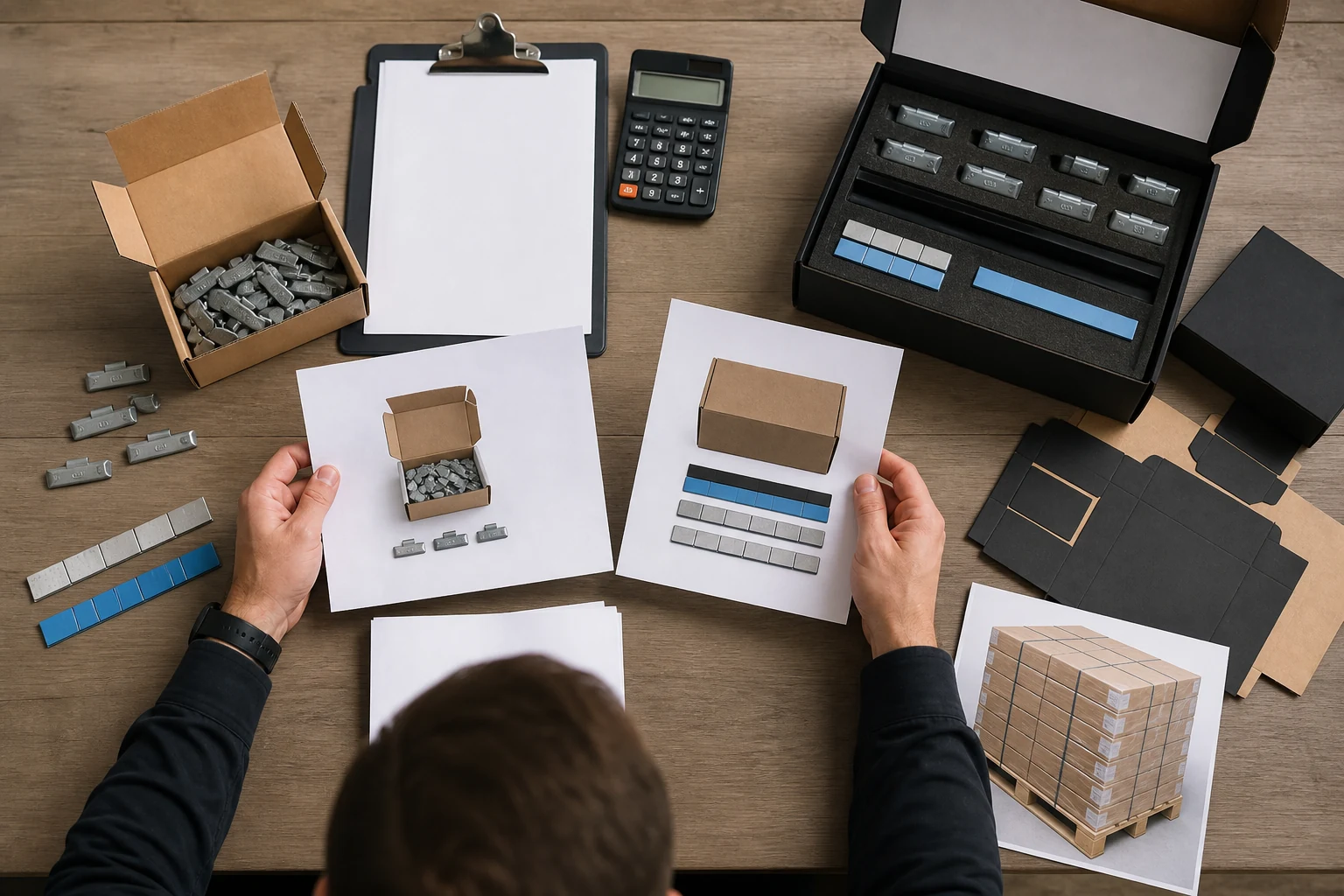
Use esta sequência:
- Build a launch shortlist around proven formats. Choose the few clip-on profiles or adhesive strips that meet the expected wheel applications and use regular materials, increments, and pack units where those are suitable.
- Rank each requested feature. Mark it as fitment-critical, compliance-critical, service-critical, brand-critical, or optional. A special carton finish may be brand-critical; a clip profile can be fitment-critical. They should not be negotiated in the same way.
- Request a standard and a custom alternative. Ask suppliers to quote the regular SKU, then list the MOQ and cost implication of each customization separately. This exposes the actual driver instead of forcing a supplier to make assumptions.
- Use sample approval before exclusive materials are ordered. Confirm the profile, strip, tape, finish, increment, and pack logic on identified samples before committing to printed cartons or special components.
- Set a realistic assortment ratio. Put more of the values and formats the market will consume, rather than spreading the order evenly across rarely used variants.
- Agree what happens at repeat order. Clarify whether MOQ changes after the first approved run, whether custom packaging remains in stock, and how a product or label revision is controlled.
Once the MOQ basis is clear, buyers can use supplier comparison points after the MOQ basis is clear to evaluate quotations on range coverage, pack logic, documents, quality control, and reorder stability instead of treating the lowest minimum as the only advantage.
For an early project, start with standard clip-on and adhesive sample families for an initial SKU shortlist that match the defined applications. Samples do not eliminate MOQ, but they reduce the chance of committing custom material or packaging to a product that has not been physically checked.
O que deve constar em uma solicitação de MOQ antes da comparação de preços?
An MOQ request should name the product scope, the quantities and pack units, the requested customization, and the information needed to compare alternatives. This gives a supplier permission to quote a viable standard route while making every exception visible.
Include the following in the request:
| Item do RFQ | O que declarar | Why it keeps MOQ answers comparable |
|---|---|---|
| Market and application | Country or channel, wheel types, intended service use, and relevant fitment need | Stops the supplier from offering an attractive but unsuitable standard line |
| Família de produtos | Clip-on or adhesive, profile or strip construction, material, finish, increments, and any non-negotiables | Identifies which part of the configuration the MOQ applies to |
| Quantity basis | Requested pieces, strips, cartons, kilograms, or mixed assortment and expected ratio | Distinguishes a total-order quantity from a per-SKU minimum |
| Embalagem | Inner pack, outer carton, label fields, pallet need, and branding requirements | Separates product MOQ from printed-material and packing minimums |
| Samples and approval | Needed samples, intended rims or test surfaces, approval timing, and evidence requested | Avoids producing special components before the buyer confirms the configuration |
| Alternativas | Request a standard option and a separately identified custom option | Lets the buyer see what change actually raises the minimum |
| Reorder assumptions | Forecast range, repeat frequency, and whether leftover packaging can be held | Helps the supplier propose a commercially realistic repeat program |
The International Automotive Task Force's requirements for sub-tier suppliers emphasize flow-down of customer requirements, change control, and traceability. A buyer does not need to impose an automotive-system audit to use that lesson: one named SKU brief and one controlled approval record make MOQ, samples, packaging, and later reorders far easier to manage.3
If MOQ is affecting your wheel-weight sourcing decision, share the target SKU range, forecast, packaging, customization, and launch schedule. We can help you separate fixed setup requirements from negotiable order quantities before you commit.
Conclusão: torne o MOQ uma variável comercial definida
Wheel weight MOQ is determined by the product and commercial scope behind the number: standard versus custom configuration, clip or strip design, material and finish, tape, increment mix, packaging, labels, samples, and production setup. The lowest number is only useful when it applies to the product the buyer can actually sell and support.
Define the launch SKU list first, keep fitment and application requirements clear, and ask suppliers to separate standard and custom alternatives. Request MOQ guidance for the proposed SKU list together with the pack plan and sample need. That gives the buyer a workable starting order without hiding the decisions that will matter on the repeat order.
Perguntas Frequentes
What is a typical MOQ for wheel weights?
There is no single typical MOQ that safely applies to all wheel weights. The minimum may be stated per SKU, profile, material, tape configuration, carton, printed package, or order. Ask a supplier to identify the exact scope before comparing any figure.
Is adhesive wheel weight MOQ usually different from clip-on wheel weight MOQ?
It can be. Adhesive weight MOQ may be affected by strip construction, tape and liner, segment pattern, and packaging; clip-on MOQ may be affected by profile, material, coating, increment assortment, and pack type. The actual minimum depends on whether those items are regular production configurations.
Can I mix wheel weight SKUs to meet an MOQ?
Sometimes, but the buyer should confirm the allowed mix. A supplier may allow different increments within one established range but not different clip profiles, materials, finishes, or packaging programs. Ask for the permitted SKU mix and the required ratio in writing.
Does private-label packaging increase wheel weight MOQ?
It often can, because printed cartons, labels, barcode versions, inserts, and custom packing may have separate material and setup minimums. Ask for a breakdown between the standard product MOQ and each packaging or label requirement.
How can a first-time buyer reduce MOQ risk?
Use standard, application-appropriate SKUs for the initial range, approve identified samples before ordering custom components, request a standard and a custom quotation, keep packaging practical, and state what can be carried into repeat orders. Do not remove fitment or product-control requirements merely to get a lower minimum.
Referências
[1] GS1. “Diretriz de Etiqueta Logística GS1.” s.d.
[2] Organização Internacional de Normalização. “ISO 9001:2015 – Sistemas de gestão da qualidade – Requisitos.” 2015.
[3] Força-Tarefa Automotiva Internacional. “Requisitos Mínimos do Sistema de Gestão da Qualidade Automotiva para Fornecedores de Subcamadas.” 2017.







