




Uma auditoria à fábrica de acessórios de carregamento de VE deve verificar o âmbito do produto e do processo, os controlos de materiais recebidos, a montagem e os testes, os registos de inspeção, a rastreabilidade, a capacidade, o controlo de alterações, o tratamento de não conformidades e a continuidade do fornecimento. Uma lista de verificação de fornecedores ajuda a pré-selecionar fornecedores; uma auditoria verifica se os controlos alegados existem na prática.
Um fornecedor pode ter um catálogo amplo, um site polido e uma cotação competitiva e ainda assim faltar-lhe os controlos necessários para um fornecimento repetido. O comprador precisa de saber se o cabo, conector, adaptador, suporte, tampa, base ou conjunto cotado é fabricado sob um processo controlado e se o fornecedor consegue provar o que aconteceu aos materiais e aos produtos acabados.
O objetivo de uma auditoria à fábrica não é recolher o maior número de fotografias. É ligar a especificação do produto a controlos de produção e registos observáveis. A auditoria deve responder a cinco perguntas: O âmbito está claro? Os materiais recebidos são identificados e aceites? A montagem e os testes são controlados? O fornecedor consegue rastrear uma unidade acabada ao longo do processo? A fábrica consegue satisfazer a procura e responder quando algo corre mal?
Utilize este artigo com o guia de compra de acessórios de carregamento de VE quando uma decisão de aprovisionamento passou da comparação de produtos para a verificação de fornecedores. Utilize o lista de verificação de fornecedores de acessórios para carregamento de VE para a pré-seleção inicial. Esta lista de verificação de auditoria serve para verificar as evidências por trás dessa pré-seleção.
Set the audit baseline with the lista de verificação da ficha de especificação do produto de acessórios de carregamento de VE. It identifies the SKU, revision, fitment, ratings, dimensions, documents, packaging, and exclusions that the factory evidence must support.
Índice
- O Que Verifica uma Auditoria à Fábrica de Acessórios de Carregamento de VE?
- Como Deve Ser Definido o Âmbito de uma Auditoria à Fábrica?
- O Que Devem os Compradores Verificar no Controlo de Materiais Recebidos?
- Como Devem Ser Verificadas a Montagem, os Testes e a Inspeção Final?
- Como Devem Ser Auditados a Rastreabilidade e o Controlo de Alterações?
- Como Devem Ser Testadas a Capacidade e a Continuidade do Fornecimento?
- Como Devem Ser Avaliadas as Não Conformidades e as Ações Corretivas?
- O Que Deve Constar num Dossiê de Evidências de Auditoria à Fábrica?
- Como Devem os Compradores Utilizar um Cartão de Pontuação de Auditoria à Fábrica?
- Que Lista de Verificação de Auditoria à Fábrica Copiável Podem os Compradores Utilizar?
- Conclusão: Verifique a Repetibilidade Antes de Aprovar o Fornecimento
- Perguntas Frequentes
- Referências
O Que Verifica uma Auditoria à Fábrica de Acessórios de Carregamento de VE?
Uma auditoria à fábrica de acessórios de carregamento de VE verifica se as pessoas, processos, equipamentos, registos e controlos de fornecimento de um fornecedor conseguem entregar o produto cotado de forma consistente. É uma revisão de processo e evidências, não uma revisão de fotografias de produtos e não substitui testes específicos do produto ou trabalho de conformidade de mercado.
A auditoria deve abranger:
- Tipos de produtos, SKUs, revisões, fábricas, linhas de produção e operações subcontratadas.
- Desenhos aprovados, listas de materiais, instruções de trabalho, parâmetros de processo e critérios de aceitação.
- Materiais e componentes recebidos, incluindo cabos, terminais, invólucros de conectores, contactos, vedantes, fixadores, etiquetas, embalagens e peças eletrónicas, quando aplicável.
- Montagem, cravação, fixação, moldagem, soldadura, selagem, etiquetagem, testes relacionados com carregamento, inspeção visual e embalagem.
- Calibração e manutenção de medidores, equipamento de teste elétrico, ferramentas de binário, dispositivos e outro equipamento crítico.
- Registos de lote, série, componente, operador, máquina, teste e expedição.
- Capacidade, mão de obra, tempo de atividade dos equipamentos, estrangulamentos, disponibilidade de materiais, manutenção e fontes de reserva.
- Não conformidade, contenção, análise de causa raiz, ação corretiva, verificações de eficácia e comunicação com o cliente.
- Alterações de engenharia, alterações de fornecedores, revisões de documentos, alterações de embalagem e regras de aprovação.
Uma auditoria pode ser remota, no local ou híbrida. A revisão remota é útil para documentos e entrevistas. A revisão no local é mais forte para confirmar a disposição real da linha, a segregação de materiais, as instruções de trabalho na estação, o estado do equipamento, a prática do operador, o preenchimento de registos e a relação entre o processo descrito e o produto que está a ser fabricado.
Como Deve Ser Definido o Âmbito de uma Auditoria à Fábrica?
O âmbito de uma auditoria à fábrica deve nomear o produto, a configuração, o local, o processo, o período de tempo, a amostra de evidências e o propósito da decisão. Sem um âmbito fixo, um fornecedor pode mostrar uma linha bem controlada que não fabrica o produto ou a revisão que o comprador planeia adquirir.
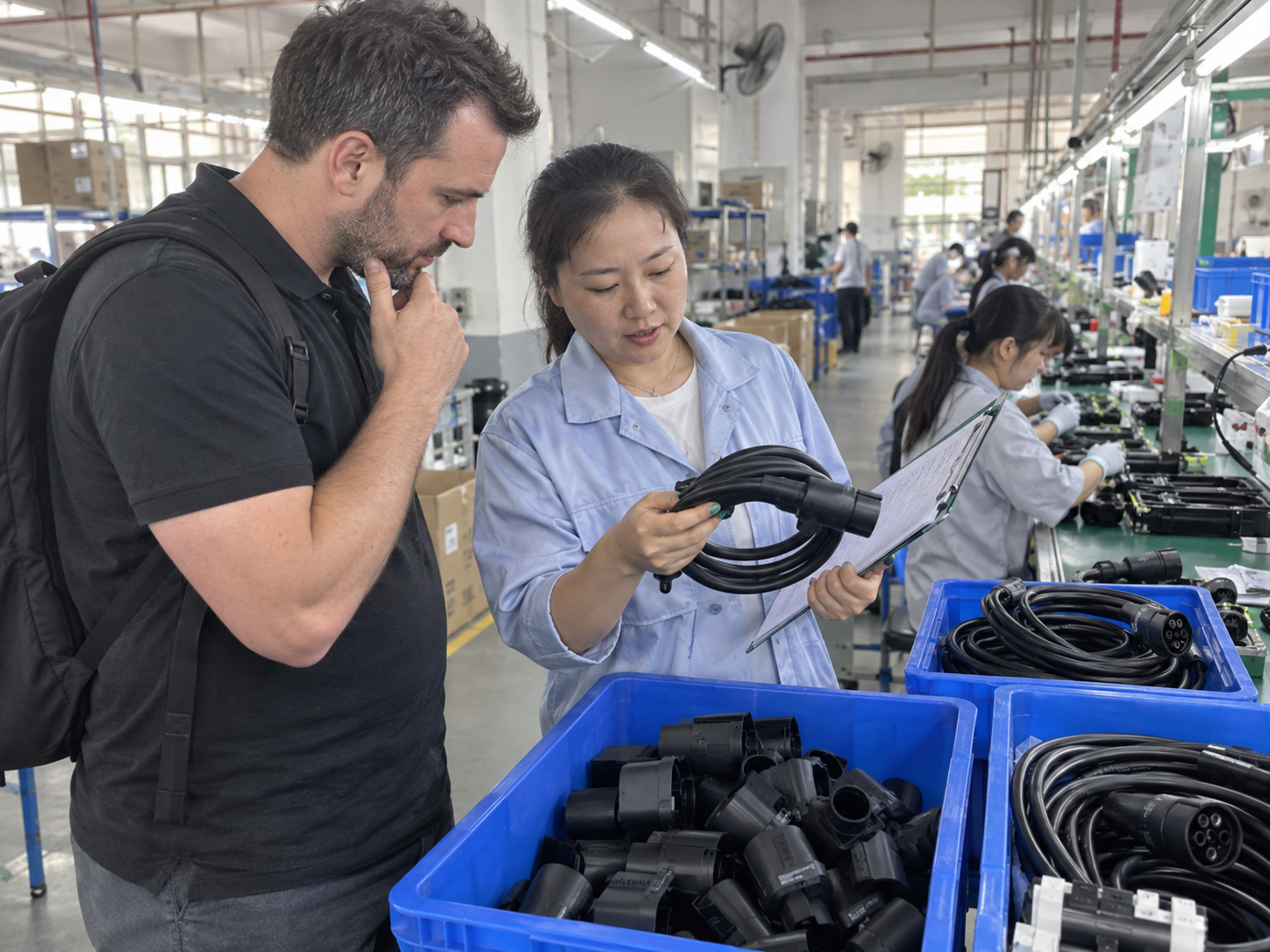
Defina o âmbito antes da auditoria:
| Campo do âmbito | O que o comprador deve especificar |
|---|---|
| Produto | Cabo, conector, adaptador, suporte, tampa, cobertura, base, peça de substituição ou conjunto |
| Configuração | SKU, modelo, revisão, combinação de conectores, comprimento do cabo, intervalo de corrente ou tensão, material, cor e peças incluídas |
| Mercado | País ou região, canal, idioma da etiqueta e do manual e documentos de mercado exigidos |
| Local | Entidade legal, fábrica física, edifício, linha, armazém e subcontratados aprovados |
| Processo | Receção, montagem, moldagem, cravação, testes, inspeção final, embalagem e libertação de expedição |
| Amostra de evidências | Lote recente, série, encomenda, registo de teste, NCR, CAPA e registo de expedição a rastrear durante a auditoria |
| Propósito da auditoria | Pré-seleção, primeira encomenda, marca privada, expansão de capacidade, seguimento de ação corretiva ou revisão periódica |
| Decisão | Aceitável, seguimento necessário, retenção, reauditoria ou rejeição |
Peça um mapa do local e um fluxo de processo antes da visita. Marque onde chegam as matérias-primas, onde é mantido o stock aceite e rejeitado, onde ocorre a produção, onde os testes são concluídos e onde os produtos acabados são libertados. O auditor deve conseguir selecionar um lote acabado recente e segui-lo retroativamente através dos registos.
Defina também o que a auditoria não abrange. Uma auditoria à fábrica pode verificar o controlo do processo e os registos sem verificar cada compatibilidade com veículos, cada aprovação do mercado-alvo ou a durabilidade ao longo da vida de um produto. Essas questões pertencem ao plano de amostragem, técnico e de revisão de documentos. O Lista de verificação de pedido de amostra de acessórios de carregamento de VE pode ser utilizado para ligar os resultados da auditoria à aprovação da amostra.
O Que Devem os Compradores Verificar no Controlo de Materiais Recebidos?
O controlo de materiais recebidos deve mostrar que o fornecedor sabe o que foi recebido, qual especificação se aplica, se foi aceite e onde foi utilizado. A auditoria deve ir além de “o armazém está organizado” e inspecionar os registos reais dos componentes utilizados no produto do comprador.
Check the following:
- Purchase specifications, approved supplier list, drawings, material requirements, and revision control.
- Receiving records that identify supplier, part number, lot or batch, quantity, date, and purchase order.
- Inspection criteria for cable, terminal, connector housing, contact, seal, fastener, plastic, metal, electronic, label, and packaging components.
- Sampling or acceptance rules, measurement records, visual criteria, and disposition of rejected or suspect material.
- Status identification for received, pending inspection, accepted, rejected, returned, reworked, and released material.
- Storage conditions, shelf-life or first-in-first-out controls where relevant, moisture protection, contamination control, and physical segregation.
- Supplier change notifications and approval records for critical components.
- Traceability from incoming lot to work order, production lot, finished product, and shipment.
Ask to see one accepted lot and one rejected or held lot. The supplier should explain who released each lot, what inspection was performed, and how the material was prevented from entering production before disposition. If all examples are perfect, ask for a recent nonconformance or supplier corrective-action record with sensitive information redacted.
For connector and cable products, verify that the incoming specifications match the quoted configuration. A different contact plating, cable construction, housing material, seal, or terminal source can affect fitment, performance, appearance, and documents. The goal is not to dictate a supplier’s internal design, but to verify that changes are controlled and that the supplier can identify what entered the finished product.
Como Devem Ser Verificadas a Montagem, os Testes e a Inspeção Final?
Assembly, testing, and final inspection should be verified by observing the actual station, checking the current work instruction, reviewing records, and tracing a result to a defined product and revision. A sign that says “100% inspection” is not sufficient evidence by itself.
Review each critical process step:
| Process area | Audit questions | Evidência a solicitar |
|---|---|---|
| Work instructions | Is the instruction current, visible, and tied to the product revision? | Controlled instruction, revision history, station copy |
| Assembly | Are tools, fixtures, torque, crimp, insertion, sealing, or molding parameters defined? | Parameter sheet, setup check, first-piece record |
| Operator control | Are operators trained and is authorization current for critical work? | Training matrix, authorization record, re-training trigger |
| In-process checks | Are critical dimensions, crimp, pull, continuity, sealing, or appearance checks performed at the right point? | Check sheet, sample record, reaction plan |
| Electrical or functional tests | Is the method, instrument, limit, result, and product identity recorded? | Test procedure, test log, equipment ID, failure disposition |
| Calibration | Are measuring and test instruments identified and within calibration? | Calibration list, certificates, overdue control |
| Inspeção final | Are final appearance, dimensions, markings, packaging, and function checked before release? | Final inspection plan and completed records |
| Shipment release | Does someone with defined authority release the lot? | Release record, hold status, packing list, lot reference |
Ask the supplier to demonstrate a normal production check and explain what happens when the result fails. A capable process has a reaction plan: stop, identify, contain, investigate, rework or reject, document, and release only after an authorized decision. The buyer should ask to see the failed result or a redacted example when possible.
For cables, connectors, and related accessories, agree which product-level checks are performed at sample approval and which are repeated in production. The Lista de verificação de inspeção de qualidade de cabos de carregamento de VE can support the detailed physical and electrical inspection layer. This factory audit asks whether the inspection system exists, is understood, and leaves traceable records.
Standards references can help define the evidence conversation. IEC 61851-1 covers general requirements for EV conductive charging systems within its scope, including connection and electrical-safety aspects. IEC 62893-1 covers construction, dimensions, and test requirements for charging cables within its stated scope. Use IEC 61851-1:2017 as 2 and IEC 62893-1:2017 as 3, while requiring the supplier to identify the exact product, test method, edition, and market boundary that apply.
For connector and inlet scope, record the applicable IEC 62196-1 reference as 4. When independent cable or connector evidence is part of the audit pack, compare the supplier’s product and test scope with the UL Solutions safety and performance testing reference as 5 rather than accepting a generic report.
Como Devem Ser Auditados a Rastreabilidade e o Controlo de Alterações?
Traceability and change control should allow the buyer to answer two questions: Which materials, process conditions, and records went into this finished lot? What happens when the supplier changes one of them?
Test traceability by selecting a recent finished lot and tracing it backward:
- Finished SKU, revision, quantity, packing date, and shipment reference.
- Final inspection and functional test records, including instrument or station identity.
- Work order, production line, operator or team, machine, fixture, and process parameters.
- Incoming component lots, supplier records, inspection results, and release status.
- Nonconformance, rework, deviation, or concession records linked to the lot.
Then perform the reverse test. Choose one incoming component lot and ask which work orders, finished products, and shipments used it. The supplier may not have the same level of serialization for every accessory, but it should define the actual lot or batch logic and show how a field issue would be contained.
Audit change control for:
- Connector, contact, cable, material, seal, housing, fastener, electronic, or packaging component.
- Supplier, subcontractor, factory, production line, process parameter, tool, mold, fixture, or test method.
- Drawing, specification, label, manual, declaration, certificate, listing, test report, barcode, or artwork.
- Product revision, SKU, bundle contents, color, cable length, or market-specific configuration.
The change record should identify the affected SKU and revision, describe the change, state the reason, assess fitment and technical impact, list updated evidence, define sample or revalidation requirements, and record buyer notification and approval. A supplier should not rely on an informal email if the change could affect the approved product or its market handoff.
Ask to see one closed change and one open or recent change. Check whether the old and new revisions were separated, whether the first affected lot was identified, and whether documents and labels were updated together. A change-control process is only useful if the factory floor and warehouse use the released revision.
After the audit, use the EV charging accessories change-control checklist to connect factory evidence with supplier notifications, revision impact assessment, sample revalidation, and stock transition after approval.
Como Devem Ser Testadas a Capacidade e a Continuidade do Fornecimento?
Capacity and supply continuity should be tested against the buyer’s product mix, forecast, delivery window, component dependencies, and recovery assumptions. A factory’s total monthly output is not the same as its available capacity for the buyer’s exact connector, cable, color, packaging, or test configuration.
Review:
- Current production lines, work centers, key equipment, shifts, staffing, and operating calendar.
- Bottlenecks such as crimping, molding, assembly, electrical testing, final inspection, packaging, or document release.
- Recent output by product family and the capacity reserved for other customers.
- Planned maintenance, equipment downtime, calibration downtime, and replacement or repair capability.
- Labor training and the number of qualified operators for critical processes.
- Component availability, approved suppliers, single-source risks, and minimum order dependencies.
- Subcontracted processes and the supplier’s oversight, acceptance, and traceability of those processes.
- Capacity expansion plans, second shifts, new equipment, and the evidence supporting those plans.
- Contingency plans for component shortage, equipment failure, quality hold, labor disruption, logistics disruption, or sudden demand changes.
Ask the supplier to show how a forecast becomes a production schedule. Compare the buyer’s peak scenario with available equipment, labor, component supply, inspection capacity, and packing capacity. If a supplier quotes a delivery date, ask which assumptions must remain true for that date to hold.
Do not treat a planned factory, planned machine, or planned second shift as current capacity. Record it as an unverified assumption until the supplier can show purchase, installation, qualification, staffing, or production evidence. The audit should distinguish available now, available after action, e not verified.
For repeat supply, review reorder lead time separately from first-order lead time. The first order may include samples, tooling, artwork, document release, or process setup. A repeat order may remove some steps but still depend on material availability, production slots, inspection, packaging, and shipping. Connect these findings to the buyer’s MOQ and forecast plan before approval.
Como Devem Ser Avaliadas as Não Conformidades e as Ações Corretivas?
Nonconformance and corrective-action controls should show how the supplier contains a problem, finds the cause, prevents recurrence, and checks whether the action worked. A completed form is not enough if the same issue keeps appearing in later records or customer claims.
Review the supplier’s process for:
- Identifying and segregating nonconforming material or finished goods.
- Stopping affected production or shipment when the risk requires it.
- Defining the affected lot, period, SKU, revision, supplier, and customer shipment.
- Recording immediate containment and authorized disposition.
- Performing root-cause analysis that reaches the process or system cause.
- Assigning corrective and preventive actions with owners and due dates.
- Verifying effectiveness through later production, inspection, audit, or field data.
- Communicating the issue and action to the buyer when the approved product or shipment is affected.
Ask for a redacted example involving fitment, electrical test, appearance, packaging, component shortage, or traceability. Check whether the record identifies the affected product and whether the final action changed a work instruction, supplier control, inspection method, fixture, training, or change-control step where appropriate.
Classify findings by effect and urgency. A critical finding may justify a hold or re-audit. A major finding may allow progress only with a dated corrective-action plan and verification. A minor finding may be closed through normal follow-up. The buyer should define these categories before the audit so the outcome does not depend on the auditor’s mood or the supplier’s presentation.
O Que Deve Constar num Dossiê de Evidências de Auditoria à Fábrica?
A factory audit evidence pack should let a reviewer understand the product scope, observe the process logic, trace a lot, verify capacity assumptions, and confirm that open risks have owners. The pack should contain controlled documents and redacted records where commercial or personal information cannot be shared.
Request:
| Evidence group | Suggested records |
|---|---|
| Site and scope | Legal entity, site address, organization owner, process flow, line map, approved subcontractors, product and revision list |
| Product control | Drawing, specification, bill of material, work instruction, control plan, sample approval, and revision history |
| Incoming materials | Approved supplier list, receiving record, inspection plan, accepted and rejected lot examples, and component traceability |
| Process control | Setup checks, first-piece approval, critical parameters, operator training, in-process checks, and reaction plan |
| Testing and inspection | Test procedure, instrument list, calibration status, sample results, final inspection plan, and shipment release record |
| Rastreabilidade | Lot genealogy, work order, component lot, machine or fixture, operator or team, test record, rework, and shipment link |
| Capacity | Recent output, equipment list, shifts, bottleneck review, maintenance, downtime, labor plan, and peak-demand scenario |
| Supply continuity | Critical component map, approved sources, backup plan, subcontractor controls, logistics plan, and recovery assumptions |
| Nonconformance | NCR, containment, disposition, root cause, corrective action, effectiveness check, and customer notification example |
| Controle de mudanças | Engineering change notice, revision release, sample or revalidation rule, document update, packaging update, and buyer approval |
Every file should identify its product or process scope, revision, date, owner, and status. A certificate or test report without a product identity is not enough to prove that the evidence covers the quoted SKU. The Lista de verificação de certificação e documentos de ensaio de acessórios de carregamento de VE can be used for document-scope review.
For private-label programs, extend that evidence trail with the private-label EV charging accessories document pack checklist, which maps labels, manuals, declarations, test reports, barcodes, and release ownership to the exact SKU and revision.
ISO 9001 describes requirements for a quality management system. It can be a useful framework reference during a supplier audit, but the buyer should still inspect product-specific records, process controls, and traceability for the actual EV charging accessories being quoted. See ISO 9001:2015 as 1.
Organize the evidence pack with a simple index:
Evidence ID | file name | product/SKU | revision | date | owner | scope | status | audit finding
If the supplier cannot share a full record, ask for a redacted sample, screen share, or on-site review. Mark the evidence as partially verified rather than treating an unavailable file as confirmed.
Como Devem os Compradores Utilizar um Cartão de Pontuação de Auditoria à Fábrica?
Buyers should use a factory audit scorecard only after screening hard-stop findings. The score should summarize evidence quality and operating capability, not compensate for an incompatible product, missing critical control, or uncontained major risk.
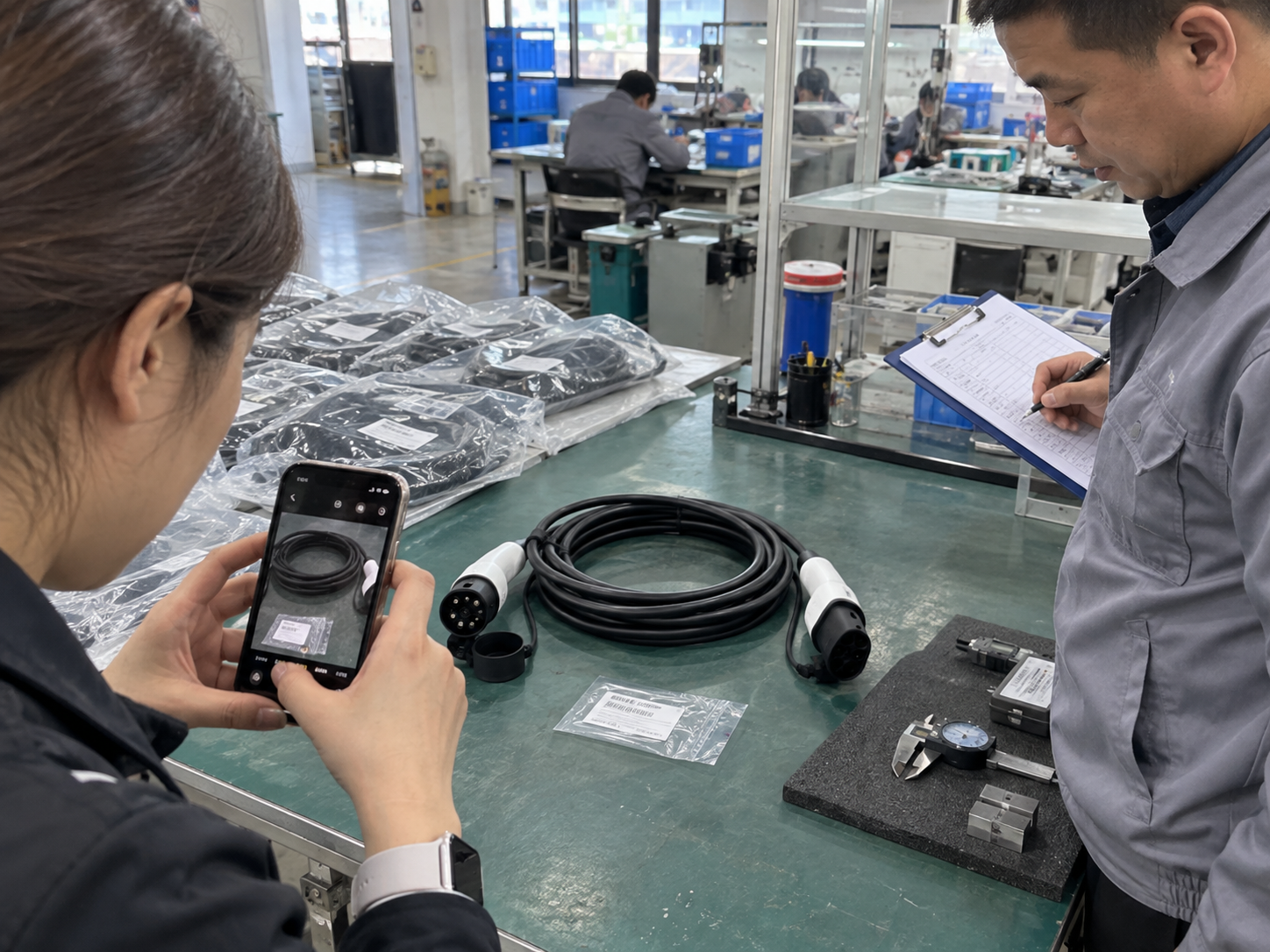
Use a buyer-defined 100-point model such as:
| Audit area | Example weight | What the auditor should verify |
|---|---|---|
| Product scope and process control | 20 | Exact SKU/revision, drawings, BOM, work instructions, process flow, and controlled releases |
| Incoming material control | 15 | Approved sources, receiving inspection, segregation, component status, and lot linkage |
| Assembly, testing, and final inspection | 25 | Critical parameters, trained operators, test methods, calibration, reaction plan, and release records |
| Rastreabilidade e controlo de alterações | 15 | Lot genealogy, revision control, supplier changes, PCN/ECN, revalidation, and buyer notification |
| Capacity and supply continuity | 15 | Product-specific capacity, bottlenecks, material dependencies, maintenance, backups, and recovery plan |
| Nonconformance and corrective action | 10 | Containment, root cause, corrective action, effectiveness, and customer communication |
Hard-stop screening before scoring
Place a supplier on hold or require a defined re-audit when any buyer-defined hard stop is present. Examples include:
- The audited site does not make or control the quoted product and the actual manufacturer is undisclosed.
- The supplier cannot identify the exact SKU, revision, product scope, or included components.
- Critical incoming components have no acceptance status or no usable traceability.
- Required assembly or electrical tests are not defined, not performed, or not supported by records.
- Test equipment used for a critical result is overdue, unidentified, or outside the supplier’s control.
- Finished lots cannot be traced back to materials, process records, or shipment.
- A major nonconformance remains uncontained or has no owner and due date.
- The supplier cannot explain how product, material, factory, document, or packaging changes are approved.
- Quoted capacity depends on unverified equipment, labor, components, or subcontractors.
Score evidence, not confidence
For each scored area, record the evidence ID, finding, status, owner, due date, and closure method. Use statuses such as verified, partially verified, open, e not applicable. A supplier that openly identifies a gap may be easier to manage than one that gives a confident answer without records, but both should be scored against the same evidence rules.
Do not publish a universal pass threshold as if it were an industry rule. Set the threshold based on product risk, target market, customer requirements, order value, and the buyer’s quality system. A buyer can require all hard stops to be closed and set a minimum score for shortlist, conditional approval, or full approval.
Que Lista de Verificação de Auditoria à Fábrica Copiável Podem os Compradores Utilizar?
Copy the following checklist into an audit form. Add evidence IDs and findings during the review. One audit record should cover one site and one defined product or process scope.
EV CHARGING ACCESSORIES FACTORY AUDIT CHECKLIST
- Audit reference:
- Supplier and legal entity:
- Factory site and address:
- Audit type: [remote / on-site / hybrid / follow-up]
- Audit date:
- Auditor(s):
- Supplier host(s):
- Audit purpose:
- Buyer product / SKU / revision:
- Target market and delivery channel:
1. Scope and Site Control
- [ ] Product, SKU, model, revision, and included components confirmed
- [ ] Factory site and production line confirmed
- [ ] Actual manufacturer and subcontractors disclosed
- [ ] Site map and process flow received
- [ ] Drawings, BOM, specifications, and work instructions controlled
- [ ] Audit sample lot / batch / order selected
- Evidence IDs:
- Finding / action / owner / due date:
2. Incoming Materials
- [ ] Approved supplier list available
- [ ] Incoming parts identified by part number and lot / batch
- [ ] Receiving and inspection records available
- [ ] Accepted, pending, rejected, and held material segregated
- [ ] Critical component specifications and revisions controlled
- [ ] Storage, shelf-life, contamination, and moisture controls reviewed
- [ ] Incoming lot can be linked to a production work order
- Evidence IDs:
- Finding / action / owner / due date:
3. Assembly and Process Control
- [ ] Current work instructions visible at relevant stations
- [ ] Operator training and authorization records available
- [ ] Critical tools, fixtures, parameters, and setup checks defined
- [ ] First-piece or start-up approval completed
- [ ] In-process checks performed and recorded
- [ ] Failed results trigger a documented reaction plan
- [ ] Rework and deviation approval controlled
- Evidence IDs:
- Finding / action / owner / due date:
4. Testing and Final Inspection
- [ ] Test methods and acceptance limits defined
- [ ] Test equipment identified and calibrated where required
- [ ] Test result links to product, lot, station, and date
- [ ] Visual, dimensional, functional, and packaging checks defined
- [ ] Final inspection record completed before shipment release
- [ ] Nonconforming results are contained and dispositioned
- [ ] Shipment release authority is defined
- Evidence IDs:
- Finding / action / owner / due date:
5. Traceability
- [ ] Finished SKU and revision linked to lot / batch / serial where applicable
- [ ] Work order, line, machine, fixture, and operator / team recorded
- [ ] Incoming component lots trace to finished products
- [ ] Finished product traces forward to shipments or customers
- [ ] Rework, concession, and deviation records linked to affected lots
- [ ] Records can be retrieved within an agreed time
- Evidence IDs:
- Finding / action / owner / due date:
6. Change Control
- [ ] Product and engineering changes are documented
- [ ] Supplier, component, factory, and process changes are controlled
- [ ] Labels, manuals, declarations, reports, and packaging revisions are linked
- [ ] Sample or revalidation rule is defined
- [ ] Buyer notification and approval requirements are defined
- [ ] First affected lot and old-stock plan can be identified
- Evidence IDs:
- Finding / action / owner / due date:
7. Capacity and Supply Continuity
- [ ] Product-specific output and bottlenecks reviewed
- [ ] Shifts, labor, equipment, maintenance, and downtime reviewed
- [ ] Critical component availability and single-source risks reviewed
- [ ] Subcontractor capacity and controls reviewed
- [ ] Peak-demand scenario tested against available capacity
- [ ] Backup equipment, supplier, labor, and logistics options identified
- [ ] Recovery plan has owners and trigger conditions
- Evidence IDs:
- Finding / action / owner / due date:
8. Nonconformance and Corrective Action
- [ ] Nonconforming material is segregated and controlled
- [ ] Containment and disposition authority defined
- [ ] Root-cause method used on significant issues
- [ ] Corrective actions have owners and due dates
- [ ] Effectiveness checks are completed
- [ ] Customer notification process is defined
- [ ] A recent redacted NCR / CAPA example reviewed
- Evidence IDs:
- Finding / action / owner / due date:
9. Decision
- Hard-stop findings: [none / open / closed]
- Audit status: [acceptable / follow-up / hold / re-audit required]
- Weighted score:
- Evidence pack complete: [yes / partial / no]
- Required corrective actions:
- Supplier response due date:
- Buyer verification date:
- Approved by:
- Approval date:
Keep the completed checklist with the evidence index, audit photos, redacted records, supplier response, corrective-action closure, sample approval, and quotation. The record should show what was verified on the audit date. It should not imply that the factory will remain unchanged without future monitoring.
If you are qualifying an EV charging accessories supplier, share the product scope, site, process, traceability records, capacity assumptions, and corrective-action evidence. We can help organize a focused factory-audit evidence review before approving repeat supply.
Conclusão: Verifique a Repetibilidade Antes de Aprovar o Fornecimento
An EV charging accessories factory audit should follow the product through the factory. Define the exact scope, inspect incoming materials, observe assembly and testing, verify final inspection and calibration, trace a finished lot backward and a component lot forward, review capacity and supply continuity, and test how the supplier handles nonconformance and change.
Use hard-stop screening before a weighted score. Require evidence IDs, owners, due dates, and closure methods for open findings. A factory audit does not replace product fitment, sample approval, market documentation, or ongoing QC. It verifies whether the supplier has the operating controls needed to deliver those requirements repeatedly.
If you need a structured review, request a supplier audit evidence pack with the target product list, SKU and revision, target market, forecast, required documents, and delivery expectations. The most useful pack connects the quoted product to the process, the records, and the people responsible for keeping it under control.
Perguntas Frequentes
What is an EV charging accessories factory audit?
It is a structured review of a supplier’s product scope, production process, incoming materials, assembly, testing, inspection, traceability, capacity, change control, nonconformance handling, and supply continuity. It verifies whether the supplier’s capability claims are supported by observable controls and records.
Is a factory audit the same as a supplier checklist?
No. A supplier checklist helps shortlist and compare suppliers using stated capabilities, documents, samples, MOQ, lead time, and service terms. A factory audit verifies whether the selected supplier’s production controls, records, equipment, traceability, and corrective-action process exist in practice.
Should the audit cover the exact SKU and revision?
Yes. State the exact product, configuration, SKU, revision, included parts, market, and factory. An audit of a similar product or a different revision may provide context, but it should not be recorded as full verification of the quoted configuration.
What evidence should an auditor request from the factory?
Request process flow, drawings, BOM, work instructions, incoming inspection records, process checks, test logs, calibration status, final inspection records, lot genealogy, capacity evidence, maintenance records, NCR/CAPA examples, and change-control records. Each file should identify product scope, revision, date, owner, and status.
How can buyers test traceability during an audit?
Select a recent finished lot and trace it backward to the work order, line, process records, test results, and incoming component lots. Then choose an incoming component lot and trace it forward to finished products and shipments. Record where the chain stops or becomes manual and assess whether that gap is acceptable.
Does ISO 9001 certification prove that an EV accessory factory is qualified?
No single certificate should replace product- and process-specific verification. A quality-management certification may be a useful framework reference, but the buyer still needs to inspect the actual product scope, tests, records, traceability, capacity, and change control for the supplier and site being considered.
How should a buyer score audit findings?
Screen hard stops first, then use a buyer-defined weighted score for process control, incoming materials, testing, traceability, capacity, continuity, and corrective action. Record the evidence behind every score. Do not let a high total score hide a critical gap in product identity, testing, traceability, or change control.
How often should a factory audit be repeated?
The frequency should match product risk, supplier performance, change activity, customer requirements, and supply importance. Repeat or follow up after a major process, factory, component, or product change, a serious nonconformance, an unresolved corrective action, or a material shift in demand or capacity.
Can a remote audit verify factory capability?
A remote audit can review documents, records, interviews, and live video evidence. It is weaker for confirming physical material segregation, station instructions, equipment condition, actual operator practice, and whether the described process matches the product. Use a hybrid or on-site review when those observations are decision-critical.
Referências
[1] International Organization for Standardization. “ISO 9001:2015 Quality management systems – Requirements.” 2015.
[2] International Electrotechnical Commission. “IEC 61851-1:2017 Electric vehicle conductive charging system – Part 1: General requirements.” 2017.
[3] International Electrotechnical Commission. “IEC 62893-1:2017 Charging cables for electric vehicles for rated voltages up to and including 0,6/1 kV – Part 1: General requirements.” 2017.
[4] International Electrotechnical Commission. “IEC 62196-1 Plugs, socket-outlets, vehicle connectors and vehicle inlets – Conductive charging of electric vehicles – Part 1.” 2022.
[5] UL Solutions. “Safety and Performance Testing for Automotive Cables and Connectors.” 2025.