


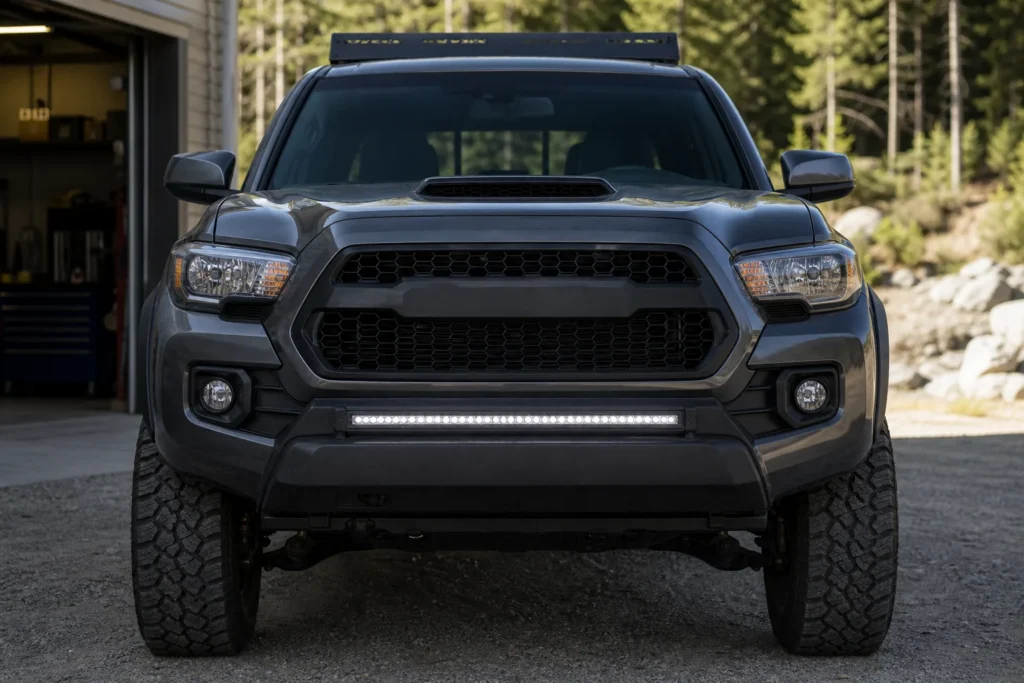
On an aftermarket LED light bar, “DRL mode” often names a separate accent or backlight circuit. The label alone does not establish an approved daytime running lamp. Confirm whether the function is a DRL, position lamp, or decorative accent, then check its specified output, switching, color, documentation, and permitted installation separately from the main beam.1
Record what lights up, how it is controlled and which function the supporting documents declare. Verify the accent and main-beam states separately before making a daytime-running-lamp claim.
Índice
- O que significa o modo DRL em uma barra de luz LED?
- Como geralmente funciona a fiação do DRL em barras de luz?
- O modo DRL é o mesmo que luz baixa ou brilho total?
- Quais cores e estilos são comuns para o modo DRL em barras de luz?
- Uma barra de luz com DRL é legal em vias públicas?
- O que os compradores devem verificar antes de escolher uma barra de luz com DRL?
- Conclusão: Trate o modo DRL como uma função separada
- Perguntas Frequentes
- Referências
O que significa o modo DRL em uma barra de luz LED?
A light bar may have a separate accent circuit, a reduced-power main circuit, or a controller-managed function. Identify which arrangement the exact product uses. A soft glow in a photograph is not enough to classify it as a daytime running lamp.
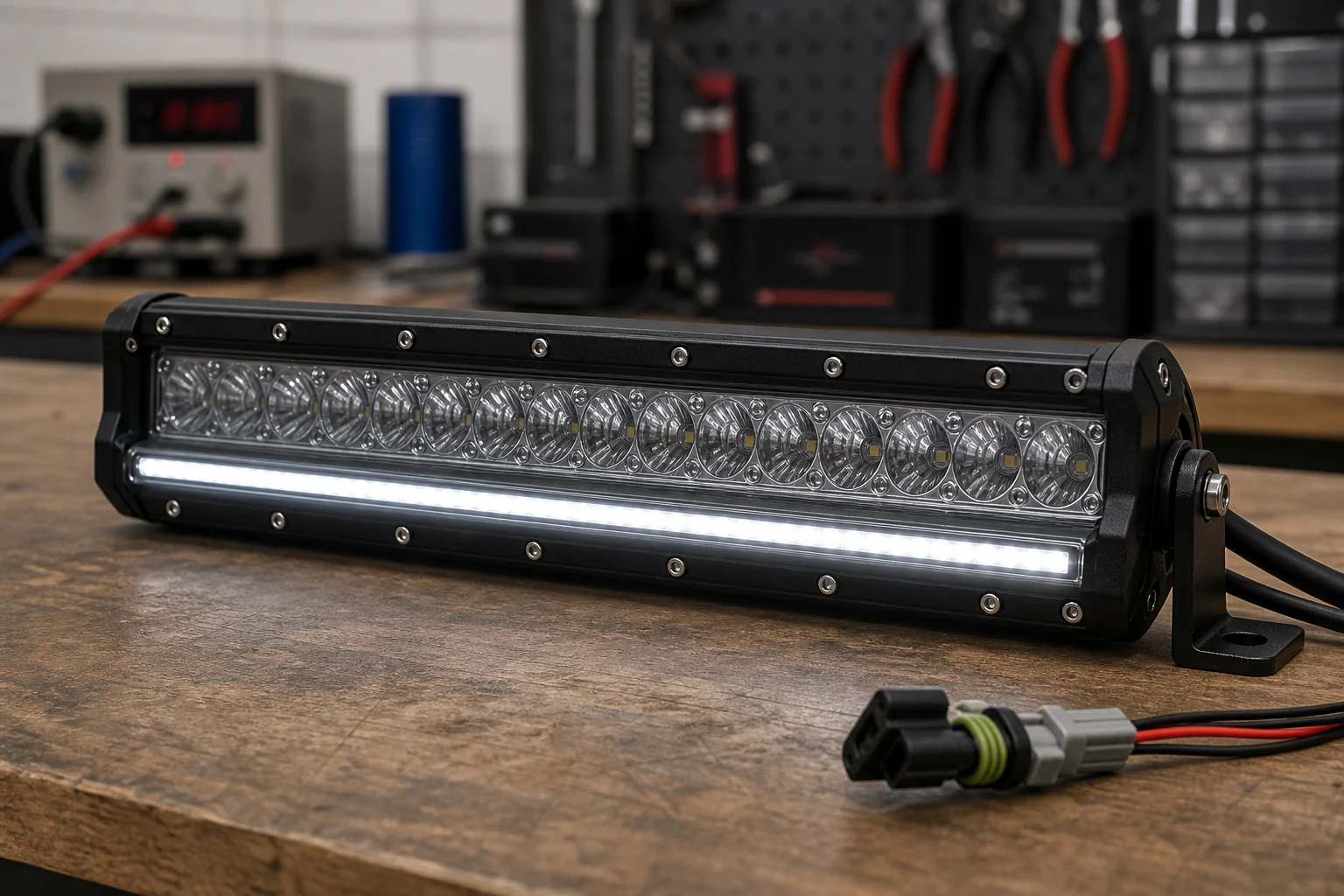
Em uma barra de luz off-road comum, os LEDs principais são projetados para projetar luz útil à noite ou em condições off-road de baixa visibilidade. Em uma barra de luz estilo DRL, um circuito adicional de baixa saída pode tornar o veículo mais visível pela frente ou dar à instalação uma aparência diurna mais limpa.
Se o leitor ainda está escolhendo a categoria principal do produto, o guia relacionado a barras de luz LED off-road explica como tamanho, padrão de feixe, posição de montagem, fiação, vedação e cautela de uso em estrada se encaixam.
UN Regulation No. 148 addresses defined light-signalling functions, including daytime running lamps. A decorative strip and an approved DRL should therefore be identified separately in the listing and supporting documents.1
Como geralmente funciona a fiação do DRL em barras de luz?
Identify the actual power and control inputs from the product drawing. The accent may have an independent feed, use a controller, or share hardware with another function; the marketing name does not specify the pinout or permitted combinations.
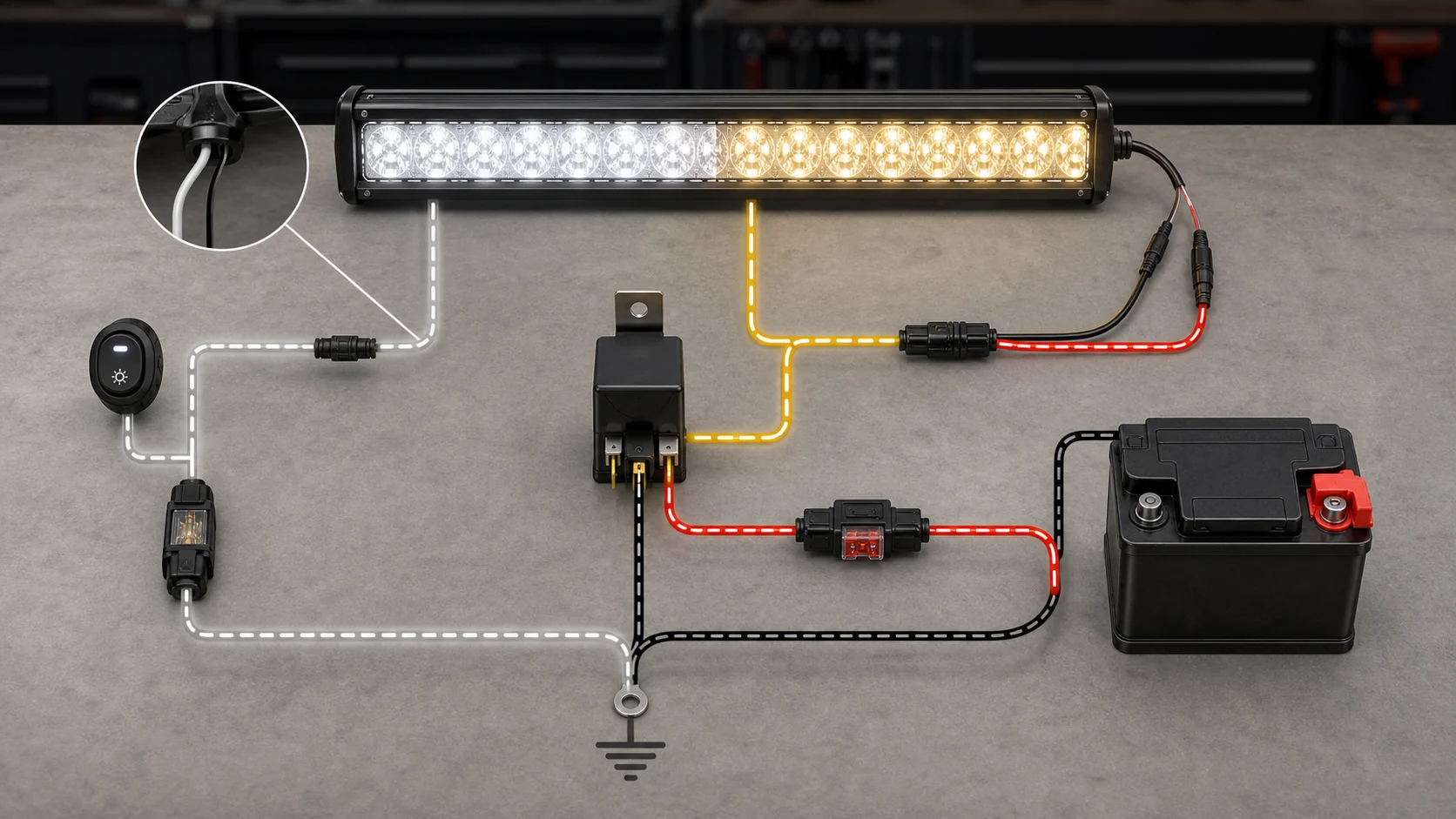
Um layout comum inclui um positivo e um terra principais para os LEDs de alta saída, além de um fio adicional para a função DRL ou luz de posição. Alguns produtos também incluem fios de acento âmbar e branco, entradas de interruptor separadas ou um módulo controlador.
O plano de fiação deve corresponder ao veículo e às instruções do produto. Um circuito DRL pode ser conectado à energia da ignição, a um circuito acessório, a um painel de interruptores ou a um circuito de luz de marcador/posição, dependendo do mercado e do uso pretendido. O feixe principal ainda deve ser fusível, com relé e comutação corretos.
Para compradores que planejam o lado elétrico, o guia relacionado a chicote de fiação para barra de luz explica fusíveis, relés, interruptores, dimensionamento de fios, conectores e roteamento seguro do chicote em mais detalhes.
What should the mode and wiring record show?
Use the manufacturer’s pinout and permitted combinations. Wire color or an extra lead is not a universal DRL connection code.
| Registro | Check on the exact product |
|---|---|
| Declared function | DRL, position lamp, accent/backlight, or main illumination |
| Inputs and return | Named connector pins, control logic, supply requirements, and ground arrangement |
| Operating states | Ignition, normal lights, main beam, and other relevant commanded states |
| Interactions | Required dimming or deactivation; which simultaneous modes are permitted |
| Electrical protection | Specified current and the harness, fuse, controller, and switching configuration |
| Verification | Observe the actual mode states against the drawing before final installation |
If the output or control sequence does not match the drawing, resolve the discrepancy before connecting it to the vehicle. Do not improvise a common three-wire layout from a product name.
O modo DRL é o mesmo que luz baixa ou brilho total?
A declared daytime running lamp, low beam, fog lamp and off-road driving beam have different functions. A decorative accent may project little useful light. Identify the function and its documented operating requirements; do not classify it from relative brightness alone.
Essa diferença importa porque a saída de luz pode rapidamente se tornar ofuscamento quando uma luz auxiliar voltada para frente é usada no modo errado. Uma barra de luz completa pode produzir milhares de lúmens e um padrão de feixe forte; um acento DRL deve ser muito mais suave. O guia relacionado a saída de lúmens de LED explica por que o brilho total deve ser separado do controle utilizável do feixe.
O padrão de feixe também continua importante. A barra de luz principal pode ser spot, flood, combo, de condução ou focada em cena, enquanto o acento DRL pode não projetar um feixe útil de forma alguma. Para a decisão do feixe principal, o guia relacionado a padrões de feixe spot, flood e combo é a melhor comparação.
A pergunta segura de compra é: o que exatamente liga em cada modo? Uma página de produto deve deixar claro se o circuito DRL é um acento fino, um marcador de baixa saída, uma luz de posição âmbar ou uma versão de potência reduzida dos LEDs principais.
Quais cores e estilos são comuns para o modo DRL em barras de luz?
Estilos comuns de barras de luz com DRL incluem tiras de acento brancas, tiras de acento âmbar, acentos bicolores branco/âmbar, barras com luz de borda, acentos estilo halo e luzes segmentadas estilo marcador. O branco é frequentemente usado para uma assinatura diurna limpa, enquanto o âmbar é frequentemente usado para aplicações de marcador, poeira ou estilo.
| Estilo DRL | Aparência comum | Melhor uso | Cuidado principal |
|---|---|---|---|
| Tira branca | Assinatura frontal moderna e limpa | Estilo diurno e visibilidade | Não deve ser confundida com feixe total |
| Tira âmbar | Aparência de marcador ou acento off-road | Permitted accent or signalling use; check the actual function | Regras de cor locais variam |
| Acento bicolor | Opções branco e âmbar | Faixas de produtos flexíveis | Fiação e comutação devem ser claras |
| Halo ou luz de borda | Brilho externo decorativo | Apelo de estilo para varejo | Pode adicionar complexidade sem desempenho |
| DRL segmentado | Múltiplas pequenas zonas de luz | Identidade visual robusta | A consistência entre lotes é fácil de notar |
Para distribuidores e programas de marca própria, a consistência de cor importa. Um lote em que uma barra tem um DRL branco mais frio e outra tem um DRL branco mais quente pode parecer barato mesmo que o feixe principal funcione. A Equipe Yirox geralmente verifica o brilho do destaque, a correspondência de cor, os rótulos dos fios, o comportamento do interruptor e as fotos da embalagem em conjunto, porque o modo DRL é em parte visual e em parte elétrico.
Também vale a pena verificar como o DRL aparece à luz do dia real, não apenas em uma sala de amostras escura. Uma faixa que parece nítida em ambientes internos pode ser fraca demais sob o sol, enquanto uma faixa que parece dramática à noite pode ser brilhante demais para um destaque diurno. Fotos de amostras lado a lado sob a mesma exposição ajudam a manter as imagens do catálogo, as expectativas dos clientes e os produtos entregues alinhados.
Uma barra de luz com DRL é legal em vias públicas?
Uma barra de luz com DRL não é automaticamente legal para uso em vias públicas só porque tem um modo DRL. A legalidade para vias depende da função da lâmpada, brilho, cor, marcações, local de montagem, regulagem, comportamento de comutação e das regras do mercado-alvo.
NHTSA’s US interpretation considers impairment of required lighting; 49 CFR 393.24 separately addresses commercial-vehicle auxiliary lamps.23 An EMC document under UN Regulation No. 10 describes a different requirement from a DRL’s light-signalling approval. It does not establish DRL photometry or the legality of the final installation.4
Para a redação do produto, evite afirmações vagas como "legal para rua", a menos que o produto tenha a documentação exigida para o mercado pretendido e a função da lâmpada. Um destaque DRL pode ser aceitável em uma instalação e não aceitável em outra, especialmente se for brilhante demais, da cor errada, montado incorretamente ou ligado para operar no momento errado.
O que os compradores devem verificar antes de escolher uma barra de luz com DRL?
Os compradores devem verificar o projeto do circuito DRL, os rótulos dos fios, a opção de cor, o brilho, o comportamento de comutação, o padrão do feixe principal, a classificação IP, o controle de calor, o encaixe do suporte e a documentação antes de escolher uma barra de luz com DRL.
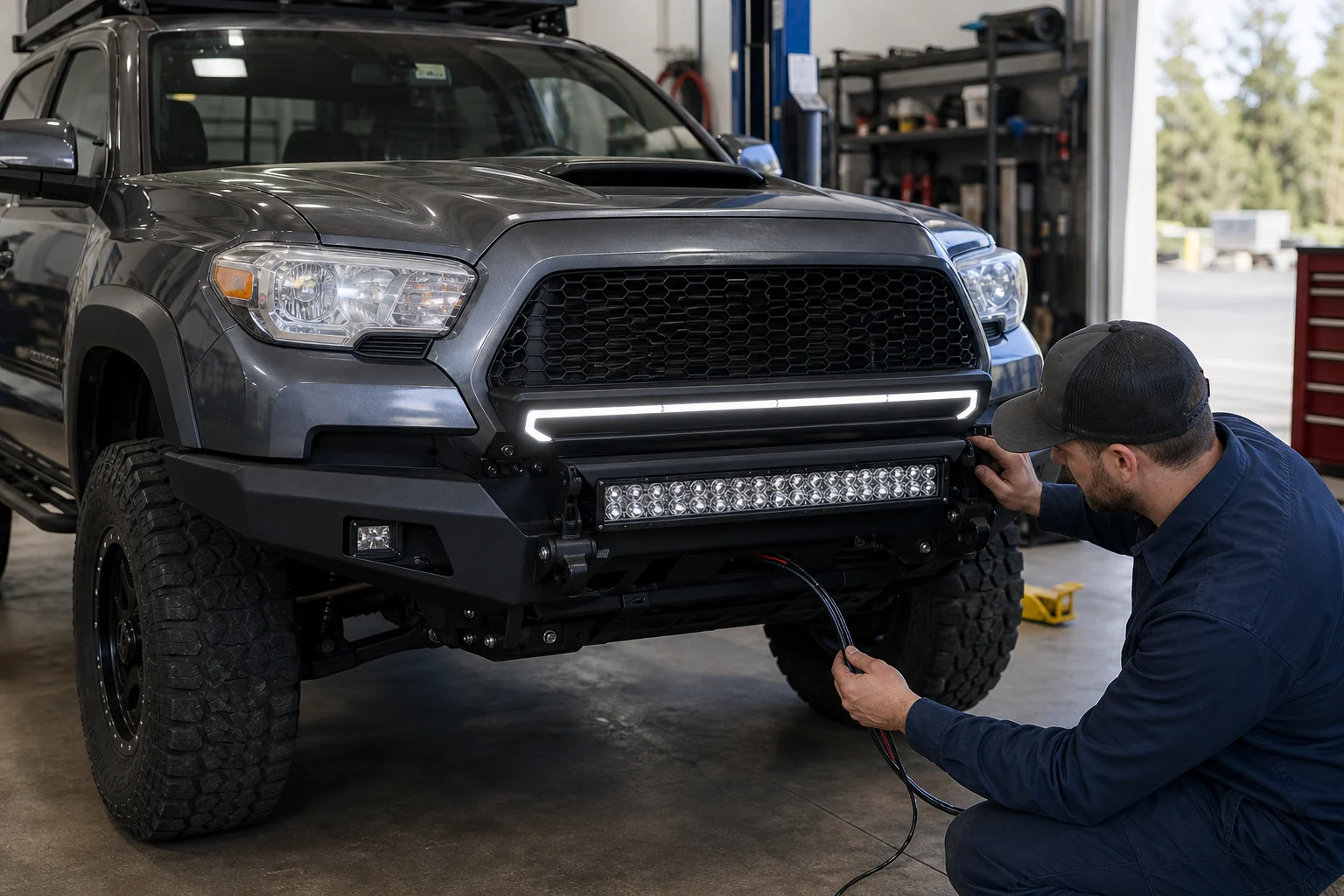
Comece confirmando a lógica do modo. O DRL liga com a energia da ignição, um interruptor, um circuito de luz de posição ou um controlador? Ele desliga ou diminui quando o feixe principal liga? Branco e âmbar podem ser energizados ao mesmo tempo e, se sim, isso é intencional?
Em seguida, inspecione a construção. Barras de luz com DRL frequentemente adicionam fiação interna extra, material de difusão ou tubos de luz. Essas peças precisam de vedação, resistência ao calor e controle de vibração. O guia relacionado a classificações IP para luzes LED ajuda os compradores a ler as alegações de vedação junto com os detalhes reais de construção.
Por fim, revise o kit completo. Uma boa barra de luz com DRL deve incluir identificação clara dos fios, um chicote adequado ou recomendação de fiação, suportes de montagem, ferragens corretas e embalagem que proteja a lente e a faixa de destaque durante o transporte.
Conclusão: Trate o modo DRL como uma função separada
Identify the exact declared function, verify its operating states and compare the supplied documentation with the lamp and harness. A styling accent and an approved daytime running lamp require different claims; neither approves the main off-road beam.
A melhor barra de luz com DRL não é a que tem o destaque mais chamativo. É a que tem comportamento de modo claro, brilho controlado, fiação confiável, vedação durável e alegações honestas de uso em vias.
Se o próximo passo for comparar opções de hardware, o relacionado gama de produtos de barras de luz LED off-road é um lugar prático para revisar barras estilo DRL junto com padrão de feixe, carcaça, chicote, suporte e escolhas de embalagem.
Perguntas Frequentes
O que significa DRL em uma barra de luz?
DRL means daytime running light, but aftermarket listings also use the term for an accent or backlight. Check what the product actually declares and whether its documents support that function. A separate illuminated strip is not automatically a compliant DRL, and it does not approve the main off-road beam.
Posso usar o modo DRL à noite?
O modo DRL pode ser visível à noite, mas não substitui os faróis ou uma luz de condução devidamente regulada. Use a lâmpada apenas de acordo com as instruções do produto e as regras locais de trânsito.
O modo DRL âmbar é melhor que o branco?
Choose the required function and permitted color first, then compare the actual optical output and switching. A white or amber accent is not interchangeable with an approved DRL or fog lamp. Color alone does not establish better visibility in dust, and road-use requirements must be checked for the intended market.
O modo DRL precisa de um interruptor separado?
Às vezes. Alguns instaladores ligam o modo DRL à energia da ignição ou da luz de posição, enquanto outros usam um interruptor ou controlador separado. O diagrama de fiação do produto deve ser seguido com cuidado.
Uma barra de luz com modo DRL é legal para rua?
Não automaticamente. Um destaque DRL não torna uma barra de luz off-road compatível para uso em vias públicas. A legalidade depende da função exata da lâmpada, marcações, brilho, cor, montagem, regulagem e regulamentos locais.
Referências
[1] UNECE / EUR-Lex. “UN Regulation No. 148: light-signalling devices.”
[2] NHTSA. “FMVSS No. 108 interpretation: supplemental lighting and impairment.”
[3] eCFR. “49 CFR 393.24: commercial-vehicle headlamps and auxiliary lamps.”
[4] UNECE. “UN Regulation No. 10: electromagnetic compatibility scope.”