



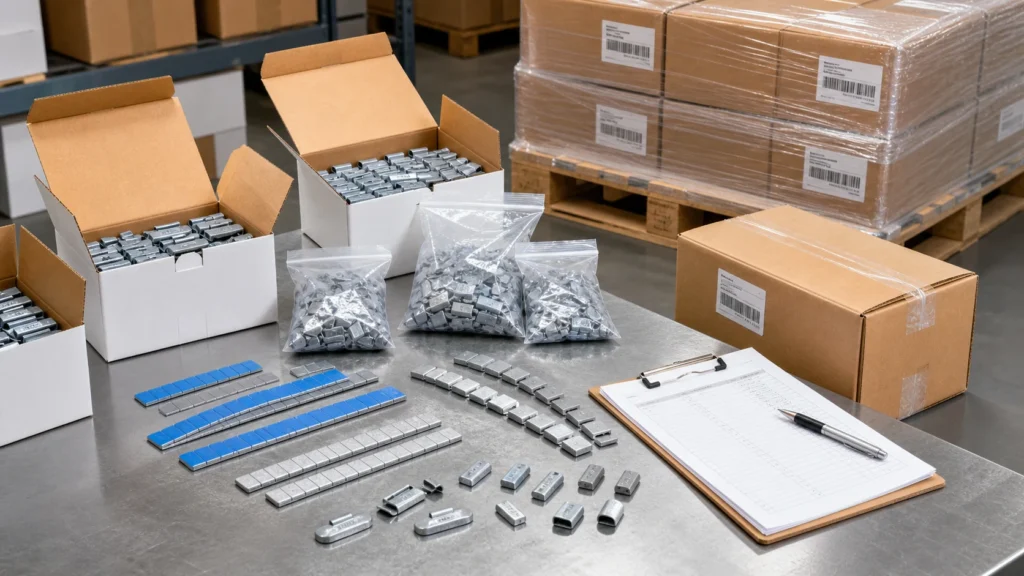
Los pesos de rueda a granel se piden mejor como una gama de productos aprobada, no como una sola gran cantidad de piezas. Antes de fijar la cantidad, defina las aplicaciones de rueda y servicio, el formato de clip o adhesivo, el material, los incrementos de peso, el embalaje, las etiquetas, los requisitos de destino y la aceptación de muestras. El MOQ se convierte entonces en una variable de planificación en lugar de una sorpresa que crea inventario inutilizable.
Distribuidores, importadores, cadenas de servicio de neumáticos, talleres de flotas y compradores de marca privada usan “a granel” de manera diferente. Uno puede necesitar cajas sueltas para taller; otro puede necesitar cajas listas para venta minorista, códigos de barras, palés mixtos y recuentos de cajas repetibles. El pedido tiene éxito cuando el producto puede identificarse, almacenarse, instalarse, venderse y volver a pedirse sin adivinar.
Los errores más costosos ocurren antes de la producción: aprobar un precio bajo sin fijar la interfaz de la rueda, pedir cantidades iguales de cada tamaño, o tratar una muestra suelta como prueba del lote final empaquetado. Las decisiones a continuación convierten esos supuestos en una ruta de compra documentada.
Tabla de contenido
- ¿Qué debe definir antes de solicitar un precio de pesos de rueda a granel?
- ¿Cómo cambia el MOQ la forma en que planifica un pedido a granel?
- ¿Qué formatos de pesos de rueda debe incluir una gama a granel?
- ¿Cómo debe construir una mezcla de SKU a partir de la demanda real?
- ¿Qué datos de embalaje y cajas deben estar en la cotización?
- ¿Qué documentos de exportación y materiales deben confirmar los importadores?
- ¿Cómo debe aprobar las muestras antes de la producción en masa?
- ¿Qué debe incluir una RFQ completa de pesos de rueda a granel?
- ¿Cómo compara las cotizaciones de pesos de rueda a granel por costo utilizable?
- ¿Qué verificaciones evitan que el primer pedido se convierta en inventario muerto?
- Conclusión: Especifique la gama antes de ampliar el pedido
- Preguntas frecuentes
- Referencias
¿Qué debe definir antes de solicitar un precio de pesos de rueda a granel?
Defina la aplicación de la rueda y el canal de venta antes de solicitar cantidad o precio. Automóviles de pasajeros, camiones, remolques, talleres de neumáticos mixtos, talleres de flotas y clientes minoristas pueden requerir diferentes métodos de fijación, tamaños de paquete, etiquetas y patrones de reposición.
Comience con un resumen de pedido que registre las siguientes capas:
| Capa de decisión | Qué registrar | Por qué cambia el pedido |
|---|---|---|
| Aplicación de servicio | Automóvil de pasajeros, camión, remolque, autobús, flota o taller mixto | Indica los perfiles de rueda probables, el rango de corrección y las condiciones de manejo |
| Interfaz de rueda | Acero, aleación, pintado, recubierto, forma de brida, área de asentamiento del barril interior | Determina si se puede aprobar la instalación con clip o adhesiva |
| Formato de peso | Piezas individuales con clip, segmentos adhesivos, tiras, rollos o paquetes mixtos | Cambia la lógica de conteo, instalación, empaque y SKU |
| Ruta de materiales | Acero/FE, zinc, programa sin plomo, recubrimiento o requisito de apariencia | Afecta la documentación, el acabado, la aceptación del cliente y la comparación de precios |
| Sistema de unidades | Gramo, onza, unidad dual o etiquetas específicas del mercado | Evita que una caja sea difícil de usar para técnicos o distribuidores |
| Canal | Granel para taller, caja para distribuidor, paquete minorista o marca privada | Define paquetes internos, códigos de barras, idioma y presentación de la caja |
La guía de pesas de equilibrado de ruedas es un punto de partida útil cuando el equipo aún necesita separar la corrección de balance del ajuste del producto. Para la RFQ real, agregue fotos o dibujos de la rueda, una pieza de muestra, la posición de servicio y el proceso de la máquina donde el perfil sea incierto.
No trate una cotización que contenga solo “pesos de rueda a granel”, cantidad y precio unitario como una especificación controlada. La falta de interfaz de rueda, sistema de unidades o estructura de caja significa que el proveedor está cotizando un supuesto.
¿Cómo cambia el MOQ la forma en que planifica un pedido a granel?
El MOQ no es un número universal para “pesos de rueda a granel”. Puede aplicarse por SKU, material, perfil de clip, cinta adhesiva, recubrimiento, etiqueta, paquete interno, diseño de caja o valor total del pedido. Pregunte qué variable lo crea antes de comparar precios.
| Factor del MOQ | Qué puede afectar | Pregunta a hacer |
|---|---|---|
| Material | Programas separados de acero/FE, zinc u otro material | ¿El mínimo se calcula por separado para cada material? |
| Fijación | Diferentes perfiles de clip, respaldos de cinta o construcciones de tiras | ¿Cada construcción de clip o adhesivo tiene su propio mínimo? |
| Incremento de peso | El número de tamaños en gramos u onzas | ¿Se pueden combinar tamaños de baja rotación en un surtido de prueba? |
| Acabado | Galvanoplastia, pintura, recubrimiento, color o tratamiento superficial | ¿El acabado es estándar o creado para este pedido? |
| Embalaje | Bolsas, cajas, cubos, etiquetas, códigos de barras o cajas de marca privada | ¿El empaque personalizado crea un mínimo de configuración separado? |
| Plan de envío | Cajas mixtas, palés o entregas divididas | ¿Se pueden escalonar los SKU aprobados sin cambiar el producto? |
La pregunta práctica no es “¿Cuál es el MOQ más bajo?” sino “¿Qué MOQ me da un rango utilizable sin forzar inventario de baja rotación?” Un precio unitario bajo es engañoso cuando exige tamaños no deseados o configuración y cajas separadas para cada pequeña variación.
Para un programa nuevo, solicite una mezcla inicial enfocada y una mezcla de reposición completa. Esto muestra qué SKU generan costo de configuración y si un pedido escalonado mantiene la construcción aprobada. Use el uso por tamaño cuando esté disponible; de lo contrario, etiquete el primer pedido como prueba de mercado y limite las variaciones no probadas.
¿Qué formatos de pesos de rueda debe incluir una gama a granel?
Un rango a granel debe incluir solo formatos que coincidan con la interfaz de rueda y el proceso de servicio. Los pesos de clip, segmentos adhesivos, rollos y surtidos mixtos resuelven diferentes problemas de manejo.
| Formato | Evidencia necesaria antes de ordenar | Canal a granel útil | Riesgo principal de stock |
|---|---|---|---|
| Contrapesos de clip | Perfil del borde de la llanta, abertura, retención, holgura y material de la rueda | Talleres de neumáticos, servicio de flotas, distribuidores comerciales | Los clips de aspecto similar pueden no ser intercambiables |
| Segmentos adhesivos | Dimensiones de la superficie de contacto, construcción de la cinta, protector, colocación y holgura | Servicio de ruedas de aleación, cadenas de reparación, paquetes minoristas | Contaminación, aplastamiento o conteos de segmentos mixtos |
| Rollos o tiras cortadas a peso | Ancho de tira, espaciado de segmentos, método de corte, etiquetas unitarias y embalaje | Talleres de alto volumen y programas de servicio controlados | Conteo deficiente o longitud de corte inconsistente |
| Surtido mixto | Contenido exacto, proporción por SKU, etiquetado de cajas y reglas de reposición | Kits de inicio, talleres multisitio, pruebas de distribuidores | Un artículo de baja rotación puede hacer que todo el kit sea difícil de reponer |
El material es solo una parte de la decisión. Una opción de acero o FE todavía necesita la construcción correcta, tolerancia de masa, acabado y embalaje; los compradores que comparan una ruta sin plomo pueden revisar contrapesos de rueda FE después de que los criterios de aplicación y aprobación estén claros.
Mantenga los productos de clip y adhesivos en líneas de cotización separadas porque necesitan diferente evidencia de ajuste, controles de instalación y, a menudo, diferente embalaje. El relacionado rango de pesos de balanceo de ruedas puede ayudar a revisar formatos, pero un catálogo amplio no es una lista de aplicaciones aprobadas.
¿Cómo debe construir una mezcla de SKU a partir de la demanda real?
Construya la mezcla de SKU a partir de la cobertura de ruedas, tamaños de corrección, política de materiales y rotación, no del número de incrementos posibles. Un primer pedido controlado tiene grupos centrales, de apoyo y de prueba limitada.
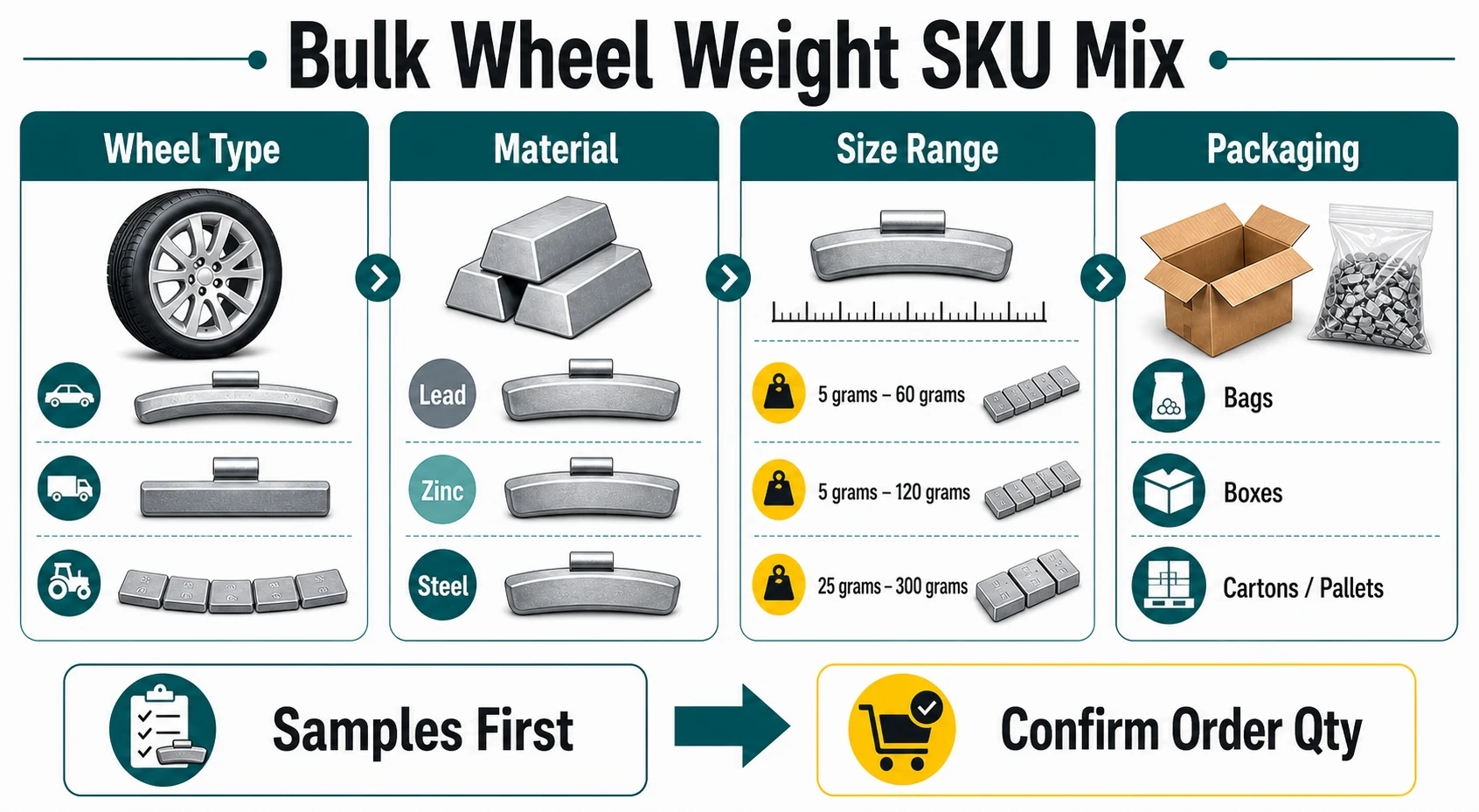
Use esta secuencia:
- Agrupe la demanda: Separe el trabajo de automóviles de pasajeros, camiones, remolques, flotas y ruedas especiales para que las ventas de alto volumen de automóviles de pasajeros no oculten una brecha de ajuste para camiones o aleación.
- Agrupe por interfaz: Registre el perfil del clip, material de la rueda, área de contacto y holgura. Masa similar no significa ajuste similar.
- Agrupe por unidad y movimiento: Mantenga las etiquetas de gramos y onzas distintas, luego clasifique los tamaños usando registros de ventas u órdenes de trabajo. El wheel weight size chart puede apoyar la revisión de incrementos.
- Asigne roles: Ponga la mayor parte en artículos centrales probados, una parte controlada en artículos de apoyo y la parte más pequeña en artículos de prueba con una fecha de revisión.
| Grupo de stock | Qué pertenece en él | Cómo gestionarlo |
|---|---|---|
| Central | Tamaños solicitados repetidamente e interfaces de rueda confirmadas | Mantenga la reposición accesible y el embalaje consistente |
| Apoyo | Aplicaciones conocidas con movimiento menor o estacional | Ordene lo suficiente para cubrir la continuidad del servicio sin igualar cantidades |
| Prueba | Material nuevo, clip nuevo, mercado nuevo o tamaño incierto | Utilice la aprobación de muestras, cantidad limitada y una decisión clara de reorden |
| Excluido | Ajuste no verificado, unidad poco clara o solicitud especial no documentada | Mantener fuera de la orden de producción hasta que se aclare |
Para los compradores de servicios de neumáticos, la pesas de rueda para talleres de neumáticos página ofrece una forma relacionada de conectar la demanda del taller con el etiquetado de contenedores, artículos de alta rotación y disciplina de reabastecimiento. El pedido al por mayor aún debe usar el historial de trabajo del propio comprador donde exista.
Una fórmula útil es: cantidad del pedido = uso esperado durante la ventana de reabastecimiento + margen de servicio − stock utilizable disponible. Vincule el margen al plazo de entrega del proveedor y la volatilidad de la demanda.
¿Qué datos de embalaje y cajas deben estar en la cotización?
El embalaje debe cotizarse como parte del producto, no agregarse después del precio unitario. Las pesas de rueda son compactas y densas, por lo que las piezas sueltas pueden rozar, volverse difíciles de contar, dañar los acabados o hacer que las cajas sean demasiado pesadas.
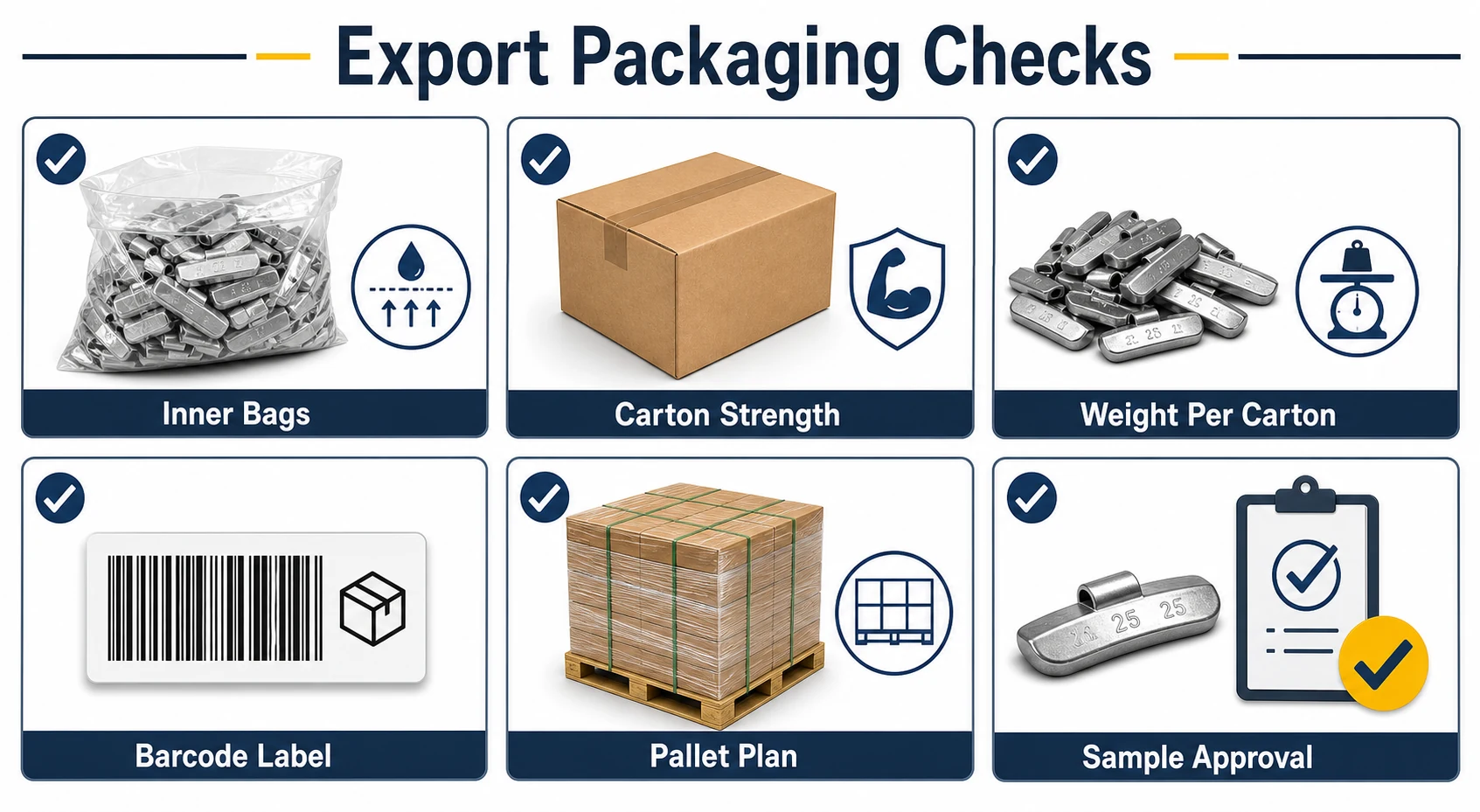
Incluya estos campos en la cotización:
| Campo de empaque | Lo que el comprador debe definir |
|---|---|
| Empaque interno | Bolsa, caja, bandeja, cubeta, paquete de tiras o paquete suelto de taller |
| Conteo | Piezas, segmentos, tiras, rollos y cantidad por empaque interno |
| Caja | Empaques internos por caja maestra, dimensiones de la caja, peso neto y peso bruto |
| Etiqueta | SKU, material, unidad, cantidad, lote o partida, código de barras, idioma y marcas de manipulación |
| Palé | Tamaño del palé, cajas por capa, capas, altura total, film estirable y material del palé |
| Protection | Separador, revestimiento, control de humedad, protección del acabado, protección del revestimiento adhesivo y resistencia de la caja |
| Envío | Reglas de cajas mixtas, plan de carga del contenedor y si las cajas pueden dividirse |
Indique si el cliente necesita eficiencia de taller o distribución posterior. Un taller de neumáticos puede preferir una bolsa interna etiquetada con conteo fácil; un distribuidor puede necesitar cajas más pequeñas, códigos de barras, etiquetas en el idioma local y embalaje que pueda venderse sin reempaque. Para productos adhesivos, inspeccione el revestimiento después del almacenamiento y el movimiento de las cajas; para piezas clip-on recubiertas, incluya verificaciones de rozadura, humedad y legibilidad de etiquetas.
ASTM D4169 proporciona una base estructurada para evaluar unidades de envío frente a riesgos de distribución como manipulación, vibración y compresión, pero no se requiere automáticamente para cada pedido de pesas de rueda. 3 La acción de compra útil es declarar el riesgo de distribución y la evidencia necesaria: un prototipo de embalaje, simulación de transporte, inspección interna o un plan de prueba formal.
¿Qué documentos de exportación y materiales deben confirmar los importadores?
Los importadores deben confirmar los requisitos del mercado de destino antes de la producción, especialmente para declaraciones de materiales, etiquetas, tratamiento de palés y documentos específicos del cliente. La documentación faltante puede retrasar un envío o dificultar la venta de un producto.
| Documento o confirmación | Por qué es importante | Quién debe confirmarlo |
|---|---|---|
| Factura comercial y lista de empaque | Concilia mercancías, valores, cantidades, cajas y detalles del envío | Comprador, proveedor y socio de flete |
| Declaración de material | Registra la ruta de material acordada y cualquier restricción específica del cliente | Contacto de calidad del comprador y del proveedor |
| Prueba de etiqueta y código de barras | Evita SKU, unidad, idioma o identificación de caja incorrectos | Equipo de almacén o ventas del comprador |
| Estado del palé y del embalaje de madera | Confirma si la ruta y el destino aceptan el palé o cajón planificado | Contacto del comprador y de flete/aduanas |
| Plano del producto y revisión | Mantiene el clip, la tira, el recubrimiento y las dimensiones enviadas vinculados a la aprobación | Equipo de ingeniería/calidad del comprador y del proveedor |
| Formularios específicos del cliente | Cubre requisitos de minoristas, talleres de cadena o marcas privadas | Comprador y cliente final |
Cuando se utilizan palés o cajones de madera en el comercio internacional, ISPM 15 aborda las medidas fitosanitarias aprobadas y el marcado para material de embalaje de madera regulado. 4 Confirme la implementación actual del destino y los requisitos del socio de flete; el proceso de un país no es una regla de importación universal.
Si un cliente requiere contrapesos de rueda sin plomo, documentación sin plomo o una ruta particular de acero/FE, inclúyalo en la RFQ, cotización, plano, etiqueta del cartón y registro de aprobación. “Sin plomo” o “eco” en el texto de marketing no es evidencia suficiente para recepción. Los pedidos adhesivos también necesitan una discusión sobre almacenamiento e instalación: 3M identifica grasa, aceite, suciedad, polvo de freno y residuo como contaminación a eliminar antes de la colocación del contrapeso. 1 Defina la superficie de la rueda, el proceso de limpieza, la ventana de temperatura, el método de presión y las condiciones de almacenamiento en lugar de aprobar la cinta por color o tacto.
¿Cómo debe aprobar las muestras antes de la producción en masa?
Apruebe el mismo producto, empaque, etiqueta y documentación planificados para el lote masivo. Una muestra suelta prueba forma y apariencia; no prueba conteo del cartón, condición de la cinta, retención, protección del recubrimiento, precisión del código de barras ni repetibilidad.
Use cuatro verificaciones en la aprobación de muestra:
| Etapa de aprobación | Qué inspeccionar | Evidencia a conservar |
|---|---|---|
| Identidad | SKU, material, unidad, formato, acabado, versión de clip o cinta | Plano aprobado, foto de muestra, etiqueta y revisión |
| Compatibilidad | Brida o área de asentamiento, inserción, retención, holgura y extracción | Identidad de rueda o ensamble y notas de ajuste |
| Service | Resultado de balanceo, colocación, manejo del técnico, remoción del liner o comportamiento del clip | Fecha de prueba, operador, máquina/proceso y resultado |
| Empaque y envío | Empaque interior, cartón, peso, etiqueta, tarima, roce y condición de almacenamiento | Fotos de muestra empacada, lista de empaque y registro de inspección |
Para contrapesos de clip, inspeccione la abertura y los puntos de contacto antes y después de la aplicación. El contrapeso debe ajustarse a la brida definida sin forzar la rueda, deslizarse, dañar el acabado o crear interferencia. Para contrapesos adhesivos, verifique limpieza, colocación, presión, área de contacto, levantamiento de borde, condición del liner y extracción.
La aprobación de adhesivo sensible a la presión debe probar las condiciones de aplicación, no solo la pegajosidad. La guía de aplicación de 3M describe la presión y la humectación del adhesivo como parte del establecimiento del contacto, por lo que una muestra que se siente pegajosa en una bolsa no es una prueba de aceptación completa. 2
Escriba el registro de aprobación como una declaración controlada que cubra material, tamaño, unidad, formato, recubrimiento, cinta, liner, empaque interior, cantidad del cartón, etiqueta, fecha y revisión. Si cualquiera de esos cambia, reabra la aprobación o documente el cambio antes de producción.
¿Qué debe incluir una RFQ completa de pesos de rueda a granel?
Una RFQ completa permite a los proveedores cotizar el mismo producto y permite al comprador comparar ofertas sin reconstruir supuestos. Debe describir la aplicación, construcción, mezcla de pedido, empaque, destino, evidencia de calidad y términos comerciales.
Incluya los siguientes campos:
- Aplicación: uso de vehículo o rueda, mercado, canal de servicio, posición de eje o rueda donde sea relevante, y restricciones de ajuste conocidas.
- Producto: clip o adhesivo, perfil o área de asentamiento, material, acabado, incrementos de peso, sistema de unidades, dimensiones y tolerancia.
- Pedido: cantidad del primer pedido por SKU, reabastecimiento esperado, estatus core/supporting/trial, y si se permiten cartones mixtos.
- Embalaje: empaque interior, piezas por paquete, cantidad del cartón master, objetivo de peso bruto, dimensiones, etiquetas, códigos de barras, plan de tarima y arte de marca privada.
- Quality: plano, cantidad de muestra, verificaciones de masa y dimensionales, prueba de ajuste, prueba de retención o adhesivo, revisión de recubrimiento, trazabilidad de lote e inspección previa al envío.
- Documentos: factura, lista de empaque, declaración de material, prueba de etiqueta, detalles de empaque y requisitos de cliente o flete específicos del destino.
- Términos comerciales: base de MOQ, tiempo de entrega, cargos de muestra, aviso de cambio, términos de pago y método de envío según lo acordado por el comprador y el proveedor.
Pida al proveedor que separe las configuraciones estándar de las personalizadas. Esto revela si un precio bajo depende de un clip, cinta, cartón o etiqueta existentes, y facilita el reabastecimiento posterior porque los cambios permitidos son claros.
Cuando el programa requiere empaque de marca privada, varios perfiles de clip o control de pedidos repetidos, un fabricante de pesas para ruedas puede evaluarse contra la misma RFQ. La comparación importante no es una afirmación genérica de “fábrica”; es si el proveedor puede mantener conectados el plano aprobado, material, empaque, etiqueta y registros de lote a lo largo del tiempo.
¿Cómo compara las cotizaciones de pesos de rueda a granel por costo utilizable?
Compare cotizaciones por costo landed utilizable e impacto en el servicio, no solo por precio por pieza o kilogramo. Una cotización más barata puede volverse más costosa cuando el comprador debe clasificar cartones, reetiquetar unidades, reempacar acabados dañados o retener tamaños MOQ de baja rotación.
Un modelo de comparación práctico es:
Costo landed utilizable = costo del producto + empaque aprobado + flete y manejo + costos de importación aplicables + costo de inspección/reempaque + costo esperado de stock de baja rotación.
La fórmula es un modelo de decisión, no una promesa sobre ningún destino particular. Pida al socio de flete o aduana que confirme los cargos específicos de la ruta, y mantenga el costo del producto, el empaque y la logística como líneas separadas para que la comparación pueda actualizarse.
| Línea de cotización | Qué comparar | Señal de alerta |
|---|---|---|
| Producto | Mismo material, formato, dimensiones, unidad de masa y tolerancia | “Equivalente” sin plano o muestra |
| Embalaje | Mismo conteo interior, cartón, etiqueta, tarima y protección | El precio excluye el empaque requerido por el cliente |
| Calidad | Misma muestra, ajuste, lote y evidencia de inspección | “QC aprobado” sin verificación definida |
| Logística | Mismas dimensiones de cartón, pesos, plan de tarima y base de envío | El flete no puede estimarse a partir de la cotización |
| Control de cambios | Mismo proceso de revisión y notificación | El proveedor puede sustituir cinta, clip, recubrimiento o empaque |
| Reabastecimiento | Mismo SKU aprobado y condiciones de pedido repetido | El primer pedido es barato pero el siguiente pedido no está definido |
Mantenga el descubrimiento de precios separado de la aprobación del producto. Marque un rango inicial como presupuestario hasta que la interfaz de rueda, el material, el paquete y los criterios de muestra estén fijados; de lo contrario, el número más barato puede anclar una comparación entre diferentes productos.
¿Qué verificaciones evitan que el primer pedido se convierta en inventario muerto?
El primer pedido evita inventario muerto cuando cada SKU tiene una aplicación, unidad, paquete y razón de reabastecimiento claras. Pruebe cada línea contra un estado de decisión simple antes de la producción.
| Decisión | Úselo cuando | Acción requerida |
|---|---|---|
| Aprobado | Aplicación, muestra, paquete y documentos coinciden | Libere el SKU para el pedido definido |
| Retenido | Falta un valor de prueba, documento, dibujo o empaque | No libere la producción hasta que se cierre la brecha |
| Clarify | El producto puede encajar, pero la rueda, el mercado, la unidad o el paquete no están definidos | Solicite la evidencia faltante y actualice la RFQ |
| Rechazado | El ajuste, la holgura, la retención, el material o la identidad fallan | Elimine el SKU o seleccione una construcción diferente |
Esté atento a estos atajos que generan devoluciones:
- “Se adapta a todas las ruedas” sin un perfil, lista de exclusiones o evidencia de muestra.
- Un precio para varios perfiles de clip o construcciones adhesivas.
- Cantidades iguales de cada tamaño sin historial de demanda.
- Piezas, tiras, kilogramos y cartones usados indistintamente.
- Una afirmación de material, muestra o plan de cartón sin registros coincidentes para la declaración, dibujo, paquete, peso bruto, pallet y etiqueta.
Mantenga la foto de muestra aprobada, el dibujo, el arte de la etiqueta, la lista de empaque y el resultado de inspección con la orden de compra. El personal de recepción debe poder identificar un clip, cinta, acabado, unidad, cantidad de cartón o etiqueta cambiados a partir de ese registro.
Si está preparando un primer pedido al por mayor o un pedido repetido, comparta las aplicaciones de rueda, los SKU objetivo, la ruta del material, el uso mensual, la preferencia de empaque, el destino y los documentos requeridos. Podemos ayudar a convertir esos detalles en una mezcla de SKU lista para cotizar y un registro de aprobación de muestra. Puede solicitar una revisión de peso de rueda al por mayor with the information already available.
Conclusión: Especifique la gama antes de ampliar el pedido
Los pesos de rueda al por mayor funcionan cuando el pedido se trata como un rango de servicio controlado en lugar de un montón de piezas de bajo precio. El comprador debe definir la interfaz de rueda, el formato de fijación, el material, el sistema de unidades, los roles de SKU, la base de MOQ, el empaque, los documentos de exportación, la evidencia de muestra y el registro de control de cambios antes de aumentar la cantidad.
La secuencia confiable es simple: mapear aplicaciones reales, separar los SKU principales de los de prueba, cotizar el paquete exacto, aprobar un producto y cartón representativos, comparar el costo utilizable y preservar la línea base aprobada para el reabastecimiento. Esa secuencia protege a talleres de neumáticos, flotas, distribuidores e importadores de comprar inventario que no se puede instalar, contar, etiquetar o vender con confianza.
Preguntas frecuentes
¿Cuál es el MOQ para pesos de rueda al por mayor?
No hay un MOQ único para cada pedido de pesos de rueda al por mayor. Puede establecerse por SKU, material, construcción, incremento, recubrimiento, empaque, etiqueta o valor total del pedido, así que pregunte qué variable crea el mínimo.
¿Deben pedirse los pesos de rueda al por mayor por piezas, kilogramos o cartones?
Escriba la orden de compra en todas las unidades relevantes: masa por pieza o segmento, piezas por empaque interno, empaques internos por cartón, peso bruto del cartón y conteo de pallets. Esto evita que el precio, la recepción y los cálculos de flete interpreten “cantidad” de manera diferente.
¿Debe un pedido al por mayor incluir pesos de rueda de clip y adhesivos juntos?
Puede, pero cada formato necesita SKU separados, evidencia de ajuste, empaque y criterios de aprobación. Un surtido vago es más difícil de controlar para un taller o almacén.
¿Cuántos SKU debe incluir un pedido inicial al por mayor?
Comience con interfaces de rueda compatibles y tamaños de corrección, luego agregue un grupo de prueba limitado. Use el historial de ventas o los registros de servicio cuando estén disponibles en lugar de cantidades iguales de cada tamaño posible.
¿Qué documentos debe solicitar un importador?
Los requisitos comunes incluyen una factura, lista de empaque, declaración de material, dibujo y revisión, prueba de etiqueta, detalles de cartón y pallet, y formularios de inspección específicos del cliente. Para pallets o cajas de madera, confirme los requisitos de madera tratada antes del envío.
¿La aprobación de muestra cubre todo el pedido al por mayor?
Solo cuando la muestra coincide con la construcción y el paquete de producción planificados. Reabra la aprobación si el material, clip, cinta, recubrimiento, dimensiones, etiqueta, cantidad de cartón o revisión cambian.
Referencias
[1] 3M. “Preparación de superficie para pesos de rueda.” 2024.
[2] 3M. “Pautas de aplicación del sistema de pesos de rueda 3M.” 2012.
[3] ASTM International. “ASTM D4169: Práctica estándar para pruebas de rendimiento de contenedores y sistemas de envío.” 2023.
[4] Convención Internacional de Protección Fitosanitaria. “ISPM 15: Regulación del material de embalaje de madera en el comercio internacional.” 2019.