





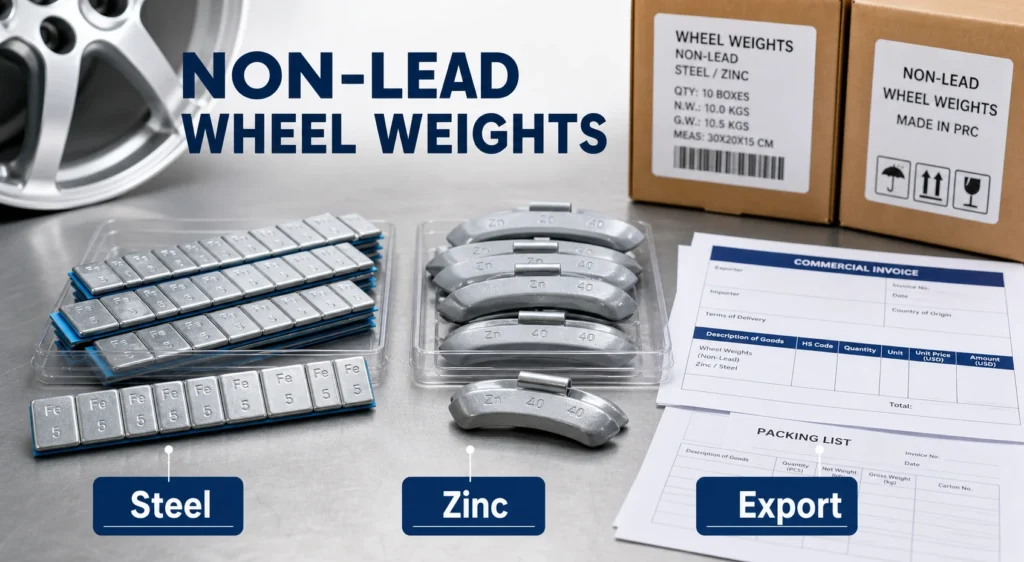
Non-lead wheel weights use materials such as steel or zinc instead of a lead body. Both are available alternatives for wheel balancing. 1 Choose the finished product by its attachment, dimensions, rim fit, and corrosion protection; confirm the material declaration and destination-market requirements before approving a lead-free claim.
For a replacement order, send the supplier the existing weight specification and the wheel application. “Non-lead” alone doesn't identify a compatible part or define the evidence needed for acceptance.
Tabla de contenido
- What counts as a non-lead wheel weight?
- Choosing between steel and zinc
- Will non-lead weights fit the same wheels as lead weights?
- Will non-lead wheel weights rust in winter?
- Sample approval before a replacement order
- Conclusion: approve the finished weight for the intended wheel
- Preguntas frecuentes
- Referencias
What counts as a non-lead wheel weight?
Specify the body material, then specify its finish and attachment separately. A steel-bodied weight with zinc plating remains a steel-bodied product; a zinc finish description doesn't establish a zinc-alloy body.
Use an order description that separates those decisions:
| Campo de especificación | Qué registrar | What it establishes |
|---|---|---|
| Body material | Steel grade or zinc-alloy designation, as declared by the supplier | Which material forms the weight body |
| Acabado superficial | Plating, paint, or other specified treatment | The finish being ordered, separately from the body |
| Fijación | Adhesive system or identified clip profile | How the part attaches to the intended wheel |
| Correction size | Nominal mass and unit; segment layout where applicable | The balancing size being supplied |
| Declaración de material | Exact wording, applicable requirement, and supporting document | The basis for accepting a non-lead or lead-free claim |
Avoid approving a generic “lead-free certificate” that doesn't identify the product it covers. If material evidence is needed, ask for the SKU, material configuration, report or declaration date, and applicable batch or production scope.
Requirements can use different definitions. For example, Maine's rule addresses intentionally added lead or mercury, including sales into the state. That is a specific jurisdiction's requirement, not a worldwide definition of “lead-free.” 1 Record the rule or customer policy applicable to your destination before agreeing to label wording.
Choosing between steel and zinc
Compare finished samples at the same nominal mass and for the same wheel application. A material name alone doesn't settle price, clearance, retention, or finish durability.
Zinc is not the denser alternative to ordinary steel. The Royal Society of Chemistry lists reference densities of 7.87 g/cm³ for iron and 7.134 g/cm³ for zinc. These are elemental values, not measurements of a particular steel grade, zinc alloy, or finished wheel weight. 2 3 Use the actual part drawing to compare length, width, and installed height.
| Decisión | Steel candidate | Zinc candidate | Cómo elegir |
|---|---|---|---|
| Fit in the available space | Request the finished dimensions | Request the finished dimensions | Compare both on the target wheel at the required correction mass |
| Corrosion protection | Identify the body grade and protective finish | Identify the alloy and finish | Compare evidence for each offered configuration |
| Clip-on application | Request the clip code and application chart | Request the clip code and application chart | Select the profile that matches the flange |
| Aplicación adhesiva | Request the segment layout and adhesive specification | Request the segment layout and adhesive specification | Check placement, clearance, and the installation instructions |
| Purchase cost | Obtain a quote for the complete specification | Obtain a quote for the complete specification | Compare equivalent quantities, packing, and delivery terms |
Don't assign steel to a “budget” tier and zinc to a “premium” tier without comparing the actual offers. Request two clearly identified samples if both are available for your application, and make the acceptance criteria the same.
For a fuller explanation of material density and product geometry, use the related comparación de plomo, acero y zinc.
Will non-lead weights fit the same wheels as lead weights?
They can be suitable replacements, but compatibility must be checked for the finished design. Maine DEP specifically notes that steel and zinc clip-on weights may be less malleable than lead and that the clip must match the wheel flange. 1
For clip-on weights: identify the wheel and flange profile before choosing the replacement code. Request the supplier's application chart and fitting instructions. During sample review, record whether the specified part seats as intended, then assess retention against an agreed procedure. Stop if the sample doesn't match the chart or requires unapproved modification to fit.
For adhesive weights: compare the usable mounting area with the full strip dimensions, including the adhesive. Check both the intended placement and nearby component clearance. A proposed replacement should have documented segment mass, layout, and installed height; approving a loose strip on a desk doesn't establish wheel fit.
Keep the supplier's adhesive instructions with the sample record. Maine DEP identifies a clean surface as a condition for proper stick-on adhesion. 1 Ask for the product's preparation, application, and storage instructions rather than borrowing limits from an unrelated tape. The related article on adhesive weights for alloy wheels covers the installation checks in more detail.
Include more than one wheel in a replacement review when the order serves several applications. Record the wheels actually checked; don't extend one successful fit to every wheel sold through the same channel.
Will non-lead wheel weights rust in winter?
“Non-lead” does not guarantee corrosion resistance. Iron rusts in damp air, so a steel weight's body grade and protective finish deserve separate review. 2 Require evidence for the offered part rather than accepting its color or material label as proof of winter durability.
Rust, installation difficulty, and retention were concerns raised by industry stakeholders in Canada's consultation on lead-wheel-weight alternatives. Those historical comments identify issues to check; they are not test results for a current product. 4
For winter-service stock, ask the supplier to identify the finish and provide any available corrosion report for that configuration. Read the report for the sample identity, test method, exposure duration, and acceptance criteria. A stated number of test hours without those details doesn't give you an agreed pass condition.
During sample inspection, record damaged coating, exposed edges, and the condition of the adhesive and liner. If a field complaint involves both rust and a detached strip, keep both observations in the investigation; don't assume that changing the body material resolves the attachment issue.
Before repeat orders, require notice of changes to the body, finish, adhesive, or production specification. The related wheel-weight coating specifications can help define the finish review.
Sample approval before a replacement order
Approve a specific configuration and record what was checked. Use the following table to keep a non-lead substitution from becoming an undocumented change of dimensions, attachment, or finish.
| Elemento de aprobación | Record to keep | Resolve before approval |
|---|---|---|
| Material and claim | Supplier declaration; applicable market or customer requirement; analysis where required | Whether the evidence covers the offered product and the agreed claim |
| Masa y dimensiones | Drawing, nominal sizes, agreed tolerances, inspection method, and sample measurements | Any missing tolerance or dimensions needed for the wheel application |
| Clip-on fit | Clip code, application chart, target wheel, and agreed retention assessment | Incorrect seating or an unsupported flange match |
| Adhesive fit | Strip layout, installed height, mounting location, and application instructions | Clearance conflicts or an unspecified adhesive system |
| Acabado | Finish specification, sample observations, and any relevant corrosion report | Unclear test criteria or a report for a different configuration |
| Repeat-order identity | Approved sample, SKU, packing unit, label, and change-notification requirement | Any difference between the approved configuration and the quotation |
Set measurement limits and review methods before evaluating the samples. Where evidence is missing, request it or record the gap; don't convert an unverified item into a passed check.
For an importer needing a fuller material evidence package, use supplier verification for lead-free wheel weights. Keep the evidence tied to the selected part rather than adding unrelated certificates to the order.
Conclusion: approve the finished weight for the intended wheel
Choose non-lead wheel weights by the finished part's fit, attachment, corrosion evidence, and material declaration. Compare samples at the same nominal mass on the intended wheel, record the accepted configuration, and require notice before changes to the material, finish, or adhesive.
To request suitable candidates from the wheel-balancing weight range, provide the destination, wheel application, attachment type, correction sizes, available mounting space, finish requirement, and packing unit. Ask which configurations are available before treating steel or zinc as the default.
Preguntas frecuentes
¿Son los contrapesos de rueda sin plomo lo mismo que los contrapesos de rueda libres de plomo?
In everyday sourcing language, they are often used together, but they are not always identical claims. “Non-lead” usually means the intended material is not lead, such as steel or zinc. “Lead-free” may imply a compliance claim, so buyers should confirm the exact wording, test expectations, and destination-market requirements.
Neither label alone identifies a material grade, an allowable lead limit, or the evidence supporting that claim. Put the body material and the applicable acceptance requirement in the purchase specification. Where a declaration or analysis is required, check that it covers the offered SKU and configuration.
¿Son los contrapesos de rueda de acero mejores que los contrapesos de rueda de zinc?
Neither is automatically better. Compare the offered weights for the target wheel, including dimensions, attachment, finish, evidence, and the complete quote. Zinc should not be selected on the assumption that it is denser than steel: the elemental reference densities for iron and zinc are 7.87 and 7.134 g/cm³ respectively, although finished alloys and product geometry must be checked separately. 2 3
Ask for comparable samples at the same nominal mass. Choose the configuration that meets the wheel application and agreed acceptance criteria; don't infer superior fit, corrosion resistance, or value from the material name.
How can I choose non-lead wheel weights that won't rust or peel in winter?
Request the exact body material, finish, and adhesive configuration, then review evidence for that finished part. For steel products, don't treat black paint or zinc plating as proof of a particular service life. Ask whether the available corrosion report covers the offered finish and what its pass criteria are.
Review attachment separately. Inspect the sample and liner, check wheel clearance, and follow the product's surface-preparation and application instructions. If weights have already rusted or detached, retain photos, the product or lot identification, installation details, and service conditions for investigation. A different material name alone doesn't establish the cause or resolve both problems.
¿Pueden los contrapesos adhesivos sin plomo reemplazar directamente los contrapesos adhesivos de plomo?
A menudo pueden cumplir la misma función de balanceo, pero la forma, el grosor, el comportamiento de la cinta y la disposición de los segmentos pueden variar. Los compradores deben probar el ajuste detrás de los radios de rueda comunes, confirmar la adherencia de la cinta y comparar los comentarios de instalación antes de cambiar un mercado de tiras adhesivas de plomo a tiras adhesivas sin plomo.
Request the replacement's dimensions including the adhesive layer and check the actual mounting position. Record the segment mass, strip layout, and specified installation conditions. If the supplier offers several profiles, compare the candidates for the available space rather than assuming that all weights with the same nominal mass have the same clearance.
¿Qué debe verificar un importador antes de pedir contrapesos de rueda sin plomo?
An importer should confirm material, attachment type, size range, coating, tape or clip profile, packaging, carton labels, required documents, and samples. The buyer should also verify the destination market's lead restrictions or customer policy before using lead-free claims in sales materials.
Keep an approved sample and a specification that identifies the offered configuration. Define packing units, inspection criteria, and the supplier's change-notification requirement before the repeat-order stage. Where material evidence is required, verify its product and batch scope instead of relying on a general certificate attached to the quotation.
Referencias
[1] Maine Department of Environmental Protection. Maine’s Lead & Mercury Wheel Weight Ban. Jurisdiction-specific requirements and alternative-weight fitment guidance.
[2] Real Sociedad de Química. Hierro: Información, propiedades y usos del elemento. Elemental reference data; not a finished-product specification.
[3] Real Sociedad de Química. Zinc: Información, propiedades y usos del elemento. Elemental reference data; not a finished-product specification.
[4] Environment and Climate Change Canada. Summary of Comments and Responses: Consultations on Risk Management Options for Lead Wheel Weights. February 24, 2017. Historical industry concerns, not current product-test evidence.







