


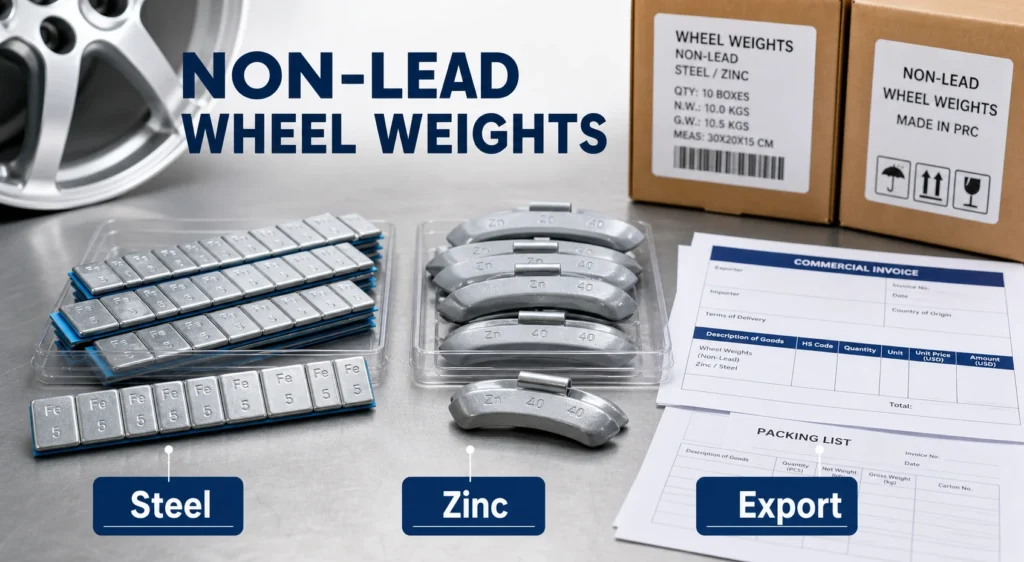
Non lead wheel weights are balancing weights made from materials such as steel or zinc instead of lead. Buyers choose them to meet market restrictions, reduce environmental risk, and simplify export sales. The right option depends on wheel type, attachment style, size range, coating, tape performance, documents, packaging, and sample testing.
For importers, distributors, tire-shop suppliers, and automotive parts brands, “non-lead” is not only a material label. It is a sourcing decision that affects cost, density, fitment, coating durability, installation habits, carton labels, and the proof buyers may need when selling into regulated or environmentally sensitive markets.
Table of Contents
- What are non-lead wheel weights?
- Why are buyers replacing lead wheel weights?
- Which non-lead material should buyers choose: steel or zinc?
- How do non-lead weights compare by application?
- What should importers include in a non-lead wheel weight RFQ?
- How do adhesive non-lead weights affect installation and packaging?
- What quality checks matter before bulk production?
- What export documents should buyers request?
- Conclusion: choose non-lead weights by market, wheel type, and proof
- Frequently Asked Questions
- References
What are non-lead wheel weights?
Non-lead wheel weights are clip-on or adhesive balancing weights made from steel, zinc, or another non-lead material. Their job is the same as any balancing weight: add a precise amount of mass to the wheel assembly so tire rotation is smoother and vibration is reduced.
The difference is in the material and the buying risk. Lead is dense and easy to shape, but it creates environmental concerns when weights detach from vehicles and enter road dust, drains, or waste streams. The U.S. Environmental Protection Agency has encouraged voluntary best practices to reduce or phase out lead wheel weights, and several regions or markets have adopted restrictions or buyer policies that make non-lead choices more practical for export programs 1.
For a buyer building a range, non-lead wheel weights still need the same basic specification work as any balancing product. You need to define clip-on or adhesive format, gram or ounce increments, rim fit, coating, tape, carton quantity, private label needs, and sample testing. The wheel weight range planning guide helps buyers connect those separate choices before they turn a material preference into a stock list.
Non-lead does not automatically mean one universal product. A steel adhesive strip for alloy wheels, a zinc clip-on weight for a premium replacement channel, and a coated steel clip-on weight for steel wheels may all be non-lead, but they solve different problems.
Why are buyers replacing lead wheel weights?
Buyers replace lead wheel weights because regulations, retailer policies, public environmental pressure, and export-market expectations can make lead a higher-risk choice. The exact rule depends on country, state, or customer channel, so buyers should verify the destination market before confirming material claims.
The policy direction is clear even when the legal details vary. Lead is a toxic metal, and wheel weights are a known use where alternatives exist. EPA guidance points to lead wheel weights as a preventable source of lead release when weights fall off vehicles 1. In Europe, the End-of Life Vehicles framework restricts lead in vehicle materials with specific exemptions and revisions, which is one reason automotive supply chains often prefer clearly documented lead-free components 2.
For export buying, the practical issue is not whether every market uses the same wording. It is whether the buyer can confidently answer customer questions. Can you confirm the material? Can you provide a declaration or test report when requested? Does the carton label avoid misleading language? Can the supplier keep the same material and coating from batch to batch?
When a buyer is still deciding whether the purchase is driven by law, customer policy, or risk reduction, lead-free wheel weight compliance planning can help separate market restrictions from normal sourcing preferences before a quotation is finalized.
The most common replacement path is steel for cost-sensitive, high-volume programs. Zinc remains useful where buyers want a denser non-lead material, a certain fitment feel, or a premium alternative. In many export assortments, both steel and zinc can appear side by side.
Which non-lead material should buyers choose: steel or zinc?
Steel usually fits buyers who need cost control, broad availability, and stable high-volume supply. Zinc usually fits buyers who want a denser non-lead option, different forming characteristics, or a product position closer to traditional lead weights in some applications.
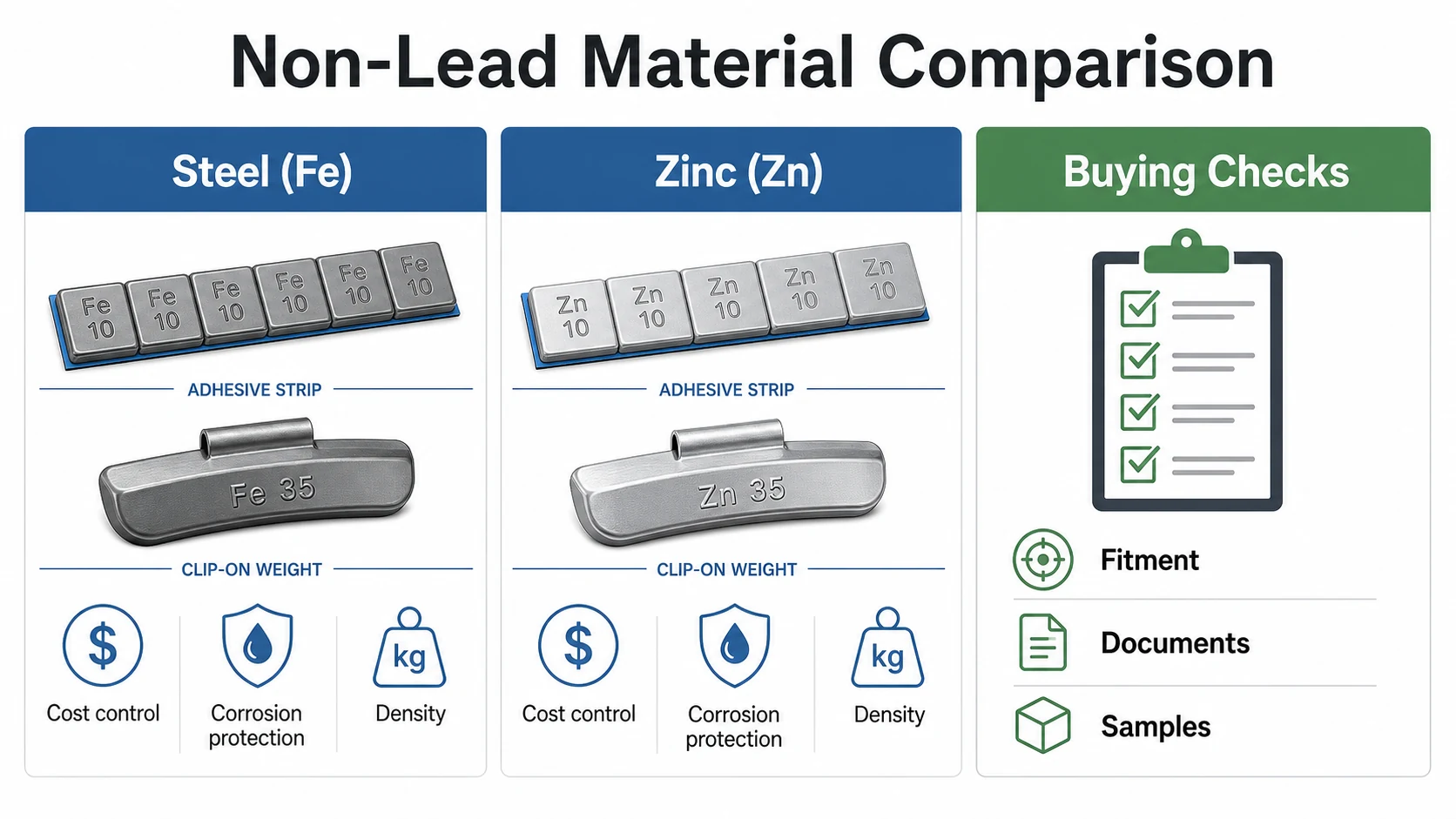
Steel and zinc are both practical non-lead materials, but they do not behave the same in sourcing, installation, or cost planning. Buyers should compare them by the application they need to serve rather than choosing from material name alone.
| Buying factor | Steel wheel weights | Zinc wheel weights | Buyer takeaway |
|---|---|---|---|
| Material symbol | Fe | Zn | Use clear material labels in RFQs and carton artwork. |
| Density | Lower than lead and zinc | Higher than steel, lower than lead | Weight shape and thickness may differ by material. |
| Cost position | Usually more cost-effective | Usually higher material cost | Steel often fits large-volume replacement programs. |
| Corrosion control | Coating is important | Surface finish still matters | Ask about plating, painting, salt spray targets, and storage conditions. |
| Common formats | Adhesive strips, clip-on weights | Clip-on weights, adhesive formats in some ranges | Confirm supplier tooling and available sizes. |
| Export fit | Strong option for broad non-lead programs | Good where buyers want a denser non-lead alternative | Match material to market positioning and customer expectation. |
If the sourcing team needs a broader material decision before it fixes the RFQ, the steel and zinc wheel weight comparison gives a more direct view of how lead, steel, and zinc differ in density, cost, corrosion risk, and best-fit use.
Steel is often specified as Fe. That marking can appear on adhesive segments, cartons, invoices, or product descriptions. Buyers who receive customer requests for “Fe wheel weights” should treat it as a steel-material requirement, then confirm size, format, coating, and tape separately. The Fe wheel weight sourcing notes are useful when a buyer needs to turn that symbol into a clear supplier specification.
Zinc is often selected where a buyer wants a non-lead material with a different weight-to-size balance. It can be attractive for certain clip-on ranges or markets that still expect a compact product feel. Before using zinc as the default, buyers should check whether the target customers will accept the price level, finish, and available sizes. The zinc wheel weight application checks can help buyers decide where Zn is worth carrying instead of treating it as a universal replacement.
How do non-lead weights compare by application?
The best non-lead choice depends on wheel type, service channel, and installation habit. Alloy-wheel service often points toward adhesive weights, while steel-wheel service often still needs clip-on weights matched to rim flange profiles.
For alloy wheels, adhesive steel strips are common because they fit behind spokes and avoid visible rim-edge clips. Buyers should compare segment size, strip length, tape brand or tape grade, liner type, and coating. A lower material price will not help if the tape fails in hot storage, humid transport, or dusty installation environments.
For steel wheels, clip-on weights remain important because many repair shops are familiar with flange-mounted balancing. The buyer must confirm clip profile, rim flange match, available gram or ounce sizes, and the coating used to protect the part from corrosion. Clip-on non-lead weights can be steel or zinc depending on market expectation and supplier range.
For tire-shop assortments, a mixed range is often safer than a single material or format. Shops may need adhesive strips for alloy wheels, clip-on options for steel wheels, and a size spread that covers common passenger car and light commercial applications. Importers serving multiple customer types should ask suppliers to quote by assortment, not only by one SKU.
For export distributors, non-lead sourcing also affects sales language. “Lead-free” can be a strong claim, but it should be backed by material declarations or test documents when the customer asks. “Non-lead steel wheel weights” or “non-lead zinc wheel weights” is often clearer in RFQ communication because it tells the supplier what material to quote.
What should importers include in a non-lead wheel weight RFQ?
A non-lead wheel weight RFQ should define material, type, sizes, coating, adhesive tape or clip profile, packing, label content, target market, and sample testing requirements. Without those details, suppliers may quote products that look similar but perform differently in the buyer’s market.
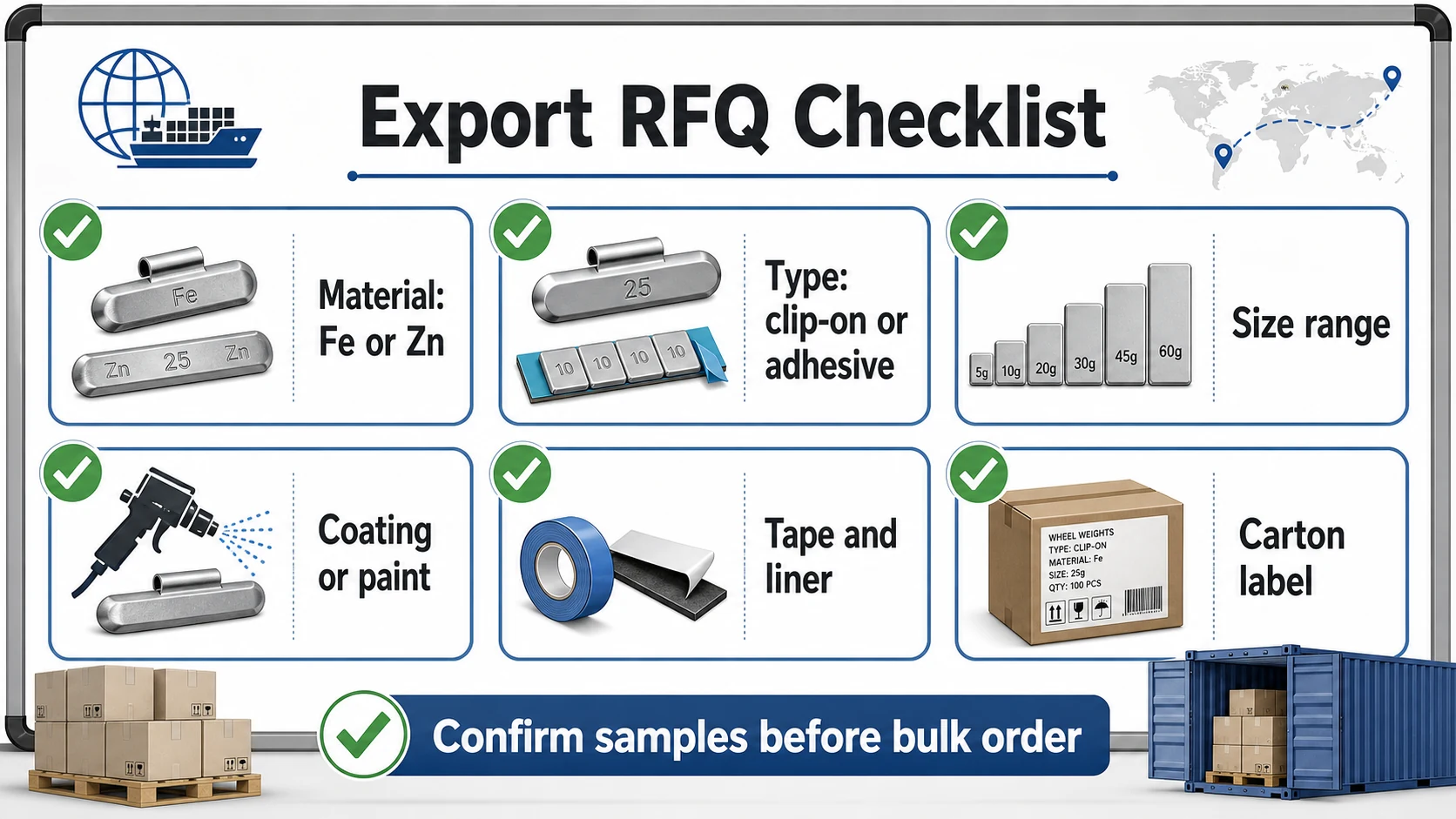
Use this checklist before asking for final pricing:
| RFQ item | What to specify | Why it matters |
|---|---|---|
| Material | Fe steel, Zn zinc, or another approved non-lead material | Prevents confusion between general “lead-free” wording and actual product composition. |
| Attachment type | Adhesive strip, adhesive roll, clip-on profile, or mixed assortment | Determines tooling, packaging, and installation use. |
| Size range | Grams or ounces, segment size, strip layout, clip-on increments | Controls shop coverage and carton SKU planning. |
| Coating or finish | Paint, plating, powder coating, corrosion expectation | Reduces rust complaints and protects shelf appearance. |
| Tape and liner | Tape grade, liner color, liner print, peel behavior | Affects installation reliability and user acceptance. |
| Carton details | Pieces per box, strips per box, net weight, gross weight, barcode, country of origin | Helps distributors receive, warehouse, and resell the products cleanly. |
| Documents | Material declaration, test report, compliance statement if needed | Supports customer audits and regulated-market sales. |
| Samples | Pre-production samples or approved reference samples | Lets the buyer test fitment, tape, finish, and labels before bulk production. |
Once the buyer has confirmed Fe or Zn, attachment type, coating, tape, and carton requirements, it becomes easier to review steel and zinc non-lead wheel weight samples against the same specification instead of comparing unrelated price quotes.
The RFQ should also state the destination market. A supplier does not need to give legal advice, but the supplier can avoid the wrong material, wrong label, or wrong document package when the buyer explains where the goods will be sold.
How do adhesive non-lead weights affect installation and packaging?
Adhesive non-lead weights require special attention to tape, liner, strip flexibility, coating, and surface preparation. The balancing weight may be correct, but poor adhesive performance can still create returns, customer complaints, or lost shop confidence.
Steel adhesive weights are common because they offer a practical non-lead cost position. Since steel is less dense than lead, the final shape may be slightly larger or thicker for the same nominal weight. Buyers should check whether the strip fits behind common wheel spokes and whether low-profile options are needed for tight clearance applications.
Tape is not a small detail. Adhesive performance depends on the tape system, storage, installation pressure, wheel cleanliness, and temperature. 3M surface-preparation guidance for VHB tapes emphasizes clean, dry surfaces and proper preparation for bonding performance 3. Wheel weight buyers do not need to turn every carton into a tape-engineering project, but they should test samples under realistic installation conditions.
Packaging also changes the user experience. Adhesive strips may be packed in boxes, rolls, bags, or private-label cartons. Strip layout matters: 5 g plus 10 g segments, quarter-ounce segments, and mixed layouts affect how shops cut, peel, and apply weights during service. Buyers comparing adhesive formats can use strip format and segment-size planning to decide whether boxed strips, rolls, or a specific segment layout better matches their sales channel.
For export, the liner and carton label deserve attention. A printed liner can support branding, but the buyer should confirm it does not weaken peel behavior or create adhesive residue. Carton labels should identify material and size clearly enough for warehouse staff, customs documents, and downstream customers.
What quality checks matter before bulk production?
Quality checks for non-lead wheel weights should focus on material consistency, weight tolerance, fitment, coating adhesion, corrosion resistance, tape performance, packaging accuracy, and batch traceability. A sample that looks acceptable is not enough if bulk cartons vary in size, finish, or label information.
Start with weight accuracy. A 5 g segment should be close enough to its nominal value for balancing work, and clip-on weights should be checked across the size range, not only at one popular size. If the buyer orders both gram and ounce versions, the carton and piece markings must not be mixed.
Next, check fitment. Clip-on weights need the correct clip shape and holding force for the intended rim flange. Adhesive weights need strip flexibility, reliable liner removal, and enough tape contact for the wheel surface. Buyers should test the actual sample on representative wheel types, not just inspect loose parts on a desk.
Coating matters more for steel than many buyers expect. If steel weights are poorly coated, corrosion can appear during ocean freight, warehouse storage, or shop shelf life. Salt spray testing is commonly used as a comparative corrosion-resistance method, and ASTM B117 describes a controlled salt spray apparatus practice used across many industries 4. A buyer should not treat one test number as a complete guarantee, but it can help compare supplier processes when combined with real storage and handling checks.
For programs where finish durability is a customer concern, coating and corrosion checks for wheel weights can help buyers decide what to ask about plating, painting, salt spray expectations, storage, and packaging before approving mass production.
Finally, verify packing. Count pieces per box, net weight, gross weight, barcode, carton print, inner-bag use, and pallet condition. Many export problems are not caused by the metal part itself; they come from mixed SKUs, unclear labels, damaged cartons, or inconsistent private-label printing.
What export documents should buyers request?
Export buyers should request documents that match the destination market and customer channel. Common requests include material declarations, lead-free or non-lead statements, test reports, packing lists, commercial invoices, product photos, and carton label artwork approval.
Do not ask suppliers for every possible certificate if the market does not require it. That slows quotation and may create unnecessary cost. Instead, start with the buyer’s real sales channel. Are the weights going to a distributor, tire-shop chain, retail package, OEM service kit, or online aftermarket brand? Each channel may need different proof.
For non-lead wheel weights, useful document questions include:
- Can the supplier state whether the product is Fe steel or Zn zinc?
- Can the supplier provide a material declaration or test report when required by the buyer’s customer?
- Does the carton label match the invoice, packing list, and actual product?
- Are lead-free or non-lead claims worded in a way the destination market accepts?
- Can the supplier keep approved samples, label artwork, and carton specifications for repeat orders?
The buyer should also confirm whether documents are needed before shipment or before production. If a distributor’s customer must approve material evidence before the order is placed, waiting until the container is ready will create avoidable risk.
Use supplier-level material and documentation verification for lead-free wheel weights when a lead-free claim must be connected to the actual supplier, product configuration, destination market, and evidence package rather than treated as a generic catalog label.
Conclusion: choose non-lead weights by market, wheel type, and proof
Non-lead wheel weights are now a practical sourcing path for many export programs, but the best choice is not simply “anything without lead.” Steel usually supports cost-controlled, high-volume assortments. Zinc can fit buyers who want a denser non-lead alternative or a different product position. Adhesive and clip-on formats still need separate fitment, tape, coating, and size decisions.
Before placing a bulk order, confirm the destination market, material, attachment type, size range, finish, tape or clip requirements, carton label, and documents. Then test samples against real wheels and storage conditions. When those details are clear, buyers can request an Fe or Zn quotation with fewer misunderstandings and fewer shipment surprises.
Frequently Asked Questions
Are non-lead wheel weights the same as lead-free wheel weights?
In everyday sourcing language, they are often used together, but they are not always identical claims. “Non-lead” usually means the intended material is not lead, such as steel or zinc. “Lead-free” may imply a compliance claim, so buyers should confirm the exact wording, test expectations, and destination-market requirements.
Are steel wheel weights better than zinc wheel weights?
Steel is usually better for cost-sensitive, high-volume programs, while zinc can be better where buyers want a denser non-lead material or a certain product feel. The better option depends on customer expectations, wheel application, price target, coating, and available sizes.
Do non-lead wheel weights need special coating?
Many non-lead weights, especially steel weights, need reliable coating or surface treatment to reduce corrosion risk. Buyers should ask about plating, paint, powder coating, salt spray targets, packing method, and storage guidance before approving bulk production.
Can non-lead adhesive weights replace lead adhesive weights directly?
They can often serve the same balancing function, but the shape, thickness, tape behavior, and segment layout may differ. Buyers should test fit behind common wheel spokes, confirm tape adhesion, and compare installation feedback before switching a market from lead to non-lead adhesive strips.
What should an importer check before ordering non-lead wheel weights?
An importer should confirm material, attachment type, size range, coating, tape or clip profile, packaging, carton labels, required documents, and samples. The buyer should also verify the destination market’s lead restrictions or customer policy before using lead-free claims in sales materials.
References
[1] United States Environmental Protection Agency. “Best Management Practices for Lead Wheel Weights.” 2015.
[2] European Union. “Directive 2000/53/EC on End-of Life Vehicles.” 2000.
[3] 3M. “VHB Tape Surface Preparation Technical Bulletin.” 2019.
[4] ASTM International. “ASTM B117-19 Standard Practice for Operating Salt Spray Apparatus.” 2019.