





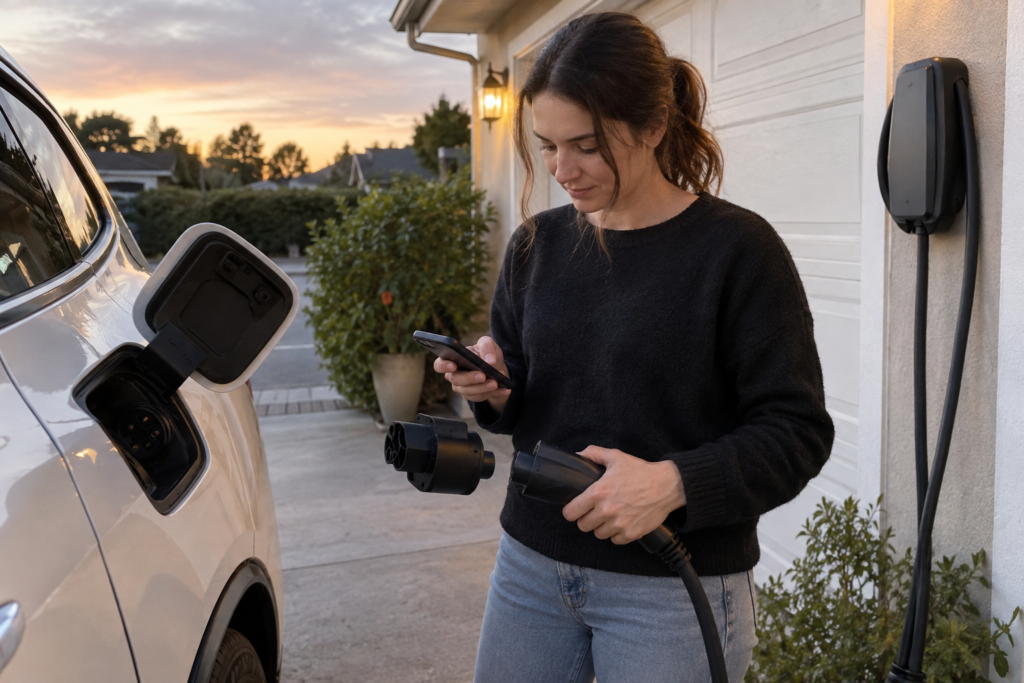
Um adaptador de carregamento de VE pode alterar uma conexão física entre equipamentos definidos, mas não torna todos os veículos, carregadores, cabos ou modos de carregamento compatíveis. Confirme o padrão e a direção do conector, o limite CA ou CC, a tensão, a corrente, a temperatura, a comunicação, o travamento, a aprovação do fabricante e os requisitos do mercado de destino antes do uso.
Um adaptador é um caminho de conexão curto com uma grande responsabilidade. O veículo, a estação de carregamento, o cabo, o adaptador e a instalação devem funcionar como uma combinação definida. Use este guia de compra de acessórios de carregamento de VE para a decisão de categoria mais ampla, depois use este guia para decidir se um adaptador específico é física, elétrica, funcional e comercialmente aceitável.
Índice
- O que um adaptador de carregamento de VE altera?
- Quais limites de adaptadores CA e CC importam?
- Como você combina conector, veículo e carregador?
- Quais classificações de corrente, tensão e temperatura controlam o uso?
- Por que encaixe mecânico, comunicação e travamento são diferentes?
- O que os compradores devem verificar antes do uso seguro ou da aprovação?
- Matriz de compatibilidade de adaptadores de carregamento de VE
- Conclusão: aprove o caminho de conexão completo
- Perguntas Frequentes
- Referências
O que um adaptador de carregamento de VE altera?
Um adaptador transforma uma interface física definida em outra interface definida. Ele pode conectar uma entrada do veículo a um conector do lado do carregador, ou pode adaptar um acoplador do lado da estação a uma entrada do lado do veículo. Ele não adiciona automaticamente um carregador, não aumenta a classificação de corrente, não cria um protocolo de controle ausente nem aprova uma combinação que o fabricante não definiu.
Interface física
A primeira pergunta é o que o adaptador está conectando fisicamente:
| Caminho de conexão | Exemplo | Primeira decisão |
|---|---|---|
| Entrada do veículo para acoplador do lado da estação | Veículo NACS/J3400 para estação J1772 | Confirme a direção, o modo CA ou CC, a cobertura exata do veículo e da estação |
| Conector do veículo para tomada do wallbox | Cabo Tipo 2 ou adaptador definido para tomada Tipo 2 | Confirme que o cabo e a tomada são aprovados para o mesmo modo de carregamento e classificação |
| Conexão de carregador entre mercados | Equipamento Tipo 1/J1772 para infraestrutura Tipo 2 | Confirme as regras locais, a fiação da tomada, o comportamento do piloto e a direção do adaptador |
| Adaptador CC para veículo | Uma interface CC definida do veículo para outra interface CC definida da estação | Confirme o adaptador qualificado exato, a comunicação, o limite térmico e de travamento |
A palavra “adaptador” abrange produtos diferentes. Um adaptador mecânico passivo, um conjunto de cabo com duas extremidades diferentes e um adaptador ativo com eletrônica de controle não têm o mesmo limite de segurança ou compatibilidade.
O que um adaptador não pode alterar
A menos que o produto seja especificamente projetado e qualificado para isso, um adaptador não pode:
- transformar carregamento CA em carregamento rápido CC;
- fazer um veículo aceitar um modo de carregamento que sua entrada ou sistema de bordo não suporta;
- aumentar a classificação de corrente ou tensão do cabo, conector, tomada, EVSE ou veículo;
- fornecer comportamento ausente de piloto de controle, proximidade, temperatura, autenticação ou comunicação;
- eliminar a necessidade do aterramento correto, proteção contra sobrecorrente, instalação e aprovação local;
- tornar segura uma combinação não aprovada de veículo e estação porque os plugues se encaixam fisicamente.
Esse limite é a regra central de compra. Se a descrição do produto explica apenas os formatos dos conectores, o adaptador não está totalmente especificado.
Quais limites de adaptadores CA e CC importam?
Adaptadores CA e CC não são categorias intercambiáveis. O carregamento CA normalmente depende do carregador de bordo do veículo e de funções de piloto definidas, enquanto o carregamento rápido CC usa um limite diferente de transferência de energia e controle. O adaptador deve ser avaliado para o modo que pretende suportar.
Adaptador CA ou conjunto de cabo
Para um adaptador CA ou conjunto de cabo, confirme a entrada do veículo, a tomada ou acoplador do lado da estação, o comportamento do piloto e de proximidade, a fase, a tensão, a corrente, o arranjo dos contatos, o comprimento do cabo e a faixa de temperatura. Um produto Tipo 1 para Tipo 2 pode ser útil em uma configuração CA definida, mas a direção e a combinação de equipamentos ainda importam.
O Departamento de Energia dos EUA identifica o SAE J1772 como um conector de veículo Nível 1 e Nível 2 e lista J1772, CCS, CHAdeMO e NACS entre as famílias de conectores usadas em contextos de carregamento nos EUA. A família de conectores é um ponto de partida, não um registro completo de aprovação. 1
Adaptador CC para veículo
Adaptadores CC exigem um nível mais alto de escrutínio porque o veículo e a estação devem coordenar a entrega de energia, os limites de corrente, as funções de controle e o comportamento térmico. A IEC TS 62196-7:2026 aborda especificamente requisitos de segurança, interoperabilidade, compatibilidade e configuração para certos adaptadores CC de veículos, ao mesmo tempo que declara limites para tipos de adaptadores que não cobre. 2
Não use uma descrição geral de adaptador CA para aprovar um adaptador CC. Peça a configuração CC exata, os sistemas de carregamento aprovados, os limites de corrente e tensão, o comportamento de comunicação, as provisões de resfriamento ou temperatura, o travamento e evidências específicas do mercado.
Adaptador versus EVSE
Um adaptador não é automaticamente EVSE. A IEC 61851-1 cobre requisitos gerais para sistemas de carregamento condutivo, incluindo a conexão entre o equipamento de alimentação do VE e o veículo, segurança elétrica, modos, requisitos de controle, marcação e requisitos relacionados a adaptadores dentro de seu escopo. 3
Se um produto inclui comutação, proteção, geração de piloto de controle, monitoramento de temperatura ou outra eletrônica de controle, identifique o EVSE ou o limite de controle separadamente. O comprador pode precisar de um conjunto de documentos diferente do de um adaptador de conector passivo.
Como você combina conector, veículo e carregador?
A correspondência correta requer três referências: a entrada do veículo, o conector do carregador ou do lado da tomada e as duas extremidades do adaptador. A direção do adaptador deve ser escrita de um lado para o outro; “adaptador universal para VE” não é uma descrição de encaixe suficiente.
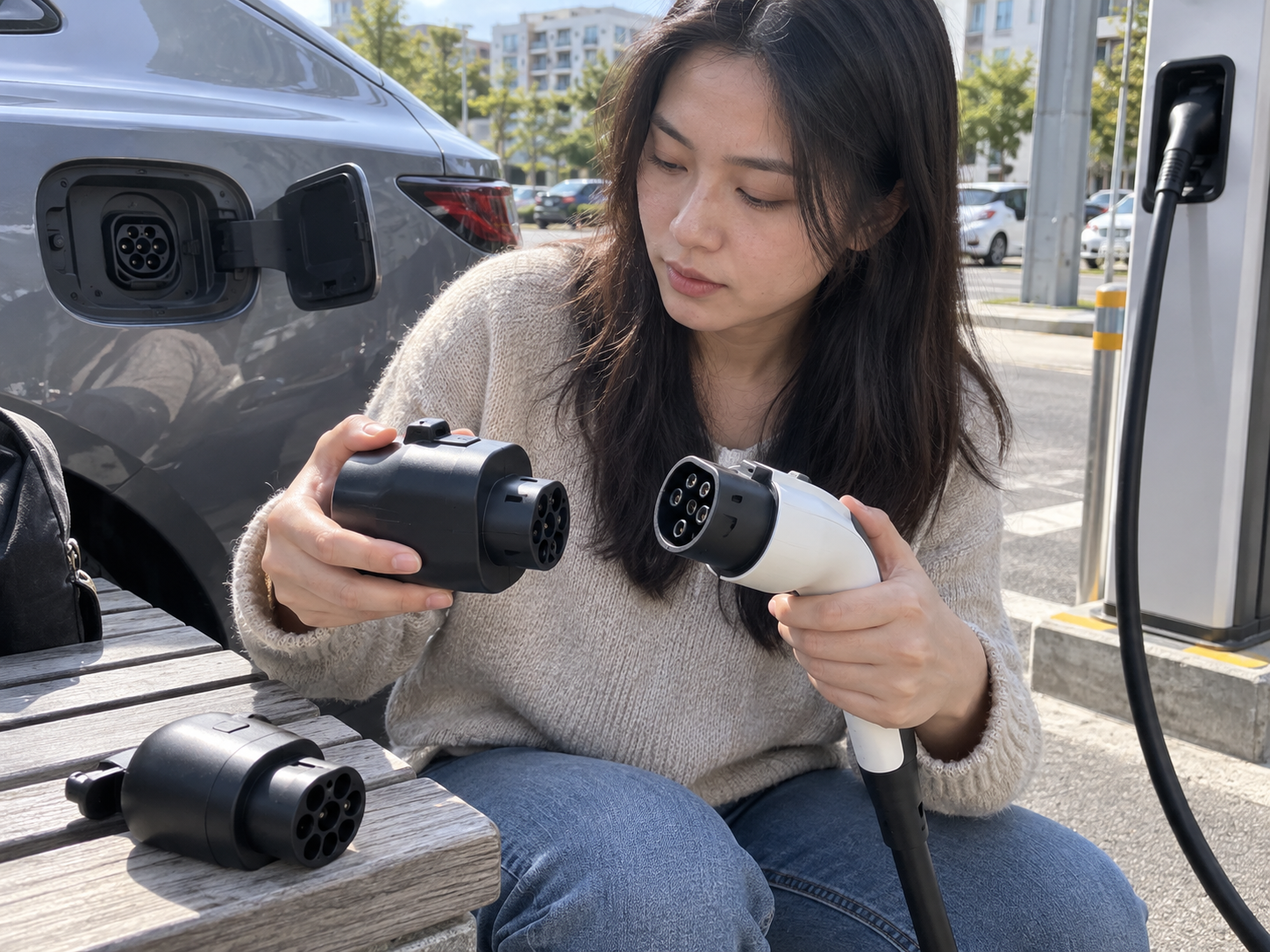
Record both ends and the direction
Use a fitment record with these fields:
| Campo | Required record |
|---|---|
| Vehicle | Make, model, year, trim, fleet group, and inlet reference |
| Vehicle-side adapter end | Connector family, keying, contacts, latch, and approved direction |
| Charger-side adapter end | Station, wallbox, socket, fixed cable, plug, and model reference |
| Modo de carregamento | AC only, DC only, or explicitly qualified AC/DC combinations |
| Adapter function | Passive interface, cable assembly, or active control adapter |
| Classificação | Voltage, current, phase, duty, temperature, and derating conditions |
| Comunicação | Pilot, proximity, temperature, authentication, release, and protocol behavior |
| Mechanical fit | Insertion, clearance, strain relief, cable support, locking, and retention |
| Mercado | Country, language, labeling, customer channel, and approval boundary |
| Decisão | Pass, Conditional, Hold, or Reject with owner and next action |
Compatibility matrix
The matrix below is a practical screening tool. Its example rows are not universal approval claims; the exact adapter, vehicle, station, and market evidence must be added before a buyer releases a product.
| Vehicle-side reference | Charger-side reference | Adapter or direct connection | Mode boundary | Rating and functional checks | Evidence or approval condition | Screening decision |
|---|---|---|---|---|---|---|
| J1772 vehicle inlet | J1772 AC EVSE | Direct connection; no adapter | AC Level 1/2 | Vehicle and EVSE ratings, pilot/proximity, cable and outlet condition | Exact equipment match and normal installation requirements | Pass when the equipment ratings match |
| NACS/J3400 vehicle inlet | J1772 AC station-side outlet or coupler | Defined NACS-to-J1772 adapter | AC only unless the product says otherwise | Voltage, current limit, latch, temperature, pilot behavior, adapter direction | Exact vehicle and station list, qualified adapter evidence, label, manual, and current revision | Conditional until the adapter is approved for the combination |
| J1772 vehicle inlet | Type 2 AC infrastructure | Type 1/J1772-to-Type 2 cable or adapter | AC only | Phase, current, pilot/proximity, contact arrangement, cable length, and local outlet configuration | Destination-market evidence and exact equipment combination | Hold if direction or pilot behavior is not documented |
| CCS1 vehicle inlet | CCS1 DC station | Direct connection; no cross-standard adapter | carregamento rápido CC | Station communication, current, voltage, thermal limits, and vehicle approval | Station and vehicle support confirmed; no physical-only assumption | Pass when the complete system is supported |
| NACS/J3400 vehicle inlet | CCS1 DC station | Defined NACS-to-CCS1 DC adapter | DC only | Communication, current and voltage, temperature, locking, cable strain, and vehicle/station software support | Adapter qualification, OEM or station approval, exact model list, and user instructions | Hold until the qualified-use boundary is verified |
| Type 2/CCS2 vehicle inlet | CCS2 DC station | Direct connection for the defined system | carregamento rápido CC | DC contacts, communication, current, voltage, thermal and locking behavior | Exact vehicle/station support and applicable product evidence | Pass only for the documented configuration |
Before using any cross-standard adapter, compare the row with the supplier's approved-use list. If the list says “compatible with most vehicles” but does not identify the vehicle inlet, station-side connector, charging mode, rating, and exclusions, keep the row at Hold or Clarify.
Buyers who need the broader sequence of vehicle, charger, rating, market, and evidence checks can use the Lista de verificação de compatibilidade de acessórios de carregamento para VE before choosing an adapter SKU.
Quais classificações de corrente, tensão e temperatura controlam o uso?
The safe operating limit is controlled by the complete connection path, not the largest number printed on the adapter. The lowest applicable rating among the vehicle, EVSE, outlet, cable, adapter, contacts, and installation controls the allowed use.
Rating fields to compare
| Rating field | What buyers should confirm |
|---|---|
| Tensão | AC or DC, nominal and maximum voltage, insulation boundary, and market supply |
| Corrente | Continuous or defined duty rating, phase, contact capacity, and any derating |
| Potência | Calculated operating power is consistent with voltage, current, phase, and system limits |
| Temperatura | Operating and storage range, contact heating, ambient assumptions, and thermal cutback |
| Duty and duration | Short-term test, continuous charging, repeated cycles, or fleet-duty expectation |
| Cable and contacts | Conductor size, contact material, termination, resistance, and connector temperature |
| Ambiente | IP boundary, rain, dust, UV, corrosion, cleaning, impact, and mounting condition |
Do not treat an adapter marked “32 A” as a guarantee that the vehicle, cable, station, or outlet may operate at 32 A continuously. Confirm what the rating means, how it was tested, and whether a temperature or installation condition reduces the allowed current.
Temperature is a compatibility field
Contact resistance, cable heating, ambient temperature, sunlight, enclosure conditions, and repeated charging cycles can affect an adapter's safe use. Request temperature limits, thermal monitoring or cutback behavior where applicable, and instructions for abnormal heating, discoloration, odor, loose fit, or damaged locking.
Do not use an adapter as a rating upgrade
An adapter cannot upgrade a 16 A outlet to a 32 A circuit, a low-rated cable to a higher-rated cable, or a vehicle's charging capability beyond its approved limit. The product listing should state the maximum approved combination and exclusions in the same place as the connector description.
Por que encaixe mecânico, comunicação e travamento são diferentes?
Mechanical mating is necessary but not sufficient. A product can insert into an inlet and still fail to provide the communication, locking, clearance, strain relief, or thermal behavior required for charging.
Mechanical fit
Check keying, orientation, insertion force, contact alignment, shell clearance, latch access, cable exit, bend radius, adapter weight, and support. An adapter that hangs from a vehicle inlet or station coupler may create strain that the connector or latch was not designed to carry.
Communication and control
Depending on the charging path, the system may rely on pilot, proximity, temperature, authentication, release, or other control behavior. A passive adapter does not automatically pass through or create every function. Ask the supplier to identify which signals are passed, transformed, monitored, or not supported.
SAE J3400/1:2025 describes general physical, electrical, functional, and performance requirements for adapters connected to conductive power transfer systems and focuses on evaluating adapters for J3400 and J1772 use. That is a useful example of why an adapter should be assessed as its own product boundary rather than treated as a plastic shape. 4
Locking and release
Confirm whether the vehicle or station locks the connector, whether the adapter has its own latch or retention feature, and how the user releases the connection after charging. Never rely on friction, a cable tie, or an improvised support to keep an adapter connected during energized use.
Strain relief and support
The adapter should be supported according to its instructions. Check cable weight, hanging load, bend radius near the adapter, drive-over or impact restrictions, and whether the adapter may rest on the ground, vehicle body, or wet surface. These details belong in the safe-use instructions and the buyer's sample review.
O que os compradores devem verificar antes do uso seguro ou da aprovação?
Safe use begins with an approved-use list and ends with a physical inspection. Buyers should not approve an adapter only because it passes a bench fit check or because a supplier provides a familiar certification mark.
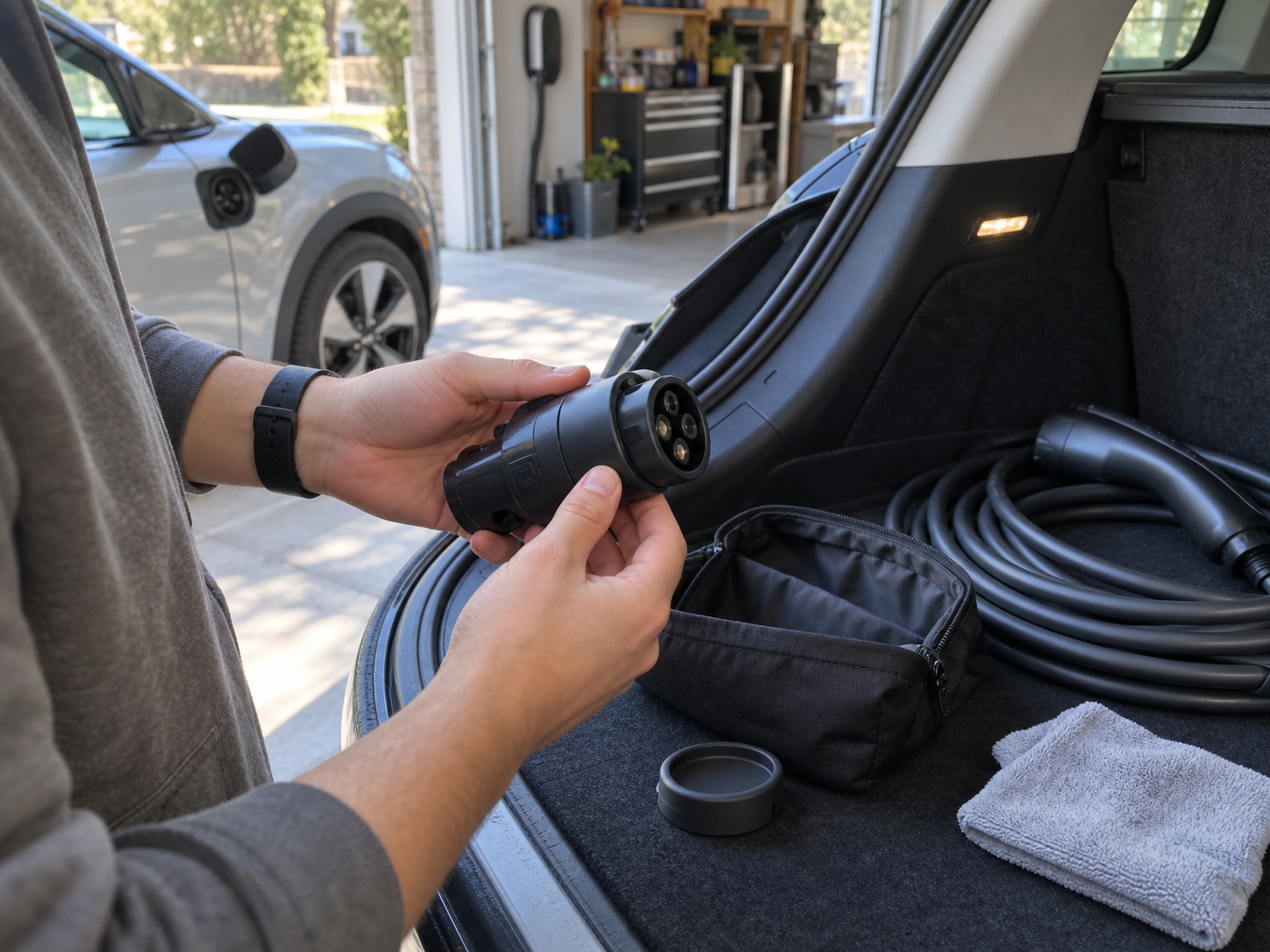
Pre-use checks
- Confirm the vehicle inlet and charger-side connector match the approved direction.
- Confirm the adapter is intended for AC or DC use as required; do not infer the mode from the shape.
- Confirm voltage, current, phase, temperature, cable, outlet, EVSE, and vehicle limits.
- Inspect housing, contacts, latch, seals, cable exit, strain relief, and signs of damage or contamination.
- Confirm the adapter is fully inserted and locked according to the instructions.
- Keep the adapter supported and protected from standing water, vehicle movement, impact, and excessive cable strain.
- Stop use for overheating, odor, arcing, discoloration, loose fit, damaged contacts, broken latch, or unexpected charging behavior.
Buyer approval checks
Request the following before sample approval or listing:
| Solicitar | Resposta do fornecedor obrigatória |
|---|---|
| Exact adapter identity | SKU, model, revision, connector ends, direction, and included accessories |
| Approved-use list | Vehicle inlet, station-side connector, AC/DC mode, supported models, exclusions, and market |
| Ratings | Voltage, current, phase, temperature, duty, derating, and environmental conditions |
| Functional behavior | Pilot, proximity, temperature, authentication, locking, release, and unsupported functions |
| Mechanical data | Dimensions, weight, cable diameter, bend radius, retention, load, and mounting or support limits |
| Evidência | Datasheet, declaration, test report, listing or assessment, label, manual, and revision traceability |
| Sample plan | Sample quantity, test conditions, first-article record, inspection criteria, and failure reporting |
| Controle de mudanças | Critical component changes, re-test triggers, document revision, and notification process |
For standards and documents, the Documentos de certificação e ensaio de acessórios de carregamento de VE article provides the evidence review sequence that should accompany this adapter matrix.
Buyers comparing several adapter configurations can use the EV charging adapter product range to organize connector direction, AC or DC boundary, rating, approved-use status, and documentation as separate SKU fields rather than comparing product photos alone.
When the adapter is supplied with a cable assembly, continue to the Inspeção de qualidade do cabo de carregamento de VE checklist to inspect the jacket, terminals, strain relief, markings, and sample approval as one configuration. This keeps an adapter’s approved-use decision connected to the cable that will actually be quoted and shipped.
Approval statuses
- Aprovado: the exact adapter, vehicle, charger, mode, rating, market, and evidence match.
- Condicional: the physical combination is plausible, but a model list, sample test, label, document, or market approval remains open.
- Em espera: the direction, AC/DC boundary, rating, communication, locking, or exact product identity is unresolved.
- Rejeitar: the supplier makes a universal claim, prohibits traceability, or cannot explain how the adapter handles the required charging function.
Matriz de compatibilidade de adaptadores de carregamento de VE
Use this shorter matrix when comparing several adapter SKUs in an RFQ. It is designed to force the supplier to state what the adapter supports and what it explicitly does not support.
| Campo da RFQ | Resposta do fornecedor obrigatória |
|---|---|
| Vehicle-side connector and approved vehicles | Connector family, vehicle models and years, inlet photos or references, and exclusions |
| Charger-side connector and equipment | Station, wallbox, socket, fixed cable, or plug model and market |
| Direction | Which end connects to the vehicle and which end connects to the charger or outlet |
| Modo de carregamento | AC only, DC only, or defined combinations; state what is not supported |
| Electrical rating | Voltage, current, phase, duty, derating, temperature, and lowest-rated system component |
| Comunicação | Pilot, proximity, temperature, authentication, release, and protocol behavior |
| Mechanical design | Keying, dimensions, contacts, latch, locking, weight, bend radius, strain relief, and support |
| Uso ambiental | IP boundary, rain, dust, UV, corrosion, cleaning, impact, and storage conditions |
| Evidência | Datasheet, standard, test report, certification or listing, declaration, label, manual, revision |
| Commercial scope | Exact SKU, inclusions, sample quantity, MOQ, lead time, warranty, spare parts, packaging, and change control |
| Decisão | Pass, Conditional, Hold, or Reject; owner, missing item, and next action |
The final approval should be tied to the exact row, not to a general product-family statement. If a supplier changes connector source, contact material, control electronics, housing, cable, firmware, or label, reopen the row and confirm whether a new sample or document review is required.
Conclusão: aprove o caminho de conexão completo
An EV charging adapter is safe only as part of a defined vehicle, charger, cable, charging mode, rating, communication, locking, environment, and market combination. The correct question is not “Does this plug fit?” but “Which exact equipment combination is this adapter approved to connect, under which limits, and with which evidence?”
Before ordering or listing an adapter, complete the compatibility matrix, request the approved-use list, compare the lowest system rating, inspect the sample, and record Pass, Conditional, Hold, or Reject. Buyers can request an adapter compatibility review with both connector references, target vehicle or fleet, charging mode, ratings, destination market, quantity, and required documents.
Perguntas Frequentes
Can an EV charging adapter make any two connectors compatible?
No. It can change a defined physical interface, but the vehicle, charger, cable, charging mode, ratings, communication, locking, and market requirements must also match. A connector that inserts successfully is not proof that charging is safe or supported.
Can a Type 1-to-Type 2 adapter be used for DC fast charging?
Do not assume it can. Type 1/J1772 and Type 2 are commonly associated with AC interfaces, while CCS adds a defined DC configuration. A Type 1-to-Type 2 product must state its charging mode, direction, ratings, and approved equipment combination; physical shape alone does not authorize DC use.
Can a NACS adapter work with every J1772 charger?
No. A NACS-to-J1772 adapter may be suitable for a defined AC combination, but vehicle model, station-side equipment, current, pilot behavior, latch, temperature, and manufacturer or certification approval still matter. Ask for the exact approved-use list and exclusions.
Does an adapter increase charging speed?
No. Charging speed remains limited by the vehicle, EVSE or station, outlet, cable, adapter, installation, and charging conditions. An adapter cannot upgrade the lowest-rated component or make a vehicle accept a higher charging mode.
Can an adapter convert AC charging to DC fast charging?
Not as a passive interface. AC and DC charging use different power-transfer and control boundaries. A product that claims a DC function needs its own defined architecture, communication behavior, ratings, safety evidence, and approved-use instructions.
What is the most important adapter rating?
There is no single rating that is always most important. Confirm voltage, current, phase, duty, temperature, connector contacts, cable, environment, communication, and the lowest-rated component together. A high current number on the adapter does not override a lower-rated outlet, cable, or vehicle.
Should an adapter have a locking or support feature?
It should have the locking, retention, strain-relief, and support behavior required for its approved connection. Do not use an improvised strap or let a heavy adapter hang from a vehicle inlet or station coupler unless the instructions explicitly allow that condition.
What documents should a buyer request for an EV charging adapter?
Request the exact SKU and revision, approved-use list, datasheet, electrical and environmental ratings, test report, certification or listing where applicable, declaration, label, manual, communication and locking description, sample test record, and change-control process. The files should identify the adapter configuration being quoted.
Referências
[1] U.S. Department of Energy Alternative Fuels Data Center. “Electric Vehicles for Consumers.” 2026.
[2] International Electrotechnical Commission. “IEC TS 62196-7:2026 Vehicle adapters.” 2026.
[3] International Electrotechnical Commission. “IEC 61851-1:2017 Electric vehicle conductive charging system – Part 1.” 2017.
[4] SAE International. “J3400/1:2025 Electric Vehicle Charging Adapter Safety and OEM-Qualified Device Designation.” 2025.
[5] UL Solutions. “EV Charging Adapter Testing and Certification.” 2026.







