





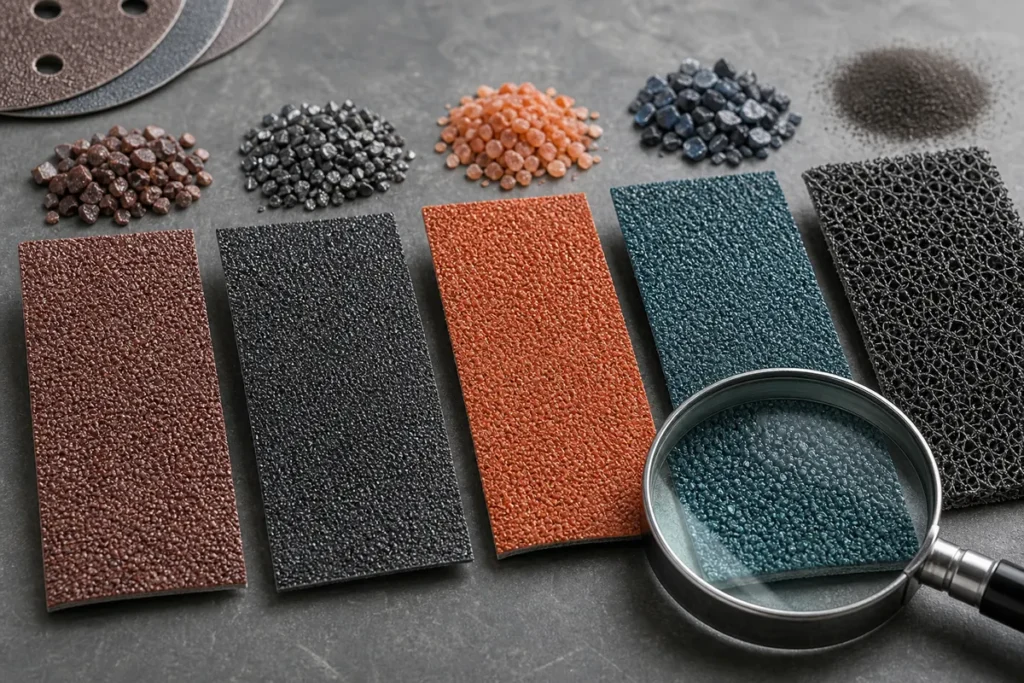
O grão abrasivo é o mineral de corte duro ligado à lixa, discos de lixamento, cintas, rolos e outros produtos abrasivos. Na lixa automotiva, o tipo de grão afeta a velocidade com que o abrasivo corta, quanto tempo dura, como se fratura, quanto calor gera e que tipo de padrão de riscos deixa.
O número de granulometria informa o tamanho da partícula, mas o grão abrasivo informa o comportamento de corte. Dois discos P320 podem parecer diferentes se um usa óxido de alumínio e outro usa grão cerâmico ou um abrasivo de precisão com suporte de filme. É por isso que a escolha do grão importa na modelagem de massa de polir, lixamento de primer, preparação de pintura e acabamento de verniz.
Índice
- O que significa grão abrasivo em lixa?
- Quais tipos de grão abrasivo são usados em lixa automotiva?
- Como o grão abrasivo é diferente da granulometria?
- Qual grão abrasivo é melhor para massa de polir, primer, pintura e verniz?
- Como o suporte, o revestimento e a extração de poeira alteram o desempenho do grão?
- Como os compradores devem avaliar a qualidade do grão abrasivo?
- Quais perguntas de fornecimento você deve fazer sobre grão abrasivo?
- Conclusão: A escolha do grão controla mais do que a rugosidade
- Perguntas Frequentes
- Referências
O que significa grão abrasivo em lixa?
O grão abrasivo é o mineral de corte que realmente risca, corta ou refina a superfície. O suporte o mantém, a liga o prende no lugar e o tamanho da granulometria controla o tamanho da partícula, mas o grão é a aresta de trabalho.
Abrasivos automotivos comuns podem usar óxido de alumínio, carbeto de silício, alumina cerâmica, alumina de zircônia ou misturas. Alguns sistemas premium usam conceitos de grão conformado ou de precisão projetados para cortar de forma consistente e fraturar de maneira controlada. Os principais fornecedores de abrasivos descrevem o tipo de grão como um fator-chave na taxa de corte, durabilidade e adequação à aplicação 1.
O relacionado guia de lixa automotiva fornece o contexto mais amplo do produto. O grão é uma parte do produto, mas funciona em conjunto com o suporte, o revestimento, a granulometria, o padrão de furos e o método de lixamento.
Quais tipos de grão abrasivo são usados em lixa automotiva?
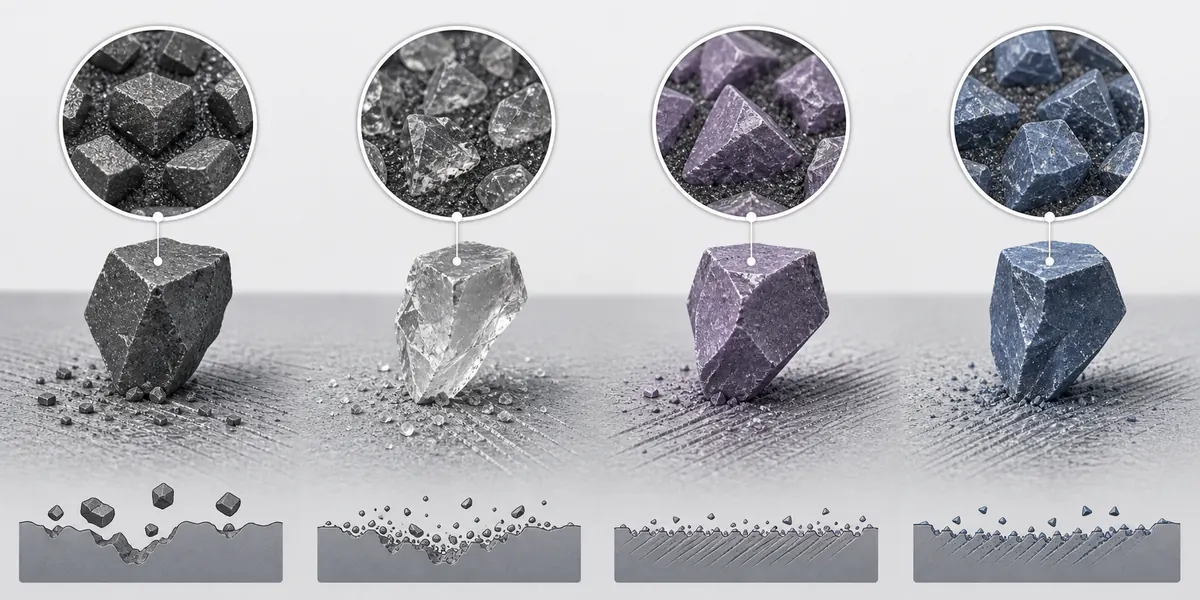
Os grãos abrasivos mais comuns em lixa automotiva são óxido de alumínio, carbeto de silício, alumina cerâmica e alumina de zircônia. Cada um tem um equilíbrio diferente de nitidez, tenacidade, comportamento de fratura, controle de calor e custo.
| Tipo de Grão | Sensação Típica | Uso Automotivo Comum | Principal Trade-Off |
|---|---|---|---|
| Óxido de alumínio | Durável, versátil | Lixamento geral, primer, massa, pintura antiga | Nem sempre é o corte mais rápido |
| Carbeto de silício | Muito afiado, corte fino | Lixa úmida/seca, acabamento de pintura e verniz | Pode fraturar mais rápido sob pressão pesada |
| Alumina cerâmica | Rápido, autoafiável | Lixamento pesado, trabalho de produção, discos premium | Custo mais alto |
| Alumina de zircônia | Resistente e agressivo | Remoção pesada de material, materiais mais duros | Pode ser agressivo demais para acabamento fino |
| Grãos misturados | Comportamento equilibrado | Discos automotivos multiuso | A qualidade depende da mistura e do revestimento |
O óxido de alumínio é comum porque é versátil e econômico. O carbeto de silício é afiado e frequentemente usado em lixas de acabamento úmido/seco. O grão cerâmico pode continuar cortando ao fraturar em novas arestas, o que ajuda em lixamento de produção exigente. A zircônia é resistente e agressiva, mas geralmente não é a primeira escolha para acabamento delicado de verniz.
Muitos abrasivos automotivos também usam misturas de grãos. Um disco pode combinar uma base familiar de óxido de alumínio com um mineral mais afiado ou mais resistente para equilibrar custo, velocidade de corte e qualidade de acabamento. É por isso que os compradores devem evitar julgar apenas por um único nome de grão. A verdadeira questão é se o abrasivo produz o risco certo para a próxima etapa, continua cortando por tempo suficiente e se comporta de forma consistente de lote para lote.
Como o grão abrasivo é diferente da granulometria?
A granulometria é o tamanho da partícula, enquanto o grão abrasivo é o material e o comportamento da partícula. Um abrasivo P400 informa a faixa aproximada de tamanho; o tipo de grão informa como essa partícula corta, embota, fratura e lida com o calor.
É por isso que o mesmo número de granulometria pode produzir resultados diferentes na oficina. Um disco pode cortar por mais tempo e permanecer mais frio. Outro pode parecer afiado no início, mas entupir ou embotar rapidamente. Outro ainda pode deixar um padrão de riscos mais uniforme que é mais fácil para o primer ou a pintura cobrir.
Para leitores que comparam faixas de tamanho, o relacionado tabela de granulometria de lixa explica granulometrias grossa, média, fina e ultrafina no uso automotivo. A escolha do grão se torna a próxima camada após a escolha da granulometria.
A FEPA e outras normas ajudam a definir a classificação do tamanho do grão abrasivo e a graduação de abrasivos revestidos, mas não fazem todos os produtos terem desempenho idêntico 4. Suporte, liga, revestimento, qualidade do mineral e controle de fabricação ainda importam.
Qual grão abrasivo é melhor para massa de polir, primer, pintura e verniz?
Não existe um único melhor grão abrasivo para cada etapa automotiva. O óxido de alumínio é uma forte escolha de uso geral, o carbeto de silício costuma ser útil para acabamento fino úmido/seco, o grão cerâmico é útil para corte mais rápido e a zircônia é melhor para remoção mais pesada do que para acabamento delicado.
For body filler shaping, durability and cut rate matter. Aluminum oxide or ceramic blends can work well depending on the shop’s speed and budget. For primer sanding, consistency and clog control matter more than raw aggression. For paint preparation, the scratch pattern must be controlled enough for the coating system.
For clear coat finishing, sharp fine abrasives and very consistent scratch patterns are critical. Silicon carbide wet/dry papers and fine finishing discs are common because clear coat correction needs controlled removal and easy polishing afterward.
If the abrasive is used as a disc rather than a sheet, the related guia de discos de lixamento explains why hole pattern, backup pad, attachment style, and dust extraction also change the result.
Como o suporte, o revestimento e a extração de poeira alteram o desempenho do grão?
Backing, coating, and dust extraction can make the same grain feel completely different. A strong grain on weak backing may tear. A sharp grain with poor anti-clog coating may load up. A good disc with blocked dust holes may overheat or create pigtails.
Open coat abrasives leave more space between grains to reduce loading. Closed coat abrasives pack more grain onto the surface and can cut more aggressively on some materials. Stearate or anti-clog coatings help when sanding paint, primer, and filler that might load the abrasive.
Dry sanding performance depends heavily on dust extraction. A grain that stays exposed cuts better and creates a cleaner scratch. Wet sanding changes the situation because water carries away residue and cools the surface. The related guia de lixamento úmido vs lixamento a seco explains how method changes dust, slurry, visibility, and cleanup.
Heat is another reason the full abrasive construction matters. A sharp grain on a stable backing usually cuts with less rubbing, while a dull or loaded abrasive can polish the surface and build heat. Heat can soften coatings, smear filler, load the disc faster, or make clear coat edges easier to damage. For production sanding, dust control and anti-clog treatment are not small extras; they help the grain stay exposed and do its job.
Como os compradores devem avaliar a qualidade do grão abrasivo?
Buyers should evaluate abrasive grain quality by testing cut rate, scratch consistency, disc life, clog resistance, grain shedding, heat behavior, and batch repeatability. A supplier claim such as “ceramic” or “silicon carbide” is not enough by itself.
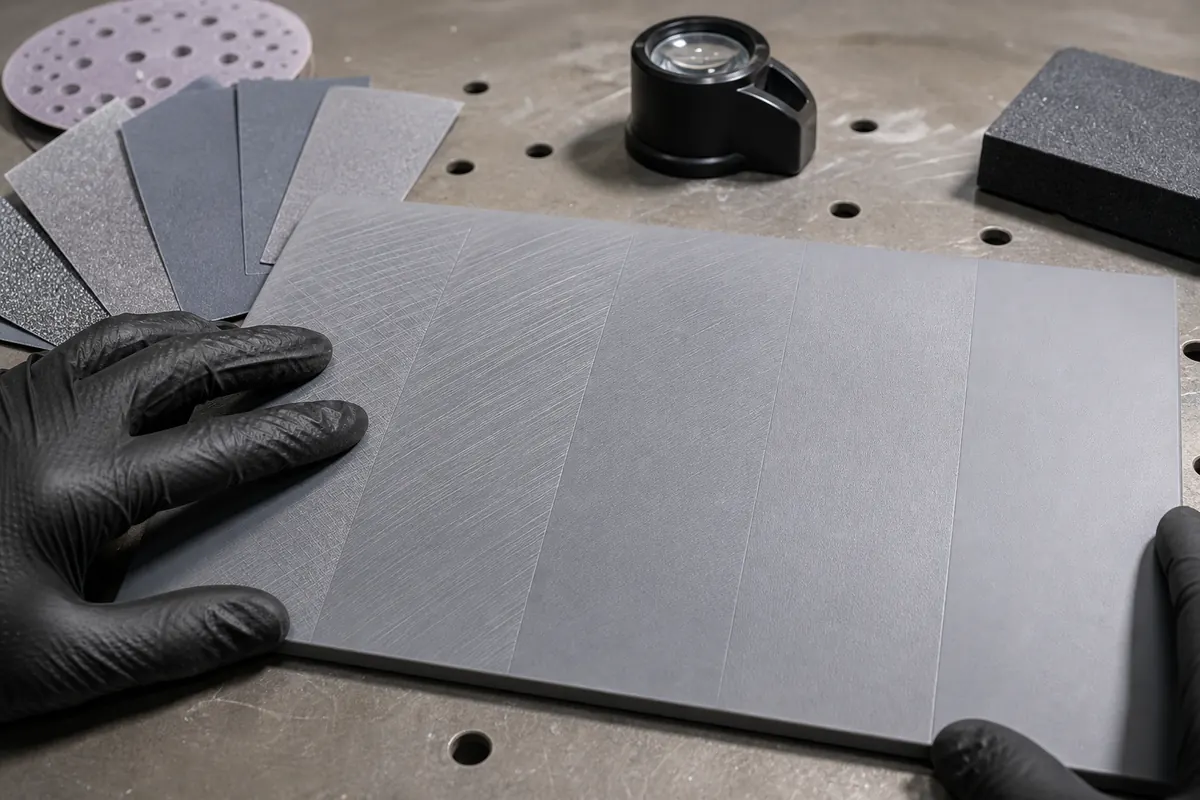
Use the same substrate and same tool when comparing samples. Sand a primer test panel under the same pressure and time. Check whether the abrasive loads up, whether scratches are uniform, and whether the previous grit can be removed by the next step.
Abrasive grain quality also shows up in consistency. If one disc cuts cleanly and the next from the same box feels dull or leaves random deep scratches, the product is risky. For automotive users, that inconsistency can become paint defects and returns.
A practical sample test should include more than first impression. Measure how many passes are needed to level a defined area, inspect the scratch under good light, then follow with the next finer grit to see whether the previous scratches are removed cleanly. Also check whether the abrasive sheds grain, leaves random deep scratches, or changes feel after a short amount of work. These details matter more than a dramatic first cut that cannot be repeated.
How do you compare two grain claims without confounding the test?
Use a product comparison, not an improvised mineral ranking. Different backings, bonds, grades, and extraction setups can change the result even when the mineral name is the same.1 Separate the supplier’s material description from the performance you actually observe.
| Registro | Keep consistent or identify separately |
|---|---|
| Identidade do produto | Product code, lot, declared mineral or blend, and grading system |
| Construção | Backing, attachment, coating type, hole layout, and interface pad |
| Substrate and setup | Same cured material, prepared area, tool, operating settings, extraction, and operator method |
| Initial cut and usable life | Defined task endpoint, work completed, loading, grain loss, and time spent |
| Finishing result | Scratch uniformity and whether the next specified abrasive removes the prior pattern |
| Decisão | Accepted configuration and evidence; do not generalize it to every ceramic or silicon-carbide product |
Keep cost per completed, acceptable repair separate from cost per disc. A faster first pass is not enough if the product leaves scratches that require extra refinement. Complete these fields with your observed results before approving the configuration for repeat orders.
Quais perguntas de fornecimento você deve fazer sobre grão abrasivo?
Ask what grain type is used, whether it is a blend, what backing and coating are paired with it, what grit standard is used, and what applications the abrasive is meant for. Also ask for sample testing across multiple batches, not just one perfect sample.
For product programs, the categoria de lixas automotivas e abrasivos is the right Yirox starting point. Buyers can compare sheets, discs, wet/dry products, and related abrasive formats around real use cases rather than just mineral names.
Retain samples and lot identifiers after approval. If a replacement lot behaves differently, repeat the documented comparison before attributing the difference to its mineral name or releasing it as an equivalent product.
Conclusão: A escolha do grão controla mais do que a rugosidade
Abrasive grain controls how sandpaper cuts, dulls, fractures, heats, clogs, and leaves scratches. Grit number still matters, but grain type explains why two abrasives with the same grit can perform differently in a body shop.
For automotive use, aluminum oxide is versatile, silicon carbide is sharp and common in wet/dry finishing, ceramic grain is strong for fast cutting, and zirconia is useful for heavier removal. The right answer depends on the surface, repair stage, sanding method, and required finish.
Good abrasive selection starts with the job and ends with verification on a real panel.
Perguntas Frequentes
What abrasive grain is best for automotive sandpaper?
Aluminum oxide is the most versatile general choice, while silicon carbide is common for fine wet/dry finishing and ceramic grain is useful for faster cutting. The best grain depends on the repair stage.
Is silicon carbide better than aluminum oxide?
Silicon carbide is sharper and often useful for fine finishing, but aluminum oxide is tougher and more versatile for general sanding. Neither is better for every job.
What does ceramic abrasive grain do?
Ceramic abrasive grain is designed to fracture and expose fresh cutting edges during use. It can cut faster and last longer in demanding sanding, but it usually costs more.
Does grit matter more than abrasive grain?
Both matter. Grit controls particle size and scratch depth, while grain controls cutting behavior, durability, heat, and consistency.
Can different abrasive grains leave different scratches at the same grit?
Yes. Grain shape, fracture behavior, backing, coating, and dust control can make two abrasives with the same grit leave different scratch patterns.
Referências
[1] Norton Abrasives. “Wide Belt Backing Types and Usage.”
[2] 3M. “Feather Prime Block: procedimento de preparação para reparo.”
[3] Mirka. “Folhas planas WPF Pro de 9 polegadas por 11 polegadas.”
[4] FEPA. “Grãos abrasivos: tamanhos de granulometria P para abrasivos revestidos.”







