



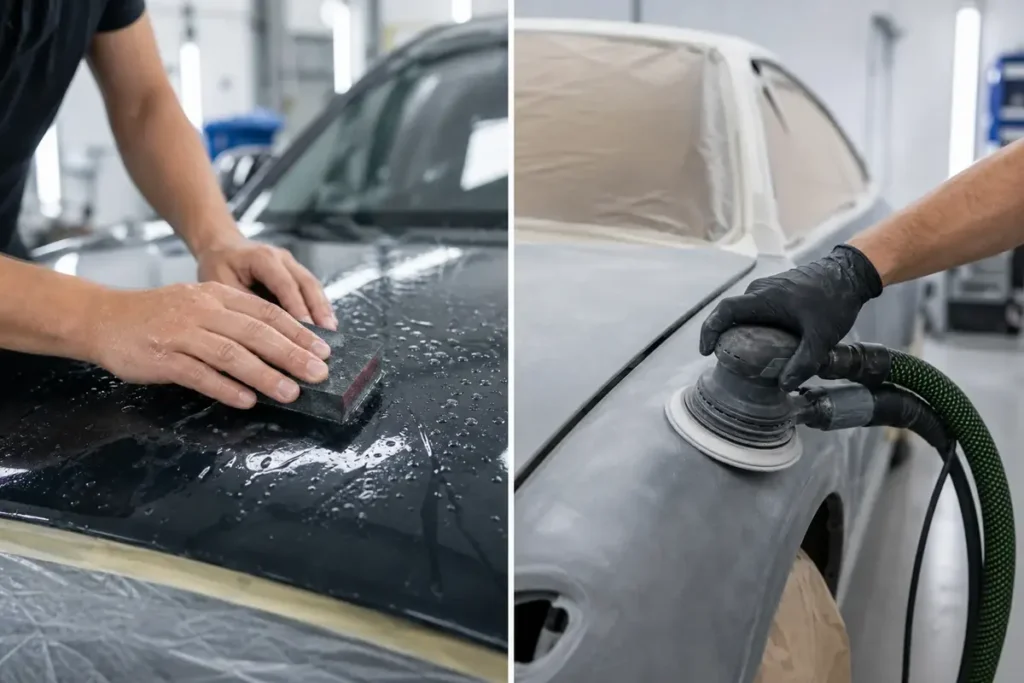
A lixamento úmido usa um abrasivo compatível com água com a quantidade de água especificada para o processo; o lixamento a seco usa um abrasivo seco aprovado e controla os resíduos com limpeza ou extração. Ambos podem ser usados no acabamento automotivo. Escolha pelo revestimento, defeito, abrasivo, ferramenta e próxima etapa—não por uma regra de que todo verniz transparente deve ser lixado a úmido.
Métodos a úmido e a seco aparecem em várias etapas posteriores ou anteriores: correção de pintura, primer automotivo lixamento, e a escolha mineral descrita em grão abrasivo. O trabalho com máquina frequentemente usa um lixadeira DA junto com lixamento manual.
Neither method is automatically better. The right choice depends on the repair stage, surface material, grit, dust-control setup, visibility needs, and what happens after sanding. A shop may dry sand primer in the morning and wet sand a clear coat nib in the afternoon.
Índice
- What is the main difference between wet sanding and dry sanding?
- When should you use wet sanding in auto body work?
- When should you use dry sanding in auto body work?
- How do wet sanding and dry sanding compare?
- What grits are best for wet sanding and dry sanding?
- What safety and cleanup issues should you consider?
- How should buyers choose wet/dry abrasive products?
- Conclusion: Use both methods where they make sense
- Perguntas Frequentes
- Referências
What is the main difference between wet sanding and dry sanding?
A distinção é o uso permitido de água e a forma como os resíduos são removidos. Processos úmidos ou damp criam lama que deve ser removida para inspeção; processos a seco dependem do controle de poeira e limpeza. Nenhum rótulo garante um corte mais rápido ou um acabamento mais fino.
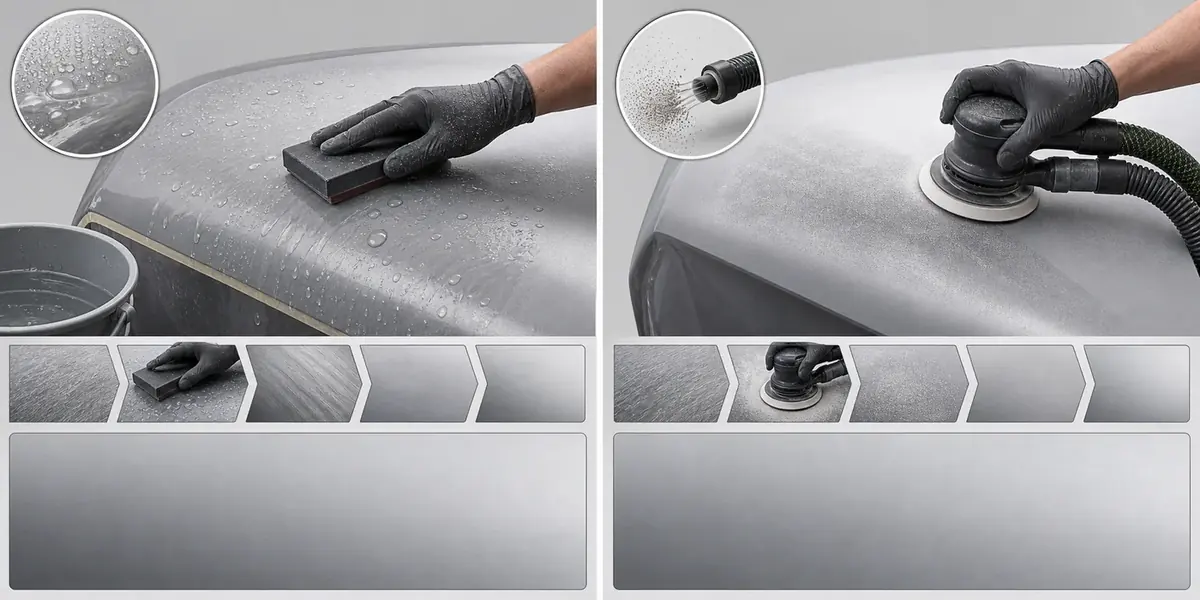
Wet sanding creates slurry. That slurry helps show what is being removed, but it can also hide the surface until it is wiped or squeegeed. Dry sanding creates dust. Dust makes defects easier to see in some primer stages, but it requires extraction, ventilation, cleaning, and respiratory protection.
O relacionado guia de lixa automotiva explains the abrasive types behind both methods. The key is to use a product designed for the method. Not every paper backing survives water, and not every dry abrasive resists clogging well.
When should you use wet sanding in auto body work?
Use lixamento úmido onde o procedimento de revestimento permite água e especifica um abrasivo compatível. O acabamento fino manual é uma aplicação. Confirme que os defeitos podem ser corrigidos dentro do revestimento disponível antes de selecionar a granulometria; a água não cria espessura extra de verniz transparente nem impede o lixamento até atravessar.
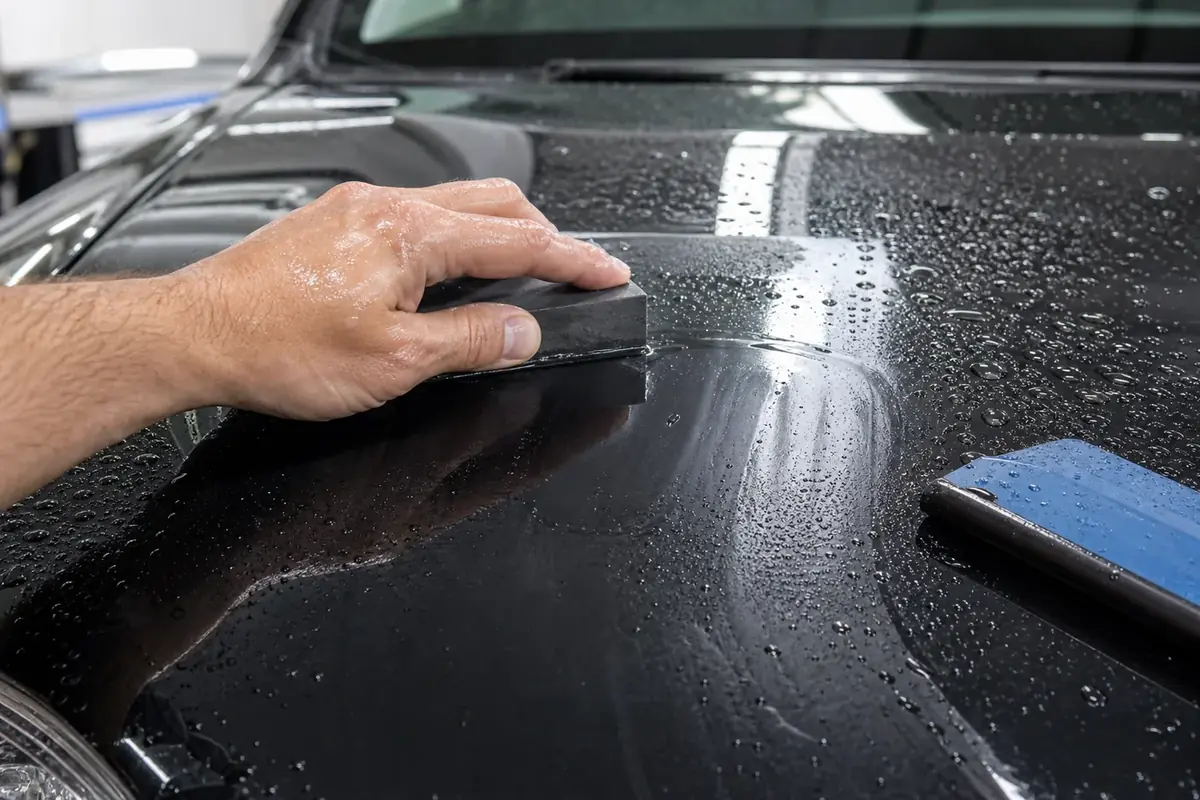
Water helps reduce abrasive loading and keeps the surface cooler. It also makes fine sanding feel smoother, especially on clear coat. After a few passes, the technician can wipe the slurry away or use a squeegee to inspect the texture.
Wet sanding is not magic. It can still cut through clear coat if pressure is too high or edges are ignored. It also requires clean water, clean paper, and controlled movement. Dirt trapped under the paper can create deep scratches that are harder to polish out.
Common wet sanding grits include P1000, P1500, P2000, P3000, and finer, depending on defect depth and the polishing system. Some paint correction starts coarser, but that increases risk and should be handled carefully.
When should you use dry sanding in auto body work?
Dry sanding is best for body filler shaping, primer surfacer leveling, old paint preparation, featheredge work, and fast material removal. It is the normal choice when the goal is to shape or level before primer or paint.
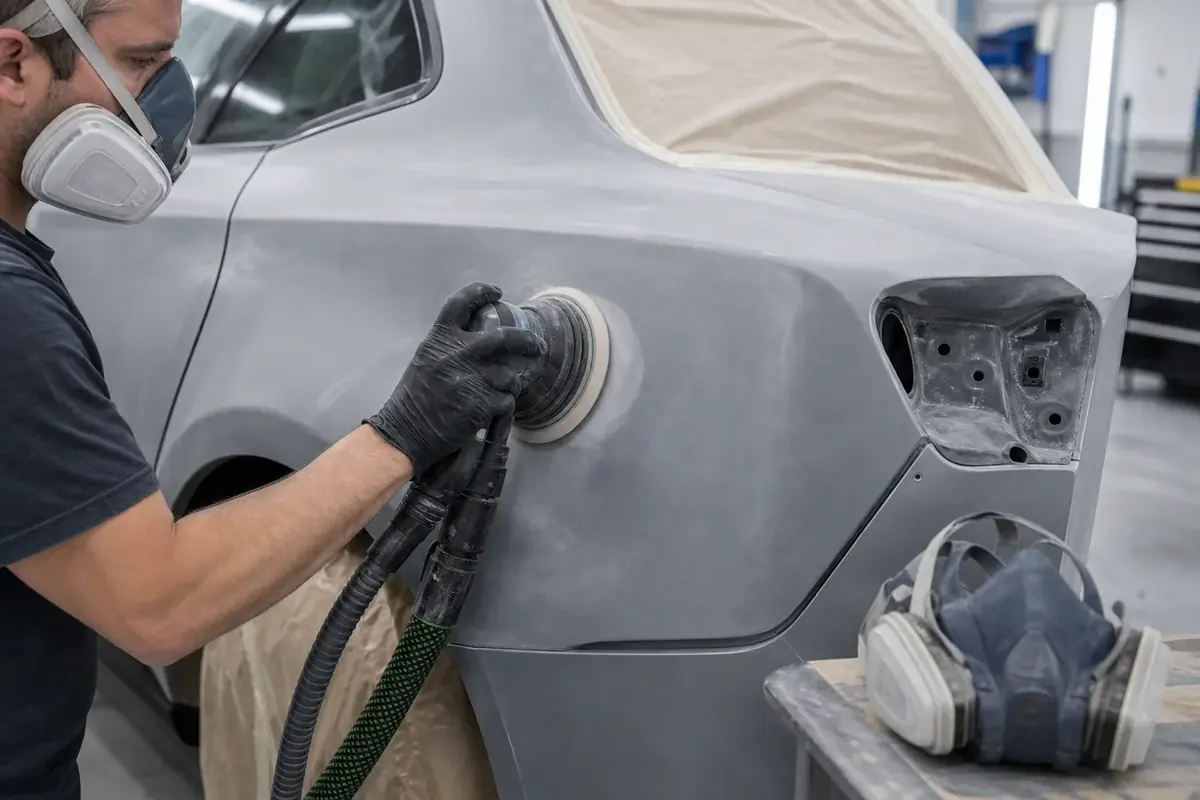
Dry sanding gives clear feedback. Guide coat remains visible, dust shows high and low areas, and the technician can move quickly with a block or DA sander. Modern dust-extraction systems make dry sanding much cleaner than old open-dust methods.
O lixamento a seco pode carregar um abrasivo, gerar calor ou espalhar poeira quando a configuração é inadequada. Também é um método legítimo de acabamento de verniz transparente com os produtos especificados. O procedimento de acabamento com orbital aleatório da 3M inclui lixamento de filme a seco e etapas separadas de refino damp; isso não autoriza o uso de água com todo disco ou ferramenta.1
Major abrasive systems often separate dry sanding for filler/primer from wet or fine finishing stages because each step has different dust, scratch, and inspection needs 1.
The pad setup matters as much as the paper. A hard block or firm pad keeps filler and primer flatter, while a soft interface pad follows curves and reduces edge pressure. Using the wrong backing can make the surface feel smooth while still leaving waves, low spots, or rounded body lines.
How do wet sanding and dry sanding compare?
Compare as configurações completas: substrato, abrasivo, suporte, ferramenta, controle de resíduos e inspeção. O rótulo úmido/seco sozinho não pode prever a taxa de corte, o risco final ou se a próxima etapa está pronta.
| Fator | Wet Sanding | Dry Sanding |
|---|---|---|
| Melhor uso | Clear coat, paint defects, ultra-fine finishing | Filler, primer, old paint prep, feathering |
| Residue | Water slurry | Airborne and surface dust |
| Speed | Usually slower | Usually faster |
| Surface visibility | Must wipe/squeegee to inspect | Easier to inspect primer and guide coat |
| Clogging control | Water helps reduce loading | Depends on abrasive coating and dust extraction |
| Safety concern | Slurry cleanup, water near tools | Dust, respiratory exposure, shop contamination |
| Common tools | Hand pad, soft block, fine wet/dry paper | Sanding block, DA sander, extraction discs |
The important point is sequencing. A technician may dry sand body filler, dry sand primer with guide coat, then wet sand clear coat after painting. These are different jobs, not competing habits.
Quando você deve parar e mudar o plano de lixamento?
| Condição | Decisão |
|---|---|
| Revestimento não curado ou desconhecido | Estabeleça o revestimento e a condição de cura antes de escolher qualquer método |
| Carga exposta, metal nu, emendas ou áreas sensíveis à água | Verifique a permissão do sistema de reparo para água e o processo de secagem necessário |
| Um disco ou máquina não tem permissão declarada para uso úmido | Mantenha a água fora da configuração até que a compatibilidade seja confirmada |
| A lama esconde o padrão de riscos | Limpe e inspecione antes de continuar; uma aparência úmida não é prova de refino |
| Uma borda está afinando ou um defeito precisa de remoção profunda | Pare e reavalie as opções de reparo em vez de mudar automaticamente para uma granulometria mais grossa |
Papel úmido/seco, discos de acabamento de espuma damp e discos de filme a seco são configurações de produto diferentes. Registre o abrasivo nomeado, o método permitido, o intervalo de inspeção e a próxima etapa de acabamento para que outro técnico possa reproduzir o processo.12
What grits are best for wet sanding and dry sanding?
Dry sanding commonly uses coarser and medium grits for shaping and prep, while wet sanding commonly uses finer grits for paint and clear coat finishing. The grit must match the surface and the next step.
For dry sanding, body filler shaping may start around P80-P120 and move finer before primer. Primer surfacer may be sanded with P220-P400 depending on build and coating recommendations. Paint preparation often lands around P400-P600.
For wet sanding, clear coat correction often uses P1500-P3000 or finer. Deeper defects may require more aggressive steps, but that increases the risk of sanding through. If a scratch is too deep for a fine wet sanding step, jumping straight to polishing will not remove it cleanly.
For a more complete grit-by-grit explanation, the related tabela de granulometria de lixa explains how coarse, medium, fine, and ultra-fine grits fit into auto body work.
What safety and cleanup issues should you consider?
Dry sanding needs dust control, and wet sanding needs slurry control. Both methods require clean work habits, appropriate PPE, and awareness of the coatings being sanded.
OSHA’s autobody repair and refinishing guidance highlights hazards around sanding, refinishing materials, ventilation, and respiratory protection 3. NIOSH also provides workplace health guidance for dust and respiratory protection topics 4. The exact PPE depends on the coating, substrate, dust level, and shop process.
Dry sanding dust can travel. Use extraction where possible, clean panels between grits, and avoid blowing dust into other repair areas. Wet sanding reduces airborne dust but creates contaminated slurry that should not be left to dry on the panel, floor, or nearby masking.
Water and electric tools require extra caution. Wet sanding is often done by hand, or with tools designed for wet use. Do not improvise with unsafe electrical setups.
How should buyers choose wet/dry abrasive products?
Buyers should choose wet/dry abrasive products by checking backing durability, cut consistency, water resistance, clog behavior, scratch uniformity, hole pattern, disc attachment, and packaging. The product should match how the end user actually sands.
For wet sanding paper, soak resistance matters. The sheet should not curl badly, split, or shed abrasive. For dry discs, anti-clog performance and hole alignment matter because extraction depends on airflow. For hand sanding, flexibility and backing feel matter. For block sanding, flat contact and tear resistance matter.
A categoria de lixas automotivas e abrasivos is the right Yirox starting point for wet/dry sheets, discs, and related abrasive formats. Buyers building a wider catalog can also review the broader linha de produtos Yirox.
Yirox Team sample checks typically look at soak behavior, scratch consistency, backing strength, disc attachment, packaging, and label clarity. Those details help prevent returns because a wet/dry abrasive must work in the actual method advertised.
Conclusion: Use both methods where they make sense
Escolha o processo aprovado para o revestimento e defeito específicos. Modelagem a seco, acabamento fino de filme a seco, refino damp e lixamento úmido manual são configurações distintas; cada uma precisa de seu próprio abrasivo, suporte, permissão de ferramenta e plano de limpeza.
The smart approach is to use the method that fits the surface and the next step. Dry sand where speed and flatness matter. Wet sand where fine control and finish refinement matter. Use the right grit sequence, keep the abrasive clean, and protect the technician from dust or slurry exposure.
For more practical background, the related Yirox repair and product guides can support customers who need to choose abrasives with less guesswork and fewer paint-prep mistakes.
Perguntas Frequentes
Is wet sanding better than dry sanding for cars?
Nenhum método é melhor para todo carro ou defeito. Lixamento de filme a seco aprovado e etapas abrasivas damp ou úmidas podem fazer parte do acabamento, enquanto carga e primer têm seus próprios requisitos de preparação. Combine o método com o sistema de revestimento, abrasivo, permissão de ferramenta e necessidades de inspeção em vez de apenas o nome do reparo.
Can you wet sand primer?
Some primer can be wet sanded, but many shops prefer dry sanding primer because guide coat and surface shape are easier to read. Follow the primer manufacturer’s instructions.
Does wet sanding remove scratches?
Wet sanding can remove or level fine paint and clear coat defects, but it also creates its own sanding scratches. Those scratches must be refined and polished afterward.
Is dry sanding dangerous?
Dry sanding can create dust that should be controlled with extraction, ventilation, and appropriate PPE. The risk depends on the material being sanded and the shop’s safety process.
What grit should I use for wet sanding clear coat?
Many clear coat correction jobs use P1500-P3000 or finer, depending on defect depth and polishing plan. Use the least aggressive grit that can remove the defect safely.
Referências
[1] 3M. “Procedimento Operacional Padrão para o Sistema de Polimento com Orbital Aleatório Perfect-It.”
[2] Mirka. “Folhas planas WPF Pro de 9 polegadas por 11 polegadas.”
[3] OSHA. “Reparo e Repintura Automotiva: Visão Geral.”
[4] NIOSH. “Controle de Poeiras do Lixamento em Oficinas de Reparo de Carrocerias Automotivas.”