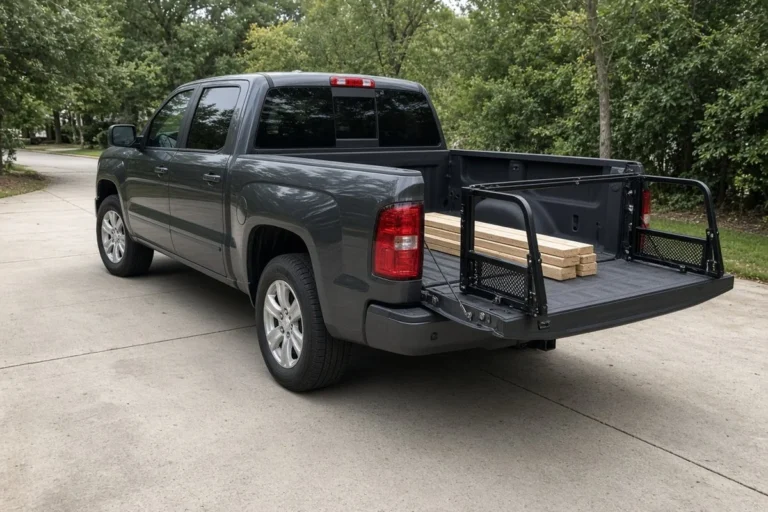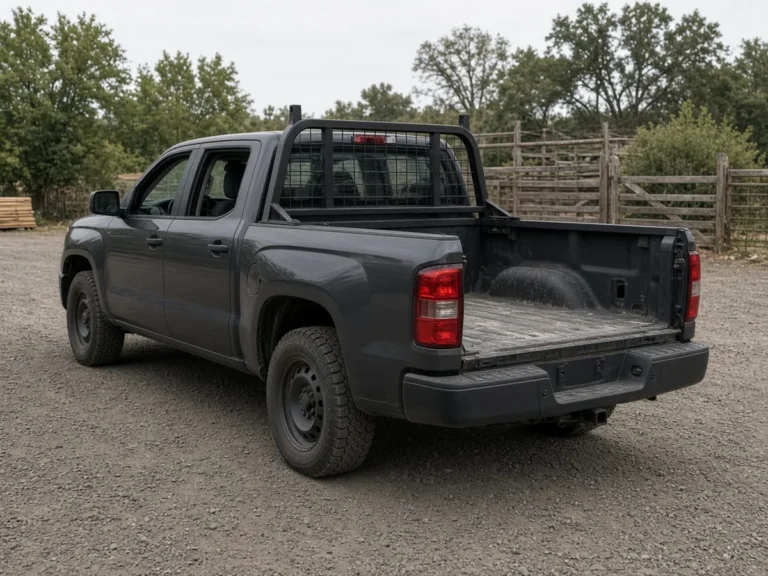




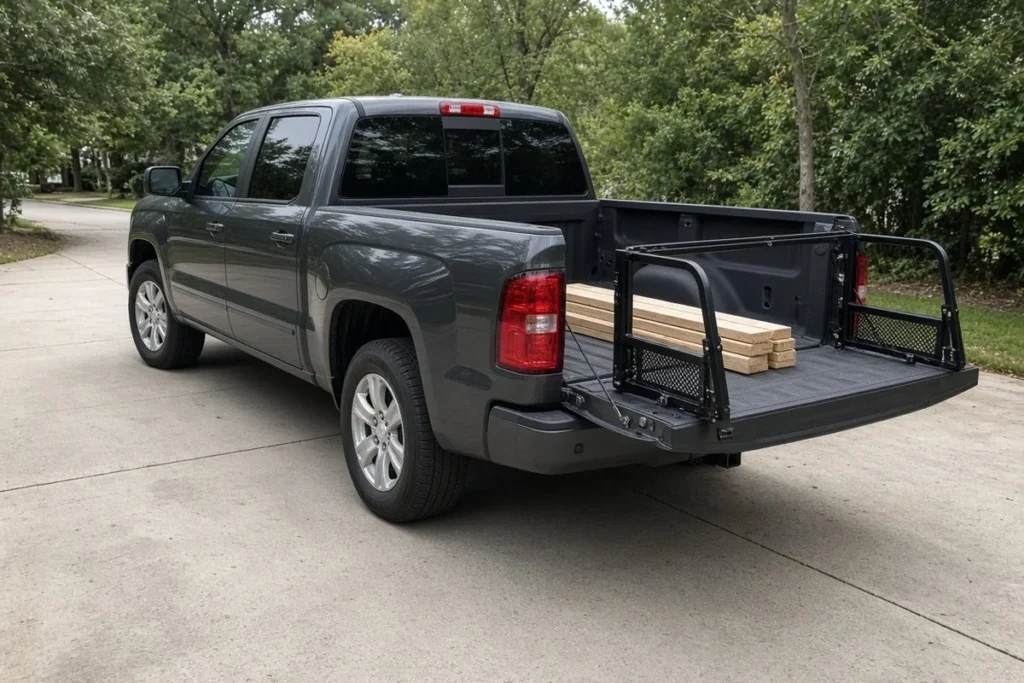
A truck bed extender is a cargo gate that mounts at the rear of a pickup bed. Flip it over the open tailgate to add about two feet of enclosed length, or flip it inward with the tailgate closed to keep smaller items from sliding. It does not replace a toolbox or a bed rack.
Scope: this article explains what a truck bed extender is, how the two operating modes work, and how it differs from a truck bed accessory such as a toolbox, other truck bed storage, a bed rack, or a headache rack. It also covers fitment, tailgate load limits and rear-load flag rules. It is not a product ranking, a drawer-system review, or a second guide to bed racks or cab protection.
What is a truck bed extender, and how does it work?
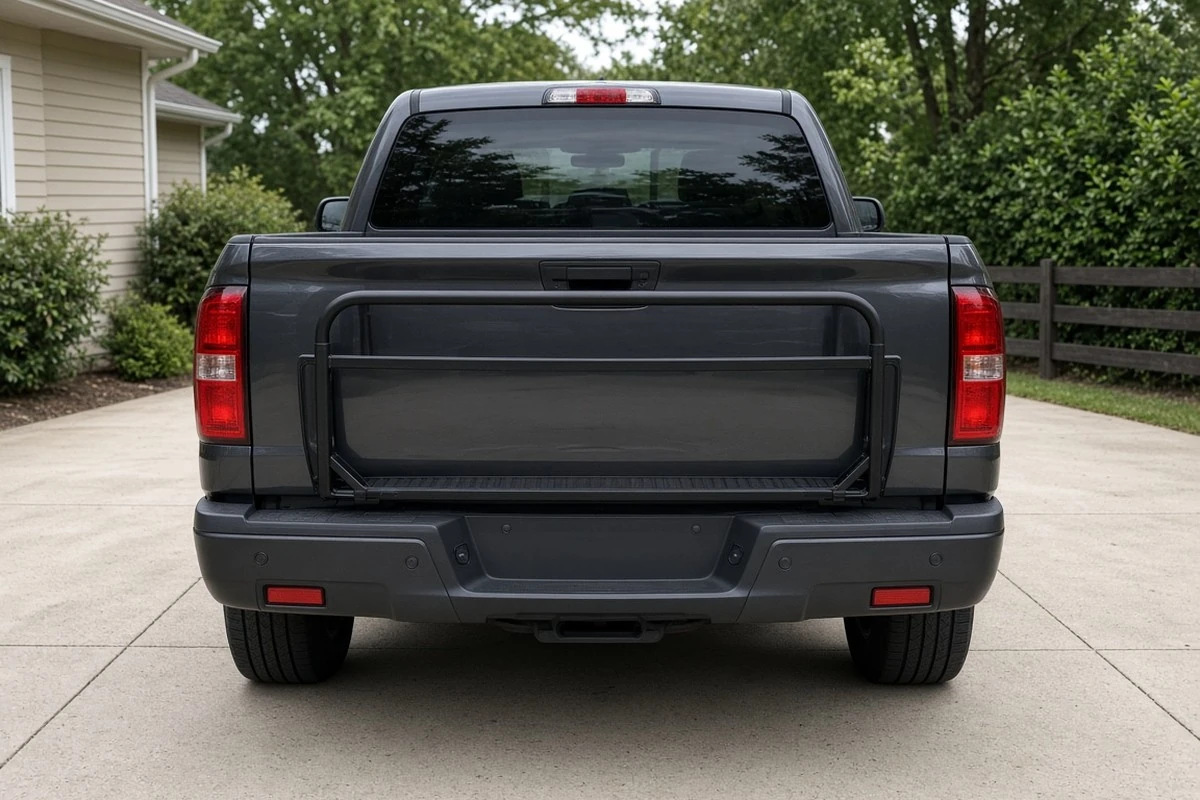
A truck bed extender is a frame or folding panel that turns the open tailgate into a short, enclosed extension of the pickup bed, or that corrals smaller cargo inside the bed when the tailgate is closed. It sits at the rear of the bed, not over the cab and not on the bed floor as a lockable box. In shops the same name is sometimes applied to other length-support hardware that is not a cargo gate; this guide covers only the bed-mounted gate.
The useful trick is the pivot. With the tailgate down, you flip the gate rearward so lumber, pipe, or long recreation gear is boxed in over the open tailgate instead of hanging past an empty opening. With the tailgate up, you flip the same frame inward so bags, tools, or groceries stay in a shorter pocket at the rear of the bed instead of sliding the full length of the floor. AMP Research describes those two jobs as adding up to two feet of enclosed cargo space when the frame is flipped out, or containing smaller items with the tailgate closed 1. Toyota’s genuine bed extender uses the same two-foot figure with the tailgate down, and the inward position to secure smaller objects with the tailgate up 4.
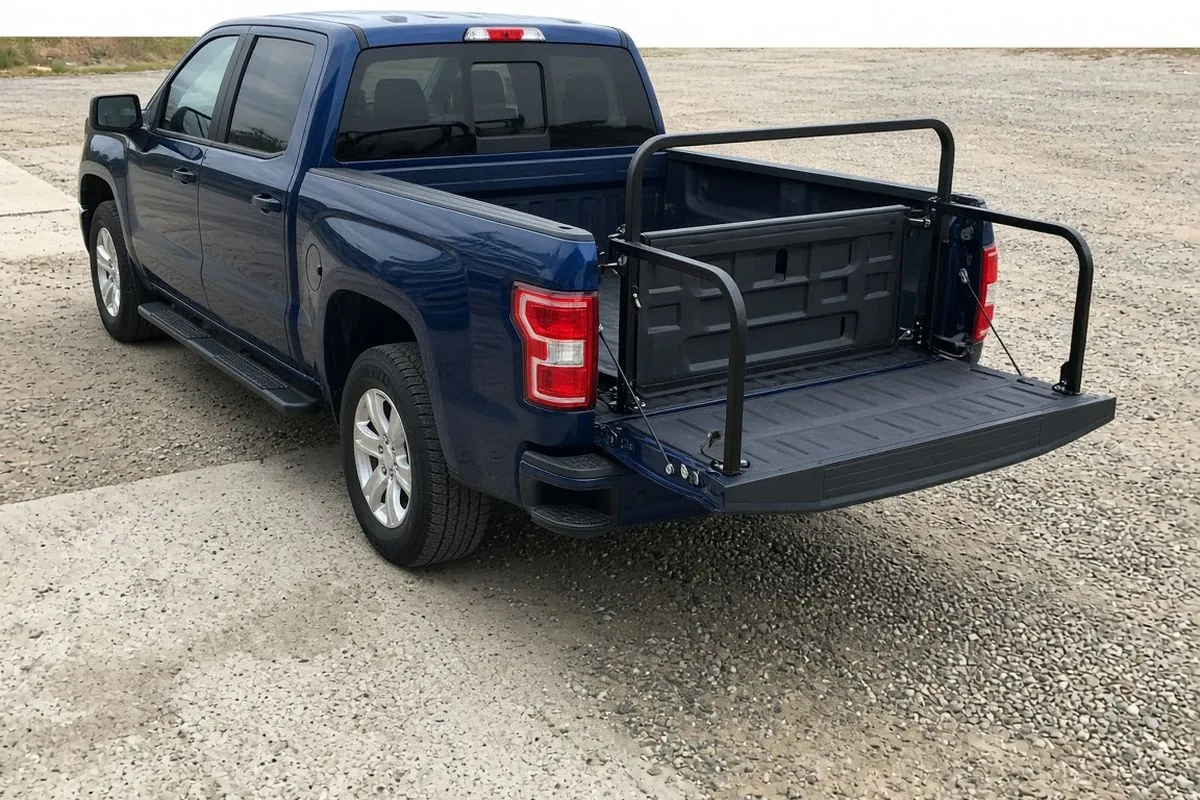
Ford’s owner’s manual uses different names for the same idea. Tailgate mode is the rearward, open-tailgate position; grocery mode is the inward position with the tailgate closed. The manual also tells the driver to engage the locking pins and knobs fully, to secure all cargo, and not to leave the extender in tailgate mode when it is not actually restraining a load 3.
That last point matters as much as the extra length. The extender is a fence, not a floor. It does not add a new rated cargo deck, and it does not lock valuables the way a toolbox does. If the load can slide, bounce, or lift, it still has to be strapped to the bed’s own tie-downs.
How does a truck bed extender compare with a toolbox, bed storage and a bed rack?
A truck bed extender adds enclosed length or corrals cargo at the rear of an open bed; a truck toolbox locks tools away; other truck bed storage organizes the floor; a bed rack carries a load above the bed. Those jobs overlap in a catalog, but they do not replace one another. Choose the part for the job that actually fails on the truck you are specifying.
UWS, a toolbox manufacturer, groups pickup boxes into three basic types: a crossover (also called a cross-bed or saddle box) that mounts across the width of the bed just behind the cab, a side-mount box along one rail, and a utility chest that sits on the bed floor 7. A crossover keeps the floor underneath open for long material, but it steals length behind the cab and can fight a cab-high cover. A chest can hide under some covers, but it occupies floor space the extender would rather leave clear. Neither box extends the tailgate opening.
A bed mat or bed liner is a fourth, quieter decision. It protects the paint and can help loose cargo stay put, but it does not enclose the tailgate opening. If a liner is already installed, the extender’s brackets usually have to sit on top of it rather than requiring the liner to be cut 2.
A cab-mounted roof rack is a different part again: it uses the cab roof, not the bed. If the load belongs on the cab roof rather than in the bed, start from the roof rack guide instead of forcing a bed extender to do roof work.
What styles of bed-mounted extenders are there?
Most bed-mounted extenders are a rigid U-shaped tube gate, a narrower frame shaped to clear cover rails, or an OEM folding-panel set that hinges at the sides of the bed. The job is the same; the way the frame occupies the tailgate opening is not.
The aftermarket pattern many buyers picture is a U-shaped aluminum tube gate with composite or metal uprights. AMP Research describes its BedXtender HD Max that way: 6063-T6 aluminum tubes, a U-shape that flips out or in, and a stake-pocket or quick-release pin mount that is meant to go on and off without a full teardown 1. Toyota’s genuine extender is also an aluminum, powder-coated gate, with angle-release brackets and adjustable strap latches that lock into the tailgate when the gate is down 4.
Some OEM units use folding panels instead of a single U-tube. Ford’s manual walks through a panel-and-knob procedure: release the locking pins, open the latches, rotate the panels toward the tailgate, connect them, then seat the latch rod and pins in the box 3. That design stays on the truck and changes shape; it is not a tube you lift out of the stake pockets after every lumber run.
A third variation is a frame whose rear bar is set to leave room for a tonneau rail or a cap. The marketing name varies by brand. The specification that matters is the measured clearance to the cover rail, the tailgate, and the bed wall — not the silhouette in a product photo. If the buyer already runs a cover, ask for that clearance in the RFQ rather than assuming a U-shaped gate will nest under the rail.
Are truck bed extenders universal, and what fitment details matter?
No. A truck bed extender is sized to a bed-width family, a tailgate style and a mounting kit, not to “pickup trucks” as a class. Listings that say universal still have to be checked against the actual bed.
AMP Research’s install guide splits applications into families such as Deep Bed, Large Truck, Small Truck and Narrow, each with its own part numbers, and it lists optional no-drill brackets, spacer kits and strap-buckle inserts for particular trucks 2. That is the opposite of one SKU for every mid-size and full-size bed. Ford and Toyota treat the extender as a vehicle-specific accessory, not a generic add-on 3, 4.
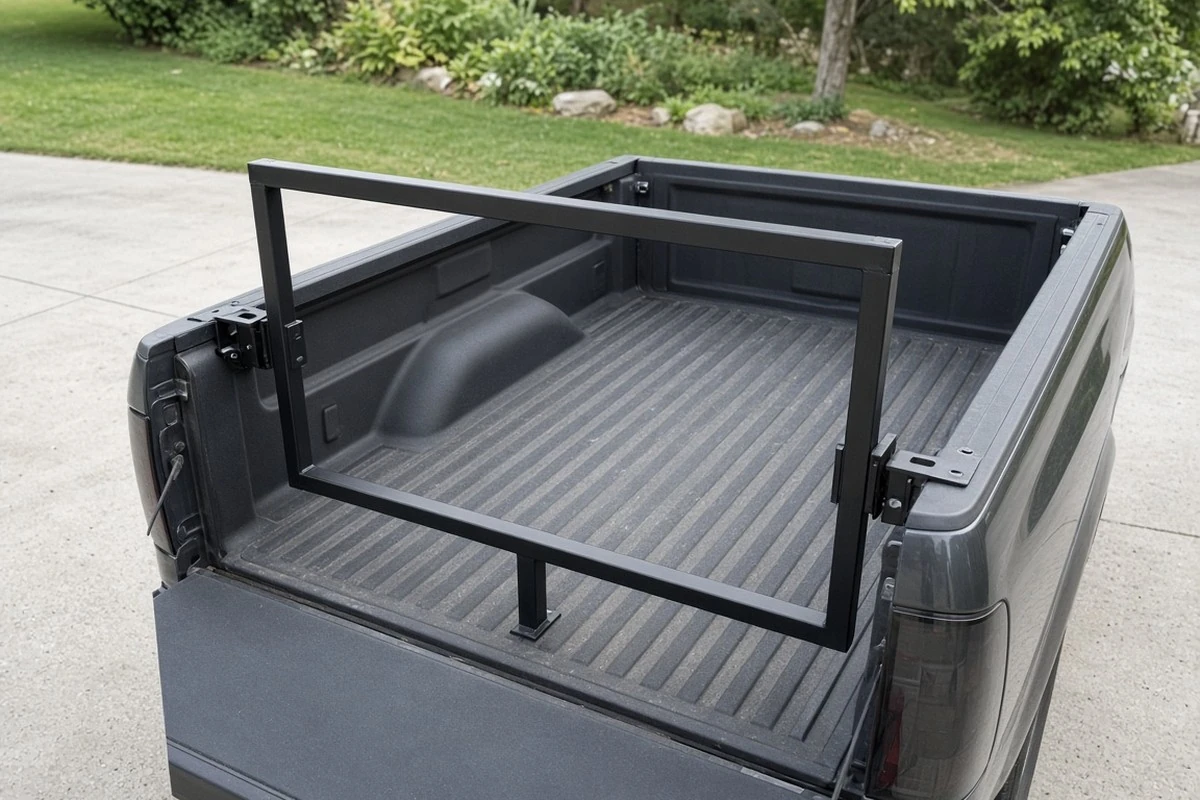
The mount is usually a pair of brackets at the rear bed rails. Many kits drop into the factory bolsos de estaca — the rectangular openings in the rail — and lock with pins. Others bolt or clamp, and some trucks need a no-drill kit so the installer does not have to put holes in a painted bed. Once the frame is in the rearward position, a second connection often ties it to the open tailgate: AMP uses strap buckles that lock into the tailgate latches, and Toyota uses adjustable strap latches for the same job 2, 4. Ford’s OEM panels use locking pins, knobs and a latch rod into the tailgate 3.
Three other details decide whether the part actually works on the truck in front of you:
- Bed width and length. Inside width at the rails, width between the wheel wells, and inside length to the closed tailgate all need to be on the inquiry. A mid-size bed is not a small full-size bed.
- Tailgate style. A one-piece dropped tailgate, a two-piece or retractable tailgate, and a tailgate with a built-in step or work surface do not automatically accept the same latch straps or latch-rod holes. Specify the tailgate family, not only the truck name.
- Tonneau, cap, or liner already on the truck. Cover rails can block a U-shaped frame. AMP’s guide says that if a bedliner is fitted, the mounting brackets go on top of the liner; do not cut the liner to clear the kit 2. Toyota also notes that its extender cannot be removed while the tailgate is up and locked, which matters if the buyer expected a tool-free daily removal 4.
Fitment is confirmed when those three items, plus the kit part number, are written down. A photo of the rear rail, the stake pocket and the cover rail saves a round of sample returns.
How much weight can a truck bed extender hold, and what rules apply to long loads?
The working limit is the lowest of the tailgate rating, the extender maker’s caution, and the truck’s payload or GVWR — and a long rear load may also need a flag or a lamp, depending on the vehicle and the jurisdiction. An extender does not raise the truck’s payload.
Ford’s owner’s manual is blunt: do not exceed 150 pounds (68 kilograms) on the tailgate when the vehicle is moving 3. That number is a moving-vehicle tailgate limit, not a static workshop figure, and it applies to the OEM extender in tailgate mode. AMP Research’s install guide, written for its aftermarket gate, gives a different caution: 200 lb maximum load on the open tailgate, with cargo distributed evenly and secured inside the bed, and with a clear instruction not to secure cargo to the extender or to the tailgate 2. Toyota does not publish a unique pound figure on the accessory page; it states that cargo and load capacity are limited by weight and distribution and that items must be properly secured 4. AMP’s marketing page adds that you should not exceed the truck bed’s gross vehicle weight rating 1.
Read those figures as a stack, not as a menu. If Ford’s 150 lb moving limit is the lowest number on that truck, it wins even if an aftermarket gate mentions 200 lb. If the certification label gives a payload of a few hundred pounds after passengers and fuel, a heavy stack of material can be illegal for the truck long before it is illegal for the gate. The extender’s own weight counts against payload too.
Length has its own rules once cargo projects past the rear of the vehicle. For a commercial motor vehicle, 49 CFR 393.87 requires red or orange fluorescent warning flags when a load extends more than 102 mm (4 inches) beyond the sides or more than 1,219 mm (4 feet) beyond the rear. Each flag must be at least 457 mm (18 inches) square. One flag marks a projecting load that is two feet wide or less; two flags are required if it is wider, placed to show the maximum width 5.
Many private pickups are not commercial motor vehicles, but states still regulate rear projections. California Vehicle Code § 24604 is a useful example, not a national rule: when a load or an integral part of any vehicle projects to the rear four feet or more beyond the rear, measured from the taillamps, the extreme end must show a solid red or fluorescent orange flag or cloth at least 18 inches square, and in darkness two red lamps visible from 500 feet 6. Other states use different measuring points, lengths, or lighting rules. Check the jurisdiction the truck will actually travel, not only the state where it is registered.
A two-foot extender does not automatically create a four-foot projection, and it does not automatically excuse one. If a board already hangs well past the closed tailgate, opening the tailgate and boxing it in with a two-foot gate can still leave the free end more than four feet behind the lamps. Example figures, not a measured vehicle: a 10-foot board in a 5.5-foot bed will project past the rear whether or not a gate is fitted; the gate only encloses the portion over the tailgate. Toyota also specifies that its extender is designed so the taillights remain visible in use, in compliance with DOT lighting requirements 4. A shifted load that covers a lamp is a separate problem the gate does not solve.
Quais riscos e exceções você deve observar?
The usual failures are an overloaded or unsecured tailgate, a gate left deployed when it is not holding cargo, a clash with a cover or a special tailgate, and a long load that is enclosed but still unmarked or poorly lit. The extender makes those mistakes easier to overlook because the cargo looks “in the truck.”
Ford tells drivers not to use the bed extender when driving off road, and not to keep it in tailgate mode when it is not restraining cargo; grocery mode or the stowed position with the tailgate closed is the default 3. A gate that stands out over an empty tailgate is extra rear length, extra rattle, and extra chance of catching a curb or a loading dock.
AMP’s install caution is easy to skip and expensive to learn in a hard stop: keep the open-tailgate load within the stated limit, distribute it, strap it to the bed, and do not tie the load to the extender or the tailgate itself 2. The gate can contain a shift. It is not the tie-down point. If the only rated anchors are in the bed, that is where the straps belong.
Other exceptions show up at install, not on the highway. A two-piece or retractable tailgate may not present the same latch holes or a full-width dropping panel for the frame to rest on. A bed extender is also a poor substitute for a lockable toolbox if the cargo is tools that have to disappear overnight. And a roof-level or over-bed rack question should be sent to the bed-rack or roof-rack article, not answered by forcing this part to do a different job.
Finally, flag and lamp rules are not the same in every market, and 49 CFR 393.87 applies to commercial motor vehicles, not automatically to every private pickup 5. Treat California’s four-foot, 18-inch-flag rule as one published example 6. If the truck crosses state lines, the stricter visible-marking practice is the safer specification to put on the packing list, as long as it still meets the local requirement.
What should distributors and importers put in a bed-extender or bed-storage RFQ?
Write the vehicle, the tailgate, the bed dimensions, the neighboring accessories, and the load case on the same page — otherwise the sample you approve will not be the part the installer can mount. A bed-extender program and a toolbox program can travel in the same container; they still need different drawings.
For a bed-mounted extender, a usable inquiry includes:
- Year, make, model, cab style, market, and the inside bed length and rail-to-rail width, plus a photo of the rear stake pockets or rail.
- Tailgate type (one-piece drop, two-piece or retractable, step or work-surface features) and whether the design must use strap-into-latch, a latch rod, or OEM-style locking pins.
- Any tonneau, cap, bedliner, bed mat, or rail system already specified, including rail height and a request for measured clearance, not a verbal “works with covers.”
- Operating mode required: rearward enclosed length, inward containment, or both, and whether the frame must be removable without tools.
- Material and finish (for example 6063-T6 aluminum tube with a powder coat, or OEM-style panels), plus any branding, color, and export carton marks.
- The load stack you will print for the installer: tailgate moving limit from the vehicle manual, any maker caution, and a reminder that payload and GVWR still govern.
- Marking kit for long rear loads where the destination market requires flags or lamps, specified as a separate line if it is not integral to the gate.
For a toolbox or other truck bed storage on the same program, add the box type (crossover, chest, or side-mount), lid profile, lock type, and whether the floor must stay open for long material 7. Do not let one “bed storage” line item stand in for both a gate and a box. If the buyer also needs a mat, a cover, or a rack, point them to those specifications rather than stretching this RFQ until it describes four different parts.
Conclusão
A truck bed extender earns its place when the regular problem is length or cargo sliding at the rear of an open pickup bed. The part is a pivoting cargo gate: about two feet of enclosed space over the open tailgate on the OEM and maker figures cited here, or a shorter contained pocket with the tailgate closed. That is a different job from a truck toolbox, a drawer or floor organizer, a bed rack, or a headache rack, and the comparison only holds if you keep those jobs separate.
Fitment is a bed-width and tailgate-style problem, not a promise that extenders are universal. The safe working number is the lowest of the vehicle’s moving tailgate limit, the extender maker’s caution, and the truck’s payload or GVWR. Ford’s 150 lb (68 kg) moving figure and AMP Research’s 200 lb open-tailgate caution are named examples, not a license to ignore the certification label. Long rear projections still have flag and lamp rules: 49 CFR 393.87 for commercial motor vehicles, and state rules such as California Vehicle Code § 24604 for other vehicles.
If you are writing a purchase order, put the vehicle list, the tailgate, the neighboring cover or liner, the operating mode and the load stack on the same sheet the installer will use. That is the difference between a gate that fits the bed and a frame that only fits the photo.
Próximo passo
Yirox can support relevant exterior and bed accessory programs from a clear specification that includes the vehicle list, bed dimensions, tailgate type and any cover or liner already planned. Start from the linha de acessórios para caçamba de caminhonete category, then send those details through the formulário de contacto.
Perguntas frequentes
What is a truck bed extender?
It is a cargo gate that mounts at the rear of a pickup bed. With the tailgate open it encloses longer cargo over the tailgate; with the tailgate closed it can flip inward to keep smaller items from sliding.
How does a truck bed extender work?
Most units pivot on brackets at the rear of the bed. Flip the frame over the open tailgate and latch it, or rotate it into the bed and close the tailgate. Ford calls those positions tailgate mode and grocery mode.
Are truck bed extenders universal?
No. Aftermarket makers sell size families for different bed widths, and OEM units are vehicle-specific parts. Confirm the bed width, tailgate style, stake-pocket or bracket kit, and any cover or liner before you treat a listing as a fit.
How much weight can a truck bed extender hold?
Only as much as the lowest applicable limit allows. Ford’s manual caps load on the tailgate at 150 lb (68 kg) when the vehicle is moving. AMP Research’s install guide cautions 200 lb on an open tailgate and says not to secure cargo to the extender or the tailgate. The truck’s payload and GVWR still govern.
What is the difference between a truck bed extender and a truck toolbox?
A truck bed extender is an open gate that adds length or corrals cargo at the rear of the bed. A truck toolbox is a lockable box — often a crossover unit across the rails behind the cab, a chest on the floor, or a side-mount box — that stores tools out of the weather. They do different jobs and can conflict for space.
Will a truck bed extender work with a tonneau cover?
Only if the frame and brackets clear the cover’s rails and the cover can still be used, or removed, in the way you need. Some frames and spacer kits are made for that clearance; many U-shaped gates are not. Check the combination, not a general claim.
Referências
- AMP Research, “AMP Research BedXtender HD Max” (up to two feet of additional enclosed space with the tailgate open; inward containment with the tailgate closed; 6063-T6 aluminum tubes; stake-pocket / quick-release mounting; do not exceed the truck bed’s gross vehicle weight rating). ampresearchco.com, BedXtender HD Max.
- AMP Research, BedXtender HD Max assembly and installation guide, part families 74811 / 74813 / 74814 (rev 01.03.12) (Deep Bed, Large Truck, Small Truck and Narrow application split; strap buckles into tailgate latches; caution: 200 lb maximum load on the open tailgate; do not secure cargo to the BEDXTENDER or the tailgate; mount on top of a bedliner and do not cut the liner). AMP Research install guide PDF.
- Ford Motor Company, Owner’s Manual, “Tailgate (If Equipped) — Bed Extender” (do not use when driving off road; engage locking pins and knobs fully; secure all cargo; do not exceed 150 lb / 68 kg on the tailgate when the vehicle is moving; do not leave the extender in tailgate mode when it is not restraining cargo; grocery mode with the tailgate closed). Ford official Owner’s Manual, Bed Extender.
- Toyota Motor Sales, U.S.A., “Bed Extender — Aluminum,” part PT392-35120 (two feet of bed length with the tailgate down; inward use with the tailgate up; taillights remain visible, in compliance with DOT lighting requirements; cannot be removed when the tailgate is up and locked; angle-release brackets; adjustable strap latches; cargo and load capacity limited by weight and distribution). autoparts.toyota.com, PT392-35120.
- Federal Motor Carrier Safety Administration, 49 CFR 393.87, “Warning flags on projecting loads” (commercial motor vehicles: flags when a load extends more than 4 inches beyond the sides or more than 4 feet beyond the rear; flags at least 18 inches square, red or orange fluorescent; one or two flags by width). eCFR, 49 CFR 393.87.
- California Vehicle Code § 24604 (when a load or integral part projects to the rear four feet or more beyond the rear of the vehicle, measured from the taillamps: 18-inch solid red or fluorescent orange flag or cloth; in darkness, two red lights visible from 500 feet; one or two flags by width). leginfo.legislature.ca.gov, VEH 24604.
- UWS, “The Ultimate Guide to All Types of Truck Tool Boxes” (three basic types: crossover or cross-bed boxes mounted across the bed just behind the cab; side-mount boxes; utility chests). uwsta.com, types of truck tool boxes.