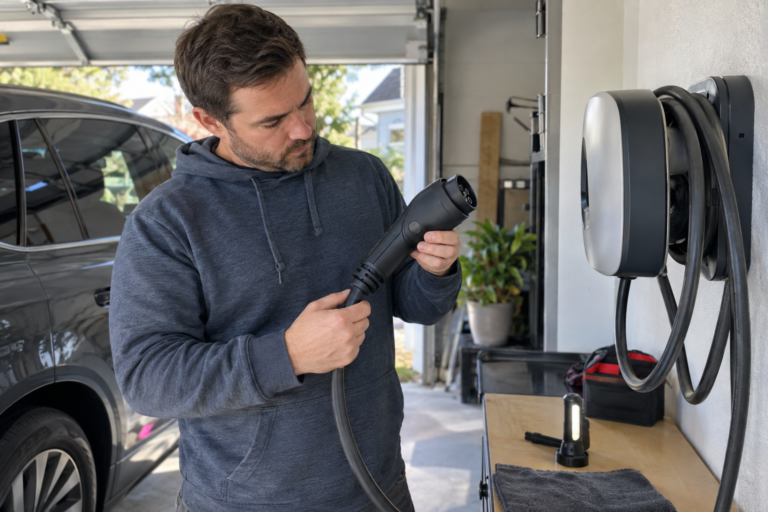




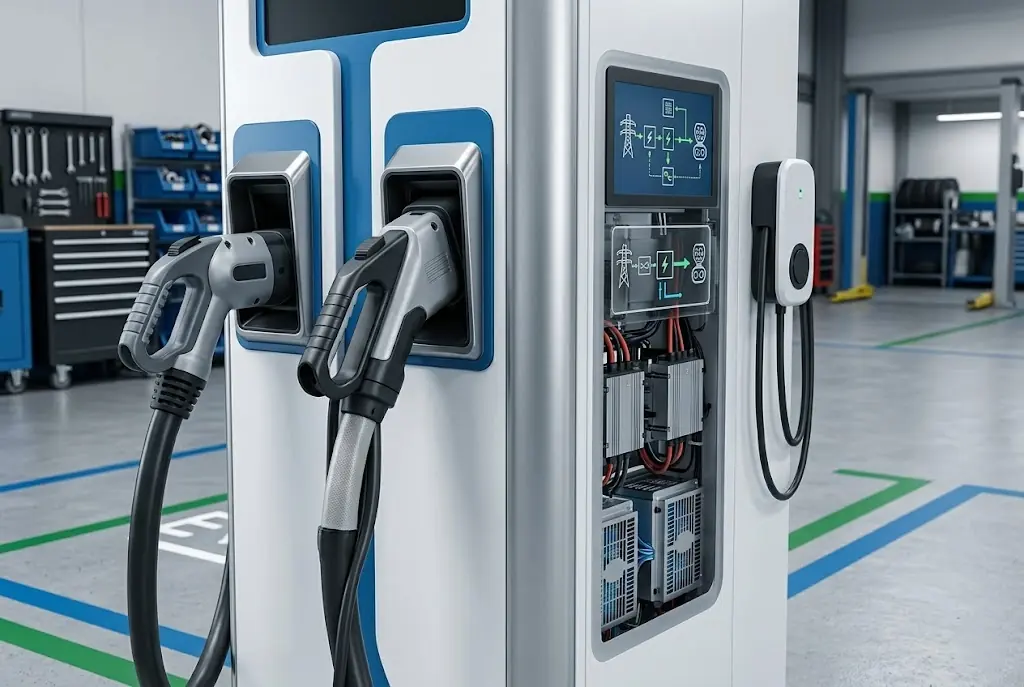
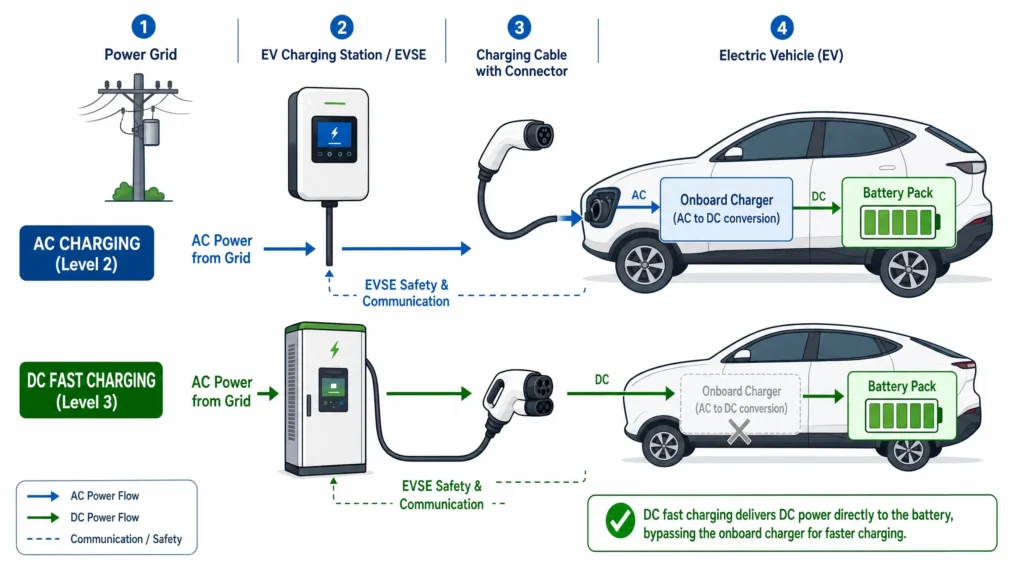
An EV charging station supplies electricity to recharge an electric vehicle. AC charging equipment (EVSE) supplies power to the car’s onboard charger; a DC fast charger converts power in the station and bypasses that onboard charger. Charging stations can be installed at home, at work, or at public parking and roadside locations. 2
For a driver, the practical checks are connector compatibility, available charging time, cable requirements, access, and price. For someone installing a station, add the site’s electrical capacity and installation requirements.
Índice
- What Is an EV Charging Station, and What Is EVSE?
- How Does an EV Charging Station Work?
- Which EV Charging Station Type Fits the Site?
- What Do Level 1, Level 2, and DC Fast Charging Mean?
- How Do Vehicle Connectors and Charging Limits Affect Compatibility?
- How Do You Use a Public EV Charging Station?
- What Should Be Checked Before Installing a Charging Station?
- How Should a Buyer Specify and Approve the Equipment?
- What Is the Difference Between a Charging Station and a Portable EV Charger?
- Conclusion: Choose the Station That Fits the Complete Use Case
- Perguntas Frequentes
- Referências
What Is an EV Charging Station, and What Is EVSE?
“Charging station” can mean the charging equipment or the location where it is installed. EVSE means electric vehicle supply equipment: the unit, controls, protection, and connection that supply power to the vehicle.
- Station location: a place with one or more charging ports.
- Charging port: equipment capable of charging one vehicle at a time.
- Connector: the plug that connects to the vehicle. A port may offer multiple connector types without charging multiple cars simultaneously. 1
When a listing says “four chargers,” check whether that means four available ports or four plugs sharing fewer ports. In a supplier quotation, check whether “station” includes the cable, mount, installation, network service, and commissioning.
How Does an EV Charging Station Work?
The station controls the power connection; the vehicle controls what its battery can accept. After connection and any required authorization, charging runs within the limits of the equipment, vehicle, and supply.
- AC charging: power passes through the EVSE and cable to the vehicle’s onboard charger, which converts AC to DC for the battery.
- DC fast charging: the station supplies controlled DC through the vehicle’s DC charging interface, bypassing the onboard AC charger. 2
- Stopping: the vehicle or station ends the session when requested, at the vehicle’s charge limit, or when a fault requires it.
Why does the power rating not equal charging speed?
A 150 kW station does not guarantee that every connected car receives 150 kW. The vehicle’s charging limit, battery temperature, state of charge, and available station power affect the result. DC charging also generally slows as the battery approaches full. Compare the vehicle’s supported charging rate with the station rating before estimating a stop. 2
Which EV Charging Station Type Fits the Site?
O tipo prático depende da duração do estacionamento, da capacidade do local, do número de veículos e do modelo operacional. O mesmo veículo pode usar EVSE CA portátil em casa, uma estação CA fixa no trabalho e carregamento CC público em uma viagem.
| Site or user situation | Common equipment direction | Main decision |
|---|---|---|
| Home with overnight parking | Level 1 cordset or fixed Level 2 AC station | Is the existing outlet sufficient, or is faster daily recovery worth a dedicated installation? |
| Apartment, hotel, or workplace | Fixed Level 2 AC stations, sometimes with load management | How many vehicles share the service, and how will access, billing, and maintenance be handled? |
| Retail or destination parking | Fixed AC stations with visible cable management and user controls | Does the dwell time justify the output, and can the equipment withstand public handling? |
| Fleet depot | Multiple AC stations or a mix of AC and DC equipment | What is the dispatch schedule, peak load, connector mix, and maintenance response? |
| Highway or high-turnover charging site | DC fast charging equipment | Can the site support the power, cooling, protection, civil works, and service requirements? |
| Travel, backup, or temporary use | Portable AC EVSE with a defined supply plug and current setting | Is portability more valuable than fixed installation, and is the source circuit known? |
What Do Level 1, Level 2, and DC Fast Charging Mean?
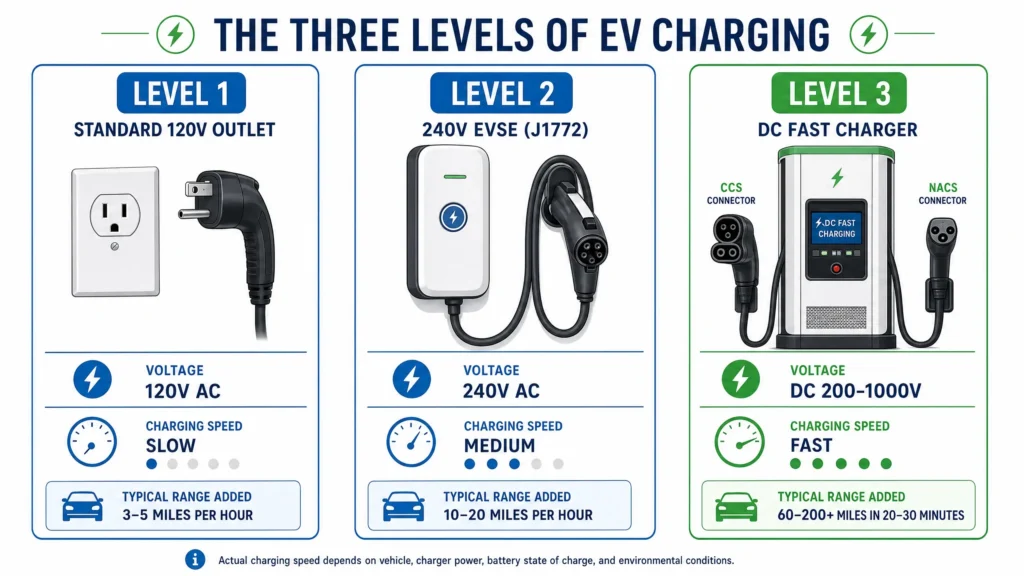
Na terminologia dos EUA, Nível 1 geralmente significa CA de 120 volts, Nível 2 significa CA de tensão mais alta — comumente 208 ou 240 volts — e o carregamento rápido CC é uma categoria CC separada. Nomes, tensões de alimentação e conectores variam por mercado, então uma RFQ internacional deve declarar a configuração elétrica real em vez de confiar apenas em “Nível 2”. 1
| Charging level | Power path | Typical setting | What the buyer must verify |
|---|---|---|---|
| Level 1 | AC from a standard low-voltage outlet to the vehicle’s onboard charger | Home, backup, low-mileage use, or some PHEV applications | Outlet condition, continuous-load suitability, supplied plug, vehicle connector, and realistic overnight energy need |
| Level 2 | AC from a dedicated or suitable 208/240-volt-class circuit to the onboard charger | Home, workplace, hotel, apartment, retail, and destination charging | Service capacity, phase, breaker, current setting, vehicle onboard limit, cable length, and installation route |
| carregamento rápido CC | AC is converted to controlled DC in the station and delivered to the vehicle battery | Public corridors, commercial hubs, and selected fleet sites | DC connector, voltage/current range, site service, cooling, protection, maintenance, and vehicle charging curve |
Como um motorista pode estimar se a janela de estacionamento é longa o suficiente?
Comece pela energia necessária, não por um número prometido de “milhas por hora”. Por exemplo, se um veículo precisa de 27 kWh adicionados à sua bateria durante uma janela de estacionamento de 9 horas, o requisito médio de potência no lado da bateria é 27 ÷ 9 = 3 kW. A estação deve fornecer um pouco mais de energia porque o carregamento não é isento de perdas, e a potência real pode variar durante a sessão. Esta é uma estimativa de planejamento, não uma garantia de carregamento.
Em seguida, verifique o limite do carregador de bordo CA do veículo, a corrente configurada da estação, a capacidade de carga contínua do circuito e se outras cargas compartilham o serviço. Se vários veículos carregarem juntos, use gestão de carga de carregamento de VE para avaliar a demanda agregada e a alocação. A configuração final deve ser confirmada em relação ao veículo e ao local específicos.
How Do Vehicle Connectors and Charging Limits Affect Compatibility?
Compatibility has separate layers: the vehicle inlet, station connector or socket, electrical rating, and communication or control. A plug that physically fits is not enough evidence that a session is safe or supported.
The vehicle interface may be SAE J1772, Type 2, NACS/J3400, CCS1, CCS2, CHAdeMO, GB/T, or another regional standard. Confirm the market and AC/DC use; connector names are not universal.
| Verificação | Confirme | Common mistake |
|---|---|---|
| Conectores do veículo e da estação | Entrada, tipo CA/CC, soquete ou cabo fixo e configuração regional | Selecionar pela marca do veículo sem verificar o ano do modelo e o mercado |
| Electrical rating | Tensão, fase, frequência, corrente e limites do veículo/local | Presumir que o formato do conector determina a classificação elétrica |
| Controle e comunicação | Pilot, proximidade, travamento, autenticação e funções de software necessárias | Presumir que um adaptador resolve diferenças de controle ou protocolo |
| Conjunto de cabo | Comprimento, condutor, capa, alívio de tensão e adequação de manuseio | Aprovar apenas o nome do conector, não o cabo completo |
Use as Lista de verificação de compatibilidade de acessórios de carregamento para VE para separar a compatibilidade do veículo da evidência de instalação. Para uma linha multi-mercado, registre conector, alimentação, classificação, cabo, firmware, etiqueta e documentos por configuração.
What should a vehicle compatibility claim say?
Uma alegação de compatibilidade útil nomeia o conector, o tipo de carregamento, a região, o limite elétrico e qualquer limitação do adaptador. Evite “funciona com todos os EVs”, a menos que as exceções sejam explícitas; o carregador de bordo do veículo e a instalação também limitam o carregamento CA.
How Do You Use a Public EV Charging Station?
Check that the station supports your car, follow its activation instructions, and confirm that charging has started before leaving the vehicle. Plugging in alone may not start a session.
- Check the listing and parking rules. Confirm the connector, AC or DC support, availability, opening hours, cable requirements, and permitted parking time.
- Check access and price. Find the accepted payment or account method and the displayed tariff before starting. Check for time, parking, or idle fees as well as the energy price.
- Connect and authorize as instructed. Follow the station’s sequence using the correct port ID. For example, ChargePoint’s North American instructions list app, Tap to Charge, and activated ChargePoint card options. These are network-specific methods, not universal payment rules. 4
- Confirm active charging. Check the vehicle display and station status. “Connected” or “authorized” can differ from power actually reaching the car.
- End the session and release the connector. Follow the stop and unlock instructions, return the attached cable or take your own cable, and move the car when finished. If it remains locked, use the vehicle manual or operator support rather than pulling forcibly. 3
At a socket-only Type 2 AC point, a driver with a Type 2 vehicle inlet should check the Type 2 to Type 2 cable configuration before travelling. Confirm current per phase and phase capability as well as usable reach.
What Should Be Checked Before Installing a Charging Station?
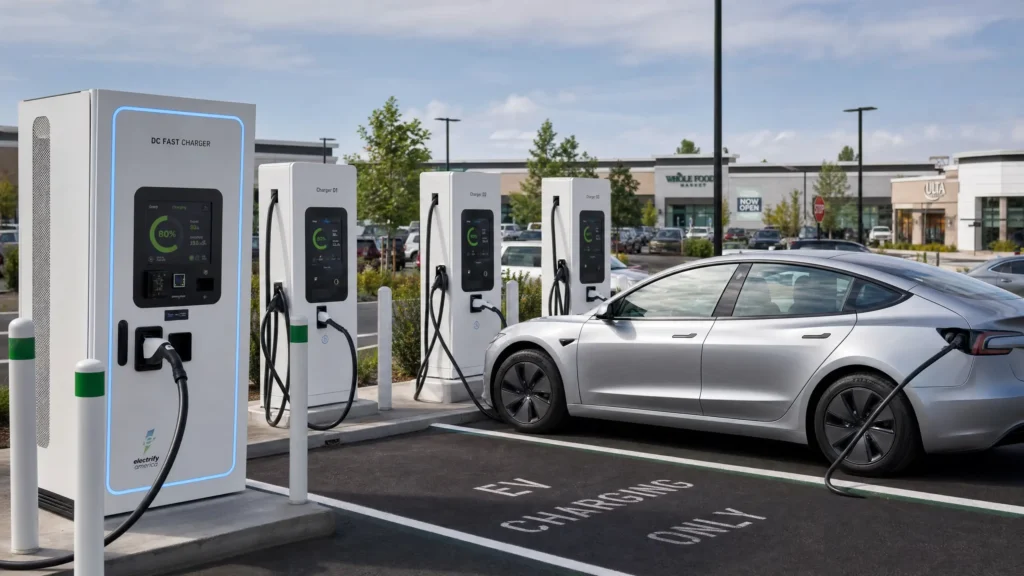
A qualified electrical professional should check the site’s capacity, circuit, protection, and local installation requirements before a fixed station is selected. For home Level 2 charging, that assessment can establish whether a new circuit or panel upgrade is needed. 2
Use a site-fit worksheet with these fields:
- Fornecimento: tensão, fase, frequência, capacidade de serviço, painel, proteção de circuito, aterramento e necessidade de gerenciamento de carga.
- Parking and cable route: posição do veículo, suporte, folga, alcance, armazenamento do conector, drenagem e risco de tropeço ou passagem por cima.
- Environment: exposição interna ou externa, temperatura, umidade, sal, UV, impacto e vandalismo.
- Operações: acesso, cobrança, rede, alertas de falha, serviço, licenças, comissionamento, etiquetas e registros de entrega.
Does an outdoor IP rating solve the installation problem?
Não. Uma classificação de proteção contra ingresso se aplica a um invólucro definido e condição de teste; ela não cobre automaticamente entradas de cabos, um conector sem tampa, penetrações na parede, drenagem ou design de instalação. Solicite a configuração testada, os limites e as instruções de instalação. Especifique a exposição à temperatura, corrosão, UV e impacto para que os fornecedores possam orçar materiais e vedações comparáveis.
How should multiple stations share site power?
Se várias estações compartilham um serviço, defina uma corrente agregada máxima e se o carregamento é fixo, agendado ou alocado dinamicamente. O medidor, o software, o caminho de comunicação e o firmware da estação devem todos suportar o controle pretendido. Projetos em rede também devem especificar integrações necessárias e funções testadas; OCPP e carregamento em rede explica por que um nome de protocolo por si só não garante compatibilidade de recursos.
How Should a Buyer Specify and Approve the Equipment?
Request a quotation for the complete configuration and installation scope. A power figure such as “7 kW” does not identify the connector, supply, cable, access controls, or included services.
- Electrical and vehicle fit: target country, AC or DC, input supply, output limits, vehicle connector, and any adapter restrictions.
- Physical installation: socket or attached cable, cable length, mount, enclosure exposure, parking reach, and required site work.
- Operation and ownership: user access, payment, load sharing, network fees, maintenance, warranty, spare parts, and support responsibility.
- Product evidence: model and revision, datasheet, installation manual, applicable market documents, and reports matching the quoted configuration.
Approve a sample against the written scope: connector fit, cable reach, start/stop behavior, current settings, status indications, installation instructions, and document identity. Record unresolved items before ordering. Use the guia de compra de acessórios de carregamento de VE for the detailed RFQ and sample-approval workflow.
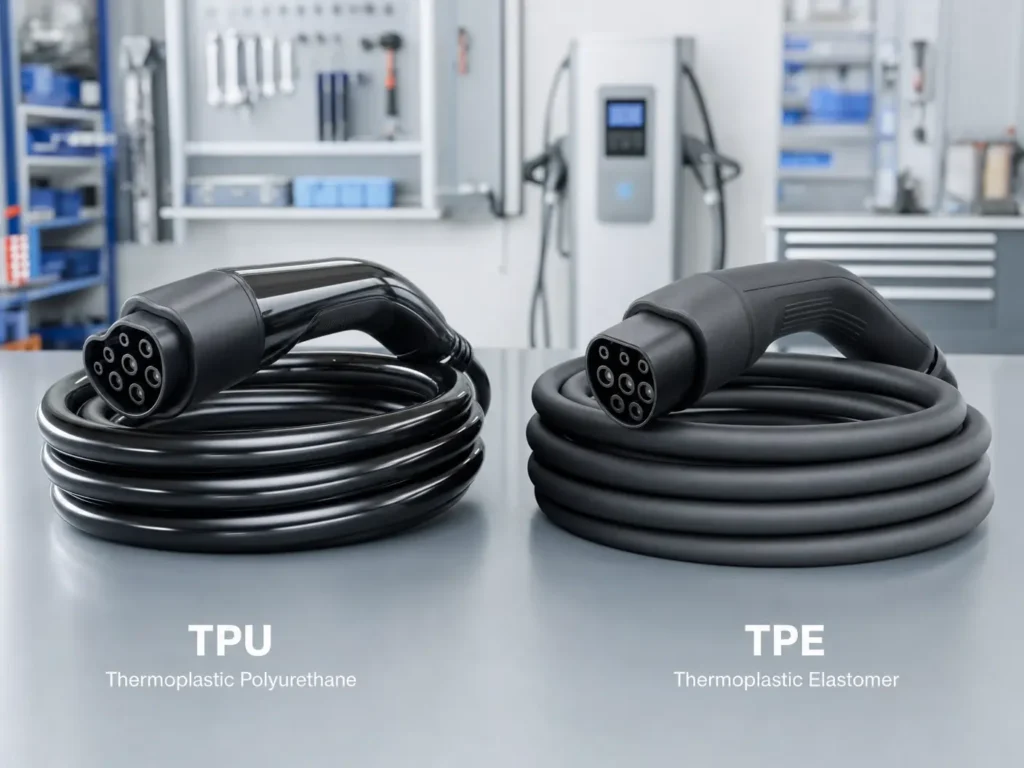
TPU and TPE identify cable-jacket material families. Appearance alone does not establish flexibility, temperature limits, or durability; compare the cable specification and evidence for the intended conditions.
For products in our linha de acessórios de carregamento de VE da Yirox, request a configuration review with the target market, supply, vehicle connector, cable, mounting, and expected volume.
What Is the Difference Between a Charging Station and a Portable EV Charger?
Um carregador de VE portátil é um EVSE portátil para uso com um plugue de alimentação definido, faixa de corrente, cabo e conector de veículo. Uma estação fixa é instalada em um local pesquisado e pode incluir montagem, gerenciamento de cabos, controle de acesso ou rede. Como “carregador” e “estação” são usados de forma ampla, compare o limite elétrico e de instalação, não apenas o nome do produto.
| Ponto de decisão | Carregador EV portátil | Fixed or public charging station |
|---|---|---|
| Site assumption | Tomada definida e faixa de corrente | Circuito pesquisado e montagem |
| Prioridade | Variantes de plugue, armazenamento e seleção de corrente | Gerenciamento de cabos, acesso, manutenção e controle de carga |
| Principal risco | Presumir que qualquer tomada é adequada | Ignorar capacidade de serviço e agenda de estacionamento |
Consulte a carregador de VE portátil visão geral e adjustable-current charging equipment guia. Selecionar uma corrente mais baixa não confirma que uma tomada ou circuito é adequado.
Conclusion: Choose the Station That Fits the Complete Use Case
An EV charging station connects a vehicle to a controlled power supply. AC equipment uses the car’s onboard charger; DC equipment supplies power through its DC interface. Before a public charging visit, confirm connector, cable, access, price, and available time. Before installation, match the daily energy need to site capacity and have the installation requirements checked. Buyers should compare a complete configuration and service scope rather than the kilowatt rating alone.
Perguntas Frequentes
What are the three main types of EV charging?
The common categories are Level 1 AC, Level 2 AC, and DC fast charging. Level 1 uses a lower-voltage AC supply, Level 2 a higher-voltage AC circuit, and DC fast charging converts power in the station. Exact voltage, current, connector, and output depend on the market and configuration.
Can any EV use any charging station?
Não. Verifique a entrada do veículo, conector da estação, tipo de carregamento, classificação elétrica e funções de controle para o mercado e modelo exatos. O carregador de bordo também pode limitar o carregamento CA mesmo quando o conector encaixa.
Does a higher-kilowatt station charge every EV faster?
No. The vehicle, battery condition, state of charge, onboard charger, cable, station, and site circuit can all limit the result. Maximum output describes station capability under defined conditions, not every vehicle’s actual rate.
Do I need a professional installation for an EV charging station?
Fixed stations and higher-current equipment should be evaluated and installed under local electrical requirements by appropriately qualified professionals. Work depends on voltage, phase, current, circuit, mounting, protection, building, and jurisdiction. A lower setting does not make a damaged or unsuitable installation safe.
What should a business request from an EV charging station supplier?
Request a configuration sheet, model and revision, input and vehicle connector details, current and power limits, cable and enclosure specifications, installation requirements, protection functions, market documents, test evidence, software scope, sample, packaging, warranty, spares, and change control. Ask which site work or software fees are excluded.
Do I need to bring my own cable to a public charging station?
Check whether the station has an attached cable or a socket. An attached cable connects directly to the vehicle; a socket-only AC station requires a compatible separate charging cable. ChargePoint’s Flex Plus instructions distinguish these two arrangements and specify a Type 2 cable for its Type 2 socket version. Check the actual station listing and your vehicle manual before travelling. A portable unit with a household supply plug is a different item. 3
Do I need an app or account to use a public EV charging station?
Check the operator’s instructions for the specific station. Some sessions require an app, account, or charging card; do not assume a phone tap is the same as paying with a bank card. ChargePoint’s North American Tap to Charge method requires its app and a signed-in account. Confirm the accepted access method and displayed price before connecting, including any parking or idle charges shown for that site. There is no single activation procedure or price for every public station. 4
Referências
[1] U.S. Department of Energy Alternative Fuels Data Center. “Electric Vehicle Charging Stations.” Accessed October 10, 2026.
[2] Agência de Proteção Ambiental dos Estados Unidos. “Plug-in Electric Vehicle Charging: The Basics.” Updated December 31, 2025; accessed October 10, 2026.
[3] ChargePoint. “Flex Plus Operation and Maintenance Guide: Introduction and Charging a Vehicle.” Accessed October 10, 2026.
[4] ChargePoint. “How do I start a charging session or use Tap to Charge at a ChargePoint station?” Updated June 16, 2026; accessed October 10, 2026.