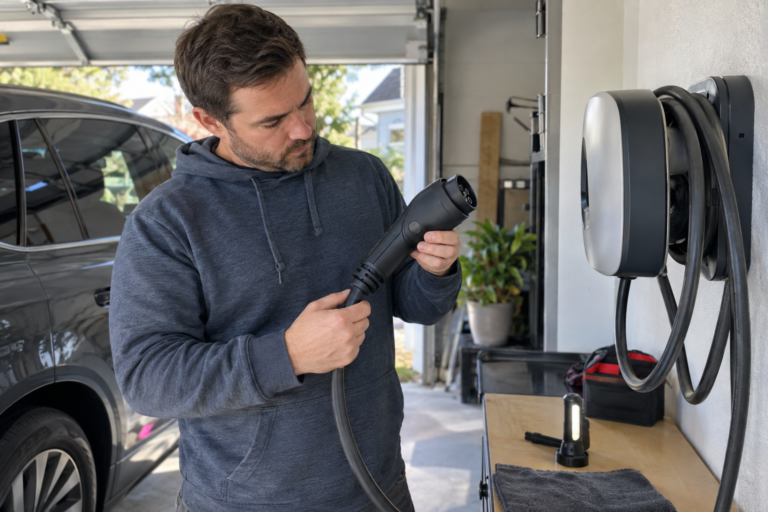




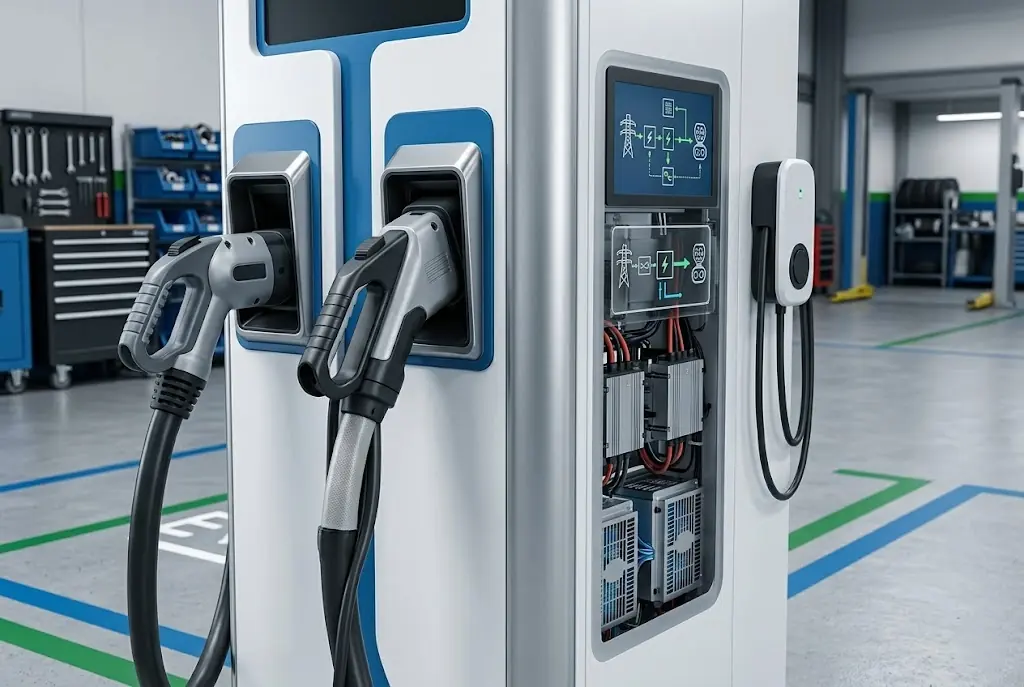
An EV charging station supplies electricity to recharge an electric vehicle. AC charging equipment (EVSE) supplies power to the car’s onboard charger; a DC fast charger converts power in the station and bypasses that onboard charger. Charging stations can be installed at home, at work, or at public parking and roadside locations. 2
For a driver, the practical checks are connector compatibility, available charging time, cable requirements, access, and price. For someone installing a station, add the site’s electrical capacity and installation requirements.
Table of Contents
- What Is an EV Charging Station, and What Is EVSE?
- How Does an EV Charging Station Work?
- Which EV Charging Station Type Fits the Site?
- What Do Level 1, Level 2, and DC Fast Charging Mean?
- How Do Vehicle Connectors and Charging Limits Affect Compatibility?
- How Do You Use a Public EV Charging Station?
- What Should Be Checked Before Installing a Charging Station?
- How Should a Buyer Specify and Approve the Equipment?
- What Is the Difference Between a Charging Station and a Portable EV Charger?
- Conclusion: Choose the Station That Fits the Complete Use Case
- Frequently Asked Questions
- References
What Is an EV Charging Station, and What Is EVSE?
“Charging station” can mean the charging equipment or the location where it is installed. EVSE means electric vehicle supply equipment: the unit, controls, protection, and connection that supply power to the vehicle.
- Station location: a place with one or more charging ports.
- Charging port: equipment capable of charging one vehicle at a time.
- Connector: the plug that connects to the vehicle. A port may offer multiple connector types without charging multiple cars simultaneously. 1
When a listing says “four chargers,” check whether that means four available ports or four plugs sharing fewer ports. In a supplier quotation, check whether “station” includes the cable, mount, installation, network service, and commissioning.
How Does an EV Charging Station Work?
The station controls the power connection; the vehicle controls what its battery can accept. After connection and any required authorization, charging runs within the limits of the equipment, vehicle, and supply.
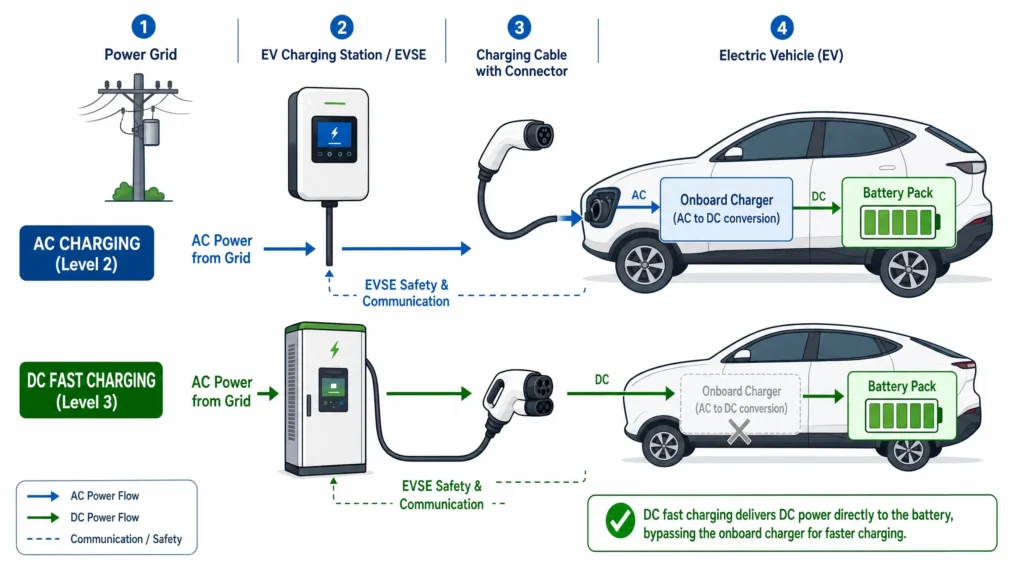
- AC charging: power passes through the EVSE and cable to the vehicle’s onboard charger, which converts AC to DC for the battery.
- DC fast charging: the station supplies controlled DC through the vehicle’s DC charging interface, bypassing the onboard AC charger. 2
- Stopping: the vehicle or station ends the session when requested, at the vehicle’s charge limit, or when a fault requires it.
Why does the power rating not equal charging speed?
A 150 kW station does not guarantee that every connected car receives 150 kW. The vehicle’s charging limit, battery temperature, state of charge, and available station power affect the result. DC charging also generally slows as the battery approaches full. Compare the vehicle’s supported charging rate with the station rating before estimating a stop. 2
Which EV Charging Station Type Fits the Site?
The practical type depends on parking duration, site capacity, number of vehicles, and operating model. The same vehicle may use portable AC EVSE at home, a fixed AC station at work, and public DC charging on a trip.
| Site or user situation | Common equipment direction | Main decision |
|---|---|---|
| Home with overnight parking | Level 1 cordset or fixed Level 2 AC station | Is the existing outlet sufficient, or is faster daily recovery worth a dedicated installation? |
| Apartment, hotel, or workplace | Fixed Level 2 AC stations, sometimes with load management | How many vehicles share the service, and how will access, billing, and maintenance be handled? |
| Retail or destination parking | Fixed AC stations with visible cable management and user controls | Does the dwell time justify the output, and can the equipment withstand public handling? |
| Fleet depot | Multiple AC stations or a mix of AC and DC equipment | What is the dispatch schedule, peak load, connector mix, and maintenance response? |
| Highway or high-turnover charging site | DC fast charging equipment | Can the site support the power, cooling, protection, civil works, and service requirements? |
| Travel, backup, or temporary use | Portable AC EVSE with a defined supply plug and current setting | Is portability more valuable than fixed installation, and is the source circuit known? |
What Do Level 1, Level 2, and DC Fast Charging Mean?
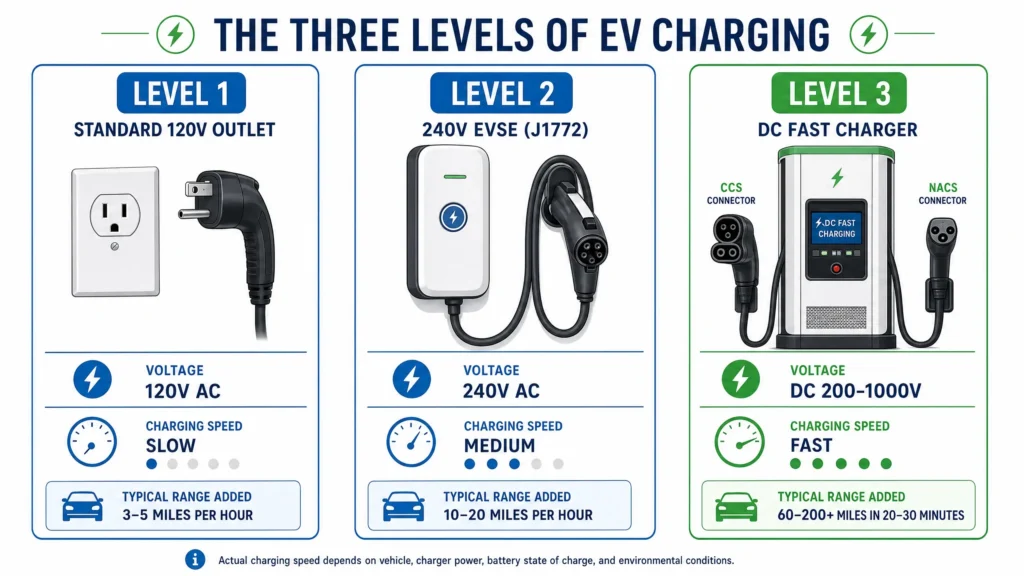
In U.S. terminology, Level 1 generally means 120-volt AC, Level 2 means higher-voltage AC—commonly 208 or 240 volts—and DC fast charging is a separate DC category. Names, supply voltages, and connectors vary by market, so an international RFQ should state the actual electrical configuration rather than rely on “Level 2” alone. 1
| Charging level | Power path | Typical setting | What the buyer must verify |
|---|---|---|---|
| Level 1 | AC from a standard low-voltage outlet to the vehicle’s onboard charger | Home, backup, low-mileage use, or some PHEV applications | Outlet condition, continuous-load suitability, supplied plug, vehicle connector, and realistic overnight energy need |
| Level 2 | AC from a dedicated or suitable 208/240-volt-class circuit to the onboard charger | Home, workplace, hotel, apartment, retail, and destination charging | Service capacity, phase, breaker, current setting, vehicle onboard limit, cable length, and installation route |
| DC fast charging | AC is converted to controlled DC in the station and delivered to the vehicle battery | Public corridors, commercial hubs, and selected fleet sites | DC connector, voltage/current range, site service, cooling, protection, maintenance, and vehicle charging curve |
How can a driver estimate whether the parking window is long enough?
Start with energy needed, not a promised “miles per hour” figure. For example, if a vehicle needs 27 kWh added to its battery during a 9-hour parking window, the average battery-side power requirement is 27 ÷ 9 = 3 kW. The station must supply somewhat more energy because charging is not lossless, and actual power may vary during the session. This is a planning estimate, not a charging guarantee.
Then check the vehicle’s AC onboard-charger limit, the station’s configured current, the circuit’s continuous-load capacity, and whether other loads share the service. If several vehicles charge together, use EV charging load management to evaluate aggregate demand and allocation. The final configuration should be confirmed against the specific vehicle and site.
How Do Vehicle Connectors and Charging Limits Affect Compatibility?
Compatibility has separate layers: the vehicle inlet, station connector or socket, electrical rating, and communication or control. A plug that physically fits is not enough evidence that a session is safe or supported.
The vehicle interface may be SAE J1772, Type 2, NACS/J3400, CCS1, CCS2, CHAdeMO, GB/T, or another regional standard. Confirm the market and AC/DC use; connector names are not universal.
| Check | Confirm | Common mistake |
|---|---|---|
| Vehicle and station connectors | Inlet, AC/DC type, socket or tethered cable, and regional configuration | Selecting by vehicle brand without checking model year and market |
| Electrical rating | Voltage, phase, frequency, current, and vehicle/site limits | Assuming connector shape determines electrical rating |
| Control and communication | Pilot, proximity, locking, authentication, and required software functions | Assuming an adapter resolves control or protocol differences |
| Cable assembly | Length, conductor, jacket, strain relief, and handling suitability | Approving only the connector name, not the complete cable |
Use the EV charging accessories compatibility checklist to separate vehicle fitment from installation evidence. For a multi-market range, record connector, supply, rating, cable, firmware, label, and documents by configuration.
What should a vehicle compatibility claim say?
A useful compatibility claim names the connector, charging type, region, electrical boundary, and any adapter limitation. Avoid “works with all EVs” unless exceptions are explicit; the vehicle’s onboard charger and installation also limit AC charging.
How Do You Use a Public EV Charging Station?
Check that the station supports your car, follow its activation instructions, and confirm that charging has started before leaving the vehicle. Plugging in alone may not start a session.
- Check the listing and parking rules. Confirm the connector, AC or DC support, availability, opening hours, cable requirements, and permitted parking time.
- Check access and price. Find the accepted payment or account method and the displayed tariff before starting. Check for time, parking, or idle fees as well as the energy price.
- Connect and authorize as instructed. Follow the station’s sequence using the correct port ID. For example, ChargePoint’s North American instructions list app, Tap to Charge, and activated ChargePoint card options. These are network-specific methods, not universal payment rules. 4
- Confirm active charging. Check the vehicle display and station status. “Connected” or “authorized” can differ from power actually reaching the car.
- End the session and release the connector. Follow the stop and unlock instructions, return the attached cable or take your own cable, and move the car when finished. If it remains locked, use the vehicle manual or operator support rather than pulling forcibly. 3
At a socket-only Type 2 AC point, a driver with a Type 2 vehicle inlet should check the Type 2 to Type 2 cable configuration before travelling. Confirm current per phase and phase capability as well as usable reach.
What Should Be Checked Before Installing a Charging Station?
A qualified electrical professional should check the site’s capacity, circuit, protection, and local installation requirements before a fixed station is selected. For home Level 2 charging, that assessment can establish whether a new circuit or panel upgrade is needed. 2
Use a site-fit worksheet with these fields:
- Supply: voltage, phase, frequency, service capacity, panel, circuit protection, grounding, and load-management need.
- Parking and cable route: vehicle position, mount, clearance, reach, connector storage, drainage, and trip or drive-over risk.
- Environment: indoor or outdoor exposure, temperature, moisture, salt, UV, impact, and vandalism.
- Operations: access, billing, network, fault alerts, service, permits, commissioning, labels, and handover records.
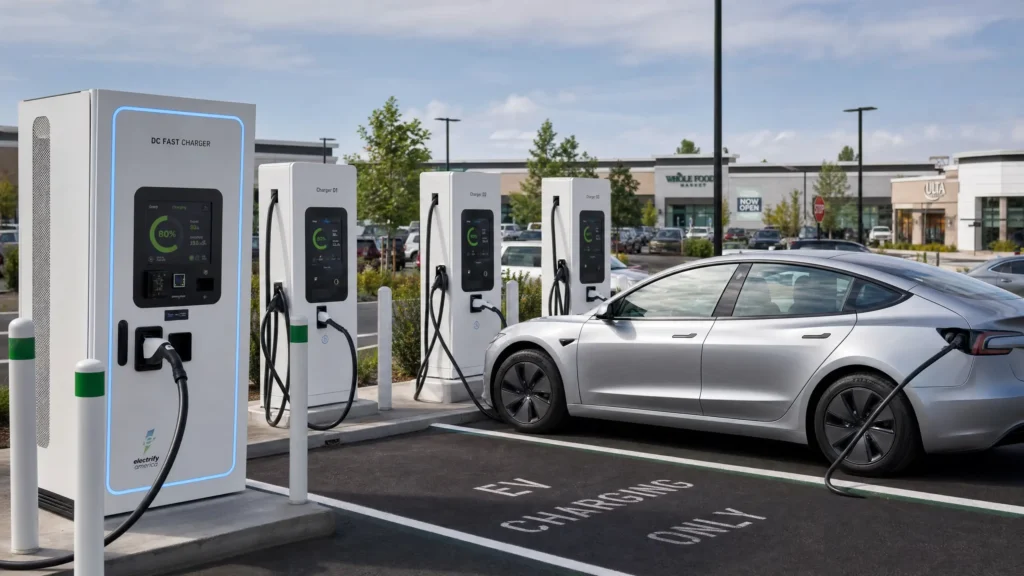
Does an outdoor IP rating solve the installation problem?
No. An ingress protection rating applies to a defined enclosure and test condition; it does not automatically cover cable entries, an uncapped connector, wall penetrations, drainage, or installation design. Request the tested configuration, limits, and installation instructions. Specify exposure to temperature, corrosion, UV, and impact so suppliers can quote comparable materials and seals.
How should multiple stations share site power?
If several stations share a service, define a maximum aggregate current and whether charging is fixed, scheduled, or dynamically allocated. The meter, software, communication path, and station firmware must all support the intended control. Networked projects should also specify required integrations and tested functions; OCPP and networked charging explains why a protocol name alone does not guarantee feature compatibility.
How Should a Buyer Specify and Approve the Equipment?
Request a quotation for the complete configuration and installation scope. A power figure such as “7 kW” does not identify the connector, supply, cable, access controls, or included services.
- Electrical and vehicle fit: target country, AC or DC, input supply, output limits, vehicle connector, and any adapter restrictions.
- Physical installation: socket or attached cable, cable length, mount, enclosure exposure, parking reach, and required site work.
- Operation and ownership: user access, payment, load sharing, network fees, maintenance, warranty, spare parts, and support responsibility.
- Product evidence: model and revision, datasheet, installation manual, applicable market documents, and reports matching the quoted configuration.
Approve a sample against the written scope: connector fit, cable reach, start/stop behavior, current settings, status indications, installation instructions, and document identity. Record unresolved items before ordering. Use the EV charging accessories buying guide for the detailed RFQ and sample-approval workflow.
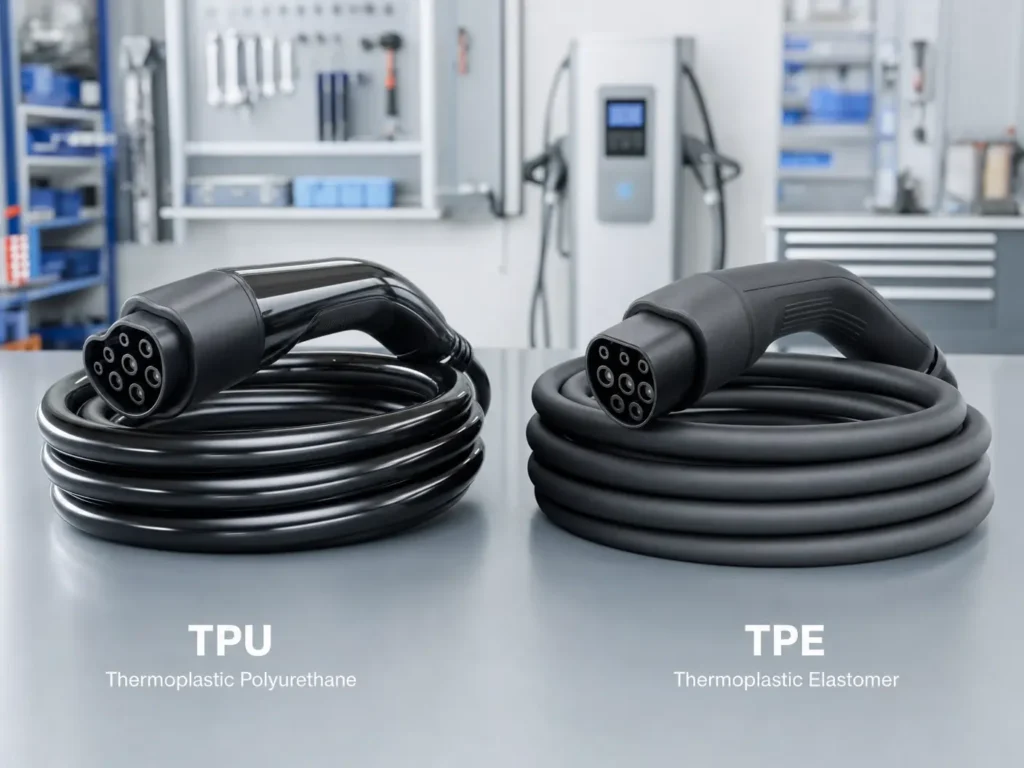
TPU and TPE identify cable-jacket material families. Appearance alone does not establish flexibility, temperature limits, or durability; compare the cable specification and evidence for the intended conditions.
For products in our EV charging accessories range, request a configuration review with the target market, supply, vehicle connector, cable, mounting, and expected volume.
What Is the Difference Between a Charging Station and a Portable EV Charger?
A portable EV charger is portable EVSE for use with a defined supply plug, current range, cable, and vehicle connector. A fixed station is installed at a surveyed location and may include mounting, cable management, access control, or networking. Because “charger” and “station” are used loosely, compare the electrical and installation boundary, not just the product name.
| Decision point | Portable EV charger | Fixed or public charging station |
|---|---|---|
| Site assumption | Defined outlet and current range | Surveyed circuit and mounting |
| Priority | Plug variants, storage, and current selection | Cable management, access, service, and load control |
| Main risk | Assuming any outlet is suitable | Ignoring service capacity and parking schedule |
See the portable EV charger overview and adjustable-current charging equipment guide. Selecting a lower current does not confirm that an outlet or circuit is suitable.
Conclusion: Choose the Station That Fits the Complete Use Case
An EV charging station connects a vehicle to a controlled power supply. AC equipment uses the car’s onboard charger; DC equipment supplies power through its DC interface. Before a public charging visit, confirm connector, cable, access, price, and available time. Before installation, match the daily energy need to site capacity and have the installation requirements checked. Buyers should compare a complete configuration and service scope rather than the kilowatt rating alone.
Frequently Asked Questions
What are the three main types of EV charging?
The common categories are Level 1 AC, Level 2 AC, and DC fast charging. Level 1 uses a lower-voltage AC supply, Level 2 a higher-voltage AC circuit, and DC fast charging converts power in the station. Exact voltage, current, connector, and output depend on the market and configuration.
Can any EV use any charging station?
No. Check the vehicle inlet, station connector, charging type, electrical rating, and control functions for the exact market and model. The onboard charger can also limit AC charging even when the connector fits.
Does a higher-kilowatt station charge every EV faster?
No. The vehicle, battery condition, state of charge, onboard charger, cable, station, and site circuit can all limit the result. Maximum output describes station capability under defined conditions, not every vehicle’s actual rate.
Do I need a professional installation for an EV charging station?
Fixed stations and higher-current equipment should be evaluated and installed under local electrical requirements by appropriately qualified professionals. Work depends on voltage, phase, current, circuit, mounting, protection, building, and jurisdiction. A lower setting does not make a damaged or unsuitable installation safe.
What should a business request from an EV charging station supplier?
Request a configuration sheet, model and revision, input and vehicle connector details, current and power limits, cable and enclosure specifications, installation requirements, protection functions, market documents, test evidence, software scope, sample, packaging, warranty, spares, and change control. Ask which site work or software fees are excluded.
Do I need to bring my own cable to a public charging station?
Check whether the station has an attached cable or a socket. An attached cable connects directly to the vehicle; a socket-only AC station requires a compatible separate charging cable. ChargePoint’s Flex Plus instructions distinguish these two arrangements and specify a Type 2 cable for its Type 2 socket version. Check the actual station listing and your vehicle manual before travelling. A portable unit with a household supply plug is a different item. 3
Do I need an app or account to use a public EV charging station?
Check the operator’s instructions for the specific station. Some sessions require an app, account, or charging card; do not assume a phone tap is the same as paying with a bank card. ChargePoint’s North American Tap to Charge method requires its app and a signed-in account. Confirm the accepted access method and displayed price before connecting, including any parking or idle charges shown for that site. There is no single activation procedure or price for every public station. 4
References
[1] U.S. Department of Energy Alternative Fuels Data Center. “Electric Vehicle Charging Stations.” Accessed October 10, 2026.
[2] U.S. Environmental Protection Agency. “Plug-in Electric Vehicle Charging: The Basics.” Updated December 31, 2025; accessed October 10, 2026.
[3] ChargePoint. “Flex Plus Operation and Maintenance Guide: Introduction and Charging a Vehicle.” Accessed October 10, 2026.
[4] ChargePoint. “How do I start a charging session or use Tap to Charge at a ChargePoint station?” Updated June 16, 2026; accessed October 10, 2026.