



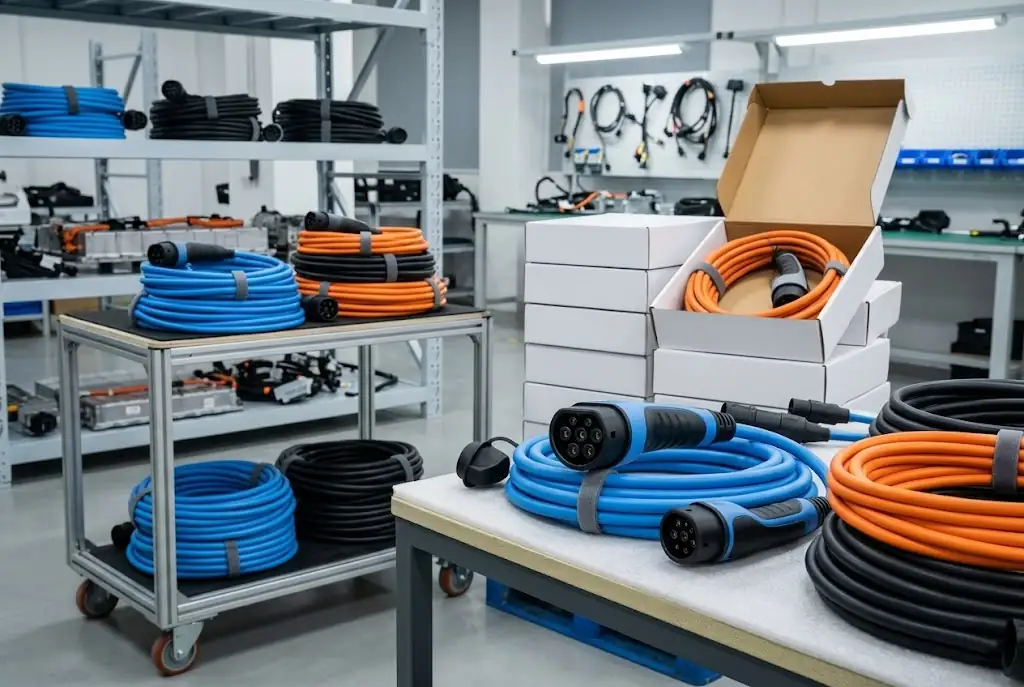
A Type 2 to Type 2 EV charging cable connects a Type 2 AC station socket to a vehicle’s Type 2 inlet. It is a detachable Mode 3 cable: one end is the station plug and the other is the vehicle connector. Choose its current rating and phase capability to match the car and charging point. 1
The main buying decision is not simply “7 kW or 22 kW.” Check amps per phase, the car’s onboard AC charging capability, the station’s available supply, and the cable’s reach. Those details determine whether a cable is suitable for home, workplace or public socket charging.
Table of Contents
- Where Can You Use a Type 2 to Type 2 Cable?
- Which 7.4 kW, 11 kW or 22 kW Cable Should You Choose?
- Why Is Charging Slower Than the Cable Rating?
- What Length, Material and Weather Rating Do You Need?
- What Should You Verify With a Type 2 Cable Supplier?
- How Should You Plan Wholesale and Custom Orders?
- Conclusion: Choose by Amps and Phases
- Frequently Asked Questions
- References
Where Can You Use a Type 2 to Type 2 Cable?
Use the appropriate detachable assembly between a Type 2 station socket and a Type 2 AC vehicle inlet. Confirm both ends before ordering; “Type 2” describes the interface family, not the complete product specification.
| Your connection | What to check |
|---|---|
| Type 2 car + socket-only Type 2 AC point | Station plug, vehicle connector, current, voltage, phase capability and supported use. |
| Charging point with an attached cable | Use the supported attached connector. A detachable cable is not automatically an approved extension or replacement lead. |
| Type 1/J1772 vehicle + Type 2 station socket | Assess a Type 1 to Type 2 cable instead. |
| CCS2 DC fast charging | Use the vehicle’s supported DC equipment; this AC assembly does not convert AC charging into DC charging. |
| Household socket | Check a suitable portable EVSE, rather than treating a station-to-car cable as a complete mains charging unit. |
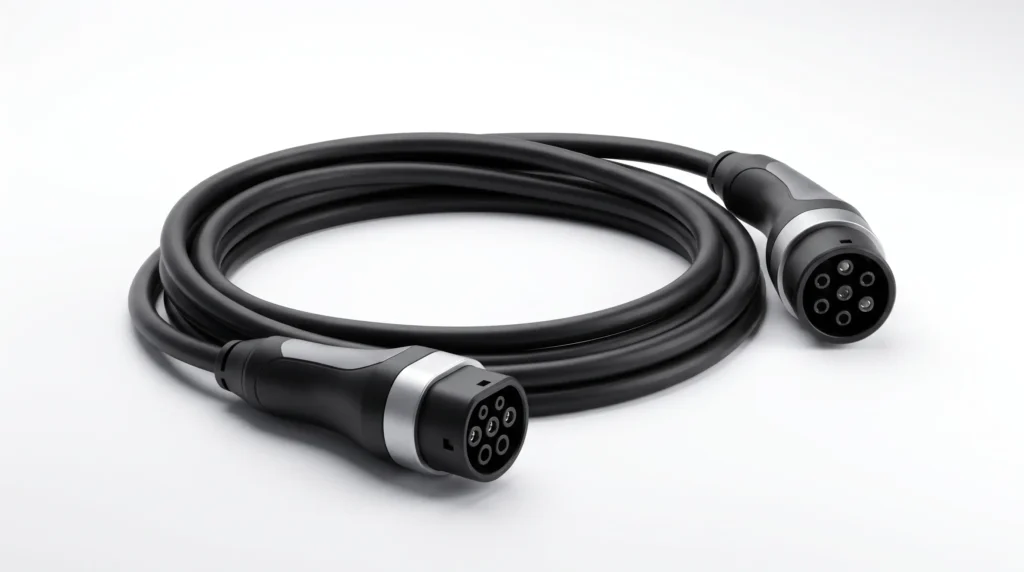
Specify the station plug and vehicle connector by function or drawing. Do not rely only on “male/female,” a vehicle brand, or the number of visible contact positions. Confirm the actual cable’s wiring and ratings in its datasheet. The referenced Phoenix Contact mobile assembly identifies the two ends separately and lists its three-phase power contacts and control contacts. 1
Which 7.4 kW, 11 kW or 22 kW Cable Should You Choose?
Compare the cable’s current per phase and supported phase configuration, then check what the car and station can use. A larger kW label can cover more supply arrangements, but it does not upgrade the car’s onboard charger.
| Cable configuration | Illustrative AC power | Important limitation |
|---|---|---|
| Single-phase, 16 A | About 3.7 kW at 230 V | Provides one phase at the stated current. |
| Single-phase, 32 A | About 7.4 kW at 230 V | Does not provide the additional phases needed for ordinary 11/22 kW three-phase charging. |
| Three-phase, 16 A per phase | About 11 kW at 400 V between phases | At 230 V single phase, 16 A corresponds to about 3.7 kW. |
| Three-phase, 32 A per phase | About 22 kW at 400 V between phases | Can provide capacity for a compatible 32 A single-phase connection; actual use depends on the vehicle, station and assembly specification. |
The table uses rounded voltage/current calculations, not measured charging results or universal connector limits. Single-phase power is approximately voltage × current; balanced three-phase power is approximately √3 × line-to-line voltage × current per phase, assuming a power factor near one. These are supply-side estimates, not guaranteed power stored in the battery.
Can an 11 kW Cable Be Slower Than a 7.4 kW Cable?
Yes, when those labels mean three-phase 16 A and single-phase 32 A, respectively. On a compatible 230 V single-phase point, the 16 A cable’s capacity is about 3.7 kW, while the 32 A cable can provide capacity for about 7.4 kW. Check the actual ratings rather than ranking cables by the largest advertised number.
When Is a 22 kW Cable Worth Considering?
A three-phase 32 A cable is worth comparing if you need both 32 A single-phase use and three-phase use, or if the vehicle supports 22 kW AC. If you only use three-phase 16 A charging, an appropriate 11 kW cable may cover that setup. Compare the quoted weight, handling, price and anticipated charging locations before choosing.
Do not assume every 11 kW car supports 32 A on a single phase. Confirm that specific capability in the vehicle’s manual or market-specific specification. Charging power also depends on the equipment, battery condition and temperature. 2
Why Is Charging Slower Than the Cable Rating?
The cable rating describes capacity, while the actual session is limited by the connected system. Check the vehicle, cable and charging point separately before replacing a working cable.
- Confirm AC capability. Look up the vehicle’s onboard AC limit for its exact model, market and equipment. A DC fast-charging specification does not describe its AC rate.
- Read the cable label. Record current per phase and whether the assembly is single-phase or three-phase. Check the datasheet if the kW label does not state the supply assumptions.
- Check the charging point. Confirm the current and phases available to that port. A site’s advertised maximum may differ from its configured or shared allocation.
- Check settings and status. Review scheduled charging, current limits, vehicle charge target and any displayed fault. Follow the equipment instructions rather than bypassing protection.
- Record actual power or energy. Note kW, delivered kWh, session duration and the starting state of charge. An estimated distance added per hour is not a direct measurement of charging power.
Battery state of charge and temperature can affect charging time. 2 If there is damage, discoloration, a burning smell or poor connector retention, stop using the suspect item and follow the charging accessory warning-sign checks.
What Length, Material and Weather Rating Do You Need?
Measure the route from the station socket to the vehicle inlet in your usual parking positions. Select enough usable reach for comfortable connection, then check storage, handling and the product’s stated environmental limits.
- Length and shape: confirm how the supplier measures the assembly. For a coiled cable, request usable reach as well as stored length; avoid planning a connection that keeps the cable under tension.
- Handling: compare the sample’s weight, grip, bend behavior, caps and strain relief. Do not infer weight or flexibility from the kW label alone.
- Materials: request the jacket grade and evidence for the intended temperature, abrasion, UV and moisture exposure. TPU/TPE names alone do not prove the finished cable’s performance.
- Ingress protection: identify whether the rating applies to the mated connector, cap, disconnected end or another defined assembly state.
For example, the referenced Phoenix Contact model distinguishes IP44 for specified plugged-in conditions from IP54 for its protective cap. Those values belong to that model and its stated conditions, not every Type 2 cable. 1 Obtain the limits and instructions for the product being quoted.
What Should You Verify With a Type 2 Cable Supplier?
Ask for one complete, identifiable cable configuration and the evidence supporting it. A connector name, certification logo or factory claim is not enough to compare quotations or approve a product.
| Specification | Evidence or clarification to request |
|---|---|
| Connection and electrical rating | Station/vehicle drawings, AC use, voltage, current per phase, phases and cable rating identification. |
| Cable construction | Conductor structure, jacket grade, length, strain relief and the conditions supporting its declared current and environmental limits. |
| Product conformity | Applicable declaration, technical documents and any claimed third-party certificate or report for the exact model and revision. |
| Sample and production identity | Approved sample, functional checks, batch markings, inspection records, packaging and change-notification arrangements. |
| Service and commercial scope | Warranty, replacement process, responsibilities, quoted MOQ, sample availability and delivery milestones. |
Do not prescribe one conductor cross-section for every 32 A cable or accept a universal cycle-life or service-life claim. Ask how the quoted assembly’s rating was established and which configuration was assessed. Changing length, material or connectors should trigger a review of the document scope.
CE marking reflects the manufacturer’s conformity responsibilities under applicable EU rules. It is not awarded by a central EU certification authority, and third-party assessment depends on the relevant product requirements. Review the declaration and supporting evidence rather than rejecting every self-declaration or treating a management-system certificate as product approval. 3
Use the EV charging accessories compatibility checklist to record the exact supported connection. For the wider quotation and sample-review process, refer to the accessories buying guide.
How Should You Plan Wholesale and Custom Orders?
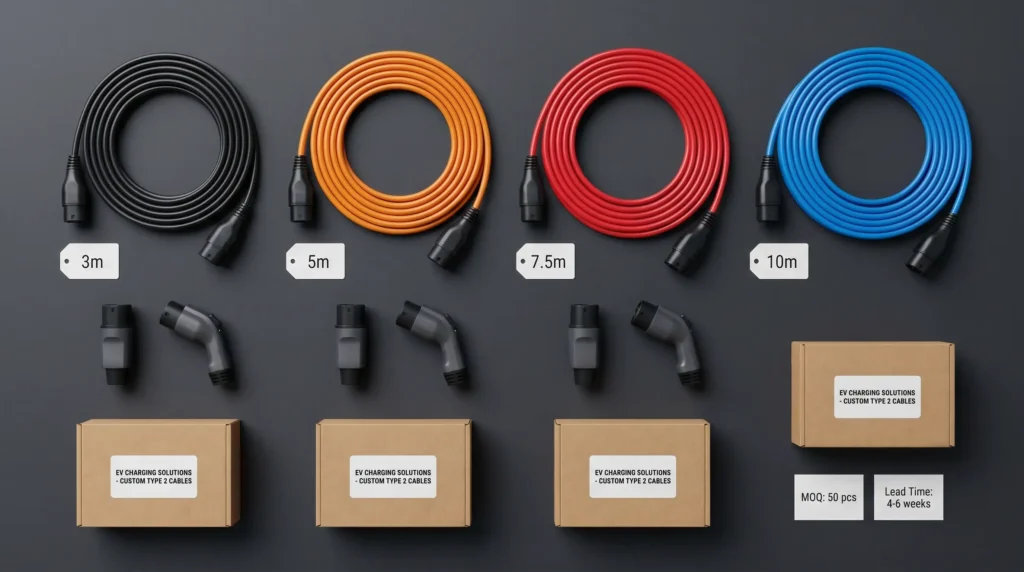
Separate an existing cable model, branding changes and engineering changes before asking for MOQ and timing. Request a written quotation tied to a configuration, rather than publishing a generic lead time as a delivery promise.
- Existing model: confirm phase/current options, lengths, stock status, included accessories and sample availability.
- Branding and packaging: approve artwork, instructions, language, barcode and batch identification separately from the electrical specification.
- Engineering change: define the drawing revision, validation required, document coverage, sample approval and production release.
- Delivery: distinguish sampling, materials, artwork approval, production, inspection and transport; agree what event starts the quoted lead time.
For a distributor range, use known vehicle and charging-site needs to choose variants. Avoid promising that one cable suits every EV or that a particular rating covers a fixed percentage of demand without customer data.
For a Type 2 cable enquiry, request a configuration quotation with destination market, station and vehicle interfaces, current per phase, phase capability, length, handling environment, quantity and packaging requirements.
Conclusion: Choose by Amps and Phases
Match the Type 2 station socket and vehicle inlet first, then check amps per phase and the car’s supported AC configuration. An 11 kW label does not necessarily outperform a 7.4 kW label on a single-phase point, and a 22 kW cable does not upgrade an 11 kW onboard charger. Choose reach and handling for the parking setup, and approve supplier evidence against the exact assembly.
Frequently Asked Questions
What is the difference between a Type 2 cable and a CCS2 cable?
A detachable Mode 3 Type 2 cable is an AC connection between a station socket and the vehicle inlet. CCS2 adds DC contacts to the combined vehicle interface and uses the supported DC fast-charging system. The AC cable does not become a CCS2 lead or convert the charging mode. A common 22 kW cable rating is also not a universal power ceiling for every Type 2 interface. Check the specific assembly and vehicle.
Can I use a 32A Type 2 cable on a 16A charging station?
A correctly specified, compatible 32 A assembly can be used where the available current is lower; a higher cable rating does not force the station to supply 32 A. Check voltage, phase capability, connector fit, equipment instructions and cable condition as well. The rating alone is not a blanket safety guarantee, and a damaged or incorrectly specified cable must not be treated as suitable merely because its stated amps exceed the station output.
What does the IP rating mean for EV charging cables?
IP (Ingress Protection) describes protection against solid objects and water ingress. Check which connector or assembly state the rating covers, including whether it is mated, capped or disconnected. Do not assume one IP number applies to every condition or makes a cable suitable for immersion or damaged-contact use. Phoenix Contact’s referenced model lists plugged-in conditions separately from its protective-cap rating. 1 Obtain the quoted model’s instructions and environmental limits instead of using a universal minimum IP number for all outdoor charging.
Why is TPU preferred over TPE for the cable jacket?
TPU is not automatically the better choice for every finished cable. Ask for the actual jacket grade and evidence for the temperatures, abrasion, UV exposure, handling and other conditions in the intended use. A material-family name cannot establish the assembly’s flexibility or lifetime. Compare the declared limits and representative samples, rather than assuming that all TPU products outperform all products labelled TPE.
How long does an OEM custom order typically take to manufacture?
Obtain a written lead time for the exact configuration and quantity. Separate an existing model with new artwork from changes to cable length, materials, connectors or tooling, then confirm sampling, required validation, material availability, production and inspection milestones. Ask what approvals start the timing and whether transport is included. A generic four-to-six-week range is not a confirmed Yirox delivery commitment for every custom order.
Do I need a single-phase or three-phase cable for my EV?
Check both the vehicle’s supported AC configuration and the charging locations you intend to use. A single-phase cable cannot provide the additional phase connections used for ordinary three-phase charging. A three-phase 16 A cable can provide about 11 kW on a 400 V three-phase supply, but only about 3.7 kW at 230 V single phase. Compare current per phase as well as phase count; do not assume every 11 kW car accepts 32 A single phase.
Why does an 11kW cable only give about 3.7kW on a single-phase charger?
If “11 kW” means three-phase 16 A, the cable is still rated for 16 A when used on one phase. At 230 V, 16 A corresponds to about 3.68 kW; the rating does not become 32 A merely because the charging point can supply more. Check the cable label and the vehicle’s supported single-phase current. A suitable 32 A assembly may remove that cable limit, but other station and vehicle limits can still apply.
Is a 22kW cable worth buying for a car that only charges at 11kW?
An 11 kW car will not gain 22 kW AC capability from the cable. A three-phase 32 A cable may nevertheless cover supported 32 A single-phase charging as well as three-phase charging, whereas a three-phase 16 A cable has less single-phase current capacity. Compare the actual vehicle specification, charging locations, cable weight, usable reach and price. If you only need three-phase 16 A operation, a suitable 11 kW cable may already meet the requirement.
References
[1] Phoenix Contact. “EV-T2G3PC-3AC32A-7,0M6,0ESBK01: mobile Type 2 AC charging cable.” Accessed October 12, 2026.
[2] U.S. Environmental Protection Agency. “Plug-in Electric Vehicle Charging: The Basics.” Accessed October 12, 2026.
[3] European Union, Your Europe. “CE marking.” Checked July 17, 2026; accessed October 12, 2026.