



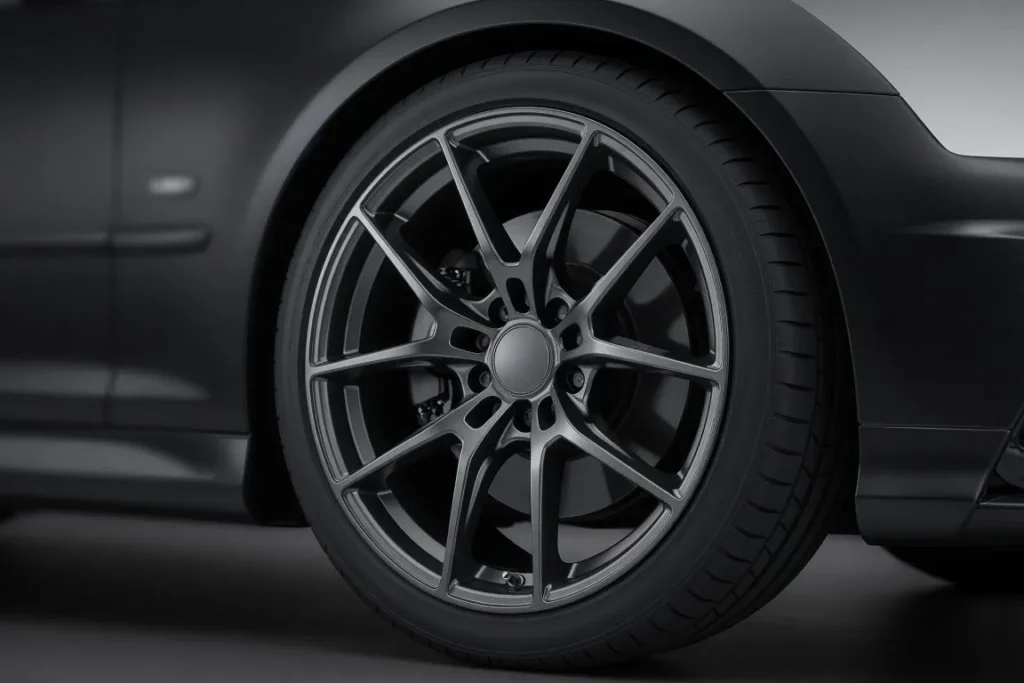
A wheel center cap is the small cover that fits into the middle of a wheel, over the center bore and hub area. Wheel center caps are not a standard size. A cap fits only when its clip or snap diameter, outer diameter, depth and retention style match the wheel’s cap recess, so you measure the wheel and the old cap before you buy or develop one.
Scope: this guide covers center cap types, sizes, measuring, fitment and custom logo caps for wheel brands and distributors. Full wheel covers and the hubcap-versus-rim question are covered in our hubcaps vs rims explainer, and wheel offset is explained in What Is Wheel Offset?
What is a wheel center cap, and what does it do?
A center cap closes the opening in the middle of a wheel. That opening, the furo central, is the hole the vehicle’s hub pilot passes through when the wheel is mounted. Around it sits the hub face, the lug studs or bolts, and on some vehicles an axle nut or a grease cap.
The cap’s main job is appearance. It finishes the wheel face, hides the hub and gives the wheel maker or vehicle maker a place for a logo. A secondary job is to keep some road dirt, water and brake dust off the hub area, which makes the hub face and studs easier to clean at the next tire change.
It is worth being precise about what a cap does not do. A center cap is not a structural part. It does not locate the wheel, carry load or hold the wheel on. If a cap is missing, the wheel is still safe to drive; the cost is cosmetic and, over time, a dirtier and more corroded hub area.
For wheel brands and distributors, the cap matters more than its size suggests. It is the most visible place for a brand mark on the whole wheel, it is one of the most frequently lost parts, and it is a steady replacement item. A wheel program that has no plan for spare caps usually ends up with customers who cannot find a matching replacement.
Center caps vs hubcaps: what is the difference?
A center cap covers only the middle of the wheel, while a full wheel cover spans most of the visible wheel face. The word “hubcap” is used loosely for both, which is why listings get confusing. Our hubcaps vs rims explainer covers the naming in detail, so this guide only draws the line that matters for ordering.
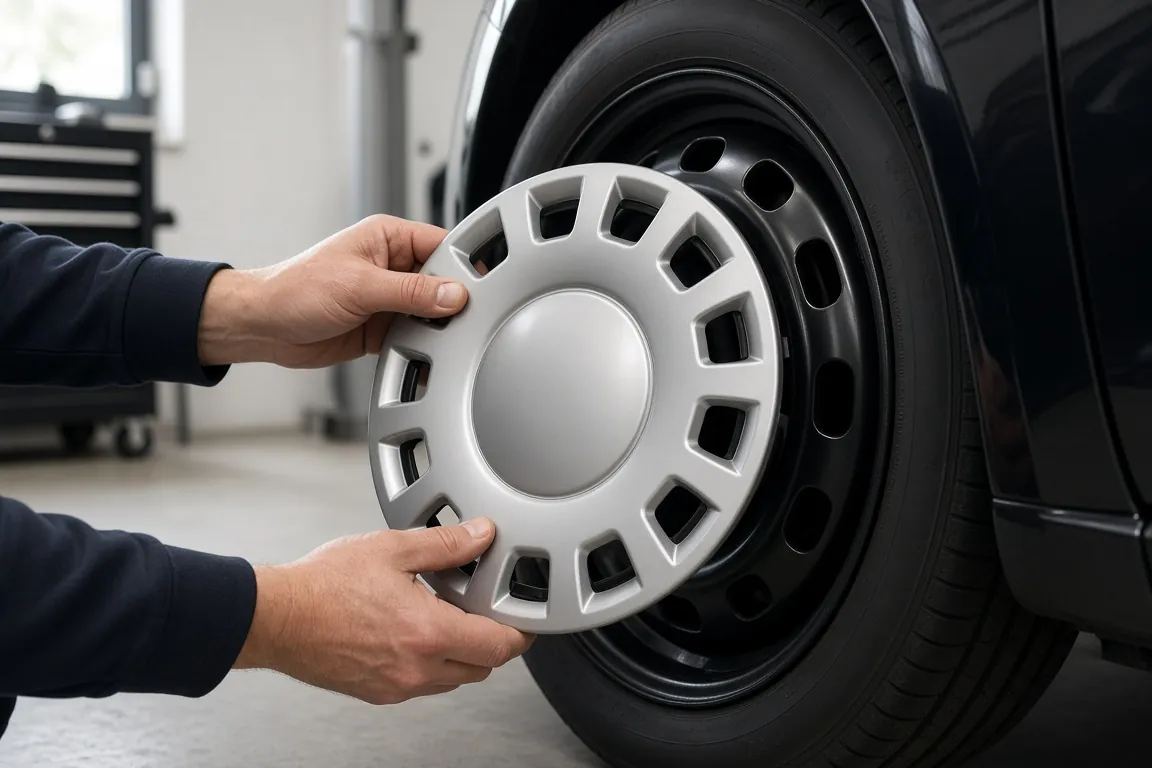
- Tampa central: sized to the wheel’s center recess. Common on alloy wheels and on some steel wheels. Measured in millimeters across the cap and its clips.
- Tampa de roda completa: sized to the wheel diameter (14, 15, 16 inches and so on) and clipped to the rim of a steel wheel. Sold through our calotas e tampões de roda range.
- Trim ring or lug nut covers: separate decorative pieces that some wheels use alongside a small center cap. Lug nut covers are plastic or metal sleeves that press over each lug nut; they are sized by the nut’s hex size and are ordered separately from the cap.
The practical rule is simple: if the part is described in inches of wheel diameter, it is a wheel cover; if it is described in millimeters across the cap, it is a center cap. When a buyer sends only “16 inch hubcap”, ask for a photo of the front and back of the part before quoting.
In short, center caps vs hubcaps comes down to coverage and wheel type. Center caps usually belong to alloy wheels and some steel wheels and only dress the middle; hubcaps in the full-cover sense belong to plain steel wheels and dress the whole face. A shop that stocks both should list them in separate categories so buyers do not order the wrong part.
What types of center caps are there?
Center caps are grouped by how they stay on the wheel. The retention style decides what you have to measure, how the cap is installed and how likely it is to come loose, so it is the first thing to identify.
| Tipo | How it is retained | Onde é comum | What to measure | Cuidado com |
|---|---|---|---|---|
| Snap-in (clip-leg) cap | Plastic or metal legs flex and grip a lip or groove in the wheel’s cap recess | Most passenger-car alloy wheels, many aftermarket wheels | Clip (snap) diameter, outer diameter, number of legs, depth | Legs that are too loose let the cap fall out; too tight and they crack on install |
| Ring-retained cap | A separate spring-steel or plastic ring holds the cap in a machined groove | Some OEM and aftermarket alloy wheels | Groove diameter, ring section, cap outer diameter | The ring is a separate part; order it with the cap |
| Push-through cap | Inserted from the back of the wheel and held once the wheel is bolted to the hub | Some truck and steel wheels, some off-road wheels | Flange diameter on the back, bore diameter, flange thickness | The wheel must come off to fit or replace it |
| Bolt-on (screw-on) cap | Screws or small bolts fasten the cap to the wheel or hub area | Many truck and off-road wheels, some dually and van wheels | Bolt circle, number and thread of screws, cap diameter, height | Screw size and bolt circle must match the specific wheel |
| Floating cap | Snap-in or bolt-on base with a bearing-mounted, weighted face | Custom and show wheels | Same as the base type, plus face clearance | Moving face must clear the wheel at every angle |
| Emblem insert or overlay | Adhesive badge on an existing cap, not a cap on its own | Logo updates, private-label programs | Insert diameter and the flat area on the cap | Adhesive grade and surface prep decide how long it stays |
Two further splits are useful when you are building a range. Closed caps cover the lug area or sit inside it with a solid face; open caps leave a hole for a hub, axle nut or locking device. Caps also come in low, flush designs and in tall designs that clear an extended hub, which is why depth is part of every fit check.
Floating vs spinning center caps: how do they differ?
Both are specialty caps with a moving face, but they move in opposite ways. A floating center cap has a weighted logo face on a small bearing, so the face stays upright while the wheel turns and the logo always reads level. A spinning center cap, often called a spinner, has a face that keeps rotating when the wheel slows or stops, which is a styling effect rather than a branding one.
- Floating caps suit wheel brands and dealers who want the logo readable in photos and at rest. They usually use a snap-in or bolt-on base, so the base is measured like any other cap.
- Spinning caps suit custom and show builds. They are a smaller niche, and their larger, moving faces need more clearance inside the wheel recess.
For both types, check the face clearance at full lock and over bumps, and buy from a source that states the bearing type and how the face is retained. In markets with vehicle approval rules on external projections, such as the UN R26 framework, avoid designs with raised or pointed parts that stand out from the wheel face [1].
Os tampões centrais das rodas têm um tamanho padrão?
No. There is no single industry size for center caps. Each wheel design has its own cap recess, and even two wheels from the same maker can use different caps if they were designed at different times.
What a seller calls “the size” is usually one number, most often the outer diameter in millimeters. That number alone is not enough to guarantee fit. A cap is defined by at least four measurements:
- Outer diameter (OD): the visible face of the cap, measured edge to edge.
- Clip or snap diameter: the distance across the outside of the clip legs, or across the ring groove. This is the measurement that actually holds the cap.
- Cap recess diameter on the wheel: the opening in the wheel face the cap sits into. It is not the same as the center bore that fits the hub.
- Depth or height: how far the back of the cap reaches into the wheel, which must clear the hub pilot, any axle nut and any hub-centric ring.
The table below shows why one number is not enough. The figures are a hypothetical example of two caps that would both be listed as “60 mm”.
| Measurement (example only) | Cap A | Cap B | Will they swap? |
|---|---|---|---|
| Diâmetro externo | 60 mm | 60 mm | Same look from the front |
| Clip diameter | 56 mm | 58 mm | No: Cap B will not press into Cap A’s recess |
| Number of clip legs | 4 | 5 | Changes grip, not always fit |
| Depth behind the face | 18 mm | 28 mm | Cap B may hit a tall hub |
How we put this together: the measurement list is our own buyer checklist, built from the questions that come up when matching replacement caps. The numbers in the table are illustrative, not the specification of any real wheel.
How do you measure a center cap?
Measure both the old cap and the wheel, with the cap removed, using a digital caliper that reads to 0.1 mm. Tape measures are too coarse for this job; a 1 mm error on the clip diameter is often the difference between a cap that holds and one that falls out.

- Remove the cap (see the next sections) and clean the recess so dirt does not add to the reading.
- Measure the cap’s outer diameter across the widest part of the face.
- Measure the clip diameter across the outside tips of opposite clip legs. With an odd number of legs, measure from one leg tip to the far edge of the cap base and note that you did so.
- Count the clip legs and note whether they are plastic or metal.
- Measure the depth from the back of the face to the end of the legs.
- Measure the wheel’s cap recess: the inside diameter where the legs grip, and the depth of the groove or lip if there is one.
- Check clearance behind the cap: with the wheel mounted, measure from the wheel face to the end of the hub pilot or axle nut. The cap’s depth must be less than this.
- Photograph the front and back of the cap next to a ruler, and photograph any part number molded on the back.
Many original caps carry a part number on the back. The part number is the most reliable match, because it identifies the exact design, including details that are hard to measure, like the shape of the leg tips. Measurements are the backup when there is no number or the cap is lost.
If the cap is missing altogether, measure the wheel recess and the hub clearance, then send those with photos of the wheel’s front face and the back of the hub area. A supplier can work from those numbers, but expect a sample fit check before a full order.
Qualquer calota central serve em qualquer roda?
No. A cap fits only wheels with a matching recess, retention style and depth. “Universal” center caps try to widen that window, but they do it by compromise.
- Adjustable-leg caps use legs that can be moved or trimmed to grip a range of recess sizes. They fit more wheels, but the grip is usually weaker than a cap designed for one recess.
- Caps with spacer rings use an adapter ring to step down from a larger recess. Each added part is another place for play to develop.
- Adhesive face caps stick onto an existing cap or hub area. They change the look but rely entirely on the adhesive and surface prep.
Universal caps can be a reasonable choice for older wheels whose original caps are no longer made. For a wheel brand or a distributor stocking replacement caps for a known wheel line, a wheel-specific cap is the better default, because it removes the guesswork that leads to returns.
The same caution applies to caps from a different wheel maker. Even when the outer diameter matches, the clip diameter, leg shape or depth often does not, and forcing a cap can crack the legs or mark the wheel’s finish.
How do you remove and install center caps?
Snap-in caps come out by pushing them from behind or by gentle, even prying at the edge; bolt-on caps come off by removing their screws; push-through caps require the wheel to be removed. The method depends on the retention type identified earlier.
- Snap-in caps, wheel off the car: push the cap out from the back of the wheel with the handle of a soft tool, pressing evenly near the legs.
- Snap-in caps, wheel on the car: use a plastic trim tool, not a screwdriver, at the edge of the cap. Work around the edge a little at a time so the legs release evenly. Protect the wheel finish with tape or a cloth where the tool rests.
- Bolt-on caps: remove the screws in a cross pattern, keep them together, and refit with the same fasteners. Do not over-tighten into plastic.
- Push-through caps: remove the wheel, push the cap out from the front or back as designed, and fit the new one before remounting the wheel.
To install a snap-in cap, line up any key or notch with the wheel, place it square in the recess and press firmly at the center with the palm of your hand. A good fit seats with an even click and does not rock. If it needs a hammer, it is the wrong cap.
When a wheel goes on a tire machine or balancer, the cap usually comes off first. Shops that handle a lot of aftermarket wheels find it useful to bag caps with the wheel’s work order, because a lost cap is a common post-service complaint. The balancing side of the job, including weight placement on alloy rims, is covered in our de pesos de balanceamento de roda.
What are center caps made of, and how are they finished?
Most center caps are injection-molded plastic, usually ABS or a similar engineering plastic, with a painted, chrome-plated or film-decorated face. Premium and off-road caps are often machined from aluminum billet. Some designs combine a plastic body with a metal or resin emblem.
| Material e acabamento | Typical use | Pontos fortes | Limits to plan for |
|---|---|---|---|
| ABS, painted | OEM-style and aftermarket snap-in caps | Easy to color-match the wheel; good detail for molded logos | Paint chips at the edge if the cap is pried badly |
| ABS, chrome-plated | Bright-finish caps and logos | Mirror look at plastic weight | Plating quality varies; check adhesion and pitting on samples |
| Plastic with emblem insert | Brand programs that change logos often | One cap body, many logo inserts | Insert adhesive and fit of the recess decide durability |
| Machined aluminum | Truck, off-road and premium wheels | Rigid, sharp edges for engraving or laser marking | Higher unit cost; anodizing or coating needed against corrosion |
Typical production for plastic caps involves a steel mold, injection molding of the cap body, trimming, then painting or plating, logo application and assembly of any ring or insert. Factories in this category usually inspect appearance, color against the approved sample, leg or ring retention and fit in the target wheel before packing.
For a buyer, the useful takeaway is that the leg design is set by the mold. Changing the clip diameter after tooling is a mold change, not a small adjustment, so confirm the wheel recess before the mold is made.
How do custom logo center caps work for wheel brands?
A custom center cap program puts your own mark on a cap that fits your wheel. It is the cheapest way for a wheel brand or a private-label distributor to make a wheel line recognizably theirs, because the cap is small and the logo is seen every time the car is parked.
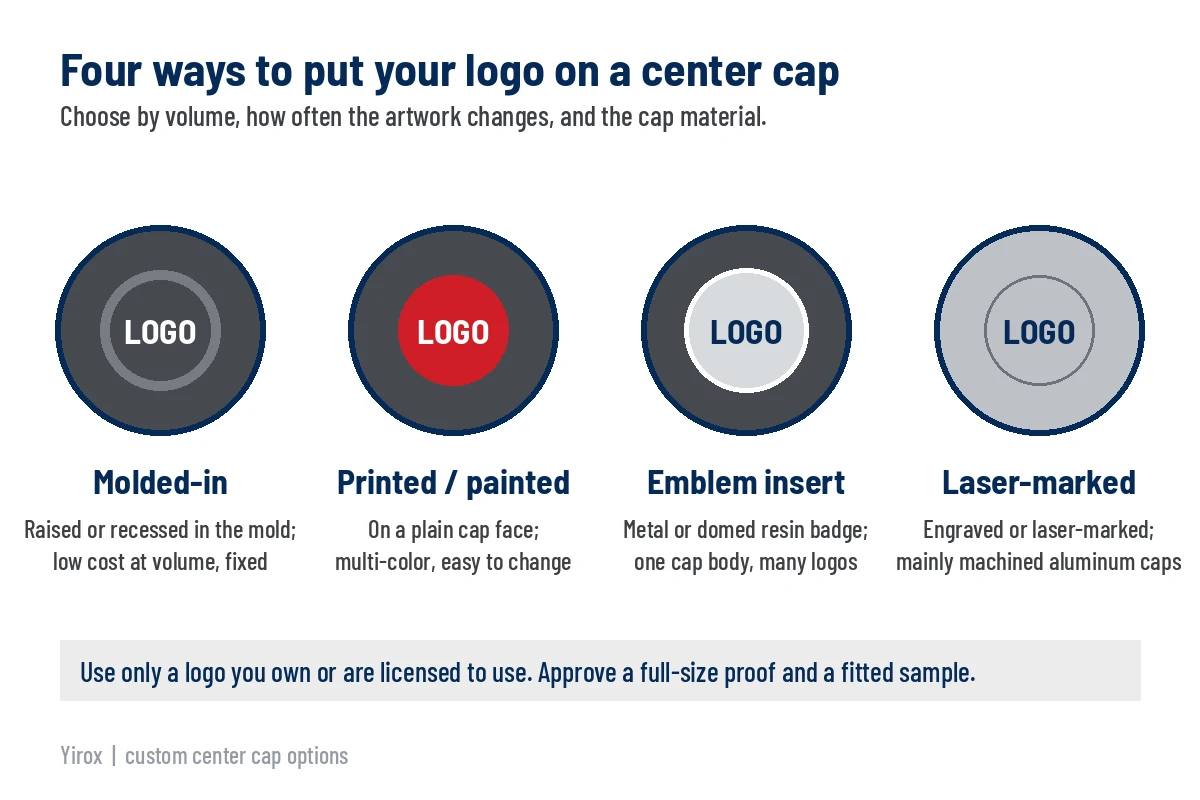
The common ways to apply a logo are:
- Molded-in logo: the logo is part of the mold, raised or recessed, then painted or plated. Lowest unit cost at volume, but the logo is fixed once the mold is made.
- Printed or painted logo: the logo is applied to a plain cap face. Good for multi-color marks and for changing artwork without a new mold.
- Emblem insert: a separate metal or domed resin badge set into a recess in the cap. One cap body can carry several brands or seasonal designs.
- Engraved or laser-marked logo: used mainly on machined aluminum caps.
Artwork should be supplied as a vector file, with color references and the minimum line width marked. Small text and thin lines that look fine on screen can disappear on a cap of around 60 mm, so a proof at actual size is worth the extra step.
The legal side matters as much as the design. A trademark identifies the source of goods and is how buyers tell one brand from another, according to the USPTO [2]. Only order a logo you own or are licensed to use. Caps carrying a vehicle maker’s or another wheel maker’s logo without permission are counterfeit goods, and U.S. Customs and Border Protection states that it targets and seizes counterfeit imports [3]. Expect any reputable factory to ask for proof of ownership or a license before it makes a branded cap.
One more point for wheel brands: the cap logo is branding, not compliance marking. Aftermarket wheels sold in the United States are commonly tested and marked to SAE J2530, which sets performance, test and marking requirements for the wheel itself [4]. Required wheel markings belong on the wheel, not on a removable cap.
Quais são os riscos e exceções?
The main risks are caps that come loose, caps that do not suit a wheel variant, and decorative designs that are not legal in some markets. Most can be caught at sample stage.
- Loose or lost caps: the usual causes are the wrong clip diameter, legs that are too stiff or too soft, and caps forced in and cracked. Cold weather makes some plastics more brittle, so a cap that clicks in easily in summer can crack in winter.
- Wheel variants: one wheel style can be made with different center bores or for different hub heights. A cap that fits the 5×114.3 version may not clear the hub on another version of the same design.
- Tall hubs and axle nuts: trucks and some vans have hubs that protrude further than passenger cars. A low passenger-car cap will not sit flush on them.
- Locking wheel nuts and lug access: some caps cover the lug nuts. They must come off for every tire change, so check that the removal method is practical for shops.
- Spiked or winged caps: in markets that apply UN Regulation No. 26 to vehicle approval, wheels, wheel nuts, hub caps and wheel discs must not have pointed or sharp projections beyond the outer plane of the wheel rim, and wing nuts are not allowed [1]. How this applies to aftermarket accessories depends on the country, so check local rules before stocking spiked designs.
- Finish mismatch: a replacement cap in “black” may not match a wheel’s gloss level or tone, especially on older wheels. Order from the same approved color sample.
What should a center cap RFQ include?
A complete RFQ lets a supplier confirm fit before tooling and quote accurately. Send the wheel data, the cap data and the branding data together, in one message.
- Wheel identity: wheel model, size, bolt pattern and center bore, plus a drawing or a sample wheel if available.
- Cap recess: recess diameter, groove or lip detail, and clearance from the wheel face to the hub or axle nut.
- Cap design: retention type, outer diameter, clip diameter, number of legs, depth, open or closed face.
- Material e acabamento: ABS painted, chrome-plated, aluminum, or another option, with a color sample or reference.
- Logo: vector artwork, logo method, colors, and proof of trademark ownership or license.
- Quantities: caps per wheel set, planned spares for replacements, and annual volume if known.
- Embalagem: loose caps, sets of four, or caps packed with each wheel; labels and barcodes.
- Approval steps: who signs off the artwork proof, the first sample and the fit test in the wheel.
Distributors who stock replacement caps should also ask for the part number system the supplier will use and keep a cross-reference to the wheel models each cap fits. That list is what lets a counter or online store answer “which cap fits my wheel?” without a return.
If you are planning wheels and caps together, specify the cap at the same time as the wheel. Our rodas de liga leve range lists custom finishes and center cap logos as program options, and designing the cap recess and the cap together avoids a second round of samples.
Conclusão
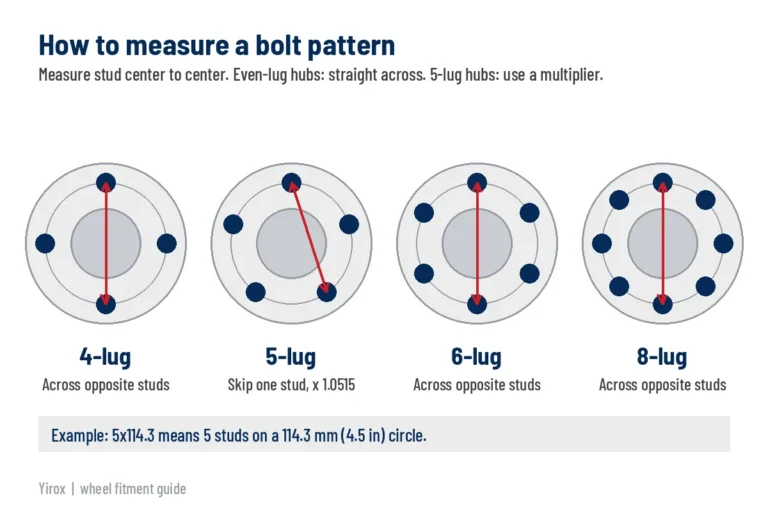
A wheel center cap is a small cosmetic cover for the center bore and hub area, but it is not a one-size part. Fit depends on the retention type and on four measurements: outer diameter, clip diameter, wheel recess and depth. (If you are changing the wheels too, first measure the bolt pattern and center bore.) The part number on the back of an original cap is the surest match; careful caliper measurements and photos are the next best thing.
For wheel brands and distributors, the cap is also the most visible brand mark on the wheel and a steady replacement item. A good program fixes the recess and cap design before tooling, uses only logos the buyer owns or licenses, keeps compliance markings on the wheel itself, and plans spare caps and a fitment cross-reference from day one.
Próximo passo
Measure one wheel and its cap using the eight steps above, photograph both sides, and write down the part number if there is one. That set of data answers most fit questions before any sample is made.
Yirox makes alloy wheels and wheel covers in its own factory and develops center caps to match a customer’s wheel drawing or sample, so a wheel and its logo cap can be specified in one project. Send your wheel data and artwork through our Veja soluções de sourcing. page, or browse the calotas e tampões de roda range first.
Perguntas frequentes
Os tampões centrais das rodas têm um tamanho padrão?
Não. Cada design de roda tem seu próprio recesso para calota, então as calotas são combinadas por diâmetro do clipe, diâmetro externo, profundidade e tipo de retenção, não por um tamanho padrão.
Como sei o tamanho do meu calota central?
Check the back of the original cap for a part number first. If there is none, measure the outer diameter, the clip diameter across the legs and the depth with a caliper, and measure the wheel’s cap recess.
Como você remove as tampas centrais?
Empurre as tampas de encaixe para fora por trás com a roda desmontada, ou use uma ferramenta de acabamento plástica ao redor da borda com a roda montada. Desparafuse as tampas aparafusadas e remova a roda para tampas de empurrar.
Qualquer calota central serve em qualquer roda?
No. A cap must match the wheel’s recess and retention style. Universal caps with adjustable legs fit a range of wheels but usually grip less securely than a wheel-specific cap.
Uma tampa central é o mesmo que uma calota?
Não exatamente. Um tampão central cobre apenas o meio da roda, enquanto uma calota completa, frequentemente chamada de calota, cobre a maior parte da face da roda de uma roda de aço.
Posso dirigir sem a calota central?
Sim. Um tampão central é cosmético e não segura a roda. Sem ele, a área do cubo acumula mais sujeira e umidade, então substitua-o quando puder.
Posso encomendar tampas centrais com o meu próprio logótipo?
Sim, se você possui o logotipo ou tem uma licença para usá-lo. Forneça arte vetorial e aprove uma prova em tamanho real e uma amostra ajustada antes da produção.
Referências
[1] UNECE, published in the Official Journal of the EU. “Regulation No 26: Uniform provisions concerning the approval of vehicles with regard to their external projections.” Paragraph 6.7.2, wheels, wheel nuts, hub caps and wheel discs. Applies to M1 vehicle approval.
[2] United States Patent and Trademark Office. “What is a trademark?” Trademark basics.
[3] Alfândega e Proteção de Fronteiras dos EUA. “Intellectual Property Rights.” Enforcement against counterfeit and pirated imports.
[4] SAE International. “SAE J2530 (December 2024): Aftermarket Wheels, Passenger Cars and Light Truck, Performance Requirements and Test Procedures.” Recommended practice, scope.