



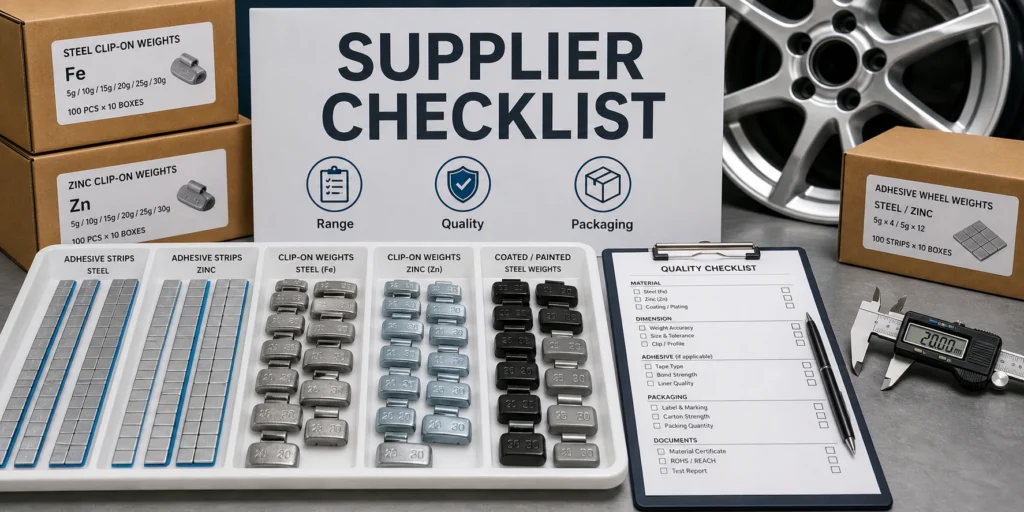
Un proveedor de contrapesos para ruedas de automóviles debe ofrecer los materiales correctos, tipos de fijación, rangos de tamaño, opciones de empaque y controles de calidad para el mercado del comprador. El mejor proveedor no es simplemente el de menor cotización; es el que puede mantener consistentes la precisión del peso, el ajuste, el recubrimiento, el rendimiento de la cinta, el etiquetado, los documentos y los pedidos repetidos.
Para distribuidores, proveedores de talleres de llantas, marcas privadas e importadores, la selección del proveedor afecta más que el precio de compra. Un proveedor débil puede generar cajas mixtas, mal rendimiento adhesivo, contrapesos de acero oxidados, afirmaciones poco claras sobre materiales o variaciones en pedidos repetidos. Un proveedor fuerte ayuda a los compradores a convertir la demanda del mercado en una gama de productos estable con menos quejas.
Tabla de contenido
- ¿Qué hace que un proveedor de contrapesos para ruedas de automóviles sea bueno?
- ¿Qué gama de productos debería ofrecer un proveedor de contrapesos para ruedas de automóviles?
- ¿Cómo deberían los compradores evaluar la capacidad del proveedor?
- ¿Qué controles de calidad deberían verificar los compradores antes de ordenar?
- ¿Qué detalles de empaque y SKU deberían confirmarse?
- ¿Qué documentos de cumplimiento y materiales deberían solicitar los compradores?
- ¿Cómo pueden los compradores comparar dos proveedores de manera justa?
- ¿Qué lista de verificación de RFQ deberían enviar los compradores a un proveedor?
- Conclusión: elegir un proveedor que pueda repetir la muestra aprobada
- Preguntas frecuentes
- Referencias
¿Qué hace que un proveedor de contrapesos para ruedas de automóviles sea bueno?
Un buen proveedor de contrapesos para ruedas de automóviles puede adaptarse a las aplicaciones de ruedas del comprador, las reglas del mercado, las expectativas de calidad y las necesidades de empaque sin cambiar la especificación aprobada entre pedidos. La gama de productos importa, pero la repetibilidad importa igual de mucho.
Los contrapesos para ruedas parecen simples por fuera: pequeñas piezas metálicas usadas durante el balanceo de ruedas. En la práctica, los compradores están adquiriendo un sistema de material, tamaño, método de fijación, tratamiento superficial, diseño de cinta o clip, empaque en caja y documentación. Si una parte es débil, todo el programa puede verse afectado.
Un proveedor debería poder responder preguntas prácticas antes de cotizar:
- ¿Qué formatos adhesivos y de clip están disponibles?
- ¿Qué materiales son estándar: acero, zinc, sin plomo u opciones específicas del mercado?
- ¿Qué tamaños en gramos y onzas se mantienen regularmente en stock o se fabrican con herramientas?
- ¿Cómo se verifican la tolerancia de peso, el tamaño, el recubrimiento, la cinta y la cantidad por caja?
- ¿Puede el proveedor apoyar marcas privadas, códigos de barras, cajas internas y arte repetido?
- ¿Se conservan muestras como referencias aprobadas para pedidos repetidos?
Antes de seleccionar un proveedor, los compradores también deberían definir la gama de productos que realmente necesitan. Una cadena de talleres de llantas, un distribuidor de aftermarket y un importador de marca privada pueden comprar contrapesos para ruedas, pero su profundidad de SKU, cantidad por caja, etiquetado y documentos pueden ser muy diferentes. La marco de planificación de la gama de contrapesos ayuda a los compradores a conectar el tipo de rueda, el material, el formato de fijación y la cobertura de tamaños antes de pedir a los proveedores que compitan por precio.
La mejor conversación con un proveedor comienza con la aplicación del comprador, no con una solicitud genérica de "precio de contrapesos para ruedas". Cuando el comprador explica el canal de ventas, los tipos de ruedas, la preferencia de material, el empaque y las necesidades de inspección, el proveedor puede cotizar una gama que sea más fácil de probar y repetir.
¿Qué gama de productos debería ofrecer un proveedor de contrapesos para ruedas de automóviles?
Un proveedor de contrapesos para ruedas de automóviles debería ofrecer tiras adhesivas, contrapesos de clip, opciones de materiales relevantes, tamaños comunes en gramos y onzas, opciones de recubrimiento y formatos de empaque que coincidan con el canal de ventas del comprador. Una gama más amplia es útil solo cuando el proveedor puede mantenerla controlada.
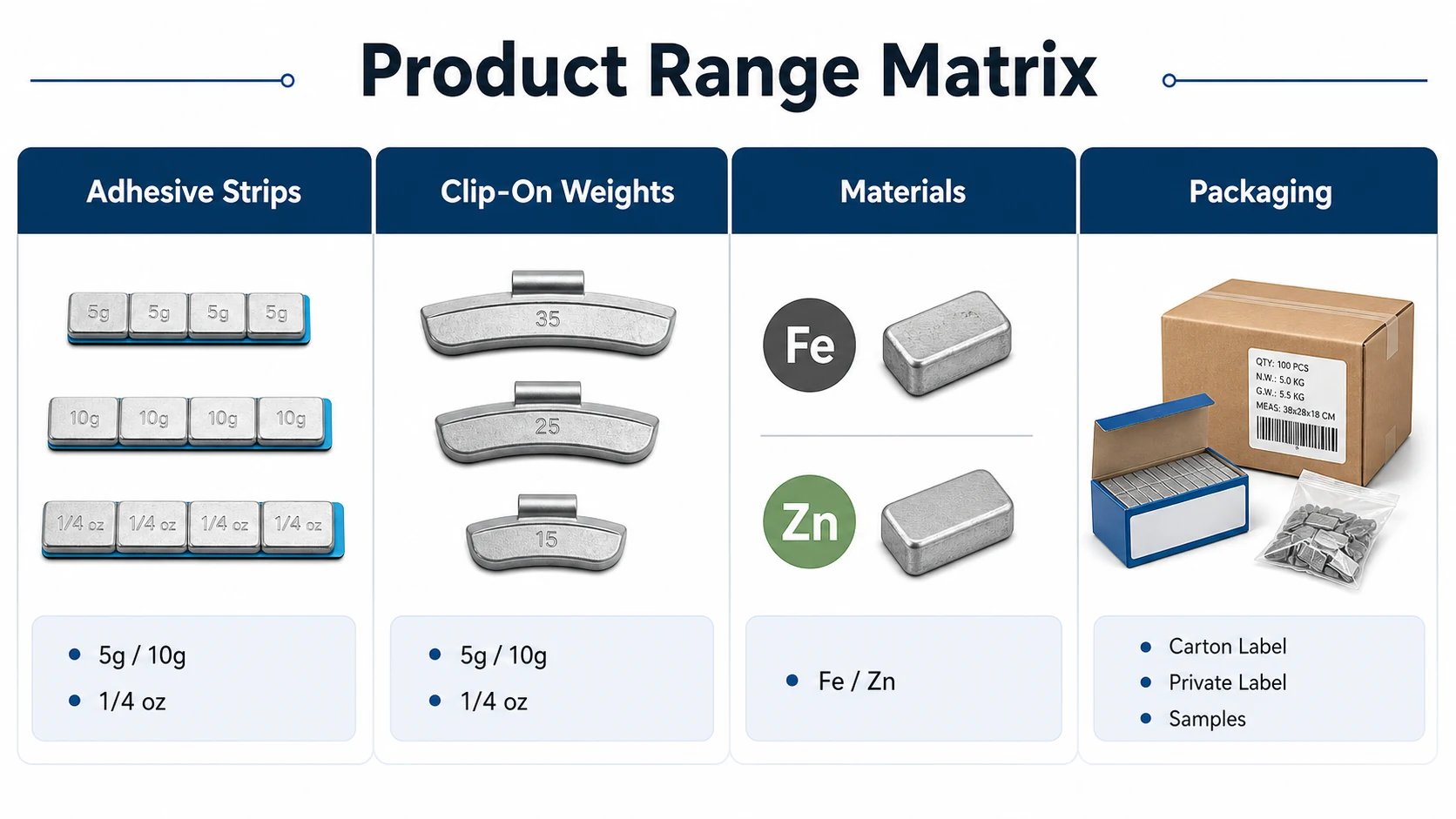
Como mínimo, los compradores deberían verificar si el proveedor puede apoyar estas familias de productos:
| Área de gama | Qué deberían verificar los compradores | Por qué es importante |
|---|---|---|
| Tiras adhesivas | 5 g, 10 g, 1/4 oz, opciones de perfil bajo, cinta y liner | Importante para ruedas de aleación y colocación detrás de los rayos. |
| Contrapesos de clip | Tamaños comunes para automóviles de pasajeros, perfiles de ajuste para ruedas de acero y de aleación | Importante para talleres de reparación y servicio de ruedas de acero. |
| Materiales | Acero Fe, zinc Zn, opciones sin plomo, restricciones específicas del mercado | Afecta el costo, la densidad, el lenguaje de cumplimiento y la aceptación del cliente. |
| Recubrimiento | Pintura, galvanizado, recubrimiento en polvo, expectativas de corrosión | Protege la apariencia en estante y reduce las quejas por óxido. |
| Embalaje | Caja interna, bolsa, rollo, caja, código de barras, marca privada | Afecta el almacenamiento, la reventa y la presentación al cliente. |
| Muestras | Muestras de preproducción, muestras de referencia conservadas, maquetas de empaque | Ayuda a controlar pedidos repetidos y registros de aprobación. |
Los compradores que necesitan comparar formatos reales pueden revisar muestras de gama de contrapesos para ruedas para evaluación de proveedores después de definir los materiales, tamaños, cinta, perfiles de clip y estilo de caja que esperan probar. Esto mantiene la visita a la página de producto vinculada a una tarea real de compra, no a una navegación casual.
El proveedor no necesita ofrecer todos los SKU posibles para ser una buena opción. Un proveedor enfocado con herramientas estables y recubrimiento consistente puede ser mejor que un catálogo amplio que cambia con frecuencia. Los compradores deberían preguntar qué artículos son de producción regular, cuáles requieren MOQ y cuáles son experimentales o personalizados.
Para programas de marca privada, el control de la gama importa aún más. Si el comprador vende tiras adhesivas en caja bajo una marca local, el diseño de la caja, el comportamiento del liner, el código de barras y el conteo del paquete se convierten en parte del producto. Un proveedor que trata el empaque como algo secundario puede crear problemas incluso si el contrapeso metálico es aceptable.
¿Cómo deberían los compradores evaluar la capacidad del proveedor?
Los compradores deberían evaluar la capacidad del proveedor mediante el proceso de producción, el control de herramientas, el abastecimiento de materiales, los registros de QC, la disciplina de empaque, la velocidad de comunicación y la consistencia de muestra a producción masiva. El objetivo es descubrir si el proveedor puede repetir el producto aprobado, no solo producir una muestra atractiva.
Pregunte cómo el proveedor fabrica o controla cada tipo de producto. Para las pesas adhesivas para ruedas, el proceso puede incluir corte o conformado, recubrimiento, aplicación de cinta, corte de protectores, empaque de tiras y verificación de apariencia. Para las pesas con clip, el proveedor debe controlar la forma, el ajuste del clip, el marcado de tamaño, el recubrimiento y el comportamiento de sujeción. Si el proveedor subcontrata pasos clave, los compradores deben entender dónde recae la responsabilidad.
La evaluación del proveedor debe incluir una conversación sobre la capacidad de la fábrica:
- ¿Qué materiales se utilizan para cada familia de pesas para ruedas?
- ¿Qué procesos son internos y cuáles son subcontratados?
- ¿Cómo se controlan el estampado, el conformado, el recubrimiento, la aplicación de cinta y el empaque?
- ¿Se conservan registros de inspección por lote?
- ¿Cómo se separan las piezas defectuosas?
- ¿El proveedor conserva muestras aprobadas y estándares de empaque?
- ¿Puede el proveedor mantener la misma especificación de caja de cartón en pedidos repetidos?
Cuando los compradores quieren profundizar más allá de una revisión de catálogo, la evaluación del fabricante de pesas para ruedas les ayuda a preguntar sobre el proceso de fábrica, la estructura de control de calidad, el control de materiales, la comunicación y la confiabilidad del proveedor antes de realizar pedidos más grandes.
No trate una hoja de cotización pulida como prueba de capacidad. Un proveedor puede cotizar una larga lista de productos pero aún tener dificultades con cajas mixtas, cinta inconsistente, recubrimiento débil o control poco claro de pedidos repetidos. Cuantos más SKU planee manejar un comprador, más importante se vuelve la disciplina del proveedor.
¿Qué controles de calidad deberían verificar los compradores antes de ordenar?
Los compradores deben verificar la tolerancia de peso, la precisión dimensional, el ajuste del clip, la adhesión de la cinta, la durabilidad del recubrimiento, el conteo de cajas y la precisión de las etiquetas antes de hacer un pedido al por mayor. Estas verificaciones detectan los problemas con mayor probabilidad de crear fallas de instalación, devoluciones y disputas de almacén.
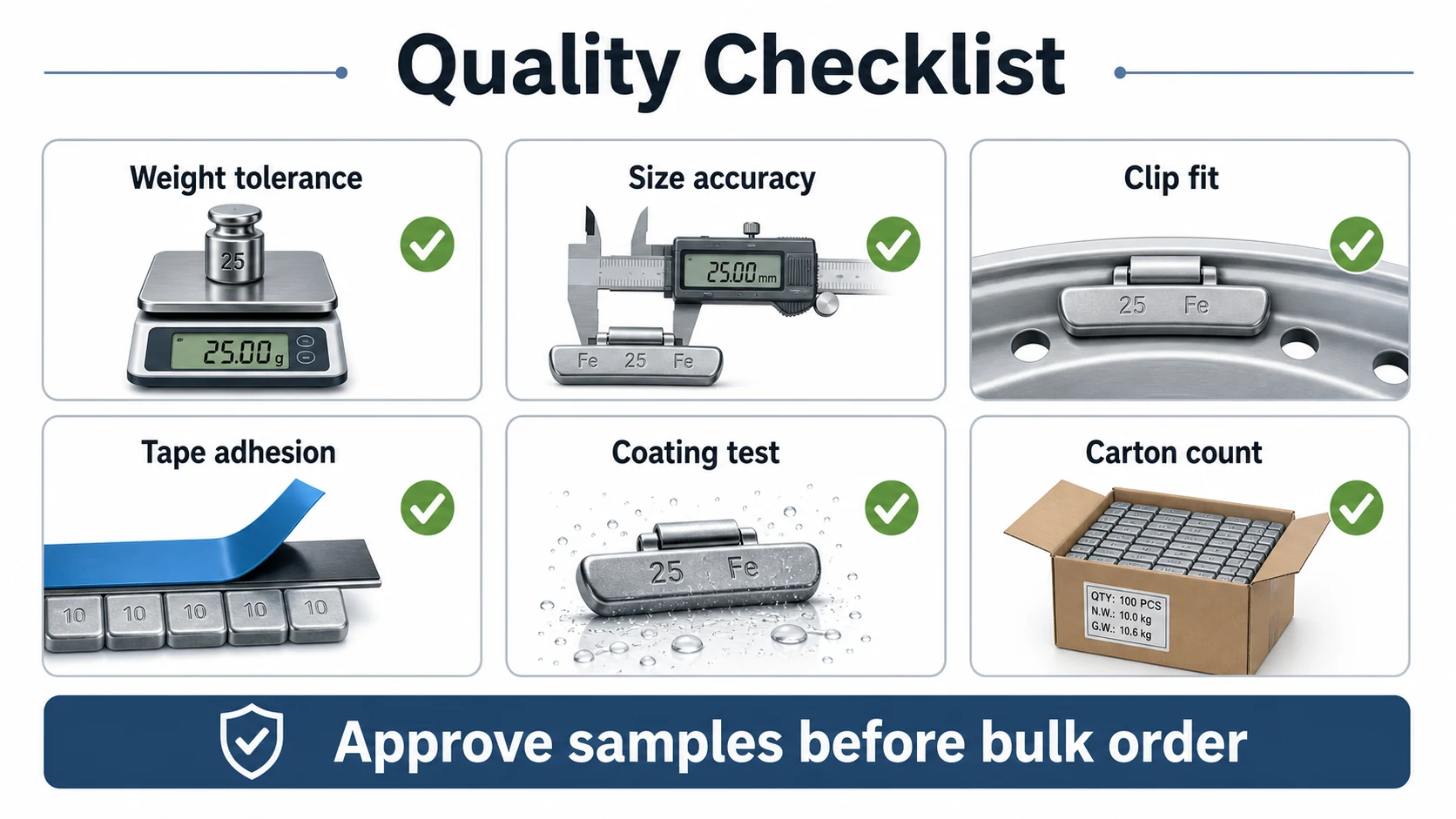
El control de calidad debe comenzar con la función de la pieza. Una pesa de balanceo debe proporcionar la masa correcta, ajustarse a la ubicación prevista en la rueda y permanecer en su lugar bajo servicio normal. Para las pesas adhesivas, la preparación de la superficie y las condiciones de unión importan; la guía de preparación de superficies de cinta VHB de 3M enfatiza superficies limpias, secas y una preparación correcta para un rendimiento de unión confiable 2. Los compradores deben probar muestras con superficies de rueda realistas en lugar de juzgar la cinta solo por el tacto.
Para las pesas con clip, el ajuste es el riesgo clave. El clip debe adherirse de forma segura al reborde de llanta previsto sin una fuerza de instalación excesiva ni una sujeción floja. Los compradores deben probar varios tamaños, no solo una muestra. Una gama de pesas con clip puede verse consistente en una bandeja pero comportarse de manera diferente en distintos perfiles de rueda.
Para el recubrimiento, los compradores deben preguntar cómo el proveedor verifica la resistencia a la corrosión y la adhesión del acabado. La prueba de niebla salina se usa comúnmente como método comparativo, y ASTM B117 describe una práctica estándar para operar aparatos de niebla salina 3. El comprador debe tratar los resultados de las pruebas como parte de la comparación de proveedores, no como una garantía total de durabilidad en el mundo real.
La ruta de producción del proveedor también importa. Si los compradores quieren entender dónde entran al proceso los riesgos de tolerancia de peso, recubrimiento, cinta y empaque, el proceso de fabricación y control de calidad de pesas para ruedas ayuda a conectar los pasos de fábrica con los puntos de inspección. Para programas sensibles al recubrimiento, la verificación de recubrimiento y corrosión ofrece a los compradores una forma más enfocada de preguntar sobre el tipo de acabado, las expectativas de niebla salina, el almacenamiento y las condiciones de envío.
Una lista de verificación de calidad útil antes del pedido incluye:
| Verificación | Acción en la etapa de muestra | Riesgo del pedido al por mayor si se omite |
|---|---|---|
| Tolerancia de peso | Pesar piezas de cada tamaño | Balanceo inexacto y quejas de clientes |
| Dimensión | Medir espesor, ancho y largo | Mal ajuste detrás de los rayos o apariencia inconsistente de la caja |
| Ajuste del clip | Probar en rebordes de llanta representativos | Instalación floja o difícil |
| Adhesión de la cinta | Probar desprendimiento, presión, temperatura y preparación de la superficie | Pesas que se caen después de la instalación |
| Recubrimiento | Inspeccionar la apariencia y solicitar la base de la prueba si es necesario | Óxido, desprendimiento y quejas de vida útil |
| Conteo de cajas | Contar piezas y verificar peso neto/bruto | Disputas en recepción y confusión en almacén |
| Precisión de etiquetas | Comparar producto, caja, factura y lista de empaque | Envío de SKU incorrecto o confusión aduanera |
La calidad del proveedor no se prueba con una sola muestra perfecta. Pregunte cómo el proveedor verifica la producción normal y qué sucede cuando un lote falla. Un comprador también debe conservar muestras aprobadas y fotos para que los pedidos futuros tengan un punto de comparación claro.
¿Qué detalles de empaque y SKU deberían confirmarse?
Los detalles de empaque deben confirmarse antes del precio final porque el conteo de cajas, el estilo de caja interior, el diseño de la etiqueta, el código de barras, el método de paletizado y los requisitos de marca privada afectan el costo, el plazo de entrega y la calidad de reventa. El empaque es parte de la experiencia del producto.
Para las pesas para ruedas, los errores de empaque pueden ser costosos. Una caja puede contener el peso total correcto pero el número incorrecto de cajas. Una etiqueta puede mostrar Fe mientras el comprador esperaba Zn. Una caja de marca privada puede usar un código de barras antiguo. Una caja de tamaños mixtos puede llegar al almacén aunque la orden de compra solicitara cajas de un solo tamaño.
Los compradores deben confirmar:
- Piezas por tira, tiras por caja, cajas por cartón
- Piezas por bolsa o bandeja para pesos de clip
- Marcas de gramos o onzas en piezas y cartones
- Peso neto, peso bruto y dimensiones del cartón
- Código de barras, código SKU, texto de país de origen e iconos de precaución si es necesario
- Diseño de caja interior, resistencia del cartón, método de paletización y protección contra la humedad
- Versión de arte de marca privada y registro de aprobación
Para envíos más grandes, el MOQ y la combinación de SKU pueden moldear el costo real tanto como el precio unitario. Los compradores que planifican un contenedor, un palé mixto o una gama de marca privada pueden usar verificaciones de MOQ y embalaje de pesos de rueda a granel para decidir cómo deben fijarse los recuentos de cartones, la profundidad de SKU, la aprobación de muestras y el embalaje de exportación antes de ordenar.
El embalaje también debe coincidir con el canal de ventas. Una caja a granel para taller de reparación puede ser simple y eficiente. Un paquete para retail o distribuidor de marca puede necesitar mejor impresión, instrucciones más claras y una presentación en estante consistente. Un proveedor que ofrece tanto embalaje estándar como de marca privada da a los compradores más margen para atender a diferentes grupos de clientes sin cambiar el producto en sí.
¿Qué documentos de cumplimiento y materiales deberían solicitar los compradores?
Los compradores deben solicitar declaraciones de materiales, declaraciones de libre de plomo o sin plomo cuando sea relevante, informes de recubrimiento o pruebas cuando se requieran, listas de empaque, facturas comerciales y arte de etiqueta aprobado. El conjunto exacto de documentos debe coincidir con el mercado de destino y el canal del cliente.
Los pesos de rueda tienen un historial ambiental conocido porque los pesos de rueda de plomo pueden desprenderse y convertirse en una fuente de liberación de plomo. La guía de mejores prácticas de la EPA ha fomentado reducir o eliminar los pesos de rueda de plomo en los Estados Unidos 1. Eso no significa que cada mercado use la misma redacción legal, por lo que los compradores deben evitar afirmaciones amplias a menos que puedan respaldarlas con los documentos que sus clientes esperan.
Para programas sin plomo, la pregunta documental debe ser práctica:
- ¿El material es Fe acero, Zn zinc u otro material aprobado?
- ¿El proveedor indica el material claramente en la cotización y la etiqueta del cartón?
- ¿Puede el proveedor proporcionar una declaración de material o informe de prueba cuando el cliente del comprador lo solicite?
- ¿La descripción del producto coincide con la factura y la lista de empaque?
- ¿Las afirmaciones de libre de plomo o sin plomo están redactadas cuidadosamente para el mercado de destino?
Los compradores que comparan opciones de material pueden usar opciones de compra de acero sin plomo y zinc para decidir cuándo deben aclararse Fe, Zn, documentos, etiquetas de cartón y pruebas de muestras antes de que el proveedor emita la cotización final.
Los documentos relacionados con la seguridad también deben manejarse con cuidado. La seguridad del servicio de ruedas no la crea solo un proveedor de pesos de rueda; depende de procedimientos adecuados de servicio del vehículo, el estado de neumáticos y llantas, y la capacitación del taller. El estándar de servicio de ruedas de rin de OSHA cubre requisitos de seguridad para dar servicio a ruedas de rin de una pieza y multipieza en contextos laborales de EE. UU. 4. Un proveedor no debe exagerar el rendimiento de seguridad más allá del rol del producto.
¿Cómo pueden los compradores comparar dos proveedores de manera justa?
Los compradores pueden comparar dos proveedores de manera justa solo cuando ambos cotizan el mismo material, rango de tamaños, tipo de fijación, recubrimiento, cinta, recuento de cartones, requisito de arte, documentos y estándar de muestra. De lo contrario, el precio más bajo puede simplemente reflejar una especificación más débil.
Una comparación justa comienza con una hoja de RFQ compartida. Si el Proveedor A cotiza tiras adhesivas de acero con cinta fuerte y cajas a color, mientras que el Proveedor B cotiza tiras básicas en cartones simples, los precios no son comparables. El comprador debe normalizar la especificación antes de juzgar.
Use una comparación ponderada en lugar del precio solo:
| Área de evaluación | Peso sugerido | Qué comparar |
|---|---|---|
| Ajuste de la gama de productos | 20% | ¿Cubre el proveedor el rango requerido de adhesivos, clip-on, materiales y tamaños? |
| Control de calidad | 25% | ¿Están claras las verificaciones de peso, ajuste, recubrimiento, cinta y embalaje? |
| Consistencia de muestras | 15% | ¿La oferta a granel coincide con las muestras y fotos aprobadas? |
| Soporte de embalaje | 15% | ¿Puede el proveedor manejar etiquetas de cartón, marca privada, códigos de barras y embalaje de exportación? |
| Documentos | 10% | ¿Están disponibles los documentos de materiales y pruebas cuando se necesitan? |
| Comunicación | 10% | ¿Responde el proveedor preguntas técnicas de manera clara y rápida? |
| Precio y pago | 5% | ¿Es el precio competitivo después de igualar la especificación? |
Los distribuidores que gestionan muchos SKU pueden necesitar un proceso de comparación aún más estricto. El proceso de comparación de proveedores para distribuidores ayuda a los compradores a pensar más allá del precio de un pedido y comparar la idoneidad del proveedor por cobertura de gama, lógica de stock, soporte de marca privada y repetibilidad a largo plazo.
Una prueba práctica es pedir a cada proveedor que cotice los mismos tres grupos de muestra: un rango de tiras adhesivas, un rango de clip-on y una opción de cartón de marca privada. Luego compare muestras, etiquetas y datos de inspección antes de negociar el precio del contenedor.
¿Qué lista de verificación de RFQ deberían enviar los compradores a un proveedor?
Una lista de verificación útil de RFQ debe decirle al proveedor lo que el comprador necesita para vender, instalar, almacenar y volver a pedir. Cuanto más precisa sea la RFQ, más fácil será comparar proveedores y evitar cambios ocultos después de aprobar las muestras.
Envíe estos elementos en la primera RFQ:
| Campo de la RFQ | Buyer instruction |
|---|---|
| Mercado objetivo | País o región, canal de cliente y cualquier restricción de material conocida |
| Tipo de producto | Tira adhesiva, rollo adhesivo, clip-on o surtido mixto |
| Material | Fe acero, Zn zinc, requisito libre de plomo o material preferido actual |
| Rango de tamaño | Incrementos en gramos u onzas, diseño de tiras, tamaños de clip, surtido de cajas |
| Recubrimiento | Pintura, galvanoplastia, recubrimiento en polvo, color o expectativa de corrosión |
| Cinta y forro | Expectativa de grado de cinta, color del liner, liner impreso, comportamiento de despegue |
| Embalaje | Piezas por caja, cajas por cartón, código de barras, etiqueta, resistencia del cartón, plan de paletizado |
| Documentos | Declaración de materiales, informe de ensayo, factura comercial, lista de empaque, prueba de arte |
| Muestras | Cantidad, retención de muestra aprobada y método de ensayo de muestra |
| Regla de pedido repetido | Si el proveedor debe mantener el mismo material, cinta, recubrimiento y especificación de cartón |
La RFQ también debe pedir al proveedor que identifique cualquier alternativa. Por ejemplo, si un tamaño solicitado no es de producción regular, el proveedor debe indicarlo antes de que el comprador apruebe el arte o cotice a un cliente. Si la cinta solicitada no está disponible, el proveedor debe proponer una alternativa y marcarla claramente.
La RFQ más sólida no es la más larga. Es la más clara. Los compradores deben incluir los detalles que afectan la instalación, la aceptación del cliente, el almacenamiento y los pedidos repetidos, y luego pedir al proveedor que confirme cada línea por escrito.
Si está preseleccionando un proveedor de contrapesos para ruedas automotrices, indíquenos su combinación de vehículos, requisitos de material y formato, controles de calidad, empaque y volumen esperado. Podemos ayudarle a solicitar muestras que sean útiles para una comparación repetible de proveedores.
Conclusión: elegir un proveedor que pueda repetir la muestra aprobada
Un proveedor de contrapesos para ruedas automotrices debe ser evaluado por el ajuste de la gama, el control de calidad, la consistencia de las muestras, la precisión del empaque y el soporte documental. Un precio bajo solo es útil cuando la especificación es clara y repetible. Los compradores deben comparar proveedores después de fijar el material, el tipo de fijación, el rango de tamaños, el recubrimiento, los requisitos de cinta o clip, los cartones, las etiquetas y la aprobación de muestras.
Antes de realizar un pedido al por mayor, solicite un catálogo, confirme la combinación de SKU necesaria, pruebe muestras en aplicaciones reales de ruedas y conserve registros de muestras aprobadas. Eso brinda tanto al comprador como al proveedor una referencia práctica para la producción futura y reduce el riesgo de piezas incorrectas, empaque débil o envíos repetidos inconsistentes.
Preguntas frecuentes
¿Qué debo preguntar primero a un proveedor de contrapesos para ruedas automotrices?
Pregunte qué rangos de contrapesos adhesivos y de clip son de producción regular, qué materiales están disponibles, qué tamaños se tienen en stock, cómo se verifica la calidad y qué opciones de empaque se admiten. Luego solicite muestras que coincidan con sus requisitos exactos de material, tamaño, recubrimiento, cinta y cartón.
¿Cómo sé si un proveedor de contrapesos para ruedas es confiable?
Un proveedor confiable puede explicar su proceso de producción, proporcionar muestras consistentes, confirmar los puntos de inspección, mantener un empaque preciso y repetir la especificación aprobada en todos los pedidos. Los compradores deben probar muestras, revisar las etiquetas de los cartones y comparar las respuestas de los proveedores antes de juzgar por el precio.
¿Debo elegir un proveedor con la gama de productos más amplia?
No siempre. Una gama amplia solo es útil cuando el proveedor puede controlar la calidad y los pedidos repetidos. Para muchos compradores, un proveedor enfocado con tiras adhesivas estables, contrapesos de clip, materiales de Fe y Zn y empaque confiable puede ser más seguro que un catálogo amplio pero inconsistente.
¿Qué problemas de calidad son más comunes con los contrapesos para ruedas?
Los problemas comunes incluyen peso inexacto, mal ajuste del clip, adhesión débil de la cinta, corrosión del recubrimiento, tamaños mezclados, conteos incorrectos en el cartón y etiquetas incorrectas. Estos problemas suelen ser más fáciles de prevenir mediante pruebas de muestras y detalles claros en la RFQ que de corregir después del envío.
¿Qué documentos debe solicitar un importador antes de hacer un pedido al por mayor?
Los importadores comúnmente solicitan declaraciones de materiales, declaraciones libres de plomo o sin plomo cuando corresponda, informes de ensayo si los clientes lo requieren, facturas comerciales, listas de empaque y arte de cartón aprobado. El conjunto exacto de documentos debe coincidir con el mercado de destino y el canal del cliente.
Referencias
[1] Agencia de Protección Ambiental de los Estados Unidos. “Mejores Prácticas de Gestión para Pesos de Rueda de Plomo.” 2015.
[2] 3M. “Boletín Técnico de Preparación de Superficies para Cinta VHB.” 2019.
[3] ASTM International. “ASTM B117-19 Standard Practice for Operating Salt Spray Apparatus.” 2019.
[4] Administración de Seguridad y Salud Ocupacional. “Servicio de ruedas de rin de varias piezas y de una sola pieza.” 2026.