



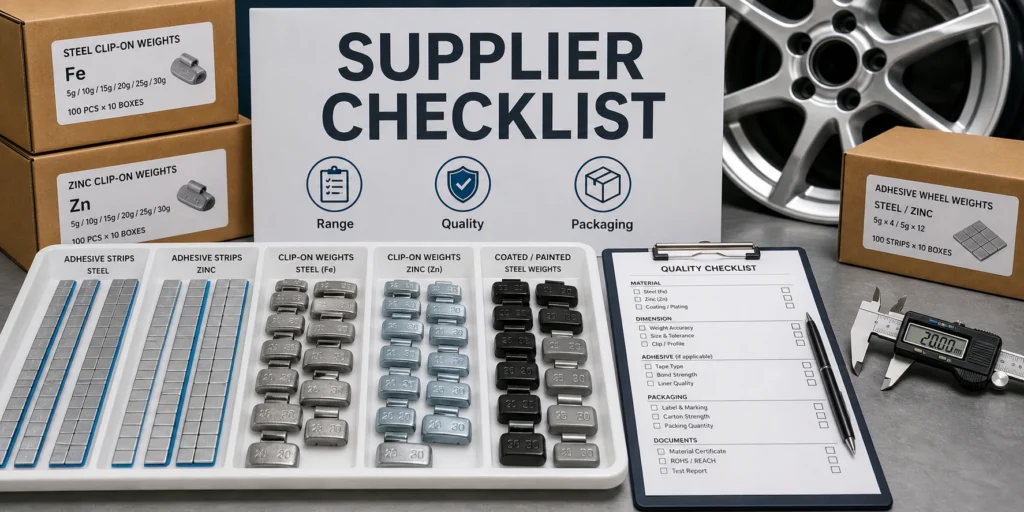
An automotive wheel weights supplier should offer the right materials, attachment types, size ranges, packaging options, and quality controls for the buyer's market. The best supplier is not simply the lowest quote; it is the one that can keep weight accuracy, fitment, coating, tape performance, labeling, documents, and repeat orders consistent.
For distributors, tire-shop suppliers, private-label brands, and importers, supplier selection affects more than purchase price. A weak supplier can create mixed cartons, poor adhesive performance, rusty steel weights, unclear material claims, or repeat-order drift. A strong supplier helps buyers turn market demand into a stable product range with fewer complaints.
Table of Contents
- What makes a good automotive wheel weights supplier?
- What product range should an automotive wheel weights supplier offer?
- How should buyers evaluate supplier capability?
- What quality checks should buyers verify before ordering?
- What packaging and SKU details should be confirmed?
- What compliance and material documents should buyers ask for?
- How can buyers compare two suppliers fairly?
- What RFQ checklist should buyers send to a supplier?
- Conclusion: choose a supplier that can repeat the approved sample
- Frequently Asked Questions
- References
What makes a good automotive wheel weights supplier?
A good automotive wheel weights supplier can match the buyer's wheel applications, market rules, quality expectations, and packaging needs without changing the approved specification between orders. Product range matters, but repeatability matters just as much.
Wheel weights look simple from the outside: small metal pieces used during wheel balancing. In practice, buyers are purchasing a system of material, size, attachment method, surface treatment, tape or clip design, carton packing, and documentation. If one part is weak, the whole program can suffer.
A supplier should be able to answer practical questions before quoting:
- Which adhesive and clip-on formats are available?
- Which materials are standard: steel, zinc, lead-free, or market-specific options?
- Which gram and ounce sizes are regularly stocked or tooled?
- How are weight tolerance, size, coating, tape, and carton quantity checked?
- Can the supplier support private labels, barcodes, inner boxes, and repeat artwork?
- Are samples kept as approved references for repeat orders?
Before selecting a supplier, buyers should also define the product range they actually need. A tire-shop chain, an aftermarket distributor, and a private-label importer may all buy wheel weights, but their SKU depth, carton quantity, labeling, and documents can be very different. The wheel weight range planning framework helps buyers connect wheel type, material, attachment format, and size coverage before they ask suppliers to compete on price.
The best supplier conversation starts with the buyer's application, not with a generic request for "wheel weights price." When the buyer explains the sales channel, wheel types, material preference, packaging, and inspection needs, the supplier can quote a range that is easier to test and repeat.
What product range should an automotive wheel weights supplier offer?
An automotive wheel weights supplier should offer adhesive strips, clip-on weights, relevant material choices, common gram and ounce sizes, coating options, and packaging formats that match the buyer's sales channel. A wider range is useful only when the supplier can keep it controlled.
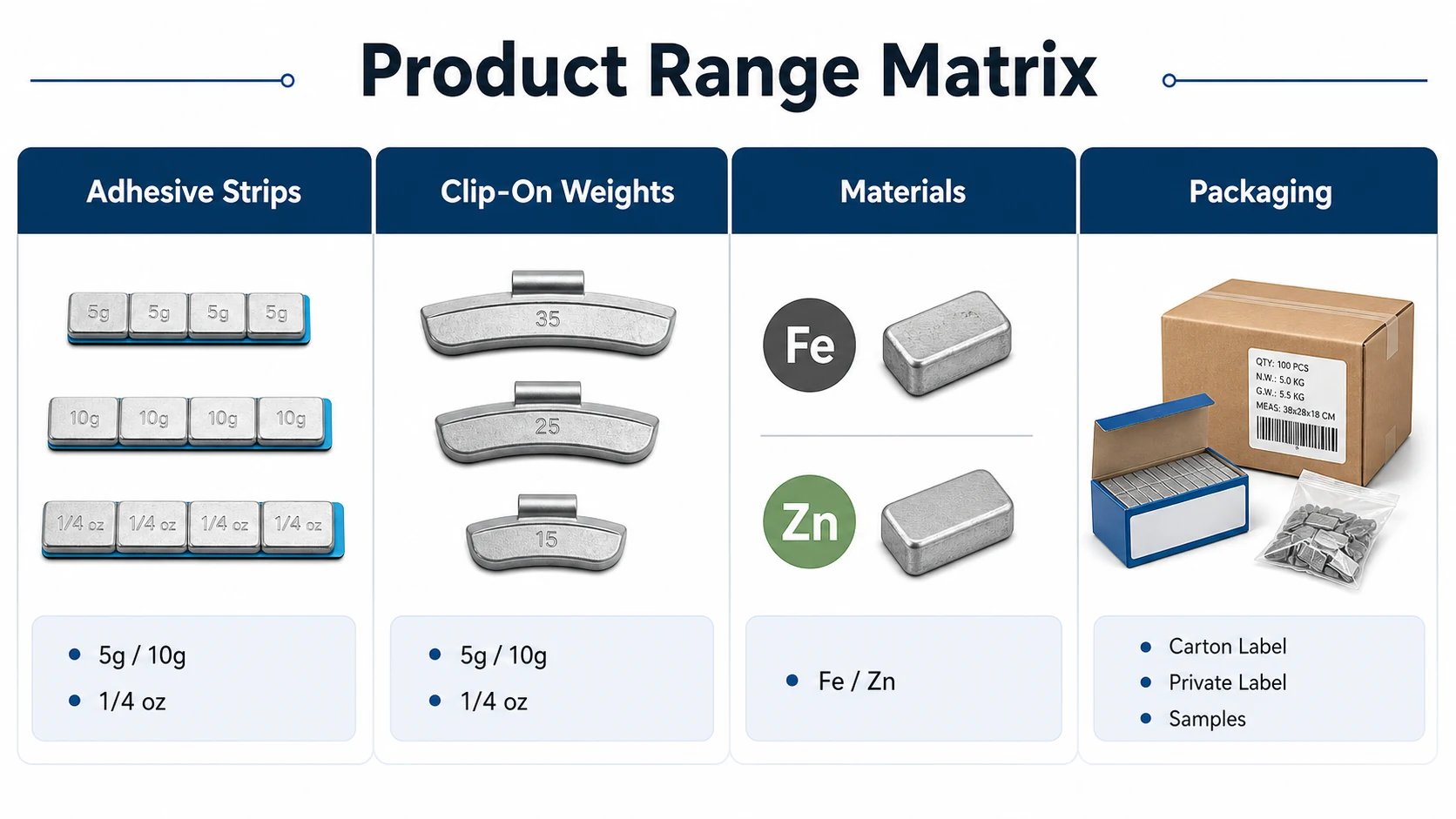
At a minimum, buyers should check whether the supplier can support these product families:
| Range area | What buyers should check | Why it matters |
|---|---|---|
| Adhesive strips | 5 g, 10 g, 1/4 oz, low-profile options, tape and liner | Important for alloy wheels and behind-spoke placement. |
| Clip-on weights | Common passenger car sizes, steel-wheel and alloy-wheel fitment profiles | Important for repair shops and steel-wheel service. |
| Materials | Fe steel, Zn zinc, lead-free options, market-specific restrictions | Affects cost, density, compliance language, and customer acceptance. |
| Coating | Paint, plating, powder coating, corrosion expectations | Protects shelf appearance and reduces rust complaints. |
| Packaging | Inner box, bag, roll, carton, barcode, private label | Affects warehousing, resale, and customer presentation. |
| Samples | Pre-production samples, retained reference samples, packaging mockups | Helps control repeat orders and approval records. |
Buyers who need to compare actual formats can review wheel weight range samples for supplier evaluation after defining the materials, sizes, tape, clip profiles, and carton style they expect to test. This keeps the product-page visit tied to a real purchasing task, not casual browsing.
The supplier does not need to offer every possible SKU to be a good match. A focused supplier with stable tooling and consistent coating may be better than a broad catalog that changes frequently. Buyers should ask which items are regular production, which require MOQ, and which are experimental or custom.
For private-label programs, range control matters even more. If the buyer is selling boxed adhesive strips under a local brand, the carton design, liner behavior, barcode, and pack count become part of the product. A supplier that treats packaging as an afterthought can create problems even if the metal weight is acceptable.
How should buyers evaluate supplier capability?
Buyers should evaluate supplier capability through production process, tooling control, material sourcing, QC records, packaging discipline, communication speed, and sample-to-bulk consistency. The goal is to find out whether the supplier can repeat the approved product, not only produce one attractive sample.
Ask how the supplier manufactures or controls each product type. For adhesive wheel weights, the process may involve cutting or forming, coating, applying tape, slitting liners, packing strips, and checking appearance. For clip-on weights, the supplier must control shape, clip fit, size marking, coating, and holding behavior. If the supplier outsources key steps, buyers should understand where responsibility sits.
Supplier evaluation should include a factory capability conversation:
- What materials are used for each wheel weight family?
- Which processes are in-house and which are outsourced?
- How are stamping, forming, coating, tape application, and packing controlled?
- Are inspection records kept by batch?
- How are defective parts separated?
- Does the supplier retain approved samples and packaging standards?
- Can the supplier keep the same carton specification across repeat orders?
When buyers want to go deeper than a catalog check, wheel weights manufacturer evaluation helps them ask about factory process, QC structure, material control, communication, and supplier reliability before placing larger orders.
Do not treat a polished quotation sheet as proof of capability. A supplier can quote a long list of products but still struggle with mixed cartons, inconsistent tape, weak coating, or unclear repeat-order control. The more SKUs a buyer plans to carry, the more important supplier discipline becomes.
What quality checks should buyers verify before ordering?
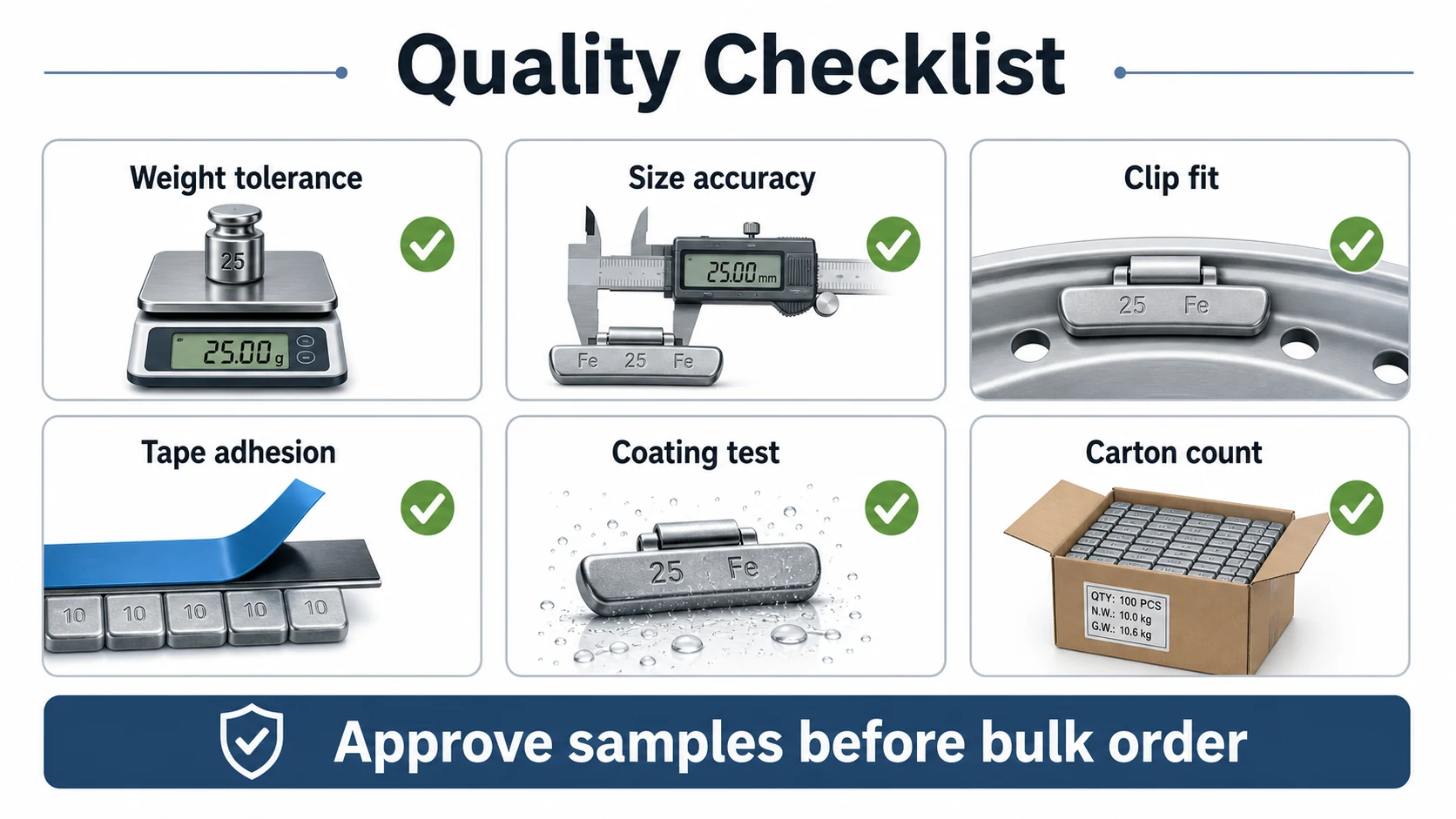
Buyers should verify weight tolerance, dimensional accuracy, clip fit, tape adhesion, coating durability, carton count, and label accuracy before bulk ordering. These checks catch the problems most likely to create installation failures, returns, and warehouse disputes.
Quality control should start with the function of the part. A balancing weight must provide the correct mass, fit the intended wheel location, and stay in place under normal service. For adhesive weights, surface preparation and bonding conditions matter; 3M's VHB tape surface preparation guidance emphasizes clean, dry surfaces and correct preparation for reliable bonding performance 2. Buyers should test samples with realistic wheel surfaces rather than judging tape only by touch.
For clip-on weights, fitment is the key risk. The clip should attach securely to the intended rim flange without excessive installation force or loose holding. Buyers should test several sizes, not just one sample. A clip-on range may look consistent in a tray but perform differently across wheel profiles.
For coating, buyers should ask how the supplier checks corrosion resistance and finish adhesion. Salt spray testing is commonly used as a comparative method, and ASTM B117 describes a standard practice for operating salt spray apparatus 3. The buyer should treat test results as part of supplier comparison, not a total guarantee of real-world durability.
The supplier's production route also matters. If buyers want to understand where weight tolerance, coating, tape, and packing risks enter the process, the wheel weight manufacturing and QC process helps connect factory steps with inspection points. For coating-sensitive programs, coating and corrosion verification gives buyers a more focused way to ask about finish type, salt spray expectations, storage, and shipment conditions.
A useful pre-order quality checklist includes:
| Check | Sample-stage action | Bulk-order risk if skipped |
|---|---|---|
| Weight tolerance | Weigh pieces from each size | Inaccurate balancing and customer complaints |
| Dimension | Measure thickness, width, and length | Poor fit behind spokes or inconsistent carton appearance |
| Clip fit | Test on representative rim flanges | Loose or difficult installation |
| Tape adhesion | Test peel, pressure, temperature, and surface preparation | Weights falling off after installation |
| Coating | Inspect appearance and request test basis if needed | Rust, peeling, and shelf-life complaints |
| Carton count | Count pieces and verify net/gross weight | Receiving disputes and warehouse confusion |
| Label accuracy | Compare product, carton, invoice, and packing list | Wrong SKU shipment or customs confusion |
Supplier quality is not proven by one perfect sample. Ask how the supplier checks normal production and what happens when a batch fails. A buyer should also keep approved samples and photos so future orders have a clear comparison point.
What packaging and SKU details should be confirmed?
Packaging details should be confirmed before final pricing because carton count, inner box style, label artwork, barcode, pallet method, and private-label requirements affect cost, lead time, and resale quality. Packaging is part of the product experience.
For wheel weights, packing mistakes can be expensive. A carton may contain the right total weight but the wrong number of boxes. A label may show Fe while the buyer expected Zn. A private-label carton may use an old barcode. A mixed-size carton may reach the warehouse even though the purchase order requested single-size cartons.
Buyers should confirm:
- Pieces per strip, strips per box, boxes per carton
- Pieces per bag or tray for clip-on weights
- Gram or ounce markings on pieces and cartons
- Net weight, gross weight, and carton dimensions
- Barcode, SKU code, country-of-origin text, and caution icons if needed
- Inner box design, carton strength, pallet method, and moisture protection
- Private-label artwork version and approval record
For larger shipments, MOQ and SKU mix can shape the real cost as much as unit price. Buyers planning a container, mixed pallet, or private-label range can use bulk wheel weight MOQ and packaging checks to decide how carton counts, SKU depth, sample approval, and export packing should be fixed before ordering.
Packaging should also match the sales channel. A repair-shop bulk box can be plain and efficient. A retail or brand-distributor package may need better printing, clearer instructions, and consistent shelf presentation. A supplier that offers both standard and private-label packing gives buyers more room to serve different customer groups without changing the product itself.
What compliance and material documents should buyers ask for?
Buyers should ask for material declarations, lead-free or non-lead statements when relevant, coating or test reports when required, packing lists, commercial invoices, and approved label artwork. The exact document set should match the destination market and customer channel.
Wheel weights have a known environmental history because lead wheel weights can detach and become a source of lead release. EPA best-practice guidance has encouraged reducing or eliminating lead wheel weights in the United States 1. That does not mean every market uses the same legal wording, so buyers should avoid broad claims unless they can support them with the documents their customers expect.
For non-lead programs, the document question should be practical:
- Is the material Fe steel, Zn zinc, or another approved material?
- Does the supplier state the material clearly on the quotation and carton label?
- Can the supplier provide a material declaration or test report when the buyer's customer requests it?
- Does the product description match the invoice and packing list?
- Are lead-free or non-lead claims worded carefully for the destination market?
Buyers comparing material options can use non-lead steel and zinc buying options to decide when Fe, Zn, documents, carton labels, and sample testing should be clarified before the supplier issues the final quotation.
Safety-related documents should also be handled with care. Wheel-service safety is not created by a wheel weight supplier alone; it depends on proper vehicle service procedures, tire and rim condition, and shop training. OSHA's rim wheel servicing standard covers safety requirements for servicing single-piece and multi-piece rim wheels in U.S. workplace contexts 4. A supplier should not overclaim safety performance beyond the product's role.
How can buyers compare two suppliers fairly?
Buyers can compare two suppliers fairly only when both suppliers quote the same material, size range, attachment type, coating, tape, carton count, artwork requirement, documents, and sample standard. Otherwise, the lower price may simply reflect a weaker specification.
A fair comparison starts with one shared RFQ sheet. If Supplier A quotes steel adhesive strips with strong tape and color boxes, while Supplier B quotes basic strips in plain cartons, the prices are not comparable. The buyer should normalize the specification before judging.
Use a weighted comparison rather than price alone:
| Evaluation area | Suggested weight | What to compare |
|---|---|---|
| Product range fit | 20% | Does the supplier cover the required adhesive, clip-on, material, and size range? |
| Quality control | 25% | Are weight, fitment, coating, tape, and packing checks clear? |
| Sample consistency | 15% | Does the bulk offer match approved samples and photos? |
| Packaging support | 15% | Can the supplier handle carton labels, private label, barcodes, and export packing? |
| Documents | 10% | Are material and test documents available when needed? |
| Communication | 10% | Does the supplier answer technical questions clearly and quickly? |
| Price and payment | 5% | Is the price competitive after the specification is equalized? |
Distributors managing many SKUs may need an even stricter comparison process. The distributor supplier comparison process helps buyers think beyond one order price and compare supplier fit by range coverage, stocking logic, private label support, and long-term repeatability.
One practical test is to ask each supplier to quote the same three sample groups: one adhesive strip range, one clip-on range, and one private-label carton option. Then compare samples, labels, and inspection data before negotiating container pricing.
What RFQ checklist should buyers send to a supplier?
A useful RFQ checklist should tell the supplier what the buyer needs to sell, install, store, and reorder. The more precise the RFQ, the easier it is to compare suppliers and avoid hidden changes after samples are approved.
Send these items in the first RFQ:
| RFQ field | Buyer instruction |
|---|---|
| Target market | Country or region, customer channel, and any known material restrictions |
| Product type | Adhesive strip, adhesive roll, clip-on, or mixed assortment |
| Material | Fe steel, Zn zinc, lead-free requirement, or current preferred material |
| Size range | Gram or ounce increments, strip layout, clip-on sizes, box assortment |
| Coating | Paint, plating, powder coating, color, or corrosion expectation |
| Tape and liner | Tape grade expectation, liner color, printed liner, peel behavior |
| Packaging | Pieces per box, boxes per carton, barcode, label, carton strength, pallet plan |
| Documents | Material declaration, test report, commercial invoice, packing list, artwork proof |
| Samples | Quantity, approved-sample retention, and sample test method |
| Repeat order rule | Whether supplier must keep the same material, tape, coating, and carton specification |
The RFQ should also ask the supplier to identify any alternatives. For example, if a requested size is not regular production, the supplier should say so before the buyer approves artwork or quotes a customer. If the requested tape is not available, the supplier should propose an alternative and mark it clearly.
The strongest RFQ is not the longest one. It is the clearest one. Buyers should include the details that affect installation, customer acceptance, warehousing, and repeat orders, then ask the supplier to confirm each line in writing.
If you are shortlisting an automotive wheel-weight supplier, tell us your vehicle mix, material and format requirements, quality checks, packaging, and expected volume. We can help you request samples that are useful for a repeatable supplier comparison.
Conclusion: choose a supplier that can repeat the approved sample
An automotive wheel weights supplier should be judged by range fit, quality control, sample consistency, packaging accuracy, and document support. A low price is useful only when the specification is clear and repeatable. Buyers should compare suppliers after fixing material, attachment type, size range, coating, tape or clip requirements, cartons, labels, and sample approval.
Before placing a bulk order, request a catalog, confirm the needed SKU mix, test samples on real wheel applications, and keep approved sample records. That gives both buyer and supplier a practical reference for future production and reduces the risk of wrong parts, weak packaging, or inconsistent repeat shipments.
Frequently Asked Questions
What should I ask an automotive wheel weights supplier first?
Ask which adhesive and clip-on weight ranges are regular production, which materials are available, what sizes are stocked, how quality is checked, and what packaging options are supported. Then request samples that match your exact material, size, coating, tape, and carton requirements.
How do I know whether a wheel weights supplier is reliable?
A reliable supplier can explain its production process, provide consistent samples, confirm inspection points, keep packaging accurate, and repeat the approved specification across orders. Buyers should test samples, review carton labels, and compare supplier answers before judging by price.
Should I choose a supplier with the widest product range?
Not always. A wide range is useful only when the supplier can control quality and repeat orders. For many buyers, a focused supplier with stable adhesive strips, clip-on weights, Fe and Zn materials, and reliable packaging may be safer than a broad but inconsistent catalog.
What quality problems are most common with wheel weights?
Common problems include inaccurate weight, poor clip fit, weak tape adhesion, coating corrosion, mixed sizes, wrong carton counts, and incorrect labels. These issues are usually easier to prevent through sample testing and clear RFQ details than to fix after shipment.
What documents should an importer request before bulk ordering?
Importers commonly request material declarations, lead-free or non-lead statements when relevant, test reports if required by customers, commercial invoices, packing lists, and approved carton artwork. The exact document set should match the destination market and customer channel.
References
[1] United States Environmental Protection Agency. “Best Management Practices for Lead Wheel Weights.” 2015.
[2] 3M. “VHB Tape Surface Preparation Technical Bulletin.” 2019.
[3] ASTM International. “ASTM B117-19 Standard Practice for Operating Salt Spray Apparatus.” 2019.
[4] Occupational Safety and Health Administration. “Servicing Multi-Piece and Single Piece Rim Wheels.” 2026.