



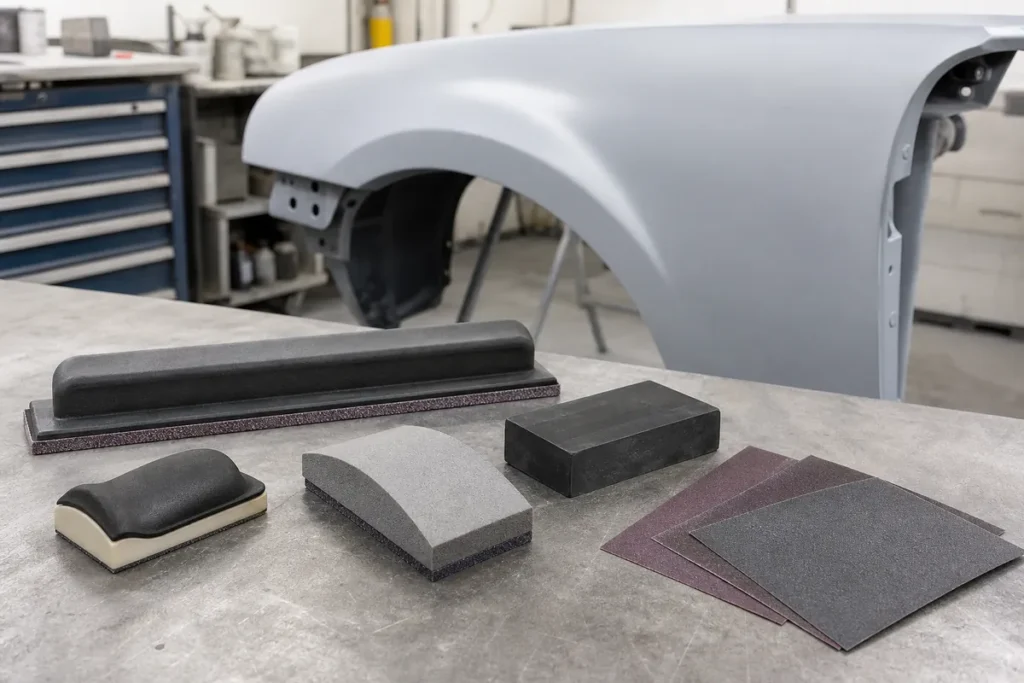
Um bloco de lixar é uma ferramenta de apoio que mantém a lixa plana ou em um formato controlado ao lixar um painel de carro. No trabalho de funilaria, o bloco é o que ajuda o abrasivo a nivelar o primer, modelar o massa, revelar ondas e evitar as marcas de dedo que acontecem quando a lixa é usada sem suporte.
O bloco pode parecer simples, mas muda todo o resultado do lixamento. Dedos nus seguem cada rebaixo e ponto alto. Um bloco adequado atravessa áreas irregulares para que o técnico possa ver e corrigir o formato do painel. É por isso que um bom trabalho de funilaria ainda depende de blocos de lixar, mesmo em oficinas cheias de lixadeiras orbitais e ferramentas elétricas.
Este guia explica os tipos de blocos de lixar, como são usados em reparos automotivos, quando escolher o lixamento manual em vez do lixamento com máquina, e o que os compradores devem verificar antes de adicionar blocos e abrasivos correspondentes a uma linha de produtos.
Índice
- O que um bloco de lixar faz no trabalho de funilaria?
- Por que um bloco de lixar é melhor do que lixar apenas com a mão?
- Quais são os principais tipos de blocos de lixar?
- Quando você deve usar um bloco de lixar em um carro?
- Como você escolhe a lixa para um bloco de lixar?
- Como o lixamento com bloco é diferente do uso de uma lixadeira orbital?
- Quais erros fazem os blocos de lixar deixarem resultados ruins?
- O que os compradores devem verificar antes de adquirir blocos de lixar e folhas?
- Conclusão: Um bloco de lixar é uma ferramenta de controle de formato
- Perguntas Frequentes
- Referências
O que um bloco de lixar faz no trabalho de funilaria?
Um bloco de lixar distribui a pressão sobre o abrasivo para que o painel seja lixado por uma superfície controlada, em vez de pelas pontas dos dedos. Ele ajuda a nivelar massa, primer de superfície e áreas reparadas, mantendo o formato do painel mais fácil de ler.
O bloco pode ser rígido, flexível, macio, longo, curto, plano ou contornado. Seu trabalho é apoiar a lixa no formato necessário para o reparo. Um bloco rígido longo nivela painéis amplos. Um bloco flexível segue uma curva suave. Um bloco de detalhe pequeno trabalha em reparos apertados e bordas.
O trabalho de funilaria não é apenas sobre remover material. É sobre remover o material certo dos pontos altos certos, mantendo o formato correto. Um bloco ajuda o técnico a lixar o painel, não apenas o defeito.
Por que um bloco de lixar é melhor do que lixar apenas com a mão?
Um bloco de lixar é melhor do que o lixamento manual sem suporte porque reduz sulcos de dedos, pressão irregular e ondas acidentais. Ele torna mais fácil encontrar altos e baixos, especialmente quando usado com camada guia no primer ou na massa.
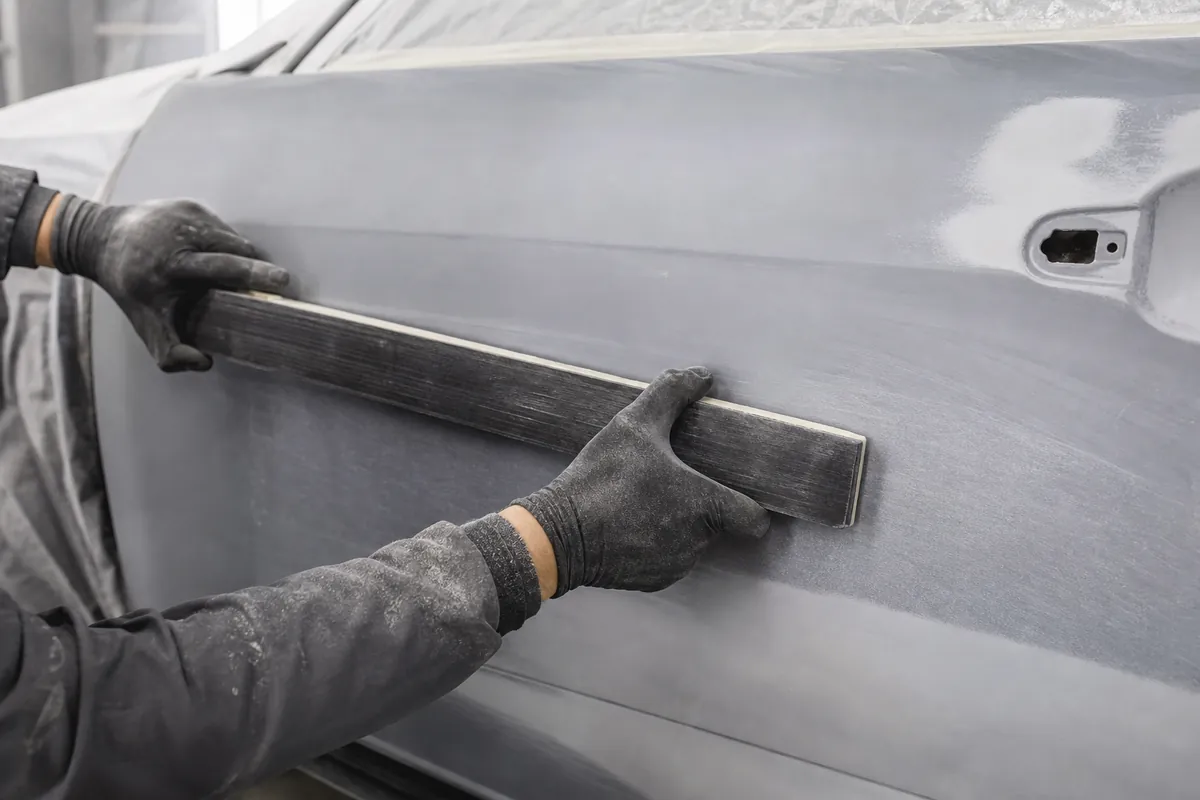
Quando a lixa é segurada apenas pelos dedos, a pressão se concentra sob cada ponta de dedo. Isso pode criar sulcos ou pontos baixos suaves. O reparo pode parecer liso no início, mas sob a tinta pode mostrar ondas, ondulações ou reflexos irregulares.
Um bloco atravessa a superfície. Os pontos altos são lixados primeiro, enquanto os pontos baixos permanecem visíveis através da camada guia ou do primer não lixado. Esse feedback é uma das razões pelas quais o lixamento manual continua importante em reparos de colisão e restauração.
O bloco também ajuda a manter o abrasivo trabalhando de forma uniforme. Lixa que dobra, enruga ou carrega de forma irregular pode criar riscos aleatórios. Um suporte plano dá ao abrasivo uma superfície de corte mais estável.
Quais são os principais tipos de blocos de lixar?
Os principais tipos de blocos de lixar automotivos são réguas longas, blocos rígidos, blocos flexíveis, blocos de espuma, blocos de borracha, blocos de detalhe e blocos de contorno. Cada um muda o quanto o abrasivo nivela, segue curvas ou alcança áreas pequenas.
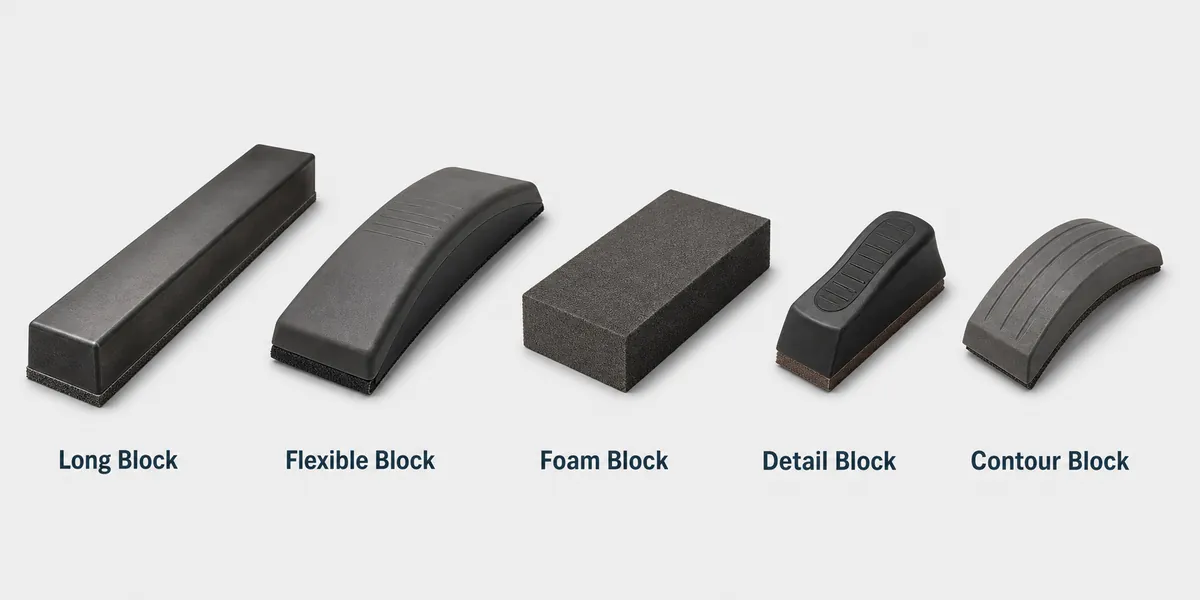
| Tipo de Bloco de Lixar | Melhor Uso | Principal Benefício | Principal Limitação |
|---|---|---|---|
| Régua longa | Portas, laterais, capôs, reparos amplos | Revela ondas e nivela áreas grandes | Difícil de usar em espaços apertados |
| Bloco rígido | Trabalho plano com massa e primer | Forte controle de formato | Pode cortar bordas se usado incorretamente |
| Bloco flexível | Curvas suaves e contornos da carroceria | Segue o formato do painel | Nivelamento menos agressivo |
| Bloco de espuma | Lixamento fino e curvas suaves | Pressão tolerante | Pode arredondar bordas |
| Bloco de detalhe | Reparos pequenos e áreas apertadas | Controle preciso | Lento em painéis grandes |
| Bloco de contorno | Curvas, canais, linhas da carroceria | Combina com superfícies moldadas | Precisa do perfil certo |
No single block is best for every repair. A shop may use a long block to shape primer, a flexible block for curved areas, and a small block near edges. The block should fit the panel, not the other way around.
Quando você deve usar um bloco de lixar em um carro?
Use a sanding block when shape control matters, especially for body filler, primer surfacer, feathered edges, flat panels, guide coat work, and final surface checks before paint. A block is most valuable when the panel must be straight, not just smooth.
For body filler, a block helps shape the repair without creating finger valleys. For primer surfacer, it reveals waves and low spots. For feathered edges, a small or flexible block can refine the transition without digging into a body line.
Blocking is also useful before final paint because reflections reveal shape problems. A panel can feel smooth but still look wavy under gloss. Guide coat and a sanding block make that problem easier to see before the car reaches the spray booth.
Para leitores que comparam formatos abrasivos, o relacionado lixa automotiva explains sheets, rolls, discs, backing types, and wet/dry papers used around sanding blocks.
Como você escolhe a lixa para um bloco de lixar?
Choose sandpaper for a sanding block by matching grit, backing, sheet size, flexibility, and wet or dry method to the repair stage. The paper should attach securely and stay flat without tearing, wrinkling, or clogging too quickly.
Coarse grits shape filler faster, while medium grits refine primer and repair edges. Fine grits prepare surfaces for sealer or paint depending on the coating system. The related gráfico de granulação de lixa gives a clearer progression for automotive work.
Backing matters. A paper that is too stiff may not wrap a small block well. A paper that is too weak can tear around edges. Wet/dry paper must hold together with water, while dry sanding paper should resist loading and cut cleanly with guide coat.
For dry block sanding, dust feedback is useful, but dust control still matters. For wet block sanding, water helps carry away residue and reduce clogging, but slurry can hide lows and scratches. The related lixamento úmido vs lixamento seco explains the practical trade-off.
Como o lixamento com bloco é diferente do uso de uma lixadeira orbital?
Blocking is slower but better for reading and correcting panel shape, while a DA sander is faster for uniform sanding over larger areas. Many repairs need both.
A DA sander moves the abrasive in a random orbital pattern, which is useful for paint prep, primer sanding, and fast surface work. The related lixadeira orbital explains how orbit, pad flatness, and pressure change sanding results. If the machine uses round discs, the related discos de lixamento explains disc size, attachment, backing, and hole pattern.
A sanding block gives more shape feedback. It can reveal waves that a soft DA pad may follow instead of correcting. That is why technicians often rough sand with machines, then block primer or filler to confirm straightness.
The choice is not a contest. Use the DA for speed where it makes sense. Use the block where the surface must be straight and readable.
Quais erros fazem os blocos de lixar deixarem resultados ruins?
Sanding blocks leave poor results when the wrong block is used, pressure is uneven, grit steps are skipped, the paper is loaded, or the technician sands only in one small direction. The block helps, but it cannot fix poor technique.
One mistake is using a soft block when flatness matters. A soft block may follow waves instead of cutting them down. Another mistake is using a rigid block on a tight curve, which can flatten the shape or cut through edges.
Sanding in only one direction can also hide problems. Crosshatch passes make the scratch pattern more even and help the technician read highs and lows. Guide coat should disappear gradually; if it stays in one line, the surface still has a low spot or edge.
Cleanliness matters too. A single coarse particle trapped under fine paper can create a deep scratch. Change paper before it stops cutting, and clean the panel between grit steps.
O que os compradores devem verificar antes de adquirir blocos de lixar e folhas?
Buyers should check block flatness, grip comfort, flexibility, durability, abrasive attachment, sheet compatibility, packaging, grit labeling, and batch repeatability. A sanding block is simple, but poor flatness or weak paper fit can create bad repair results.
Sample testing should include real automotive primer and filler panels. Check whether the block stays flat, whether it twists, whether the handle is comfortable, and whether the abrasive slips during sanding. For flexible blocks, test whether they return to shape after use.
A categoria de lixas e abrasivos automotivos is a practical place to connect sanding blocks with matching sheets, rolls, and abrasives. Yirox Team sample checks usually focus on abrasive cut feel, backing strength, packaging protection, label clarity, and whether the delivered batch matches the approved sample.
For distributors, compatibility is important. A block and paper range should make sense together: common sheet sizes, clear grit steps, stable packaging, and labels technicians can read quickly in a busy shop.
If you are sourcing sanding blocks for an auto-body workflow, tell us the repair stage, abrasive format, grit range, block shape, backing, and shop conditions you need to support. We can help you identify a practical product and sample brief.
Conclusão: Um bloco de lixar é uma ferramenta de controle de formato
A sanding block is not just a holder for sandpaper. It is a tool for controlling pressure, reading panel shape, and preventing the uneven marks that happen when sanding by fingers alone.
Use long and rigid blocks for leveling, flexible or foam blocks for curves, and small blocks for detail areas. Match the block with the correct sandpaper grit, backing, and method. For auto body work, the best finish usually comes from using power tools for speed and sanding blocks for shape control.
Perguntas Frequentes
Do you really need a sanding block for auto body work?
Yes, a sanding block is strongly recommended when panel shape matters. It helps prevent finger grooves and makes highs, lows, and waves easier to see.
What is the best sanding block for body filler?
A rigid or semi-rigid block is often best for shaping body filler because it levels high spots instead of following them. The block length should match the repair area.
Can you wet sand with a sanding block?
Yes, wet sanding with a block is common for fine finishing and paint work. Use wet/dry paper and keep the surface clean so slurry does not hide scratches or trap debris.
Is a foam sanding block good for cars?
Foam blocks are useful for curves, fine sanding, and softer contact. They are less ideal when a repair must be blocked very flat.
Can a DA sander replace a sanding block?
No, not completely. A DA sander is faster, but a sanding block gives better shape feedback for filler, primer, and straightness checks.
Referências
[1] 3M. *Automotive sanding blocks and surface preparation systems*.
[2] I-CAR. *Collision repair surface preparation and blocking practices*.
[3] OSHA. *Riscos de reparo e repintura automotiva*.