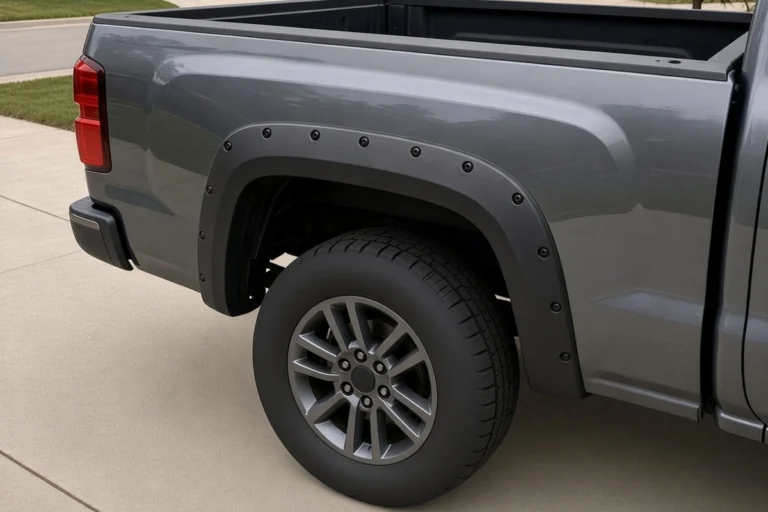




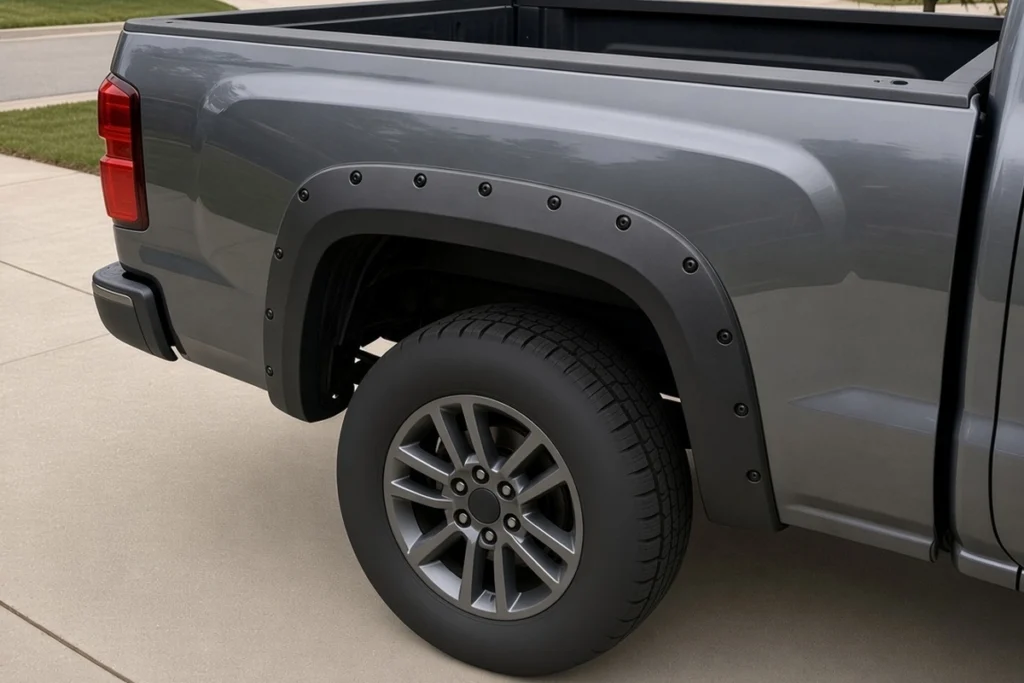
Os alargadores de para-lamas são extensões de carroçaria montadas sobre os arcos das rodas para adicionar cobertura aos pneus, reduzir os detritos lançados contra a pintura e completar um conjunto de rodas mais largo. Este guia explica os estilos bolt-on, pocket e cut-out, os materiais comuns e as verificações de encaixe a fazer antes de encomendar.
Âmbito: este artigo é sobre o alargador em si — estilos, materiais e encaixe. Os kits que alargam ou substituem o para-lamas são abordados em o que é um kit widebody. As peças que percorrem a soleira são abordadas em o que são as saias laterais num carro.
O que são alargadores de para-lama?
Os alargadores de para-lamas são extensões adicionais (ou de fábrica) do arco da roda que se destacam da abertura original do para-lamas e cobrem mais do pneu.
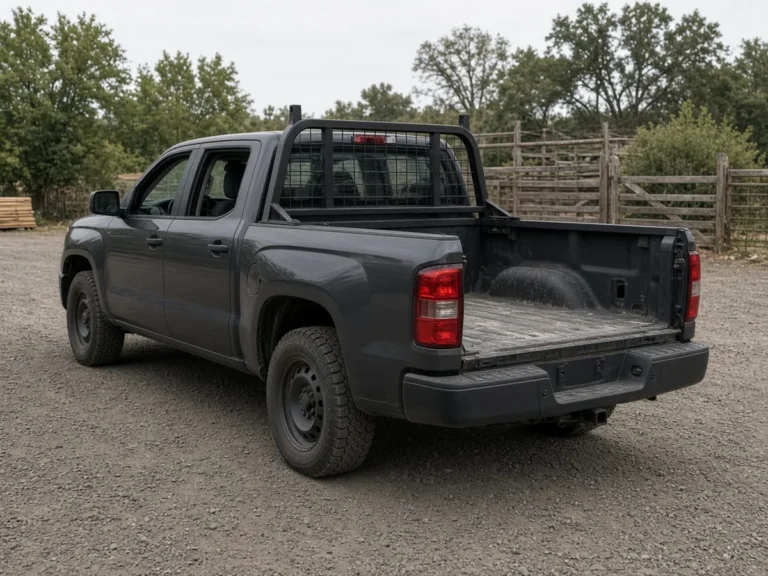
São usados em pickups, SUVs e Jeeps, e em carros que têm um conjunto de rodas mais largo do que a abertura de série consegue cobrir. O alargador é uma peça separada, não um para-lamas de substituição completo, a menos que o produto seja vendido como painel completo. Essa distinção é importante quando compara alargadores com um kit widebody.
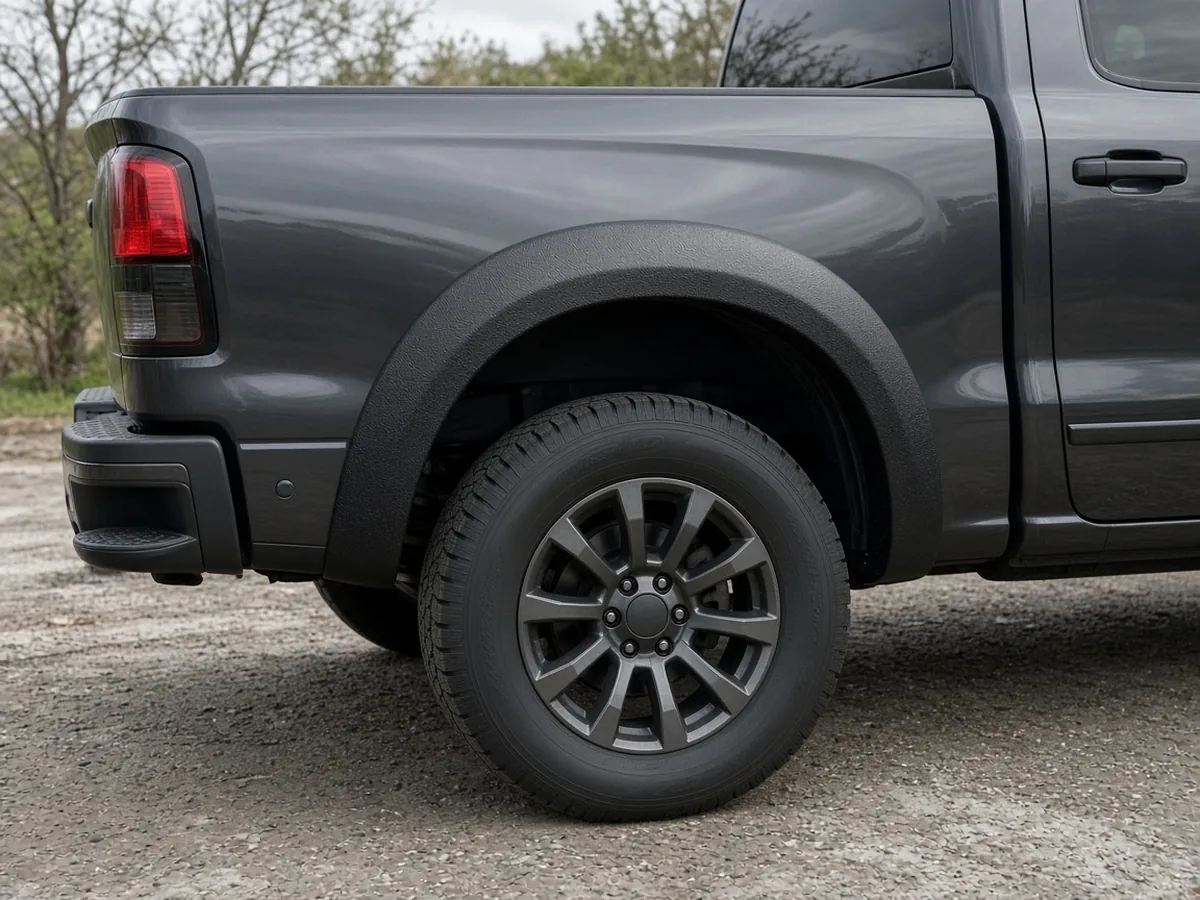
Um alargador pode ser específico para o veículo, moldado para um ano, marca, modelo e estilo de carroçaria, ou vendido como uma tira universal. O primeiro tipo segue o arco de fábrica. O segundo tem de ser cortado e posicionado pelo instalador, e é uma decisão de compra diferente, abordada na secção de encaixe abaixo.
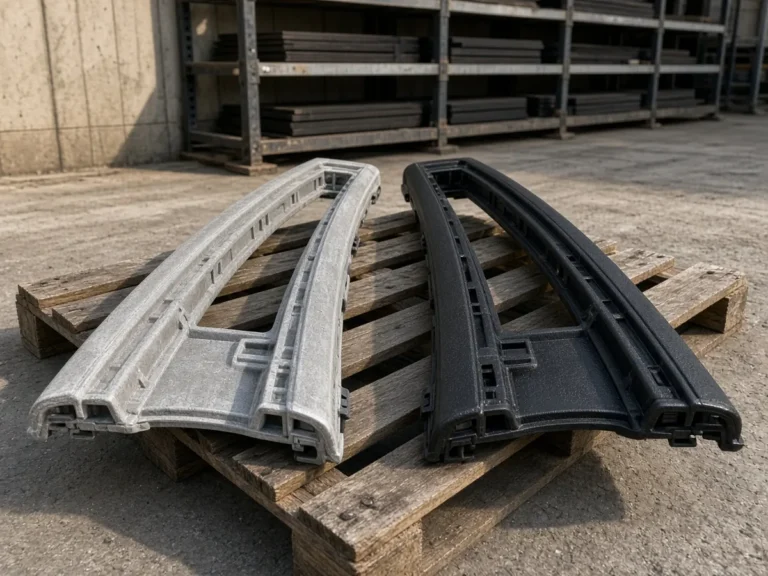
Os alargadores são normalmente feitos de um termoplástico como ABS ou uma olefina mais flexível, ou de fibra de vidro ou aço. A produção típica para este tipo de peça exterior é moldagem por injeção, corte e, quando especificado, pintura ou uma cor moldada, seguida de uma prova de encaixe dos pontos de montagem.
Porque é que os camiões e outros veículos usam alargadores de para-lamas?
As funções habituais são a cobertura dos pneus, a proteção da pintura e a aparência — muitas vezes as três ao mesmo tempo.
Quando uma roda fica mais para fora do que a abertura de fábrica, o piso do pneu pode lançar água, lama e pedras contra a porta, a soleira e os veículos atrás de si. Um alargador estende o arco para que mais desse piso fique sob uma cobertura. Quanta cobertura obtém é uma especificação do produto, não um número único que sirva para todos os kits.
A mesma aresta extra retém parte dos detritos que de outra forma atingiriam a pintura em torno da abertura da roda. Isso é um complemento, não um substituto, de um guarda-lamas ou proteção contra salpicos, que se destina a apanhar os salpicos lançados para trás. Se precisar dessa proteção traseira, consulte para-lamas vs protetores contra respingos.
Muitos compradores também querem o aspeto: uma postura mais larga, um arco de estilo de fábrica num nível de equipamento que não vinha com alargadores, ou uma aresta estilo pocket num camião elevado. A aparência é uma razão válida, mas não substitui uma verificação de cobertura quando o pneu já sobressai para além da chapa.
Um alargador também pode esconder uma aba danificada ou enferrujada. Isso não repara o metal por baixo. Se a sujidade e a humidade ficarem retidas contra o painel, a corrosão pode continuar, o que é um dos riscos abaixo.
Qual é a diferença entre alargadores de para-lamas bolt-on, pocket e cut-out?
Os nomes misturam duas coisas diferentes: o aspeto do alargador e a forma como está realmente fixado. Trate esses aspetos separadamente, ou um conjunto “bolt-on” pode surpreendê-lo na instalação.
Os alargadores estilo OE ou lisos seguem o arco de fábrica e mantêm uma aresta limpa. São a escolha habitual quando quer um aspeto mais discreto ou um acabamento igual à pintura, e quando a cobertura extra de que precisa é modesta.
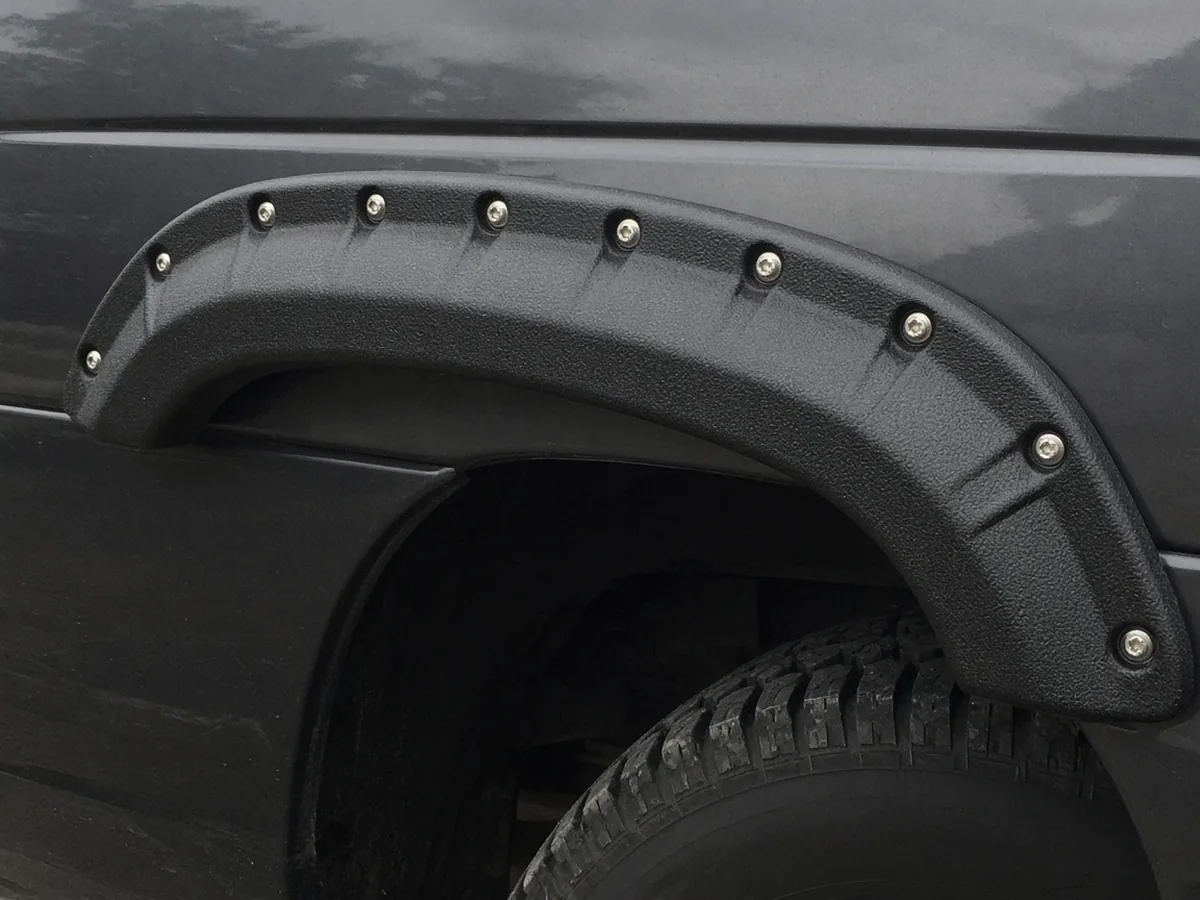
“Os alargadores com ”aspeto bolt-on" têm cabeças de parafuso visíveis ao longo da aresta exterior. Em muitos kits, essas cabeças são decorativas. O alargador pode ainda fixar-se por clipes, fita ou através dos orifícios de fábrica, ou pode usar ferragens ocultas. Não assuma que os parafusos que vê são a fixação estrutural.
Os alargadores estilo pocket ou estilo rebite recolhem essas fixações em bolsos. Nos kits Bushwacker Pocket Style, a ferragem dos bolsos é real: um parafuso e uma anilha atravessam cada bolso pelo exterior, e uma porca é apertada no interior 1. Outras marcas podem usar os bolsos apenas como aspeto. Leia a folha de instalação do kit que tem à frente.
Os alargadores extra-largos ou prolongados são vendidos para um poke maior, quando um conjunto de perfil baixo não cobre o piso do pneu. Os alargadores cut-out ou planos, de grande folga, têm uma forma diferente. Abrem mais do arco interior para a condução fora de estrada. Não são o mesmo que cortar o quarto de fábrica para instalar um painel widebody, o que é uma kit widebody decisão, não uma decisão de estilo de alargador.
Kits de carroceria e peças aerodinâmicas are a related product family: lips, skirts and diffusers change the lower body, while a flare changes the arch. A program can include both, but they should be specified as separate parts.
Que material deve escolher para os alargadores de para-lamas?
Choose the material for the finish you want and the abuse the arch will see, then confirm that the paint system, if any, matches that plastic or metal.
ABS is a common thermoplastic for a stiffer, more precise part that will be painted. Bushwacker’s Pocket Style instructions treat those flares as ABS plastic: if you paint them, you do it before installation, use a plastic adhesion promoter recommended by the paint-system maker, and use a quality enamel or polyurethane automotive paint. The same sheet advises against painting the edge trim, or calls for a flex additive if someone still paints it 1.
More flexible thermoplastics — polypropylene, TPO or polyethylene — are widely used when the flare is expected to take knocks and return to shape. Factories in this category usually mold those parts, trim them, and ship them textured, primed or painted. Do not assume every flexible flare takes a color-match as cleanly as a smooth ABS part. Ask for the finish the plant actually offers on that tool.
Fiberglass flares are still sold, often when a smooth, paintable surface is the priority. Steel or other metal flares show up where a buyer wants a fabricated look. Metal adds a corrosion check: any exposed fastener or bare edge should be protected before the part goes on the vehicle 1.
There is no single “best” material. A painted street truck and a work truck that sees gravel will not want the same combination of stiffness, texture and coating. If a buyer needs a weathering method called out in the purchase file, that specification belongs in the RFQ, and the test methods are explained in the guia de testes de intemperismo para plásticos automotivos externos.
Como verifica o encaixe e a cobertura antes de comprar?
Fitment starts with the vehicle and the wheel package, not with a style name. A pocket-style flare for the wrong generation will not become the right part because the bolts look correct.
Write down the year, make, model and body style, including cab and bed where they change the rear arch. Then look at the tire relative to the factory opening. The useful measurement is how far the tread sits outboard of the fender, including full steering lock and suspension travel if you can do that safely with the vehicle supported as the installer will use it.
Match that poke to the coverage width the flare maker states for the part. Do not borrow a generic “one to two inches” figure from a blog. Coverage is a product claim, and it varies by tool.
Vehicle-specific flares are molded or bracketed for one arch. Universal flares — including the flexible 80 mm or 90 mm strips often sold as a “wide body kit” online — are a different product. They can be useful for a custom build, but they are not a drop-in substitute for a model-specific arch, and they need a careful dry fit, even coverage, and a mounting plan that will not lift or flatten on a curved lip.
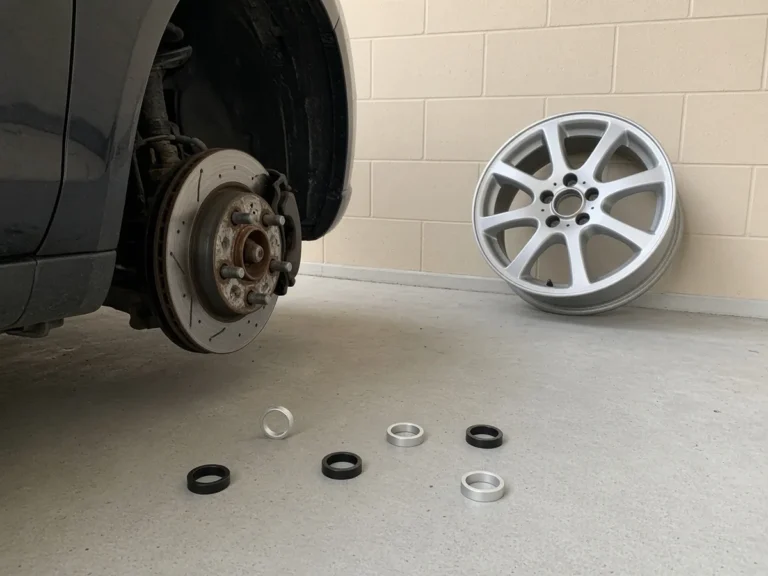
A flare covers poke. It does not move the wheel. If the wheel package itself needs a spacer to clear brakes or to set offset, that is a separate part with its own hardware and thickness checks, not something a flare replaces.
Use this checklist before you order:
- Year, make, model, and the body style, cab or bed that changes the arch.
- Whether the set is front, rear, or all four, and whether a bumper or fender piece is included.
- How far the tire sits outboard of the opening, including lock and travel if you can measure them.
- The coverage width stated for that flare, in the unit the maker uses.
- Vehicle-specific versus universal, and whether you will accept a trim-to-fit install.
- Mounting method: factory holes, new holes, clips, or a mixed kit.
- Finish: textured black, primed, painted, or molded-in color, and whether a color match is required.
- Wheel, tire and lift or level details, so the seller can flag a rub or a coverage shortfall.
- Whether mud flaps, running boards or an aftermarket bumper share the same area.
Como são instalados os alargadores de para-lamas, e é necessário perfurar?
Some flares use existing holes or clips and need no new drilling; others require new holes. The only reliable answer is the instruction sheet for that kit 1.
Bushwacker approves installation only with its written instructions and the supplied hardware. The same manuals warn that alternative methods, hardware or materials, including threadlocker or super glue on the hardware or the flares, will invalidate the stated warranty 1.
Those Pocket Style sheets also list a drill and a drill bit among the tools for some kits, for example a 3/32-inch or a 5/16-inch bit depending on the set. Other flares on the market are sold as no-drill. “Pocket style” is not a synonym for “no-drill,” and “bolt-on” is not a synonym for “no new holes” 1.
Edge trim or weatherstripping belongs on the flare edge that contacts the vehicle, before the part is final-tightened, when the kit includes it. The Bushwacker sequence is to apply the adhesive edge trim along that contact edge, then install the pocket hardware, then mount the flare 1.
If the flares will be painted, the same instructions say to paint them before they go on the vehicle 1. Test-fit first, so you are not painting a part that does not sit correctly on the arch.
Some trimming or other on-vehicle fitting may be necessary to get a clean sit. Follow the maker’s sheet for that work, including any note about door-gap clearance at the rear of a front flare.
Install checklist:
- Read the kit instructions end to end, including the warnings page, before you mark a hole.
- Dry-fit every piece and confirm door, bumper and tire clearance at lock.
- Paint, if specified, before final installation, with the promoter and paint system the plastic requires 1.
- Apply edge trim to the contact edge when the kit includes it 1.
- Use only the supplied fasteners, unless the sheet explicitly allows a substitute 1.
- Treat any newly exposed metal before the flare covers it 1.
- Re-check tightness and look for trapped debris after a short drive, then again after a few days.
Quais riscos e exceções você deve observar?
The main exceptions are legal coverage rules that vary by place, and damage that starts where the flare meets the sheet metal. Neither one is solved by choosing a style name.
There is no single U.S. rule that says every vehicle must wear aftermarket fender flares. Tire coverage and spray control sit mostly in state vehicle codes, and the wording is not the same everywhere. Check the code for the state where the vehicle is registered and driven, and any inspection program that applies to it.
California Vehicle Code section 27600 is a useful example. It says that a person shall not operate a motor vehicle with three or more wheels, or a trailer or semitrailer, unless fenders, covers or devices, including flaps or splash aprons, or the body or attachments, “effectively minimize the spray or splash of water or mud to the rear.”
That equipment “shall be at least as wide as the tire tread.” The section exempts vehicles exempt from registration, trailers and semitrailers under 1,500 pounds unladen, and vehicles manufactured and first registered before 1 January 1971 that are under 1,500 pounds unladen 2.
Florida’s splash-and-spray statute is narrower. Section 316.252 applies to trucks of 26,000 pounds gross vehicle weight or more, truck tractors, and trailers or semitrailers of 2,000 pounds net weight or more. It is not written as a blanket rule for every passenger car or light pickup. An agricultural exemption is also stated 3.
Oregon sets its own equipment standards in ORS 815.180. A required fender or mudguard must extend at least to each side of the tire tread and must be capable of arresting and deflecting dirt, mud, water or other material picked up by the wheels 4.
ORS 815.182 assigns Type I, Type II and Type III geometries to different vehicle classes. Type III applies to each axle of every motor vehicle not otherwise described in that section. Operation without the required fenders or mudguards is a Class C traffic violation under ORS 815.185, with a path to dismissal if the equipment is brought into compliance 4.
Commercial vehicles on the U.S. National Network are also subject to a federal width limit. Under 23 CFR 658.15, no state may impose a width limitation of more or less than 102 inches on a vehicle operating on that network, with a 108-inch exception for Hawaii 5.
23 CFR 658.16 includes splash-and-spray suppressant devices among the components excluded from the measured width. It also excludes certain non-property-carrying devices that do not extend more than 3 inches beyond each side. Those rules apply to commercial motor vehicles on that network, not to every passenger vehicle on a local street 5.
On the vehicle itself, Bushwacker warns that dirt and debris can lodge between the flare and the fender and cause scratching and paint wear from vibration 1. Edge trim is there to manage that contact line, but it is not a reason to skip cleaning. If you later remove a drilled flare, the holes remain and have to be repaired if you want a clean factory arch back.
The same manuals require rust-resistant paint on exposed fasteners and bare metal before the flares are installed, and they allow undercoating of the inner well after the attachments are completed 1. A flare is a poor place to hide active rust. Moisture that stays behind the part can keep the problem going out of sight.
Two clearance warnings from the same instructions are easy to miss. Maintain a minimum 4-inch clearance between those flares and exhaust pipes, and do not let exhaust vent directly onto the part. That 4-inch figure is a Bushwacker instruction, not a universal law, but the heat risk is real on any plastic flare that sits near a tailpipe 1.
Larger tire and wheel packages can also need more room to steer. The manuals note that some combinations may require lowering bump stops or installing steering stops so the tire does not contact the flare 1. If the tire hits the new part at lock, the flare has become a rub point, not a clearance fix.
O que devem os distribuidores e as oficinas incluir num pedido de cotação de alargadores de para-lamas?
A usable RFQ names the vehicle, the style, the coverage, the material and finish, and the mounting method — not just “truck flares, pocket style.”
Yirox produces exterior styling parts of this kind, including fender flares, as part of its body-kit and aero range. A quote is only as good as the brief, so put the following on the request, then repeat the same list when samples are checked in.
- Vehicle list with year, make, model and body style, including cab, bed and any facelift that changes the arch. If the program is universal, say so explicitly and describe the arch shape you need to cover.
- Set composition: front, rear or four pieces, plus any bumper or liner piece.
- Style in two lines: the look (smooth, bolt-on look, pocket/rivet, extra-wide, cut-out or flat) and the mount (factory holes, new holes, clips, or mixed).
- Stated coverage width, in the unit you will inspect against, and a note if the tire package is larger than stock.
- Material and finish: ABS or a flexible thermoplastic, fiberglass or steel; textured, primed, painted or molded-in color; whether a color match is required.
- Hardware and edge trim: what ships in the box, and whether a no-drill promise is a requirement.
- Clearance notes the installer must inherit: exhaust proximity, door-gap trim, and large-tire steering travel.
- A weathering or appearance requirement, if the destination market needs one, written as a test method rather than a vague “UV resistant” line. The weathering test article is a starting point for that wording.
- Packing so each side and each arch stays labelled, with edge trim and fasteners protected in transit.
- Related parts kept on separate lines: a widebody or replacement fender kit, saias laterais, and mud flaps are not “included flares.”
On incoming inspection, check the same items against the sample: sit on the arch, coverage versus the stated width, fastener type and count, edge-trim length, and finish. If the pocket bolts are supposed to be structural, confirm that the holes, washers and nuts are present and that the flare is not only a decorative bolt-on look.
Conclusão
Fender flares extend the wheel arch so more of the tire sits under a cover, and so the paint around that opening takes less debris. The right set is the one that matches the vehicle, the poke you actually have, and the look you want — not the one with the most familiar style name.
Separate the look from the mount before you buy. A smooth flare, a bolt-on-look flare and a pocket-style flare can all be no-drill or all need new holes. On some pocket-style kits the bolts through the pockets are real hardware; on others the heads are only a design. Cut-out or flat flares are still flares, while a kit that cuts or replaces the fender is a widebody project on a different brief.
Confirm coverage from the product specification, install with the supplied instructions, and treat legal coverage as a state-by-state check rather than a single nationwide rule. Protect the metal at the contact line, give plastic flares room around the exhaust, and do not ask the part to hide rust or to stand in for a spacer or a mud flap.
Próximo passo
Write down the vehicle’s year, make, model and body style, the coverage you need, and whether you want a smooth, pocket-style or extra-wide look, before you request a set.
Yirox produces fender flares and other exterior styling parts for that kind of brief. Send the vehicle list and the style and coverage notes through the página de contato, ou comece pelas kits de carroceria e peças aerodinâmicas categoria.
Perguntas frequentes
O que são alargadores de para-lama?
Os alargadores de para-lamas são extensões montadas sobre os arcos das rodas para adicionar cobertura aos pneus, reduzir os detritos lançados contra a pintura ao redor e mudar a aparência do arco. Eles são uma peça de arco separada, não um para-lama de substituição completa ou um kit widebody completo.
Qual é a diferença entre alargadores de para-lama parafusados e estilo bolso?
Bolt-on look usually describes visible bolt heads on the outer edge, which may be decorative. Pocket-style flares recess the fasteners into pockets. On some kits, including Bushwacker Pocket Style sets, those pocket bolts are real hardware that clamp the flare, and the install may still require new holes 1.
Você precisa fazer furos para instalar os alargadores de para-lama?
Not always. Some kits use factory holes or clips and are sold as no-drill. Other kits, including some pocket-style sets, list a drill and a specific bit in the tool list. Use the instruction sheet for the part you have 1.
Os alargadores de para-lamas são legais para uso na rua nos EUA?
It depends on where the vehicle is registered and driven. Some states, such as California Vehicle Code section 27600, require fenders, covers or flaps that control spray and are at least as wide as the tire tread, while others, such as Florida section 316.252, apply only to heavier trucks and trailers. Check the local code, including Oregon’s Type I, II and III standards if that is the market, rather than assuming one nationwide answer 2 3 4.
Os alargadores de para-lamas são a mesma coisa que um kit widebody?
No. A fender flare is an extension added over the existing arch. A widebody kit changes the body width and may use bolt-on or cut-fender panels, which is explained in o que é um kit widebody.
Os alargadores de para-lamas podem ser pintados para combinar com o veículo?
Many smooth ABS-style flares can be painted, and some kits are supplied primed for that purpose. Bushwacker’s instructions say to paint before installation and to use a plastic adhesion promoter for ABS with the paint system you choose. Textured flares may not color-match as cleanly. Follow the part maker and the paint-system maker; do not paint over a poor dry fit 1.
Referências
- Bushwacker / Lund — Pocket Style fender flare installation instructions (Set Part #40968-XX, Rev-2, 1 March 2016; manufacturer sheet hosted by AmericanTrucks). Install only with the written instructions and supplied hardware; Loctite or super glue is not approved; optional paint is done before install with an ABS adhesion promoter and enamel or polyurethane paint; edge trim goes on the contact edge; pocket bolts and nuts are functional hardware; some kits list a drill bit; dirt can cause paint wear; treat bare metal before install; keep a 4-inch clearance from exhaust pipes; large tire packages may need bump or steering stops.
- California Vehicle Code § 27600. Fenders, covers or devices, including flaps or splash aprons, or the body or attachments, must effectively minimize spray or splash of water or mud to the rear and be at least as wide as the tire tread, with the exemptions stated in the section. Official LegInfo URL; text verified against a FindLaw reprint current as of 1 January 2026 after the LegInfo HTML page returned 403 from this research host.
- Florida Statutes § 316.252 (2026). Splash and spray suppressant devices required on trucks of 26,000 pounds GVW or more, truck tractors, and trailers or semitrailers of 2,000 pounds net weight or more, with the agricultural exemption stated in the section.
- Oregon Revised Statutes, chapter 815, §§ 815.180, 815.182 and 815.185. Width and deflection standards for fenders and mudguards; Type I, II and III assignments, including Type III on each axle of motor vehicles not otherwise described; Class C traffic violation and a compliance path to dismissal.
- 23 CFR 658.15, Width, e 23 CFR 658.16, Exclusions from length and width determinations. 102-inch width limit on the National Network (108-inch Hawaii exception); splash-and-spray suppressant devices excluded from measured width; certain non-property-carrying devices excluded if they do not extend more than 3 inches beyond each side. These rules apply to commercial motor vehicles on that network.