Exterior Styling Accessories
Leverage our advanced manufacturing facility and robust supply chain to scale your brand. Whether it’s custom molding or your own private-label part designs, we provide flexible production capacities and rapid prototyping to keep you ahead of the competition.
ISO/TS16949 Certified
Competitive Price
Fast & Reliable
7/24 Customer Service
Tell us your vehicle and the part you need. We develop OEM/ODM molds in-house and can source other parts through vetted partner factories.
Send an InquirySend your vehicle, part list or drawing. Our team checks fitment and replies within one business day.
Buying Guide
Wheel weights are a small consumable, but the wrong type falls off, stains rims or breaks local law. Tire shops and distributors usually pick by three things: how the weight attaches, what it is made of, and the size range they need on the shelf.
Clip-on wheel weights hammer onto the rim flange. They are fast and secure on steel wheels and on alloy wheels with a matching flange.
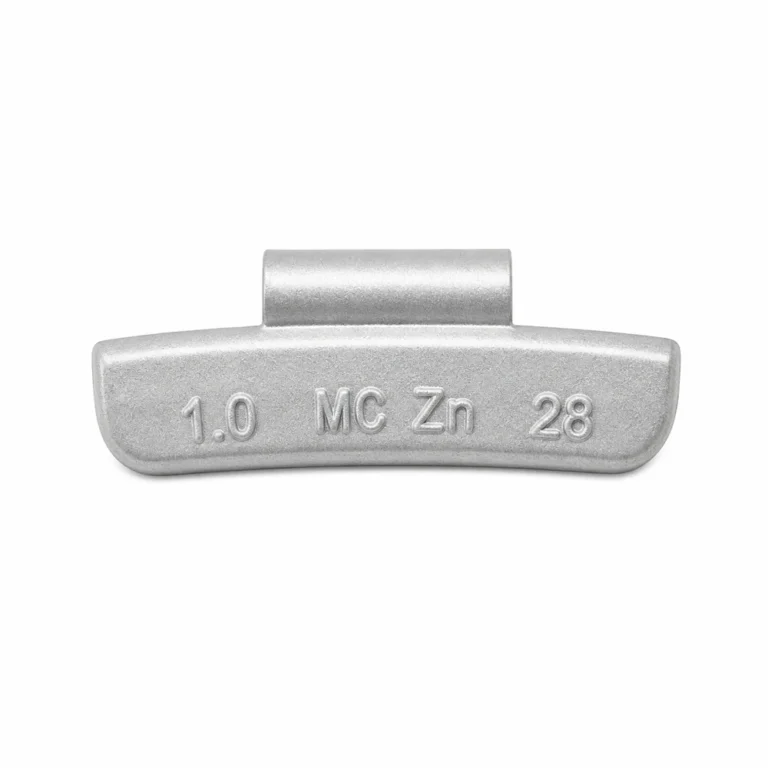
The clip profile must match the flange. Common profiles are P for most steel wheels, MC and AW for many alloy rims, FN and EN for import and European wheels, and IAW and heavy clips for trucks.
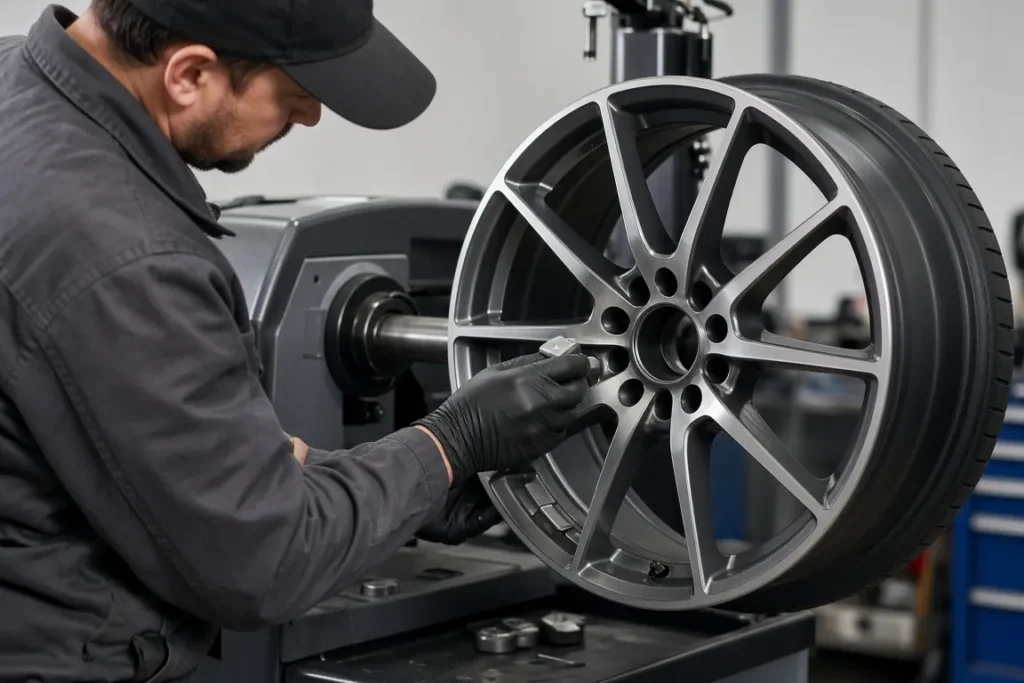
Adhesive (stick-on) wheel weights bond to the inner barrel. They are hidden behind the spokes and are the standard choice for alloy wheels, low-profile tires and rims without a usable flange.
Steel (Fe) is lead-free, low cost and the most widely accepted material today. It is harder, so clips must match the flange closely.
Zinc (Zn) is also lead-free and a little softer, so it conforms to the rim more easily, but it is less dense and slightly larger for the same weight.
Lead (Pb) is the densest and most malleable, but it is banned or restricted in many markets. Check local rules before you buy or resell lead weights.
Zinc plating, Dacromet and polymer coatings protect steel weights from rust and stop them marking alloy rims. Black or grey coatings blend into dark wheels.
Look for strong adhesive with an easy-peel or blue backing film, and wide-brim tape for curved barrels.
A wheel weight assortment kit with the most common clip profiles and strip sizes helps shops cover most jobs from one rack.
Stock adhesive strips in 5 g and 10 g segments or 1/4 oz steps, and clip-on weights from 5 g to 60 g for cars; trucks need larger clip and adhesive weights.
Specs and Regulations
| Material | Density | Lead-Free | Size for the Same Mass | Typical Use |
|---|---|---|---|---|
| Steel (Fe) | About 7.8 g/cm³ | Yes | Larger than lead | Clip-on and adhesive weights for most markets |
| Zinc (Zn) | About 7.1 g/cm³ | Yes | Largest of the three | Clip-on weights where a softer clip helps fitment |
| Lead (Pb) | About 11.3 g/cm³ | No | Smallest | Only where legally allowed, mainly trucks and some export markets |
| Market | Status | What It Means for Buyers |
|---|---|---|
| European Union | Lead wheel weights banned since 2005 under the End-of-Life Vehicles rules | Supply steel or zinc only |
| United States (several states) | California, New York, Washington, Vermont, Maine and other states ban or restrict lead weights | Use steel or zinc for national distribution |
| Other markets | Rules vary by country | Ask us and confirm local rules before ordering lead |
| Balancer Reading | Clip-On Choice | Adhesive Choice |
|---|---|---|
| 5–30 g (0.25–1 oz) | One clip weight of the nearest size | Break off 5 g or 10 g segments |
| 30–60 g (1–2 oz) | One larger clip weight | One strip, or two strips side by side |
| Over 60 g (2 oz+) | Split between both planes or recheck tire mounting | Split inner and outer planes; recheck the tire if very high |
| Trucks and SUVs | Truck clip profiles from 50 g to 250 g | Truck adhesive strips such as 4 oz or 50 g |
Conversion: 1 oz is about 28.35 g, so a 1/4 oz weight is about 7 g. Regulations change, so confirm the current rules in your market. Each product page lists the material, weight, coating and clip profile.
How to Apply
Good practice for tire technicians. Always follow your balancer and the instructions for each weight.
Why Yirox
P, MC, AW, FN, EN, IAW and ST clip series cover steel, alloy and truck wheels.
Steel and zinc weights in many sizes for markets with lead restrictions.
Zinc-plated, Dacromet and coated finishes resist rust and protect alloy rims.
Boxes and rolls in gram or ounce sizes, with private-label packaging available.
Wholesale and OEM
Wheel weights move in high volume, so steady supply and consistent mass matter more than anything else. Yirox has supplied auto parts since 2010, with 10+ years in the trade, around 180 staff and buyers in 40+ countries. Our quality system is certified to ISO 9001 and IATF 16949, and we combine our own approximately 20,000 m² injection-molding factory with vetted partner factories for metal parts.
Lead-free mixes for regulated markets, truck sizes for fleet channels and motorcycle sizes for powersports dealers.
Weights marked and packed in grams or ounces to match the balancers your customers use.
Your brand on boxes, rolls and cartons, from shop packs to bulk distributor packaging.
Low MOQ on selected items. Mixed types and sizes can share one order, and lead time is confirmed with the quote.
FAQ
Wheel weights correct uneven mass in a tire and wheel assembly. A balanced wheel stops vibration, reduces uneven tire wear and protects steering and suspension parts.
Use clip-on weights on steel wheels and alloy rims with a matching flange. Use stick-on (adhesive) weights on alloy wheels without a suitable flange, or where you want the weights hidden.
Check the rim with a profile gauge or the application chart for the wheel. The clip should touch the flange at the top and bottom without the body touching the rim.
It depends on the market. The EU and several US states, including California, New York and Washington, ban or restrict them. Steel and zinc are the safe choice for most buyers.
Steel is cheaper and the most common lead-free option. Zinc is a little softer, so it can conform better to some clip fits, but it is bulkier for the same weight.
Adhesive weights or coated clip-on weights with an alloy profile such as MC or AW. Coating stops bare metal from marking or corroding the aluminum.
There is no fixed number. Most car wheels need one or two weights per plane. Needing more than about 3 oz on one wheel usually means the tire should be checked or match-mounted first.
The wheel goes out of balance, which causes vibration at speed and uneven tire wear. Have the wheel rebalanced and check that the right clip or adhesive was used.
About 28 grams. A 1/4 oz weight is about 7 g, and a 5 g segment is about 0.18 oz.
The usual causes are a dirty or wet surface, applying in the cold, or not pressing the strip down firmly. Clean, dry and warm surfaces give the strongest bond.
Wheel weights are the standard for cars and light trucks and give a precise, measurable balance. Balancing beads are mainly used in large truck tires and are not a replacement for weights on most passenger wheels.
It is not recommended. The clip loses tension after removal and is more likely to come off.
Yes. The range includes heavy clip-on and adhesive weights for trucks and small adhesive weights for motorcycles. Tractor ballast weights are a different product and are not in this range.
Options include zinc plating, Dacromet and polymer coatings, in silver, grey and black, to resist rust and protect rims.
Low MOQ on selected items. Types and sizes can be mixed, and we confirm the MOQ with your quote.
Yes. We offer private-label boxes, rolls and cartons in gram or ounce sizes for shops and distributors.
Keep Browsing
Tell us your vehicle model, year and the parts you need.
Yirox supports single-piece orders, wholesale, OEM/ODM and custom sourcing for any auto parts.