




Em 2026, a tendência mais prática de balanceamento de rodas é uma mudança em direção a portfólios de materiais sem chumbo, equipamentos de serviço mais assistidos por dados e verificações de conformidade específicas de cada mercado. Para a maioria dos serviços em carros de passeio, pneus de perfil baixo e rodas de liga leve, os pesos de roda medidos continuam sendo o ponto de partida confiável. Aplicações selecionadas de serviço pesado ou especializadas podem justificar um teste controlado de outro método, mas o pneu exato, a roda, a válvula ou a configuração de TPMS, o processo de serviço e a regra local decidem a compatibilidade. 1 2 3
Esta perspectiva é para fornecedores, empresas de serviços de pneus, distribuidores, equipes de frotas e compradores que planejam para o mercado de 2026. Ela separa desenvolvimentos confirmados de sinais de longo prazo. Este visão geral de pesos de roda versus balanceamento de pneus explica a distinção básica entre serviço e produto.
Índice
- O que está confirmado na perspectiva de balanceamento de rodas para 2026?
- O que há de novo na tecnologia de balanceamento de rodas?
- Quais mudanças de material mais importam para os compradores de balanceamento de rodas?
- Os pesos de roda de chumbo estão sendo eliminados gradualmente?
- Como a automação está mudando os fluxos de trabalho de serviços de pneus?
- Como as oficinas devem comparar balanceamento manual e automatizado?
- O que as regulamentações de pesos de roda de 2026 significam por região?
- Como os compradores devem avaliar alegações sobre material, automação e conformidade?
- O que os fornecedores devem preparar para 2026?
- O que as oficinas de pneus devem preparar para 2026?
- Metodologia e registro de atualização anual
- Conclusão: qual é a decisão de planejamento mais segura para 2026?
- Perguntas frequentes
- Referências
O que está confirmado na perspectiva de balanceamento de rodas para 2026?
Quatro sinais são sólidos o suficiente para orientar um plano para 2026.
Primeiro, o fornecimento sem chumbo não é mais um pedido de nicho. A Agência de Proteção Ambiental dos EUA disse em dezembro de 2024 que não iniciaria uma proposta de regulamentação da TSCA sobre pesos de roda de chumbo. O mesmo anúncio informou que nove estados dos EUA e o Canadá haviam proibido pesos de roda de chumbo, que alternativas como aço, liga de zinco e compósito de plástico-metal estavam amplamente disponíveis, e que os fabricantes de veículos pesquisados pela agência não usavam mais pesos de roda de chumbo em veículos novos vendidos nos Estados Unidos. 1
Isso não é o mesmo que uma única proibição mundial. Significa que um fornecedor deve tratar as opções sem chumbo como a direção padrão do portfólio, enquanto verifica a regra, a especificação do cliente e o escopo do produto para cada destino.
Segundo, os equipamentos de balanceamento de rodas estão se tornando mais capazes de capturar e padronizar dados. Uma página atual de produto de balanceadora de rodas da Hunter descreve medição automática de dimensões da roda por meio de um sistema de visão, verificações automáticas de centralização, um banco de dados de veículos relacionado a TPMS integrado e recursos de autocalibração. Essas são capacidades de equipamento declaradas pelo fabricante, não prova de que toda oficina tenha o mesmo nível de automação. 3
Terceiro, a regulamentação está se tornando um problema de documentação tanto quanto um problema de material. O quadro de veículos em fim de vida da UE permanece em vigor e sua diretiva delegada de 2023 atualiza isenções para chumbo em materiais e componentes especificados de veículos. A resposta legal depende do escopo do veículo/componente e da implementação nacional; não deve ser reduzida a uma alegação genérica de que “a UE proíbe todo peso de roda de chumbo em todas as situações”.” 2
Quarto, as orientações de segurança atuais conectam o balanceamento com o restante da manutenção de pneus. A orientação TireWise da NHTSA diz que balanceamento e alinhamento por um técnico qualificado importam para a vida útil do pneu e a segurança do veículo, e trata TPMS, pressão, banda de rodagem, rodízio, balanceamento e alinhamento como tópicos de manutenção relacionados. 5
Esta é evidência direcional, não um conjunto de dados de participação de mercado. Ela apoia a direção de planejamento para 2026 — materiais sem chumbo, equipamentos assistidos por dados e fluxos de trabalho de serviço documentados — mas não prova que toda oficina ou fornecedor adotou o mesmo sistema. Construa um portfólio documentado de materiais e ajustes, depois conecte-o ao fluxo de trabalho de serviço e ao mercado de destino.
Mudanças confirmadas versus sinais de longo prazo
| Item de planejamento para 2026 | Status | O que um comprador pode agir agora |
|---|---|---|
| Disponibilidade de pesos de roda sem chumbo | Direção de mercado confirmada | Qualifique alternativas de aço, liga de zinco e compósito com registros de composição e ajuste |
| Nenhuma nova proposta federal da TSCA nos EUA a partir da decisão da EPA | Confirmado a partir da decisão citada | Não a chame de proibição federal; verifique requisitos estaduais, provinciais, do cliente e de exportação |
| Mais recursos automatizados de medição e centralização | Confirmado no nível de recurso do equipamento | Compare tempo de ciclo medido, repetibilidade, retrabalho e saída de dados |
| Uma regra global universal de pesos de roda | Não confirmado | Mapeie cada destino, categoria de veículo, escopo de componente e data de vigência |
| Serviço de pneus totalmente autônomo em oficinas comuns | Sinal de longo prazo | Trate a automação como um investimento em fluxo de trabalho com inspeção humana e tratamento de exceções |
| Um material de substituição vencendo todas as classes de rodas e veículos | Não confirmado | Mantenha múltiplos formatos e aprove por segmento de aplicação |
O que a evidência atual realmente prova?
A perspectiva para 2026 é baseada em sinais observáveis, não em uma previsão fabricada de participação de mercado. Cada fonte apoia uma parte diferente da tendência, então a evidência deve ser lida como uma pilha direcional:
| Fonte e data | O que ela apoia | O que não prova |
|---|---|---|
| Decisão da EPA publicada em 2024 e atualizada pela última vez em 2025 | Alternativas sem chumbo estão comercialmente disponíveis, novos veículos dos EUA pesquisados pela agência não usam mais pesos de roda de chumbo, e existem restrições estaduais/canadenses 1 | Uma única proibição federal dos EUA ou adoção global universal |
| Página do código da Califórnia atual em 2026 | Um estado nomeado tem um limite operacional de 0,1% de chumbo por peso para fabricar, vender ou instalar contrapesos de roda na Califórnia 4 | Que todo mercado de exportação usa o limite ou escopo da Califórnia |
| Informações do balanceador de rodas Hunter atuais em 2026 | Equipamentos atuais podem incluir medição por visão, verificações de centralização, dados relacionados a TPMS e recursos de autocalibração 3 | Que toda loja de pneus adotou a mesma automação ou alcançará o mesmo resultado de tempo de ciclo |
| Orientação NHTSA TireWise atual em 2026 | Balanceamento, alinhamento, pressão, banda de rodagem, rodízio e TPMS pertencem a um fluxo de trabalho conectado de manutenção de pneus 5 | Uma previsão de vendas de equipamentos ou uma alegação causal sobre acidentes relacionados a pneus |
Isso é suficiente para justificar um artigo de planejamento de 2026. Não é suficiente para publicar uma alegação numérica de crescimento de mercado sem um conjunto de dados do setor separado.
O que há de novo na tecnologia de balanceamento de rodas?
A física do desequilíbrio não mudou: um conjunto rotativo de pneu e roda ainda precisa ter sua distribuição de massa medida e corrigida. Mais etapas em torno de medição, diagnóstico e registros agora podem ser auxiliadas por equipamentos e software.
O serviço tradicional pode exigir que um técnico insira as dimensões da roda, selecione um programa, centralize o conjunto, gire-o, leia as posições de correção, instale o contrapeso apropriado e execute uma reverificação. Equipamentos modernos podem reduzir entradas manuais, identificar dimensões por meio de um sensor ou sistema de visão, verificar a centralização, sugerir locais de correção e armazenar ou compartilhar dados de serviço. As informações atuais dos produtos Hunter são um exemplo útil dessa direção, incluindo medição de dimensões baseada em visão, CenteringCheck, tecnologia SmartWeight e um banco de dados de veículos. 3
Para um comprador, “nova tecnologia” deve ser traduzida em perguntas mensuráveis:
- Quais dimensões são medidas automaticamente e quais ainda exigem entrada manual?
- Como a máquina verifica se a roda está centralizada no eixo ou adaptador?
- Ela pode suportar os programas reais da loja para aço, liga leve, contrapesos ocultos e contrapesos adesivos?
- Ela fornece um modo de força de estrada ou outro modo de diagnóstico, ou apenas um balanceamento convencional por rotação?
- O resultado pode ser exportado para uma ordem de serviço, registro de frota ou painel de qualidade?
- Como são tratados calibração, manutenção, atualizações de software e treinamento do operador?
A automação é valiosa quando reduz a variação, mas a loja ainda precisa de manutenção, adaptadores corretos, superfícies de colagem limpas e diagnóstico de vibração repetida. O roteiro deve cobrir da montagem até a inspeção final.
Quais mudanças de material mais importam para os compradores de balanceamento de rodas?
A seleção de material afeta densidade, volume de correção, comportamento à corrosão, revestimento, geometria do clipe, desempenho do adesivo, manuseio e documentação de fim de vida. A comparação correta não é “qual material é melhor?”, mas “qual material e formato atendem a esta interface de roda e padrão de serviço na faixa de correção exigida?”

Os principais grupos de materiais têm diferentes implicações de compra:
| Material or format | Vantagem prática | Perguntas a verificar antes da aprovação |
|---|---|---|
| Aço | Amplamente compreendido, durável e disponível em muitos formatos de encaixe e adesivos | Densidade e geometria do segmento, desempenho de revestimento ou corrosão, retenção do clipe, compatibilidade do adesivo e volume de correção necessário |
| Liga de zinco | Opção sem chumbo com uso estabelecido em portfólios de reposição | Declaração da liga, acabamento superficial, ajuste do clipe, consistência do revestimento e se a peça corresponde à flange da roda ou ao local do adesivo |
| Compósito de plástico e metal | Pode suportar um portfólio sem chumbo e metas selecionadas de embalagem ou manuseio | Composição do material, densidade, comportamento à temperatura, resistência da fixação, comportamento de corte ou quebra e repetibilidade entre lotes |
| Chumbo | Densidade familiar e ajustes legados em algumas populações de serviço mais antigas | Restrições de destino, requisitos de eliminação gradual do cliente, expectativas de manuseio e descarte e se um equivalente sem chumbo está comercialmente disponível |
| Tira adesiva | Útil onde um perfil de encaixe não é adequado ou um posicionamento oculto é necessário | Acabamento da roda, processo de limpeza, temperatura, pressão, requisitos de cura ou tempo de permanência, folga do freio e método de remoção |
Use as faixa de pesos de balanceamento de rodas para comparar formatos, depois especifique a interface da roda, a faixa de correção, a posição de serviço e a embalagem.
Para rodas de liga leve, uma alegação sem chumbo não é uma aprovação de ajuste. O clipe pode danificar a flange, o adesivo pode falhar em um revestimento, ou o local de correção pode interferir no freio. Verifique a roda real e o processo de serviço.
Os pesos de roda de chumbo estão sendo eliminados gradualmente?
Sim, como uma direção de mercado — especialmente para novos veículos dos EUA e compradores com requisitos de redução de chumbo — mas não como uma regra universal de 2026 cobrindo todos os países, veículos e peças de reposição.
O anúncio da EPA de 2024 fornece uma linha de base útil para os EUA: a agência recusou iniciar a proposta de regulamentação TSCA, relatou proibições em nove estados e no Canadá, identificou aço, liga de zinco e compósito de plástico e metal como alternativas amplamente disponíveis, e disse que as montadoras pesquisadas não usavam mais contrapesos de roda de chumbo em novos veículos vendidos nos EUA. 1
A Califórnia fornece um requisito concreto em nível estadual. O Código de Saúde e Segurança da Califórnia §25215.8 proíbe fabricar, vender ou instalar um contrapeso de roda na Califórnia que contenha mais de 0,1% de chumbo por peso. A página legislativa atual identifica a disposição como a seção renumerada em vigor desde 1º de janeiro de 2020; esta é uma restrição estadual operacional, não uma fase de implementação proposta para 2026. 4
A resposta comercial não é alegar que todos os produtos de chumbo são subitamente ilegais. Em vez disso:
- Torne as opções sem chumbo o padrão para novos programas e cotações de exportação.
- Mantenha os ajustes legados separados e marque seus limites de mercado.
- Solicite uma declaração de material e documentos de rastreabilidade.
- Verifique a regra de destino e confirme que a substituição preserva a faixa de correção e o ajuste da roda.
Na UE, a Diretiva 2000/53/CE estabelece uma base segundo a qual os materiais e componentes de veículos colocados no mercado após 1 de julho de 2003 não devem conter chumbo, mercúrio, cádmio ou crómio hexavalente, sujeitos às isenções do Anexo II. A Diretiva Delegada (UE) 2023/544 da Comissão entrou em vigor 20 dias após a sua publicação em 10 de março de 2023, e os Estados-Membros tiveram de pôr em vigor as disposições de execução até 1 de junho de 2023. A diretiva também exclui os contrapesos de equilíbrio das rodas de uma exceção específica de peças sobressalentes para veículos mais antigos. 2
O quadro da UE ainda não substitui uma revisão jurídica produto a produto. Uma equipa de conformidade deve ler o âmbito do veículo/componente, a linguagem de isenção e a implementação pelo Estado-Membro antes de aprovar uma reclamação para um programa específico de pesos de roda.
Como a automação está mudando os fluxos de trabalho de serviços de pneus?
A automatização está a deslocar a discussão de valor de “quão rápido gira a máquina?” para “quão consistentemente todo o trabalho alcança um resultado aprovado?”

As melhorias de fluxo de trabalho mais relevantes para 2026 são:
Medição mais consistente
A medição automática de dimensões pode reduzir erros de introdução de dados e tornar a configuração do próximo operador mais previsível. Não elimina a necessidade de selecionar o adaptador correto, verificar a roda ou reconhecer uma configuração invulgar.
Melhor controlo de centragem
Uma verificação automática de centragem pode ajudar a identificar uma condição de montagem que, de outra forma, produziria um resultado pouco fiável. A funcionalidade da máquina só é útil quando a oficina utiliza os cones, adaptadores e procedimento de fixação corretos para a roda.
Diagnóstico mais rápido de reclamações persistentes
Alguns balanceadores avançados acrescentam funções de força de estrada ou de diagnóstico. Essas funções podem ajudar a separar um simples desequilíbrio de um problema de pneu, roda, montagem ou uniformidade. O equipamento não pode reparar uma roda empenada ou um componente de suspensão defeituoso; só pode fornecer melhores evidências para a próxima decisão.
Um registo de dados mais claro
Os operadores de frotas e de múltiplas localizações podem beneficiar quando o registo de serviço inclui a posição da roda, a quantidade de correção, o modo, o resultado da reverificação e o motivo da exceção. Isto torna as reclamações repetidas mais fáceis de analisar e cria uma base mensurável para comparar equipamentos ou alterações de materiais.
Menor variação do operador, não responsabilidade zero do operador
Uma máquina moderna pode automatizar a medição e os avisos, mas os técnicos ainda inspecionam o pneu e a roda, limpam as superfícies adesivas, selecionam a peça correta, instalam-na na posição especificada e decidem quando escalar uma falha. O melhor fluxo de trabalho para 2026 é assistido e auditável, não cegamente automático.
Como as oficinas devem comparar balanceamento manual e automatizado?
Utilize uma comparação de processos em vez de uma comparação de contagem de funcionalidades.
| Fator de decisão | Fluxo de trabalho manual ou convencional | Fluxo de trabalho automatizado ou assistido por dados |
|---|---|---|
| Investimento inicial | Custo de equipamento mais baixo e percurso de formação familiar | Capital, software, calibração e expectativas de serviço mais elevados |
| Medição | Mais introdução e interpretação por parte do operador | Pode automatizar dimensões, avisos, verificações de centragem ou diagnósticos selecionados |
| Capacidade de produção | Depende fortemente da competência do técnico e do retrabalho | Pode reduzir introduções repetidas e passos de espera quando corretamente configurado |
| Registo de qualidade | Frequentemente limitado a papel ou notas de ordem de trabalho | Pode suportar captura digital de resultados e análise ao nível da frota |
| Tratamento de exceções | O técnico experiente deteta frequentemente condições invulgares diretamente | A máquina pode revelar uma exceção, mas um técnico ainda a diagnostica |
| Melhor aplicação | Faixas de serviço de baixo volume, estabelecidas ou com controlo orçamental | Programas de serviço de alto volume, múltiplas localizações, repetíveis ou orientados por dados |
Teste as próprias montagens da oficina e meça o tempo de ciclo, o sucesso à primeira, o retrabalho, as reclamações repetidas, os erros de configuração, as interrupções de calibração e o tempo de formação. Se um fornecedor citar uma poupança de tempo dramática, pergunte quais passos e qual população de pneus/rodas abrange.
A modos de balanceadora de rodas O guia é útil ao documentar qual programa uma oficina realmente utiliza. Isto é importante porque “automatizado” não diz a um comprador se o equipamento suporta o fluxo de trabalho estático, dinâmico, de liga, de pesos ocultos ou de diagnóstico exigido.
O que as regulamentações de pesos de roda de 2026 significam por região?
Documente a jurisdição antes de aprovar uma reclamação material. A tabela abaixo resume o que as fontes citadas estabelecem e o que não estabelecem.

| Região ou mercado | Posição confirmada pela fonte citada | Data de entrada em vigor ou âmbito a verificar | Ação do comprador |
|---|---|---|---|
| Estados Unidos — federal | A EPA anunciou que não iniciaria a proposta de regulamentação TSCA sobre pesos de roda de chumbo | Nenhuma proibição federal ou nova data de entrada em vigor decorre dessa decisão; o âmbito revisto abrangia o fabrico, processamento, distribuição, utilização e eliminação ao abrigo da TSCA | Não utilize a decisão da EPA como aprovação geral; verifique as regras estaduais, as especificações do cliente e os requisitos de destino |
| Estados Unidos — mercados estaduais | A EPA reportou que nove estados dos EUA tinham proibido pesos de roda de chumbo | O estado específico, a data de entrada em vigor, o âmbito do produto e os detalhes de aplicação devem ser verificados na fonte estadual aplicável | Mantenha uma matriz de expedição e produtos estado a estado em vez de uma única suposição para todos os EUA |
| Califórnia — estado | A HSC §25215.8 da Califórnia proíbe o fabrico, venda ou instalação de um peso de roda na Califórnia contendo mais de 0,1% de chumbo em peso 4 | A página de código atual identifica a seção como renumerada com efeito a partir de 1º de janeiro de 2020; trata-se de uma restrição operativa, não de uma implementação gradual para 2026 | Manter os pedidos da Califórnia em uma especificação sem chumbo e reter as declarações de materiais para os produtos enviados |
| Canadá | A EPA informou que o Canadá proibiu os contrapesos de chumbo para rodas | Os detalhes aplicáveis de âmbito nacional, provincial, de produto e de data de entrada em vigor precisam de confirmação direta antes que uma alegação seja feita | Solicite ao importador ou ao responsável pela conformidade a regra exata do mercado e mantenha a declaração de materiais junto com o embarque |
| União Europeia | A Diretiva 2000/53/CE estabelece uma linha de base sem chumbo para materiais e componentes em veículos colocados no mercado após 1º de julho de 2003, sujeita às isenções do Anexo II; os contrapesos de balanceamento de rodas estão excluídos de uma exceção específica para peças de reposição de veículos mais antigos 2 | A Diretiva Delegada (UE) 2023/544 da Comissão entrou em vigor 20 dias após sua publicação em 10 de março de 2023, ou seja, em 30 de março de 2023; os Estados-Membros tiveram que colocar em vigor as disposições de implementação até 1º de junho de 2023 | Mapeie o programa real de contrapesos de rodas para o escopo de veículo/componente, a linguagem do Anexo II e a implementação aplicável do Estado-Membro |
CTA principal: solicitar uma revisão documentada da aplicação
Se você está escolhendo um material de contrapeso de roda para 2026, verificando a conformidade com a Califórnia ou a UE, ou avaliando equipamentos automatizados de balanceamento, compartilhe seus tamanhos de pneu, material e acabamento da roda, faixa de correção, detalhes de TPMS ou válvula, mercados de destino e volume anual. Podemos ajudá-lo a comparar uma especificação prática por meio deste solicitação de orçamento de acessórios automotivos antes de um pedido maior.
Como os compradores devem avaliar alegações sobre material, automação e conformidade?
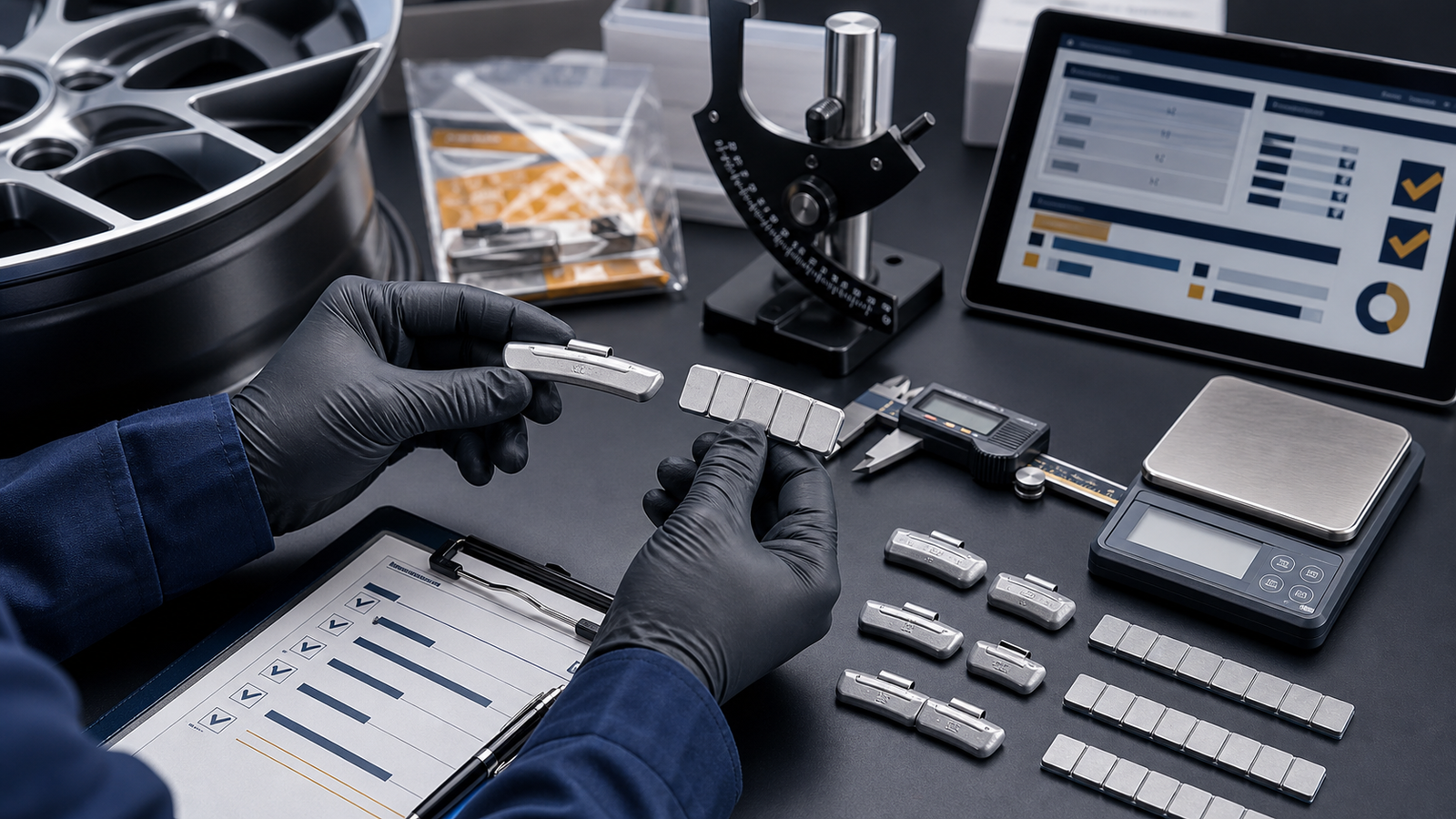
Os compradores devem avaliar as evidências em três faixas separadas. Combiná-las em uma única alegação de “melhor tecnologia” cria risco evitável.
Evidências de material
Solicite a composição declarada, a tolerância de densidade ou massa, a especificação de revestimento, o método de teste de corrosão ou ambiental, as dimensões do clipe, a construção adesiva e a identificação do lote. Para uma alegação sem chumbo, defina se significa ausência de chumbo adicionado intencionalmente, um limite declarado ou conformidade com um requisito nomeado de cliente ou legal.
Evidências de equipamento
Solicite o modelo exato, a faixa de rodas e pneus suportada, os adaptadores, as funções automáticas, o intervalo de calibração, as saídas de dados, os requisitos de serviço e o escopo de treinamento. Compare uma amostra controlada das montagens da oficina. Uma máquina excelente para rodas de liga leve de automóveis de passeio pode não ser a escolha correta para configurações de rodas para serviço pesado ou incomuns.
Evidência de conformidade
Pergunte em qual autoridade ou requisito de cliente a alegação se baseia, a data de publicação ou entrada em vigor, o escopo legal/de produto, o mercado abrangido e o responsável pelo documento. Um fornecedor deve ser capaz de dizer “esta declaração abrange este material e este embarque” em vez de simplesmente colocar “ecológico” ou “sem chumbo” na página de um produto.
Evidências de custo total
Compare o custo do material, a quantidade de correção, a embalagem, o armazenamento, o tempo de instalação, o retrabalho, a remoção, o descarte, o treinamento, a manutenção do equipamento e o tratamento de reclamações. Um preço unitário mais baixo pode desaparecer se a peça exigir mais volume de correção, criar mais falhas adesivas ou não puder ser usada na população de rodas existente da oficina.
O que os fornecedores devem preparar para 2026?
Os fornecedores podem se preparar para a tendência tornando o portfólio de produtos mais fácil de aprovar, não apenas adicionando outro nome de material.
- Crie uma linha padrão sem chumbo. Separe produtos de aço, liga de zinco e compósitos por interface de roda e faixa de correção.
- Construa uma biblioteca de compatibilidade. Registre perfis de clipe, dimensões adesivas, limites de acabamento, folga do freio e posições aprovadas.
- Padronize as declarações. Forneça documentação específica de composição, tolerância de massa, revestimento, lote, embalagem e destino.
- Segmente o mercado. Separe aplicações de automóveis de passeio, comerciais, off-road, RV e frotas em vez de prometer uma peça para todos os veículos.
- Venda com evidências. Pergunte sobre modos de balanceadora e adaptadores, depois defina rodas representativas, critérios de aceitação, método de reverificação e duração do teste.
- Mantenha um registro de atualizações. Registre quando uma regulamentação, requisito de cliente, declaração ou especificação de produto foi revisada pela última vez.
Para aplicações comerciais, o planejamento de peso de roda para veículos comerciais recurso pode ajudar a estruturar uma linha separada para serviço pesado em torno do tipo de roda, posição de serviço, faixa de correção, revestimento e profundidade de estoque.
O que as oficinas de pneus devem preparar para 2026?
As oficinas devem tratar a tendência como uma atualização do sistema operacional para o serviço de rodas.
- Mapeie a população de rodas. Registre tamanhos de pneu, materiais e acabamentos de rodas, posições de eixo, layouts de TPMS e aplicações incomuns.
- Defina o caminho padrão. Para trabalhos comuns em automóveis de passeio, perfil baixo e rodas de liga leve, comece com contrapesos de roda medidos e uma reverificação documentada.
- Teste métodos especializados separadamente. Para beads ou outro método interno, defina o segmento de pneu/roda, as instruções do fornecedor, a revisão de válvula e sensor e a regra de teste.
- Audite a configuração da máquina. Verifique adaptadores, centralização, calibração, seleção de programa e modos estático, dinâmico, liga leve ou diagnóstico.
- Acompanhe exceções e treine de forma consistente. Registre vibrações repetidas e constatações do veículo, ensine a instalação/remoção sem chumbo e use as mesmas regras de primeira passagem e escalonamento em todas as localidades.
A orientação atual TireWise da NHTSA também trata o balanceamento e o alinhamento como parte da manutenção dos pneus e afirma que pneus novos devem ser balanceados quando instalados. 5 Isso apoia um fluxo de trabalho que verifica pressão, TPMS, banda de rodagem, montagem, centralização e condição do veículo, em vez de culpar o contrapeso por toda vibração.
Essa abordagem transforma automação e mudanças de materiais em melhorias mensuráveis de serviço. Também evita que uma oficina culpe o peso quando o problema real é uma roda torta, um erro de montagem, uma questão de uniformidade do pneu ou uma falha do veículo.
Metodologia e registro de atualização anual
Este artigo usa o enquadramento de 2026 do briefing do tema e o verifica em relação às páginas atuais do governo dos EUA e da Califórnia, texto legal da UE, documentação atual de equipamentos e orientações atuais de segurança de pneus. A pontuação de demanda do briefing é apenas um proxy; seus URLs de exemplo de SERP não são citados.
Revise o artigo anualmente ou quando um mercado-alvo alterar sua regra material ou especificação de cliente. Atualize a tabela de regulamentos, referências, declarações de produto, capacidades de equipamentos e números de desempenho. Não adicione linguagem de “proibição global”, “totalmente automático” ou “um material serve para toda roda” sem uma nova fonte.
Registro de atualizações: Agosto de 2026 — perspectiva inicial de 2026 cobrindo materiais, automação, regulamentação, preparação de fornecedores e preparação de oficinas de pneus.
Conclusão: qual é a decisão de planejamento mais segura para 2026?
A decisão mais segura para 2026 é um programa segmentado e baseado em evidências. Use pesos de roda medidos como ponto de partida prático para a maioria dos serviços em carros de passeio, pneus de perfil baixo e rodas de liga leve. Incorpore alternativas de aço, liga de zinco e compósitos ao portfólio sem chumbo. Avalie equipamentos automatizados por repetibilidade, centralização, diagnóstico, captura de dados e impacto total no fluxo de trabalho. Reserve métodos especializados para aplicações que passem por uma revisão documentada de pneu, roda, válvula ou TPMS, serviço e conformidade.
Para fornecedores, a oportunidade é tornar as evidências de material e compatibilidade fáceis de aprovar. Para oficinas de pneus e frotas, a oportunidade é transformar cada mudança de material ou equipamento em um teste controlado com uma regra de aceitação clara. Isso é mais durável do que reagir a uma manchete sobre uma proibição, um novo recurso de máquina ou um material substituto.
Perguntas Frequentes
Qual é a maior tendência de balanceamento de rodas automotivas em 2026?
A maior tendência prática é a combinação de planejamento de materiais sem chumbo e equipamentos de serviço de rodas mais assistidos por dados. O princípio de correção permanece, mas o portfólio e o fluxo de trabalho estão se tornando mais documentados e específicos por mercado. 1 3
Pesos de roda de chumbo são ilegais em todos os lugares em 2026?
Nenhuma regra global universal é estabelecida pelas fontes usadas aqui. A EPA relatou proibições em nove estados dos EUA e no Canadá e nenhum peso de roda de chumbo em novos veículos dos EUA, de acordo com informações de montadoras, enquanto a agência federal não iniciou proposta de regulamentação TSCA. Verifique o destino, o escopo do produto e o requisito do cliente. 1
Qual material substituto um fornecedor deve estocar primeiro?
Comece com o material e o formato que correspondem à população de rodas do cliente. Opções de aço e liga de zinco são pontos de partida comuns sem chumbo; compósitos podem se adequar a aplicações selecionadas. Compare densidade, volume de correção, encaixe por clipe ou adesivo, revestimento, corrosão e documentação — não apenas o nome do material. 1
Um balanceador automatizado elimina o julgamento do técnico?
Não. A automação pode auxiliar na medição de dimensões, centralização, prompts de correção, diagnósticos e captura de registros, dependendo do equipamento. O técnico ainda verifica o conjunto, escolhe o adaptador e o peso corretos, inspeciona a roda e o pneu e escala uma exceção. 3
Como uma frota deve avaliar novos equipamentos ou materiais de balanceamento?
Defina um segmento representativo, teste o mesmo tipo de conjuntos de pneu e roda e registre sucesso na primeira passada, tempo de serviço, retrabalho, reclamações repetidas, esforço de instalação ou remoção, problemas de compatibilidade e custo total. Aprove a mudança por segmento em vez de tratar uma roda bem-sucedida como prova para toda a frota.
O que deve ser incluído em uma RFQ de pesos de roda de 2026?
Inclua tamanho e construção do pneu, material e acabamento da roda, localização da flange ou adesivo, faixa de correção, posição do eixo, detalhes de TPMS ou válvula, declaração de material, revestimento, embalagem, controle de lote, quantidade de amostras, critérios de aceitação, mercados de destino e o equipamento de serviço usado. Isso torna as cotações de fornecedores comparáveis e reduz a chance de aprovar um substituto incompatível.
Referências
[1] Agência de Proteção Ambiental dos Estados Unidos. “EPA Decide Not to Proceed with Proposing Lead Wheel Weight Rulemaking.” 2024.
[2] Comissão Europeia / EUR-Lex. “Diretiva Delegada (UE) 2023/544 da Comissão.” 2023.
[3] Hunter Engineering Company. “Balanceadora de Rodas Road Force WalkAway.” 2026.
[4] Informação Legislativa da Califórnia. “Código da Califórnia, Código de Saúde e Segurança Seção 25215.8 — Contrapesos de Roda de Chumbo.” 2026.
[5] Administração Nacional de Segurança no Tráfego Rodoviário. “Classificações e Conscientização sobre Segurança de Pneus (TireWise).” 2026.