

Why Steel Wheel Weights Are Replacing Lead Worldwide

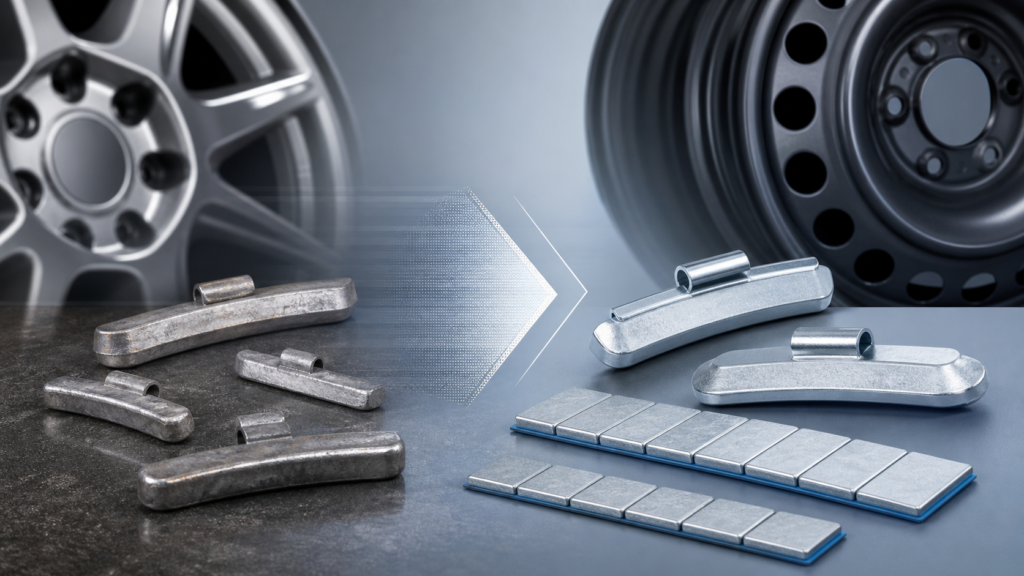
Steel clip-on and adhesive wheel weights illustrating the shift from lead to steel

Steel wheel weights are replacing lead in many markets because buyers, vehicle-service networks, and regulators increasingly want to reduce the risk of lead entering the environment through lost wheel weights. Steel can support both clip-on and adhesive formats, but a successful transition still depends on fitment, mass increments, coating, tape, and destination-specific compliance checks.

For importers and distributors, the change is less about declaring one material universally better and more about building a range that can be sold, installed, and documented with confidence. Lead remains subject to different rules in different jurisdictions and product scopes, so the responsible question is not "Is lead banned everywhere?" It is "What does this destination, customer, vehicle application, and sales channel require?"

Table of Contents

Why is steel replacing lead wheel weights?

Steel is replacing lead wheel weights because it gives buyers a broadly accepted lead-free material path while allowing manufacturers to supply familiar clip-on and adhesive formats. The shift is driven by environmental risk management, destination requirements, and the operational value of standardizing a more widely acceptable product range.

Wheel weights eventually fall off vehicles, are removed during service, or enter scrap and waste streams. The U.S. Environmental Protection Agency has described best-management practices intended to reduce environmental releases from lead wheel weights, including collection and proper handling during tire and wheel service.[1] That concern is a practical reason repair chains, fleets, distributors, and public-sector buyers may prefer non-lead alternatives even where a specific local prohibition does not decide the sale.

Steel is also easier to position as part of a repeatable international assortment. A distributor that serves multiple countries does not want to maintain one lead line for a shrinking set of accounts, then separate non-lead lines for export and environmentally sensitive channels. Consolidating part of the range around Fe or coated steel can simplify catalog presentation, sample management, warehouse handling, and conversations with customers that ask what material is being installed.

This does not mean that steel wins every comparison solely by density or price. Lead is denser, so the same balancing correction takes less physical volume in lead. Steel's lower density means the required piece is usually larger for the same mass, and that affects clip geometry, adhesive-strip layout, and wheel-clearance review. The replacement succeeds because suppliers adapt the format and range around that physical difference, not because the difference disappears.

What makes the move global without making the rules global?

The trend is global because environmental expectations and supply-chain requirements travel across markets, but legal obligations remain destination-specific. Buyers should treat "lead-free" as a procurement and verification question, not as a universal legal conclusion.

In the European Union, the End-of-Life Vehicles Directive creates a framework for restricting certain hazardous substances in vehicles and components, with exemptions and scope details managed through its annexes.[2] That framework is not a substitute for checking the current status of a particular wheel-weight application, vehicle class, or destination. In the United States, federal EPA guidance on lead wheel weights is environmental best-practice material; state requirements and customer policies can differ. Other markets may use their own chemical, waste, vehicle, or customer-specification routes.

For an exporter, this creates a straightforward discipline:

QuestionWhy it mattersEvidence to request or retain
Where will the goods be sold and installed?Rules and customer expectations can differ by destination.Ship-to market, vehicle channel, and customer specification.
Is the claim "lead-free," "steel," or "zinc-coated steel"?A marketing phrase should match the actual material and coating construction.Material declaration and product drawing.
Does a customer require substance information?Chemical declarations can be contract or market requirements.Current compliance statement relevant to the destination.
Is the part for clip-on or adhesive use?Attachment method changes fitment, corrosion, tape, and installation checks.Application list and sample-test plan.

The European Chemicals Agency's Candidate List is updated over time, which is exactly why a historical certificate should not be treated as a permanent answer.[3] A buyer does not need to become a chemist; they do need to state the destination and requested declaration at the RFQ stage, then ask the supplier what document version and material scope the statement covers.

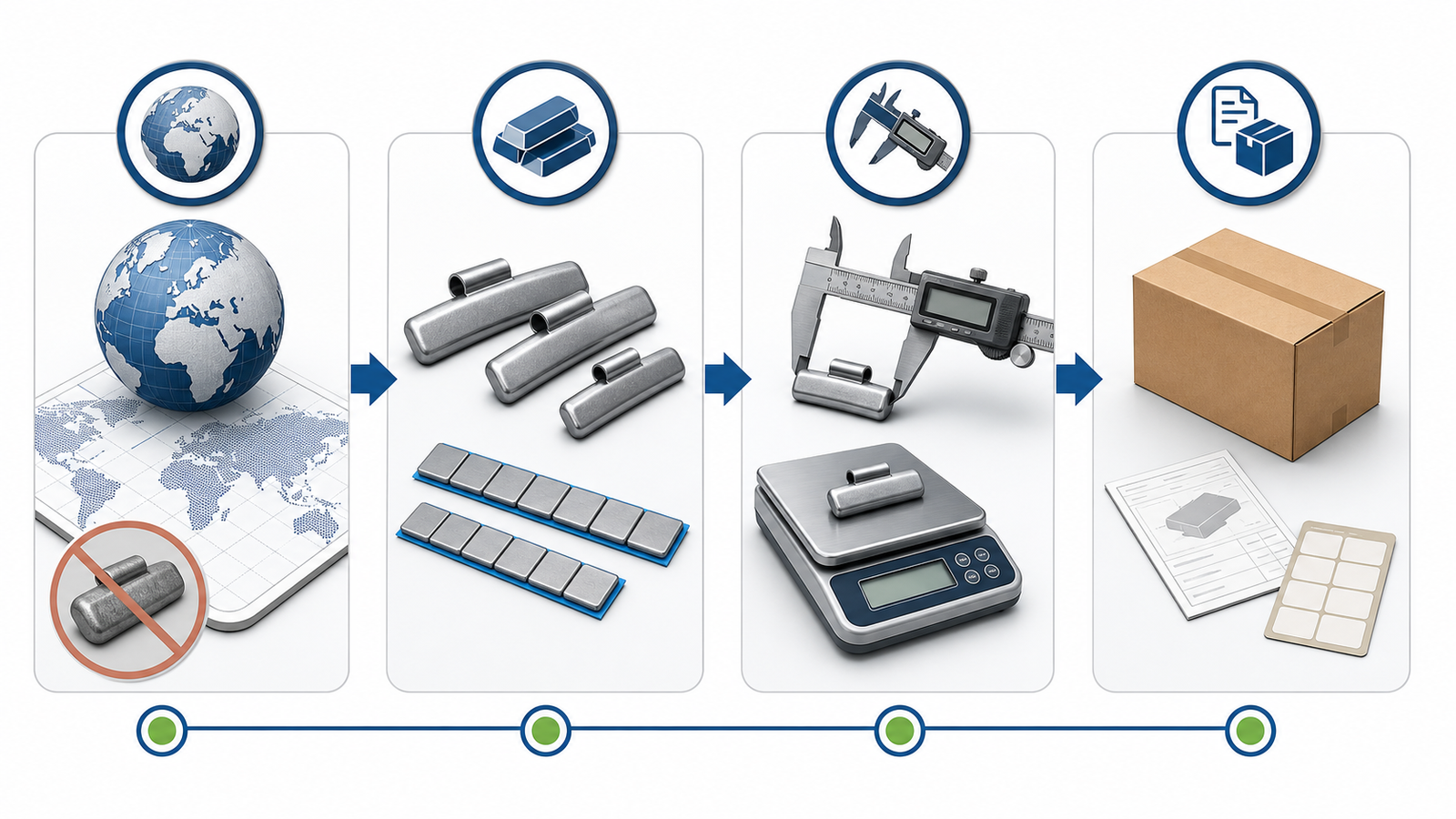
Export verification workflow for steel wheel weights
A material transition works best when destination checks, samples, dimensional verification, and documentation are reviewed together.

A steel transition does not remove the need for evidence. Market-by-market lead-free verification helps buyers define the destination, documentation, and material claim before they approve a range.

How does steel compare with lead in real balancing work?

Steel can perform the balancing function effectively when the weight increment, attachment, and wheel fit are matched correctly; the major design difference is that steel takes more space than lead for the same mass. That makes physical fit and range design central to the material decision.

Wheel balancing corrects a measured imbalance by placing a defined mass at a calculated wheel location. The balancing machine and installer care about the actual correction mass and placement. The material matters because density, shape, corrosion resistance, and attachment design influence whether that correction can be delivered reliably on a particular rim.

FactorLead wheel weightSteel wheel weightBuyer implication
DensityHigher density; compact for a given mass.Lower density; more volume for the same mass.Confirm clearance and segment layout, especially on compact alloy-wheel cavities.
Environmental profileRaises lead-loss and disposal concerns.Supports a lead-free range when material is correctly declared.Verify claims for the destination rather than making blanket statements.
Corrosion managementMaterial behavior differs from steel.Usually relies on suitable coating or plating for service exposure.Request coating details and corrosion-test method when relevant.
Clip-on geometryExisting profiles vary by rim flange.Must be engineered around the same rim-fit requirement.Match clip profile to the intended steel-wheel flange family.
Adhesive applicationAvailable in strip formats.Commonly supplied as segmented, tape-backed strips.Test tape adhesion on real wheel surfaces and service conditions.

Zinc wheel weights are another non-lead option, and the material choice can depend on local preference, range strategy, cost, and format availability. Steel is often attractive because a coated-steel construction can be designed into both service-shop clip-on assortments and adhesive programs. It is not necessary for a buyer to choose one material for every application; what matters is avoiding an accidental mix of material claims, wheel applications, and installation methods.

For a range decision rather than a single conversion, the full material comparison behind a steel replacement decision places steel alongside zinc and legacy lead trade-offs.

Why does attachment design matter as much as material?

Attachment design matters because a wheel weight only works when it remains securely positioned at the balancing location. Changing from lead to steel without reviewing the clip or tape is an incomplete conversion.

For clip-on weights, the critical issue is not simply whether the body is steel. It is whether the clip profile grips the target rim flange correctly without damaging the rim or sitting at an incorrect location. Passenger-car steel wheels, light-truck applications, and different original-equipment rim profiles can require different clip shapes. A weight that looks close enough in a sample tray may still be wrong for the intended flange.

For adhesive weights, steel changes the package geometry that shops handle. Segment mass, segment width, strip length, liner removal, tape type, and the available flat mounting surface all affect installation. A larger steel segment may be perfectly acceptable on one alloy wheel and unsuitable behind a tight spoke pattern on another. Clean, dry preparation and correct application pressure remain installation requirements regardless of material.

Material decisions also interact with finish. For clip-on weights, coating should protect the steel body and clip from routine moisture and road exposure without cracking during handling or installation. For adhesive strips, buyers should consider whether the tape and backing perform on the surface finish and climate of the intended market. A request for a steel material declaration does not replace a basic attachment sample test.

How should buyers build a usable steel replacement range?

Buyers should build a steel range around the wheel applications their customers service, then choose material, attachment format, and increments that cover those applications efficiently. Starting with a generic lead-equivalent SKU list often leaves avoidable gaps.

First separate the service need into clip-on and adhesive demand. A distributor supplying independent tire shops with many steel rims may need broader clip-on flange coverage. A program focused on modern alloy wheels may need more adhesive strips in selected gram increments, tape options, and low-profile formats. The proportion is a business decision based on vehicles serviced, not a fixed industry ratio.

Next map the mass system used by each customer group. Some ranges are organized around ounce increments, while others rely on gram increments and segmented strips. Ask the supplier for the nominal mass, permitted tolerance, segment pattern, strip length, and units shown on the carton. Do not assume that an identical-looking strip has identical mass coverage or packaging logic.

Material is only one input to an assortment. Before locking a stock list, buyers can use the wheel-weight range planning framework to connect wheel types and attachment choices with the steel SKUs they need to warehouse.

A practical range review can group products this way:

Service channelLikely starting formatKey specification questionCommon validation step
Steel-wheel tire serviceClip-on steel weightsWhich flange profiles cover the rims actually serviced?Fit samples on representative rim flanges.
Alloy-wheel serviceAdhesive steel stripsIs the segment size and tape suitable for the available mounting surface?Apply samples to cleaned representative wheels.
Mixed repair networkBoth formatsWhich increments avoid duplicate or low-turning stock?Compare recent balancing corrections and stock movement.
Export distributorMarket-specific mixWhat material statement, label language, and carton configuration are expected?Review destination requirements before approval.

After the replacement specification is clear, buyers can review Fe wheel-weight options after the replacement specification is approved alongside mass coverage and attachment requirements.

What should importers verify for each export market?

Importers should verify the destination, material claim, documentation scope, and commercial labeling before approving production. The same steel weight can be technically sound yet poorly prepared for a particular market if the paperwork or package information is incomplete.

Start with the buyer's own requirement: Does the customer ask for lead-free weights, a stated steel composition, a particular coating, an environmental declaration, or a test report? Then distinguish what is legally required from what is contractually required. A customer may request a declaration even when the destination rule is less specific; conversely, a generic declaration may not answer a local product-scope question.

Ask suppliers to identify the exact product family covered by each document. A declaration that covers an adhesive strip should not automatically be applied to a clip-on line with a different clip, coating, or tape. Check document date, issuer, product code or description, material basis, and any limitations. When a market's rules are uncertain, the responsible commercial position is to verify with the importer, customer compliance team, or qualified local adviser before making a sales claim.

Carton details deserve the same attention. Confirm product code, material wording, unit system, piece count, net weight where required, lot or traceability convention, and any customer-specific labels. A distributor receiving mixed material or mixed units in visually similar cartons can create a warehouse error that no material certificate will fix later.

What specifications reduce returns and installation issues?

Clear specifications reduce returns because they turn "steel wheel weight" from a broad material label into a repeatable part definition. Mass, fit, finish, adhesive construction, packaging, and inspection criteria should be agreed before the first production order.

For clip-on products, record the intended rim or flange family, clip profile, nominal weight, permitted mass tolerance, coating type, finish appearance, and corrosion-test method or acceptance criteria where applicable. For adhesive products, record the segment mass, strip pattern, backing material, tape specification, liner behavior, total strip dimensions, and expected surface-preparation conditions. The right values are application-specific, so a supplier should be able to explain how a quoted option matches the requested wheel type rather than simply sending a broad catalog image.

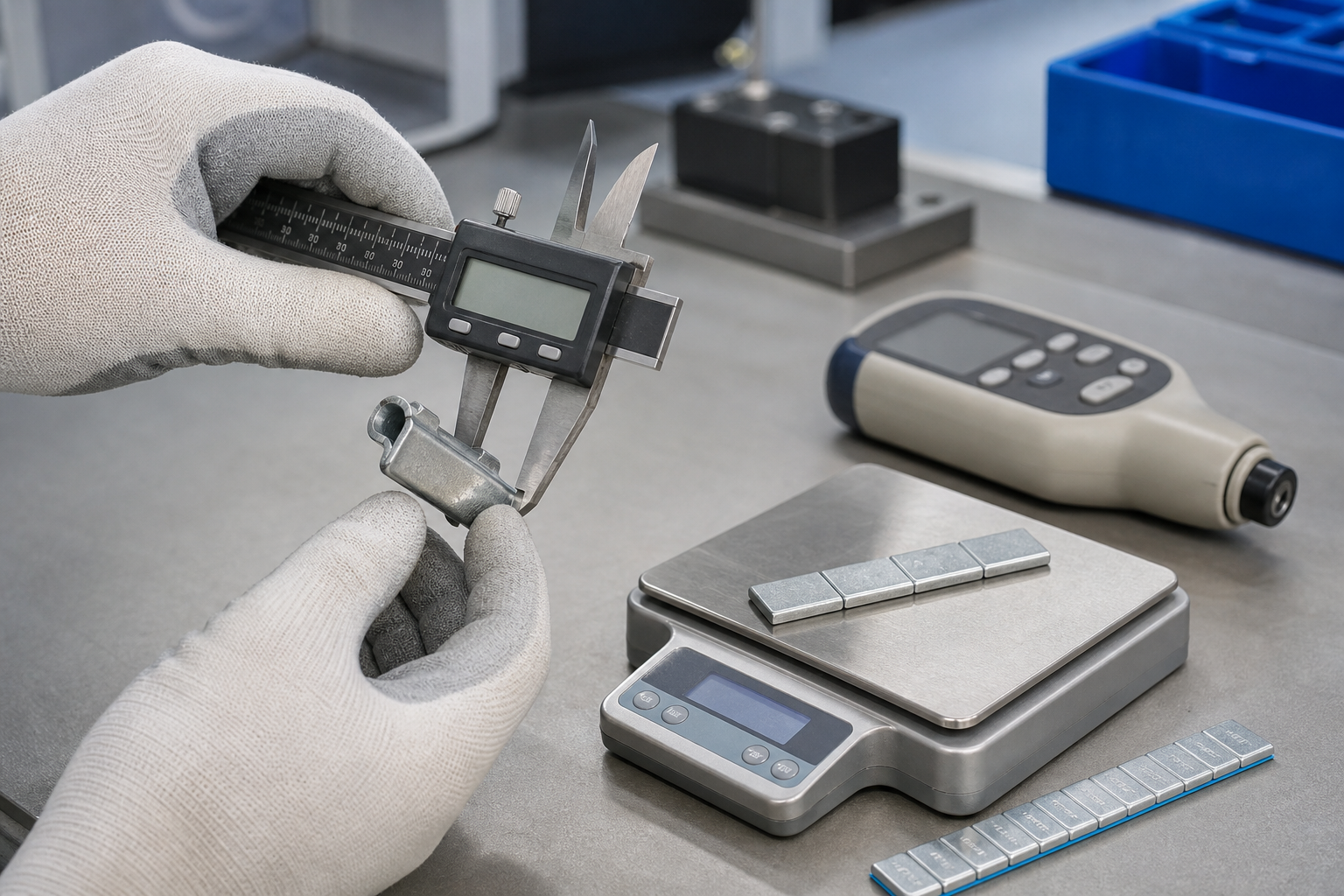
Quality inspection of a zinc-coated steel wheel weight
Mass tolerance, clip profile, coating condition, and adhesive-strip construction are practical checks for steel wheel-weight sourcing.

Inspection should be tied to real failure modes. Weigh a sample across the order, measure clip and segment dimensions, inspect the coating after normal handling, check the adhesive strip for clean segmentation and liner release, and review the cartons against the approved artwork or marking list. A pre-shipment inspection can be useful, but a first-order sample test on representative rims is usually the more valuable early safeguard.

When the RFQ is already clear about the target wheel types, material statement, coating expectation, and packing format, buyers can compare zinc-coated steel wheel-weight samples against the proposed order instead of evaluating a random assortment. This gives the production specification a physical reference for format and construction.

The material transition should be backed by coating, tape, and QC controls for steel-weight repeatability so the approved sample can be reproduced across orders.

What should buyers check before ordering?

Buyers should check the application match and evidence package together, because an acceptable material claim cannot compensate for a poor rim fit or unreliable attachment. A short approval checklist keeps the first order from becoming an expensive field trial.

  • Confirm the sales destination, customer channel, and whether a lead-free or material declaration is requested.
  • Identify clip-on versus adhesive demand and list the wheel or flange families to be served.
  • State the required grams or ounces, segment configuration, and acceptable mass tolerance.
  • For clip-on weights, approve the clip profile on actual representative rims.
  • For adhesive strips, test tape adhesion after the intended wheel-surface preparation and in relevant temperature conditions.
  • Request the material declaration, coating or tape information, and the document date and product scope.
  • Approve carton quantity, inner packs, labeling, unit system, and lot-identification convention.
  • Retain approved samples and photographs as the reference for repeat orders.

This checklist is deliberately practical. It does not assume every buyer needs the same laboratory report or every market uses the same rule. It gives the importer enough structure to ask relevant questions before production, then lets the final requirement come from the actual destination and customer contract.

Conclusion: Treat the change as a range decision

Steel wheel weights are replacing lead across many sales channels because they help buyers respond to environmental concerns and build lead-free options for a wider group of markets. The direction is real, but the right product decision is still specific: confirm destination requirements, choose the proper clip-on or adhesive format, check physical fit, and document what will actually be delivered.

For a new steel program, request Fe or zinc-coated steel samples that match the proposed application, together with a material declaration, dimensional and mass details, tape or coating information, and carton or lot-label specifications. That turns a broad material transition into a range that installers can use and importers can reorder with fewer surprises.

Frequently Asked Questions

Steel's global adoption is driven by a mix of environmental expectations and market-specific requirements, so buyers should verify each destination rather than rely on a single universal rule.

Are lead wheel weights banned worldwide?

No. Requirements differ by country, state or province, vehicle scope, customer policy, and current regulatory status. The practical approach is to verify the intended market and product use, then request documentation that supports the claim being made for that shipment.

Are steel wheel weights as effective as lead wheel weights?

They can be effective when the correct mass is placed in the correct location and the attachment is suitable for the rim. Because steel is less dense than lead, the physical weight is generally larger for the same correction, so fitment and adhesive or clip design must be checked.

Do steel wheel weights rust?

Bare steel can corrode, which is why wheel weights are commonly supplied with a coating or protective finish. Buyers should ask what coating is used, how it is applied, and what inspection or corrosion-performance criteria are available for the intended market.

Should a distributor stock steel, zinc, and lead wheel weights together?

That depends on destination rules, customer demand, service applications, and warehouse complexity. A range review should consider each material's allowed market position, format availability, mass coverage, and labeling so that similar-looking parts are not mixed or mis-sold.

What documents should be requested for steel wheel weights?

Start with a product-specific material declaration, product drawing or specification, package and lot-label details, and any customer- or destination-required compliance statement. For adhesive products, tape information is also useful; for clip-on products, rim-fit sample approval is often more informative than a generic document alone.

References

[1] United States Environmental Protection Agency. “Best Management Practices for Lead Wheel Weights.” 2015.
[2] European Union. “Directive 2000/53/EC on end-of life vehicles.” 2000.
[3] European Chemicals Agency. “Candidate List of substances of very high concern for Authorisation.” Accessed June 2026.

Facebook
X
LinkedIn
LinkedIn
Reddit
yirox auto parts

Yirox is an automotive and new-energy vehicle product manufacturer and solution provider, covering EV charging accessories, BYD/Tesla accessories, pickup truck accessories, wheel-service consumables, automotive abrasives and off-road LED lighting. With multi-process manufacturing, OEM/ODM development, traceable quality control and export-oriented service, Yirox helps distributors, wholesalers and brand owners build reliable, market-ready automotive product programs.

If you’re evaluating suppliers, refining a lash design, or planning a private label order, we’re happy to share practical input or provide samples to support your decision.

Recent Post
Clip-on wheel weight fitted to a black steel wheel compared with adhesive weights inside a silver alloy wheel
Wheel Weight Types: Clip-On vs Adhesive and How to Choose
Non-lead steel and zinc wheel weights with export cartons and documents
Non Lead Wheel Weights: Steel, Zinc, and Export Buying Options
Adhesive wheel weight rolls and pre-cut strips displayed side by side with boxes, cartons, tape liner, and selection checklist.
Wheel Weight Rolls vs Strips: Which Adhesive Format Fits Your Market?
Rim weights and wheel balance weights displayed with alloy and steel rims, clip-on weights, stick-on strips, and terminology notes.
Rim Weights Explained: Are They the Same as Wheel Balance Weights?
Passenger car wheel weights displayed with alloy and steel wheel examples, adhesive strips, clip-on weights, boxes, and sizing tools.
Passenger Car Wheel Weights: Types, Sizes, and Fitment Guide
Commercial vehicle wheel weights displayed with fleet, truck, and bus service context, cartons, and sizing tools.
Commercial Vehicle Wheel Weights: Fleet, Truck, and Bus Buying Guide