



In 2026, the most practical wheel-balancing trend is a shift toward lead-free material portfolios, more data-assisted service equipment, and market-specific compliance checks. For most passenger-car, low-profile-tire, and alloy-wheel service, measured wheel weights remain the dependable starting point. Selected heavy-duty or specialty applications may justify a controlled trial of another method, but the exact tire, wheel, valve or TPMS setup, service process, and local rule decide compatibility. 1 2 3
This outlook is for suppliers, tire-service businesses, distributors, fleet teams, and buyers planning for the 2026 market. It separates confirmed developments from longer-term signals. This wheel weights versus tire balancing overview explains the basic service/product distinction.
Table of Contents
- What is confirmed in the 2026 wheel-balancing outlook?
- What is new in wheel-balancing technology?
- What material changes matter most for wheel-balancing buyers?
- Are lead wheel weights being phased out?
- How is automation changing tire-service workflows?
- How should shops compare manual and automated balancing?
- What do 2026 wheel-weight regulations mean by region?
- How should buyers evaluate material, automation, and compliance claims?
- What should suppliers prepare for 2026?
- What should tire shops prepare for 2026?
- Methodology and annual update log
- Conclusion: what is the safest 2026 planning decision?
- Frequently asked questions
- References
What is confirmed in the 2026 wheel-balancing outlook?
Four signals are solid enough to guide a 2026 plan.
First, lead-free sourcing is no longer a niche request. The U.S. Environmental Protection Agency said in December 2024 that it would not initiate a proposed TSCA rulemaking on lead wheel weights. The same announcement reported that nine U.S. states and Canada had banned lead wheel weights, that alternatives such as steel, zinc alloy, and plastic-metal composite were widely available, and that vehicle manufacturers surveyed by the agency no longer used lead wheel weights on new vehicles sold in the United States. 1
That is not the same as a single worldwide ban. It means a supplier should treat lead-free options as the default portfolio direction while checking the rule, customer specification, and product scope for each destination.
Second, wheel-balancing equipment is becoming more capable of capturing and standardizing data. A current Hunter wheel-balancer product page describes automatic wheel-dimension measurement through a vision system, automatic centering checks, an onboard TPMS-related vehicle database, and self-calibration features. These are manufacturer-stated equipment capabilities, not proof that every shop has the same automation level. 3
Third, regulation is becoming a documentation problem as much as a material problem. The EU end-of-life vehicle framework remains in force and its 2023 delegated directive updates exemptions for lead in specified vehicle materials and components. The legal answer depends on the vehicle/component scope and national implementation; it should not be reduced to a generic claim that “the EU bans every lead wheel weight in every situation.” 2
Fourth, current safety guidance connects balancing with the rest of tire maintenance. NHTSA’s TireWise guidance says balancing and alignment by a qualified technician matter for tire life and vehicle safety, and it treats TPMS, pressure, tread, rotation, balance, and alignment as related maintenance topics. 5
This is directional evidence, not a market-share dataset. It supports the 2026 planning direction—lead-free materials, data-assisted equipment, and documented service workflows—but it does not prove that every shop or supplier has adopted the same system. Build a documented material-and-fitment portfolio, then connect it to the service workflow and destination market.
Confirmed changes versus longer-term signals
| 2026 planning item | Status | What a buyer can act on now |
|---|---|---|
| Lead-free wheel-weight availability | Confirmed market direction | Qualify steel, zinc-alloy, and composite alternatives with composition and fitment records |
| No new U.S. federal TSCA proposal from the EPA decision | Confirmed as of the cited decision | Do not call it a federal ban; check state, provincial, customer, and export requirements |
| More automated measurement and centering features | Confirmed at the equipment-feature level | Compare measured cycle time, repeatability, rework, and data output |
| One universal global wheel-weight rule | Not confirmed | Map each destination, vehicle category, component scope, and effective date |
| Fully autonomous tire service in ordinary shops | Longer-term signal | Treat automation as a workflow investment with human inspection and exception handling |
| One replacement material winning every wheel and vehicle class | Not confirmed | Keep multiple formats and approve by application segment |
What does the current evidence actually prove?
The 2026 outlook is based on observable signals, not a fabricated market-share forecast. Each source supports a different part of the trend, so the evidence should be read as a directional stack:
| Source and date | What it supports | What it does not prove |
|---|---|---|
| EPA decision published in 2024 and last updated in 2025 | Lead-free alternatives are commercially available, new U.S. vehicles surveyed by the agency no longer use lead wheel weights, and state/Canadian restrictions exist 1 | A single federal U.S. ban or universal global adoption |
| California code page current in 2026 | A named state has an operative 0.1% lead-by-weight threshold for manufacturing, selling, or installing wheel weights in California 4 | That every export market uses California’s threshold or scope |
| Hunter wheel-balancer information current in 2026 | Current equipment can include vision measurement, centering checks, TPMS-related data, and self-calibration features 3 | That every tire shop has adopted the same automation or will achieve the same cycle-time result |
| NHTSA TireWise guidance current in 2026 | Balance, alignment, pressure, tread, rotation, and TPMS belong in a connected tire-maintenance workflow 5 | A forecast of equipment sales or a causal claim about tire-related crashes |
That is enough to justify a 2026 planning article. It is not enough to publish a numeric market-growth claim without a separate industry dataset.
What is new in wheel-balancing technology?
The physics of imbalance has not changed: a rotating tire-and-wheel assembly still needs its mass distribution measured and corrected. More steps around measurement, diagnosis, and records can now be assisted by equipment and software.
Traditional service can require a technician to enter wheel dimensions, select a program, center the assembly, spin it, read the correction positions, install the appropriate weight, and run a recheck. Modern equipment may reduce manual entries, identify dimensions through a sensor or vision system, check centering, suggest correction locations, and store or share service data. Hunter’s current product information is a useful example of this direction, including vision-based dimension measurement, CenteringCheck, SmartWeight technology, and a vehicle database. 3
For a buyer, “new technology” should be translated into measurable questions:
- Which dimensions are measured automatically, and which still require manual entry?
- How does the machine verify the wheel is centered on the shaft or adapter?
- Can it support the shop’s actual steel, alloy, hidden-weight, and adhesive-weight programs?
- Does it provide a road-force or other diagnostic mode, or only a conventional spin balance?
- Can the result be exported to a work order, fleet record, or quality dashboard?
- How are calibration, maintenance, software updates, and operator training handled?
Automation is valuable when it lowers variation, but the shop still needs maintenance, correct adapters, clean bonding surfaces, and repeat-vibration diagnosis. The roadmap should cover mounting through final inspection.
What material changes matter most for wheel-balancing buyers?
Material selection affects density, correction volume, corrosion behavior, coating, clip geometry, adhesive performance, handling, and end-of-life documentation. The correct comparison is not “which material is best?” but “which material and format meet this wheel interface and service standard at the required correction range?”

The main material groups have different purchasing implications:
| Material or format | Practical advantage | Questions to verify before approval |
|---|---|---|
| Steel | Widely understood, durable, and available in many clip-on and adhesive formats | Density and segment geometry, coating or corrosion performance, clip retention, adhesive compatibility, and required correction volume |
| Zinc alloy | Lead-free option with established use in replacement portfolios | Alloy declaration, surface finish, clip fit, coating consistency, and whether the part matches the wheel flange or adhesive location |
| Plastic-metal composite | Can support a lead-free portfolio and selected packaging or handling goals | Material composition, density, temperature behavior, attachment strength, cut or break behavior, and repeatability across batches |
| Lead | Familiar density and legacy fitments in some older service populations | Destination restrictions, customer phase-out requirements, handling and disposal expectations, and whether a lead-free equivalent is commercially available |
| Adhesive strip | Useful where a clip-on profile is unsuitable or a hidden placement is needed | Wheel finish, cleaning process, temperature, pressure, cure or dwell requirements, brake clearance, and removal method |
Use the wheel-balancing weights range to compare formats, then specify the wheel interface, correction range, service position, and packaging.
For alloy wheels, a lead-free claim is not a fitment approval. The clip can damage the flange, the adhesive can fail on a coating, or the correction location can interfere with the brake. Verify the actual wheel and service process.
Are lead wheel weights being phased out?
Yes, as a market direction—especially for new U.S. vehicles and buyers with lead-reduction requirements—but not as one universal 2026 rule covering every country, vehicle, and replacement part.
The EPA’s 2024 announcement provides a useful U.S. baseline: the agency declined to begin proposed TSCA rulemaking, reported bans in nine states and Canada, identified steel, zinc alloy, and plastic-metal composite as widely available alternatives, and said surveyed automakers no longer used lead wheel weights on new vehicles sold in the U.S. 1
California provides a concrete state-level requirement. California Health and Safety Code §25215.8 prohibits manufacturing, selling, or installing a wheel weight in California that contains more than 0.1% lead by weight. The current legislative page identifies the provision as the renumbered section effective January 1, 2020; this is an operative state restriction, not a proposed 2026 phase-in. 4
The commercial response is not to claim that all lead products are suddenly illegal. Instead:
- Make lead-free options the default for new programs and export quotations.
- Keep legacy fitments separate and mark their market limits.
- Request a material declaration and traceability documents.
- Check the destination rule and confirm the replacement preserves correction range and wheel fit.
In the EU, Directive 2000/53/EC sets a baseline that materials and components in vehicles put on the market after July 1, 2003 must not contain lead, mercury, cadmium, or hexavalent chromium, subject to Annex II exemptions. Commission Delegated Directive (EU) 2023/544 entered into force 20 days after its March 10, 2023 publication, and Member States had to bring implementing provisions into force by June 1, 2023. The directive also excludes wheel balance weights from a specific spare-parts exception for older vehicles. 2
The EU framework is still not a substitute for a product-by-product legal review. A compliance team should read the vehicle/component scope, exemption language, and member-state implementation before approving a claim for a specific wheel-weight program.
How is automation changing tire-service workflows?
Automation is moving the value discussion from “how fast does the machine spin?” to “how consistently does the entire job reach an approved result?”

The workflow improvements most relevant to 2026 are:
More consistent measurement
Automatic dimension measurement can reduce data-entry mistakes and make the next operator’s setup more predictable. It does not remove the need to select the correct adapter, verify the wheel, or recognize an unusual configuration.
Better centering control
An automatic centering check can help identify a mounting condition that would otherwise produce an unreliable result. The machine feature is only useful when the shop uses the correct cones, adapters, and clamping procedure for the wheel.
Faster diagnosis of persistent complaints
Some advanced balancers add road-force or diagnostic functions. Those functions can help separate a simple imbalance from a tire, wheel, mounting, or uniformity issue. The equipment cannot repair a bent wheel or a defective suspension component; it can only provide better evidence for the next decision.
A clearer data trail
Fleet and multi-location operators can benefit when the service record includes the wheel position, correction amount, mode, recheck result, and exception reason. This makes repeat complaints easier to analyze and creates a measurable basis for comparing equipment or material changes.
Lower operator variation, not zero operator responsibility
A modern machine may automate measurement and prompts, but technicians still inspect the tire and wheel, clean adhesive surfaces, select the correct part, install it at the specified position, and decide when to escalate a fault. The best 2026 workflow is assisted and auditable, not blindly automatic.
How should shops compare manual and automated balancing?
Use a process comparison rather than a feature-count comparison.
| Decision factor | Manual or conventional workflow | Automated or data-assisted workflow |
|---|---|---|
| Initial investment | Lower equipment cost and familiar training path | Higher capital, software, calibration, and service expectations |
| Measurement | More operator entry and interpretation | May automate dimensions, prompts, centering checks, or selected diagnostics |
| Throughput | Depends heavily on technician skill and rework | Can reduce repeated entries and waiting steps when correctly configured |
| Quality record | Often limited to paper or work-order notes | May support digital result capture and fleet-level analysis |
| Exception handling | Experienced technician often detects unusual conditions directly | Machine can surface an exception, but a technician still diagnoses it |
| Best fit | Low-volume, established, or budget-controlled service lanes | High-volume, multi-location, repeatable, or data-driven service programs |
Test the shop’s own assemblies and measure cycle time, first-pass success, rework, repeat complaints, setup errors, calibration interruptions, and training time. If a vendor quotes a dramatic time saving, ask which steps and tire/wheel population it covers.
The wheel balancer modes guide is useful when documenting which program a shop actually uses. This matters because “automated” does not tell a buyer whether the equipment supports the required static, dynamic, alloy, hidden-weight, or diagnostic workflow.
What do 2026 wheel-weight regulations mean by region?
Document the jurisdiction before approving a material claim. The table below summarizes what the cited sources establish and what they do not.

| Region or market | Confirmed position from the cited source | Effective date or scope to verify | Buyer action |
|---|---|---|---|
| United States — federal | EPA announced it would not initiate proposed TSCA rulemaking on lead wheel weights | No federal ban or new effective date follows from that decision; the reviewed scope covered manufacture, processing, distribution, use, and disposal under TSCA | Do not use the EPA decision as a blanket approval; check state rules, customer specifications, and destination requirements |
| United States — state markets | EPA reported that nine U.S. states had banned lead wheel weights | The specific state, effective date, product scope, and enforcement details must be checked in the applicable state source | Maintain a state-by-state shipping and product matrix rather than one U.S.-wide assumption |
| California — state | California HSC §25215.8 prohibits manufacturing, selling, or installing a wheel weight in California containing more than 0.1% lead by weight 4 | The current code page identifies the section as renumbered effective January 1, 2020; it is an operative restriction, not a 2026 phase-in | Keep California orders on a lead-free specification and retain material declarations for the products shipped |
| Canada | EPA reported that Canada had banned lead wheel weights | The applicable national, provincial, product, and effective-date details need direct confirmation before a claim is made | Ask the importer or compliance owner for the exact market rule and keep the material declaration with the shipment |
| European Union | Directive 2000/53/EC sets a no-lead baseline for materials and components in vehicles put on the market after July 1, 2003, subject to Annex II exemptions; wheel balance weights are excluded from a specific older-vehicle spare-parts exception 2 | Commission Delegated Directive (EU) 2023/544 entered into force 20 days after its March 10, 2023 publication, or March 30, 2023; Member States had to bring implementing provisions into force by June 1, 2023 | Map the actual wheel-weight program to the vehicle/component scope, Annex II language, and applicable member-state implementation |
Primary CTA: request a documented application review
If you are choosing a 2026 wheel-weight material, checking California or EU fit, or evaluating automated balancing equipment, share your tire sizes, wheel material and finish, correction range, TPMS or valve details, destination markets, and annual volume. We can help you compare a practical specification through this automotive accessories quote request before a larger order.
How should buyers evaluate material, automation, and compliance claims?
Buyers should score evidence in three separate lanes. Combining them into one “better technology” claim creates avoidable risk.
Material evidence
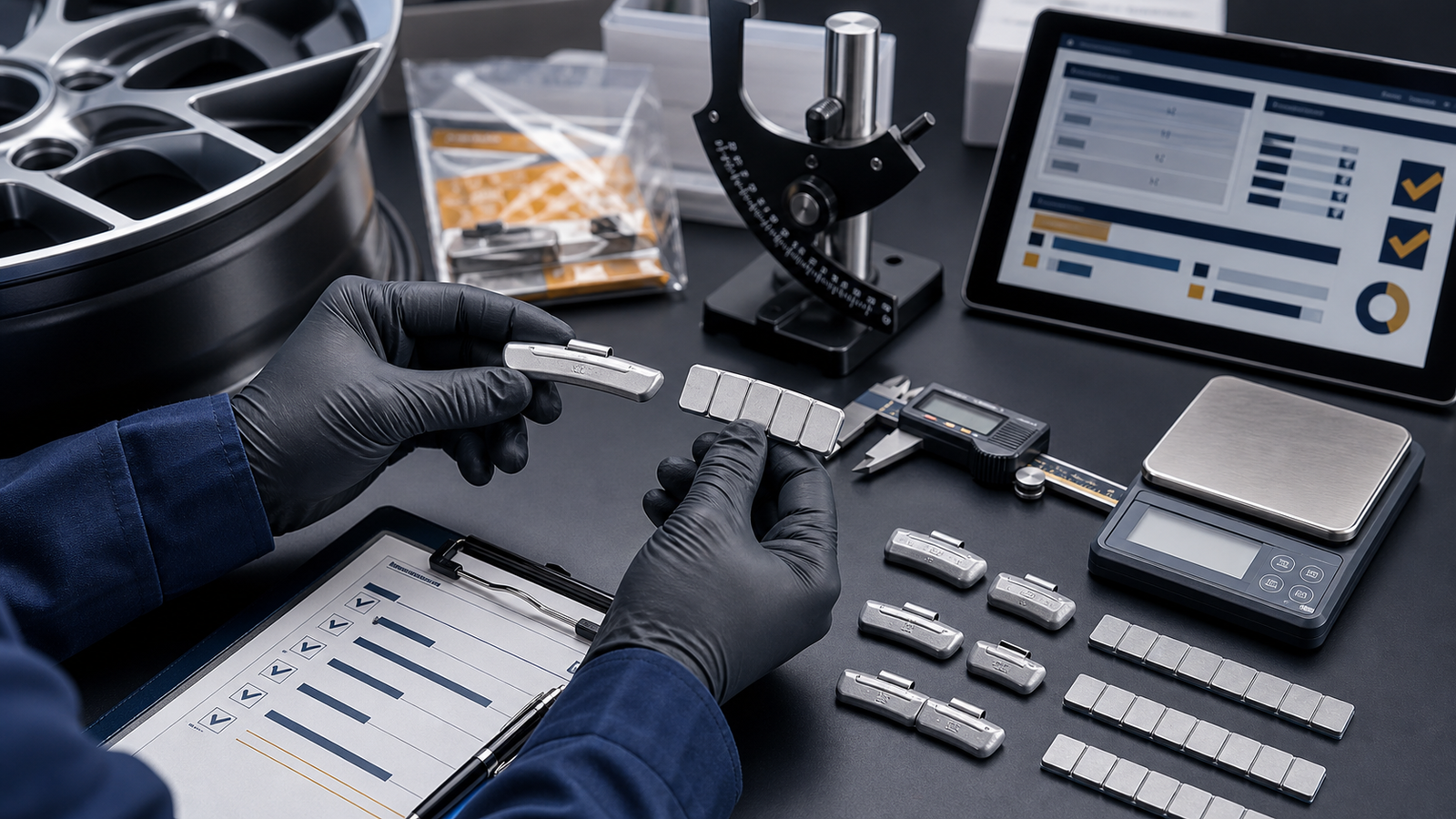
Ask for the declared composition, density or mass tolerance, coating specification, corrosion or environmental test method, clip dimensions, adhesive construction, and batch identification. For a lead-free claim, define whether it means no intentionally added lead, a stated threshold, or compliance with a named customer or legal requirement.
Equipment evidence
Ask for the exact model, supported wheel and tire range, adapters, automatic functions, calibration interval, data outputs, service requirements, and training scope. Compare a controlled sample of the shop’s assemblies. A machine that is excellent for passenger-car alloy wheels may not be the correct choice for heavy-duty or unusual wheel configurations.
Compliance evidence
Ask which authority or customer requirement the claim relies on, the publication or effective date, the legal/product scope, the market covered, and the document owner. A supplier should be able to say “this declaration covers this material and this shipment” rather than simply placing “eco-friendly” or “lead-free” on a product page.
Total-cost evidence
Compare material cost, correction quantity, packaging, storage, installation time, rework, removal, disposal, training, equipment maintenance, and complaint handling. A lower unit price can disappear if the part requires more correction volume, creates more adhesive failures, or cannot be used on the shop’s existing wheel population.
What should suppliers prepare for 2026?
Suppliers can prepare for the trend by making the product portfolio easier to approve, not merely by adding another material name.
- Create a lead-free default range. Separate steel, zinc-alloy, and composite products by wheel interface and correction range.
- Build a fitment library. Record clip profiles, adhesive dimensions, finish limits, brake clearance, and approved positions.
- Standardize declarations. Provide composition, mass tolerance, coating, batch, packaging, and destination-specific documentation.
- Segment the market. Separate passenger-car, commercial, off-road, RV, and fleet applications instead of promising one part for every vehicle.
- Sell with evidence. Ask about balancer modes and adapters, then define representative wheels, acceptance criteria, recheck method, and a trial duration.
- Maintain an update log. Record when a regulation, customer requirement, declaration, or product specification was last reviewed.
For commercial applications, the commercial-vehicle wheel-weight planning resource can help structure a separate heavy-duty range around wheel type, service position, correction range, coating, and inventory depth.
What should tire shops prepare for 2026?
Shops should treat the trend as an operating-system update for wheel service.
- Map the wheel population. Record tire sizes, wheel materials and finishes, axle positions, TPMS layouts, and unusual applications.
- Define the default path. For ordinary passenger-car, low-profile, and alloy-wheel work, begin with measured wheel weights and a documented recheck.
- Test specialty methods separately. For beads or another internal method, define the tire/wheel segment, supplier instructions, valve and sensor review, and trial rule.
- Audit the machine setup. Verify adapters, centering, calibration, program selection, and static, dynamic, alloy, or diagnostic modes.
- Track exceptions and train consistently. Record repeat vibration and vehicle findings, teach lead-free installation/removal, and use the same first-pass and escalation rules across locations.
NHTSA’s current TireWise guidance also treats balance and alignment as part of tire maintenance and says new tires should be balanced when installed. 5 This supports a workflow that checks pressure, TPMS, tread, mounting, centering, and vehicle condition rather than blaming the weight for every vibration.
This approach turns automation and material changes into measurable service improvements. It also keeps a shop from blaming the weight when the actual problem is a bent wheel, a mounting error, a tire-uniformity issue, or a vehicle fault.
Methodology and annual update log
This article uses the topic brief’s 2026 framing and checks it against current U.S. and California government pages, EU legal text, current equipment documentation, and current tire-safety guidance. The brief’s demand score is only a proxy; its example SERP URLs are not cited.
Review the article annually or when a target market changes its material rule or customer specification. Update the regulation table, references, product declarations, equipment capabilities, and performance figures. Do not add “global ban,” “fully automatic,” or “one material fits every wheel” language without a new source.
Update log: August 2026 — initial 2026 outlook covering materials, automation, regulation, supplier preparation, and tire-shop preparation.
Conclusion: what is the safest 2026 planning decision?
The safest 2026 decision is a segmented, evidence-led program. Use measured wheel weights as the practical starting point for most passenger-car, low-profile-tire, and alloy-wheel service. Build steel, zinc-alloy, and composite alternatives into the lead-free portfolio. Evaluate automated equipment by repeatability, centering, diagnosis, data capture, and total workflow impact. Reserve specialty methods for applications that pass a documented tire, wheel, valve or TPMS, service, and compliance review.
For suppliers, the opportunity is to make material and fitment evidence easy to approve. For tire shops and fleets, the opportunity is to turn every material or equipment change into a controlled test with a clear acceptance rule. That is more durable than reacting to a headline about a ban, a new machine feature, or a replacement material.
Frequently Asked Questions
What is the biggest automotive wheel-balancing trend in 2026?
The biggest practical trend is the combination of lead-free material planning and more data-assisted wheel-service equipment. The correction principle remains, but the portfolio and workflow are becoming more documented and market-specific. 1 3
Are lead wheel weights illegal everywhere in 2026?
No universal global rule is established by the sources used here. EPA reported bans in nine U.S. states and Canada and no lead wheel weights in new U.S. vehicles according to automaker information, while the federal agency did not initiate proposed TSCA rulemaking. Verify the destination, product scope, and customer requirement. 1
Which replacement material should a supplier stock first?
Start with the material and format that match the customer’s wheel population. Steel and zinc-alloy options are common lead-free starting points; composites may fit selected applications. Compare density, correction volume, clip or adhesive fit, coating, corrosion, and documentation—not the material name alone. 1
Does an automated balancer eliminate technician judgment?
No. Automation can assist dimension measurement, centering, correction prompts, diagnostics, and record capture, depending on the equipment. The technician still verifies the assembly, chooses the correct adapter and weight, inspects the wheel and tire, and escalates an exception. 3
How should a fleet evaluate new balancing equipment or materials?
Define a representative segment, test the same type of tire-and-wheel assemblies, and record first-pass success, service time, rework, repeat complaints, installation or removal effort, compatibility issues, and total cost. Approve the change by segment instead of treating one successful wheel as proof for the whole fleet.
What should be included in a 2026 wheel-weight RFQ?
Include tire size and construction, wheel material and finish, flange or adhesive location, correction range, axle position, TPMS or valve details, material declaration, coating, packaging, batch control, sample quantity, acceptance criteria, destination markets, and the service equipment used. This makes supplier quotations comparable and reduces the chance of approving an incompatible substitute.
References
[1] United States Environmental Protection Agency. “EPA Decides Not to Proceed with Proposing Lead Wheel Weight Rulemaking.” 2024.
[2] European Commission / EUR-Lex. “Commission Delegated Directive (EU) 2023/544.” 2023.
[3] Hunter Engineering Company. “Road Force WalkAway Wheel Balancer.” 2026.
[4] California Legislative Information. “California Code, Health and Safety Code Section 25215.8 — Lead Wheel Weights.” 2026.
[5] National Highway Traffic Safety Administration. “Tire Safety Ratings and Awareness (TireWise).” 2026.