



For truck fleets, the choice between balancing beads and wheel weights is a service-system decision, not a simple contest between two products. Fixed weights give a measured correction at the rim; beads use moving internal media. The right starting point depends on tire size, wheel construction, route, equipment, and how the fleet handles repeat complaints.
This guide is for fleet maintenance managers, truck tire dealers, commercial-vehicle distributors, and buyers evaluating a repeatable balancing program. It focuses on where each method fits, what can fail, and how to run a representative test before standardizing a fleet specification. For the basic distinction between the two service concepts, see this wheel weights versus tire balancing overview.
Table of Contents
- Are balancing beads or wheel weights better for trucks?
- How do balancing beads and wheel weights work differently?
- Which truck applications fit conventional wheel weights?
- When might balancing beads be worth evaluating?
- What can go wrong with each balancing method?
- Can balancing beads damage TPMS sensors?
- Which method is better for alloy wheels?
- Do wheel weights work better at highway speeds?
- How should a fleet test the right balancing method?
- What should buyers include in a truck balancing specification?
- Conclusion: Choose around the fleet service workflow
- Frequently Asked Questions
- References
Are balancing beads or wheel weights better for trucks?
For most standard truck tire-shop workflows, conventional wheel weights are the more predictable starting point because the assembly is measured and the correction is fixed. Balancing beads may deserve testing on selected heavy-duty, off-road, or specialty applications. Neither method repairs a bent wheel, tire uniformity issue, mounting error, or suspension fault. 1 3
The practical fleet question is not “which product wins?” It is “which method produces a repeatable result through our actual service workflow?” A highway tractor fleet with established balancer access may value measurement and inspection. A specialty fleet may value an internal method that avoids external hardware, but it still needs application validation and controlled installation.
| Decision factor | Conventional wheel weights | Balancing beads or compounds |
|---|---|---|
| Where the correction is created | At a measured position on the rim | Inside the tire cavity as the assembly rotates |
| Primary workflow | Spin the mounted assembly, then attach the specified mass | Add the specified internal medium during tire service |
| What is easy to inspect | Weight location, retention, and rim interface | Correct product, quantity, valve path, and installation record |
| Typical fleet advantage | Familiar process and visible correction | Potential fit for selected applications where internal balancing is preferred |
| Main buying risk | Wrong clip profile, poor adhesion, or incorrect placement | Wrong medium or quantity, incompatible valve/sensor setup, or inconsistent service procedure |
The table is a selection framework, not a performance guarantee. Manufacturer literature for balancing compounds commonly describes internal redistribution during rotation, while trade coverage emphasizes that fleets have adopted both mechanical and compound-based approaches for different reasons. Treat those claims as inputs to a trial, then judge the method against your own vibration, service-time, and repeat-repair data. 3 4
How do balancing beads and wheel weights work differently?
Fixed wheel weights correct a measured imbalance by placing mass on the rim at a calculated position. Balancing beads use loose internal media that redistributes inside the tire cavity while the assembly rotates. Both approaches still depend on correct tire mounting, compatible hardware, and a service process that can identify problems beyond imbalance. 2 4
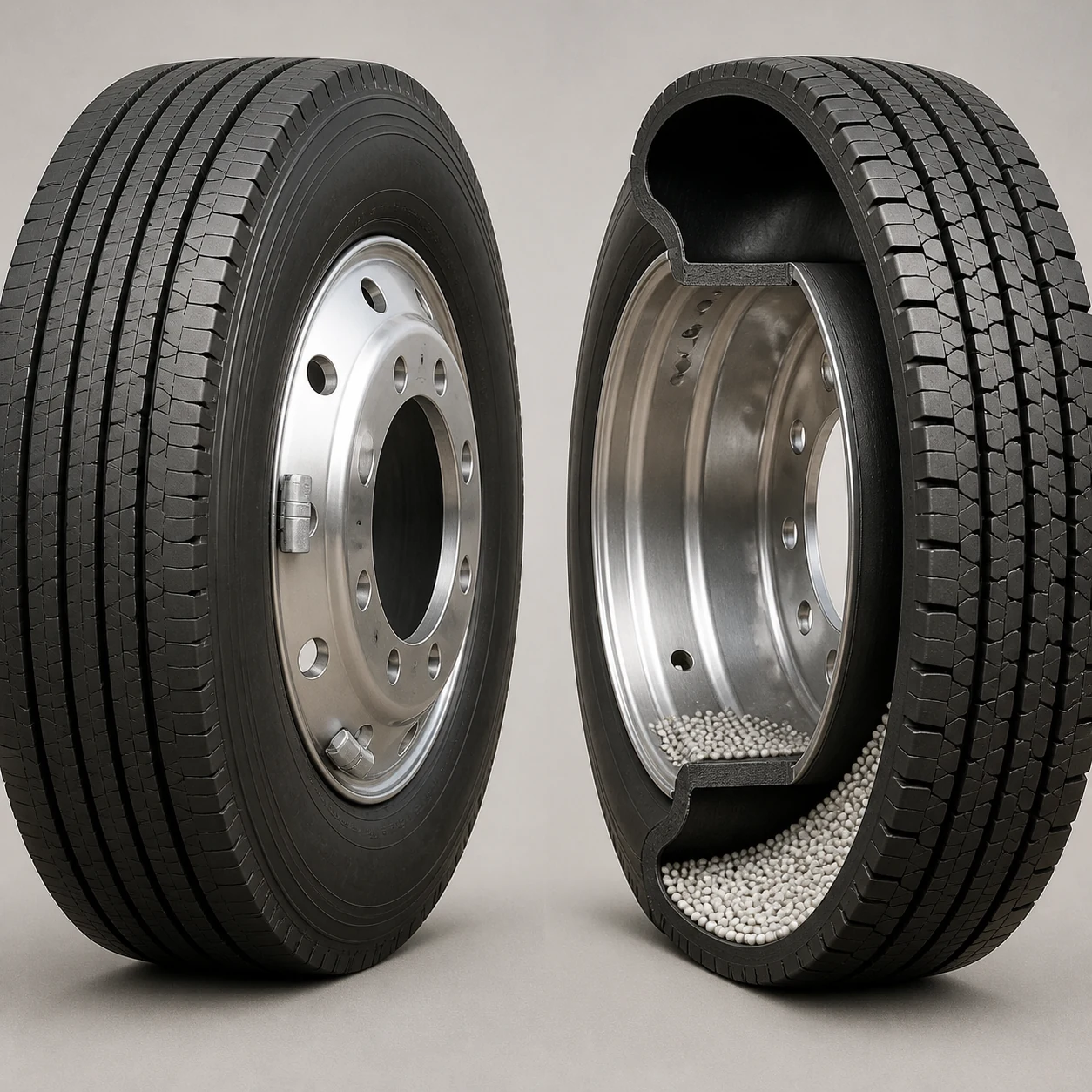
Fixed weights attach to the rim, while balancing beads move inside the tire cavity; the illustration is a conceptual comparison and not a substitute for product instructions.
How fixed weights fit the shop workflow
The shop mounts the tire and wheel, enters or measures the assembly dimensions, spins it on suitable equipment, and follows the machine’s correction position. The technician then chooses a clip-on or adhesive format that matches the wheel interface and confirms the result. A fleet can document this process through its existing wheel balancer modes and service records.
This method is easy to audit visually: the product, location, and retention can be checked after installation. That does not make it failure-proof. The wrong profile, dirty surface, incorrect placement, or a missing weight can create a repeat complaint even when the part itself is within specification.
How internal balancing fits the tire workflow
Beads or other compounds are added inside the tire according to the product’s application method and quantity. As the tire rotates, the medium is intended to redistribute and create a counter-effect within the assembly. Product literature may specify bag sizes, injection tools, valve handling, or tire applications; those instructions should control the trial rather than a generic online dosage chart. 4
The internal workflow can reduce the amount of visible hardware, but it introduces a different checklist. The installer must control product identity, quantity, tire dismounting, valve or sensor compatibility, moisture or contamination, and how the medium is handled during a repair. The method should be considered only when those controls are practical for the fleet.
Which truck applications fit conventional wheel weights?
Conventional wheel weights usually fit best where a truck tire shop already has a heavy-duty balancer, technicians are trained to read the correction, and the fleet wants a visible, repeatable record for each assembly. Common examples include highway tractors, trailers, regional delivery vehicles, and mixed commercial fleets with established wheel-service routines. 2 3
Highway tractors and trailers
Long-haul and regional fleets often prioritize a predictable initial correction, quick diagnosis of a new vibration, and a clear handoff between the fleet shop and outside tire dealer. Fixed weights support that workflow because the correction is visible and tied to a measured assembly. A commercial-vehicle wheel-weight range can be organized around the actual wheel and service mix rather than a generic catalog list.
Mixed fleets and service networks
If multiple depots or dealers service the same fleet, standardization matters as much as the part number. Define how assemblies are mounted, which balancing mode is used, where correction is allowed, how removed weights are recorded, and when a repeat complaint triggers a tire or wheel inspection. The goal is consistent service data, not simply a single weight format.
When fixed weights are not enough
Fixed weights cannot compensate for every condition. If the wheel has excessive runout, the tire has a uniformity or mounting issue, the assembly is not centered correctly, or the vehicle has a steering or suspension problem, adding more mass may mask the symptom rather than solve it. A fleet standard should define an escalation path for those cases.
When might balancing beads be worth evaluating?
Balancing beads may be worth evaluating when a fleet has a specific heavy-duty or specialty application, a clear internal-balancing service process, and a reason to compare the method with its current external-weight workflow. The case should be proven on representative assemblies; it should not be assumed from a product brochure or one successful tire.
Larger and specialty assemblies
Some internal-balancing products are marketed for tractor-trailer, RV, off-road, or small-truck tires. ESCO’s product literature, for example, lists truck and tractor-trailer applications and describes bead quantities and installation routes. That makes the document useful for building a test plan, but it does not establish suitability for every tire, wheel, speed, load, valve, or sensor combination. 4
When an internal method can simplify the buying problem
The strongest reason to test beads is usually workflow fit, not a universal promise of lower cost or longer tire life. If the fleet wants to reduce reliance on external correction hardware, has consistent access to the tire cavity, and can control the product quantity and repair process, an internal method may deserve a measured comparison. Keep the claim narrow until field data supports expansion.
When beads should not be treated as a shortcut
Beads do not eliminate the need to inspect a damaged assembly, confirm tire pressure, or investigate a vibration that persists. They also do not remove the need for correct installation. If the fleet cannot identify the product, quantity, valve path, or repair procedure at each service location, the apparent simplicity may become a traceability problem.
What can go wrong with each balancing method?
The main failure mode for fixed weights is an incorrect or poorly retained rim correction; the main failure mode for internal media is an incompatible or inconsistently installed tire-cavity method. Both can be misdiagnosed when the real problem is runout, tire uniformity, mounting, centering, inflation, alignment, or suspension. 1 2
| Symptom or finding | Possible issue | Better next step |
|---|---|---|
| Weight is missing after service | Poor profile fit, contamination, wrong location, or impact | Inspect and remeasure the assembly; do not copy the old mass |
| Adhesive strip lifts or shifts | Surface preparation, temperature, coating, pressure, or clearance issue | Review the bond process and validate the strip on the actual wheel |
| Vibration continues after a measured balance | Runout, tire uniformity, mounting, centering, or vehicle fault | Escalate to tire, wheel, hub, alignment, and suspension checks |
| Beads appear at the valve during service | Valve path, product type, quantity, or handling issue | Follow the product instructions and confirm valve/sensor compatibility |
| Different depots report different results | Inconsistent equipment, mode, quantity, training, or records | Create one approved procedure and compare representative assemblies |
NHTSA advises consulting a tire service professional when a vehicle develops noise or vibration. For a fleet, that principle becomes a documented escalation rule: a balancing product should support diagnosis, not replace it. 1
Can balancing beads damage TPMS sensors?
There is no safe universal yes-or-no answer for all balancing beads and all TPMS systems. Some manufacturers state that their specific internal product is compatible with TPMS, while also warning that a valve-stem injection method may be blocked or unsuitable when a sensor is present. The product, sensor, valve, tire, and installation method must be checked as one system. 5 6
E.T.R.T.O. recommends consulting the tire, wheel, and valve manufacturers before using balancing powder, and its commercial-vehicle recommendations emphasize careful checking of unverified sensor, valve, and rim combinations by trained operators. 5
What should an installer verify before using beads with TPMS?
- Identify the sensor and valve. Confirm the sensor position, valve type, and whether a filtered or special valve core is required; the installation path can change even for the same tire size.
- Check the exact product instructions. Look for an explicit statement about the bead or compound, sensor type, tire application, and installation route.
- Separate “compatible in service” from “injectable through the valve.” A product can be claimed as TPMS-compatible inside the tire while still requiring the tire to be broken down for installation. 6
- Protect the sensor during mounting and dismounting. E.T.R.T.O. calls for appropriate tools and trained operators to avoid contact between the sensor housing and tire bead. 5
- Prove the system after service. Check pressure, inspect for leaks, and confirm that the TPMS reports correctly using the vehicle or sensor manufacturer’s procedure.
Do not use a TPMS claim as a substitute for a fitment record, or treat a warning light as proof that the balancing product caused a problem. NHTSA says TPMS is not a replacement for regular tire-pressure checks, so the tire, valve, sensor, and service history should be reviewed together. 1
Which method is better for alloy wheels?
For many alloy-wheel service jobs, adhesive wheel weights are the more natural first option because they can be placed on the inner barrel when the wheel has a suitable, clean metallic bonding surface and enough clearance. That does not make every adhesive product suitable, and it does not make balancing beads automatically better: the actual wheel, tire, surface, valve, sensor, and product instructions still control the decision. 2 5
The fitment question is where the correction can be installed without damaging the wheel or interfering with the brake, suspension, valve, sensor, or tire. E.T.R.T.O. specifically says glued balance weights should be attached to the metallic part, not flexible flanges. 5
When do adhesive weights make sense on alloy wheels?
Adhesive weights may fit when the inner barrel is wide enough, clean, dry, and clear of brake or suspension parts. Confirm tape and wheel-finish compatibility, apply the specified pressure, observe temperature guidance, and run a sample adhesion check when the coating is unfamiliar.
When might beads be considered for an alloy-wheel application?
Beads may be considered only when the tire-and-wheel application is expressly supported and the buyer can install, inspect, and remove them. Alloy construction alone does not establish suitability for the tire, speed rating, TPMS layout, or vehicle; modified wheels, tires, or suspension can introduce vibration sources that a balancing product cannot correct. 6
Do wheel weights work better at highway speeds?
Wheel weights do not automatically work better simply because the vehicle travels at highway speed. They do offer a clear advantage in a conventional service workflow: a machine measures the rotating assembly, the technician applies a known correction, and the result can be rechecked before the vehicle returns to the road. Persistent highway-speed vibration still requires diagnosis of tire uniformity, radial or lateral runout, mounting, centering, wheel condition, and vehicle components. 2 1

Continental notes that imbalance becomes more noticeable as speed increases and that road-force equipment can identify force variations a standard balance may not detect. Highway use therefore increases the value of a consistent diagnostic process, not the value of a product category by default. 2
For a service manager, the preferred workflow is usually:
- Verify tire pressure, inspect the tire and wheel, and confirm correct mounting and centering.
- Measure the assembly using the correct machine mode.
- Apply the specified correction or follow the approved internal method, then recheck and record it.
- If the symptom remains, stop the product comparison and diagnose the tire, wheel, alignment, driveshaft, or suspension fault. 2 6
How should a fleet test the right balancing method?
A useful fleet trial compares methods on the same type of assemblies and measures the whole service outcome. Start with the tire and wheel population, then record installation time, equipment needs, repeat complaints, dismounting steps, valve or sensor compatibility, and cost per successful service—not only the purchase price of the balancing material.
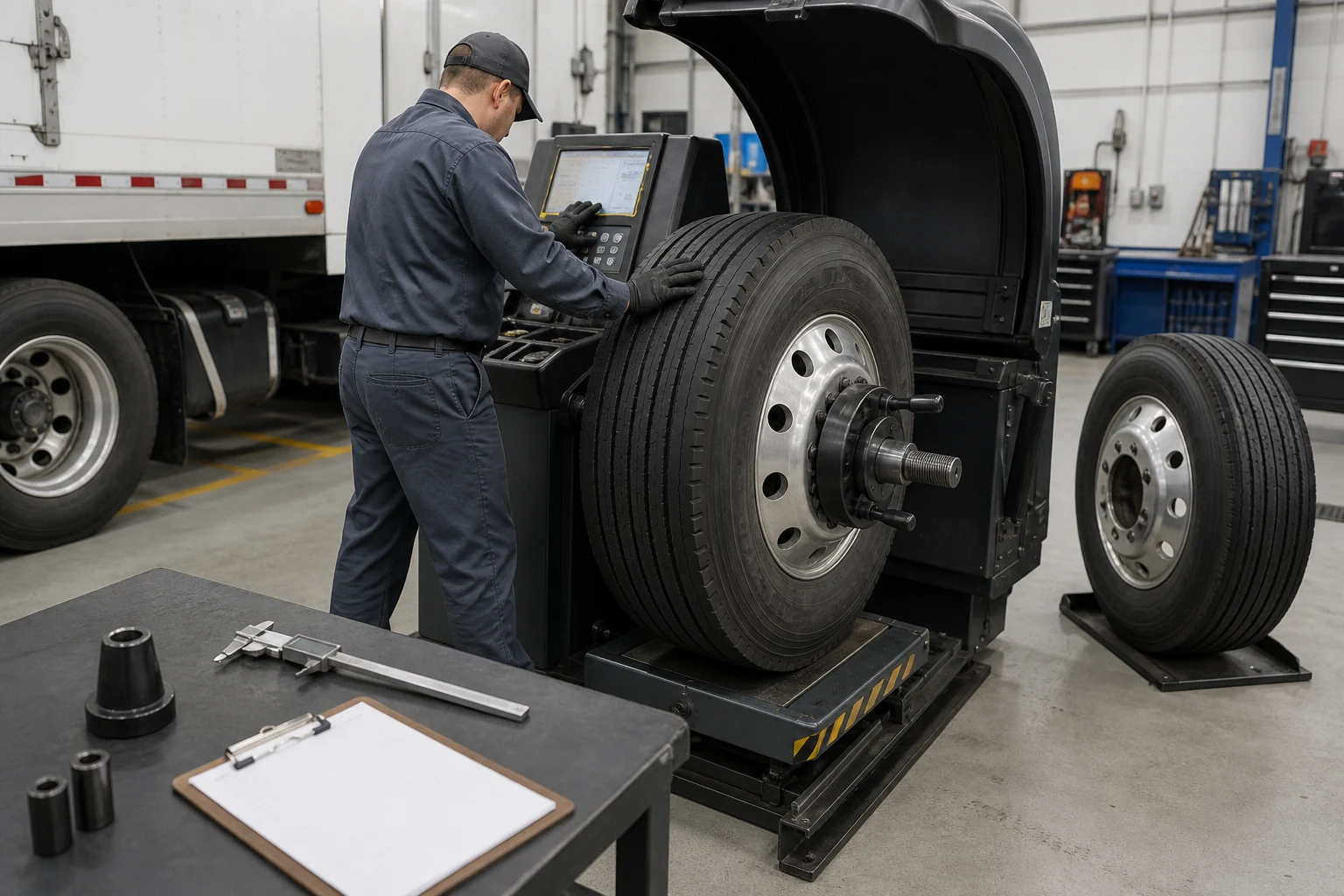
A controlled trial should use representative assemblies and a consistent inspection and recording process.
- List the real applications. Record tire sizes, tread types, wheel materials, axle positions, dual-wheel configurations, routes, loads, and service locations.
- Record the current problem. Separate vibration complaints, missing weights, uneven wear, repeat balancing, tire changes, and road-impact damage instead of combining them into one metric.
- Segment the fleet. Keep highway, regional, off-road, vocational, RV, and specialty applications separate. A method that fits one segment may not fit another.
- Choose representative assemblies. Include common, difficult, and high-complaint examples. Use the same wheel and tire conditions when comparing methods.
- Define the service procedure. Specify mounting, measurement, balancer mode, correction placement or internal-media quantity, valve handling, safety checks, and documentation.
- Track the service burden. Measure labor time, dismounting or repair steps, inventory needs, training, equipment, packaging waste, and whether another balance is required.
- Set an acceptance rule. Compare vibration or complaint recurrence, tire and wheel inspection findings, service consistency, and total cost over an agreed trial period before approving a fleet segment.
The output should be an application decision, not a single “winner.” A fleet may approve fixed weights for highway steer axles, test internal balancing on a specialty segment, and keep a separate specification for trailers or off-road equipment.
What should buyers include in a truck balancing specification?
A truck balancing specification should connect the correction method to the actual wheel, tire, vehicle position, and service procedure. Buyers should request enough information to reproduce the test: fitment data, product identity, installation instructions, compatibility limits, packaging, quality records, and the acceptance criteria used for the sample.

Sample approval is stronger when the wheel interface, internal method, service tools, and packaging are reviewed as one system.
| Specification field | What to confirm |
|---|---|
| Tire and wheel application | Tire size, construction, load use, wheel diameter and width, material, finish, and axle or service position |
| Fixed-weight fitment | Flange profile, clip geometry, adhesive strip dimensions, clearance, retention, and approved correction locations |
| Internal-method fitment | Product type, quantity basis, installation route, tire compatibility, valve-core path, and sensor or TPMS considerations |
| Service workflow | Required balancer, measurement mode, tools, technician steps, cleaning or preparation, and repair or dismounting procedure |
| Quality and traceability | Material or coating information, batch identification, inspection records, packaging labels, and change-control process |
| Commercial supply | Sample quantity, case pack, unit system, replenishment plan, private-label needs, and destination-market documentation |
| Trial acceptance | Allowed vibration or complaint threshold, repeat-service rule, inspection records, and total-cost comparison period |
The wheel-weight sample approval process can help organize the sample stage for fixed products. For beads, add the tire-cavity, valve, and repair questions explicitly; do not assume a wheel-weight checklist covers the internal method.
If you are comparing balancing beads and wheel weights for a truck or fleet application, share your tire sizes, wheel construction, service workflow, target mileage, and valve or TPMS requirements. We can help you compare representative samples before standardizing the program.
Conclusion: Choose around the fleet service workflow
For trucks, wheel weights are often the most straightforward starting point when a fleet already uses measured wheel balancing and wants a visible, auditable correction. Balancing beads may deserve a controlled trial for selected heavy-duty or specialty applications where an internal method fits the tire, valve, service, and repair workflow.
The publishable decision is therefore application-specific: define the assembly, test the process, measure repeat outcomes, and standardize only the fleet segment that the evidence supports. That approach keeps the comparison commercial and useful without turning either method into a universal claim.
Frequently Asked Questions
The questions below address the buying and service decisions that most often change the right truck balancing method. Always reconcile the final procedure with the tire, wheel, vehicle, and product manufacturer instructions.
Are balancing beads better than wheel weights for trucks?
Not universally. Fixed weights are a predictable starting point for many conventional truck tire-shop workflows. Balancing beads may fit selected heavy-duty, off-road, RV, or specialty applications after compatibility and service-process testing. Compare repeat complaints, installation, repair handling, and total cost on representative assemblies.
Do truck tires need wheel weights?
Truck tires need a properly balanced tire-and-wheel assembly, but not every assembly automatically needs a fixed weight. A balancer or approved internal method determines the correction approach. If vibration or uneven wear appears, inspect the assembly and vehicle rather than adding weight by guesswork. 1 2
Can balancing beads be used with TPMS or special valves?
Compatibility must be confirmed for the specific tire, valve core, sensor, and product. Do not assume that a bead product approved for one valve path or service procedure is suitable for another. Include valve and sensor checks in the sample trial and repair instructions.
What should a fleet test before standardizing balancing beads?
Test representative tire and wheel assemblies from each fleet segment. Record the specified quantity, installation time, equipment, valve handling, dismounting, repeat complaints, vibration observations, tire wear, and total service cost. Approve the method by application segment, not automatically for every truck.
Should a fleet buy wheel weights or rely on a tire service dealer?
A fleet can source products directly when it controls fitment data, installation quality, inventory, and inspection. A dealer or qualified service partner is still important for mounting, balancing, diagnosis, and safety. The commercial decision should cover the full service workflow rather than unit price alone.
Are balancing beads suitable for alloy wheels?
Sometimes, but alloy construction by itself does not prove suitability. Confirm that the bead product is approved for the tire and vehicle application and that the valve, TPMS, speed, load, and installation process are compatible. For many alloy-wheel service lanes, adhesive weights remain the more familiar starting point when the inner barrel accepts them. 2 5 6
Do wheel weights work better for highway speeds?
Not because of speed alone. Wheel weights work well in a measured and rechecked balancing workflow, but a highway-speed vibration can also come from tire uniformity, wheel runout, mounting, centering, alignment, or suspension problems. Diagnose the assembly instead of adding correction by guesswork. 2 1
References
[1] National Highway Traffic Safety Administration. “Tire Safety Ratings and Awareness.” 2026.
[2] Continental Tires. “Balancing tires.” 2026.
[3] Tire Review Magazine. “Weighing Options: Mechanical Balancing or Balancing Compounds?” 2009.
[4] ESCO. “About ESCO Balancing Beads.” 2016.
[5] European Tyre and Rim Technical Organisation. “E.T.R.T.O. Recommendations.” 2024.
[6] Counteract Balancing Beads. “Support and frequently asked questions.” n.d.