



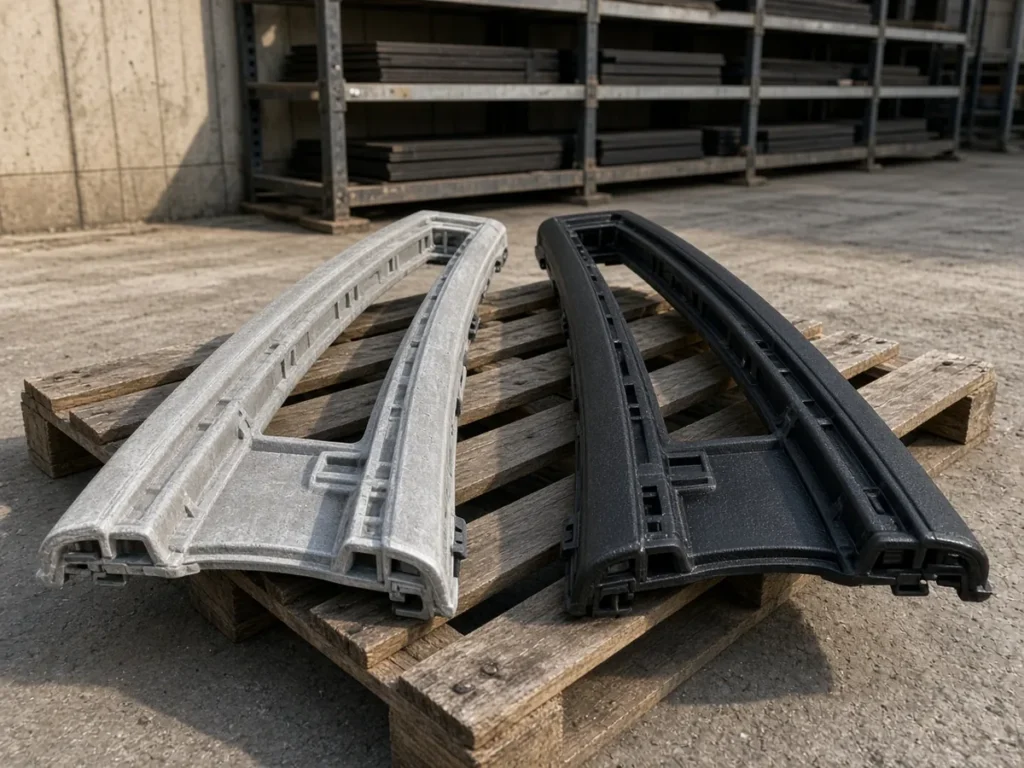
ASA vs ABS, for injection-molded exterior car parts, is a choice about sunlight and finish, not about 3D-print filament. Unpainted outdoor trim is usually ASA (acrylonitrile styrene acrylate). Painted or plated appearance parts often stay in ABS (acrylonitrile butadiene styrene). Large flexible parts such as bumper covers are usually polypropylene (PP) or thermoplastic polyolefin (TPO).
Scope: this article compares ASA, ABS and PP/TPO as resins for injection-molded exterior car parts, and how weathering, paint and RFQ specs should drive that choice. It is not a 3D-print filament guide (print settings, warping, PETG or fumes), a TPO roofing comparison, or a luggage or plumbing-pipe article. Grade pages for each resin live in the ASA material page, the ABS material page y la PP and TPO material page. How to specify a weathering test is covered in the weathering-test guide. Paint-shop process is on the pintura y acabado de superficies page, and primed, painted and molded-in-color states are on their finish-state page. Spoiler construction in carbon fiber, ABS or fiberglass is a different question, covered in the spoiler materials guide.
What are ASA, ABS, PP and TPO on exterior car parts?
They are four related thermoplastic families used to mold exterior parts, and they are not interchangeable just because all four can leave a tool as a rigid plastic panel.
ASA, or acrylonitrile styrene acrylate, is a styrenic resin used when a part will sit in sunlight without a paint film to protect it. A resin producer such as INEOS Styrolution positions its Luran S ASA grades for exterior work, including automotive uses such as radiator grilles and mirror housings, on the strength of UV and heat performance and colour fastness 1.

ABS, or acrylonitrile butadiene styrene, is the more familiar styrenic in aftermarket appearance parts. It molds with a sharp surface, takes paint well, and is the usual route when a part will be plated. It is not the first choice for a part that will stay raw in the sun.
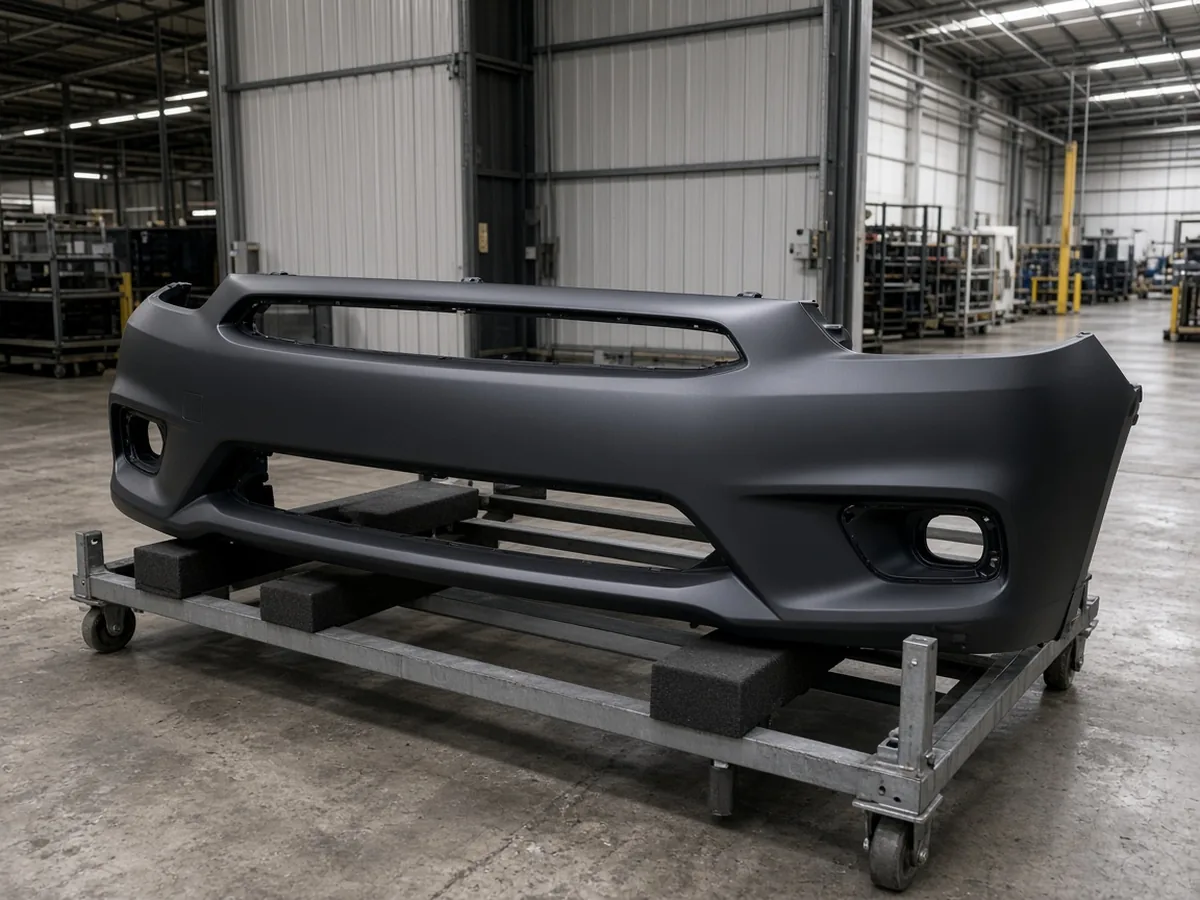
PP, or polypropylene, is a polyolefin. On cars it is used for larger, more flexible exterior pieces and for many replacement body parts. TPO, or thermoplastic polyolefin (also called TPE-O), is a PP-based blend with an elastomer such as EPDM or a polyolefin elastomer 8. That blend is the everyday material family for painted bumper covers, and for other parts that have to take a low-temperature impact without cracking.
Two naming traps are worth clearing at the start. “ASA vs ABS” in general search is often about 3D-print filament; this page is about injection-molded production parts. “TPO vs PP” is also a roofing-membrane comparison in building products; the TPO in this article is the automotive bumper and cladding family, not a roof sheet.
Factories in this category usually injection-mold the part, trim gates and flash, then either leave a molded-in color and texture or send the part through a paint or plating route. Typical checks are color, gloss, adhesion where the part is painted, and a trial fit to the vehicle or to a checking fixture. Those process steps are industry-typical; they are not a substitute for the grade and test limits you write into a quote.
Why does unpainted ASA weather better than unpainted ABS?
The two resins share a styrene-acrylonitrile matrix, but they use different rubber phases, and that difference shows up on an unpainted surface after outdoor exposure.
ABS gets its toughness from butadiene rubber. That rubber is more open to photo-oxidation in sunlight, so an unprotected ABS surface can lose gloss, shift color, and eventually turn chalky or brittle. ASA uses an acrylate rubber instead. That substitution is why ASA is sold as a weatherable styrenic, and why INEOS describes Luran S as a material of choice for exterior applications that need long-term performance under UV and heat 1.
The practical result for a buyer is simple. An unpainted ABS grille insert, mirror cap or trim piece is a short-life appearance risk in a sunny market. The same geometry in a UV-intended ASA grade is the usual way to keep a molded-in color and texture outdoors. Paint or plating on ABS can carry the weather load, but then the coating system, not the raw resin, is doing that job.
Weathering is still grade-, color- and texture-dependent. A dark ASA package with a stable pigment is not a guarantee that every light or high-gloss color will hold the same way. A “UV-stabilized ABS” compound can improve a short outdoor exposure, but an additive package does not turn ABS into ASA. If you need a number, you get it from a test on the actual grade, color and surface, not from a generic resin name.
Accelerated methods exist so you can compare those systems in a lab. ISO 4892-2:2013 specifies xenon-arc exposure of plastics in the presence of moisture, to reproduce effects of daylight or of daylight filtered through window glass 2. ISO 4892-3:2024 covers fluorescent UV lamp exposure of plastics 3. For automotive exterior materials, SAE J2527 is the widely cited performance-based xenon-arc practice 4. How to choose among those methods, and how not to convert test hours into “years outdoors,” is the job of the weathering-test guide. This page uses the method names only so a resin choice and a test request can be written together.
How do ASA, ABS and PP/TPO compare on weathering, paint and specs?
Use one decision table that includes finish path, not a two-column “ASA or ABS” rule alone. PP and TPO change the answer on bumpers and other large, flexible parts.
The rows below are buyer directions, not measured Yirox lab results and not a substitute for a named grade’s data sheet. “Better” always depends on whether the visible surface is raw, painted or plated, and on the impact the part has to survive.
Read the table as a screening tool. If the part is a small, stiff, unpainted exterior skin, start with ASA. If it is a painted or plated appearance part, start with ABS. If it is a bumper-size panel that has to flex and take a hit, start with PP or TPO. Then lock a named grade, a finish state and a test method, which the later sections cover.
Heat resistance of ASA and ABS is in the same general range on many data sheets, but it is still grade-specific. If a part sits near a lamp housing, exhaust path or other heat source that exceeds a styrenic’s comfort zone, a PC/ABS or similar blend may be the exception to consider, not a thicker coat of paint. That blend is outside this three-resin comparison.
Which resin should you specify for which exterior part?
Specify the resin from the part’s job, the finish, and the climate the vehicle will see, not from a single “best plastic” label.
Choose ASA when the visible surface will stay unpainted or only lightly textured in molded-in color, and the part will live in sunlight: window-surround and pillar trim, cowl and louver panels, some grille surrounds, and mirror bases that are not going to be painted body color. That is the use case INEOS cites when it lists automotive exterior parts such as radiator grilles and mirror housings among Luran S applications 1.
Choose ABS when the part will be painted or chrome plated, and you want a stiff, high-gloss or plateable styrenic: many spoilers, grille inserts, mirror caps and body-kit pieces. Unpainted ABS in those roles is the option that later shows up as faded or chalked trim.
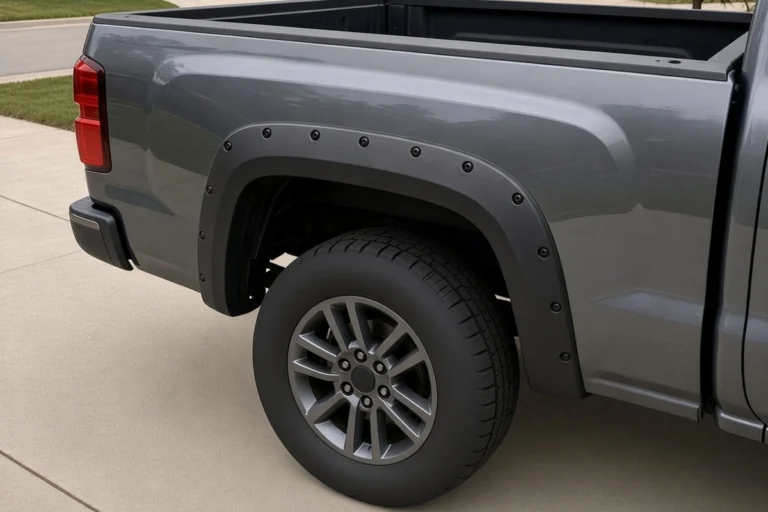
Choose PP or TPO when the part is large, has to flex, or has to keep impact performance in the cold: bumper covers and bumper trims, some side skirts, wheel-arch cladding, flares and mud flaps. TPO is the usual painted bumper-cover family; a stiffer PP compound may be enough for a simpler, less impact-critical panel. The two names are related, not identical, so the quote should say which family, and preferably which grade, you want.
A short choose-if list:
- Unpainted exterior skin in a sunny market: start with a UV-intended ASA grade, not raw ABS.
- Body color or piano-black paint on a stiff appearance part: start with ABS, and specify the paint system.
- Chrome or similar plating: start with a plating-grade ABS, not ASA or PP/TPO.
- Bumper cover or another large flexible panel: start with PP or TPO, and budget an adhesion primer if the part will be painted.
- A part that must be both unpainted and unusually tough or heat-resistant: do not force ASA or ABS to do a job they were not graded for; ask for a data sheet and, if needed, a different family.
The same part name can still take more than one resin if the finish changes. A grille surround can be unpainted ASA or painted ABS. A side skirt can be a painted styrenic or a painted TPO, depending on length, flex and how the vehicle is used. Write the finish next to the resin so the supplier is not guessing.
How should paint and molded-in color change the resin choice?
The finish often decides the resin as much as the part name does, because paint, primer and molded-in color put the weather load on different layers.
Molded-in color, or MIC, puts the color in the resin. On ASA trim, that is frequently the point of the material: you can ship a textured black or dark-grey part without a color coat, and the resin is expected to hold that appearance outdoors. On PP/TPO, MIC is common on unpainted cladding and flares, usually in a dark, textured finish rather than a class-A body color.
A painted part shifts the UV job to the coating. ABS is widely painted in industrial finishing after the surface is cleaned and pretreated. PP and TPO are a different problem. Honda’s technical review of bumper painting notes that TPO has low surface energy and is a difficult substrate to paint to exterior specifications, and that adhesion-promoter chemistry (including chlorinated polyolefin) is used so a basecoat will bond 7. If you buy a painted or paint-ready bumper, the RFQ should say that a PP/TPO-specific adhesion promoter or primer is required, not only “paint to this color.”

Primed parts are a finish state, not a resin. A primed PP bumper is supplied ready for the customer or a later paint line; a primed ABS spoiler is a different substrate with a different pretreatment. Those states, and the choice among MIC, primed and fully painted, are spelled out on the primed, painted and molded-in-color page. How a paint line is run, including film build and inspection, belongs on the pintura y acabado de superficies page, not in this resin comparison.
Paint adhesion, when you need a lab method on the quote, is commonly rated with a tape test such as ASTM D3359 6. Color after weathering or for incoming color match is commonly calculated from instrumented coordinates using a practice such as ASTM D2244 5. Write the method, the illuminant and the limit you will accept. Do not assume a supplier’s in-house default is the same as your customer’s standard.
What risks and exceptions should buyers watch for?
Most resin mistakes come from treating a family name as a finished specification, or from borrowing a rule that only holds for one finish.
UV-stabilized or “UV-modified” ABS is not ASA. An additive package can help a limited outdoor exposure, but it does not give you the acrylate rubber phase that ASA is sold for. If the part will stay unpainted in a harsh sunbelt market, write ASA (and a named grade), or write a painted/plated ABS system, but do not file them as the same buy.
Color and gloss results are not transferable from a black textured plaque to a light, high-gloss part. Pigment, carbon black, texture and the UV package all move the result. A weathering pass on one color is evidence for that color, not for the whole palette.
Chrome plating is an exception that cuts against “just use ASA outdoors.” Plating-grade ABS is the usual styrenic path; ASA and PP/TPO are not interchangeable stand-ins for a plated bezel or grille bar. If you need a plated look on a sunny vehicle, you are usually specifying a plated ABS system, not an unpainted ASA.
Shrinkage and tool design cut the other way for bumpers. An ABS spoiler tool is not a bumper tool. PP and TPO shrink more, and the part geometry, gates and steel are designed around that. Swapping a styrenic into a polyolefin tool, or the reverse, is a requalification, not a resin line-item change.
Accelerated test hours are not years in the field. ISO 4892-2, ISO 4892-3 and SAE J2527 are methods for running an exposure; they do not, by themselves, convert 500 hours or 2,500 kJ/m² into a service life 2 3 4. The conversion problem, and how to write a method that can be audited, is covered in the weathering-test article.
A spoiler material question can also be the wrong question for this page. If the decision is carbon fiber versus ABS versus fiberglass construction, use the comparación de materiales de alerones. If the decision is whether that ABS spoiler should have been ASA, or should be painted, stay here.
What should buyers put in an RFQ and weathering spec?
Name the resin family, the finish, and the test you will accept, then leave enough room for a named grade and a lab method. A quote that only says “UV-resistant plastic, exterior grade” will come back as three different parts.
Yirox molds exterior parts in these families, but the RFQ still has to tell any plant what to tool, paint and test. The checklist below is written so a distributor, importer or aftermarket brand can paste it into a request and fill the blanks.
RFQ and weathering-spec checklist:
- Part name, vehicle application, and whether the part is a stiff appearance piece, a plated piece, or a large flexible panel (bumper, cladding, flare).
- Resin family: ASA, ABS, or PP/TPO. Add a named grade if you already have one; if not, ask the plant to propose a grade and attach the data sheet.
- Finish state: molded-in color and texture; primed (and, for PP/TPO, a stated adhesion promoter or primer); fully painted, including color standard (for example a code, a master plaque, or a ΔE limit under a named illuminant); or plating-grade, if that is the route.
- Weathering method: ISO 4892-2 xenon-arc 2, ISO 4892-3 fluorescent UV 3, SAE J2527 for automotive exterior xenon exposure 4, or the OEM method your customer already uses. Write the cycle or filter, the dose or duration, and the apparatus class. Do not invent a hours-to-years claim.
- Acceptance metrics after exposure: color change calculated per ASTM D2244 (state ΔE formula and limit) 5, gloss retention if required, and a visual rating (chalking, cracking, blistering).
- For painted parts: adhesion method, commonly ASTM D3359 or the customer’s equivalent, and the grade you will accept 6. For PP/TPO, state that the adhesion promoter is part of the qualified system 7.
- What must be submitted with the quote or with samples: data sheet, color standard, weathering report from an accredited lab if you require it, and a fit or dimensional check plan.
The method language — which xenon cycle, how to read a report, why hours are not years — should follow the guide to specifying a weathering test. This checklist only makes sure the resin and the finish are in the same document as that test.
If your incoming inspection is thinner than a full lab program, still keep three field checks: the resin and finish on the packing list match the PO, the unpainted or painted appearance matches the approved standard under an agreed light, and a painted PP/TPO part has evidence of the primer system, not only a color coat on bare polyolefin.
Conclusión
ASA vs ABS on an exterior car part is a weathering and finish decision. Unpainted outdoor trim belongs in a UV-intended ASA grade. Painted or plated appearance parts often remain in ABS, because the coating or the plate, not the raw butadiene rubber, is what faces the sun. PP and TPO are the third option for bumper covers and other large, flexible panels, and they need their own paint pretreatment.
A family name is not a specification. The useful buy is a named grade, a finish state, and a weathering and adhesion method with limits you can audit. Use the comparison table to screen the resin, then put the checklist into the RFQ and send method questions to the weathering-test article rather than inventing a hours-to-years rule.
If the part in front of you is really a spoiler-construction choice, or only a paint-shop process question, those jobs already have their own pages. This page is for the buyer who has to pick among ASA, ABS and PP/TPO and then write that choice down.
Siguiente paso
If you already know which family you need, open the ASA, ABS o PP/TPO materials page for grade and quote inputs, then send the part, finish and test limits through the formulario de contacto. Yirox can mold these exterior parts in-house and will work from the resin and weathering spec you put in the request.
Preguntas frecuentes
Are ASA and ABS the same plastic?
No. Both are styrenic thermoplastics, but ASA uses an acrylate rubber phase and ABS uses butadiene rubber. That is why unpainted ASA is the usual outdoor choice and unpainted ABS is not.
Is ASA always better than ABS for exterior car parts?
No. ASA is the usual resin when the surface stays unpainted in the sun. Painted or plated appearance parts often stay in ABS, which is typically lower cost and is the standard plating route. The better resin is the one that matches the finish and the part’s job.
Can you paint ASA, ABS and PP/TPO parts?
Yes, but the prep is not the same. ABS is commonly painted after cleaning and pretreatment. ASA can be painted, though many outdoor ASA parts stay molded-in color. PP and TPO usually need a plastic adhesion promoter or primer because of low surface energy.
Is UV-stabilized ABS the same as ASA?
No. A UV additive package can improve ABS for a limited outdoor exposure, but it does not change the butadiene rubber phase into the acrylate rubber used in ASA. For long unpainted sun exposure, specify ASA or a painted or plated system, not a renamed ABS.
Where do PP and TPO fit if I am comparing ASA vs ABS?
They are the usual family for bumper covers and other large, flexible exterior panels, especially where low-temperature impact matters. They are not a drop-in substitute for ASA trim or for plating-grade ABS, and painted PP/TPO needs its own primer path.
Which weathering test should I write into an RFQ?
Write the method your customer already uses, or name ISO 4892-2 or SAE J2527 for xenon-arc work, or ISO 4892-3 for fluorescent UV, plus the cycle, dose and acceptance limits. The weathering-test guide explains how to specify that method; do not convert hours into years of outdoor service on your own.
Referencias
- INEOS Styrolution, Luran S (ASA) product catalog: exterior applications, UV and heat performance, colour fastness; automotive examples include radiator grilles and mirror housings. eshop.ineos-styrolution.com, Luran S catalog.
- ISO 4892-2:2013, Plastics — Methods of exposure to laboratory light sources — Part 2: Xenon-arc lamps, confirmed 2023, with Amendment 1:2021. iso.org/standard/55481.html.
- ISO 4892-3:2024, Plastics — Methods of exposure to laboratory light sources — Part 3: Fluorescent UV lamps. iso.org/standard/83802.html.
- SAE International, J2527_201709, Performance Based Standard for Accelerated Exposure of Automotive Exterior Materials Using a Controlled Irradiance Xenon-Arc Apparatus, revised 19 September 2017. doi.org/10.4271/J2527_201709.
- ASTM D2244-25, Standard Practice for Calculation of Color Tolerances and Color Differences from Instrumentally Measured Color Coordinates. store.astm.org/d2244-25.html.
- ASTM D3359-23, Standard Test Methods for Rating Adhesion by Tape Test. store.astm.org/d3359-23.html.
- Honda, “Development of a Novel Bumper Adhesion Promoter,” Honda Technical Review (TPO bumper fascias, low surface energy, chlorinated-polyolefin adhesion promoter). global.honda.com technical review PDF.
- HEXPOL, “What is TPO,” TPE Academy: thermoplastic polyolefins (TPO or TPE-O). hexpol.com, What is TPO.