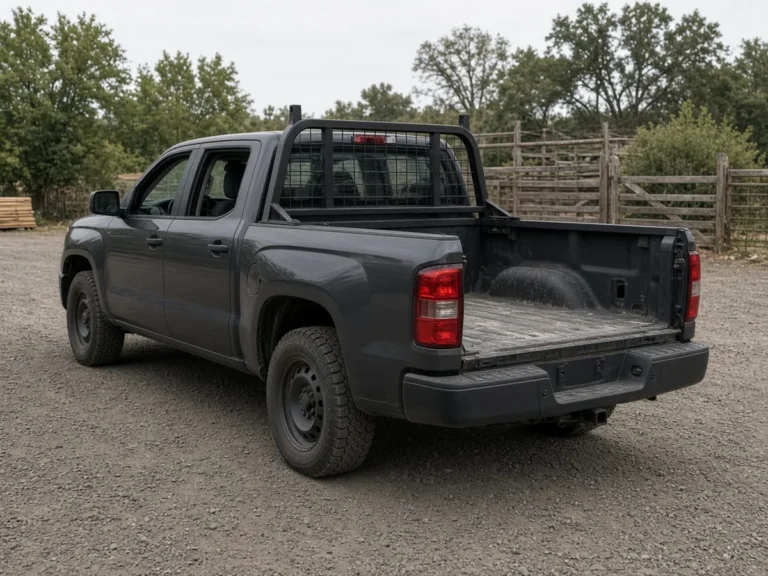





A headache rack is a frame or screened panel at the front of a pickup bed, just behind the cab, that stops cargo from hitting the rear window in a hard stop. It is cab protection first. A bed rack is different: it carries gear above the bed floor.
Scope: this article is about pickup-truck headache racks — the same part often sold as a cab guard, cab protector or window protector — and how that cab-protection job differs from a load-carrying bed rack. It is not a guide to Class 8 or flatbed tractor cab racks, UTV racks, lighting products, or cab-corner body repair. Truck bed racks, bed rails and bed organizers are compared in rack para cama de camioneta vs rieles de cama vs organizador de cama.
What is a headache rack, and why is it called that?
A headache rack is cab protection mounted at the bulkhead of the bed, immediately behind the rear window, so a shifting load hits the rack instead of the glass.

The usual explanation for the name is literal. If lumber, a pipe, a toolbox or a loose tool slides forward in a hard stop, the rack is there to keep that mass out of the cab and away from the occupants’ heads. That is the job the part was named for, not decoration and not a guaranteed crash structure.
The same part is sold under several names. Cab guard, cab protector and window protector are common synonyms on pickup catalogs. “Cab rack” appears too, especially on heavier work trucks. “Back rack” is used informally as another synonym, but BackRack is also a brand name, so treat a search for that phrase as mixed: generic part and maker, not one thing.
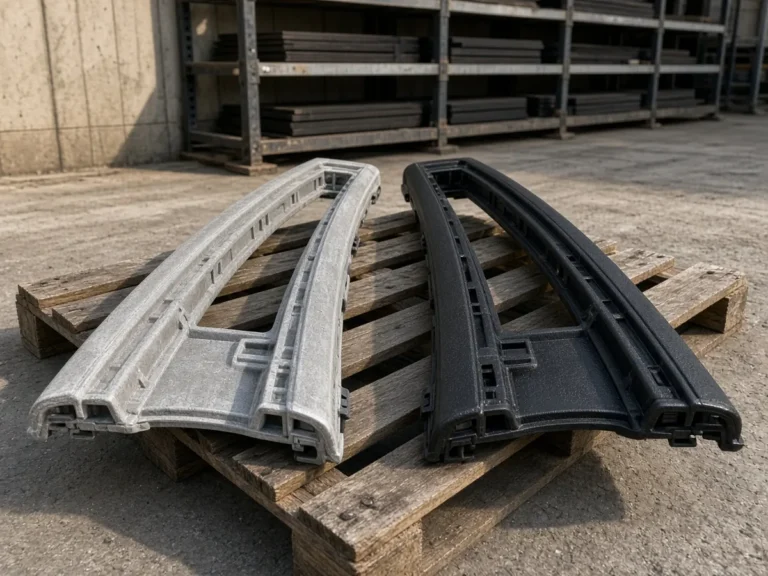
On a pickup, the rack usually stands about as high as the cab, or a little under it on a low-profile design. Some are an open frame. Others fill the opening with mesh, louvers or a window cutout so you can still see through the glass.
Many add slots or loops where a strap can hold the front of a long load. That cargo-rest function is useful, but it is secondary to stopping a load from punching the rear window.
A headache rack is not a substitute for tying cargo down. On a commercial motor vehicle, federal cargo-securement rules still require the load to be contained, immobilized or secured so it does not shift enough to hurt stability, and a front-end structure only has to meet a specific performance standard when cargo is actually in contact with it 1 2. Those limits belong in the risks section below; they are easy to over-read on a retail product page.
Class 8 and flatbed tractor racks are a related idea with a different build. They often add chain hangers and tray storage behind a highway tractor. This guide stays with pickup beds. If the truck on the order is a tractor or a platform body, ask for that drawing set, not a pickup window protector.
How is a headache rack different from a bed rack?
A headache rack protects the cab; a bed rack carries cargo above the floor. They can share stake-pocket hardware, and they are often confused in the same search, but they solve different problems.
A bed rack uses side bars and one or more crossbars so bins, recovery gear, a roof tent or other equipment can sit over the bed while the floor stays usable. That is the comparison in rack para cama de camioneta vs rieles de cama vs organizador de cama. A headache rack is the shorter, cab-wall device. Some systems combine them — a front bulkhead plus a rear crossbar — but buying “a rack” without saying which job you need is how people end up with the wrong one.
A ladder or contractor rack is closer to a bed rack than to a cab guard. Its bars sit at or above cab height so ladders, conduit or lumber can ride over the cab. It may include a front hoop, but its first job is still carrying long stock, not screening the rear window. A crossover toolbox sits in the same front-of-bed zone as a headache rack and can block the install, which is why it belongs in the same table.
If you only haul items that stay inside the bed and you want them organized or kept off the paint, a bed mat or bed liner and an organizer — both in the gama de accesorios para cama de camioneta category — are the closer products, not a headache rack. If the risk is a load sliding into the glass, the cab-protection rack is the part to specify.
You can run more than one of these, but only when the mounts and the front rail all have room. A headache rack plus a rear ladder bar is a common work-truck layout. A full over-bed rack plus a deep crossover box plus a hard folding cover is where drawings start to collide. Confirm the combination on the actual cab, bed length and cover type before you buy all three.
What styles and materials should you compare?
Choose the panel style for how much of the rear window you need to protect and still see through, then choose steel or aluminum for weight, corrosion and how hard a hit the rack is expected to take.
Una open frame is the lightest visual design: uprights and a top bar, sometimes with a lower bar, and a large opening in front of the glass. It is a good cargo rest and a poor screen. A loose 2×4 or a tool handle can still reach the window through that opening. Use it when you want a place to strap the front of a long load and the cargo is not likely to poke through.
A mesh or punched-screen rack fills most of the opening. It is the usual choice when the job is window protection, because small parts and the ends of pipe are less likely to pass through. The tradeoff is rear visibility. A dense screen can darken the inside mirror view, which matters on trucks that still rely on that mirror.
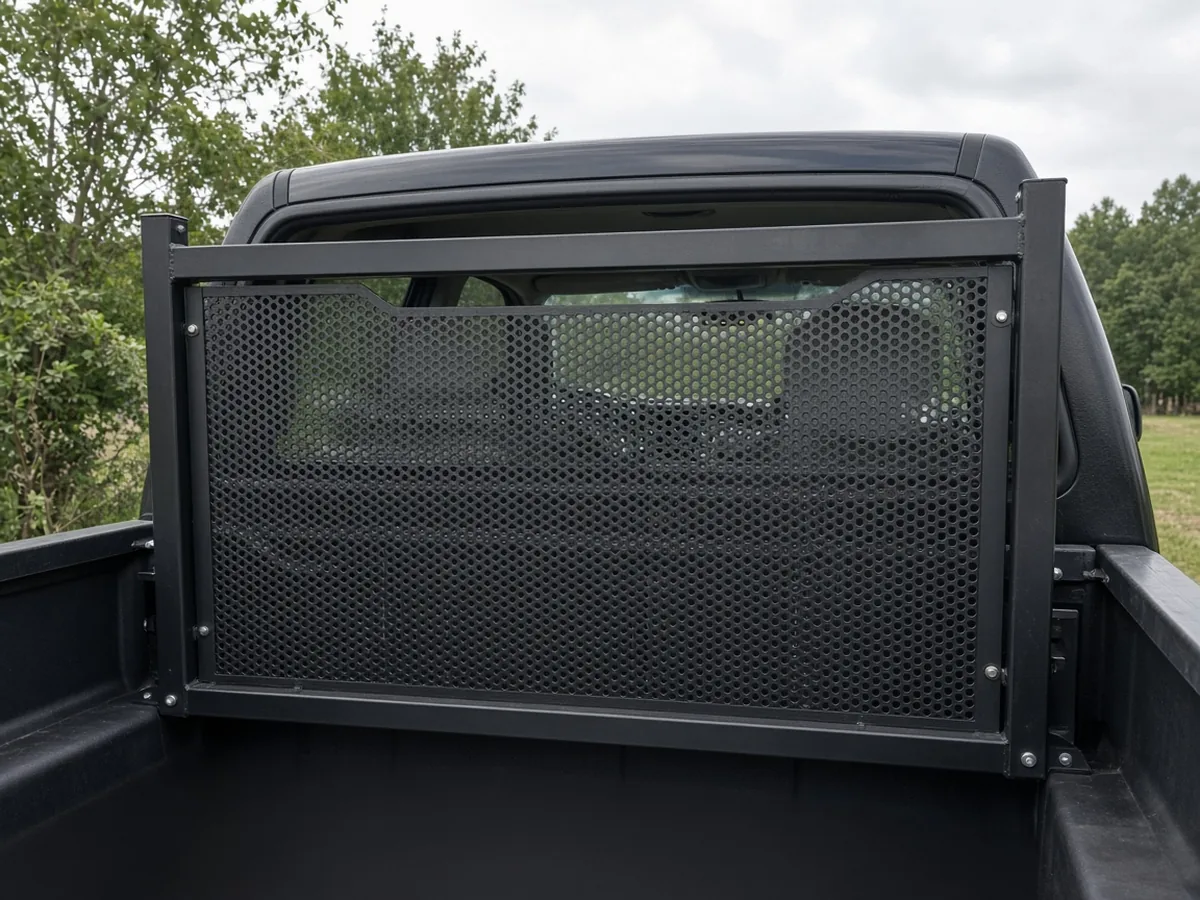
A louvered panel uses angled slats. It blocks some sun and some debris while leaving horizontal sight lines, and it is often chosen when someone wants more privacy in the cab without a solid sheet. A window-cutout design leaves a clear opening the size of the rear glass, or a little larger, with structure around it. That is the style to look at when you need the inside mirror or you do not want a screen sitting in the camera or defroster area.
Perfil bajo racks sit below the roofline and sometimes below the top of the glass. They are easier to pair with a high-mount stop lamp at the top of the cab and with some covers, but they protect less of the window. If the cargo you worry about can rise above that rail, a low-profile bar is the wrong height.
Steel racks are the heavy-duty default in this category. Factories usually cut and weld tube or plate, then apply a powder-coat or similar finish. Steel takes a hard impact well and is straightforward to repair, but it rusts where the coating chips, and the extra mass uses up payload before you load the bed.
Aluminum racks are lighter and do not rust the way bare steel does, which is why they show up on trucks that see road salt or sit near salt air. They generally cost more, and a hard hit is more likely to bend than to punch through and then be an easy steel-shop repair. Neither material is “stronger” in the abstract. Match the material to the cargo and the climate, then read the maker’s rating for that SKU rather than borrowing a number from a different rack.
Finish quality matters as much as the base metal. Look for even coating, sealed weld areas, and hardware that will not set up galvanic corrosion on an aluminum bed or body. The mounting section below includes one manual’s isolation step for that last point.
How do headache racks mount, and will they fit your truck?
Most pickup headache racks clamp or bolt at the front of the bed rails, often into the factory stake pockets, but “no-drill” is not a universal promise, and width alone is not enough to confirm fit.
A stake-pocket mount uses the rectangular openings already built into the tops of the bed sides. Those pockets were made for wooden stakes. Today they are the standard no-drill anchor for rails, racks and some tie-down hardware. A typical cab-protection kit drops an anchor into the frontal pockets and hangs the rack from brackets at the bulkhead, so the bed floor stays clear.
That still is not always a drill-free afternoon. Rail caps may have to come off, or openings may have to be cut in a rail cover, to reach the pocket. A drop-in bedliner can hide the side holes in the pocket wall.
Buyers Products’ KabGard window-protector instructions tell the installer to remove those caps or cut the covers, and, if a bedliner is in the way, to drill the liner wall at the marks many liners already provide 6. The same sheet lists an electric drill among the required tools. Read the sheet for the kit you have, not a generic “no-drill” headline.
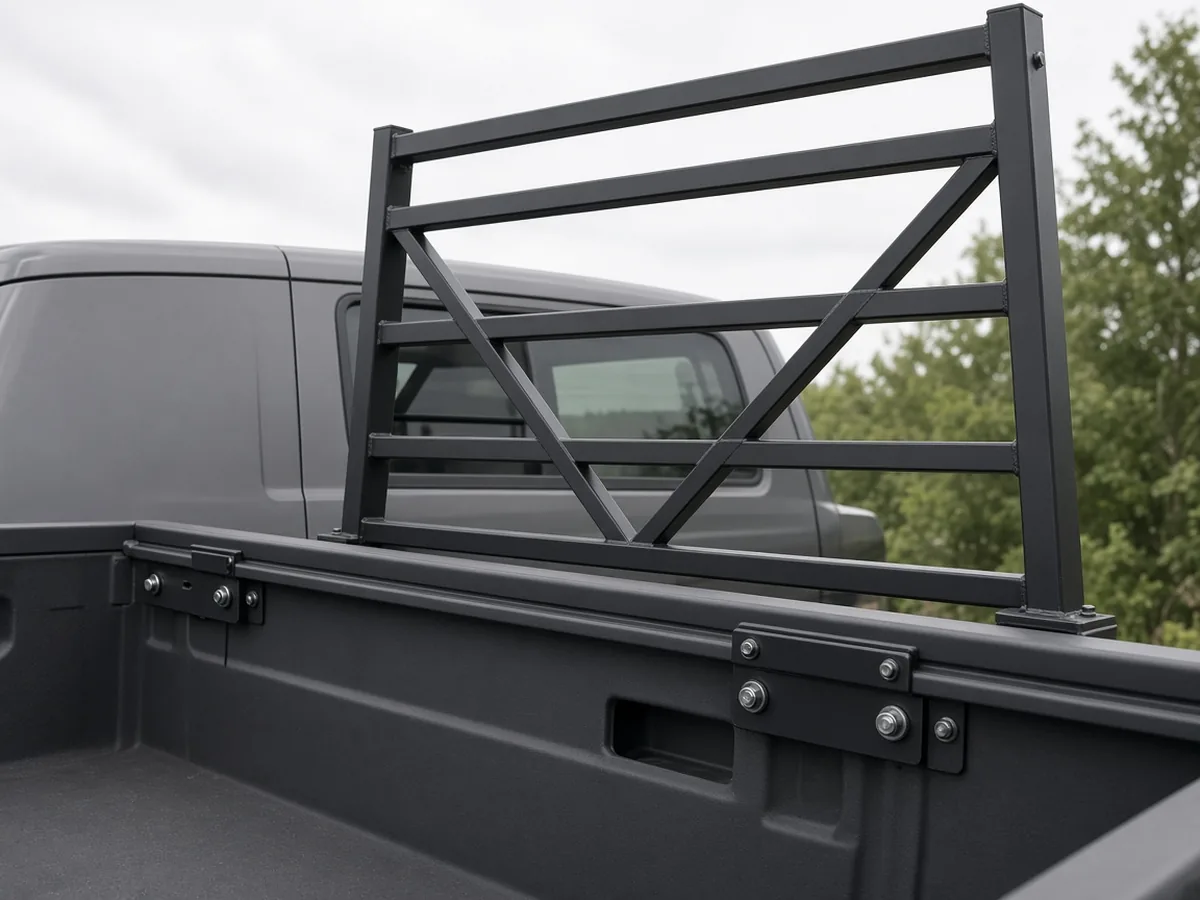
A bolt-on or drill-in mount fastens through the rail or into a reinforced point the truck maker allows. It can be the more rigid option on a heavy rack, and it is sometimes the only option if the front pockets are the wrong size, already occupied, or not present on that bed. Drilling in the wrong place can hit a wiring run, a stake-pocket inner, or a cover clamp track. If the truck is still under warranty, check the owner’s manual for bed-accessory and bed-reinforcement notes before you drill.
Cab height above the bed is a fitment dimension many buyers skip. One widely used steel window protector, Buyers KabGard, is sold in two classes for that reason: part 85104 is listed at 69 by 23.5 inches for full-size pickups whose cab height is 24 inches above the bed, and part 85204 is listed at 71.6 by 26.3 inches for trucks whose cab height is 26 inches above the bed, with separate vehicle lists for each 6.
Those figures belong to that product family. They are not a universal size chart. They are a reminder to measure the cab height the way the maker defines it, not only the inside width of the bed.
Universal, adjustable-width racks exist, and they can be the right buy for a mixed fleet if the width range actually covers each bed. A vehicle-specific bracket set is still worth it when the pocket spacing, cab wall, or third stop lamp is unusual. Mid-size beds, including popular Ranger and Tacoma applications, are not interchangeable with a full-size 69-inch frame.
The same KabGard sheet has two installation cautions that apply beyond that brand. On aluminum-body trucks, it tells the installer to put vinyl tape on steel washers and anchors wherever they touch aluminum, to limit premature corrosion.
When the rack is in the bracket guides, it specifies 60 to 70 foot-pounds on the lock nuts, and it warns that overtightening the bracket screws can damage the truck’s sheet metal 6. Use the torque and isolation steps printed for your kit. Do not treat 60 to 70 foot-pounds as a global number.
The same instructions also say to check the owner’s manual or the truck manufacturer for bed-box reinforcement kits, to install any recommended kit before the window protector, and never to exceed the truck maker’s maximum combined weight of equipment and cargo 6. A rack has a mass of its own. Count it against payload with the rest of the bed equipment, not after the truck is already at the door sticker limit.
Will a headache rack work with a tonneau cover or toolbox?
Sometimes, but only when the rack’s brackets leave room for the cover’s front rail or for the box that already sits against the cab. There is no single yes for every combination.
A tonneau cover, the usual pickup truck bed cover, typically clamps along the bed rails and needs a clean front header. A headache rack that drops into the stake pockets and keeps its brackets inboard or behind that header can often coexist with a rolling, folding or hinged cover. A rack whose feet sit on top of the rail, or whose frame leans over the header, will block the cover from closing or from coming off for service.
Hard folding and retractable covers are the fussiest, because their panels or canister sit at the front of the bed. Soft roll-up covers are often more forgiving, but they still need the front rail. If you already have a cover, measure the header and the rail clamp area and ask the rack maker for a documented compatible configuration, not a verbal “it should fit.”
A crossover toolbox occupies the same real estate as the rack. Some window protectors are sold with toolbox-mount brackets, or with a taller side plate that lets a box sit under or just behind the frame. Others cannot be installed at all until the box comes out.
If both products are on the truck, specify the box width, height and mount type in the same order as the rack. Do not assume a 20-inch box and a 27-inch box need the same bracket 6.
Bed mats and drop-in liners are easier neighbors, but they are not invisible. A liner can hide stake-pocket access, as the mounting section notes, and a thick mat at the front wall can change how far a rack foot or a strap can sit. If the truck already uses a modular cargo mat or a spray-in liner, confirm pocket access before the rack ships.
How do you choose the right headache rack?
Start with the cargo that could hit the glass, then match height, panel style, mount and the other equipment already on the bed. Appearance is the last filter, not the first.
You have a strong reason to fit one if you carry lumber, pipe, tools, a generator, landscaping gear or any loose object that can slide forward. You have a weaker reason if the bed is usually empty or holds only light, tied-down bags. A rack can still earn its place as a cargo rest or as a theft deterrent in front of a sliding rear window, but it is optional in that case, not a must-buy.
Use this checklist before you order:
- Write down the year, make, model, cab style and bed length, and measure inside bed width plus cab height above the bed the way the rack maker defines it.
- Decide whether the main risk is a poke-through (mesh or a solid panel) or a long load that only needs a front rest (open frame), and whether you still need a clear view through the rear glass (window cutout or a more open louver).
- Choose steel or aluminum based on impact, payload and corrosion, not on a generic “heavy duty” label.
- Pick a mount that matches the front stake pockets or a documented drill plan, and plan for rail caps, a bedliner, or an aluminum body if those are on the truck.
- If a tonneau cover, crossover toolbox, bed rack or ladder rack is already fitted or planned, confirm a compatible bracket set in writing.
- Walk around the parked truck and check the rear window, the center high-mounted stop lamp, and the backup-camera view with the intended height and panel style in mind.
- If the vehicle can be a commercial motor vehicle, or if cargo will bear on the rack, read the risks section before you treat the rack as part of a securement system.
- Count the rack’s own weight against the truck’s payload, together with the cover, box and cargo.
If two options both fit, prefer the one with a clear instruction sheet, a stated vehicle list or width range, and hardware that you can inspect on arrival. A slightly narrower retail choice that documents those points is usually a better buy than a custom-looking frame with no install sheet.
What risks and exceptions should you check first?
A headache rack is not automatically a legal cargo-securement device, and it must not defeat the rear view the truck was certified with. Those two limits are the ones product pages most often skip.
Federal cargo-securement rules in 49 CFR Part 393 Subpart I apply to trucks, truck tractors and trailers when they are used as commercial motor vehicles. The cargo has to be loaded and secured so it does not leak, spill or fall, and so it does not shift enough to hurt the vehicle’s stability or maneuverability 2. In general, cargo has to be firmly immobilized or secured by structures of adequate strength, dunnage, shoring, tiedowns or a combination of those, and the aggregate working load limit of the tiedowns must be at least one-half the weight of the article or group of articles they hold 3.
A commercial motor vehicle, in the interstate-commerce definition in 49 CFR 390.5 (linked from the references), includes a self-propelled or towed vehicle used to transport property when its GVWR, GCWR, or actual gross weight is 4,536 kg (10,001 pounds) or more, along with separate passenger and hazardous-materials prongs 2. Many 3/4-ton and 1-ton pickups can meet that weight prong in commercial use. A personal-use half-ton often does not. The label on the driver’s door and the way the truck is used, not the presence of a rack, decide whether Part 393 applies.
The practical rule is simple. Tie the load down as if the rack were not there, unless you have a structure the maker has designed and rated to stand in as a front-end structure, and the cargo actually bears on it. A headache rack can still reduce damage if something slips. It is not a reason to run fewer straps.
Rear visibility is a separate constraint. Federal Motor Vehicle Safety Standard No. 111 sets rear-visibility and mirror requirements for new vehicles 4.
In a 2002 interpretation about an aftermarket cargo rack, NHTSA’s Chief Counsel’s office explained that if a manufacturer meets Standard No. 111 on a truck with a GVWR of 4,536 kg or less by using an inside rearview mirror, a rack may not obstruct that required field of view. Inside mirrors are not required on heavier trucks under that alternative, though other mirror rules still apply 5.
The same letter classifies an aftermarket cargo rack as motor vehicle equipment and reminds dealers, distributors, manufacturers and repair businesses of 49 U.S.C. 30122: they may not knowingly make a required safety device inoperative. A footnote in that letter states that the make-inoperative rule does not apply to equipment installed by the vehicle owner, while still urging owners not to degrade the safety of systems on the vehicle. States can add their own rules on use 5.
A later interpretation on backup-camera obstruction makes the same owner versus commercial-installer split and again points buyers to state officials if a camera view will be blocked 5.
That is why a window cutout, an open louver, or a rack that stays out of the inside-mirror and camera picture is not just a style choice. If a shop is doing the install on a light-duty truck, it has to take Standard No. 111 seriously. If you are installing it yourself, you are still responsible for being able to see behind the truck, and for not covering the center high-mounted stop lamp.
Other exceptions are more ordinary, and still easy to miss. Overtightening rail brackets can crush sheet metal 6. A rack that rattles is often a pocket-access or torque problem, not a reason to keep driving it loose.
A rack is not a roll cage and is not a substitute for a proper headache-prevention plan if the cargo was never secured. A vehicle-specific sheet that lists reinforcement kits is there because some beds need those kits; skipping them can be a warranty as well as a strength issue 6.
What should B2B buyers put in a headache-rack RFQ?
Put the truck list, the protection job, the mount, and the other bed equipment in the request, and ask for a drawing and an install sheet before you approve a sample.
Distributors, fleets and aftermarket brands should not order “a headache rack” as if it were a universal width of steel. The same bulkhead looks different on a mid-size bed, a short-bed crew cab and a one-ton with a taller cab. Send the vehicle matrix with year ranges, cab styles, bed lengths and, where you can measure it, cab height above the bed.
State the job in one line: window protection, long-load rest, or both. Then specify the panel style (open, mesh, louvered, cutout, low-profile), material and finish, and whether cargo will ever be allowed to bear on the rack in commercial service. If it will, ask the supplier whether that design is offered as a front-end structure under 49 CFR 393.114, and request the rating method, not a marketing adjective 1.
RFQ and incoming-inspection checklist:
- Vehicle matrix, including cab style, bed length, inside width, and cab height above the bed.
- Mount type: front stake-pocket anchors, rail brackets, or a documented drill pattern, plus any bedliner, rail-cap or aluminum-body isolation hardware.
- Panel style and whether a clear rear-window or camera path is required; confirm the rack does not cover the center stop lamp.
- Compatibility with a named tonneau cover, crossover toolbox, bed rack or mat already on the truck.
- Material, coating, and corrosion protection at steel-to-aluminum joints.
- A dimensioned drawing, the install sheet, hardware list, and the rack’s own weight.
- Packaging and labeling for the destination market, including left/right or vehicle-specific kit marks if the brackets are handed.
- On arrival: match the weldment and brackets to the drawing, check coating coverage at welds, confirm hardware is complete, and dry-fit one truck from the matrix before the rest of the shipment goes out.
Yirox can produce pickup accessories in this category and will go over drawings, the vehicle list and bracket specifications before sampling. Do not treat a catalog photo as the specification. If a load rating, salt-spray hour figure or lead time is not on the quotation, ask for it in writing rather than filling the gap with a guess.
Conclusión
A headache rack is the cab-protection frame at the front of a pickup bed. Its first job is to keep cargo off the rear window. A bed rack, a ladder rack and a crossover toolbox share the same neighborhood of the truck, but they are different parts, and the right choice depends on whether you need a shield, a cargo deck, long-load support or storage.
Fitment is more than bed width. Confirm cab height, the front stake pockets, any cover or toolbox already on the rails, and the view through the glass and the backup camera. If the truck is used as a commercial motor vehicle, keep using tiedowns that meet 49 CFR 393, and do not treat a retail window protector as a 393.114 front-end structure unless it is actually designed and rated for that contact.
Choose the panel style and the metal for the cargo you actually haul, then install to the sheet that comes with that kit. The rack is there to reduce a bad outcome when something moves. It is not a reason to leave the load loose.
Siguiente paso
If you are sourcing a headache rack or another truck-bed accessory, Yirox can review your vehicle list, drawings and bracket specifications before a sample is built. Start with the gama de accesorios para cama de camioneta category, or send the fitment details through the formulario de contacto.
Preguntas frecuentes
What is a headache rack on a truck?
A headache rack is a frame or screened panel mounted at the front of a pickup bed, just behind the cab, so cargo that slides forward hits the rack instead of the rear window. It is also sold as a cab guard, cab protector or window protector.
¿Por qué se llama rejilla para el dolor de cabeza?
The usual explanation is that the rack is there to prevent the headache — or much worse — that comes from a load coming through the rear glass in a hard stop. The name describes the cab-protection job, not a medical product.
Is a headache rack the same as a bed rack?
No. A headache rack protects the cab wall and rear window. A bed rack is a load-carrying structure that uses side bars and crossbars to hold gear above the bed floor. Some systems combine a front bulkhead with a rear bar, but the two jobs should be specified separately.
Will a headache rack work with a tonneau cover?
It can, if the rack’s brackets leave the cover’s front rail and clamps clear. Many rail-top or bulky front mounts will not. Confirm the combination for the specific cover type, not as a general rule.
Are headache racks required by law?
There is no general rule that every pickup must have one. On a commercial motor vehicle, 49 CFR 393 still requires cargo to be secured, and 393.114 applies to a front-end structure only when cargo is in contact with it 1 2. A retail cab guard is not automatically that structure.
Do headache racks block the rear window or backup camera?
They can, depending on height and whether the panel is an open frame, a dense screen or a window cutout. On light-duty trucks, a commercial installer must not make a required rear-visibility device inoperative, and a blocked inside-mirror or camera view is a reason to choose a different style 4 5.
Referencias
- 49 CFR 393.114, Requirements for front end structures used as part of a cargo securement system. The section applies to commercial motor vehicles transporting cargo that is in contact with the front-end structure. It sets height (4 feet above the floor, or high enough to block the cargo, whichever is lower), width, horizontal forward static strength (0.5 of cargo weight if the structure is under 6 feet high; 0.4 if 6 feet or higher), and penetration resistance at a deceleration of 20 feet per second per second.
- 49 CFR 393.100, Applicability and general requirements of cargo securement standards. Subpart I applies to trucks, truck tractors, semitrailers, full trailers, and pole trailers. Each commercial motor vehicle must be loaded and the cargo secured to prevent leaking, spilling, blowing or falling, and to prevent shifting that adversely affects stability or maneuverability. For the interstate-commerce definition of a commercial motor vehicle, including the 4,536 kg (10,001 pound) weight prong, see also 49 CFR 390.5.
- 49 CFR 393.106, General requirements for securing articles of cargo. Cargo must be firmly immobilized or secured by structures of adequate strength, dunnage or dunnage bags, shoring bars, tiedowns or a combination of these. The aggregate working load limit of tiedowns used to secure an article or group of articles must be at least one-half times the weight of that article or group.
- 49 CFR 571.111 (FMVSS No. 111, Rear visibility). The standard sets performance and location requirements for rearview mirrors and, for specified light vehicles, rear-visibility (camera) requirements. It applies to the vehicle as certified, not as an aftermarket-rack approval.
- NHTSA interpretation 23544rack (John Womack, Acting Chief Counsel, February 26, 2002). If a manufacturer meets Standard No. 111 on a multipurpose passenger vehicle, truck, or bus with a GVWR of 4,536 kg or less by using an inside rearview mirror, a rack may not obstruct that required field of view. The letter also discusses 49 U.S.C. 30122 (make inoperative) for manufacturers, distributors, dealers, and repair businesses, notes in a footnote that the prohibition does not apply to an installation by the vehicle owner, and points to possible state use rules. See also NHTSA interpretation 18-0661 (Jonathan C. Morrison, Chief Counsel, May 3, 2019) on backup-camera obstruction, owner versus commercial-installer duties, and state regulation of vehicle use.
- Buyers Products KabGard Installation Instructions, Part Nos. 85104 (69 × 23.5 in, listed for full-size pickups with cab heights of 24 in above the bed) and 85204 (71.6 × 26.3 in, listed for cab heights of 26 in above the bed). The sheet covers front stake-pocket anchors, rail-cover and bedliner access, vinyl tape on steel hardware that touches an aluminum body, 60–70 foot-pound lock-nut torque, a warning against overtightening bracket screws, recommended bed-box reinforcement kits, and the instruction not to exceed the truck maker’s maximum combined weight of equipment and cargo. Figures and vehicle lists apply to this product family, not to every headache rack.