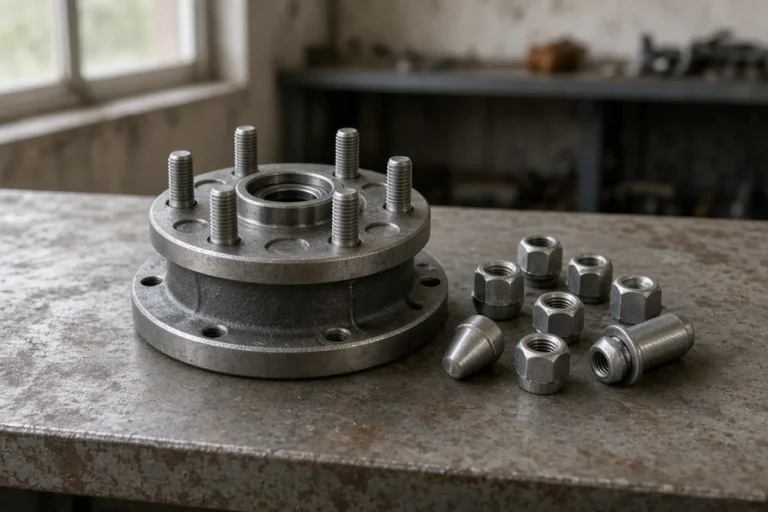




Tuercas de rueda are the threaded nuts that screw onto a vehicle’s wheel studs and clamp the wheel to the hub. The seat under each nut has to match the wheel, and the clamp load comes from the published torque, not from an impact-wrench guess.
Scope: this article explains what lug nuts are, how cone, ball and mag seats differ, how to read thread size, how to torque and re-check them, and when locking lug nuts (wheel locks) are useful. It is not a steering-wheel lock guide, a bolt-pattern measuring article (that is the bolt-pattern guide), a hub-centric rings vs lug-centric fitment page, or a wheel spacers guide. It does not publish a universal foot-pound chart. Other alloy-wheel fitment data live on the alloy wheels category and those sibling guides. Wheel and tire accessory programs are listed under ruedas y accesorios para neumáticos.
What are lug nuts, and how do they differ from lug bolts and wheel studs?
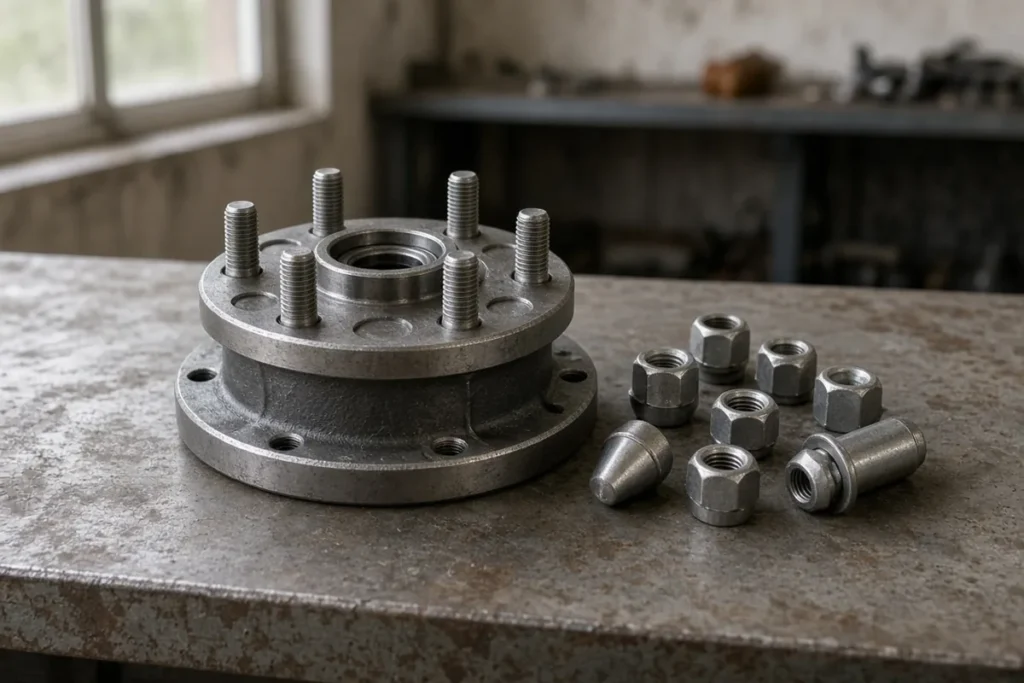
Lug nuts are separate nuts that thread onto wheel studs standing out from the hub, and they clamp the wheel against the hub face. A wheel stud is the threaded pin fixed in the hub.
A lug bolt, sometimes called a wheel bolt, is a one-piece fastener that passes through the wheel and screws into a threaded hole in the hub, so there is no standing stud. Many European hubs use lug bolts; many North American and Asian vehicles use studs and lug nuts. The two systems are not interchangeable on the same hub.

In everyday speech, people also say wheel nuts or lugs. Those names still refer to the clamp fasteners, not to the number of holes in a bolt pattern. A five-lug wheel is a five-stud pattern. It is not a specification for the nut itself.
The nut or bolt does two mechanical jobs at once. It creates clamp load so the wheel cannot move on the hub, and the seat under the nut helps center the wheel in the bolt holes as the fasteners are tightened. That centering is not a substitute for a hub-bore fit.
If you are comparing hub-centric and lug-centric wheels, or deciding whether you need rings, use the hub-centric rings guide. If the stack includes spacers, the wheel spacers article covers thickness, pattern and hub-centric fit, including the extra fastener length that a spacer can demand.
Because the nut is a wear and service part, shops often replace a set when wheels are changed, when a cap has swollen, or when threads or seats are damaged. The replacement still has to match the hub’s thread and the wheel’s seat, not just the old hex size.
What lug nut seat types are there, and why must the seat match the wheel?
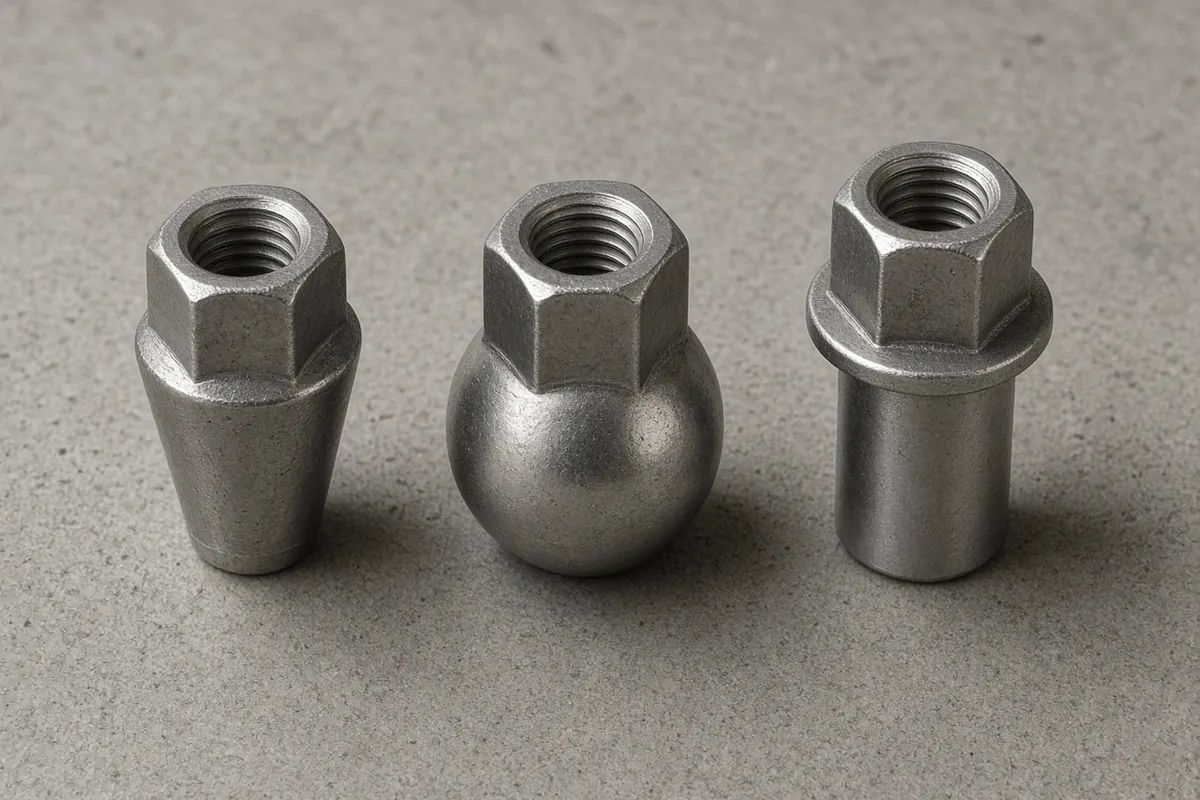
The seat is the contact face between the nut and the wheel, and it has to be the same geometry as the wheel’s countersink or flat pad. The SEMA and Wheel & Tire Committee aftermarket wheel installation guidelines, in the copy NHTSA hosts with recall 18E065, name three basic seats: conical (60° taper “acorn” and “bulge”), mag, and spherical or ball. They warn that the types are not compatible, and that a mismatch can let the fastener lose torque and, in the worst case, let the wheel come off 1.
A cone or taper seat is the common OEM and aftermarket shape: a 60° cone on the nut sits in a matching cone in the wheel and helps the wheel center as you tighten. A bulge or acorn nut is still a conical seat; the “bulge” is the body style, not a different angle.
A ball, spherical or radius seat uses a rounded face in a matching rounded pocket. It is not a worn-down cone.
A mag or shank nut uses a cylindrical shank that slips into an oversized wheel hole, plus a washer that clamps on a flat wheel face. The shank diameter and length are part of the fit, not optional styling.
McGard’s installation instructions tell the installer to confirm thread size and seating surface — cone, radius or shank — against the wheel maker’s recommendation, then to prove the nut is actually clamping the wheel.
For a cone or radius nut, tighten one sample, remove it, and look for a witness mark from the wheel on the seat. If the seat is unmarked, the closed end may have bottomed on the stud while the seat never reached the wheel.
For a mag or shank nut, the shank must not be a sloppy fit in the hole, the washer must tighten against the wheel, and the shank must not bottom on the hub 2.
The same instructions note that a spare tire on a steel wheel can use a different seat than aluminum road wheels, so a set that fits the alloys may be wrong for the spare.
Some racing wheels use a conical seat with a different included angle than the 60° OEM taper in the SEMA/WTC guideline. Treat that as a different seat, not as a “close enough” cone. If the wheel maker publishes a seat drawing, use that drawing. Do not assume an aftermarket nut that fitted an OEM steel wheel will fit a new alloy wheel.
How do you identify thread size, hex size and nut length?
Thread size is the stud diameter and the pitch, and it is not the same measurement as the socket that turns the nut. A common metric callout looks like M12×1.5 or M14×1.5: 12 mm or 14 mm outside diameter, and 1.5 mm between threads. Inch callouts such as 1/2-20 name the diameter and the threads per inch.
Those sizes appear often in catalogs, but the only correct size is the one on the vehicle’s studs or in the vehicle or wheel documentation. A nut that is the right hex and the wrong pitch can be started by hand for a turn or two and then cross-thread or strip.
Hex or socket size is the tool interface: 17 mm, 19 mm, 21 mm, 13/16 inch and similar. Two nuts can share a 19 mm hex and still differ in thread, seat, length or drive style. Tuner and spline-drive nuts use a special key instead of a standard hex. Measure the stud with a pitch gauge or a known nut, and confirm the seat against the wheel, rather than buying by socket size alone.
Length and whether the nut is open-end or closed-end matter for engagement and for bottoming. McGard’s rule of thumb is that minimum thread engagement should at least equal the thread diameter — for example, an M12×1.5 nut needs at least 12 mm (0.472 in) of thread engagement 2.
A closed-end nut that runs out of internal thread before the seat hits the wheel is bottomed out, even if a torque wrench clicks.
An open-end nut can make it easier to see that the stud has come through, but it still has to meet the same engagement rule and must not interfere with a cap or a brake component.
Aftermarket wheels often need a different nut than the OEM set, because the seat, the hole diameter or the thickness of the wheel changes.
A two-piece nut with a thin decorative cap can also cause a service problem that looks like a wrong socket: the cap can swell or spin, so a standard wrench no longer fits or rounds the cap instead of turning the nut. In that case the hardware is due for replacement, not a larger impact socket.
How should lug nuts be torqued, and when should they be rechecked?
Tighten lug nuts in a star or crisscross pattern to the torque published by the vehicle maker, or by the wheel maker when that document governs an aftermarket wheel. The SEMA/WTC guidelines say to use the original-equipment manufacturer’s torque specification, to apply it evenly by repeating the star or crisscross pattern, and not to under- or over-torque the fasteners 1.
Toyota’s T-SB-0313-17, written about brake vibration on 2015–2018 models, makes the same process point: take the value from the model-year repair manual, use a star pattern, and use a torque wrench or torque stick that is kept on a calibration schedule. The bulletin also states that even one over- or under-torqued nut can cause brake vibration 3.
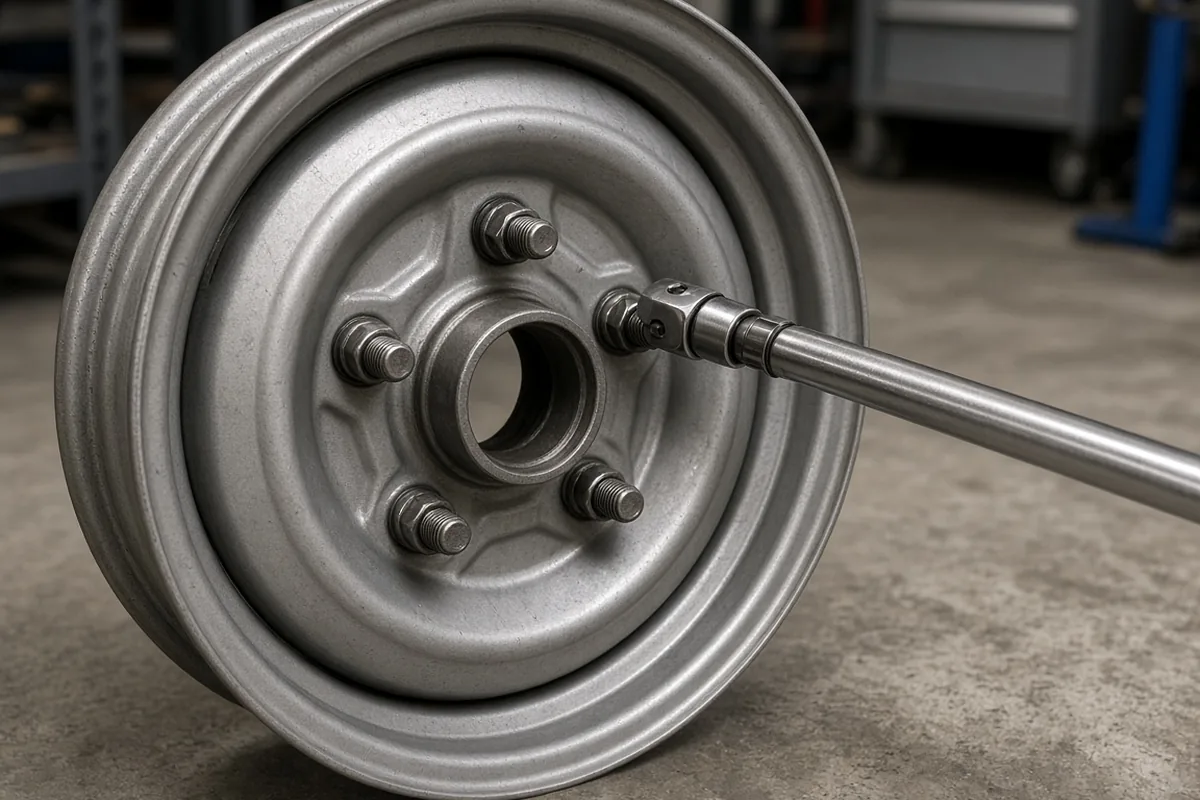
A safe shop sequence is consistent across those sources, even when the exact foot-pound number is not. Clean and inspect the studs and the mating faces. The Ford owner’s manual warns that corrosion, dirt or foreign material on the wheel or hub mounting surfaces can prevent metal-to-metal contact, and that the nuts can then loosen until the wheel comes off 4.
Start every nut by hand to avoid cross-threading. Snug them in a star pattern with the wheel off the ground, lower the vehicle so the tire is supporting weight, then apply the final specified torque, again in a star pattern, with a calibrated torque wrench.
McGard does not recommend impact guns for final installation because they often cannot hold a known torque and can over-tighten or leave the set uneven 2. Toyota allows a torque stick as well as a torque wrench, but still treats calibration as part of the job 3.
Do not copy a generic foot-pound chart into an RFQ or a work order. Published examples vary by vehicle, stud size and wheel, and a number that is correct for one model is wrong for another. If a tool-aisle article quotes a range, treat it as unusable for a specific car.
Those recheck windows are not in conflict if you treat them as source-specific. A Ford vehicle follows the Ford manual. An aftermarket wheel may add its own recheck. A McGard lug-bolt set follows McGard’s 25-mile note for that product. When two documents apply, use the stricter early check, then stay with the vehicle maker’s torque value.
What are wheel locks, and when do you need locking lug nuts?
In this article, wheel locks are locking lug nuts: one specially keyed nut (or bolt) per wheel that needs a matching key to turn, not a bar that locks the steering wheel. The everyday search term “wheel locks” is used for both products, so a buyer should confirm which one is on the request before ordering.
Locking lug nuts use the same thread and the same seat as the rest of the set. The only intended difference is the key interface.
They are a theft deterrent, not a guarantee. A lock slows a thief who is equipped only with a standard socket. It will not make an expensive wheel unstealable, and it will not replace parking, lighting or other theft controls.
The usual fit is one lock per wheel, plus a key that has to stay with the vehicle and with the shop record. If the key is lost, a tire shop may still be able to service the wheel, but that is a recovery job, not a reason to publish defeat methods here.
McGard’s verification steps for lock nuts are the same seat, engagement and bottoming checks used for ordinary lug nuts, including the reminder that a steel spare may need a different seat than the road wheels 2. A lock that is the right thread but the wrong seat is as unsafe as any other mismatched nut.
Tuner or spline-drive sets that use a special socket on every nut are a related style: they also need a key, and the key is part of the kit, not an optional accessory.
Whether locks are “necessary” depends on the risk, not on a universal rule. They are easier to justify on distinctive aftermarket wheels, on vehicles that park on the street, or in a lot with a known wheel-theft problem.
They add a process burden: the key has to be found at every rotation, puncture repair or brake job. For a distributor, that burden belongs in the pack-out (a labeled key pouch, a spare key policy, and a note in the fitment file) rather than in a surprise at the first service visit.
¿Qué riesgos y excepciones debes tener en cuenta?
Most lug-nut failures start as a fit or process error, not as a mystery metallurgy problem. The highest-risk mistakes are a seat mismatch, a nut that has bottomed on the stud, a short thread engagement, and an impact wrench used as the final torque tool 1, 2. Each of those can produce a reassuring click on a wrench while the wheel is still not clamped.
Do not treat a missing nut as a minor cosmetic issue. The remaining fasteners then carry more of the clamp load and can loosen or fatigue. If a nut is already missing, or if a wheel has been driven that way, inspect the studs, the wheel holes and the other nuts before you just replace the one part and send the vehicle out.
The same caution applies after a rounded or stripped nut: the stud may have been twisted, and a new nut on a damaged stud is not a repair.
Two-piece capped nuts, aluminum nuts and mixed spare-wheel hardware are the usual exceptions. A swollen or spinning cap can make a nut impossible to service with the standard socket and can hide corrosion under the cap.
Lightweight aluminum nuts exist, but they are a specified part, not a generic upgrade; if the vehicle or wheel maker did not approve that material, do not substitute it to save weight or to get a color.
A steel spare with a different seat than the alloys is easy to miss in a four-wheel kit. If you do not want to verify the spare at the counter, McGard’s practical advice is to keep a set of the original nuts for that spare 2.
Thread lubricant is another exception that only applies when the document in front of you says so. The default in the SEMA/WTC guidelines and in McGard’s instructions is dry, clean threads, because lubricant changes the clamp load you get at a given torque 1, 2.
Ford’s two-piece flat-nut note — one drop of oil between the washer and the nut, never on the threads — is a written OEM exception, not a reason to oil every stud in the shop 4.
What should buyers and shops put in a lug-nut RFQ?
A usable lug-nut request names the thread, the seat, the tool interface and the document that supplies the torque, plus any lock and spare-wheel requirements. A request that only says “19 mm chrome nuts for a 5-lug truck” is not a specification.
Include at least the following in the written request or incoming-inspection sheet:
- Vehicle make, model, year and, if known, the OEM fastener part number, or the aftermarket wheel brand and part number if the wheel maker governs the nut.
- Thread diameter and pitch (for example M14×1.5 or 1/2-20), and whether the hub uses nuts on studs or lug bolts.
- Seat type: cone (and the angle if the wheel drawing gives one), ball/radius, or mag/shank, including shank diameter and length and washer style when a shank nut is required.
- Hex or key style (standard hex size, tuner, spline-drive), overall length, and open-end or closed-end.
- Material and finish (for example one-piece steel, not a two-piece cap, if that is a service requirement), and any color or coating note that is actually a corrosion or tool-fit requirement.
- Quantity per wheel, whether the set includes locking nuts, how many keys, and where the key will be packed and recorded.
- Spare-wheel requirement: same seat as the road wheels, or a separate spare set.
- Minimum thread engagement target (McGard’s diameter rule is a clear default if the wheel maker does not publish another figure 2) and a bottoming / witness-mark check on first article.
- Torque source: the exact manual or wheel-installation sheet, including any recheck interval, and a note that final tightening is with a calibrated torque wrench, not an impact gun.
For a distributor or importer, add pack-out and labeling: thread and seat on the bag or box, a warning not to mix leftover nuts from another wheel, and a key tag that survives the warehouse. Incoming inspection should try one nut on a known stud, check the seat against the wheel, and reject a lot that starts poorly, bottoms, or leaves a loose mag washer. Do not ask a supplier for a single foot-pound number that is supposed to cover every vehicle in the catalog.
Conclusión
A lug nut is a clamp fastener, and it only works when the thread, the seat and the torque all belong to that hub and that wheel. Cone, ball and mag seats are different joints. Mixing them can give you a torque reading without a clamped wheel. The published specification, applied in a star pattern with a calibrated wrench and then rechecked after a short drive, is the process the first-party documents actually describe.
Wheel locks, in this sense, are keyed lug nuts. They can be worth packing on distinctive wheels, but they still have to match the seat and the thread, and the key has to stay with the set. None of this replaces bolt-pattern, center-bore or spacer fitment, which already have their own pages.
If you are writing a purchase order, write the fastener down the way a shop will have to install it: thread, seat, length, key, spare and the manual that supplies the torque.
Siguiente paso
If you are building a wheel or tire accessory program, start from the ruedas y accesorios para neumáticos category and the llantas de aleación category, then send the vehicle or wheel list, seat, thread and torque source through the formulario de contacto. Yirox can support wheel and tire accessory programs from its Wuxi factory and will work from the fitment details you put in the request.
Preguntas frecuentes
What are lug nuts on a car?
They are the nuts that thread onto the wheel studs and clamp the wheel to the hub. They are service parts, not a structural part of the wheel itself, and they have to match both the stud thread and the wheel seat.
Are lug nuts and lug bolts the same thing?
No. Lug nuts screw onto studs that already stand out from the hub. Lug bolts are one-piece fasteners that screw into threaded holes in the hub. A hub built for one system will not use the other without a different hub or conversion, which is a separate engineering job.
What happens if you use the wrong lug nut seat?
The nut may not bear on the full contact face, so a torque wrench can click while the wheel is still not clamped. The SEMA/WTC guidelines treat cone, mag and ball seats as incompatible and warn that a mismatch can lead to lost torque and wheel loss 1.
How tight should lug nuts be?
As tight as the vehicle repair or owner’s manual says, or the aftermarket wheel maker if that document governs the wheel, applied in a star pattern with a calibrated torque wrench. There is no single foot-pound number that is safe for every car. Recheck the same specification after a short drive, using the interval in the document that applies 1, 3, 4.
Are wheel locks necessary?
Not as a universal rule. Locking lug nuts are a reasonable deterrent when the wheels are distinctive or the parking risk is high, and they are a process cost at every tire service. They do not make theft impossible. They still have to match the seat and thread, and the key has to stay with the vehicle.
Can I drive with a missing lug nut?
You should not treat a missing nut as acceptable remaining capacity. The other fasteners then share a load they were not meant to carry alone. Inspect the studs and the wheel and restore a complete, correctly seated, correctly torqued set before the vehicle goes back into service.
Referencias
- SEMA / Wheel & Tire Committee (WTC), Aftermarket Wheel Installation Guidelines, copy hosted by NHTSA in equipment-recall file 18E065, document RCONL-18E065-6286 (seats, torque method, lubrication default, and a torque check within 100 miles or 2 to 3 days). static.nhtsa.gov, RCONL-18E065-6286.pdf.
- McGard, Installation/Removal instructions (seat verification, thread-engagement rule, bottoming and spare-wheel checks, impact-wrench caution, and a 25-mile re-torque for McGard lug bolts). shop.mcgard.com/installation-removal.
- Toyota Motor Sales, U.S.A., T-SB-0313-17, Brake Vibration and Lug Nut Torque, 14 November 2017, NHTSA TSB copy MC-10146519-9999 (repair-manual torque value, star pattern, calibrated wrench or torque stick; one over- or under-torqued nut can cause vibration). static.nhtsa.gov, MC-10146519-9999.pdf.
- Ford Motor Company, Owner’s Manual, Wheels and Tires — Lug Nuts, US web edition (clean metal-to-metal mounting surfaces; retighten to the specified torque within 100 miles / 160 km after any wheel disturbance). fordservicecontent.com, Wheels and Tires — Lug Nuts.