




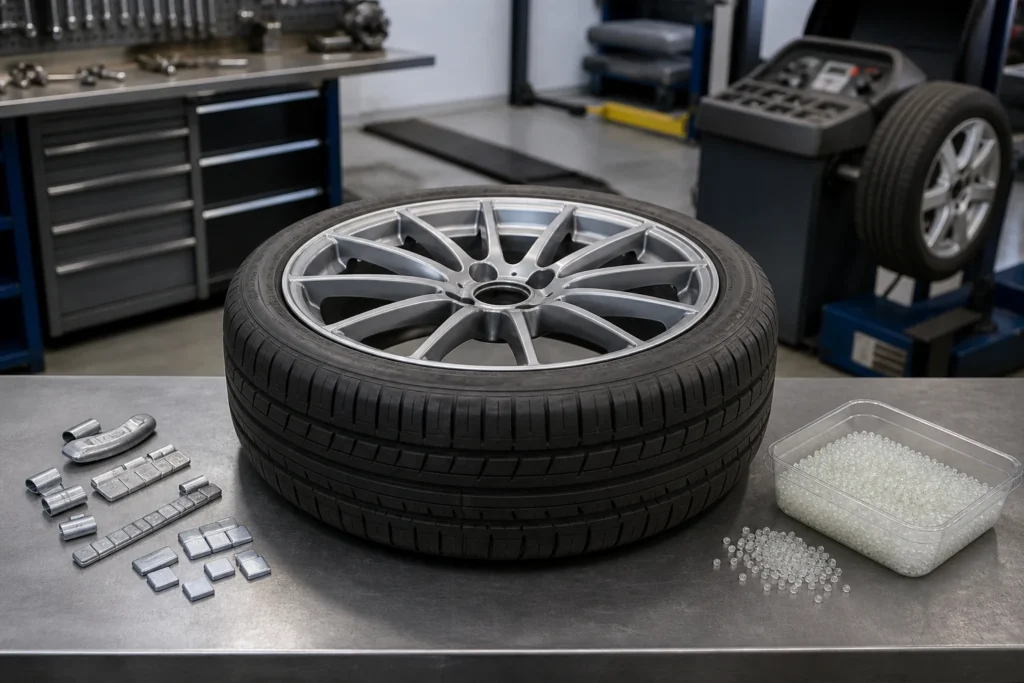
Para a maioria dos carros de rua, pneus de perfil baixo e serviço em rodas de liga leve, os pesos de roda medidos são o ponto de partida mais seguro. Para aplicações grandes, de serviço pesado, off-road, RV e frotas selecionadas, as esferas de balanceamento podem valer um teste controlado. O pneu exato, a roda, o TPMS ou a configuração da válvula e as instruções do produto decidem a compatibilidade. 1 2 3
Esta comparação de 2027 é escrita para instaladores de pneus, equipes de manutenção de frotas, operadores de caminhões, distribuidores e compradores que estão construindo um programa repetível de balanceamento de rodas. Ela se concentra nas questões que criam os erros mais caros: compatibilidade com TPMS, encaixe em rodas de liga leve, vibração em velocidade de estrada, fluxo de trabalho de caminhões e frotas, e o que um fornecedor deve comprovar antes de um pedido maior.
Se a terminologia ainda estiver confusa, comece com este visão geral de pesos de roda versus balanceamento de pneus. Ele separa o serviço de balanceamento do produto de correção física, que é a primeira distinção que um comprador precisa.
Índice
- Qual método de balanceamento de rodas é melhor em 2027?
- Como os pesos de roda e as esferas de balanceamento funcionam de maneira diferente?
- As esferas de balanceamento são melhores que os pesos de roda?
- As esferas de balanceamento podem danificar os sensores de TPMS?
- Qual método é melhor para rodas de liga leve?
- Os pesos de roda funcionam melhor em velocidades de estrada?
- As esferas de balanceamento são adequadas para caminhões e uso em frotas?
- Como os instaladores e as equipes de frota devem testar o método?
- O que os compradores devem verificar antes de adquirir produtos de balanceamento de rodas?
- Conclusão escolha o método que você pode verificar
- Perguntas Frequentes
- Referências
Qual método de balanceamento de rodas é melhor em 2027?
Use este roteiro antes de comparar preço ou alegações do produto:
- Carro de rua, pneu de perfil baixo ou serviço comum em rodas de liga leve: comece com pesos de roda medidos.
- Aplicação grande, de serviço pesado, off-road, RV ou frota selecionada: avalie esferas de balanceamento apenas por meio de um teste controlado e específico do produto.
- Configuração de TPMS ou válvula incerta: pause a compra até que o fornecedor documente a rota de instalação e a compatibilidade.
- Vibração em velocidade de estrada: diagnostique e meça o conjunto antes de escolher um produto de correção.
- Programa de frota ou distribuidor: aprove por segmento de aplicação após comparar tempo de serviço, reclamações recorrentes, inventário e custo total.
| Fator de decisão | Contrapesos de roda | Esferas de balanceamento |
|---|---|---|
| Onde a correção é criada | Fixados na borda, geralmente como produto de encaixe ou adesivo | Dentro da cavidade do pneu como meio interno |
| Como a quantidade é selecionada | Um balanceador mede o conjunto e indica a quantidade e a posição da correção 1 | A tabela de aplicação e as instruções de instalação do produto determinam a quantidade; não copie uma tabela genérica |
| Questão do TPMS | Verifique o sensor e a válvula antes do serviço no pneu, mas não há meio interno no pneu | A compatibilidade é específica do produto; a instalação pela válvula pode não ser permitida com algumas configurações de sensor 2 3 |
| Questão das rodas de liga leve | Formatos adesivos podem se encaixar onde um perfil de encaixe não se encaixa, sujeitos a verificações de superfície e folga | O material da roda por si só não aprova um produto interno; verifique o pneu, a válvula, o sensor e a combinação do produto |
| Fluxo de trabalho em velocidade de estrada | Fácil de conectar à correção medida e a uma reverificação | Requer um método específico do produto e não deve substituir o diagnóstico de empenamento, uniformidade ou falhas do veículo |
| Rastreabilidade do instalador | Localização, formato e retenção do peso podem ser inspecionados visualmente | Identidade do produto, quantidade, caminho da válvula e procedimento de reparo precisam ser registrados |
| Melhor regra de decisão | Escolha quando a correção medida e os registros de serviço visíveis importam | Escolha apenas quando o método interno tiver uma aplicação verificada e um fluxo de trabalho controlado |
O caminho de decisão separa a escolha do produto do diagnóstico de falhas. Se uma reverificação medida não resolver o sintoma, passe para o diagnóstico de pneu, roda, montagem, alinhamento ou suspensão em vez de trocar produtos por tentativa e erro. 1 4
Como os pesos de roda e as esferas de balanceamento funcionam de maneira diferente?
Os pesos de roda adicionam uma massa conhecida a uma posição calculada na borda. As esferas de balanceamento são meios internos soltos destinados a se redistribuir dentro do pneu conforme o conjunto gira. As duas abordagens resolvem o mesmo problema amplo por meio de fluxos de trabalho de serviço diferentes, portanto seus requisitos de instalação e verificação não devem ser misturados. 1 3
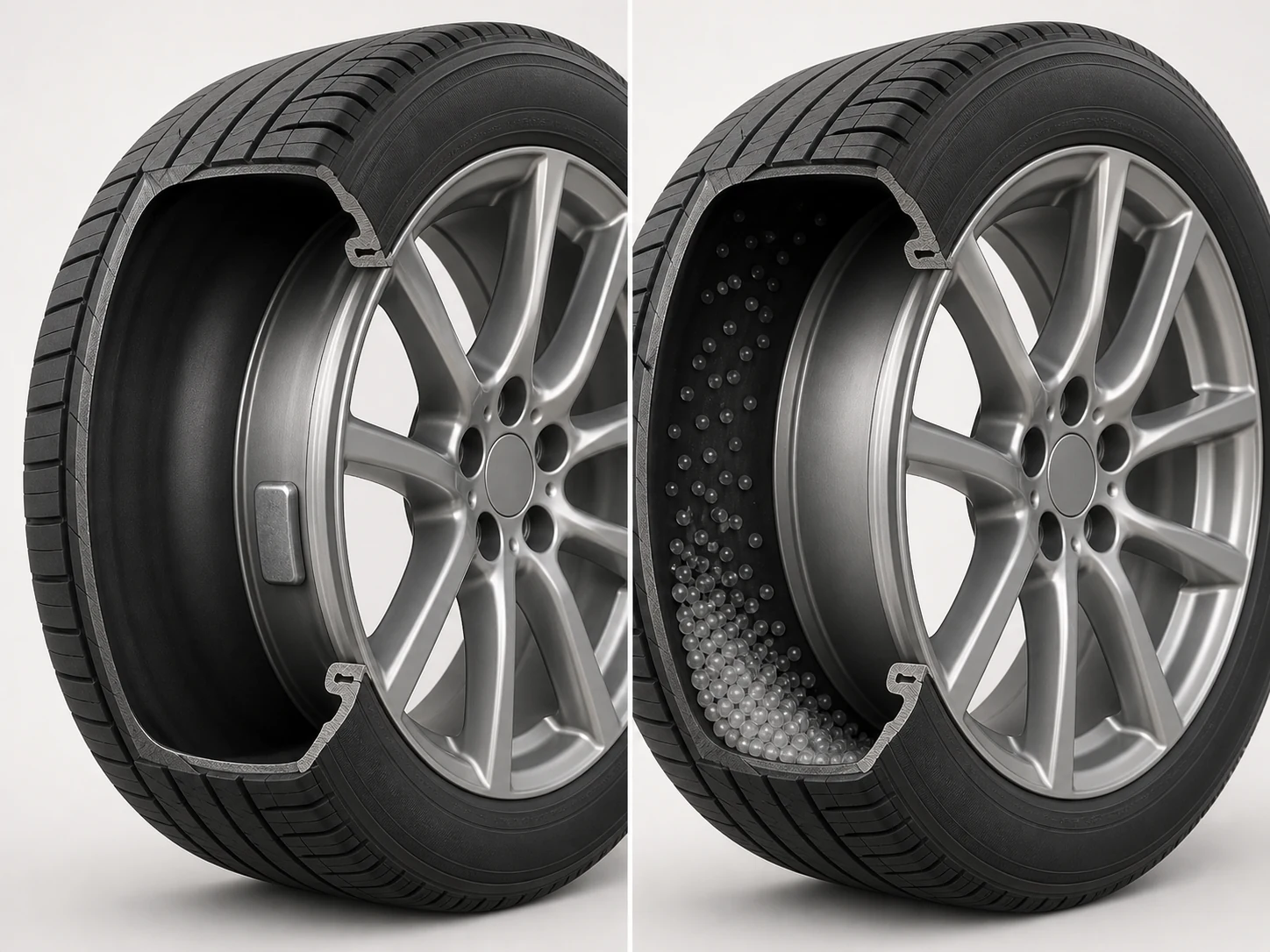
Como os pesos de roda se encaixam no fluxo de trabalho normal de uma loja de pneus?
The technician mounts the tire and wheel, centers the assembly on a suitable balancer, spins it, reads the correction amount and position, installs the appropriate clip-on or adhesive weight, and rechecks the result. Continental describes static, dynamic, and road-force balancing as different ways of measuring or correcting the rotating assembly, with dynamic equipment specifying how much weight to apply and where. 1
The result is easy to audit through the wheel type, balancer mode, correction value, weight format, and recheck. The clip profile or adhesive strip still has to fit the flange, clearance, surface, and local gram-or-ounce stock system. See the modos de balanceadora de rodas guide for the equipment side of that workflow.
How do balancing beads fit an internal-balancing workflow?
Beads or another internal medium are added inside the tire according to the product’s stated application, quantity, installation route, and repair instructions. A current manufacturer support page explains that its beads move to a balanced position through inertia and vehicle suspension movement, and that its product should not be combined with other balancing products. Those are product instructions, not a universal rule for every bead or compound on the market. 3
The work order should record the product, dose, tire size, valve and TPMS configuration, installation route, and removal procedure. Without that traceability, an internal method can be harder to troubleshoot than a visible rim correction.
As esferas de balanceamento são melhores que os pesos de roda?
For street cars, low-profile tires, and most ordinary alloy-wheel service, choose measured wheel weights first. For large, heavy-duty, off-road, RV, and selected fleet applications, balancing beads are a test candidate when the supplier provides an approved application, installation route, and service procedure. 1 3
| Aplicação | Practical starting point | Why the recommendation is conditional |
|---|---|---|
| Everyday passenger car | Contrapesos de roda | A conventional shop can measure, correct, and recheck the assembly with familiar equipment; some bead suppliers specifically limit or discourage use in most automobile tires 3 |
| Alloy-wheel service | Adhesive wheel weights when the actual rim and surface accept them | Tape, clearance, finish, and bonding preparation still need validation; E.T.R.T.O. says glued weights belong on the metallic part, not flexible flanges 2 |
| Highway-speed vibration complaint | Measured wheel balancing and diagnosis first | Speed can make imbalance noticeable, but it does not identify whether the cause is the tire, rim, mounting, or vehicle 1 |
| Truck, bus, RV, or specialty assembly | Compare both methods by application segment | Heavy-duty fitment, valve path, load, speed, tire construction, and repair workflow can differ substantially |
| Multi-depot fleet | The method that produces the most repeatable service records | A fleet needs one procedure, training, compatible inventory, and an acceptance rule across locations |
The buyer’s choice should follow the operating profile in the table. Compare a complete service cycle—including a repeat complaint, tire repair, sensor service, and product removal—rather than comparing bag or strip price alone.
As esferas de balanceamento podem danificar os sensores de TPMS?
There is no safe universal yes-or-no answer for all balancing beads and all TPMS systems. Some manufacturers state that their specific internal product is compatible with TPMS, while also warning that a valve-stem injection method may be blocked or unsuitable when a sensor is present. The product, sensor, valve, tire, and installation method must be checked as one system. 2 3
E.T.R.T.O. recommends consulting the tire, wheel, and valve manufacturers before using balancing powder, and its commercial-vehicle recommendations emphasize careful checking of unverified sensor, valve, and rim combinations by trained operators. 2
What should an installer verify before using beads with TPMS?
- Identify the sensor and valve. Confirm the sensor position, valve type, and whether a filtered or special valve core is required; the installation path can change even for the same tire size.
- Check the exact product instructions. Look for an explicit statement about the bead or compound, sensor type, tire application, and installation route.
- Separate “compatible in service” from “injectable through the valve.” A product can be claimed as TPMS-compatible inside the tire while still requiring the tire to be broken down for installation. 3
- Protect the sensor during mounting and dismounting. E.T.R.T.O. calls for appropriate tools and trained operators to avoid contact between the sensor housing and tire bead. 2
- Prove the system after service. Check pressure, inspect for leaks, and confirm that the TPMS reports correctly using the vehicle or sensor manufacturer’s procedure.
Do not use a TPMS claim as a substitute for a fitment record, or treat a warning light as proof that the balancing product caused a problem. NHTSA says TPMS is not a replacement for regular tire-pressure checks, so the tire, valve, sensor, and service history should be reviewed together. 4
Qual método é melhor para rodas de liga leve?
For many alloy-wheel service jobs, adhesive wheel weights are the more natural first option because they can be placed on the inner barrel when the wheel has a suitable, clean metallic bonding surface and enough clearance. That does not make every adhesive product suitable, and it does not make balancing beads automatically better: the actual wheel, tire, surface, valve, sensor, and product instructions still control the decision. 1 2
The fitment question is where the correction can be installed without damaging the wheel or interfering with the brake, suspension, valve, sensor, or tire. E.T.R.T.O. specifically says glued balance weights should be attached to the metallic part, not flexible flanges. 2
When do adhesive weights make sense on alloy wheels?
Adhesive weights may fit when the inner barrel is wide enough, clean, dry, and clear of brake or suspension parts. Confirm tape and wheel-finish compatibility, apply the specified pressure, observe temperature guidance, and run a sample adhesion check when the coating is unfamiliar.
When might beads be considered for an alloy-wheel application?
Beads may be considered only when the tire-and-wheel application is expressly supported and the buyer can install, inspect, and remove them. Alloy construction alone does not establish suitability for the tire, speed rating, TPMS layout, or vehicle; modified wheels, tires, or suspension can introduce vibration sources that a balancing product cannot correct. 3
Os pesos de roda funcionam melhor em velocidades de estrada?
Wheel weights do not automatically work better simply because the vehicle travels at highway speed. They do offer a clear advantage in a conventional service workflow: a machine measures the rotating assembly, the technician applies a known correction, and the result can be rechecked before the vehicle returns to the road. Persistent highway-speed vibration still requires diagnosis of tire uniformity, radial or lateral runout, mounting, centering, wheel condition, and vehicle components. 1 4

Continental notes that imbalance becomes more noticeable as speed increases and that road-force equipment can identify force variations a standard balance may not detect. Highway use therefore increases the value of a consistent diagnostic process, not the value of a product category by default. 1
For a service manager, the preferred workflow is usually:
- Verify tire pressure, inspect the tire and wheel, and confirm correct mounting and centering.
- Measure the assembly using the correct machine mode.
- Apply the specified correction or follow the approved internal method, then recheck and record it.
- If the symptom remains, stop the product comparison and diagnose the tire, wheel, alignment, driveshaft, or suspension fault. 1 3
As esferas de balanceamento são adequadas para caminhões e uso em frotas?
Balancing beads can be suitable for selected trucks, buses, trailers, RVs, or specialty fleets when the product documentation, tire construction, valve or TPMS setup, service tools, and repair workflow all match. They should not be approved for an entire fleet because one truck or one successful installation felt smooth. Fixed truck wheel weights remain the more straightforward starting point when a fleet already uses measured balancing and wants visible correction records.
Truck and fleet decisions add axle position, tire size, casing, load, route, wheel construction, dual-wheel configuration, depot equipment, and outside-dealer procedures. The truck wheel weights guide is useful for a separate heavy-duty fitment review.
| Fleet question | Why it changes the choice | Evidence to collect |
|---|---|---|
| Are the vehicles highway, regional, vocational, or off-road? | Different routes and tire constructions create different service demands | Segment-level complaint, wear, and service records |
| Does every depot have a suitable balancer? | A fixed-weight program depends on consistent measurement and correction | Equipment list, machine modes, training records |
| Can technicians install and remove the internal product correctly? | Beads may require a controlled mounting or dismounting procedure | Work instructions, tools, time study, valve and sensor checks |
| How are repeat complaints handled? | A fleet needs diagnosis rules, not only a new balancing material | Escalation path for tire, wheel, hub, alignment, and suspension checks |
| What must be stocked? | Weights require compatible sizes and profiles; beads require application-specific doses | SKU plan, package sizes, replenishment lead time, and labels |
| What does a comeback cost? | Unit price can be much smaller than downtime or a second service visit | Total cost per successful service, not cost per bag or strip |
For commercial programs, separate steer, drive, trailer, and specialty segments rather than forcing one product across every position. The commercial-vehicle wheel-weight planning resource helps structure the fixed-weight side around wheel type, correction range, coating, packaging, and stock depth.
If you are qualifying a method for a real tire range or fleet segment, request a wheel-balancing sample review with tire sizes, wheel construction, TPMS or valve details, service workflow, and target quantity. That gives the supplier enough information to compare a usable specification instead of sending a generic assortment.
Como os instaladores e as equipes de frota devem testar o método?
A useful test compares the two methods on representative assemblies and measures the whole service outcome. The trial should begin with a baseline, keep the installation variables visible, and use an acceptance rule agreed by the service and purchasing teams before the first sample is installed.
- Define the population. Record tire sizes, wheel materials, axle positions, load, speed, tread patterns, dual fitments, and service locations.
- Separate symptoms from causes. Log vibration, uneven wear, missing weights, tire changes, road impacts, and repeat balancing separately.
- Choose representative assemblies. Include common, difficult, and high-complaint examples; do not compare one new tire with one worn tire and call it a fleet conclusion.
- Write both procedures. Specify machine setup, correction or product quantity, valve and sensor precautions, surface preparation, tools, and recheck steps.
- Measure service burden. Record labor, dismounting, equipment, training, packaging, inventory, and tire-repair steps.
- Track repeat results and approve by segment. Use consistent definitions for complaints, rework, sensor issues, leaks, and tire or wheel findings.
Approve the method by segment: fixed weights for measured passenger-car and alloy-wheel lanes, internal balancing for a verified specialty application, and a separate specification for commercial fleets when the data support it.
O que os compradores devem verificar antes de adquirir produtos de balanceamento de rodas?
Buyers should source against an application specification, not the words “wheel weights” or “balancing beads” alone. The RFQ should identify the tire and wheel, correction method, installation procedure, sensor or valve requirements, packaging, documents, quality checks, and sample acceptance criteria.

| Sourcing field | What to confirm before approval |
|---|---|
| Aplicação | Vehicle class, tire size, wheel material, axle or service position, operating speed, load, and route |
| Fixed-weight fitment | Clip profile, flange geometry, adhesive dimensions, clearance, retention, surface preparation, and correction increments |
| Internal-method fitment | Product type, quantity basis, tire compatibility, valve path, TPMS instructions, installation tools, and removal procedure |
| Material e acabamento | Steel, zinc, lead-free requirement, coating, corrosion expectations, and market-specific documentation |
| Service records | Required machine mode, installation steps, recheck method, batch or lot identification, and complaint escalation |
| Embalagem | Bag or box size, unit system, barcode, carton strength, pallet plan, storage instructions, and private-label needs |
| Quality control | Weight accuracy, clip consistency, tape performance, bead size or cleanliness, batch records, and change-control process |
| Trial acceptance | Test quantity, representative wheels, permitted rework, observation period, total-cost method, and approval owner |
For fixed weights, the wheel balancing weights range is a useful reference for comparing clip-on and adhesive formats, materials, packaging, and program options. Yirox’s category information also highlights batch checks, sample approval, packaging review, and documentation—useful controls because later shipments can differ from an acceptable first sample.
For beads, request the application chart, dose logic, tire and valve compatibility, TPMS instructions, installation route, repair and removal instructions, and written limits. If the supplier cannot state where the product is approved and how the installer should handle it, the quote is incomplete.
If you are sourcing wheel weights or evaluating balancing beads for a defined tire, wheel, TPMS, or fleet application, share the tire sizes, wheel construction, valve details, service workflow, packaging needs, and target volume. We can help you prepare a representative sample review before approving a broader specification.
Conclusion: Choose the method you can verify
Wheel weights are usually the better starting point when the service team needs a measured, visible, and repeatable correction on conventional passenger-car, alloy-wheel, or established commercial tire-shop work. Balancing beads may be the better fit for a narrower truck, bus, RV, off-road, or specialty application when the product is explicitly supported and the internal installation, TPMS, valve, repair, and record-keeping process can be controlled.
The 2027 decision should therefore be made by application segment, not by headline claim. Define the assembly, verify the sensor and wheel interface, run a representative trial, measure rework and service burden, and approve only the method that your installers and buyers can reproduce. That approach turns “wheel weights vs balancing beads” into a practical sourcing decision instead of a universal-product argument.
Perguntas Frequentes
As esferas de balanceamento são melhores que os pesos de roda?
For street cars, low-profile tires, and most alloy-wheel service, start with measured wheel weights. For large, heavy-duty, off-road, RV, and selected fleet applications, balancing beads may be worth a controlled trial, subject to the exact tire, wheel, TPMS or valve setup, and product instructions. 1 3
As esferas de balanceamento podem danificar os sensores de TPMS?
Some manufacturers state that their specific beads are compatible with TPMS, but the installation route still matters. A product may be compatible inside the tire while not being suitable for injection through a valve stem with a sensor installed. Check the product, sensor, valve, tire, and manufacturer instructions together. 2 3
Do wheel weights work better for highway speeds?
Not because of speed alone. Wheel weights work well in a measured and rechecked balancing workflow, but a highway-speed vibration can also come from tire uniformity, wheel runout, mounting, centering, alignment, or suspension problems. Diagnose the assembly instead of adding correction by guesswork. 1 4
Are balancing beads suitable for alloy wheels?
Sometimes, but alloy construction by itself does not prove suitability. Confirm that the bead product is approved for the tire and vehicle application and that the valve, TPMS, speed, load, and installation process are compatible. For many alloy-wheel service lanes, adhesive weights remain the more familiar starting point when the inner barrel accepts them. 1 2 3
As esferas de balanceamento são adequadas para caminhões e uso em frotas?
They may be suitable for selected fleet segments, but a fleet should not standardize them from one successful installation. Test representative truck or trailer assemblies, record the internal installation and repair workflow, and compare complaints, service time, compatibility, and total cost against the existing weight-based process.
What should B2B buyers check before sourcing wheel-balancing products?
Confirm the tire and wheel application, correction method, size or dose, clip or adhesive fit, material, coating, valve and TPMS requirements, installation procedure, packaging, documents, batch control, sample plan, and acceptance criteria. A comparable RFQ makes it easier to evaluate real supply risk instead of comparing unit prices with different specifications.
Referências
[1] Continental Tires. “Balancing tires.” n.d.
[2] European Tyre and Rim Technical Organisation. “E.T.R.T.O. Recommendations.” 2024.
[3] Counteract Balancing Beads. “Support and frequently asked questions.” n.d.
[4] National Highway Traffic Safety Administration. “Tire Safety Ratings and Awareness.” n.d.