



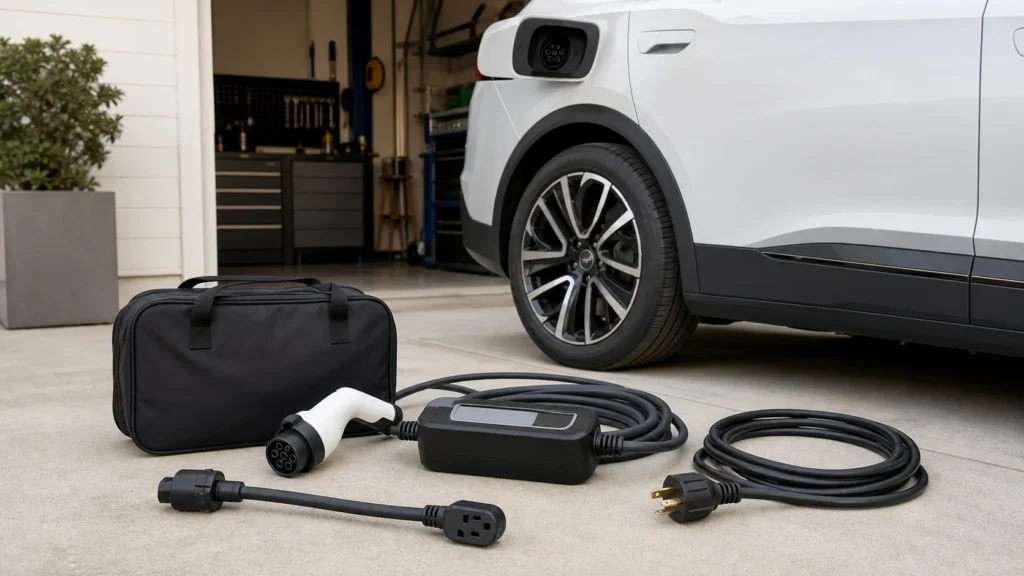
A portable EV charger, more precisely called portable AC EVSE, is a movable plug-in unit that takes electricity from a compatible AC wall outlet and safely supplies it to an electric vehicle. It normally includes a wall plug, cable, in-cable control box, protection electronics, and vehicle connector. It does not carry meaningful traction-battery energy inside the unit.
This article covers outlet-powered portable AC EVSE only. It does not cover battery-based mobile charging units, portable power stations used as energy sources, or mobile DC rescue chargers carried by roadside-assistance vehicles. Those products store or convert energy and solve a different use case; a portable AC EVSE still needs a suitable live outlet and circuit wherever it is used.
The word "charger" can be a little misleading. In most electric vehicles, the onboard charger inside the car converts AC power into DC power for the battery. The portable unit outside the car is technically electric vehicle supply equipment, or EVSE, which communicates with the vehicle and controls safe power delivery.
Portable charging is not one single product type. Some units plug into a normal household outlet for slow Level 1 charging. Others use a 240 V outlet for faster Level 2 charging. The real question is whether the EVSE fits the driver's energy need, outlet access, circuit limit, vehicle inlet, and verified safety requirements—not whether the listing shows the largest amperage number.
Table of Contents
- What is a portable EV charger?
- What types of portable EV chargers are available?
- What do three portable charging scenarios deliver?
- How does a portable EV charger work?
- What are the main benefits of a portable EV charger?
- What are the downsides of portable EV chargers?
- When is a portable EV charger the best choice?
- When is a wall-mounted EV charger better?
- What should buyers check before choosing a portable EV charger?
- Portable EV Charger Supplier Verification Sheet
- Conclusion: Choose portable charging for flexibility, not as a shortcut around safety
- Frequently Asked Questions
- References
What is a portable EV charger?
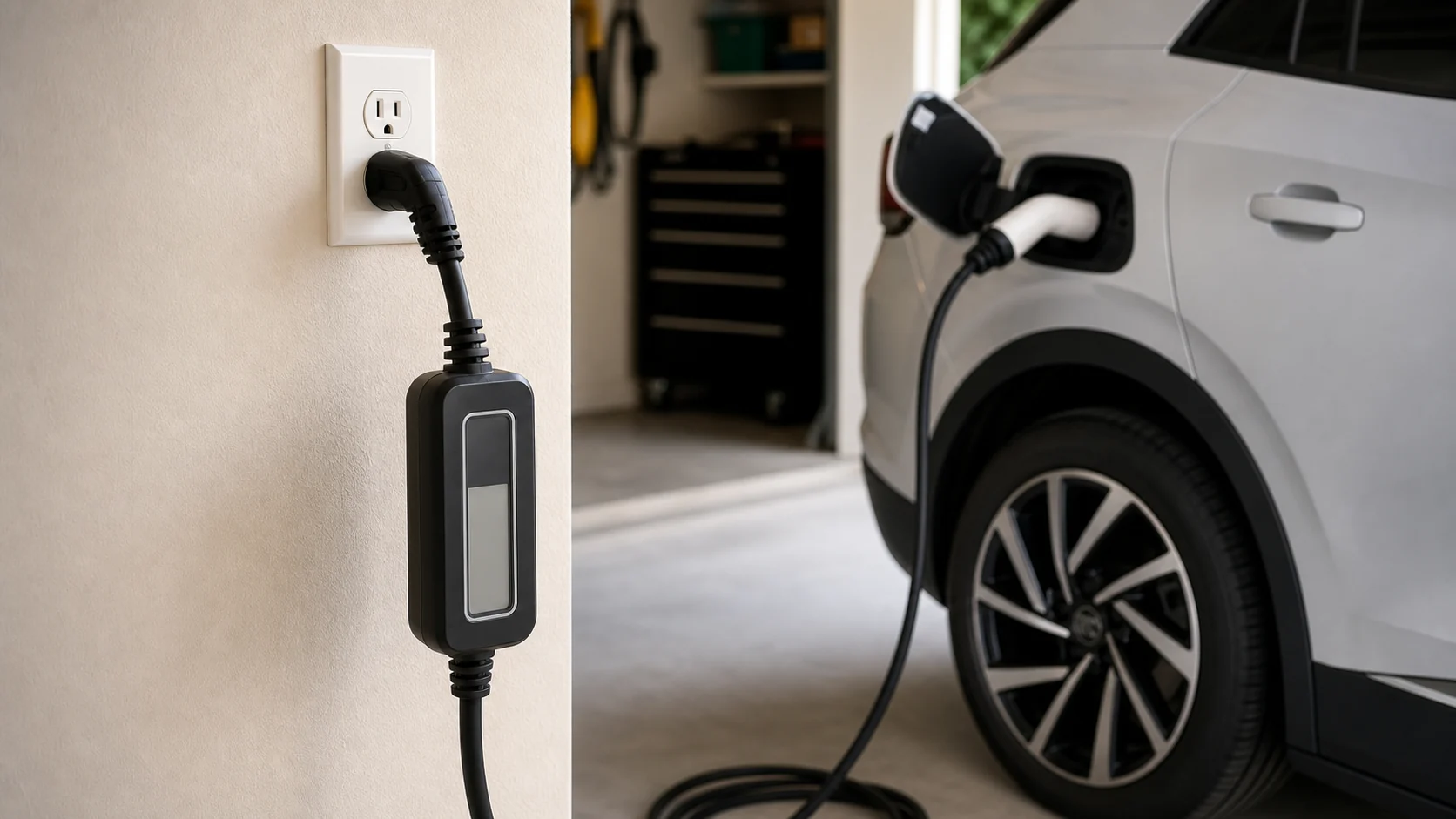
A portable EV charger is a plug-in EVSE unit that can be moved, stored, and used at different compatible outlets. It normally includes a wall plug, cable, control box, safety electronics, and a vehicle connector such as J1772, Type 2, NACS-related adapters, or another market-specific connector.
Unlike a fixed wallbox, a portable charger is not permanently mounted and hardwired to one location. That makes it convenient for drivers who move between homes, travel with the car, live in rentals, or want a backup cord in the trunk.
The trade-off is that portability depends on the outlet. A portable unit cannot make a weak or unsuitable circuit safe. The U.S. Department of Energy advises EV owners using Level 1 charging for long-term home charging to consult a licensed electrician to make sure there is a dedicated circuit, and also notes that an electrician can install or check a 240 V outlet for Level 2 charging 1. That point matters because EV charging is a long continuous electrical load, not a quick appliance cycle.
For product descriptions, it is helpful to separate the EVSE unit, the wall-side plug, and the vehicle-side connector. Confusing these parts creates returns: a customer may buy the right vehicle connector but the wrong wall plug, or a unit rated for more current than the outlet can safely support.
What types of portable EV chargers are available?
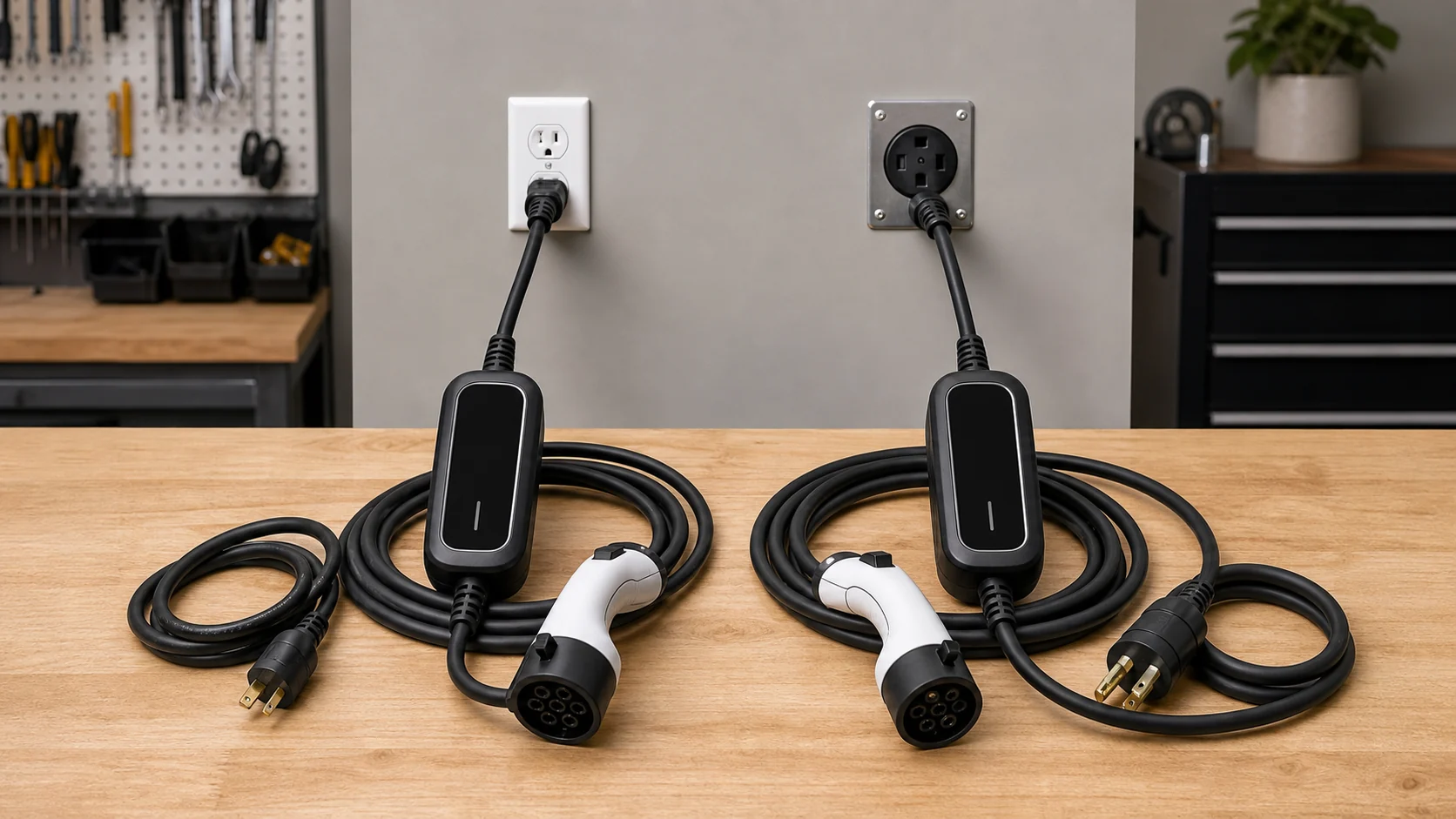
Portable EV chargers are usually grouped by charging level, plug type, vehicle connector, and control features. For most retail and everyday use, the biggest difference is Level 1 versus portable Level 2.
Level 1 portable chargers use a standard household outlet in markets such as North America. The EPA explains Level 1 charging as 120 V charging and Level 2 as 240 V charging, with Level 2 charging much faster for home and public use 2. The U.S. Department of Transportation also notes that charging speed depends on vehicle, charger, temperature, and battery factors 3.
| Portable charger type | Typical power source | Main strength | Main limitation | Best fit |
|---|---|---|---|---|
| Portable Level 1 EV charger | Standard household outlet in compatible markets | Easy access and low setup cost | Slow range recovery | Plug-in hybrids, low daily mileage, backup use |
| Portable Level 2 EV charger | 240 V outlet or market-equivalent higher-voltage outlet | Faster charging without hardwiring | Needs the right outlet, circuit, and plug | Homeowners, rentals with approved outlets, travel sites |
| Adjustable-current portable EVSE | Depends on included plug and settings | Can match different circuit limits when used correctly | User must understand settings | Mixed outlet access, fleets, experienced users |
| Interchangeable-plug portable charger | Multiple compatible wall plugs | More flexible assortment | More parts to verify and label | Retail kits, travel kits, regional variants |
| Connector-specific portable charger | Depends on product design | Easier vehicle fit when matched correctly | Wrong connector makes it unusable | J1772, Type 2, GB/T, or NACS-related use cases |
A Level 1 unit is often enough for short-distance drivers who can plug in overnight. A portable Level 2 unit fits drivers who need more range back between trips but cannot or do not want to install a hardwired wallbox.
Adjustable current and connected controls are feature layers, not separate charging levels. The adjustable-current portable EV charger guide explains how the selected current must stay within the approved circuit limit. The smart portable EV charger guide covers scheduling, app control, connectivity, and firmware questions without implying that a smart feature can correct an unsuitable outlet.
Connector choice is its own decision. North American AC charging has historically used J1772 for many non-Tesla vehicles, while Europe and many IEC-based markets use Type 2. A separate Type 1 vs Type 2 EV charger guide can help clarify region and vehicle fit before choosing a portable product.
How does a portable EV charger work?
A portable EV charger works by connecting a compatible electrical outlet to the vehicle through an EVSE control unit that communicates with the car before power flows. The unit tells the vehicle how much current is available, monitors the charging session, and helps stop charging when a fault or unsafe condition is detected.
In simple terms, the portable EVSE is a controlled gate, not an ordinary extension cord. It checks connection status, manages pilot signaling, and provides protection features designed for EV charging. The vehicle's onboard charger then converts incoming AC power into DC power for the battery.
Charging speed depends on several practical factors:
- Outlet voltage and circuit capacity: Household outlets are slower; approved 240 V outlets can support faster Level 2 charging.
- EVSE current setting: Adjustable settings must stay within circuit limits.
- Vehicle onboard charger limit: The car may accept less AC power than the EVSE can provide.
- Battery state and temperature: Real charging speed can change with conditions.
- Cable and connector rating: The product must suit the intended current and duty cycle.
The Department of Energy's Federal Energy Management Program describes Level 1 EVSE as typically around 1.4 kW and notes that portable Level 1 cords are commonly associated with 120 V receptacles 5. That helps explain why a household-outlet portable charger is useful but slow. It may be enough to recover daily commuting miles overnight, but it is not the same experience as a dedicated higher-power Level 2 setup.
What do three portable charging scenarios deliver?
Use voltage × current ÷ 1,000 to estimate AC input power in kilowatts. Multiply power by charging hours to estimate theoretical wall energy. The following planning examples apply an 85% wall-to-battery assumption and use 0.30kWh per mile as an example vehicle consumption rate. Actual efficiency and consumption change with the vehicle, temperature, battery conditioning, speed, terrain, and accessories.
| Scenario | Theoretical input power | Theoretical wall energy | Estimated battery energy at 85% | Example daily distance at 0.30kWh/mile |
|---|---|---|---|---|
| 120V × 12A × 10 hours | 1.44kW | 14.4kWh | 12.24kWh | About 40.8 miles / 65.7km |
| 240V × 16A × 8 hours | 3.84kW | 30.72kWh | 26.11kWh | About 87.0 miles / 140.1km |
| 240V × 32A × 8 hours | 7.68kW | 61.44kWh | 52.22kWh | About 174.1 miles / 280.1km |
Scenario 1: 120V, 12A, 10 hours
The calculation is 120 × 12 ÷ 1,000 = 1.44kW. Over ten hours, the outlet supplies a theoretical 14.4kWh. At the stated 85% assumption, approximately 12.24kWh reaches the battery, enough for about 40.8 example miles at 0.30kWh/mile.
This can cover a modest commute or plug-in hybrid use, but only when the outlet and circuit have been confirmed for the load. It is not evidence that any unknown household receptacle is suitable for ten hours of charging.
Scenario 2: 240V, 16A, 8 hours
The calculation is 240 × 16 ÷ 1,000 = 3.84kW. Over eight hours, theoretical wall energy is 30.72kWh. After the 85% assumption, estimated battery energy is 26.11kWh, or about 87.0 example miles.
This suits many drivers who need more overnight recovery than Level 1 but do not require a high-current unit. The wall plug, receptacle, wiring, breaker, EVSE setting, and vehicle onboard-charger limit must still agree.
Scenario 3: 240V, 32A, 8 hours
The calculation is 240 × 32 ÷ 1,000 = 7.68kW. Over eight hours, theoretical wall energy is 61.44kWh. At 85%, estimated battery energy is 52.22kWh, or about 174.1 example miles.
The number describes energy potential, not permission to use 32A. The circuit and protective equipment must be designed and approved for the continuous charging load, and the vehicle may accept less power than the EVSE can offer.
To adapt any scenario, replace 0.30kWh/mile with the driver's measured consumption: estimated distance = battery energy delivered ÷ vehicle consumption. Also cap input power at the lowest of the circuit allowance, EVSE rating, selected current, and vehicle AC charging limit.
What are the main benefits of a portable EV charger?
The main benefit of a portable EV charger is flexibility. It gives the driver a movable charging option that can support home charging, backup charging, travel, temporary locations, or a second charging point without installing a full wall-mounted charger in every place.
The first advantage is simple access. If a suitable outlet and circuit are already available, a Level 1 portable charger can turn that access into overnight charging for plug-in hybrids and low-mileage EV use.
The second advantage is backup value. A portable charger in the vehicle is not a replacement for public fast charging on long highway routes, but it can help at a friend's house, a workshop, a campsite with approved electrical service, or a temporary parking location.
The third advantage is easier product packaging. For branded automotive NEV accessories, portable EV chargers can be built as complete retail kits with a carrying bag, cable organizer, manual, and plug options.
The strongest benefits are:
- Mobility: The same unit can be stored, moved, or carried with the vehicle.
- Lower setup barrier: Level 1 charging may use an existing suitable outlet.
- Backup capability: It can help when regular charging is unavailable.
- Temporary use: It works for rentals, seasonal homes, workshops, and trial deployments.
The important wording is "suitable outlet." Portability helps only when the electrical source is appropriate for EV charging.
What are the downsides of portable EV chargers?
The biggest downsides are slower charging, outlet dependence, user-error risk, and lower convenience compared with a properly installed wallbox. A portable charger can be very useful, but it is not a magic solution for every parking space.
Slow charging is the most obvious limitation. Level 1 can work for short commutes, but it may struggle with large batteries, long daily mileage, cold weather, or limited parking time. Portable Level 2 improves speed only where a compatible outlet and circuit are available.
Outlet dependence is the second limitation. The right vehicle connector does not guarantee the right wall connection. A customer may own a portable Level 2 charger but have no matching outlet. They may find a dryer outlet that looks useful but is not located safely, not rated for repeated EV charging use, or not installed in a way that supports the charger. This is why user manuals and product pages should be direct about outlet and circuit requirements.
Portable products also get moved, coiled, stored in trunks, and used outdoors. That makes cable jacket quality, strain relief, weather protection, and connector caps more important.
Common drawbacks include:
- Speed limits: Level 1 is slow, and portable Level 2 depends on outlet access.
- Electrical uncertainty: The user may not know whether a circuit is suitable.
- More handling wear: Cables and plugs are moved more often.
- Storage needs: The unit should be kept clean, dry, and protected.
- Compatibility confusion: Vehicle connector, wall plug, and current rating can be mixed up.
- Less daily convenience: A fixed wallbox is usually easier for routine home charging.
For sellers, the risk is overselling portability as universal compatibility. A better approach is to make limits visible: connector type, plug type, voltage, current settings, cable length, use conditions, certification or test basis, and when to consult an electrician.
When is a portable EV charger the best choice?

A portable EV charger is the best choice when the driver needs flexibility more than maximum daily charging speed. It works especially well for low-mileage drivers, plug-in hybrid owners, emergency backup, temporary charging, and locations where a fixed charger is not practical yet.
For daily use, the best match is a driver who can plug in for many hours and does not need to recover a large amount of range every night. For travel, it is best understood as a backup layer: a way to charge slowly at a compatible outlet when the car will be parked for a long time.
Good use cases include:
- Plug-in hybrid charging: Smaller batteries can often recover enough energy overnight on Level 1.
- Low daily mileage: Drivers who only need a modest range refill may not need a full wallbox.
- Backup charging: A trunk kit can help when the usual charger is unavailable.
- Rental homes: A portable product avoids permanent installation when the electrical setup is suitable.
- Second homes and workshops: One unit can move between known compatible outlets.
- Temporary fleet operations: A portable unit can support trial deployments before permanent infrastructure is installed.
Portable products also help explain the wider charging ecosystem. A customer who understands a portable EVSE kit is usually better prepared to compare wallbox chargers, adapters, and EV charging cable connector types.
When is a wall-mounted EV charger better?
For daily charging at a capacity-constrained home or a site with multiple charge points, the fixed installation may also support metering and EV charging load management. That system-level control should be evaluated separately from the portability of the charging cable or control box.
A wall-mounted EV charger is better when the driver charges at the same location every day and needs faster, easier, more reliable charging. If the parking spot is permanent and the electrical upgrade is acceptable, a fixed Level 2 wallbox is usually the stronger daily solution.
The main advantage is convenience. A wallbox stays mounted, the cable stays ready, and the driver simply plugs in after parking.
The second advantage is electrical planning. A proper installation can be matched to the home's electrical panel, circuit, breaker, cable run, charger rating, and local code. The Department of Energy notes that a licensed electrician can install a 240 V outlet for Level 2 charging or check whether an existing outlet is safe for vehicle charging 1. For hardwired equipment, the same principle applies: EV charging deserves electrical planning because it runs for long periods.
A fixed wallbox may be better when:
- The driver has a battery EV and long daily mileage.
- The vehicle needs to recover range quickly overnight.
- The home has a dedicated parking spot.
- The owner can install approved electrical infrastructure.
- Two EVs share the same household charging setup.
- The user wants smart scheduling, load management, or a cleaner daily routine.
This does not make portable chargers inferior. A wallbox is a daily charging appliance, while a portable EV charger is a flexible charging tool. Many drivers may eventually own both. The complete wall-mounted EV charger guide compares plug-in, hardwired, and smart wallbox designs in more detail.
What should buyers check before choosing a portable EV charger?
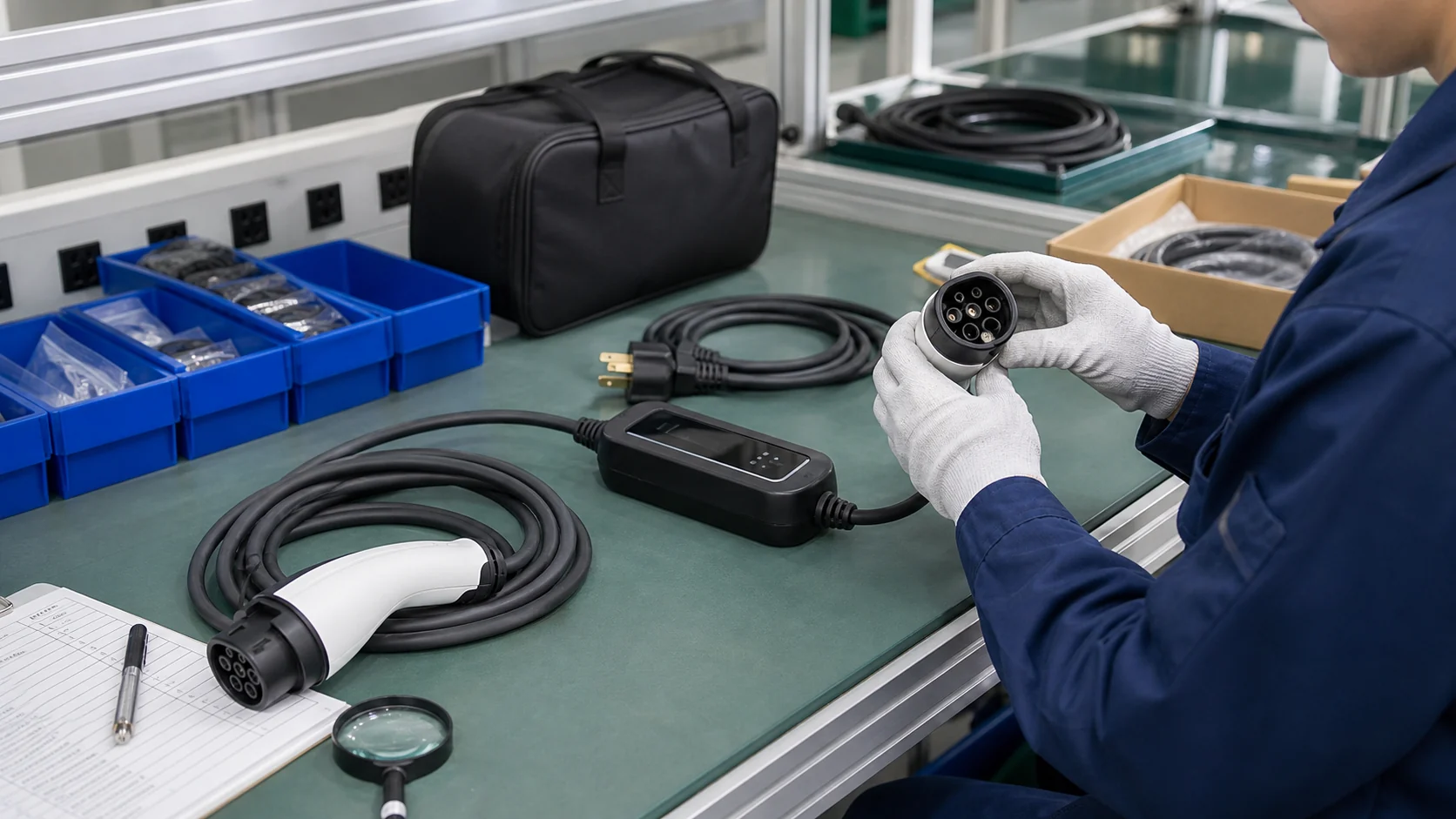
Buyers should check the vehicle connector, wall plug, voltage, current rating, cable length, safety markings, environmental rating, and documentation before choosing a portable EV charger. The product should be selected as an electrical system, not just a cable that happens to fit the car.
Start with connector compatibility. The vehicle-side connector must match the inlet or approved adapter strategy. A J1772 vehicle needs the right AC connector in North America. A Type 2 vehicle needs the correct Type 2 product in Europe and many IEC-based markets. Product listings should never hide this detail behind vague "universal EV charger" language.
Then check the wall-side plug. A portable Level 2 charger may be sold with a NEMA 14-50 style plug, a different regional plug, or an interchangeable plug set. The customer must have a matching outlet and suitable circuit. If the charger has adjustable current, the manual should explain settings clearly.
For distributors, quality checks should include:
- Connector fit: The vehicle connector should mate cleanly with the intended inlet.
- Plug configuration: The wall plug must match the target market and product listing.
- Cable rating: Cable gauge, jacket material, flexibility, and temperature range should fit the rated current.
- Control box build: The enclosure should feel solid, sealed as claimed, and easy to read.
- Markings and labels: Ratings, warnings, model information, and certification marks should be durable and accurate.
- Manual quality: Instructions should explain outlet requirements, current settings, storage, weather limits, and fault indicators.
- Packaging: Storage bags, cable ties, plug covers, retail boxes, and inserts should match the target market.
Do not treat a printed logo as proof of certification. The related guide to portable EV charger safety standards explains why the certificate, exact model, report scope, issuing body, product label, and official database record must agree. Good products make ratings, limits, and safe use easy to verify.
Portable EV Charger Supplier Verification Sheet
Use one sheet for every SKU, plug variant, connector variant, firmware revision, and target market. Record measured values and document identifiers rather than checking a generic "passed" box. The approved sheet should remain linked to the golden sample, test reports, production control plan, labels, manual, and packaging artwork.
A. Product identity and market fit
| Verification item | Supplier submission | Verification record | Result |
|---|---|---|---|
| Supplier and factory | ___ | Legal name and manufacturing address verified ___ | Pass / Fail |
| Product model/SKU | ___ | Product, label, certificate, report, manual, and carton all match ___ | Pass / Fail |
| Target market | ___ | Voltage, frequency, language, warnings, and plug rules reviewed ___ | Pass / Fail |
| Wall-side plug | ___ | Plug standard, pin dimensions, current marking, temperature sensor location ___ | Pass / Fail |
| Vehicle connector | J1772 / NACS / Type 2 / GB/T / Other ___ | Fit checked with intended inlet or approved gauge ___ | Pass / Fail |
| Rated input | ___ V / ___ Hz / ___ A | Label and test report match ___ | Pass / Fail |
| Selectable current | ___ A steps | Each setting verified under load ___ | Pass / Fail |
| Cable | ___ m, conductor ___, jacket ___ | Gauge, marking, flexibility, and supplier specification verified ___ | Pass / Fail |
| Enclosure/environmental claim | ___ | Exact test report, configuration, and use limitations verified ___ | Pass / Fail |
| Firmware/app version | ___ | Release, update, permissions, and offline behavior recorded ___ | Pass / Fail |
B. Electrical-output and temperature record
Measure at stable supply conditions with calibrated equipment and the intended plug, cable, control box, and connector assembly. Define the laboratory method, ambient temperature, sensor locations, duration, and acceptance limits before testing.
| Selected current | Measured voltage | Measured current | Input power | Plug temperature rise | Cable temperature rise | Control-box temperature rise | Vehicle-connector temperature rise | Result |
|---|---|---|---|---|---|---|---|---|
| 8A | ___ V | ___ A | ___ kW | ___°C | ___°C | ___°C | ___°C | Pass / Fail / N/A |
| 10A | ___ V | ___ A | ___ kW | ___°C | ___°C | ___°C | ___°C | Pass / Fail / N/A |
| 12A | ___ V | ___ A | ___ kW | ___°C | ___°C | ___°C | ___°C | Pass / Fail / N/A |
| 16A | ___ V | ___ A | ___ kW | ___°C | ___°C | ___°C | ___°C | Pass / Fail / N/A |
| 24A | ___ V | ___ A | ___ kW | ___°C | ___°C | ___°C | ___°C | Pass / Fail / N/A |
| 32A | ___ V | ___ A | ___ kW | ___°C | ___°C | ___°C | ___°C | Pass / Fail / N/A |
Do not copy universal temperature limits into this sheet. Acceptance criteria must come from the applicable standard, component ratings, approved test plan, certification scope, and target-market requirements.
C. Protection and failure-behavior verification
| Test | Test method/report ID | Expected response | Measured response/time | Result |
|---|---|---|---|---|
| Protective earth/ground fault | ___ | Charging inhibited or interrupted as specified | ___ | Pass / Fail |
| Leakage/residual-current protection | ___ | Trip threshold and time within approved limits | ___ | Pass / Fail |
| Overcurrent/current-setting control | ___ | Output does not exceed commanded or approved limit | ___ | Pass / Fail |
| Plug overtemperature | ___ | Derate or stop according to design | Sensor location ___ / Response ___ | Pass / Fail |
| Control-box overtemperature | ___ | Derate or stop according to design | ___ | Pass / Fail |
| Vehicle connector overtemperature | ___ | Derate or stop where supported | ___ | Pass / Fail / N/A |
| Supply under/overvoltage | ___ | Fault behavior matches manual | ___ | Pass / Fail |
| Relay/contactor behavior | ___ | No unintended energized state | ___ | Pass / Fail |
| Power interruption and restart | ___ | Safe restart; charging does not bypass checks | ___ | Pass / Fail |
| Stuck button/current selector | ___ | Safe and documented behavior | ___ | Pass / Fail |
| App/network loss | ___ | Local charging remains safe; state is documented | ___ | Pass / Fail / N/A |
| Outdoor/water-ingress configuration | ___ | Claim matches tested assembly and connector state | ___ | Pass / Fail |
D. Certification and document traceability
| Document | Record |
|---|---|
| Applicable standards and market requirements | ___ |
| Certification/testing body | ___ |
| Certificate number and validity | ___ |
| Report number, date, and exact model list | ___ |
| Official database URL or verification contact | ___ |
| Product label photograph and revision | ___ |
| Declaration of Conformity or equivalent | ___ |
| Critical-component list | Plug ___ / Cable ___ / Relay ___ / RCD ___ / Enclosure ___ |
| User manual revision and languages | ___ |
| Warnings: outlet, current, extension cord, outdoor use, storage | ___ |
| Packaging artwork and included accessories | ___ |
E. Vehicle compatibility and production consistency
| Check | Record | Result |
|---|---|---|
| Vehicle/inlet samples tested | Make/model/year/inlet ___ | Pass / Fail |
| Pilot/handshake and latch behavior | ___ | Pass / Fail |
| Maximum vehicle AC acceptance observed | ___ kW | Recorded |
| Fault display and recovery | Code/message/action ___ | Pass / Fail |
| Ten-hour continuous run or approved endurance method | Voltage/current/ambient/result ___ | Pass / Fail |
| Cable bend, strain relief, and pull test | Method/report ___ | Pass / Fail |
| Drop/impact/handling test | Method/report ___ | Pass / Fail |
| Golden sample ID and seal | ___ | Verified |
| Incoming inspection plan | Sample size and checkpoints ___ | Approved |
| Production end-of-line test | Items and stored data ___ | Approved |
| Replacement parts | Plug adapter ___ / Cable ___ / Control box ___ / Connector cap ___ / Bag ___ | Available / Not available |
Reject the sample when its marketing claim cannot be traced to the exact tested configuration. A certificate for a related model, an IP report without the intended connectors, or a safety mark printed only on artwork is not evidence for the product being ordered.
Conclusion: Choose portable charging for flexibility, not as a shortcut around safety
A portable EV charger is a movable AC EVSE unit that can charge an electric vehicle from a compatible outlet. It can be a smart choice for home backup, low-mileage driving, plug-in hybrids, travel support, rental properties, temporary fleet use, and accessory kits. The best portable charger is not the one with the biggest number on the listing. It is the one that matches the vehicle connector, outlet, circuit, charging level, current rating, cable quality, and real parking routine.
Level 1 portable chargers are simple and widely understandable, but slow. Portable Level 2 chargers can be much more useful for daily range recovery, but they need the right outlet and electrical setup. A fixed wallbox is usually better for drivers who charge in the same place every day and want the easiest routine. Many owners can benefit from both: a wallbox for daily use and a portable unit for backup or travel.
For buyers, the safer path is to treat the charger as a complete electrical product. Check the connector, wall plug, current rating, cable length, protection features, verified documentation, instructions, and actual charging routine before ordering. For distributors and brand programs, complete the Supplier Verification Sheet for the exact SKU and reject unsupported claims before approving production.
Frequently Asked Questions
Is a portable EV charger the same as an EV charging cable?
Not exactly. A portable EV charger usually includes an EVSE control box, wall plug, cable, and vehicle connector, while an EV charging cable may refer only to the cable and connectors used with a charging point. The EVSE control box is what makes the portable charger more than a simple cable.
Can I use a portable EV charger every day?
Yes, if the charger, outlet, circuit, and vehicle are suitable for regular EV charging. For long-term home use, it is wise to have a qualified electrician check the circuit, especially for high-current or 240 V charging.
Is a portable Level 1 charger enough for an EV?
It can be enough for plug-in hybrids, low daily mileage, or drivers who can leave the car plugged in for many hours. It may not be enough for long daily commutes, large battery EVs, cold weather use, or short parking windows.
Is a portable Level 2 charger worth it?
A portable Level 2 charger can be worth it if you have access to a compatible 240 V outlet and need faster charging than Level 1. It is especially useful for rentals, workshops, second homes, or drivers who want flexibility without a hardwired wallbox.
Can I plug a portable EV charger into an extension cord?
Most EV charger manuals discourage or prohibit ordinary extension cords because EV charging is a long continuous load. Follow the charger manual and local electrical guidance, and use a suitable outlet instead of improvising with undersized cords.
What plug do I need for a portable EV charger?
The plug depends on the charger model, target market, voltage, and circuit. Before buying, match the wall-side plug to an approved outlet and circuit, and match the vehicle-side connector to the car's charging inlet.
Is a portable EV charger safe in the rain?
Some portable EV chargers are designed for outdoor use within stated limits, but the rating and instructions matter. Check the product's environmental rating, keep connections away from standing water, use properly installed outlets, and follow the manual.
What is the biggest mistake when buying a portable EV charger?
The biggest mistake is choosing only by connector shape or advertised power. Buyers should also check the wall plug, circuit requirements, current rating, cable quality, vehicle limits, documentation, and whether the charger fits the actual charging routine.
References
[1] U.S. Department of Energy. “How To Charge Electric Vehicles.” 2026.
[2] U.S. Environmental Protection Agency. “Plug-in Electric Vehicle Charging: The Basics.” 2026.
[3] U.S. Department of Transportation. “Charger Types and Speeds.” 2025.
[4] National Institute of Standards and Technology. “Electric Vehicle Fueling FAQs.” 2024.
[5] U.S. Department of Energy Federal Energy Management Program. “Fleet Electrification Step 2: Review ZEV and EVSE Training Materials.” 2026.