
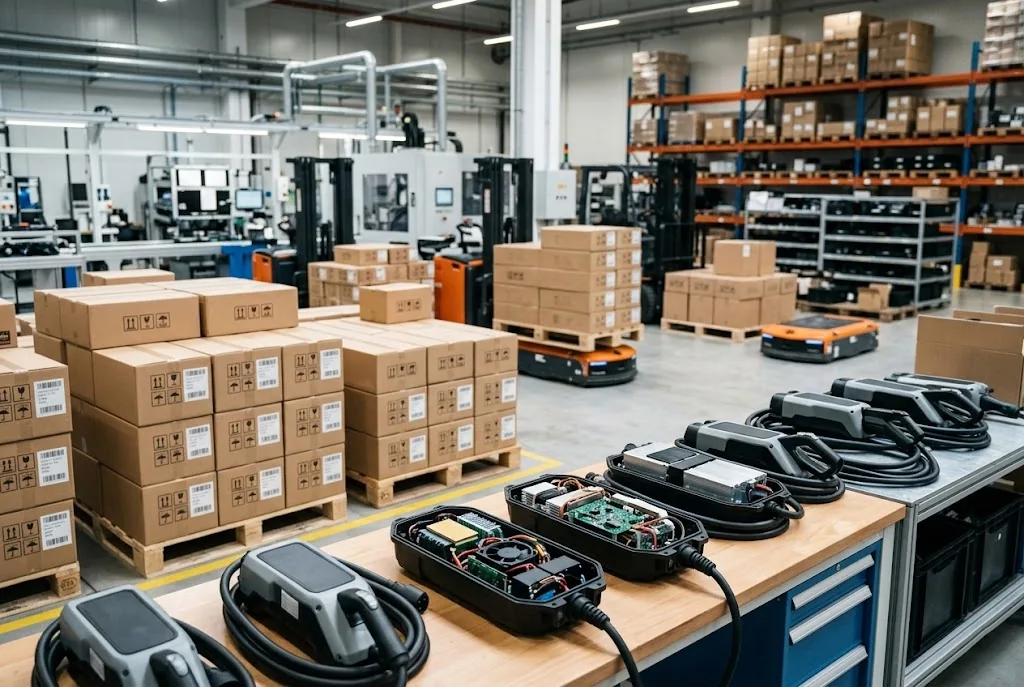
The short answer: If you are a B2B distributor, fleet manager, or automotive aftermarket retailer looking to build a profitable EV charging product line, partnering with a dedicated portable EV charger manufacturer that offers genuine OEM and ODM capabilities is your most efficient path to market. This guide explains exactly why portable EVSE is the highest-margin entry point, what to look for in a manufacturing partner, and how to navigate certifications, customization, and supply chain management.
The electric vehicle revolution is no longer a distant forecast—it is reshaping global supply chains right now. While public DC fast chargers dominate industry headlines, portable EV chargers are quietly emerging as one of the most commercially compelling product categories in the entire EV ecosystem. For B2B distributors, the numbers tell a compelling story: the global portable EV charger market was valued at USD 4.11 billion in 2024 and is projected to reach USD 12.35 billion by 2030, growing at a CAGR of 19.3% [1]. The Level 2 portable EV charger segment alone was valued at USD 1.41 billion in 2024, with projections pointing toward USD 7.4 billion by 2032 [2].
This growth is not happening in a vacuum. The International Energy Agency (IEA) confirmed that in 2024, more than 1.3 million public charging points were added globally—a 30% year-over-year increase [3]. In the United States alone, over 18,000 new DC fast-charging ports were installed in 2025, the largest single-year expansion in U.S. history [4]. As the EV fleet grows, so does the demand for flexible, portable charging solutions that complement fixed infrastructure.

Why Are Portable EV Chargers the Smartest Entry Point for Global Distributors?
When building an EV charging accessories portfolio, many distributors debate whether to start with fixed wallboxes or portable units. Having worked with buyers across multiple continents, I can tell you that portable EV chargers consistently win on three critical business dimensions: lower barrier to entry, broader addressable market, and faster inventory turnover.
Unlike hardwired Level 2 wallboxes that require professional electrician installation and local permits, portable EVSE units are genuinely “plug-and-play.” They connect to standard household outlets or higher-voltage receptacles like NEMA 14-50, CEE 16A, or CEE 32A industrial sockets. This eliminates installation friction entirely, which dramatically expands the total addressable market beyond homeowners with dedicated garages.
The use cases for portable EV chargers extend far beyond residential charging, which is precisely what makes them so commercially attractive. A well-designed portable EVSE unit can serve multiple market segments simultaneously, giving distributors the ability to target diverse buyer profiles with a single SKU.
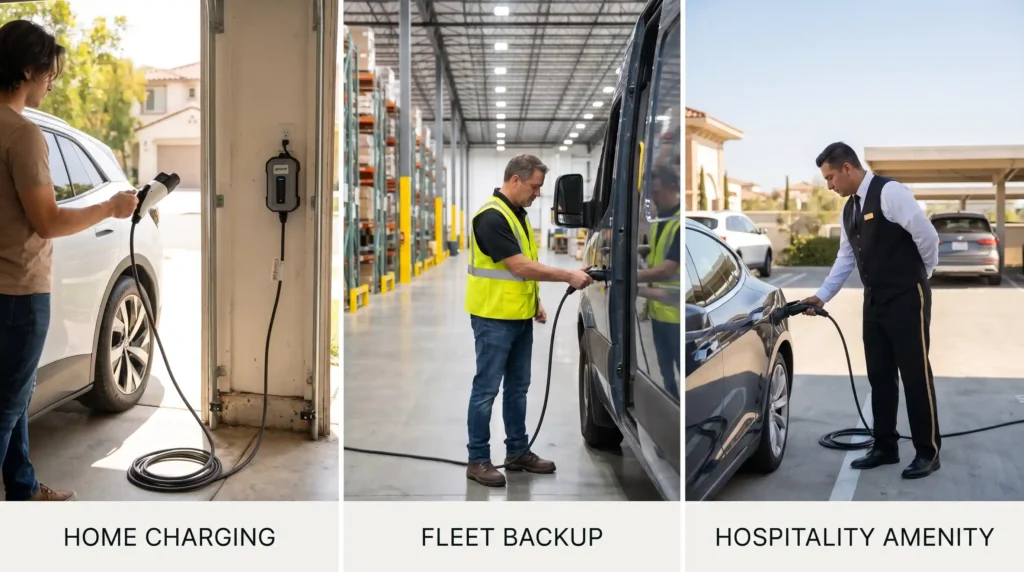
The four primary B2B customer segments driving demand are worth understanding in detail. Automotive aftermarket retailers represent the largest volume opportunity, as consumers routinely upgrade from the basic portable charger supplied with their vehicle to a faster, more feature-rich unit. Commercial fleet operators—logistics companies, delivery services, and corporate fleets—maintain portable EVSE units as essential emergency backup solutions, preventing costly vehicle stranding. Hospitality and property management businesses, including hotels, resorts, and short-term rental hosts, are increasingly offering portable EV chargers as a premium amenity that commands higher nightly rates. Finally, automotive dealerships bundle branded portable chargers with new and used EV sales as high-margin accessories.
Understanding which segment you are targeting shapes everything from your product specification to your packaging design and pricing strategy.
What Is the Difference Between OEM and ODM, and Which Model Is Right for You?
This is the question I hear most often from new B2B partners, and it is one of the most important decisions you will make when entering the portable EV charger market. The two models are fundamentally different in terms of timeline, investment, and intellectual property ownership.
ODM (Original Design Manufacturer) is the model that the vast majority of distributors should start with. In this approach, the manufacturer has already invested in the R&D, tooling, and baseline certifications for a product platform. You select an existing, proven design and customize it with your brand identity—your logo, preferred housing color, specific connector type, and custom retail packaging. The lead time is typically 6 to 10 weeks from sample approval to shipment, and MOQs often start as low as 100 to 500 units. This is how most successful private-label EV charging brands launch.
OEM (Original Equipment Manufacturer) involves creating a completely custom product based on your proprietary design and technical specifications. You own the intellectual property; the manufacturer executes the production. This model is ideal for established brands seeking a highly differentiated product, but it requires significant upfront investment in tooling, longer lead times of 4 to 6 months, and higher MOQs (typically 2,000+ units). Most buyers who insist on OEM from day one spend months developing a product that ends up nearly identical to what was already available as an ODM option.
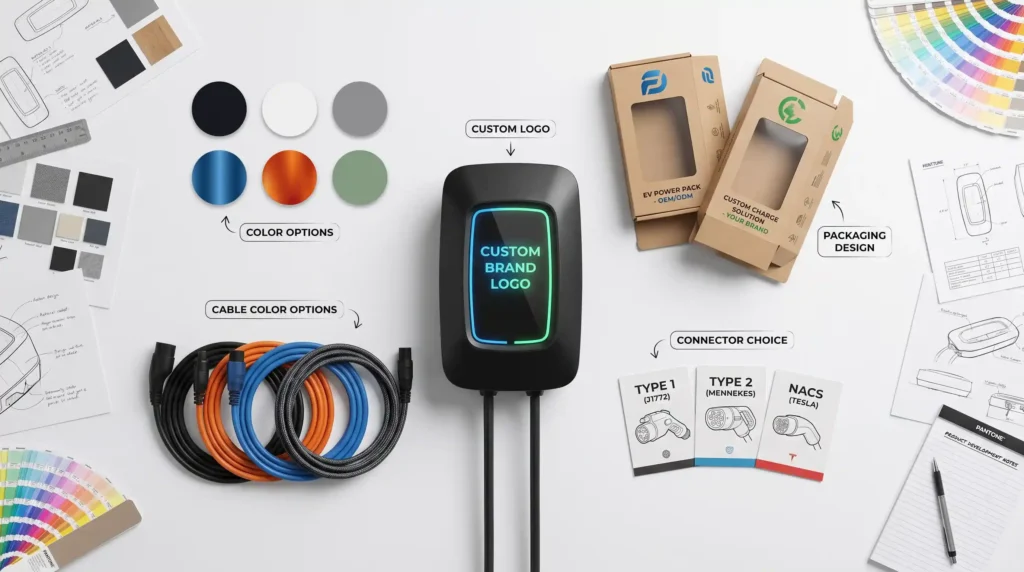
The practical recommendation for most global distributors is to begin with ODM to validate your market and build your customer base, then transition to full OEM development for your next-generation product once you have sufficient volume and market intelligence to justify the investment.
Customization Options at Each Level
The table below outlines the typical customization scope, MOQ, and lead time at each level of engagement with a professional portable EV charger manufacturer:
| Customization Level | Typical MOQ | Lead Time | Best For |
|---|---|---|---|
| Standard product, no customization | 50–100 units | 2–3 weeks | Market testing |
| Standard product + logo printing | 100–500 units | 3–4 weeks | Brand entry |
| Standard product + custom packaging | 200–500 units | 4–5 weeks | Retail launch |
| Custom color / cable length | 500–1,000 units | 6–8 weeks | Differentiated offering |
| Full ODM (new housing design) | 1,000–3,000 units | 3–5 months | Proprietary product |
| Full OEM (client-owned design) | 2,000+ units | 4–6 months | Market leadership |
What Technical Specifications Define a High-Quality Portable EV Charger?
Not all portable EV chargers are created equal. When evaluating a manufacturer’s product catalog, you must look beyond the external housing and scrutinize the technical specifications that determine real-world performance, safety, and longevity. This is where most inexperienced buyers make costly mistakes.
Which Connector Standard Does Your Target Market Require?
Your target market dictates the required connector standard, and getting this wrong means your product is unsellable. A professional portable EV charger manufacturer must offer options for all major global standards. Type 1 (SAE J1772) is the standard for AC charging in North America and Japan. Type 2 (IEC 62196) is the dominant standard in Europe and is increasingly adopted across Asia-Pacific and the Middle East. NACS (North American Charging Standard), originally developed by Tesla, has been adopted by all major U.S. automakers including Ford, GM, and Rivian, and is rapidly becoming the new North American default. GB/T remains the national standard for the Chinese domestic market.
For distributors targeting multiple regions simultaneously, the ability to source multi-standard products from a single manufacturer is a significant logistical advantage. You can explore the full range of compatible EV charging accessories to understand how connector standards fit into a broader product ecosystem.
Level 1 vs. Level 2: What Power Output Do Your Customers Actually Need?
Portable chargers are categorized by their power output, which directly determines charging speed. Level 1 chargers operate on standard 120V household outlets and deliver 1.4 kW to 1.9 kW of power, adding roughly 3 to 5 miles of range per hour. These are adequate for plug-in hybrid electric vehicles (PHEVs) or drivers with very short daily commutes, but they are increasingly seen as insufficient for full battery electric vehicles (BEVs) [5].
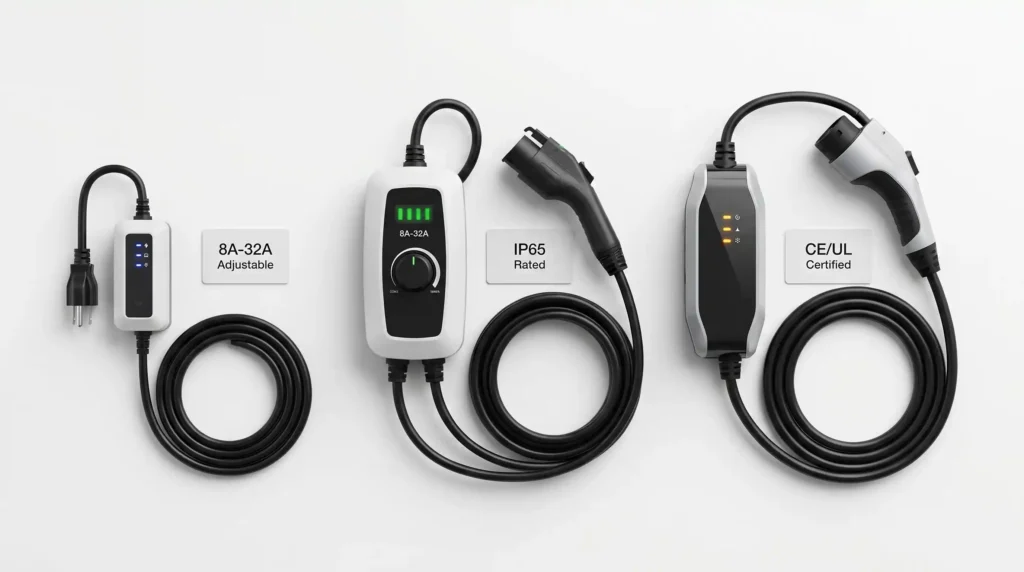
Level 2 chargers require a 240V supply and can deliver anywhere from 3.3 kW to 19.2 kW, adding 12 to 80 miles of range per hour. For B2B distributors, the most commercially successful products are adjustable Level 2 portable chargers that allow the user to manually select the amperage (e.g., 8A, 10A, 13A, 16A, or 32A) to match the capacity of the available electrical circuit. This flexibility is a genuine selling point that commands a price premium in the market.
What IP Rating and Build Quality Should You Require?
Because portable chargers are used outdoors and subjected to rough handling, physical durability is non-negotiable. The Ingress Protection (IP) rating is the internationally standardized measure of a device’s resistance to dust and water. For portable EV chargers, specify a minimum of IP65, which certifies the unit as completely dust-tight and protected against water jets from any direction. For markets with harsh weather conditions, IP67 (submersion-rated) is preferable.
The housing material should be high-impact, flame-retardant PC+ABS (polycarbonate/acrylonitrile butadiene styrene) with a temperature operating range of at least -30°C to +50°C. A quality portable EVSE should also incorporate multiple built-in safety protections: over-temperature protection, over-current protection, ground fault detection, and leakage current protection. These are not optional features—they are the baseline safety requirements for any product you intend to sell in regulated markets.
What Certifications Are Mandatory for Portable EV Chargers in Your Target Market?
Certification is the single most important quality indicator when evaluating a portable EV charger manufacturer. Selling non-certified electrical equipment in regulated markets is not just a legal risk—it is a safety risk that can result in product recalls, customs seizures, liability claims, and permanent brand damage. A reputable manufacturer will not rely on self-declarations; they will invest in rigorous testing by accredited, independent laboratories such as TUV Rheinland, SGS, Bureau Veritas, or Intertek.
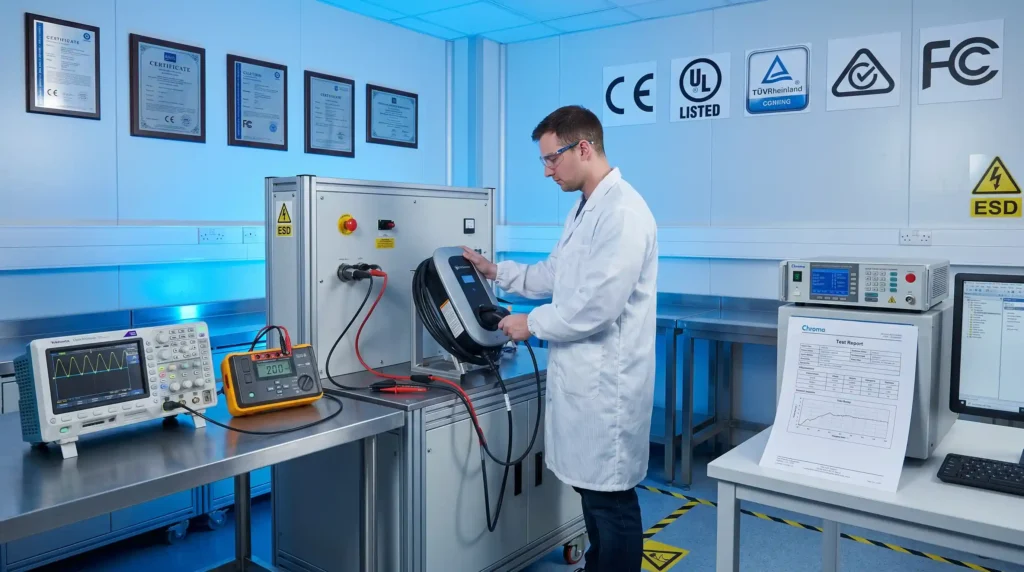
The certification requirements vary significantly by region. Before placing any order, confirm that your manufacturer can provide the specific certifications required for your target geography:
| Target Market | Required / Recommended Certifications | Key Standards |
|---|---|---|
| European Union | CE marking (mandatory), TUV Rheinland, RoHS, REACH | Low Voltage Directive, EMC Directive |
| United States | UL 2594 (AC EVSE), FCC (smart chargers), ETL | NRTL-listed certification |
| United Kingdom | UKCA | Post-Brexit equivalent of CE |
| Australia / NZ | RCM, SAA | Electrical Safety and EMC |
| Global Operations | ISO 9001, ISO 14001 | Quality and Environmental Management |
A critical point that many buyers overlook: always request the actual test report, not just a certificate image. A reputable manufacturer will have no hesitation in providing the full test report from the accredited laboratory. If a supplier hesitates or can only provide a self-declaration, treat it as a serious red flag. You can verify UL and ETL certificates directly through the UL Product iQ database.
How Do You Vet and Select the Right Portable EV Charger Manufacturer?
The market is saturated with trading companies that present themselves as manufacturers. This distinction matters enormously because trading companies have no direct control over production quality, cannot accommodate meaningful customization, and offer limited technical support. Here is a practical framework for evaluating potential manufacturing partners.
Verify factory ownership first. A direct manufacturer owns its production facility and can provide a factory audit report or offer a virtual tour. During the tour, look for a dedicated R&D department (its absence suggests the supplier is simply reselling other manufacturers’ products), a high-voltage testing station for electrical safety testing, and documented quality control checkpoints throughout the production line. Any manufacturer that has been exporting for 8 to 10 years and has real customers to lose will welcome this scrutiny.
Scrutinize their certification portfolio. Request copies of all current certificates and verify the certificate numbers directly with the issuing body. Ask specifically which products are covered by each certificate—a manufacturer may hold CE certification for one product variant but not for the specific configuration you need. Certificates that cannot be verified online are worthless.
Assess their MOQ flexibility and pricing structure. A manufacturer that is genuinely interested in building a long-term partnership will offer reasonable MOQs for initial orders to help you validate your market. Be cautious of suppliers who demand large upfront commitments before you have had a chance to test their quality. Understand the pricing tiers and how unit costs decrease with volume—a price that is more than 20% below the market average should raise an immediate red flag.
Evaluate their after-sales support capability. Portable EV chargers are complex electrical devices that will occasionally require warranty support. Your manufacturer must provide clear warranty terms (typically 12 to 24 months), responsive technical troubleshooting, and access to replacement components. A supplier who disappears after payment is a liability, not a partner.
For a comprehensive overview of what a professional B2B EV charging accessories product portfolio looks like, you can review the full range at Yirox Auto Parts.
Common Mistakes B2B Buyers Make When Sourcing Portable EV Chargers
Having worked with buyers across Europe, North America, and Asia-Pacific, I have seen the same costly mistakes repeated. Understanding these pitfalls will save you significant time and money.
The most common error is prioritizing price over certification. The cheapest portable charger is rarely the best value. Non-certified products can fail customs inspections, be seized at the border, or—most dangerously—cause electrical fires in the field. The cost of a single product recall or liability claim far exceeds any savings from choosing an uncertified supplier. One Dutch distributor I know of lost an entire container of DC fast chargers because the CE certificates turned out to be self-declarations that had never been tested by an independent laboratory.
A second frequent mistake is underestimating lead times for certified products. Many buyers assume they can place an order and receive certified products within two to three weeks. In reality, if you are launching a new product that requires new certification testing, the process can take two to four months. Plan your inventory cycles accordingly and always order samples well before your planned launch date.
Finally, many distributors neglect the connector standard evolution. The rapid adoption of NACS in North America caught many buyers off guard, leaving them with inventory of J1772-only products that required adapters to remain relevant. Always ask your manufacturer about their product roadmap and their ability to pivot quickly to new standards as the market evolves.
Conclusion
The portable EV charger market represents one of the most compelling B2B opportunities in the global automotive accessories sector. With a market growing at nearly 20% annually and demand driven by structural shifts in transportation infrastructure, distributors who establish strong OEM/ODM manufacturing partnerships today will be positioned to capture significant market share over the next decade.
The most important decision you will make is choosing the right manufacturing partner. A professional portable EV charger manufacturer does not just supply a product—they become a strategic partner in your business growth, helping you navigate connector standard evolution, maintain certification compliance, and scale your product line efficiently. Start with ODM to validate your market, insist on verified certifications, and build a relationship with a manufacturer that owns its factory and stands behind its products.
Frequently Asked Questions (FAQ)
What is the minimum order quantity (MOQ) for private-label portable EV chargers?
For standard ODM products with your custom logo and packaging, MOQs typically start at 100 to 500 units. For fully custom OEM designs requiring new tooling or molds, the MOQ is generally 1,000 to 3,000 units or more. Initial sample orders of 2 to 5 units are usually available for quality testing before committing to mass production.
What is the difference between Level 1 and Level 2 portable EV chargers?
Level 1 chargers operate on standard 120V household outlets and provide slow charging at approximately 1.4 kW to 1.9 kW, adding 3 to 5 miles of range per hour. Level 2 chargers require a 240V supply and deliver 3.3 kW to 19.2 kW, adding 12 to 80 miles of range per hour. For most commercial and consumer applications, Level 2 adjustable portable chargers offer the best balance of performance and flexibility.
Are CE and UL certifications mandatory for selling portable EV chargers?
Yes, in practice. CE marking is legally required to sell electrical equipment in the European Union. In the United States, while UL certification is technically voluntary at the federal level, it is functionally required by most local electrical codes, insurance companies, and major retail platforms. Always verify that your manufacturer’s certificates are current and issued by an accredited third-party laboratory, not self-declared.
How long does the OEM/ODM customization process take for portable EV chargers?
For an ODM project (customizing an existing design with your brand), the process from initial consultation to mass production typically takes 6 to 10 weeks. A full OEM project (developing a completely new product from scratch) requires 4 to 6 months due to the time needed for R&D, tooling fabrication, and new certification testing.
What connector types should my portable EV charger support for the North American market?
For North America, the primary connector standard has historically been Type 1 (SAE J1772). However, with the rapid adoption of NACS (North American Charging Standard) by Ford, GM, Rivian, and other major automakers, new products targeting North America should ideally support NACS or include a NACS adapter. Consult with your manufacturer about their current NACS-compatible product options.
How do I protect my brand and intellectual property when working with a Chinese OEM manufacturer?
For ODM arrangements, IP risk is minimal since you are working on the manufacturer’s existing product platform—your brand and market knowledge are the valuable assets. For full OEM projects, work with a qualified attorney to draft a comprehensive OEM agreement that includes intellectual property clauses, non-disclosure provisions, and non-compete terms. Additionally, register your trademark in China before sharing detailed technical specifications.
References
[1] NextMSC. Portable EV Charger Market: 2030 Strategic Growth Forecast.
[2] Straits Research. Level 2 Portable Electric Vehicle (EV) Charger Market Size, Share & Forecast.
[3] International Energy Agency (IEA). Global EV Outlook 2025 – Electric Vehicle Charging.
[4] EV Connect. 2025 EV Charging Industry Report.
[5] Car and Driver. Tested: Best Home EV Chargers for 2026.
[6] Hongjiali. How to Source EV Chargers from China: OEM/ODM Buyer's Guide 2026.
[7] Grand View Research. Electric Vehicle Charging Infrastructure Market Report, 2033.