



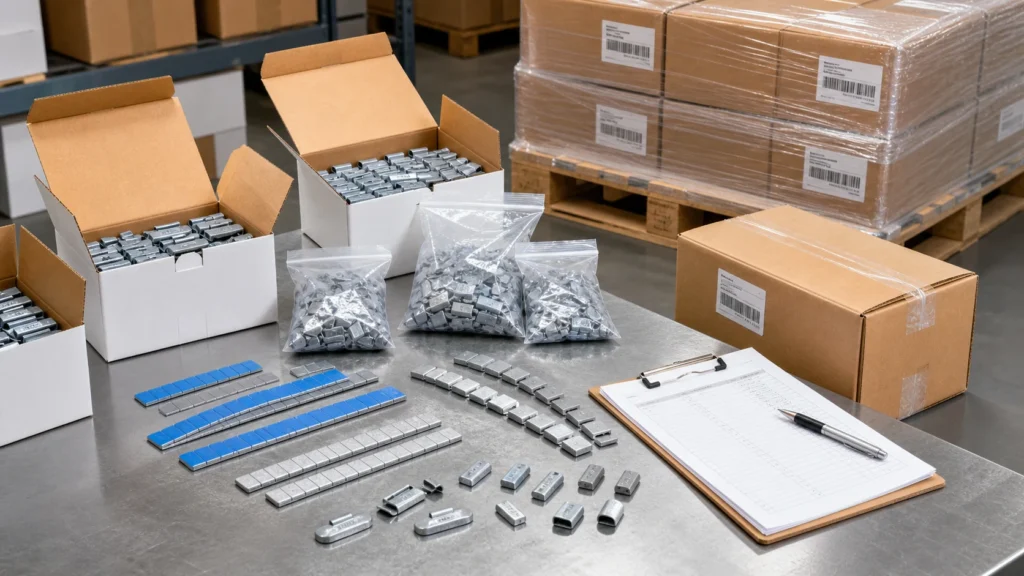
Bulk wheel weights are best ordered as an approved product range, not as a single large number of pieces. Before quantity is fixed, define wheel and service applications, clip-on or adhesive format, material, weight increments, packaging, labels, destination requirements, and sample acceptance. MOQ then becomes a planning variable rather than a surprise that creates unusable inventory.
Distributors, importers, tire-service chains, fleet workshops, and private-label buyers all use “bulk” differently. One may need loose workshop cartons; another may need retail-ready boxes, barcodes, mixed pallets, and repeatable carton counts. The order succeeds when the product can be identified, stored, installed, sold, and reordered without guessing.
The costliest mistakes happen before production: approving a low price without fixing the wheel interface, ordering equal quantities of every size, or treating a loose sample as proof of the final packed batch. The decisions below turn those assumptions into a documented buying path.
Table of Contents
- What Should You Define Before Asking for a Bulk Wheel Weight Price?
- How Does MOQ Change the Way You Plan a Bulk Order?
- Which Wheel Weight Formats Should a Bulk Range Include?
- How Should You Build a SKU Mix From Real Demand?
- What Packaging and Carton Data Should Be in the Quote?
- Which Export and Material Documents Should Importers Confirm?
- How Should You Approve Samples Before Mass Production?
- What Should a Complete Bulk Wheel Weight RFQ Include?
- How Do You Compare Bulk Wheel Weight Quotes by Usable Cost?
- Which Checks Prevent the First Order From Becoming Dead Inventory?
- Conclusion: Specify the Range Before You Enlarge the Order
- Frequently Asked Questions
- References
What Should You Define Before Asking for a Bulk Wheel Weight Price?
Define the wheel application and selling channel before asking for quantity or price. Passenger cars, trucks, trailers, mixed tire shops, fleet workshops, and retail customers can require different attachment methods, pack sizes, labels, and replenishment patterns.
Start with an order brief that records the following layers:
| Decision layer | What to record | Why it changes the order |
|---|---|---|
| Service application | Passenger car, truck, trailer, bus, fleet, or mixed workshop | Indicates the likely wheel profiles, correction range, and handling conditions |
| Wheel interface | Steel, alloy, painted, coated, flange shape, inner-barrel landing area | Determines whether clip-on or adhesive fitment can be approved |
| Weight format | Individual clip-on pieces, adhesive segments, strips, rolls, or mixed packs | Changes counting, installation, packing, and SKU logic |
| Material route | Steel/FE, zinc, lead-free program, coating, or appearance requirement | Affects documentation, finish, customer acceptance, and price comparison |
| Unit system | Gram, ounce, dual-unit, or market-specific labels | Prevents a carton from being difficult for technicians or distributors to use |
| Channel | Workshop bulk, distributor carton, retail pack, or private label | Defines inner packs, barcodes, language, and carton presentation |
The wheel balancing weights guide is a useful starting point when the team still needs to separate balance correction from product fitment. For the actual RFQ, add wheel photos or drawings, a sample part, the service position, and the machine process wherever the profile is uncertain.
Do not treat a quote containing only “bulk wheel weights,” quantity, and unit price as a controlled specification. Missing wheel interface, unit system, or carton structure means the supplier is pricing an assumption.
How Does MOQ Change the Way You Plan a Bulk Order?
MOQ is not one universal number for “bulk wheel weights.” It can apply by SKU, material, clip profile, adhesive tape, coating, label, inner pack, carton design, or total order value. Ask which variable creates it before comparing prices.
| MOQ driver | What it may affect | Question to ask |
|---|---|---|
| Material | Separate steel/FE, zinc, or other material programs | Is the minimum calculated separately for each material? |
| Attachment | Different clip profiles, tape backs, or strip constructions | Does each clip or adhesive construction have its own minimum? |
| Weight increment | The number of sizes in grams or ounces | Can slow-moving sizes be combined in a trial assortment? |
| Finish | Plating, paint, coating, color, or surface treatment | Is the finish standard or created for this order? |
| Packaging | Bags, boxes, buckets, labels, barcodes, or private-label cartons | Does custom packing create a separate setup minimum? |
| Shipment plan | Mixed cartons, pallets, or split deliveries | Can approved SKUs be phased without changing the product? |
The practical question is not “What is the lowest MOQ?” but “Which MOQ gives me a usable range without forcing slow inventory?” A low unit price is misleading when it requires unwanted sizes or separate setup and cartons for every small variation.
For a new program, request a focused starter mix and a full replenishment mix. This shows which SKUs create setup cost and whether a phased order keeps the approved construction. Use size-by-size usage when available; otherwise label the first order as a market test and limit unproven variations.
Which Wheel Weight Formats Should a Bulk Range Include?
A bulk range should include only formats that match the wheel interface and service process. Clip-on weights, adhesive segments, rolls, and mixed assortments solve different handling problems.
| Format | Evidence needed before ordering | Useful bulk channel | Main stock risk |
|---|---|---|---|
| Clip-on weights | Rim flange profile, opening, retention, clearance, and wheel material | Tire shops, fleet service, commercial distributors | Similar-looking clips may not interchange |
| Adhesive segments | Landing-surface dimensions, tape construction, liner, placement, and clearance | Alloy-wheel service, repair chains, retail packs | Contamination, crushing, or mixed segment counts |
| Rolls or cut-to-weight strips | Strip width, segment spacing, cut method, unit labels, and packaging | High-volume workshops and controlled service programs | Poor counting or inconsistent cut length |
| Mixed assortment | Exact contents, ratio by SKU, carton labeling, and replenishment rules | Starter kits, multi-site workshops, distributor trials | One slow item can make the whole kit hard to replenish |
Material is only one part of the decision. A steel or FE option still needs the correct construction, mass tolerance, finish, and packaging; buyers comparing a lead-free route can review FE wheel weights after the application and approval criteria are clear.
Keep clip-on and adhesive products in separate quote lines because they need different fitment evidence, installation controls, and often different packaging. The related wheel balancing weights range can help review formats, but a broad catalog is not an approved application list.
How Should You Build a SKU Mix From Real Demand?
Build the SKU mix from wheel coverage, correction sizes, material policy, and turnover—not from the number of possible increments. A controlled first order has core, supporting, and limited trial groups.
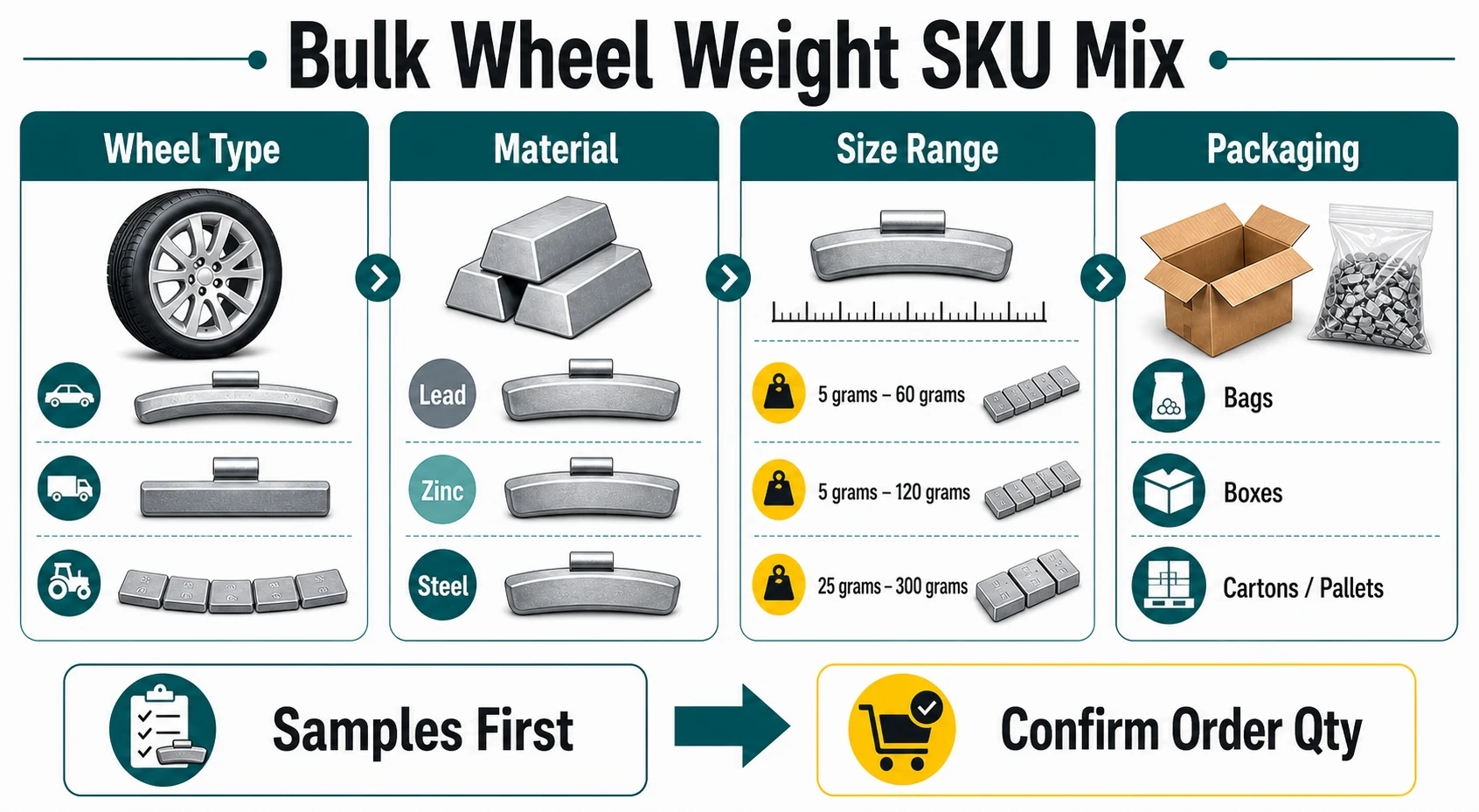
Use this sequence:
- Group the demand: Separate passenger-car, truck, trailer, fleet, and special wheel work so high-volume passenger-car sales do not hide a truck or alloy fitment gap.
- Group by interface: Record clip profile, wheel material, landing area, and clearance. Similar mass does not mean similar fitment.
- Group by unit and movement: Keep gram and ounce labels distinct, then rank sizes using sales or work-order records. The wheel weight size chart can support the increment review.
- Assign roles: Put the largest share into proven core items, a controlled share into supporting items, and the smallest share into trial items with a review date.
| Stock group | What belongs in it | How to manage it |
|---|---|---|
| Core | Repeatedly requested sizes and confirmed wheel interfaces | Keep replenishment accessible and packaging consistent |
| Supporting | Known applications with lower or seasonal movement | Order enough to cover service continuity without equalizing quantities |
| Trial | New material, new clip, new market, or uncertain size | Use sample approval, limited quantity, and a clear reorder decision |
| Excluded | Unverified fitment, unclear unit, or undocumented special request | Keep out of the production order until clarified |
For tire-service buyers, the wheel weights for tire shops page offers a related way to connect shop demand with bin labeling, fast-moving items, and replenishment discipline. The bulk order should still use the buyer’s own work history where it exists.
A useful formula is: order quantity = expected usage during the replenishment window + service buffer − usable stock on hand. Tie the buffer to supplier lead time and demand volatility.
What Packaging and Carton Data Should Be in the Quote?
Packaging should be quoted as part of the product, not added after the unit price. Wheel weights are compact and dense, so loose pieces can rub, become difficult to count, damage finishes, or make cartons too heavy.
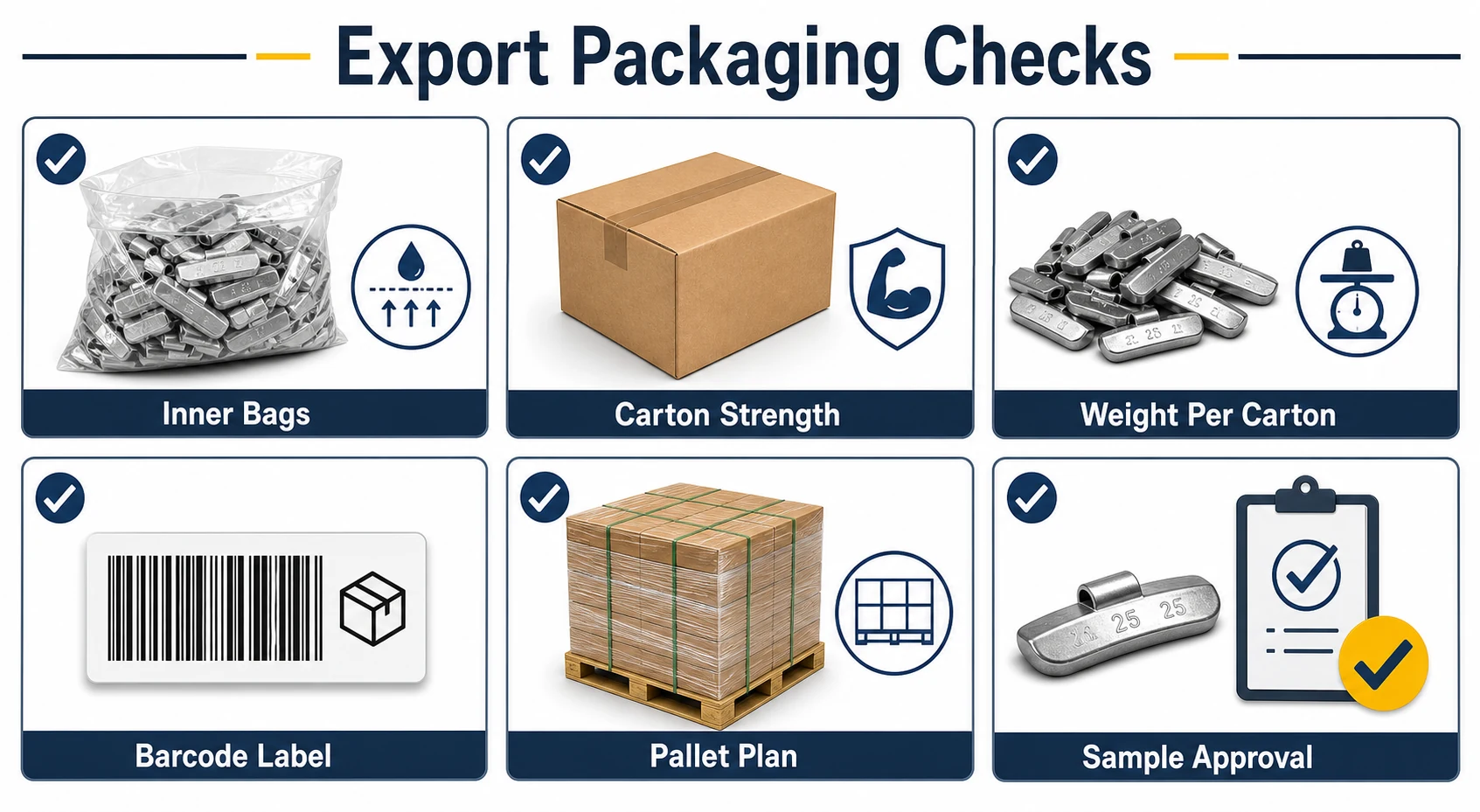
Put these fields in the quote:
| Packaging field | What the buyer should define |
|---|---|
| Inner pack | Bag, box, tray, bucket, strip bundle, or loose workshop pack |
| Count | Pieces, segments, strips, rolls, and quantity per inner pack |
| Carton | Inner packs per master carton, carton dimensions, net weight, and gross weight |
| Label | SKU, material, unit, quantity, lot or batch, barcode, language, and handling marks |
| Pallet | Pallet size, cartons per layer, layers, total height, stretch wrap, and pallet material |
| Protection | Divider, liner, moisture control, finish protection, tape-liner protection, and carton strength |
| Shipment | Mixed-carton rules, container loading plan, and whether cartons may be split |
State whether the customer needs workshop efficiency or downstream distribution. A tire shop may prefer a labeled inner bag with easy counting; a distributor may need smaller cartons, barcodes, language labels, and packaging that can be sold without repacking. For adhesive products, inspect the liner after storage and carton movement; for coated clip-on parts, include rubbing, moisture, and label-legibility checks.
ASTM D4169 provides a structured basis for evaluating shipping units against distribution hazards such as handling, vibration, and compression, but it is not automatically required for every wheel weight order. 3 The useful purchasing action is to state the distribution risk and the evidence needed: a packaging mockup, transport simulation, internal inspection, or a formal test plan.
Which Export and Material Documents Should Importers Confirm?
Importers should confirm destination-market requirements before production, especially for material declarations, labels, pallet treatment, and customer-specific documents. Missing paperwork can delay a shipment or make a product difficult to sell.
| Document or confirmation | Why it matters | Who should confirm it |
|---|---|---|
| Commercial invoice and packing list | Reconciles goods, values, quantities, cartons, and shipment details | Buyer, supplier, and freight partner |
| Material declaration | Records the agreed material route and any customer-specific restriction | Buyer and supplier quality contact |
| Label and barcode proof | Prevents wrong SKU, unit, language, or carton identification | Buyer’s warehouse or sales team |
| Pallet and wood-packaging status | Confirms whether the route and destination accept the planned pallet or crate | Buyer and freight/customs contact |
| Product drawing and revision | Keeps the shipped clip, strip, coating, and dimensions tied to approval | Buyer and supplier engineering/quality team |
| Customer-specific forms | Covers retailer, chain workshop, or private-label requirements | Buyer and end customer |
When wooden pallets or crates are used in international trade, ISPM 15 addresses approved phytosanitary measures and marking for regulated wood packaging material. 4 Confirm the destination’s current implementation and the freight partner’s requirements; one country’s process is not a universal import rule.
If a customer requires lead-free wheel weights, non-lead documentation, or a particular steel/FE route, put it in the RFQ, quotation, drawing, carton label, and approval record. “Lead-free” or “eco” in marketing copy is not enough evidence for receiving. Adhesive orders also need a storage and installation discussion: 3M identifies grease, oil, dirt, brake dust, and residue as contamination to remove before wheel-weight attachment. 1 Define the wheel surface, cleaning process, temperature window, pressure method, and storage conditions instead of approving tape by color or touch.
How Should You Approve Samples Before Mass Production?
Approve the same product, packaging, label, and documentation planned for the bulk batch. A loose sample proves shape and appearance; it does not prove carton count, tape condition, retention, coating protection, barcode accuracy, or repeatability.
Use four checks in the sample approval:
| Approval stage | What to inspect | Evidence to retain |
|---|---|---|
| Identity | SKU, material, unit, format, finish, clip or tape version | Approved drawing, sample photo, label, and revision |
| Fitment | Flange or landing area, insertion, retention, clearance, and removal | Wheel or assembly identity and fitment notes |
| Service | Balance result, placement, technician handling, liner removal, or clip behavior | Test date, operator, machine/process, and result |
| Pack and shipment | Inner pack, carton, weight, label, pallet, rub, and storage condition | Packed sample photos, packing list, and inspection record |
For clip-on weights, inspect the opening and contact points before and after application. The weight should fit the defined flange without forcing the wheel, slipping, damaging the finish, or creating interference. For adhesive weights, check cleaning, placement, pressure, contact area, edge lift, liner condition, and removal.
Pressure-sensitive adhesive approval should test application conditions, not just tack. 3M’s application guidance describes pressure and adhesive wet-out as part of establishing contact, which is why a sample that feels sticky in a bag is not a complete acceptance test. 2
Write the approval record as a controlled statement covering material, size, unit, format, coating, tape, liner, inner pack, carton quantity, label, date, and revision. If any of those change, reopen approval or document the change before production.
What Should a Complete Bulk Wheel Weight RFQ Include?
A complete RFQ lets suppliers quote the same product and lets the buyer compare offers without reconstructing assumptions. It should describe the application, construction, order mix, packaging, destination, quality evidence, and commercial terms.
Include the following fields:
- Application: vehicle or wheel use, market, service channel, axle or wheel position where relevant, and known fitment constraints.
- Product: clip-on or adhesive, profile or landing area, material, finish, weight increments, unit system, dimensions, and tolerance.
- Order: first-order quantity by SKU, expected replenishment, core/supporting/trial status, and whether mixed cartons are allowed.
- Packaging: inner pack, pieces per pack, master-carton quantity, gross-weight target, dimensions, labels, barcodes, pallet plan, and private-label artwork.
- Quality: drawing, sample quantity, mass and dimensional checks, fitment test, retention or adhesive test, coating review, batch traceability, and pre-shipment inspection.
- Documents: invoice, packing list, material declaration, label proof, packaging details, and destination-specific customer or freight requirements.
- Commercial terms: MOQ basis, lead time, sample charges, change notice, payment terms, and shipment method as agreed by the buyer and supplier.
Ask the supplier to separate standard from custom configurations. This reveals whether a low price depends on an existing clip, tape, carton, or label, and makes later replenishment easier because allowed changes are clear.
When the program requires private-label packaging, several clip profiles, or repeat-order control, a wheel weights manufacturer can be evaluated against the same RFQ. The important comparison is not a generic “factory” claim; it is whether the supplier can keep the approved drawing, material, pack, label, and batch records connected over time.
How Do You Compare Bulk Wheel Weight Quotes by Usable Cost?
Compare quotes by usable landed cost and service impact, not by piece or kilogram price alone. A cheaper quote can become more expensive when the buyer must sort cartons, relabel units, repack damaged finishes, or hold slow-moving MOQ sizes.
A practical comparison model is:
Usable landed cost = product cost + approved packaging + freight and handling + applicable import costs + inspection/repacking cost + expected slow-stock cost.
The formula is a decision model, not a promise about any particular destination. Ask the freight or customs partner to confirm the route-specific charges, and keep product cost, packaging, and logistics as separate lines so the comparison can be updated.
| Quote line | What to compare | Red flag |
|---|---|---|
| Product | Same material, format, dimensions, mass unit, and tolerance | “Equivalent” without a drawing or sample |
| Packaging | Same inner count, carton, label, pallet, and protection | Price excludes the pack needed by the customer |
| Quality | Same sample, fitment, batch, and inspection evidence | “QC passed” with no defined check |
| Logistics | Same carton dimensions, weights, pallet plan, and shipment basis | Freight cannot be estimated from the quote |
| Change control | Same revision and notification process | Supplier may substitute tape, clip, coating, or pack |
| Replenishment | Same approved SKU and repeat-order conditions | First order is cheap but the next order is undefined |
Keep price discovery separate from product approval. Mark an early range as budgetary until the wheel interface, material, pack, and sample criteria are fixed; otherwise the cheapest number can anchor a comparison between different products.
Which Checks Prevent the First Order From Becoming Dead Inventory?
The first order avoids dead inventory when every SKU has a clear application, unit, pack, and replenishment reason. Test each line against a simple decision state before production.
| Decision | Use it when | Required action |
|---|---|---|
| Pass | Application, sample, package, and documents agree | Release the SKU for the defined order |
| Hold | A test, document, drawing, or packaging value is missing | Do not release production until the gap is closed |
| Clarify | The product may fit, but the wheel, market, unit, or pack is undefined | Ask for the missing evidence and update the RFQ |
| Reject | Fitment, clearance, retention, material, or identity fails | Remove the SKU or select a different construction |
Watch for these return-producing shortcuts:
- “Fits all wheels” without a profile, exclusion list, or sample evidence.
- One price for several clip profiles or adhesive constructions.
- Equal quantities of every size without demand history.
- Pieces, strips, kilograms, and cartons used interchangeably.
- A material claim, sample, or carton plan without matching records for the declaration, drawing, pack, gross weight, pallet, and label.
Keep the approved sample photo, drawing, label artwork, packing list, and inspection result with the purchase order. Receiving staff should be able to identify a changed clip, tape, finish, unit, carton quantity, or label from that record.
If you are preparing a first or repeat bulk order, share the wheel applications, target SKUs, material route, monthly usage, packaging preference, destination, and required documents. We can help turn those details into a quote-ready SKU mix and sample approval record. You can request a bulk wheel weight review with the information already available.
Conclusion: Specify the Range Before You Enlarge the Order
Bulk wheel weights work when the order is treated as a controlled service range rather than a pile of low-priced pieces. The buyer should define the wheel interface, attachment format, material, unit system, SKU roles, MOQ basis, packaging, export documents, sample evidence, and change-control record before increasing quantity.
The reliable sequence is simple: map real applications, separate core from trial SKUs, quote the exact pack, approve a representative product and carton, compare usable cost, and preserve the approved baseline for replenishment. That sequence protects tire shops, fleets, distributors, and importers from buying inventory that cannot be fitted, counted, labeled, or sold with confidence.
Frequently Asked Questions
What is the MOQ for bulk wheel weights?
There is no single MOQ for every bulk wheel weight order. It may be set by SKU, material, construction, increment, coating, packaging, label, or total order value, so ask which variable creates the minimum.
Should bulk wheel weights be ordered by pieces, kilograms, or cartons?
Write the purchase order in all relevant units: mass per piece or segment, pieces per inner pack, inner packs per carton, gross carton weight, and pallet count. This prevents pricing, receiving, and freight calculations from interpreting “quantity” differently.
Should a bulk order include clip-on and adhesive wheel weights together?
It can, but each format needs separate SKUs, fitment evidence, packaging, and approval criteria. One vague assortment is harder for a workshop or warehouse to control.
How many SKUs should a starter bulk order include?
Start with supported wheel interfaces and correction sizes, then add a limited trial group. Use sales history or service records when available instead of equal quantities of every possible size.
What documents should an importer request?
Common requirements include an invoice, packing list, material declaration, drawing and revision, label proof, carton and pallet details, and customer-specific inspection forms. For wooden pallets or crates, confirm treated-wood requirements before shipment.
Does sample approval cover the whole bulk order?
Only when the sample matches the planned production construction and pack. Reopen approval if the material, clip, tape, coating, dimensions, label, carton quantity, or revision changes.
References
[1] 3M. “Wheel Weight Surface Prep.” 2024.
[2] 3M. “3M Wheel Weight System Application Guidelines.” 2012.
[3] ASTM International. “ASTM D4169: Standard Practice for Performance Testing of Shipping Containers and Systems.” 2023.
[4] International Plant Protection Convention. “ISPM 15: Regulation of Wood Packaging Material in International Trade.” 2019.