



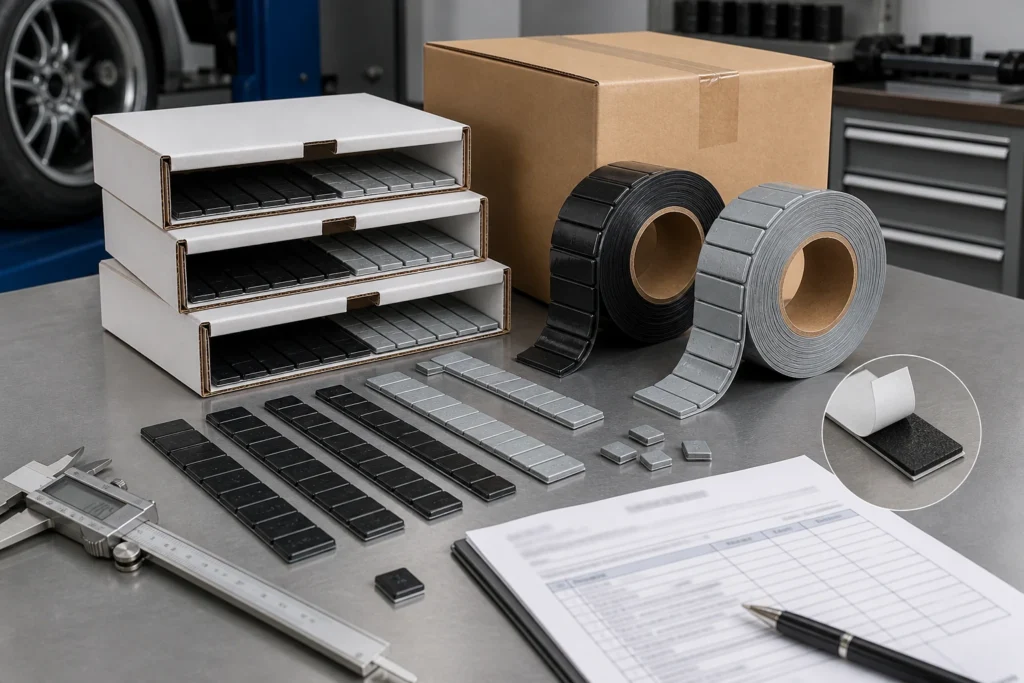
Adhesive wheel weights wholesale programs should be specified by rim application, strip and segment format, material, tape and liner construction, finish, packaging, storage, and sample validation. Distributors should treat tape behavior and installation conditions as product requirements, not details to discover after the bulk order arrives.
Table of Contents
- What does a wholesale adhesive wheel-weight program need?
- Why does wholesale adhesive sourcing need a defined program?
- How should buyers define the wheel application?
- How should buyers select strip and segment formats?
- How should buyers compare tape and liner construction?
- How should buyers validate samples before a bulk adhesive-weight order?
- How should buyers pack and store adhesive weights?
- What should be included in an adhesive-wheel-weight RFQ?
- Conclusion: approve the adhesive system before the carton price
- Frequently Asked Questions
- References
What does a wholesale adhesive wheel-weight program need?
A wholesale adhesive wheel-weight program needs a clear description of where the strip will sit on the wheel, how technicians will use it, and how the product will remain protected until installation. The quote should cover more than the metal segment: it should also identify tape, liner, strip geometry, finish, packout, storage conditions, and the sample that represents bulk production.
An adhesive weight is a system. The metal body supplies correction mass, the tape creates the bond, the liner protects the tape before use, and the carton preserves that assembly through freight and warehouse handling. A weak instruction on any one of these components can make a low-cost offer expensive once shops report lifted strips, hard-to-peel liners, clearance problems, mixed stock, or crushed packaging.
| Program element | Buyer decision | What should be fixed before quotation? |
|---|---|---|
| Wheel application | Alloy-wheel barrel, visible finish expectation, available clearance | Target wheel type, placement area, and any low-profile restriction |
| Product format | Pre-cut strip, roll, or a defined mix | Segment mass, strip length, roll length, and unit system |
| Material and finish | Steel, zinc, composite, coating color, and corrosion expectation | Exact material route and approved visual standard |
| Bonding system | Tape construction, liner behavior, and installation conditions | Tape data, liner type, surface preparation, pressure, and evaluation condition |
| Packaging | Inner pack, dispenser, carton, label, and pallet plan | Quantity, orientation, carton dimensions, gross weight, and barcode fields |
| Validation | Product sample, packed sample, and acceptance criteria | Representative wheel surface, test sequence, and permitted deviations |
The buyer’s task is not to prescribe a brand of tape by habit. It is to state the conditions that the supplied strip must meet in the intended market. A supplier can then confirm whether its standard configuration applies or propose a controlled alternative before price and MOQ are finalized.
Why does wholesale adhesive sourcing need a defined program?
Wholesale adhesive sourcing needs a defined program because distributors do not sell a loose laboratory sample. They sell a repeatable service item to tire shops, wheel specialists, and regional resellers. Each channel handles strips differently, keeps different stock levels, and may have different expectations for dispenser convenience, carton labeling, corrosion appearance, and tape performance.
The broader distributor range and replenishment choices beyond adhesive weights should be decided first: the fast-moving SKUs, expected monthly consumption, carton size, replenishment cadence, and whether the buyer also carries clip-on weights. This prevents adhesive products from being ordered as an isolated bargain that does not fit the rest of the range.
For example, one distributor may need pre-cut 5 g segmented strips in small inner boxes for shop counters. Another may need longer rolls for high-throughput service centers that cut to mass at the workstation. Both are adhesive programs, but their format, carton design, tool needs, liner handling, and inventory logic are different. A third buyer may serve premium alloy-wheel workshops where strip height and black finish are essential, even if the price per kilogram is higher.
The program should answer five commercial questions before the RFQ is circulated:
- Which wheel and customer applications will the range cover?
- Which strips or rolls will technicians actually install and reorder?
- What tape and liner behavior is acceptable on the specified wheel surface?
- How must units be packed, labeled, stored, and received?
- What sample and pre-shipment evidence will release the first bulk order?
Those answers make supplier quotations comparable. They also let the buyer decide where a common standard format is sufficient and where a market-specific tape, finish, carton, or low-profile construction is justified.
How should buyers define the wheel application?
Buyers should define the wheel application by mounting area, wheel finish, clearance, workshop practice, and environmental conditions. “For alloy wheels” is a useful starting point, but it is not a complete specification. A painted inner barrel, a machined or chrome-like surface, and a tight-spoke design can create different requirements for strip height, conformability, adhesive contact, and visible finish.
Start by settling the choice between adhesive and clip-on formats before range planning. Adhesive weights often suit inner-barrel placement where the buyer wants a less visible solution and wants to avoid a flange clip. That does not mean every wheel can accept the same strip. Ask target shops for representative wheel samples or at least photographs and dimensions of the intended mounting area.
| Application question | Why it changes the order | Sample check |
|---|---|---|
| Where will the weight sit? | Determines available height, width, length, and curvature | Place the strip at the intended balancing plane |
| Which wheel surface is present? | Paint, clear coat, contamination, and texture affect bond behavior | Test on a representative clean surface, not only a flat coupon |
| Is clearance tight? | A standard strip may interfere behind spokes or near brake components | Measure installed strip height and wheel clearance |
| How do shops install it? | Cleaning, liner removal, pressure, and dwell depend on actual workflow | Observe a realistic technician application sequence |
| Which climate and storage conditions apply? | Heat, cold, humidity, and transit exposure influence handling risk | Include relevant handling and storage conditions in the approval plan |
3M’s wheel-weight product information illustrates the distinction between a conformable balancing material and the attachment tape used with it. 1 A buyer should use that distinction in the RFQ: approve the weight body, tape construction, and installation method together instead of assuming that a good metal strip guarantees a good bond.
How should buyers select strip and segment formats?
Select the format around how the customer balances wheels and replenishes stock. Pre-cut segmented strips can make common correction masses fast to build and easy to count. Rolls can reduce SKU complexity and allow technicians to cut to the required mass, but they require a controlled cutting and dispensing routine. Low-profile strips may solve a clearance problem but should be evaluated as their own configuration, not just a thinner version of a standard strip.
For listed Yirox examples and a worked segment-mass calculation, compare wheel weight strip formats and segment specifications.
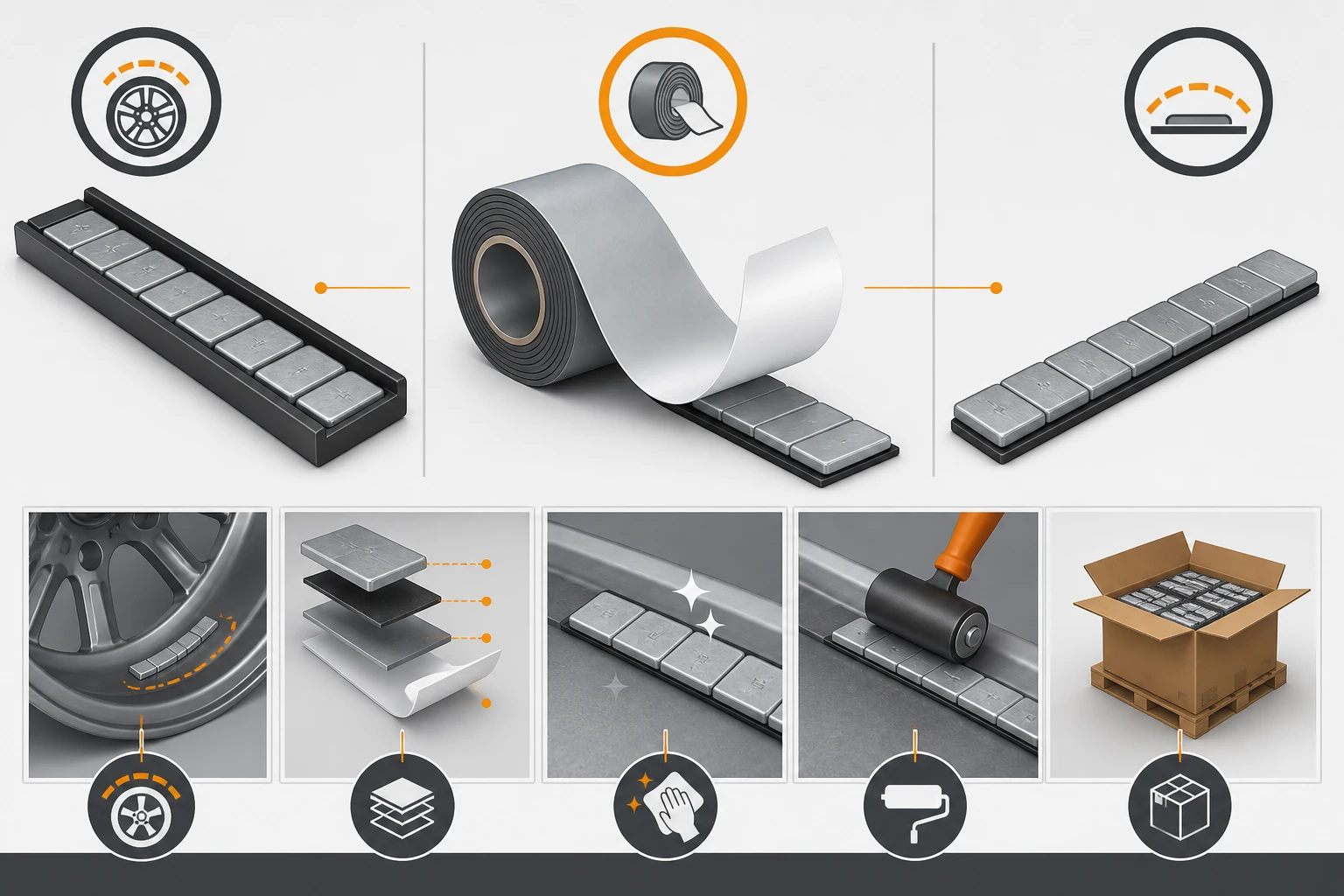
Format selection should account for the workshop workflow, stock model, tape protection, and wheel clearance.
| Format | Where it often fits | Wholesale advantage | Buyer check before approval |
|---|---|---|---|
| Pre-cut segmented strips | General tire shops and boxed retail/service supply | Easy picking, clear unit count, familiar technician workflow | Segment mass, break line, liner peel, strip count, and carton protection |
| Continuous or level-wound rolls | High-volume service centers or controlled cutting stations | Flexible cut-to-mass use and potentially fewer stocked increments | Roll length, dispenser or cutter compatibility, clean cut, and end-of-roll handling |
| Low-profile strips | Tight-clearance or appearance-sensitive alloy wheels | Helps when space behind spokes is limited | Installed height, clearance, segment geometry, and tape contact area |
| Mixed format program | Distributors serving more than one channel | Lets stock follow different customer workflows | Separate SKUs, labels, carton rules, and demand forecasts |
The operating differences between adhesive rolls and pre-cut strips are useful once the buyer has identified the channel. A roll does not automatically reduce inventory if shops do not have the right cutter, storage discipline, or training. Conversely, a pre-cut strip does not automatically simplify supply if the buyer must stock too many slow segment patterns.
Write the increment system in the RFQ. For metric programs, list the segment mass and strip total. For ounce-based programs, list the increment and the expected range. Avoid asking for “standard sizes” because standards differ by region, balancer setup, and distributor range. State the planned SKU mix and monthly or quarterly demand estimate so the supplier can propose an MOQ and carton plan that reflects actual turnover.
How should buyers compare tape and liner construction?
Compare tape and liner construction by the installation conditions and handling behavior the buyer needs, not by liner color or a generic statement such as “strong tape.” A sound comparison identifies the tape construction, the prepared wheel surface, application pressure, temperature at installation, observation time, liner removal behavior, and storage condition before the test.
Surface condition matters. 3M’s general VHB application guidance emphasizes surface preparation, contaminant removal, and adequate application pressure as contributors to a better bond. 2 That guidance is not a claim that every wheel-weight tape is the same as a VHB product. It is a useful reminder that tape data and technician procedure have to be evaluated together.
The field causes of adhesive-weight loss should inform the sample plan. A strip may lift because of dirty wheel surfaces, cold installation, insufficient pressure, a poorly matched tape, damaged liner, storage exposure, or a geometry that does not conform to the wheel. The buyer should resist resolving all of those risks with a vague demand for “premium tape.”
| Tape or liner question | What to ask the supplier | What to observe in samples |
|---|---|---|
| Tape construction | Tape family, thickness, supplied backing, and any data the supplier can share | Consistent placement, clean edges, and no obvious voids or lifting |
| Liner | Liner material, release behavior, edge protection, and pack orientation | Peels without tearing, adhesive transfer, or lifting tape from the weight |
| Wheel surface | Intended substrate and cleaning procedure | Bond on a representative wheel surface after agreed preparation |
| Application | Required temperature, pressure, and dwell before check | Repeatable installation with the target shop’s normal tools |
| Storage | Supplier guidance for temperature, moisture, dust, compression, and shelf life | Liner and tape condition after agreed storage or transport simulation |
Peel adhesion can be one controlled comparison input, but it is not a complete prediction of wheel service. ASTM lists D3330/D3330M as a test method for peel adhesion of pressure-sensitive tape and notes that representative materials can be used for comparison. 3 If a buyer calls for a peel test, define the substrate, sample conditioning, method version, angle or procedure where relevant, observation point, and acceptance criterion with the supplier. Do not compare unrelated figures from different methods as though they were interchangeable.
How should buyers validate samples before a bulk adhesive-weight order?
Buyers should validate a product sample, a packed sample, and an installation sequence before releasing bulk production. A glossy strip placed once on a clean showroom wheel is useful, but it does not answer whether the liner stays intact after carton travel, whether the specified tape reaches the buyer, or whether a busy shop can repeat the installation correctly.
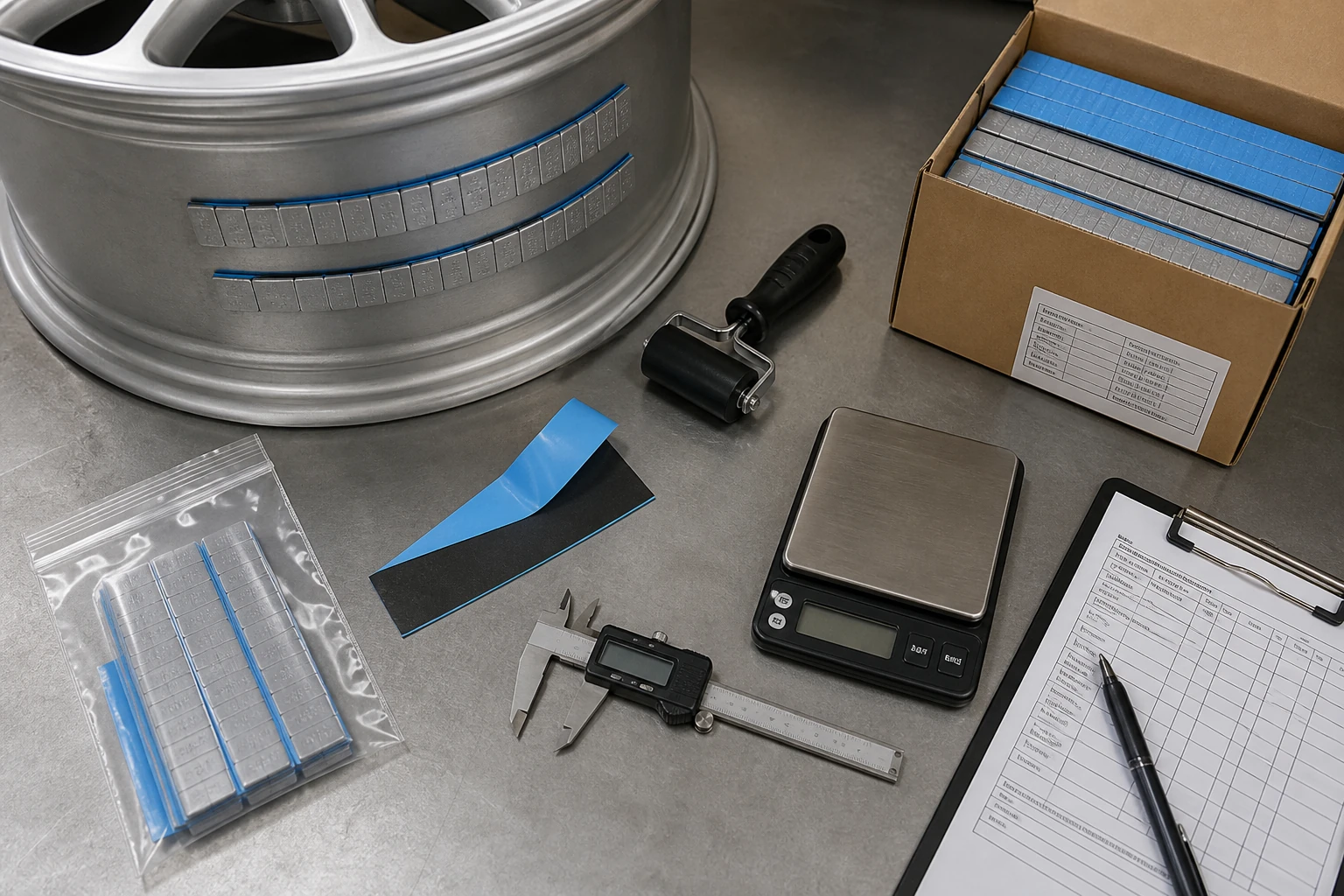
Sample approval should test the product and its delivery condition, not a loose strip alone.
Use a staged approval:
- Specification sample: Verify material, finish, segment mass, strip height, length, liner, and labels against the RFQ.
- Application sample: Install on representative wheel surfaces using the agreed cleaning, temperature, pressure, and dwell procedure.
- Packaged sample: Review inner box or dispenser, strip orientation, edge protection, carton count, gross weight, labels, and barcode if used.
- Conditioned sample: Where the order risk warrants it, review product after agreed storage or transit-like conditioning, then inspect liner release and installation behavior.
- Production-intent confirmation: Require the supplier to disclose any change in tape, liner, coating, material, segment geometry, or packaging before bulk production.
The most valuable test result is one a receiving team and supplier can reproduce. Record the wheel surface, cleaning materials, ambient conditions, method, evaluation time, photos, and sample identifier. This avoids a later argument where the supplier tested a different tape or the buyer’s shop used a different installation process.
For roll-based programs, the sample should also include the actual dispenser or cutting arrangement that the buyer plans to use. A 3M technical data sheet describes wheel-weight products supplied in level-wound rolls for cut-to-weight use. 4 That illustrates the practical point: format and application equipment can be part of the operating system, so they should be approved together.
How should buyers pack and store adhesive weights?
Pack and store adhesive weights so that tape faces and liner edges remain clean, strips stay flat enough for the intended installation, and each SKU remains identifiable. Adhesive products should not be treated like loose metal parts that can be compressed, mixed, or stored next to dust and liquids without consequence.
Agree the packaging hierarchy: individual strip protection where required, inner box or dispenser, master carton, pallet pattern, and shipping mark. The outer carton should let warehouse staff identify the format, material where relevant, unit system, quantity, buyer SKU, and lot or production reference without opening every box.
| Handling point | Why it matters | Buyer control |
|---|---|---|
| Strip orientation | Prevents bent segments and damaged liner edges | Require a packed sample and a clear inner-pack layout |
| Liner protection | Avoids early exposure, dust contact, or tape transfer | Specify closed packaging and inspect the first and last strip in a pack |
| Carton strength | Limits crush damage during stacking and transport | Set practical gross-weight and stack conditions for the route |
| Storage environment | Helps preserve tape, finish, labels, and carton integrity | Define supplier guidance and warehouse receiving checks |
| SKU and lot identity | Keeps similar strips from being mixed after receipt | Require buyer SKU, unit, quantity, and lot field on the outer carton |
Review storage controls for adhesive tape and protected liners before setting warehouse rules. The page is helpful once the buyer knows the supplier’s recommended conditions; it cannot substitute for the supplier identifying the exact tape and packaging configuration in the approved order.
At receiving, isolate cartons with visible water damage, heavy crushing, open inner packs, damaged liner edges, or labels that do not match the packing list. Photograph the condition and preserve carton/lot information before the stock is redistributed. This makes it easier to distinguish a storage or transport issue from a production deviation.
What should be included in an adhesive-wheel-weight RFQ?
An adhesive-wheel-weight RFQ should state the product configuration, commercial quantities, and approval rules well enough that every supplier quotes the same program. It should give the supplier an opportunity to identify a constraint, such as a tape MOQ, special carton, unavailable liner, or format change, before the buyer selects a low price.
Once the requirement is clear, request adhesive sample formats matched to a defined RFQ. The category helps the buyer separate adhesive formats for the sample request; it does not replace the detailed specification needed to approve a bulk order.
Include these fields:
- Destination market, customer channel, and the intended wheel application.
- Adhesive format: pre-cut strips, rolls, low-profile items, or a separated SKU mix.
- Material, finish, segment mass or increment, strip/roll dimensions, and permitted tolerances.
- Tape and liner requirement, expected installation conditions, and supplier data requested.
- Inner-pack quantity, master-carton quantity, gross-weight preference, pallet plan, labels, and barcode fields.
- Estimated purchase volume by SKU, first-order quantity, and anticipated reorder cadence.
- Product sample, packaged sample, and the test sequence and acceptance criteria required before bulk release.
- Pre-shipment evidence: carton-label proof, quantity check, production/lot identifier, and any agreed inspection record.
Ask suppliers to identify every deviation next to the affected line. This practice is particularly valuable where two offers look similar but one has a different tape, liner, strip height, or carton count. It also makes MOQ discussions more productive because both sides can see which variables drive a special production run.
If you are sourcing wholesale adhesive wheel weights, tell us the wheel finishes, strip format, tape expectations, size range, and packaging requirements you need to validate. We can help you request representative samples before comparing carton prices.
Conclusion: approve the adhesive system before the carton price
Adhesive wheel weights wholesale buying is strongest when the buyer approves a complete system: the wheel application, strip or roll format, material, tape and liner construction, packaging, storage controls, and installation sample. Price and MOQ become meaningful only after those variables are fixed.
Define the target wheels and customer workflow, request production-intent strip and packed samples, record a repeatable validation method, then release the bulk order with matching SKU, label, and carton controls. Request adhesive strip samples and tape data for the target wheels once the RFQ is specific enough to compare suppliers fairly.
Frequently Asked Questions
Are adhesive wheel weights better than clip-on wheel weights for wholesale buyers?
Neither is universally better. Adhesive weights can suit many alloy-wheel and appearance-sensitive applications, while clip-on weights can suit steel wheels and fast flange-fit workflows. Wholesale buyers should choose by wheel application, customer practice, size range, packaging, and service expectations rather than by format name alone.
What tape details should an adhesive wheel-weight buyer ask for?
Ask for the tape construction, liner behavior, supplier guidance for storage and installation, and any available product data. More importantly, agree on a representative wheel surface, cleaning procedure, application pressure, temperature, dwell period, and pass/fail observation for the sample test.
Should a distributor buy adhesive strips or rolls?
Buy pre-cut strips when the channel needs fast picking, clear unit counts, and familiar segment use. Consider rolls when the service workflow supports cutting and dispensing and the buyer wants flexible cut-to-mass operation. Test the actual dispenser or cutter with the selected roll before ordering in bulk.
How should adhesive wheel weights be stored in a warehouse?
Keep them in intact, clean packaging under the supplier’s stated storage conditions. Avoid damaged cartons, moisture, dust, uncontrolled heat, and compression that can affect liner edges or strip geometry. Inspect labels and a small sample at receiving before stock is mixed into the warehouse.
What should a packed adhesive-weight sample include?
It should include the planned inner pack or dispenser, the actual strip or roll, master-carton presentation where practical, outer label, quantity statement, and any barcode or lot field. The buyer should check it after normal handling, not only immediately after the supplier prepares it.
References
[1] 3M. “3M Wheel Weight PN55409 (TN4020P).” 2026.
[2] 3M. “Applying 3M VHB Tape.” 2026.
[3] ASTM International. “ASTM D3330/D3330M Standard Test Method for Peel Adhesion of Pressure-Sensitive Tape.” 2025.
[4] 3M. “3M Wheel Weights Technical Data Sheet.” 2024.