



Clip-on wheel weights wholesale programs should begin with the buyer's recurring rim-flange applications, then define clip profiles, increments, material, finish, labels, and carton assortment. A broad clip catalog is not a useful range unless the selected profiles are validated against the wheel mix the distributor actually serves.
Table of Contents
- What does a wholesale clip-on wheel-weight program need?
- Why does clip-on wholesale sourcing need a defined assortment?
- How should buyers start with rim data?
- How should buyers choose profile and increment coverage?
- How should buyers confirm material and finish?
- How should buyers build a carton assortment?
- How should buyers validate clip-on samples before ordering?
- What should buyers ask a clip-on wheel weight supplier?
- Conclusion: stock validated profiles, not catalogue breadth
- Frequently Asked Questions
- References
What does a wholesale clip-on wheel-weight program need?
A wholesale clip-on program needs a controlled connection between a rim flange and a stocked SKU. The buyer must know which flange families recur in the target market, which clip profiles seat and retain correctly on those flanges, which increments are demanded, and how the selected weights will be labeled, packed, and replenished.
The code stamped on a clip-on weight is not enough by itself. P, C, T, MC, FN, or another catalogue name can indicate a profile family, but a letter does not capture every wheel flange, coating, wheel finish, or special application. The configuration that a distributor approves should include the actual weight profile, mass increment, material, finish, intended wheel population, carton quantity, and acceptance record.
| Program element | Decision to make | Evidence to request |
|---|---|---|
| Rim-flange family | Which recurring steel or alloy rim flanges will the range serve? | Representative wheel sample, flange dimensions, photos, or validated application chart |
| Clip profile | Which profile family has passed a trial fit on those flanges? | Profile drawing or gauge comparison, installed sample, and retention observation |
| Increment range | Which gram or ounce sizes match local balancing practice? | SKU list tied to customer demand and anticipated monthly consumption |
| Material and finish | Steel, zinc, or another approved route; coating and visual expectation | Product specification, finish sample, and any buyer-required material evidence |
| Packaging | Inner box, tray, carton, labels, pallet and mixed-SKU rules | Packed sample, label proof, carton dimensions, gross weight, and handling plan |
| Supplier control | How will the approved configuration be repeated? | Sample/lot record, inspection checks, change-notification agreement |
This is why an assortment should be built around a service population, not a supplier's longest profile list. The right range makes it easy for the distributor to cover frequent jobs while keeping slow, unclear, or unvalidated profiles out of the first purchase order.
Why does clip-on wholesale sourcing need a defined assortment?
Clip-on wholesale sourcing needs a defined assortment because inventory becomes expensive when profile, increment, and wheel application are not linked. A distributor can receive dozens of visually similar boxes and still leave shops without the right weight when the common rim-flange family or fast-moving mass increment was missed.
Start with distributor assortment and replenishment planning across wheel-weight formats. That page helps establish which products deserve recurring stock, how many SKUs the warehouse can support, and how carton/MOQ decisions should relate to customer turnover. The clip-on order can then be treated as one controlled portion of the overall wheel-weight range rather than an isolated price list.
A defined assortment also makes supplier comparison fairer. One supplier may quote a broad mix of profile codes with attractive box prices; another may quote fewer, better-documented items that match the buyer's actual rims. Without a required profile-and-increment list, the first offer can look cheaper merely because it is not covering the same jobs.
Use a simple range structure:
- Core profiles: Validated against the flanges responsible for the majority of shop demand.
- Core increments: Sizes with a known sales history or a confirmed balancer/service convention.
- Controlled extensions: Low-volume profiles, special materials, or appearance-sensitive options that are approved separately.
- Exception path: A sample and quotation procedure for unusual wheels rather than stocking every possible profile.
That structure reduces stock risk. It also gives sales teams an honest answer when a customer needs an unvalidated profile: request rim data and a sample instead of promising that a familiar letter code will fit.
How should buyers start with rim data?
Buyers should begin with the rims their customers actually service. Collect representative wheel samples where possible. When physical wheels cannot be sent, record the vehicle/wheel application, rim photographs, mounting location, rim material, visible finish, flange dimensions, and any current weight being replaced. Use a rim gauge or caliper to make the flange description repeatable.
The attachment and wheel-application choices behind a clip-on range should be agreed before measurements are taken. Some appearance-sensitive or nonstandard wheels may be better served with an adhesive format, while others have a suitable flange for a mechanical clip. The goal here is not to force clip-on weights onto every wheel; it is to establish which applications belong in a clip-on assortment.
ISO 13988:2021 describes nomenclature, test procedures, and performance requirements for clip and adhesive balance weights, and notes the relationship between clip configurations and rim flanges for passenger cars and light trucks. 1 For wholesale buyers, that is the essential idea: flange geometry is part of the product requirement, not an afterthought after the carton arrives.
Use rim-flange measurements that turn a profile label into a fitment decision to document the check. An application chart is a useful starting point, but it must be confirmed on the actual wheel or a representative flange. Coating thickness, damage, unusual wheel geometry, and placement constraints can alter what a visual code match suggests.
| Rim-data field | Why the buyer records it | Decision it supports |
|---|---|---|
| Wheel type and vehicle/application | Groups recurring service demand | Which customer group justifies stock |
| Rim material and finish | Flags scratch-sensitive or coated applications | Whether a clip-on solution is appropriate |
| Flange shape, lip, gap, and depth | Defines the engagement geometry | Candidate profile family and trial-fit method |
| Intended mounting plane | Ensures the weight sits where balancing requires | Clearance and body orientation check |
| Existing installed weight, if available | Gives a useful comparison point, not proof by itself | Sample shortlist and installer discussion |
Do not base a range solely on copied vehicle lists. Wheel variants, aftermarket replacements, and regional configurations can differ. Treat every list as a way to identify candidate wheels, then use the actual flange to approve the profile.
How should buyers choose profile and increment coverage?
Choose profile coverage first, then build increments inside each validated profile. A broad increment range in the wrong clip is not useful. Conversely, one correct profile may need different increment coverage in a market that balances in ounces versus a market that works mainly in grams.
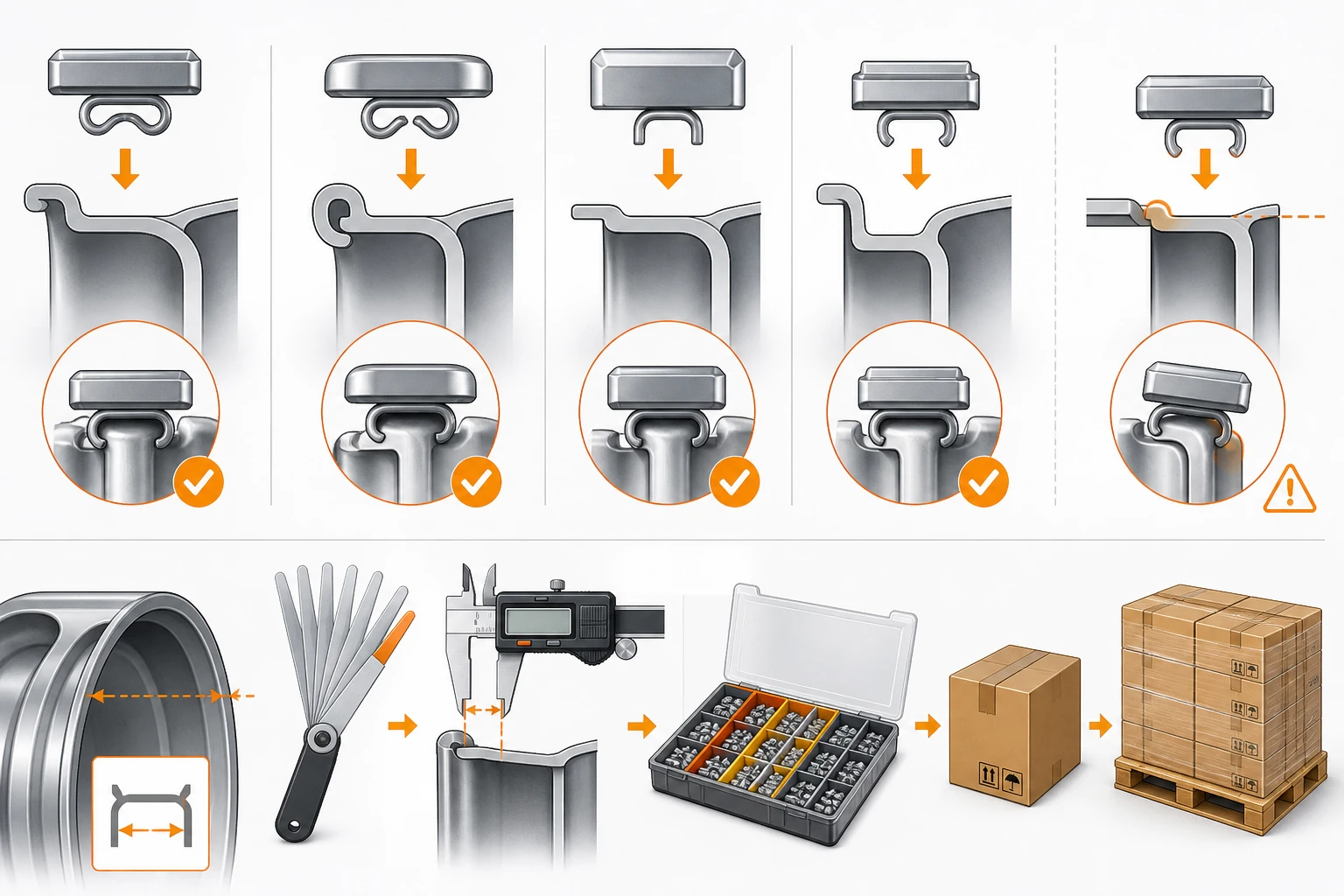
Profile codes help organize a range, but a rim measurement and trial fit decide whether a SKU belongs in it.
The article on clip profile families before an assortment is built can help a purchasing team understand common profile labels without treating them as universal fitment claims. Pair it with the buyer's own measurement record and installed samples.
| Coverage question | Buyer action | Result |
|---|---|---|
| Which flanges recur most often? | Rank representative rims by sales or service frequency | Core profile shortlist |
| Which profile fits each flange? | Compare gauge/dimensions, perform a trial fit, and record result | Approved profile-to-rim map |
| Which increments sell? | Review balancer units, past invoices, and shop demand | Core mass range for each profile |
| Which sizes are slow but necessary? | Keep an exception or small-order route | Avoids forcing slow stock into every carton |
| Which units will labels use? | Separate gram and ounce stock clearly | Fewer picking and installer errors |
Manufacturer catalogues can help shape the first sample tray. Plombco, for example, lists passenger-car clip-on products by profile and size bands and directs users to an application chart or rim gauge for profile selection. It also distinguishes passenger-car PFe use from selected light-truck applications where another series may be more suitable. 2 That is useful evidence that a supplier catalogue should be read as a candidate map, not a self-sufficient fitment approval.
When calculating the initial assortment, do not split order quantities evenly across all boxes. Use the buyer's service history. A simple first-pass model is to allocate more stock to validated profiles and increments with the highest expected monthly movement, then keep a controlled remainder for special profiles. Revisit the mix after the first reorder cycle using actual sales, returns, and shop feedback.
How should buyers confirm material and finish?
Confirm material and finish after the profile is selected, because material and coating affect corrosion appearance, weight geometry, handling, labeling, and customer expectations. A correct clip profile with an unsuitable finish can still create returns from rust, visible marking, coating loss, or damaged rims.
For steel/Fe programs, specify the grade or product description used by the supplier, the coating/finish expectation, visual standard, and any comparative corrosion test or report the buyer requires. For zinc or other non-lead routes, identify the actual material and finish separately. Do not treat "lead-free" as a substitute for a product specification.
| Material/finish point | What to define | Buyer check |
|---|---|---|
| Weight body | Steel/Fe, zinc, or another named material | Product description and sample marking match the RFQ |
| Clip construction | Integral or separate clip; relevant spring behavior | Clip seats without obvious distortion on the approved rim |
| Coating/finish | Plating, paint, powder coat, color, and visual expectation | Edges, contact area, and packed samples show no unacceptable finish damage |
| Appearance sensitivity | Visible flange, alloy finish, wheel-cover or hubcap use | Test installation on the intended wheel, not only a generic rim section |
| Label wording | Material, unit system, size, profile, buyer SKU | Inner box and carton make similar parts distinguishable |
Installation guidance from Perfect Equipment instructs users to select the right application with a guide, make sure the clip aligns with the flange, and check that the installed weight is secured. 3 Wholesale buyers should use the same practical logic at approval stage: a coating or material claim cannot compensate for a clip that sits incorrectly or damages the intended flange.
How should buyers build a carton assortment?
Build carton assortments from approved profile-and-increment demand, not merely from convenient supplier box counts. The carton should help a warehouse receive, store, pick, and replenish the range without confusing close-looking weights. Separate profiles and unit systems clearly, and make mixed assortments intentional rather than accidental.
| Carton decision | Questions to answer | Practical control |
|---|---|---|
| Inner-box quantity | Does the count suit shop consumption and warehouse picking? | State pieces, mass range, profile, and buyer SKU on every inner box |
| Master-carton mix | One profile per carton or controlled mixed SKU carton? | Use a carton map and labels that identify every included SKU |
| Gross weight and dimensions | Can staff safely handle, store, and freight the carton? | Ask for packed sample, measurements, and stack/pallet plan |
| Reorder logic | How will core and slow SKUs be replenished? | Tie MOQ and carton count to expected usage rather than equal allocation |
| Label fields | What does receiving need to identify the product? | Include profile, material, increment, quantity, SKU, and lot field where agreed |
An assortment can be organized in two ways. A shop-oriented assortment contains a practical set of sizes in one profile family for immediate service. A distributor-oriented assortment often uses separate inner boxes by profile and increment, then combines them in a master carton or pallet according to demand. The latter usually gives stronger replenishment control, provided labels are consistent.
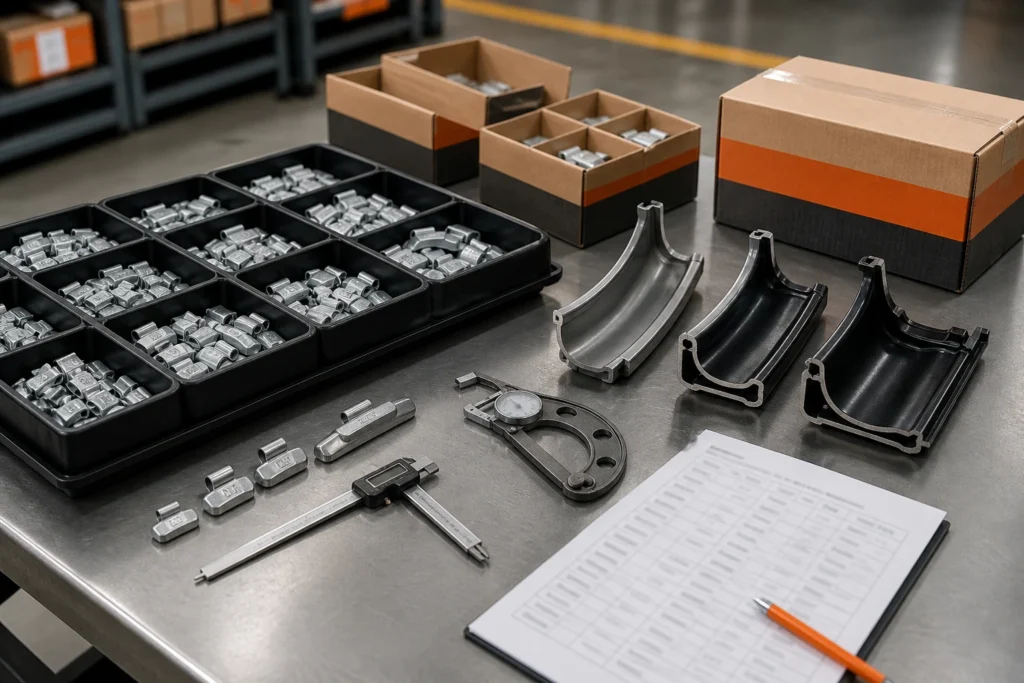
For a new range, request one packed sample for the core profile group and one label proof for each recurring SKU. Check whether warehouse staff can read the profile and increment without opening the box, whether similar gram/ounce items can be separated, and whether cartons prevent parts from shifting or damaging the finish.
How should buyers validate clip-on samples before ordering?
Buyers should validate samples on representative rims, then validate the sample packaging as the product will be received. The approval must prove that the selected clip fits the intended flange and that the supplied increment, material, finish, marking, box, and carton match the purchase specification.
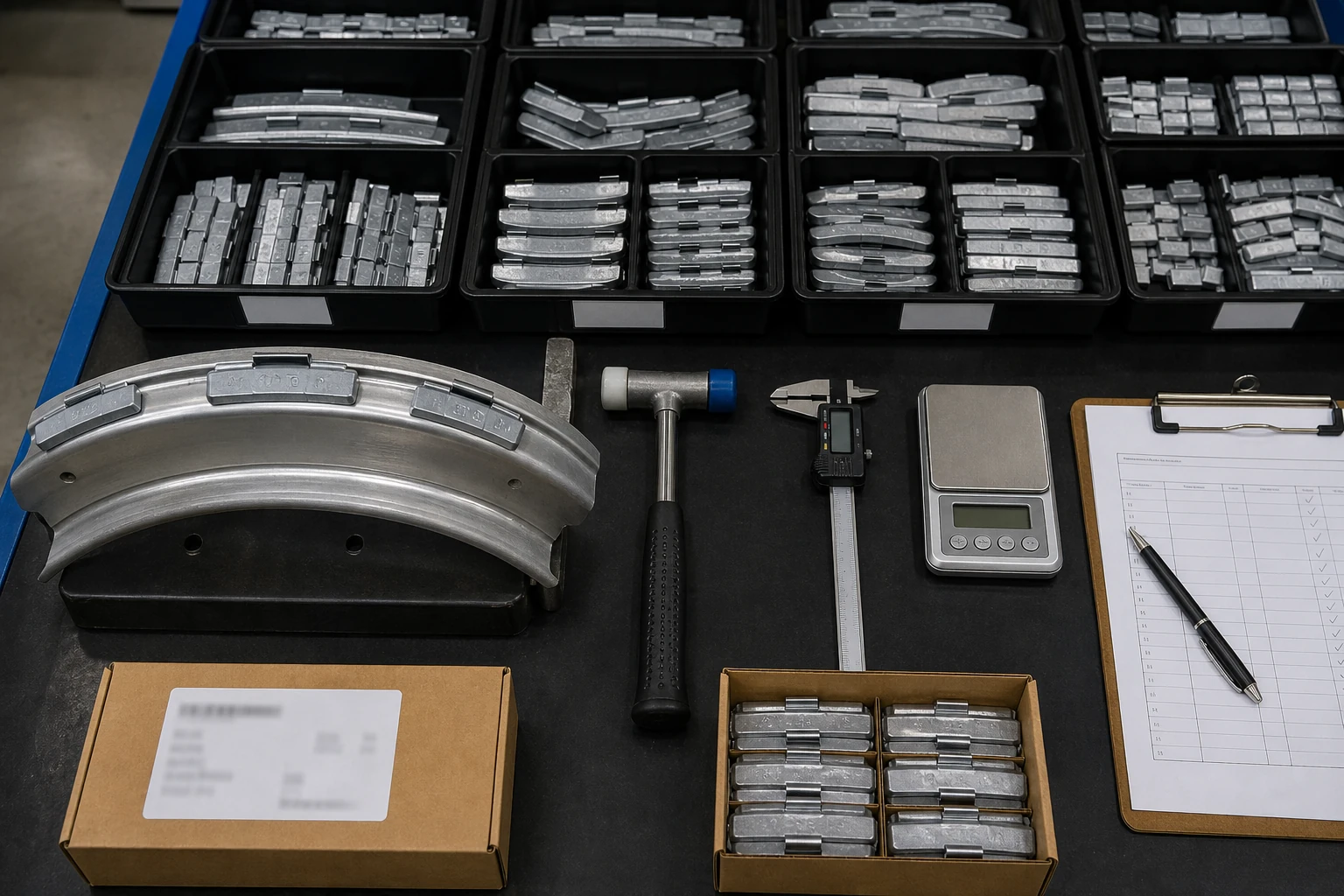
An approved clip-on sample should represent both the intended rim flange and the bulk product's labels and packaging.
Use this sample sequence:
- Identify the sample: Record supplier SKU, proposed profile, material, increment, finish, and sample date.
- Check the flange: Measure or gauge the representative rim and document the intended mounting location.
- Trial fit: Position the clip without forcing it; confirm the profile follows the flange and the weight body sits as intended.
- Install and inspect: Use the agreed installation method, then check seating, movement, obvious finish damage, and accessibility for service work.
- Review the pack: Verify inner-box count, profile/increment label, carton description, and whether parts remain sorted and protected after handling.
- Approve the reference: Retain the sample record, photos, and any gauge data with the buyer's SKU before production.
Request a representative sample request for a new clip-on range rather than a generic box of weights. The request should name the target flange families, intended vehicle/wheel applications, units, material, finish, requested increments, packaging, and checks the buyer plans to perform.
SAE J1986 illustrates why those physical checks matter: it addresses rim-flange features and clip-on balance-weight configuration and identifies typical application families, while noting that flange dimensions outside typical ranges may require different choices to meet retention targets. 4 An approved sample is the buyer's practical way to verify that the proposed product works in the actual range, not only in a catalogue drawing.
What should buyers ask a clip-on wheel weight supplier?
Ask the supplier questions that make the quotation, sample, and bulk shipment comparable. A serious supplier should be able to identify which profile it is quoting, what rim applications it expects the profile to serve, what evidence it has for the proposed configuration, and where it needs buyer input before offering a commitment.
Once the profile list is validated, use clip-on formats matched to the buyer's validated profile list to select representative products for the RFQ. The category is a useful format reference, but the final order still needs buyer-specific profile, increment, material, finish, and packaging details.
Include these questions in the RFQ:
- Which clip profile, material, and mass increments are quoted on each line?
- Which rim-flange family or application chart does the supplier use as the starting point, and what trial fit does it recommend?
- What dimensions or gauge information does the supplier need from the buyer for unclear rims?
- What material, clip construction, coating, and visual standard apply to the supplied configuration?
- How are increment, profile, material, buyer SKU, quantity, and lot identified on inner boxes and master cartons?
- What is the MOQ by profile, increment, material, inner-box configuration, and total assortment?
- Can the supplier provide production-intent samples and a packed sample before bulk approval?
- What inspection, change-notification, and claim-support records can accompany the first and repeat orders?
Require deviations to be stated beside the affected item. This makes it visible when a supplier is proposing a different finish, substituted profile, altered box count, or an untested application. It also protects the relationship: both parties can resolve a constraint before the goods are packed, instead of negotiating a mismatch at receiving.
If you are building a wholesale clip-on assortment, tell us which rim profiles, service markets, weight increments, and carton quantities you need. We can help you shortlist a practical sample range instead of quoting a catalogue that does not fit your customers.
Conclusion: stock validated profiles, not catalogue breadth
Clip-on wheel weights wholesale buying works when the distributor turns rim data into a controlled, replenishable assortment. Start with the wheel flanges customers actually service, validate the profile and increment range with representative samples, then specify material, finish, labels, inner boxes, and cartons as part of one approved SKU record.
The best first order is not the largest catalogue selection. It is a defensible core range that covers recurring demand and has a clear exception path for unusual rims. Send rim samples or dimensions for a clip-on assortment proposal once the buyer's target wheels, units, and inventory priorities are clear.
Frequently Asked Questions
Are P, C, T, and MC clip-on weights interchangeable?
No. Those labels are commonly used for clip profile families, but they do not prove compatibility with every rim. The buyer should use a profile drawing or application chart as a starting point, then measure and trial-fit the proposed weight on a representative rim flange before ordering bulk quantities.
Should a clip-on wholesale range use grams or ounces?
Use the unit system that the target market's balancing equipment, shops, and existing inventory use. Some distributors need one system; others need clearly separated gram and ounce ranges. Do not mix units in labels or cartons without an explicit SKU and warehouse plan.
What should be included in a clip-on sample set?
Include the proposed profile families and increments, material and finish options, labeled inner boxes, representative carton packaging, and any requested product data. The buyer should also provide representative rims or documented flange dimensions so the supplier and buyer can judge the same application.
Why is the rim flange more important than a vehicle list?
Vehicle lists can identify likely applications, but wheel variants and replacement rims can differ. The clip attaches to the actual rim flange, so measuring and testing the flange produces stronger fitment evidence than a vehicle name alone.
How should a distributor reduce slow-moving clip-on inventory?
Build the initial purchase around validated profiles and increments with the strongest service demand. Treat special profiles and rare increments as controlled extensions or sample-to-order items until sales history justifies holding regular stock.
References
[1] International Organization for Standardization. “ISO 13988:2021 Passenger car and light truck vehicle wheels – Clip and adhesive balance weight and rim flange nomenclature, test procedures and performance requirements.” 2021.
[2] Plombco. “Steel Passenger Car Clip-On Wheel Weights.” 2026.
[3] Perfect Equipment. “Product Catalog and Wheel Weight Installation Instructions.” 2019.
[4] SAE International. “J1986 Balance Weight and Rim Flange Design Specifications, Test Procedures, and Performance Recommendations.” 2016.