
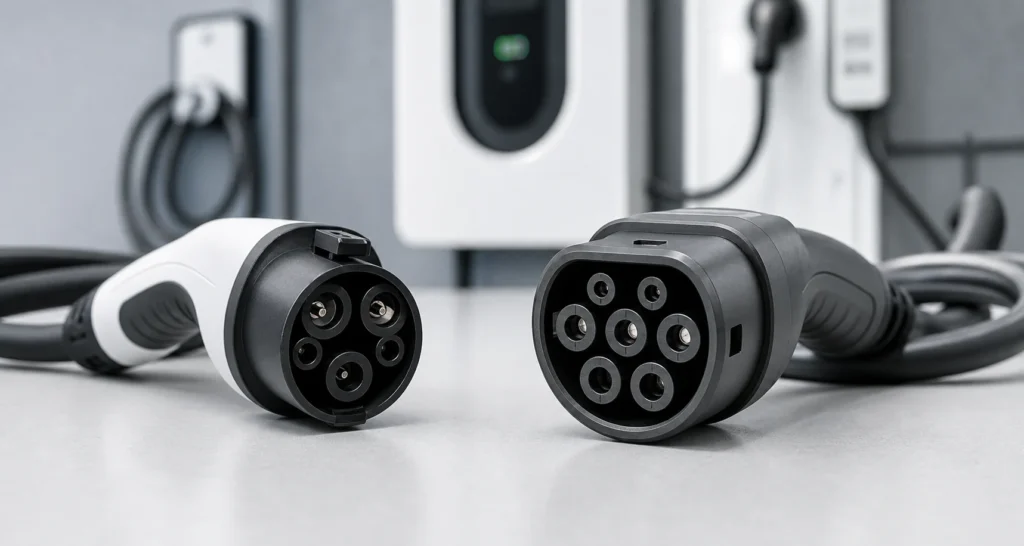
Type 1 and Type 2 EV chargers are different AC connector standards, not different charging-speed levels. Type 1, also called SAE J1772 or J-plug, is common in North America and Japan. Type 2, also called IEC 62196 Type 2 or Mennekes, is the main AC connector in Europe and many other IEC-based markets.
The right choice starts with one simple check: match the connector to the vehicle inlet and the region where the product will be used. A Type 1 product usually fits North American or Japanese AC charging needs. A Type 2 product usually fits European-style AC charging, especially where drivers carry a Type 2 cable for public socketed charging points.
The confusion comes from everyday wording. Many people say “Type 1 charger” or “Type 2 charger” when they really mean the cable, connector, wallbox lead, portable EVSE, or vehicle-side plug. For EV charging accessories, getting the language right matters because a connector that looks close in a product photo can still be wrong for the vehicle, country, current rating, or charging setup.
Table of Contents
- What is the real difference between Type 1 and Type 2 EV chargers?
- What is a Type 1 EV charger?
- What is a Type 2 EV charger?
- Is Type 2 faster than Type 1?
- Are Type 1 and Type 2 the same as Level 1 and Level 2?
- Can you use a Type 1 to Type 2 adapter?
- How do you choose between Type 1 and Type 2?
- What should distributors check before ordering Type 1 or Type 2 EV charging products?
- Conclusion: Choose by vehicle inlet, region, and charging setup
- Frequently Asked Questions
- References
What is the real difference between Type 1 and Type 2 EV chargers?
The real difference is the AC connector system: Type 1 uses a five-contact SAE J1772-style connector, while Type 2 uses a seven-contact Mennekes-style connector that can support single-phase or three-phase AC charging when the full charging system allows it. The connector affects vehicle fit, regional compatibility, cable design, locking behavior, phase support, and product assortment.
| Feature | Type 1 EV Charger / SAE J1772 | Type 2 EV Charger / IEC 62196 |
|---|---|---|
| Common names | Type 1, SAE J1772, J-plug, J1772 connector | Type 2, Mennekes, IEC Type 2 |
| Main charging role | AC charging | AC charging |
| Typical regions | North America, Japan, some imported-vehicle markets | Europe, UK, Australia, and many IEC-based markets |
| Contact layout | Five contacts | Seven contacts |
| Phase support | Usually single-phase AC | Single-phase or three-phase AC, depending on product and installation |
| Common product style | Tethered wallbox lead, portable EVSE, replacement vehicle connector | Type 2-to-Type 2 public cable, wallbox lead, adapter cable |
| Public AC charging pattern | Often station-provided cable or wallbox cable | Often socketed public AC stations where the driver brings a cable |
| DC fast charging? | Not by itself; CCS1 adds DC pins below the J1772 section | Not by itself; CCS2 adds DC pins below the Type 2 section |
The U.S. Department of Transportation describes Level 1 and Level 2 as AC charging categories and shows J1772 in the U.S. context for those AC levels 1. The Alternative Fuels Data Center also notes that Level 1 and Level 2 units use the same SAE J1772 connector to the vehicle in the U.S. market, while public DC fast charging may use CCS, CHAdeMO, or NACS 2. That is why Type 1 is still a practical North American AC connector even as NACS adoption grows.
Type 2 is different because it became the normal AC interface in Europe and many IEC-based markets. IEC 62196-2:2022 covers dimensional compatibility requirements for AC plugs, socket-outlets, vehicle connectors, and vehicle inlets used in conductive EV charging 4. For market planning, that means Type 2 is not just a plug shape. It is part of a wider charging practice that includes socketed public posts, three-phase AC options, and a strong aftermarket for detachable cables.
What is a Type 1 EV charger?
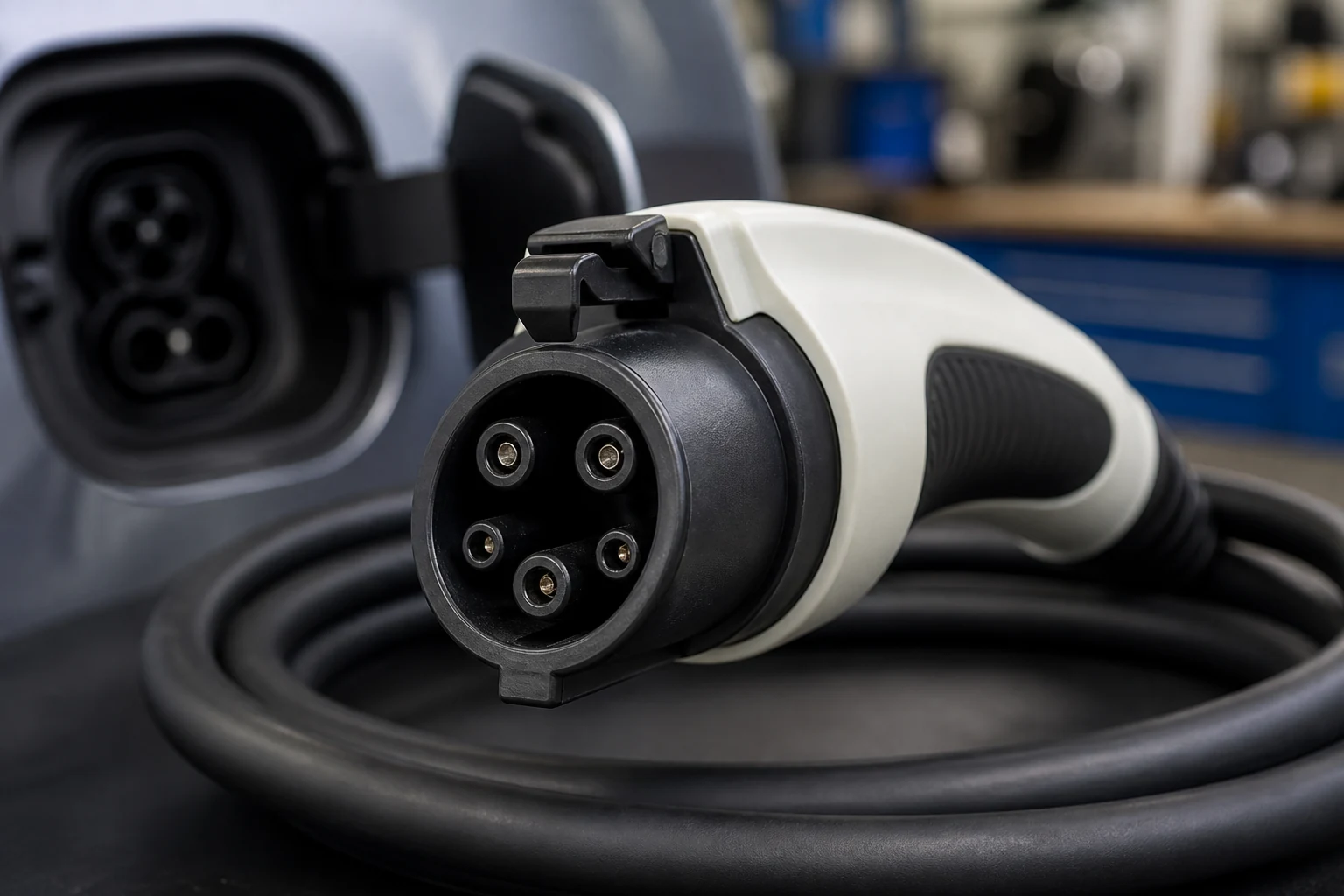
A Type 1 EV charger usually means an AC charging product that uses the SAE J1772 vehicle connector. In stricter technical language, the wallbox or portable unit is the EVSE, and the connector is the Type 1/J1772 interface that plugs into the vehicle.
SAE J1772 defines a common conductive charging method for EVs and plug-in hybrids, including operational requirements and dimensional requirements for the vehicle inlet and mating connector 3. In daily use, drivers recognize it as the round-ish J-plug used on many non-Tesla EVs and plug-in hybrids in North America.
Type 1 usually makes sense when the target vehicle or market fits these conditions:
- The vehicle has a J1772 AC inlet. The product must physically match the vehicle first.
- The market is North America, Japan, or a region with imported Type 1 vehicles. This is where users are most familiar with J1772 AC charging.
- The charging product is for home, workplace, destination, fleet, or portable AC charging. These are the everyday use cases where Type 1 still matters.
- Single-phase AC is enough. Type 1 products are normally associated with single-phase AC charging.
- The assortment needs to support vehicles already on the road. Even if a market is shifting toward another connector, existing vehicles still need cables, adapters, and replacements.
For sellers, the risk is over-simplifying Type 1 as “old.” North America is in a connector transition because SAE J3400/NACS has become important for future vehicles and charging networks. SAE J3400 covers a coupler capable of transferring either DC or AC single-phase power through a compact connector 6. That does not erase J1772 demand overnight. Many installed vehicles, portable EVSE products, replacement cables, and adapter use cases will still involve Type 1.
What is a Type 2 EV charger?
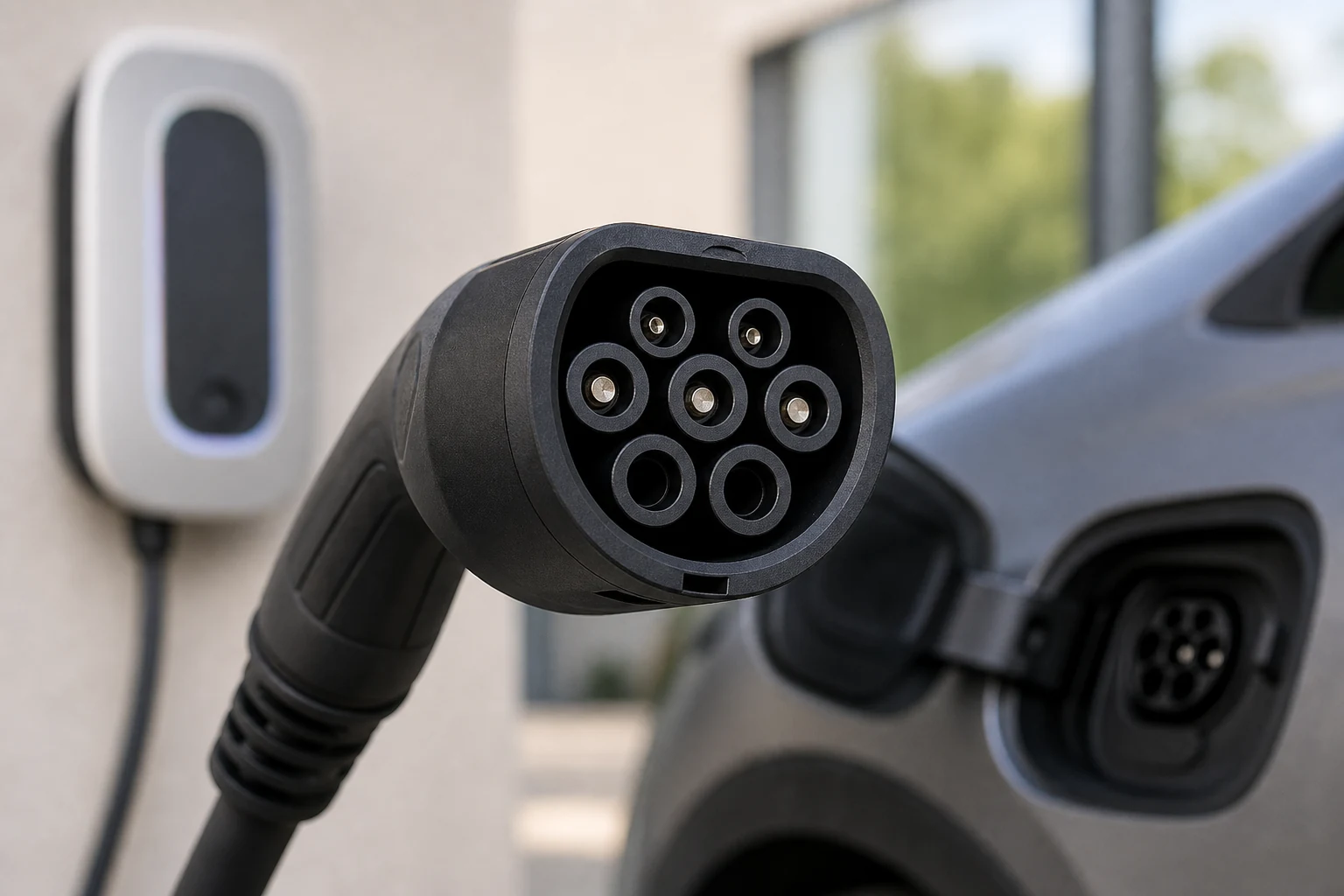
A Type 2 EV charger usually means an AC charging product using the IEC 62196 Type 2 connector system. It is the connector most drivers associate with European AC wallboxes, public AC posts, and Type 2-to-Type 2 charging cables.
Type 2 is especially important because many European public AC charging points are socketed. Instead of a station always having a fixed cable, the station may provide a Type 2 socket, and the driver brings a detachable Type 2 cable. That turns the cable into a product users buy, carry, coil, store, and replace.
European rules reinforce the Type 2 direction. Commission Delegated Regulation (EU) 2025/656 states that AC normal-power recharging points for light-duty EVs installed or renovated from January 8, 2026, shall be equipped at least with Type 2 socket-outlets or vehicle connectors for Mode 3 recharging, with certain low-power exceptions 5. For exporters, this is one reason Type 2 product planning should pay close attention to European documentation and compatibility language.
Type 2 usually makes sense when:
- The vehicle has a Type 2 AC inlet. This is common for modern European-market EVs.
- The charging location is Europe, the UK, Australia, or another IEC-oriented market.
- The user may need a Type 2-to-Type 2 public cable. This is a normal retail product in socketed public AC networks.
- The product family may include single-phase and three-phase versions.
- The buyer needs clear current ratings, cable length choices, storage bags, and packaging language.
For branded automotive NEV accessories, Type 2 is rarely one simple SKU. A practical assortment may include 16 A and 32 A versions, single-phase and three-phase versions, 5 m and 7 m cable lengths, straight or angled handle designs, storage bags, private-label packaging, and market-specific manuals.
Is Type 2 faster than Type 1?
Type 2 can be faster in many AC charging setups because it can support three-phase AC charging, but the connector alone does not decide charging speed. The actual speed depends on the vehicle onboard charger, EVSE output, cable current rating, supply voltage, number of phases, installation, battery temperature, and vehicle charging limits.
This is where many product pages become misleading. A Type 2 cable can be part of an 11 kW or 22 kW AC charging setup in Europe, but only when every part of the system supports that power. The wallbox must provide the power, the cable must be rated for the current and phase configuration, and the vehicle must have an onboard charger that can accept it.
Type 1 can also be used for Level 1 and Level 2 AC charging in North America. The U.S. DOT explains that Level 2 uses higher-rate AC service than Level 1 and is common for homes, workplaces, and public sites, while charging time still varies by vehicle and conditions 1. That means a Type 1/J1772 Level 2 wallbox can be perfectly practical for daily charging even if it is not a three-phase connector.
| Charging setup | Connector usually involved | What controls speed |
|---|---|---|
| North American Level 1 AC | Often Type 1/J1772 or NACS depending on vehicle | Household circuit, EVSE, and vehicle onboard charger |
| North American Level 2 AC | Often Type 1/J1772 or NACS depending on vehicle | 208/240 V supply, EVSE output, cable rating, onboard charger |
| European single-phase AC | Usually Type 2 | Supply, cable current, wallbox, vehicle onboard charger |
| European three-phase AC | Usually Type 2 | Phase support, wallbox power, cable rating, vehicle onboard charger |
| DC fast charging | CCS, CHAdeMO, or NACS, not plain Type 1/Type 2 | Charging station, vehicle DC charging system, battery conditions |
The practical rule is simple: the fastest connector on paper does not override the weakest part of the charging system. A 32 A three-phase Type 2 cable will not make a car with a 7.4 kW single-phase onboard charger charge at 22 kW.
Are Type 1 and Type 2 the same as Level 1 and Level 2?
Type 1 and Type 2 are connector types; Level 1 and Level 2 are charging power categories, especially in North American terminology. They sound similar, but they answer different questions.
Type 1 answers: “What shape and standard is the AC connector?” Level 1 answers: “What charging power category is being used?” A Type 1 connector can be used for North American Level 1 or Level 2 AC charging. Type 2 is a connector standard commonly used in Europe and other IEC-based markets, where the language of Level 1 and Level 2 is not always used the same way.
| Term | What it means | Common buyer mistake |
|---|---|---|
| Type 1 | SAE J1772-style AC connector | Assuming it means slow charging |
| Type 2 | IEC 62196 Type 2 AC connector | Assuming it means Level 2 charging |
| Level 1 | Lower-power AC charging category in North America | Confusing it with Type 1 connector |
| Level 2 | Higher-power AC charging category in North America | Confusing it with Type 2 connector |
| CCS1 / CCS2 | DC fast charging connector families that add DC pins | Assuming a plain Type 1 or Type 2 cable can do DC fast charging |
This difference matters for SEO, packaging, and customer support. A North American customer may search for “Level 2 J1772 charger.” A European customer may search for “Type 2 charging cable 32A 7m.” If the product page uses the wrong vocabulary, the buyer may either miss the product or buy the wrong one.
Can you use a Type 1 to Type 2 adapter?
Sometimes, but only for the right AC charging direction, current rating, vehicle, station, and market rules. A Type 1 to Type 2 adapter should never be treated as a universal fix for every connector mismatch.
Adapters exist because real charging networks are mixed. A Type 1 vehicle may need to use a Type 2 public AC socket in Europe. A Type 2 vehicle may encounter older or imported charging equipment. Adapter cables can solve specific AC charging situations, but they also create safety and support risks when the direction is unclear.
Before selling or sourcing an adapter, confirm these details:
- Direction: Type 1 vehicle to Type 2 station is not the same product as Type 2 vehicle to Type 1 station.
- AC-only use: Type 1 and Type 2 adapters do not turn a plain AC connector into CCS DC fast charging.
- Current rating: The adapter must be rated for the intended current and duty cycle.
- Locking behavior: Vehicles and stations may lock connectors differently, especially at public AC posts.
- Vehicle onboard charger: The vehicle must accept the incoming AC supply.
- Cable markings: Ratings and warnings should be clear on the product, not hidden only in a listing.
- User documentation: The manual should explain direction, limits, safe storage, and incompatible cases.
For distributors, adapter products deserve more careful labeling than ordinary cables. Returns often happen because the customer bought the correct-looking connector in the wrong direction.
How do you choose between Type 1 and Type 2?
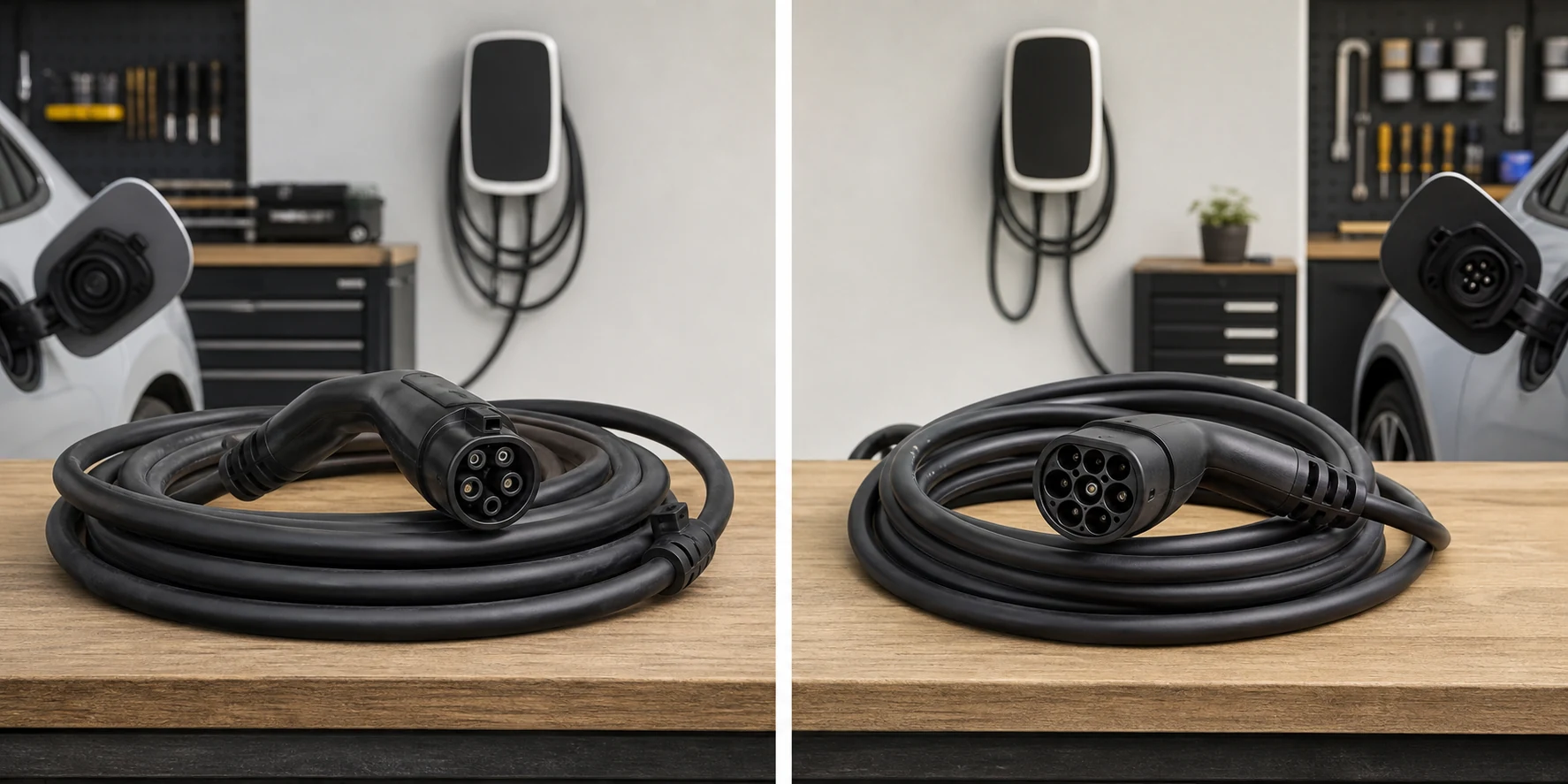
Choose Type 1 or Type 2 by starting with the vehicle inlet and the charging market, then narrow the product by current rating, phase, cable length, and user scenario. The connector family is only the first filter.
Use this practical checklist:
- Check the vehicle inlet. If the vehicle has a J1772/Type 1 AC inlet, choose Type 1. If it has a Type 2 inlet, choose Type 2.
- Check the region. North America and Japan often point toward Type 1/J1772 for AC charging; Europe and many IEC-based markets point toward Type 2.
- Check the charging equipment. A socketed public AC post may require the driver to bring a cable. A tethered wallbox already includes the cable.
- Check single-phase or three-phase needs. Type 2 product families often need clear single-phase and three-phase options.
- Check current rating. Common retail choices may include 16 A and 32 A, but the product must match the intended installation and cable design.
- Check cable length. A shorter cable is easier to store and handle; a longer cable helps with awkward parking positions.
- Check outdoor durability. Jacket flexibility, strain relief, connector sealing, and molded grip quality matter for daily use.
- Check support language. Product pages should explain compatibility without implying universal fit.
For a retailer, the best choice may not be one connector. It may be a focused regional assortment: Type 1/J1772 portable and wallbox products for a North American program, Type 2-to-Type 2 cables for a European public-charging accessory program, and clearly labeled adapter cables for mixed-vehicle use cases.
What should distributors check before ordering Type 1 or Type 2 EV charging products?
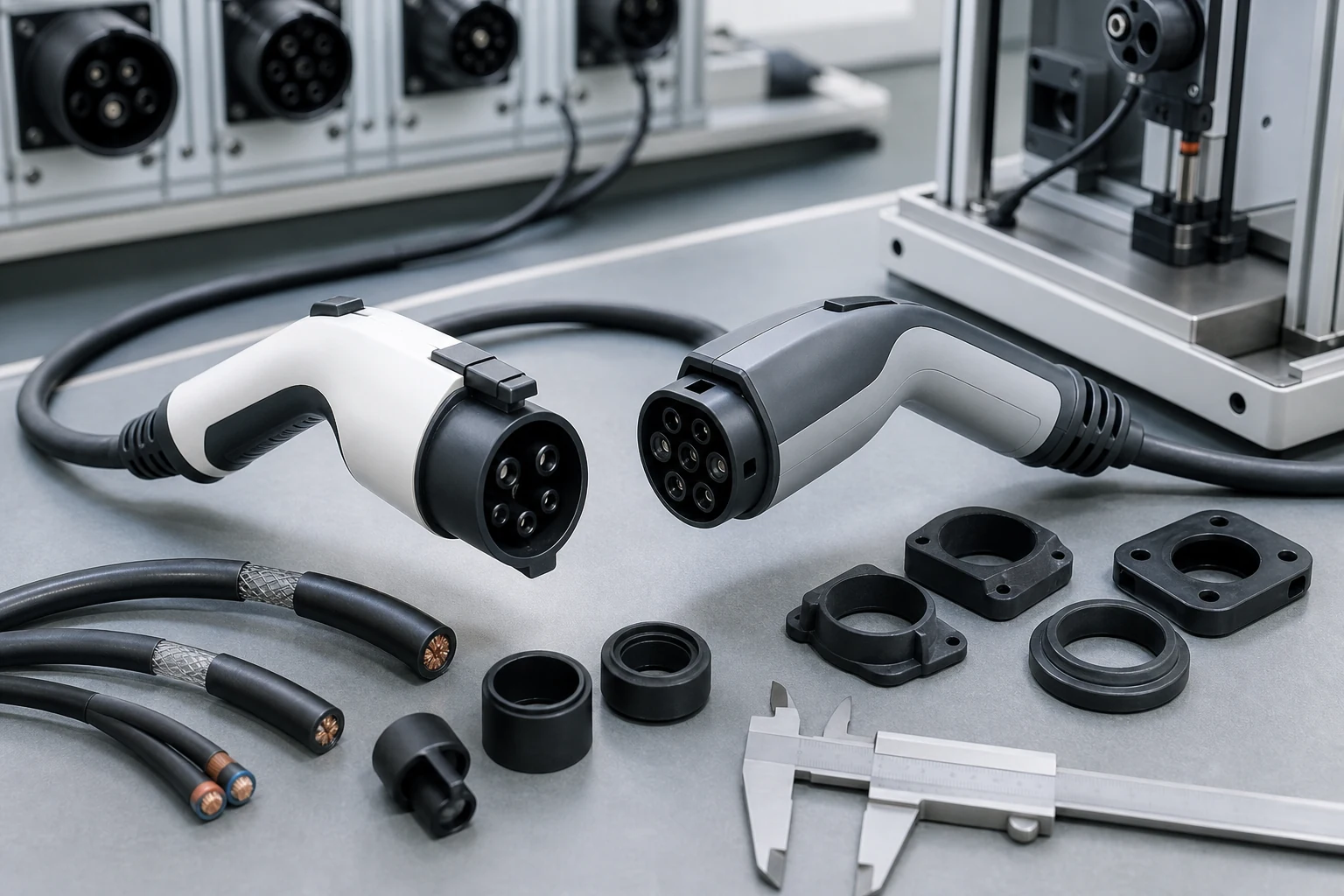
Distributors should check more than connector shape before placing a bulk order. A charging cable is a safety-sensitive electrical product, so product consistency, labeling, packaging, and documentation matter as much as the plug style.
Start with the specification sheet. It should clearly state connector type, rated current, voltage, phase support, cable cross-section, cable length, jacket material, operating temperature range, relevant certification or test basis, IP rating where applicable, and packaging contents. If the supplier cannot answer those basics clearly, the product is not ready for serious distribution.
Then check the physical details:
- Connector fit: The plug should mate cleanly with a matching inlet, without excessive looseness or force.
- Pin and contact quality: Pins should be aligned, clean, and consistent across samples.
- Cable jacket: The cable should feel flexible enough for daily use but durable enough for outdoor handling.
- Strain relief: The cable-to-handle transition should resist bending fatigue.
- Marking: Ratings, warnings, and model information should be durable and readable.
- Packaging: Retail boxes, manuals, labels, and QR codes should match the target market language.
- Batch consistency: Golden samples, pre-shipment inspection, and carton checks reduce return risk.
This is where EV charging products behave like the rest of an automotive accessory portfolio. A distributor that already sells off-road LED light bars, pickup tonneau covers, wheel balancing weights, or related accessories already understands the pattern: the product must fit correctly, survive real use, and arrive with clear customer-facing information.
For Type 1 and Type 2 cables, the extra challenge is compatibility language. A poorly worded listing can create returns even when the product itself is well made. The safest product pages explain connector type, region, vehicle fit, cable rating, AC-only limitations, and adapter direction in plain language.
Conclusion: Choose by vehicle inlet, region, and charging setup
Type 1 and Type 2 EV chargers are best understood as AC connector families. Type 1/J1772 is the familiar AC connector for many North American and Japanese-market vehicles. Type 2/Mennekes is the dominant AC connector in Europe and many IEC-based charging markets, with strong support for socketed public AC charging and single-phase or three-phase product variants.
The better choice is not the one that sounds newer or faster. It is the one that matches the vehicle inlet, charging equipment, region, current rating, phase, cable length, and user scenario. Type 2 can support higher AC power in three-phase systems, but speed still depends on the wallbox, cable, electrical supply, and vehicle onboard charger. Type 1 remains important where J1772 vehicles and AC charging infrastructure are still common.
For buyers and distributors, the practical answer is to build a clear compatibility-first assortment. Make the connector type obvious, separate Type 1/Type 2 from Level 1/Level 2 language, avoid vague universal claims, and check quality before scaling orders. The same sourcing discipline used for automotive sandpaper abrasives and other vehicle accessories applies here too: know the use case, control the specification, and make the product easy to choose correctly.
Frequently Asked Questions
Is Type 1 the same as J1772?
Yes. In most EV charging conversations, Type 1 refers to the SAE J1772 AC connector, often called the J-plug. It is common in North America and Japan for AC charging.
Is Type 2 the same as Mennekes?
Yes. Type 2 is commonly called Mennekes and is standardized under IEC 62196-2. It is widely used for AC charging in Europe and many IEC-based markets.
Is Type 2 always faster than Type 1?
No. Type 2 can support three-phase AC charging, which can allow higher AC power in the right system. But actual charging speed depends on the charger, cable rating, electrical supply, and the vehicle onboard charger.
Can a Type 1 car use a Type 2 charger?
Sometimes, if the product is a correctly rated AC adapter or adapter cable in the right direction. It must match the vehicle, station, current rating, and local rules.
Can Type 1 or Type 2 do DC fast charging?
Plain Type 1 and Type 2 connectors are AC connectors. CCS1 and CCS2 add extra DC pins for DC fast charging, while NACS/J3400 can support AC and DC through its own coupler design.
Which connector should I choose for Europe?
For most European AC charging products, Type 2 is the normal choice. Public AC charging often uses Type 2 sockets or connectors, so Type 2-to-Type 2 cables are common.
Which connector should I choose for North America?
For many existing non-Tesla AC charging products, SAE J1772/Type 1 remains important. However, North America is also moving toward SAE J3400/NACS for many new vehicles and charging products, so assortments may need both J1772 and NACS-related options.
What is the biggest mistake when buying Type 1 or Type 2 EV charging cables?
The biggest mistake is choosing by connector name alone. Buyers should also check region, vehicle inlet, current rating, phase support, cable length, outdoor durability, adapter direction, and certification or testing expectations.
References
[1] U.S. Department of Transportation. (2025). Charger Types and Speeds.
[2] Alternative Fuels Data Center. (2026). Electric Vehicles for Consumers.
[3] SAE International. (2024). J1772_202401: SAE Electric Vehicle and Plug-in Hybrid Electric Vehicle Conductive Charge Coupler.
[4] IEC. (2022). IEC 62196-2:2022.
[5] European Union. (2025). Commission Delegated Regulation (EU) 2025/656.
[6] SAE International. (2023). J3400_202312: NACS Electric Vehicle Coupler.