
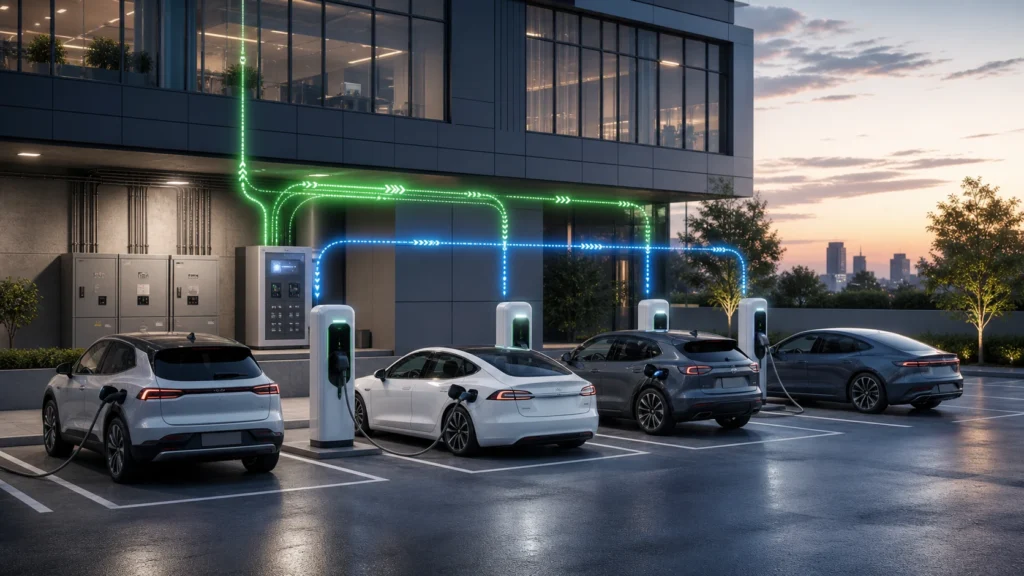
Dynamic load balancing in EV charging is a control method that adjusts charger output in real time so EVs can charge without exceeding the safe power limit of a home, building, parking site, or fleet depot.
Instead of giving every charger a fixed maximum current all the time, the system watches how much electricity the site is already using and then assigns the remaining capacity to the chargers. If the building load rises, charging current falls. If the building load drops, charging current can increase again.
This matters because EV chargers can draw high current for hours, and several chargers together can push an electrical panel, transformer, or service connection beyond its intended capacity. Managed charging guidance from the U.S. Department of Energy describes charging control as a way to respond to changing vehicle, site, and energy conditions through connected charging equipment 1.
For homeowners, installers, property managers, charge point operators, and EV charging product buyers, dynamic load balancing is becoming a practical feature rather than a luxury add-on. It helps sites add charging points, protect infrastructure, reduce peak demand pressure, and give more drivers access to charging.
Table of Contents
- What problem does dynamic load balancing solve?
- How does dynamic load balancing work step by step?
- How is dynamic load balancing different from static load balancing?
- What are the main benefits of dynamic load balancing?
- Where does dynamic load balancing make the biggest difference?
- What charger features should you check before buying?
- How should buyers compare load balancing solutions?
- Conclusion: Is dynamic load balancing worth it?
- Frequently Asked Questions
- References
What problem does dynamic load balancing solve?
Dynamic load balancing solves the problem of EV chargers competing with the rest of the building for limited electrical capacity. It keeps charging demand within a safe site limit while still allowing vehicles to use spare power when it is available.
In a basic home installation, one charger may run from a dedicated circuit with a fixed current setting. That can work well when the main panel has enough spare capacity. The challenge appears when a site adds multiple chargers or when other loads, such as HVAC, lifts, machinery, kitchen equipment, water heaters, or office loads, change throughout the day.
Without load balancing, the installer may need to set every charger to a low fixed current, upgrade the electrical service, or accept overload risk. A conservative current limit wastes capacity at quiet times, while a major upgrade can be expensive and slow.
Dynamic load balancing gives the site a more flexible option. The chargers are treated as controllable loads. They can slow down when the building is busy and speed up when the building has spare capacity. If the reader is still sorting out the hardware side, a basic guide to EV charging station types helps explain how charging levels, station layouts, and use cases affect the electrical design.
The result is better capacity use. A site that could not safely run four chargers at full output may still install four charging points and let the system share power intelligently.
How does dynamic load balancing work step by step?
Dynamic load balancing works by measuring site demand, calculating available capacity, and sending current limits to compatible chargers. The charger output then changes as the building load changes.
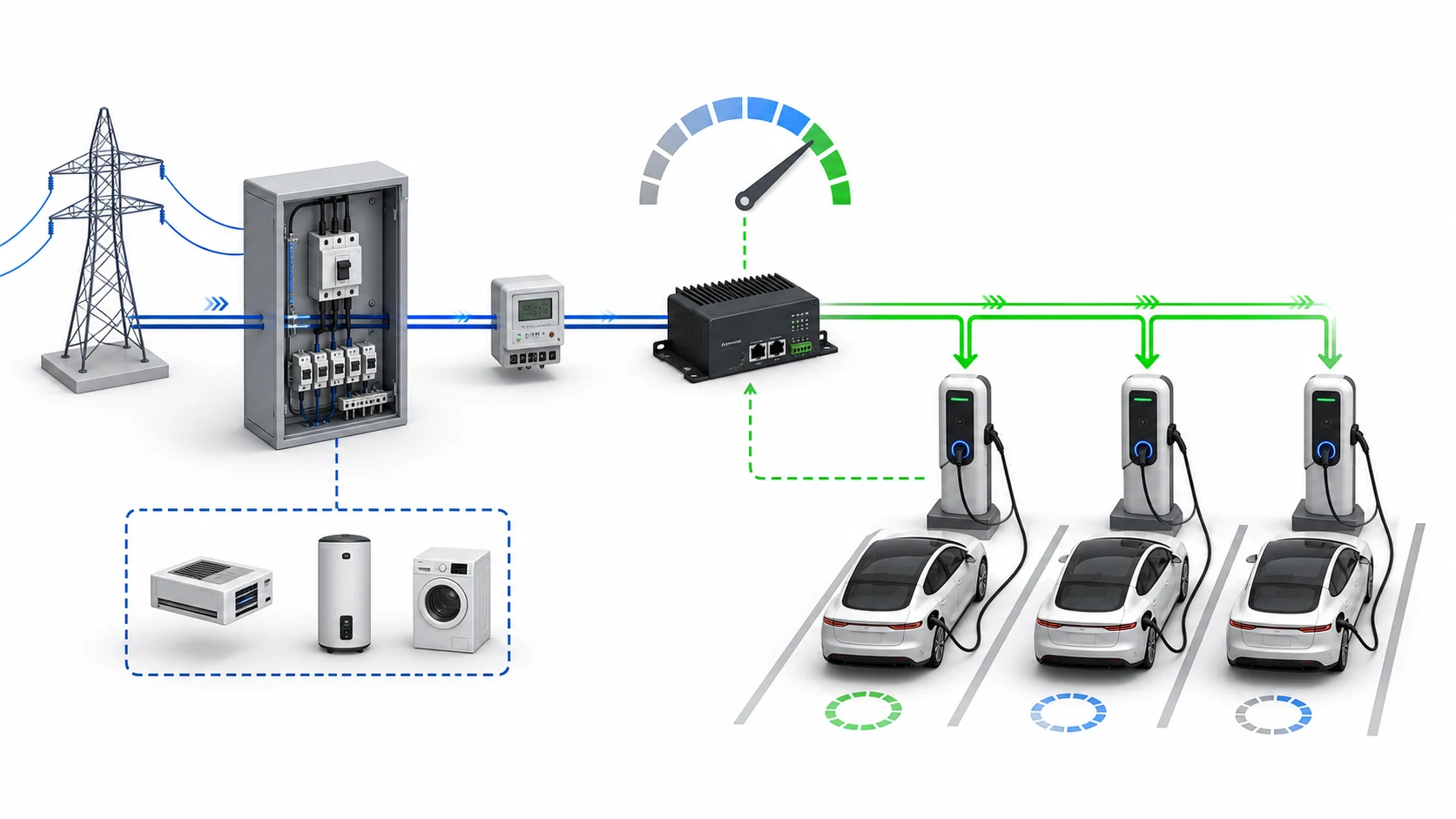
A typical system includes a power meter or current transformer, a controller or energy management system, and chargers that can accept charging limits. The meter watches the supply or sub-panel feeding the charger group. The controller compares live consumption with the allowed site limit, then the chargers reduce, increase, pause, or share current.
For example, imagine a site has 100 amps available for a charger group and the building is using 70 amps for non-EV loads. The controller may allow 30 amps for EV charging. Later, if the building load falls to 45 amps, the controller may allow 55 amps for charging.
Some systems divide power equally. Others prioritize specific chargers, users, vehicles, or departure times. A fleet depot may give higher priority to vehicles needed early the next morning. An apartment building may share power more evenly. A commercial parking operator may reduce charging during expensive peak-tariff periods.
Communication can be local or networked. Some systems rely on a local meter and charger controller. Larger charging networks may use backend software, charger management platforms, or open communication protocols. For readers comparing connected charging equipment, the guide to OCPP communication for EV chargers explains why charger-to-platform communication can matter.
Siemens describes dynamic load management as a way to keep charging infrastructure within instant power limits while supporting remote control and monitoring 4. That is the core idea: the charger does not make a one-time decision. It keeps adjusting to the site.
How is dynamic load balancing different from static load balancing?
Static load balancing uses fixed rules, while dynamic load balancing adjusts charging current based on live site conditions. Static systems are simpler, but dynamic systems usually make better use of available power.
| Feature | Static load balancing | Dynamic load balancing |
|---|---|---|
| Power limit | Fixed charger group limit | Changes according to measured site load |
| Building load measurement | Usually not central to the system | Essential for true dynamic control |
| Best fit | Predictable small installations | Homes, apartments, workplaces, fleets, and commercial sites with changing loads |
| Charging speed | Often conservative | Can rise when extra capacity is available |
| Setup complexity | Lower | Higher because metering and control are required |
| Scalability | Useful for simple sharing | Stronger for multi-charger growth |
reev describes static load management as a fixed distribution of charging power and dynamic load management as a system that reacts to live available capacity 2. That distinction is important because many product descriptions use “load balancing” loosely.
There are also two related but different ideas: charger group power sharing and whole-site dynamic load balancing. Charger group sharing divides a known charging allowance between chargers. Whole-site dynamic load balancing also monitors the building’s other electrical loads and changes the charger group’s allowance in real time. The strongest installations often combine both.
Static control is not wrong. It can be enough for a small, predictable site where the available charging capacity is known and stable. Dynamic control becomes more valuable when non-EV loads change, the number of chargers grows, or the site wants to avoid leaving unused capacity on the table.
What are the main benefits of dynamic load balancing?
The main benefits are safer charging, better use of existing electrical capacity, lower upgrade pressure, and easier support for multiple EVs. It turns EV charging into a controllable load instead of a fixed burden on the building.
1. It helps prevent overloads. When the building approaches its power limit, the system can reduce charger current before the electrical supply is pushed too far. This helps protect breakers, wiring, panels, and upstream equipment from avoidable stress.
2. It may reduce infrastructure upgrade costs. Many sites want EV charging before they are ready for a major service upgrade. Dynamic load balancing cannot create new capacity, but it can use existing capacity more efficiently. Eaton’s load management material explains the value of distributing available power across charging equipment instead of assuming every charger must draw maximum power at once 5.
3. It lets more vehicles share the same supply. Not every EV needs full output for the whole parking period. Some vehicles arrive partly charged, some stay parked overnight, and some only need a top-up. Load balancing uses that flexibility so more vehicles can plug in.
4. It helps manage peak demand. Commercial sites may face demand charges, time-of-use tariffs, or internal power limits. Dynamic load balancing can reduce charging output during constrained periods and restore it when more capacity is available.
5. It supports phased expansion. A site may start with two chargers, then add more as demand grows. If the charging system already supports load management, expansion can be planned around real usage data instead of assumptions.
6. It can improve driver experience when designed well. Drivers do not always need the fastest possible charge; they need enough energy by the time they leave. A good system can combine load balancing with schedules, access rules, and priority settings so available power goes where it matters most.
Where does dynamic load balancing make the biggest difference?
Dynamic load balancing makes the biggest difference wherever several EVs need to charge from limited or changing electrical capacity. It is especially useful in homes with multiple EVs, apartment buildings, workplaces, fleet depots, hotels, retail parking, and shared commercial sites.
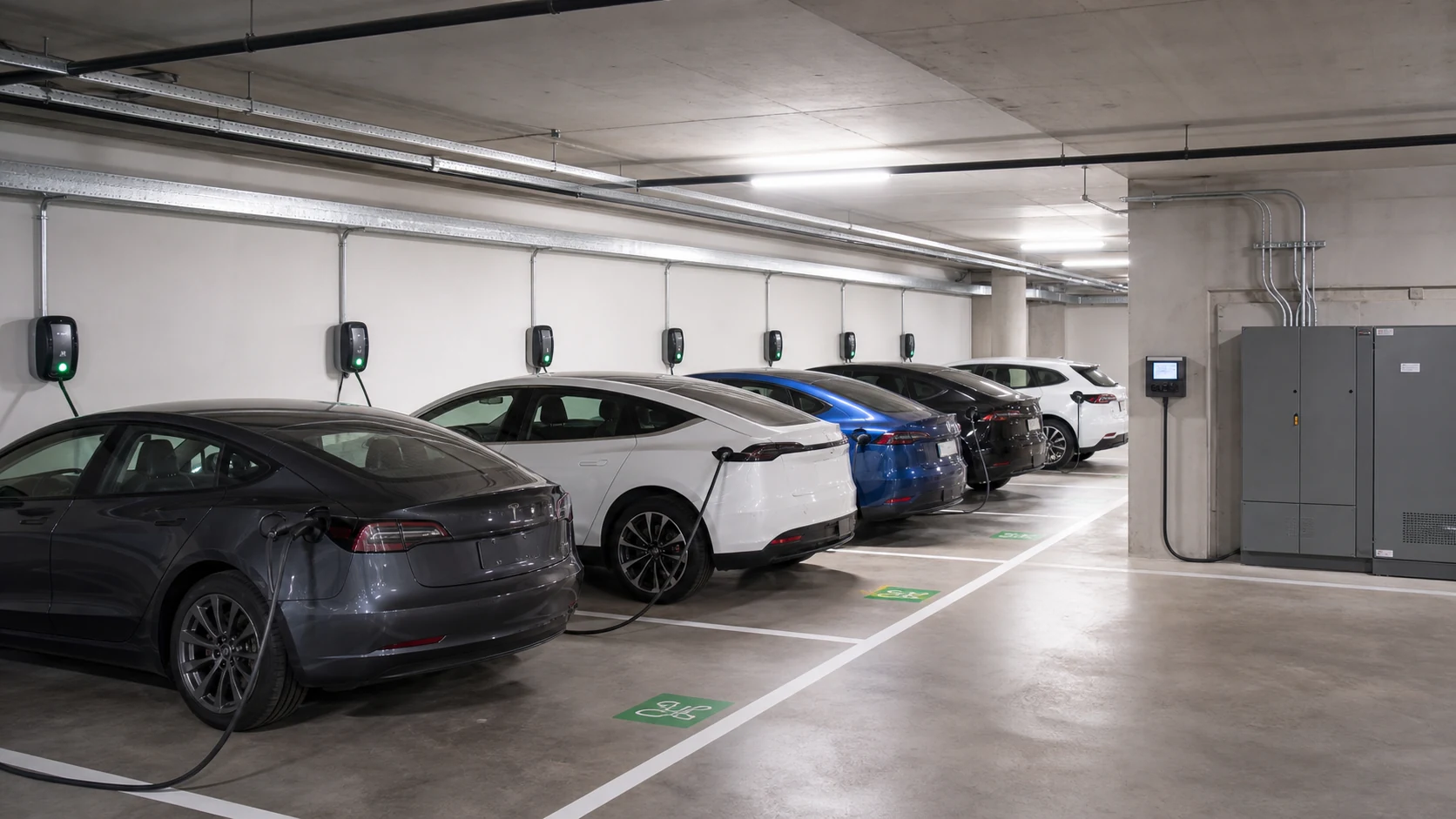
In homes, the issue is often panel capacity. A house may already have large electrical loads such as heating, cooling, cooking, laundry, water heating, solar, or battery storage. A load-aware charger can reduce output when the home is busy and increase output when demand falls.
In apartments and condominiums, the issue is usually scale. One charger may be manageable, but dozens of parking spaces can exceed the building’s spare capacity. Evnex describes load management as a way to safely distribute available electrical capacity across multiple chargers on a shared supply 3. That is exactly the problem many residential parking sites face.
In workplaces, charging demand often overlaps with business-hour electricity use. Employees may arrive around the same time, plug in together, and leave in the afternoon. Dynamic load balancing helps the site offer charging access without letting charger demand collide with HVAC, lighting, office equipment, and production loads.
Fleet depots have another priority: readiness. Vehicles may need to leave by a specific time, and some vehicles are more important than others for the next route. A load balancing system can pair power control with schedules so the depot stays within capacity while still preparing the right vehicles first.
What charger features should you check before buying?
The key charger features are adjustable current, reliable communication, metering compatibility, safe fallback behavior, and documentation for the target market. A charger cannot support meaningful load balancing unless it can follow current limits safely and predictably.
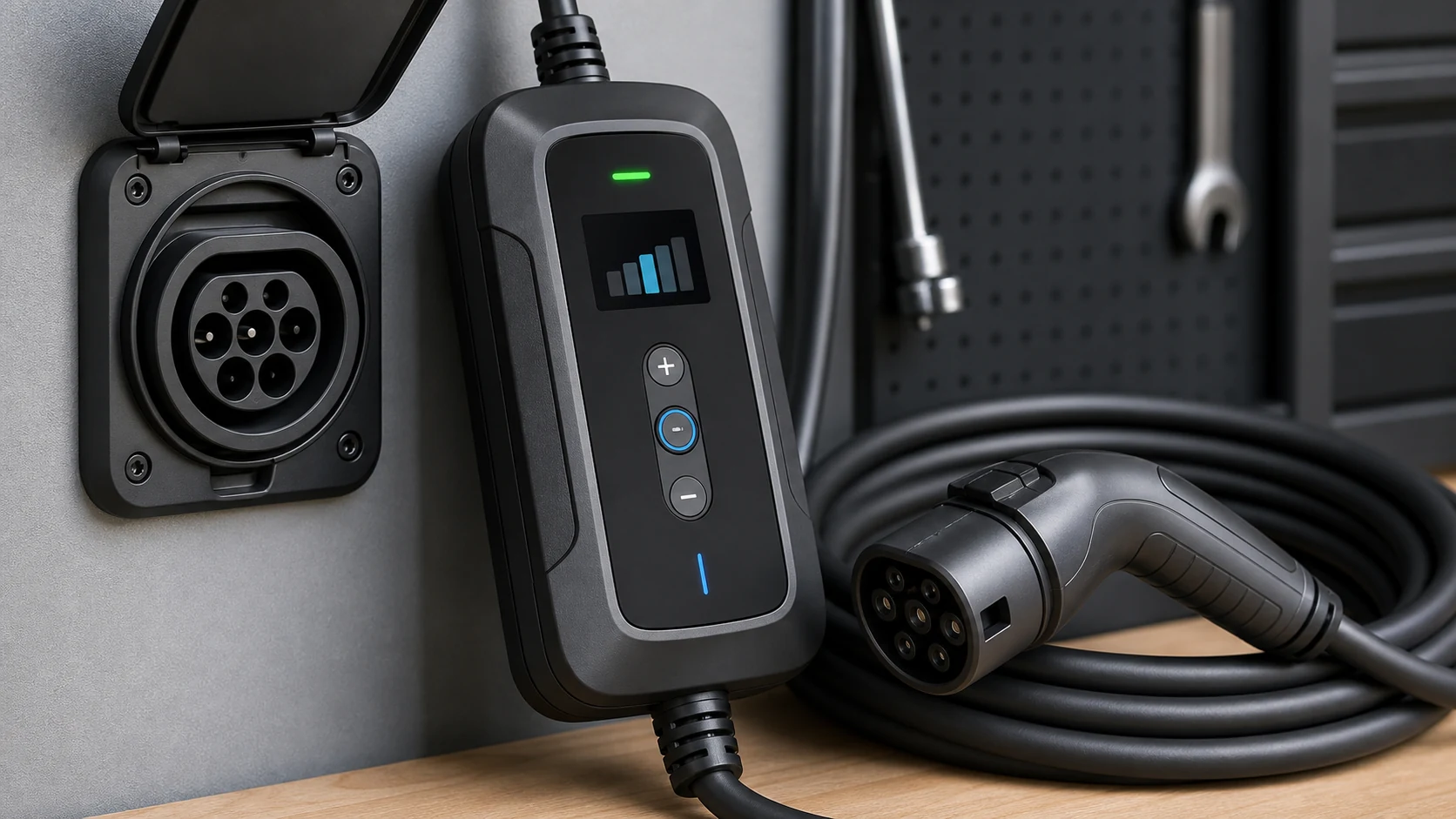
Adjustable current is the first thing to check. For AC chargers and portable chargers, the ability to operate at several current levels gives installers and users more flexibility. Yirox’s related guide to adjustable-current portable EV chargers explains why ranges such as 8A to 32A matter for different sockets, circuits, and product markets.
Communication is the second layer. Depending on the product type, this may involve Wi-Fi, Bluetooth, Ethernet, RS485, 4G, app control, local controllers, or cloud platforms. For readers comparing connected portable products, the guide to smart portable EV chargers is a useful next step because smart features often sit close to load-aware charging behavior.
Meter compatibility is easy to overlook. Some systems require a specific current transformer, smart meter, gateway, or energy management controller. If the meter, controller, and charger are not compatible, the load balancing promise may not work in the field.
Fallback behavior is also critical. What happens if the network drops, the meter stops reporting, or the controller loses communication? A well-designed charger should have a defined safe mode, such as reducing current or stopping charging, instead of continuing blindly at a high output.
For importers, distributors, and branded product programs, product consistency matters as much as the feature list. Plug type, cable length, enclosure rating, current range, manuals, labeling, packaging, and inspection procedures should match the target market and sales channel.
How should buyers compare load balancing solutions?
Buyers should compare load balancing solutions by looking at the site electrical limit, charger compatibility, control method, safety behavior, connector requirements, and long-term support. A good solution is the one that fits the real installation, not the one with the most impressive feature name.
Start with the electrical design. What is the main service size? Which sub-panel feeds the chargers? Is the site single-phase or three-phase? How many chargers may be added later? The load balancing plan should be based on measured capacity and local installation rules, not guesswork.
Next, define the charging behavior. A home, apartment garage, workplace, hotel, and fleet depot do not need the same control logic. Ask how long vehicles stay parked, how many may charge together, whether users need equal sharing, and whether certain vehicles should receive priority.
Then check vehicle and connector compatibility. Software cannot fix the wrong connector or an undersized cable. If the product range still needs to be matched to regional vehicles, the Type 1 vs Type 2 EV charger comparison helps clarify why connector choice affects market fit.
Safety and compliance deserve a separate review. Look for documentation around leakage protection, temperature monitoring, grounding, overcurrent behavior, enclosure rating, cable material, plug durability, and applicable certification expectations. For portable and light commercial products, the related guide to portable EV charger safety standards is a practical reference.
A buyer’s checklist should include:
- Available site capacity: main panel, sub-panel, transformer, utility limit, and circuit ratings.
- Charging goal: overnight charging, workplace top-ups, visitor charging, or fleet readiness.
- Control type: local meter-based control, charger group sharing, backend control, or building energy management integration.
- Compatible hardware: charger current range, meter support, communication method, and connector type.
- Failure mode: safe behavior during meter fault, network loss, or controller downtime.
- Market fit: certification awareness, labeling, manuals, cable specification, packaging, and after-sales support.
For Yirox customers, this is where OEM/ODM flexibility can matter. A charging product program may need different plugs, cable specifications, current settings, enclosure details, and packaging for different markets. Dynamic load balancing works best when the charging hardware, documentation, and supply consistency are planned together.
Conclusion: Is dynamic load balancing worth it?
Dynamic load balancing is worth it when a site wants EV charging but does not have unlimited spare electrical capacity. It helps chargers share power intelligently, protects the building supply, and allows more vehicles to charge from the same infrastructure.
The feature is most valuable in real-world sites where demand changes: homes with several large electrical loads, apartment parking garages, workplaces, hotels, commercial parking, and fleet depots. It is less about one charger being “smart” and more about the whole charging system responding to the site around it.
Before choosing a solution, look at the full system: the electrical limit, meter, controller, charger current range, communication method, connector type, safety documentation, and supplier support. A load balancing claim is only useful if the charger can actually receive limits, respond safely, and fit the target installation.
If the next step is building or comparing a complete product range, Yirox’s EV charging accessories range is a natural place to continue. The right charging accessory program should combine practical hardware, market-ready connector choices, quality control, and customization options rather than treating load balancing as a standalone buzzword.
Frequently Asked Questions
Is dynamic load balancing the same as smart charging?
Dynamic load balancing is part of smart charging, but it is not the whole category. Smart charging can include scheduling, app control, tariff-based charging, user access, remote monitoring, and backend management, while dynamic load balancing specifically controls charging current according to available electrical capacity.
Do I need dynamic load balancing for a single EV charger at home?
You may not need it if your home has enough spare panel capacity and the charger is installed on a properly rated dedicated circuit. It becomes more useful if the panel is limited, the home has large electrical loads, or you plan to add a second EV.
Can dynamic load balancing make charging faster?
It can make charging faster than a conservative fixed current setting because the charger can use more power when the building has spare capacity. It cannot exceed the charger rating, vehicle onboard charger limit, circuit rating, or site electrical limit.
What happens when several EVs plug in at once?
The system divides the available charging capacity according to its control rules. It may share current evenly, prioritize certain chargers, reduce all chargers to a minimum current, or schedule charging based on vehicle departure needs.
Does dynamic load balancing require OCPP?
Not always. Some systems use local proprietary communication between a meter, controller, and chargers, while networked charging systems may use OCPP or another backend communication method to manage charging limits and profiles.
Can portable EV chargers support dynamic load balancing?
Some portable EV chargers can support load-aware charging through adjustable current, smart control, or integration with external devices. Buyers should check the actual current range, communication method, safety behavior, and certification documentation instead of relying only on a feature claim.
Is static load balancing enough for small sites?
Static load balancing can be enough when the site load is predictable and the charger group has a known fixed power allowance. Dynamic load balancing is usually better when building demand changes or when the site wants to use spare capacity more efficiently.
References
[1] U.S. Department of Energy Federal Energy Management Program. (2025). Managed EV Charging for Federal Fleets.
[2] reev. (2026). EMS | Static and Dynamic Load Management.
[3] Evnex. (2026). Load Management.
[4] Siemens. (2026). Electrification X – Load Management.
[5] Eaton. (2025). EV Charging Load Management White Paper.