



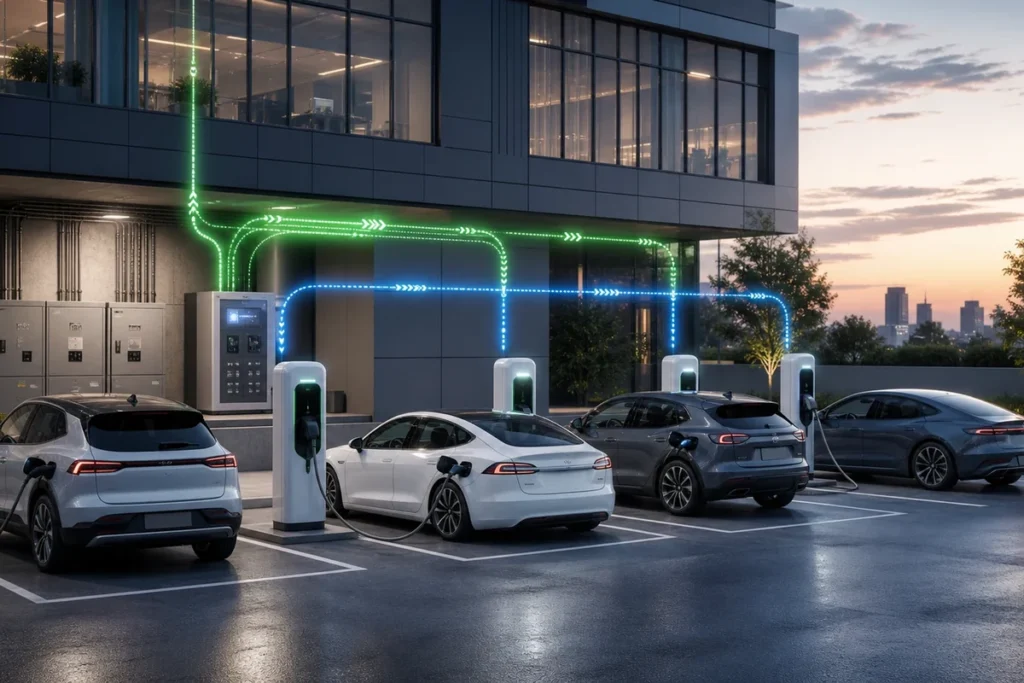
EV charging load management is the practice of controlling how much power EV chargers use so a home, building, parking site, or fleet depot can charge vehicles without exceeding safe electrical limits. Instead of letting every charger draw maximum power at the same time, a load management system sets limits, shares capacity, schedules sessions, or adjusts charging in real time.
Identify the electrical asset to protect, the charging energy required by departure, and the control response during a failure. The worksheet below organizes those inputs; the three calculations are hypothetical planning examples, not measured site results.
Table of Contents
- What does EV charging load management mean?
- How does EV charging load management work?
- Where should the controller, meter, and CTs be installed?
- What are the main types of EV charging load management?
- What is dynamic load balancing in EV charging?
- What can dynamic load balancing do, and what can it not do?
- EV charging load management sizing worksheet
- What do three load management calculations look like?
- What benefits does EV charging load management provide?
- Where is EV charging load management used?
- What should buyers check before choosing load management hardware?
- Which option fits: integrated controls, a separate device, or a panel upgrade?
- What happens when another vehicle plugs in?
- What affects the cost of an EV load management system?
- How should installers and product buyers compare solutions?
- Conclusion: EV load management is about using capacity wisely
- Frequently Asked Questions
- References
What does EV charging load management mean?
EV charging load management means controlling charger power demand so the total electrical load stays within an allowed limit. That limit may be a circuit rating, panel capacity, building service limit, transformer allowance, utility agreement, or operating target set by the site owner.
In an unmanaged setup, each charger may try to deliver its configured maximum whenever a vehicle plugs in. That can be fine for a single properly installed charger. The problem appears when several chargers operate together or when the rest of the building load changes during the day.
A managed setup treats chargers as flexible loads. If the building is using a lot of power for HVAC, lighting, elevators, production equipment, or kitchen loads, chargers can slow down. If the building is quiet, chargers can use more available capacity. The driver may still receive enough energy because most vehicles stay parked longer than they actually need to charge.
Load management is closely related to load balancing, smart charging, and managed charging, but the terms are not always identical. Load management is the broad control strategy. Load balancing usually means sharing available power across chargers. Smart charging can also include scheduling, tariffs, app control, user access, remote monitoring, and utility programs. For readers who want the narrower real-time sharing concept, the dynamic load balancing section below covers that specific feature.
How does EV charging load management work?
EV charging load management works by setting a power limit, measuring or estimating demand, and telling chargers how much current they may deliver. The system may use fixed settings, charger group rules, real-time meters, backend software, or a building energy management system.
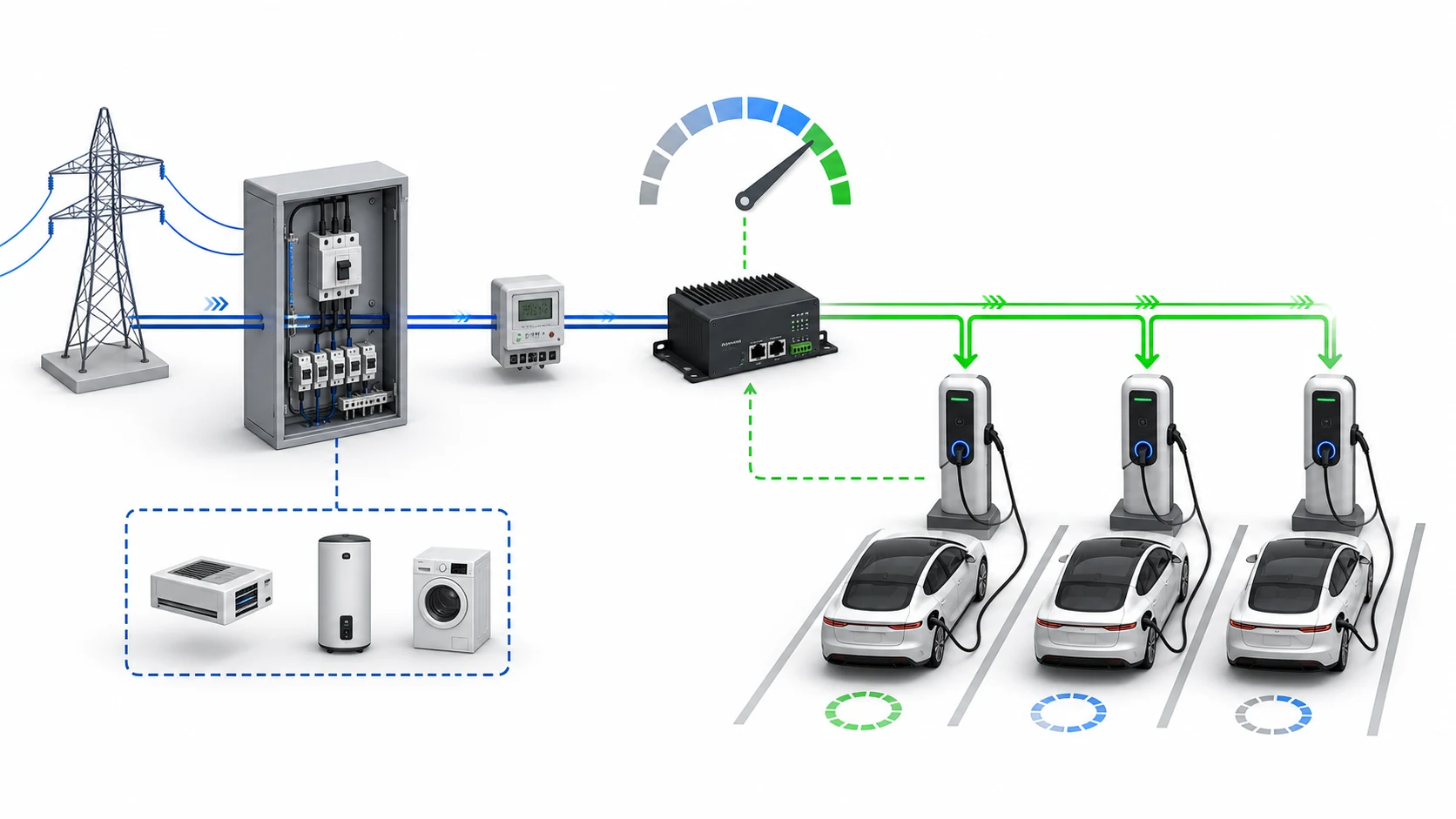
A simple system may use fixed current settings inside the charger. For example, a charger might be limited to 16A or 24A so it never exceeds the circuit design. A more advanced system may watch the whole building supply, calculate spare capacity every few seconds, and adjust several chargers at once.
A typical dynamic setup has four parts:
- Measurement: A meter, current transformer, or energy gateway reads site demand.
- Control logic: A controller decides how much capacity can go to EV charging.
- Charger communication: The controller sends current limits or schedules to each charger.
- Safe response: Chargers reduce, increase, pause, or resume charging according to the command.
In networked charging systems, communication may involve charger management software and open protocols. This is where OCPP communication for EV chargers becomes relevant, because open charger-to-backend communication can help operators monitor sessions, send limits, and manage charging profiles. The Open Charge Alliance describes OCPP as a protocol for communication between charging stations and charging management systems 4.
The strongest systems also consider the driver goal. A parked vehicle may need full power right away, or it may only need enough energy by 7 a.m. A fleet vehicle with an early route may deserve priority over a vehicle parked for two days. Good load management is not only about cutting power; it is about using time, priority, and available capacity intelligently.
Where should the controller, meter, and CTs be installed?
A load management system can be local, charger-led, cloud-managed, or connected to a building energy management system (BEMS). The correct architecture depends on which electrical asset is constrained and whether the system must keep operating without an internet connection.
| Architecture | Control path | Best fit | Main design question |
|---|---|---|---|
| Local gateway | Site meter/CTs → local controller → chargers | Homes, apartments, workplaces | Can the controller enforce a safe limit if the internet is unavailable? |
| Master-and-follower chargers | Meter/CTs → one master charger → charger group | Small and medium charger groups | What happens if the master charger is offline? |
| Cloud-managed | Meter or chargers → cloud platform → chargers | Multi-site operators and remote support | What local fallback applies during a network or cloud outage? |
| BEMS-integrated | Building meters/BEMS → charging controller → chargers | Large commercial sites, campuses, fleets | Which system has final authority over the site power limit? |
The measurement point must match the constraint. Place whole-site CTs or a compatible revenue-grade meter at the service entrance when the main service or transformer is the limit. Measure the EV distribution board when only the EV feeder is constrained. Some projects need both measurements: one limit protects the building service, while a second protects the charging feeder.
CT direction, phase identification, meter scaling, and the controller's import/export convention must be checked during commissioning. Reversed CTs or mismatched phases can make a controller believe load is falling when it is actually rising. For three-phase sites, the controller should monitor each phase rather than relying only on total kilowatts.
Phase balancing is not the same as total-power balancing. A site can remain below its total kW limit and still overload one phase. The controller should either assign single-phase chargers across L1, L2, and L3 or reduce charging on the most heavily loaded phase. Three-phase chargers also need per-phase current limits when building loads are uneven.
Communication failure must have a documented response rather than an undefined one:
| Failure | Acceptable planned response | Commissioning check |
|---|---|---|
| Meter or CT data becomes stale | Reduce to a conservative site-approved limit or pause | Disconnect the data source and confirm the response time and limit |
| Local controller is unavailable | Chargers use a configured fallback current or stop | Power down the controller and verify every charger |
| Internet/cloud connection drops | Local control continues, or chargers enter a documented fallback | Isolate the WAN connection without removing site power |
| One charger loses communication | The remaining group stays inside the shared limit | Disconnect one charger from the control network |
| System restarts after an outage | Limits load before sessions resume | Restore power with several vehicles still connected |
The fallback current is a site-design value, not a universal number. It must keep the protected service, feeder, and phases within their approved limits even when every affected charger enters fallback at the same time.
What are the main types of EV charging load management?
The main types are static load management, dynamic load management, scheduled charging, priority-based control, and utility or grid-responsive managed charging. Many real installations combine more than one type.
| Type | How it works | Best fit | Main limitation |
|---|---|---|---|
| Static load management | Sets a fixed maximum charging allowance | Small, predictable installations | Can leave unused capacity when the building load is low |
| Dynamic load management | Adjusts charger output based on live site demand | Homes, apartments, workplaces, commercial sites, fleets | Needs metering, compatible chargers, and control setup |
| Load sharing or balancing | Divides a known charging allowance across several chargers | Multi-charger groups | May not account for the rest of the building unless paired with site monitoring |
| Scheduled charging | Moves charging into selected time windows | Off-peak tariffs, fleet dwell time, overnight charging | Needs reliable parking time and user acceptance |
| Priority-based charging | Gives certain users, vehicles, or chargers more power first | Fleets, depots, staff parking, operations vehicles | Requires clear rules and software support |
| Utility-managed charging | Responds to grid, tariff, or demand-response signals | Larger programs and grid support | Depends on utility programs and connected equipment |
reev separates static and dynamic load management clearly: static allocation is set in advance, while dynamic allocation changes according to real-time conditions such as building consumption, grid demand, and the number of vehicles charging 2. That distinction is useful because product pages often use the phrase "load balancing" without explaining whether the system is truly dynamic.
Static control still has a place. A single-family home or small business with predictable demand may only need a conservative current limit. Dynamic control becomes more valuable when the site has multiple chargers, changing non-EV loads, or a goal to add charging without oversizing the electrical service.
Terminology differs between suppliers. Eaton groups load leveling and adaptive allocation under dynamic methods, even though its comparison says those methods do not automatically track changes in other site loads. Verify the measurement point and inputs rather than assuming that a “dynamic” label means whole-building protection.3
Does the feature label prove site protection?
No. A timer shifts sessions; an adjustable current setting caps one charger; group sharing divides a charging pool; a site-responsive system uses the appropriate live measurement. None of those labels alone proves protection of every upstream asset.
For OCPP 1.6, OCA identifies Smart Charging as an optional charging-station certification profile. Check the actual certificate scope and firmware, then verify limit commands with the intended backend. A Core certificate or an OCPP logo alone does not establish the required charging-control behavior.5
What is dynamic load balancing in EV charging?
Dynamic load balancing is the real-time allocation of available electrical capacity between EV chargers and the other loads connected to the same protected service, feeder, or panel. A meter or CT sensor supplies live demand data; a controller calculates the remaining headroom; compatible chargers then receive a lower, higher, or zero charging limit.
The term is also called dynamic load management or dynamic power management. Product descriptions may use “load balancing” for a simpler function that divides a fixed EV allowance between chargers. That is useful, but it is not whole-site dynamic control unless the system also measures the relevant non-EV load.
The EV charging station is only one part of the boundary. The vehicle, circuit, meter, controller, software, and utility connection each impose different limits, and dynamic control coordinates them rather than making the charger enclosure more powerful.
Is dynamic load balancing the same as smart charging?
Dynamic load balancing is one type of smart charging. Smart charging can also include schedules, tariffs, access, remote monitoring, fleet priorities, and renewable-energy coordination. A charger that starts at midnight or responds to an app may be smart without measuring the building service, while a charger that shares a fixed allowance may balance a group without protecting the upstream load. Ask which signal changes the limit and which asset it protects.
What can dynamic load balancing do, and what can it not do?
Dynamic load balancing can make constrained charging more usable, but it is a control layer, not a replacement for electrical design. It can reduce or increase EV current, share a group limit, prioritize vehicles, and support expansion when the controller has documented capacity.
It cannot increase a service, transformer, feeder, breaker, cable, outlet, or connector rating; fix wrong sensing or phase mapping; guarantee full power or a full battery; or replace permits, qualified installation, protection, grounding, and instructions. DOE guidance likewise treats smart charge management as a coordinated system needing building-load data, charging-station data, operating requirements, and communication. 6
Dynamic load balancing is also not the same as vehicle-to-grid or vehicle-to-building operation. Those functions involve energy flowing from the vehicle back to a building or grid. Dynamic load balancing, as discussed here, controls the vehicle’s charging demand so the site stays within its defined operating boundary.
EV charging load management sizing worksheet
Use this worksheet to organize the inputs before an installer or electrical engineer completes the formal load calculation. Fill in the measured or approved values for the exact service, feeder, voltage, and charging equipment. Do not substitute this planning worksheet for conductor, breaker, continuous-load, demand-factor, or utility calculations required by local rules.
| Worksheet item | Your value | Unit or answer | How it is used |
|---|---|---|---|
| Protected electrical asset | ______ | Service / transformer / feeder / panel | Defines what the controller must protect |
| Supply arrangement | ______ | Single-phase / three-phase | Determines the current-to-power calculation |
| Nominal voltage | ______ | V | Used to estimate charging power |
| Approved capacity of protected asset | ______ | A or kVA/kW | Upper electrical boundary |
| Verified peak non-EV demand | ______ | A or kW | Existing building demand |
| Required reserve margin | ______ | A or kW | Capacity intentionally kept unused |
| Available EV capacity | ______ | A or kW | Capacity − non-EV peak − reserve |
| Number of installed chargers | ______ | chargers | Used for connected-load and sharing checks |
| Maximum output per charger | ______ | A or kW | Highest individual charger demand |
| Minimum controllable output | ______ | A | Lowest stable current the charger accepts |
| Maximum connected EV load | ______ | kW | Charger count × maximum charger output |
| Simultaneous active sessions | ______ | sessions | Expected or worst-case sharing condition |
| Charging window | ______ | hours | Time available to deliver required energy |
| Required energy by departure | ______ | kWh | Confirms whether the power cap meets the operating goal |
| Static EV power cap | ______ | A or kW | Fixed pool when live building measurement is not used |
| Dynamic EV power cap range | ______ to ______ | A or kW | Minimum fallback through maximum available output |
| Allocation rule | ______ | Equal / priority / departure time / energy need | Determines how the pool is divided |
| Meter/CT location | ______ | Service / EV feeder / both | Must match the protected asset |
| Per-phase current limit | L1 ___ / L2 ___ / L3 ___ | A | Prevents phase overload on three-phase sites |
| Loss-of-communication fallback | ______ | A per charger or pause | Safe state during stale data or control failure |
| Future charger count | ______ | chargers | Tests whether the architecture can expand |
For a single-phase AC estimate, use power (kW) ≈ voltage × current ÷ 1,000. For a balanced three-phase estimate, use power (kW) ≈ 1.732 × line-to-line voltage × current × power factor ÷ 1,000. Actual design values must come from the equipment data, measured loads, applicable code, and the authority having jurisdiction.
The worksheet should produce two decisions. First, determine the maximum EV charging pool that does not exceed the protected asset. Second, confirm that the available kWh over the parking window can still meet driver or fleet departure needs. A system can be electrically safe yet operationally inadequate if too many vehicles need too much energy in too little time.
What do three load management calculations look like?
The following examples illustrate the worksheet logic. They are not installation instructions or code-compliant load calculations.
Example 1: one home charger on a capacity-constrained service
Assume a 240V single-phase service has 40A of approved capacity available for EV charging after the formal building-load calculation and reserve have already been applied. The selected charger is rated at 32A.
- Charger demand: 240V × 32A ÷ 1,000 = 7.68kW.
- Available EV pool: 40A, so one 32A session fits inside the approved pool.
- Remaining planning margin inside that pool: 40A − 32A = 8A.
- Control decision: use a 32A maximum; add dynamic monitoring if other loads can reduce the approved EV allowance below 32A.
- Failure decision: the fallback must be no higher than the minimum EV capacity the site can safely guarantee during loss of meter data.
This example does not mean that every nominally similar service has 40A available. That value must come from the site's approved load calculation.
Example 2: ten apartment chargers on a three-phase building
Assume a 400V three-phase building has a 250kW approved site limit, a verified coincident non-EV peak of 160kW, and a required 20kW reserve.
- Available EV capacity: 250kW − 160kW − 20kW = 70kW.
- Connected charger load: 10 chargers × 11kW = 110kW.
- If all ten charge together, equal sharing gives an average ceiling of 7kW per charger.
- Over an eight-hour parking window, the 70kW pool could theoretically deliver up to 560kWh before conversion losses and changing building demand are considered.
- Control decision: dynamic management is justified because the 110kW connected load is greater than the 70kW EV pool.
- Phase decision: check L1, L2, and L3 independently and rotate or reduce single-phase sessions if one phase approaches its limit.
The energy check matters: if the ten vehicles together require more usable energy than the managed window can deliver, the site needs longer dwell time, priority rules, additional capacity, or fewer simultaneous commitments.
Example 3: four fleet chargers sharing an 80A pool
Assume four 240V single-phase chargers are each capable of 32A, but the approved charging pool is 80A.
- Maximum connected load: 4 × 32A = 128A, or 30.72kW.
- Managed pool: 240V × 80A ÷ 1,000 = 19.2kW.
- Equal sharing with four active vehicles: 80A ÷ 4 = 20A each, or 4.8kW per vehicle.
- Priority example: two early-departure vehicles receive 32A each, leaving 16A for the other two vehicles, or 8A each, provided 8A is within the chargers' supported range.
- Energy example: the 19.2kW pool running for six hours provides a theoretical maximum of 115.2kWh before losses.
The priority rule should be set from route energy and departure time, not driver preference alone. If either lower-priority charger cannot operate safely at 8A, the controller must use another supported allocation—such as pausing one session—while remaining inside the 80A pool.
What benefits does EV charging load management provide?
EV charging load management helps sites add more charging points, reduce overload risk, use existing electrical capacity more efficiently, and improve the economics of charging infrastructure. It cannot create unlimited power, but it can make limited power much more useful.
The first benefit is electrical protection. EV charging is a long-duration load, and several chargers can run for hours. Load management keeps total demand inside a planned limit so panels, breakers, feeders, and transformers are not pushed beyond their intended use.
The second benefit is lower upgrade pressure. Electrical upgrades can be expensive, slow, and dependent on utility timelines. Eaton notes that EV load management can help bridge the gap by optimizing existing capacity while infrastructure upgrades are pending or constrained 3. For apartment sites, workplaces, and fleets, this can be the difference between starting a project now and waiting years.
The third benefit is better charger availability. A site may not be able to run every charger at full output at the same moment, but it may still let more drivers plug in. Because vehicles often sit parked for hours, shared charging at lower power can be more useful than a small number of high-power points that are always occupied.
The fourth benefit is cost control. Scheduled charging and managed charging can reduce use during expensive peak periods. For larger sites, that may help manage demand charges, tariff exposure, or internal power budgets.
The fifth benefit is future expansion. A site can start with a few chargers, collect real usage data, and add more charging points later. Load management gives operators a framework for growth instead of requiring every expansion decision to begin with a full electrical redesign.
Where is EV charging load management used?
EV charging load management is used anywhere chargers share limited electrical capacity. It is especially useful in homes with multiple EVs, apartment buildings, workplaces, hotels, retail parking, public charging sites, fleet depots, campuses, and mixed-use buildings.
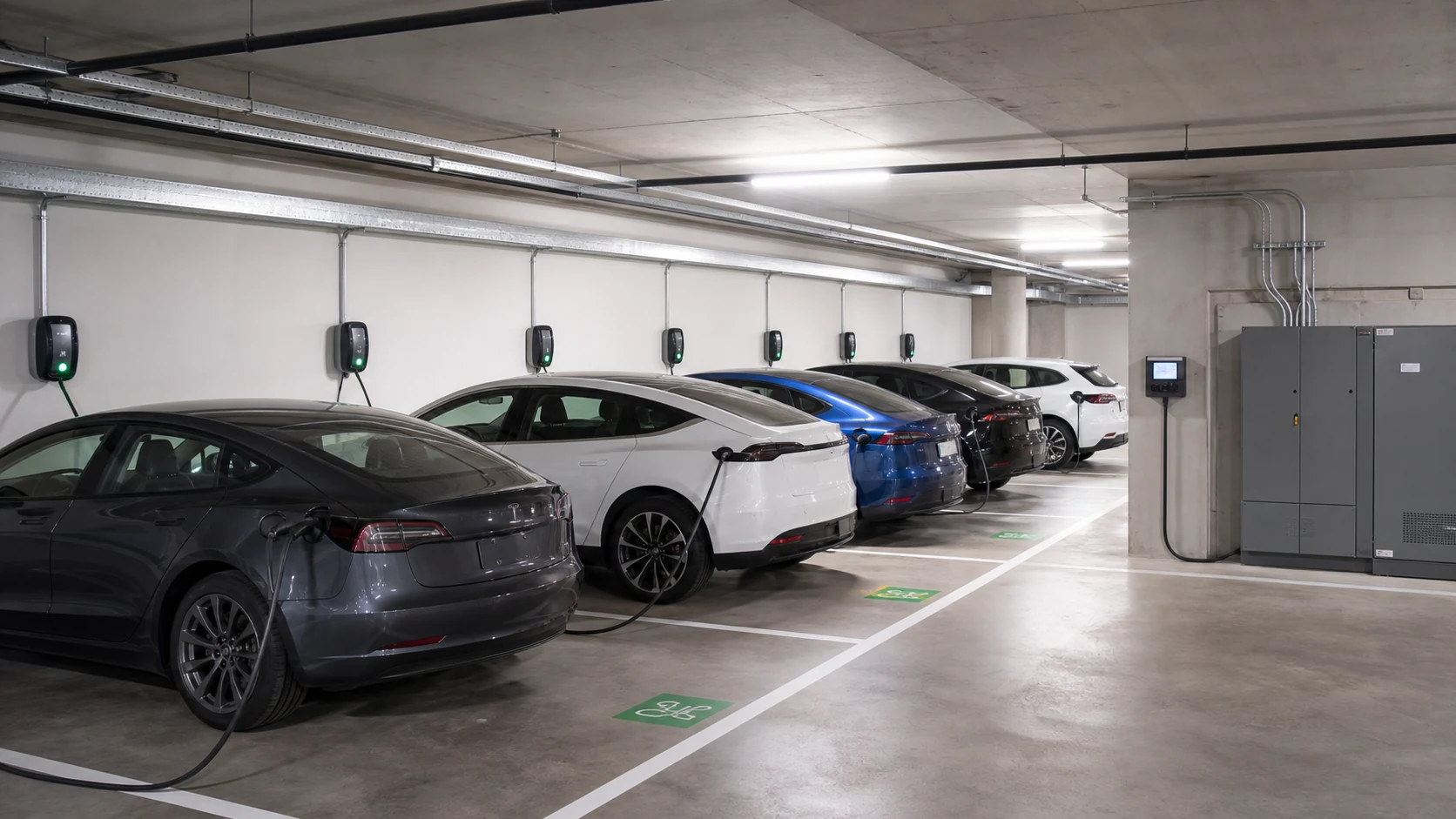
In homes, the issue is often panel capacity. A household may already have air conditioning, heat pumps, electric cooking, dryers, water heaters, solar inverters, or battery systems. Load-aware charging can reduce output when the home is busy and increase output when other loads drop.
In apartments and condominiums, the issue is scale. One charger may be simple. A full parking garage may require a system that allocates power by user, circuit, parking zone, or subscription plan. Good management lets more residents access charging without assuming every space needs maximum power at all times.
In workplaces and commercial parking, charging demand often overlaps with normal building operation. Employees may arrive together, visitors may expect a top-up, and the building may already have daytime peaks. Load management helps the site offer charging while keeping business operations first.
Fleet depots need an energy-and-departure check as well as a power cap. Specify each route’s required energy and available dwell time, then verify how the controller prioritizes sessions. DOE managed-charging guidance considers vehicle energy needs alongside control objectives.1 A controller cannot make an inadequate charging window deliver unlimited energy.
What should buyers check before choosing load management hardware?
Buyers should check whether the charger can accept current limits, communicate reliably, match the metering system, fail safely, and fit the target market. A load management feature is only useful if the charger responds correctly in real installations.
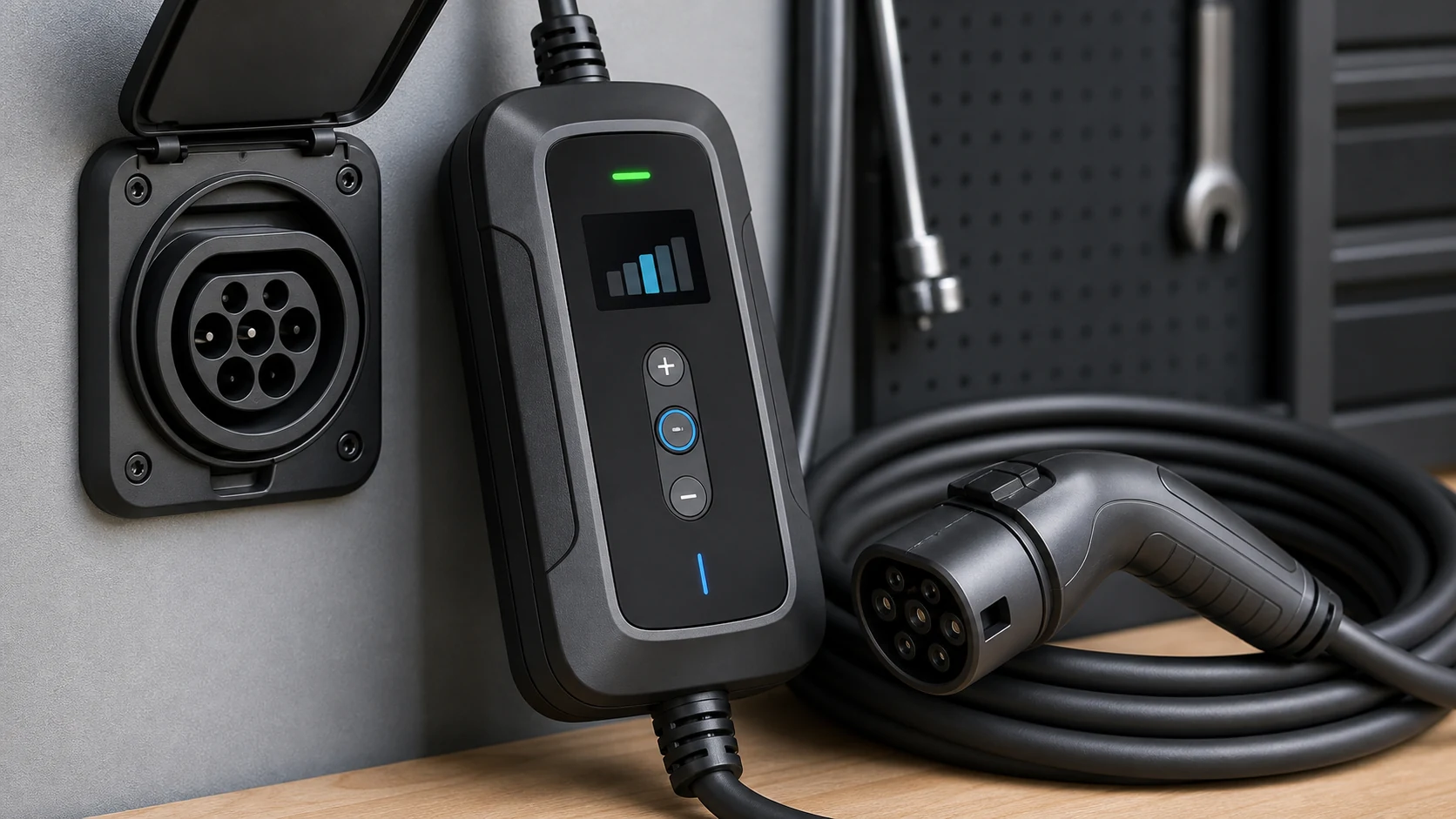
Start with current control. Chargers should accept the current range and control increments required by the design, and the commissioning team should verify that measured output follows the requested limit.
Next, check communication. Some systems use local wired communication, while others use Wi-Fi, Ethernet, cellular, RS485, a cloud platform, or OCPP. The right answer depends on the installation. A home charger may need simple local metering; a multi-site operator may need networked monitoring and remote configuration. In either case, safety must not depend on a marketing label such as "smart."
Meter compatibility matters just as much as charger compatibility. A dynamic system may require a specific meter, current transformer, gateway, or energy management controller. If the meter and charger cannot exchange useful data, the system may fall back to a fixed limit.
Safe fallback behavior is critical. Ask what happens if the meter fails, the network drops, or the controller stops responding. A responsible system should reduce current, pause charging, or use a documented safe limit instead of continuing at an unsafe output.
Also check cable rating, enclosure rating, protective functions, temperature behavior, labeling, manuals, firmware support, and certification expectations. Load management is a system function, but it still depends on suitable EVSE hardware.
Which option fits: integrated controls, a separate device, or a panel upgrade?
Use the following decision path before comparing brands or asking for a price:
| Site condition | First option to evaluate | Why | What to verify |
|---|---|---|---|
| One home or workplace charger, with documented spare capacity | Charger-integrated current limit or schedule | Lowest system complexity when the charger already provides the required control | Circuit rating, charger setting range, commissioning method, and future expansion |
| One charger sharing a service with variable building loads | Charger-integrated dynamic control with an approved meter or CT sensor | Charging power can move up or down as other loads change | Meter compatibility, phase sensing, maximum conductor limit, and loss-of-communication behavior |
| Two or more chargers on one constrained service | Multi-charger load-management controller or platform | A site-level controller can allocate power across sessions | Number of supported chargers, protocol, local or cloud control, priority rules, and recovery behavior |
| Fleet or apartment site with scheduled departure needs | Managed charging platform with site capacity rules | Charging can be assigned by departure time, vehicle priority, or energy requirement | User data, communications uptime, session priority, minimum current, and override controls |
| Site has little or no usable capacity after the electrical assessment | Panel, feeder, transformer, or service-upgrade evaluation | Software cannot create missing electrical capacity | Utility process, construction scope, lead time, cost, and whether a smaller managed system can bridge the gap |
The best answer is often a combination: a properly sized circuit, a charger with a defined maximum current, and a local or networked control layer. Do not select a standalone load-management box until the charger manufacturer confirms how it can limit current and what signal or protocol the box must use.
What happens when another vehicle plugs in?
The answer depends on the control strategy and the energy available at that moment.
Assume a site has a defined EV limit of 48 kW and one vehicle is drawing 32 kW. If a second vehicle starts a session, the controller might:
- keep the first vehicle at its current allocation and give the second vehicle the remaining capacity;
- reduce both vehicles to an agreed share;
- assign priority to the vehicle with the earlier departure time;
- pause the second session until a minimum charging level becomes available; or
- use a fixed group limit that does not change when the building's other loads change.
When a large building load starts, a dynamic system may reduce one or more EV charging currents even if no new vehicle has plugged in. When that building load drops, the controller may increase charging again. The buyer should confirm whether the adjustment is smooth, stepped, immediate, delayed, or limited by the vehicle's minimum controllable current.
Also ask whether a driver sees a pause, a lower charging speed, or an unavailable connector. The charging experience affects fleet operations and customer support, especially when drivers expect a full battery at a fixed departure time.
What affects the cost of an EV load management system?
There is no reliable universal price for an EV charger load management system because the cost is driven by the site and the control boundary. A useful quotation separates the following items:
| Cost driver | What changes the cost |
|---|---|
| Charger count | One charger, a group of AC chargers, several cabinets, or a mixed AC/DC site |
| Measurement hardware | Direct meter, CT sensors, submeter, gateway, communications cable, and enclosure |
| Control architecture | Charger-integrated feature, local controller, cloud platform, or site energy-management integration |
| Wiring distance | Panel-to-meter, meter-to-controller, charger-to-network, and trench or conduit requirements |
| Electrical work | New circuit, distribution-board changes, protection, grounding, labeling, and commissioning |
| Software and service | License, cellular data, dashboard, user management, API, reporting, updates, and support term |
| Allocation requirements | Equal sharing is simpler than departure-time priority, fleet scheduling, or energy targets |
| Market and documentation | Local design review, inspection, language, warranty, test records, and project documentation |
| Expansion plan | Spare controller capacity, additional CT channels, network capacity, and staged commissioning |
When requesting an EV charger load management system for sale, ask for a line-item quote that identifies hardware, licenses, installation, commissioning, and recurring service. Compare the cost of a slower managed installation with the cost and schedule of an upgrade using the same number of chargers and required daily energy.
How should installers and product buyers compare solutions?
Installers and product buyers should compare solutions by looking at the electrical limit, control type, charger compatibility, user experience, safety behavior, and long-term support. The best load management system is the one that fits the real site, not the one with the most impressive software claim.
Begin with the electrical question. Which panel or transformer is the constraint? How many amps or kilowatts are available for charging? Are loads single-phase or three-phase? Will more chargers be added later? A system designed around the wrong limit can be either unsafe or unnecessarily restrictive.
Then define the charging goal. A hotel, office, apartment building, public car park, and fleet depot need different rules. Some sites want equal sharing. Some want priority by user type. Some want overnight scheduling. Some need every vehicle ready for a route by a fixed time.
Hardware fit comes next. Software cannot fix the wrong connector, undersized cable, or unsuitable plug. If the product range is still being selected, the guide to EV charging cable connector types is a useful next step because regional connector choice and cable rating must match the intended market.
A practical comparison checklist includes:
- Site capacity: main service, sub-panel, feeder, transformer, and circuit ratings.
- Control method: static setpoint, group sharing, dynamic meter-based control, schedule, priority, or utility response.
- Charger compatibility: current range, communication method, firmware maturity, and supported protocols.
- Metering design: approved meter, CT placement, gateway, and commissioning process.
- User rules: equal sharing, priority users, fleet departure times, access control, and billing needs.
- Failure mode: behavior during communication loss, meter fault, software outage, or power interruption.
- Documentation: installer manuals, user instructions, labels, market compliance files, and after-sales support.
Finally, require a commissioning record that states the protected asset, meter and CT mapping, per-phase limits, allocation rule, fallback current, firmware version, and test results. A feature label alone is not evidence that the site will remain inside its limit.
If you are evaluating EV charging load-management equipment for a site or fleet, share the charger count, electrical capacity, vehicle mix, control requirements, and target market. We can help you define a practical technical and product inquiry.
Conclusion: EV load management is about using capacity wisely
EV charging load management helps chargers work within real electrical limits. It controls current, shares power, schedules charging, and can respond to building or grid conditions so more vehicles can charge without treating every charger as a maximum-power load all the time.
The main types include static limits, dynamic load management, charger group balancing, scheduled charging, priority-based control, and utility-responsive managed charging. Static control is simple and useful for predictable sites. Dynamic control is stronger when building demand changes, multiple chargers share a supply, or the site wants to expand without wasting capacity.
Before choosing a system, look at the whole installation: electrical capacity, meter design, charger communication, per-phase current, fallback behavior, driver energy needs, documentation, and support. Complete the sizing worksheet first, then verify the assumptions through an approved electrical design and a recorded failure-mode test during commissioning.
Frequently Asked Questions
Is EV charging load management the same as load balancing?
Not exactly. Load balancing usually means sharing available charging power across several chargers, while load management is the broader strategy for controlling charger demand through limits, schedules, priorities, dynamic measurement, or grid-response rules.
Do I need load management for one EV charger at home?
You may not need it if the charger is installed on a properly rated dedicated circuit and the home has enough spare panel capacity. It becomes more useful when panel capacity is tight, large household loads run at the same time, or a second EV charger may be added later.
Can EV load management avoid an electrical upgrade?
It can sometimes delay or reduce the need for an upgrade by using existing capacity more efficiently. It cannot create new capacity, so sites with high daily energy demand or strict charging deadlines may still need electrical upgrades.
Does load management make charging slower?
It can reduce charging speed when the site is constrained or when many vehicles are plugged in. The trade-off is that more vehicles may be able to plug in safely, and charging can speed up again when capacity becomes available.
What is the difference between static and dynamic load management?
Static load management uses a fixed power limit or sharing rule. Dynamic load management adjusts charger output according to live conditions such as building consumption, available capacity, and the number of vehicles charging.
Does EV charging load management require OCPP?
Not always. Some systems use local meters and proprietary communication. OCPP is useful for networked charging systems where chargers and backend software need to exchange status, meter data, charging profiles, and remote commands.
Can portable EV chargers support load management?
Some portable EV chargers can support load-aware use through adjustable current settings, smart controls, or integration with compatible external devices. Buyers should verify the exact current range, communication method, safety behavior, and documentation before making that claim.
What is the biggest mistake when choosing load management equipment?
The biggest mistake is judging the system by a feature label alone. Buyers should confirm the electrical design, meter compatibility, charger response, failure mode, connector fit, certification expectations, and after-sales support.
Can dynamic load balancing make an EV charge faster?
It can charge faster than a conservative fixed setting when spare capacity returns. It cannot exceed the charger, vehicle, circuit, phase, or protected-site limit, and it does not create capacity.
How much does an EV load management system cost?
Cost depends on charger count, meter or CT hardware, controller architecture, wiring distance, electrical work, software, commissioning, support, and expansion requirements. Request a line-item quotation and compare it with a panel or service-upgrade option using the same charging demand and schedule.
Which EV chargers have dynamic load balancing?
Many charger families offer some form of dynamic or managed charging, but the supported sensor, communication method, phase arrangement, charger count, and software profile vary. Ask the supplier to show the complete measurement-to-control path and identify which combinations have been tested.
When is a separate EV load-management device needed?
A separate device is worth evaluating when the chargers cannot directly measure the protected service, several different charger models must share one limit, the site needs a central allocation policy, or the energy-management system must coordinate EVs with solar, batteries, fleets, or building loads. It adds equipment and commissioning work, so confirm the charger control interface before purchase.
References
[1] U.S. DOE FEMP. “Managed and Bidirectional Charging.”
[2] reev. “EMS: Static and Dynamic Load Management.”
[3] Eaton. “EV Charging Load Management, WP191003EN Rev 01, February 2026.”
[4] Open Charge Alliance. “Open Charge Point Protocol: versions and functions.”
[5] Open Charge Alliance. “OCPP 1.6 certification: Core, Smart Charging and Advanced Security.”
[6] U.S. Department of Energy. “Smart Charge Management Implementation for Federal Fleets.” 2024; accessed September 2026.