



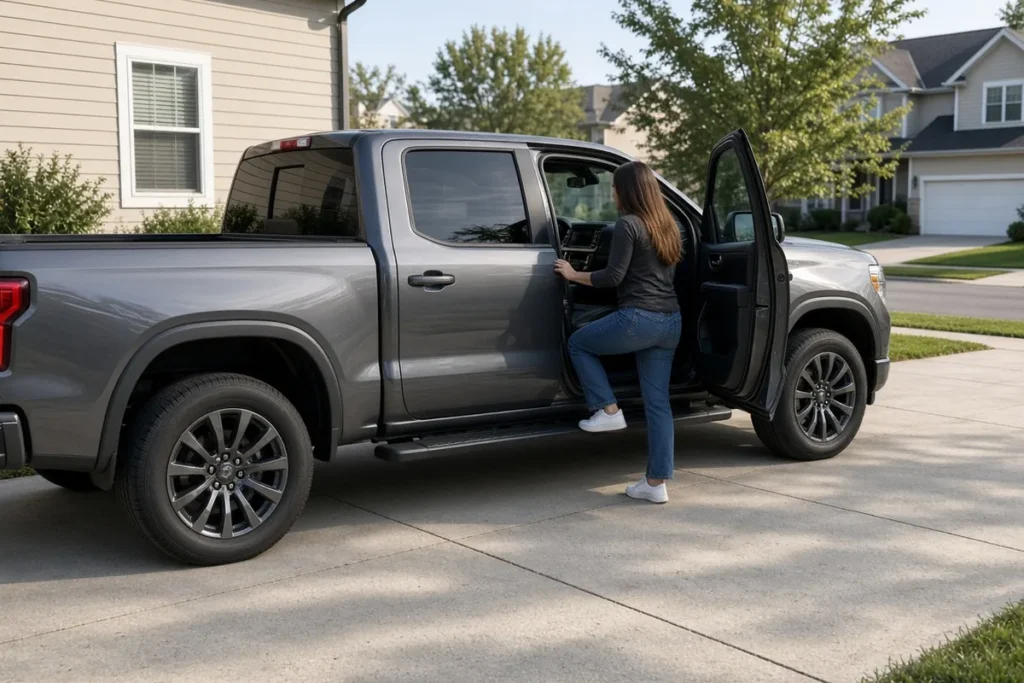
Running boards, nerf bars and power steps are all side steps that help you climb into a truck or SUV, but they differ in shape and movement. A running board is a wide, flat, fixed platform. A nerf bar is a narrower tube with step pads. A power step is a board that folds out when a door opens and tucks away when it closes.
Scope: this guide compares the three main side step types for pickups and SUVs and helps you pick one. It does not cover rock sliders in depth, which are body protection rather than steps, or bed and bumper accessories, which have their own guides.
What is the difference between running boards, nerf bars and power steps?
The difference comes down to three things: how wide the stepping surface is, whether it moves, and how much it hangs below the body. Everything else, such as looks, price range and installation effort, follows from those.
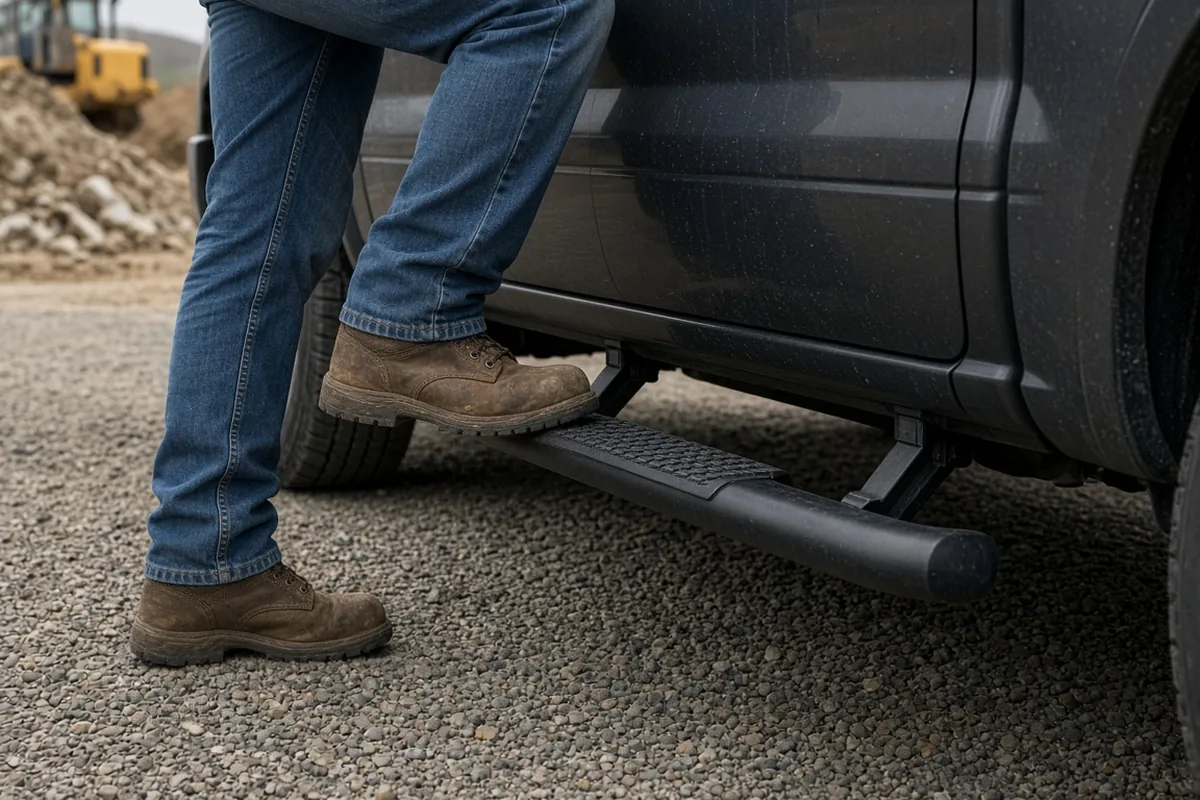
- Running boards are long, flat platforms that run the length of the cab. They stay fixed in one position. The top is covered with a textured or rubber tread.
- Nerf bars are round or oval tubes, typically steel or aluminum, mounted below the doors. You step on molded pads placed where your feet land. Some versions run wheel-to-wheel; others are short “drop steps” or “hoop steps” that serve one door.
- Power steps (also sold as power running boards, electric running boards or retractable running boards) are boards on motorized hinge arms. They stow up against the rocker panel while you drive and swing down and out when you open a door.
The names overlap in the market. Many sellers use “side steps” as the umbrella term, and “nerf bar” sometimes gets used for any tube-style step. When you compare products, look at the shape and mechanism in the photos and drawings rather than the label.
How do they compare side by side?
Each type trades step area against ground clearance, simplicity and cost. This table summarizes how they usually compare; exact figures depend on the product and the truck.
| Running boards | Nerf bars | Power steps | |
|---|---|---|---|
| Stepping surface | Widest, flat, full length | Narrow tube with pads | Wide board, full length |
| Moves? | No | No | Yes, deploys with the doors |
| Step height when in use | Fixed at mount height | Fixed at mount height | Drops lower than a fixed step on most designs |
| Ground clearance while driving | Reduced | Moderate; tube sits below rocker | Best; board tucks up when stowed |
| Look | OEM-style, finished | Sporty or rugged | Clean side profile when stowed |
| Installation | Bolt-on brackets | Bolt-on brackets | Brackets plus motors and a wiring harness |
| Maintenance | Clean tread | Clean tread, watch coating chips | Clean and grease hinges; check wiring |
| Typical relative price | Low to mid | Low to mid | Highest |
| Best for | Family use, daily driving | Work trucks, occasional off-road | Lifted or tall trucks, easy entry |
How we put this together: the comparison reflects the common construction of each type as described in vehicle owner manuals and manufacturer installation guides [1][3], plus general product knowledge. It is a starting point; check the specific product’s drawings for height, depth and clearance.
When are running boards the right choice?
Running boards are the right choice when the people using the truck need a wide, stable place to put their whole foot, and the truck spends most of its time on pavement. Children, older passengers and anyone wearing work boots get the most benefit from a flat platform.
The wide surface also catches some road spray and gravel before it reaches the rocker panels and doors, and it gives you a place to stand when loading a roof rack. On the other hand, a fixed board sits lower than the rocker panel the whole time you drive, so it reduces ground clearance and can catch on ruts, curbs, snowbanks and trail obstacles.
Look for these features when comparing running boards:
- A tread that drains water and grips when wet or muddy
- Brackets that use the vehicle’s existing mounting points, so no drilling is needed
- End caps that close the profile, so dirt does not pack into the extrusion
- A length that matches your cab (regular, extended/double or crew cab)
When do nerf bars make more sense?
Nerf bars make more sense when you want a lighter, tougher step that keeps a sporty look and leaves more of the body exposed, which suits work trucks and occasional off-road use. The tube shape sheds mud and snow better than a flat board, and a dented tube is cheap to replace.
The trade-off is the stepping area. You step on a pad on a round or oval tube, so the foot contact is smaller than on a board, and the pad positions have to line up with the doors. Oval tubes with wide pads give more contact than round tubes. “Wheel-to-wheel” bars extend to the rear wheel and let you step up to reach the front of the bed.
A note on names: nerf bars are not rock sliders. Rock sliders bolt to the frame and are built to take the truck’s weight on rocks; nerf bars are a step first and offer limited body protection. If you drive hard trails, buy a part designed as a slider.
How do power steps work, and are they worth it?
Power steps use small motors at the front and rear hinge arms. When you open a door, the board swings down and out; when you close it, it returns to the stowed position. On Ford’s factory power running boards, for example, the boards stow after a two-second delay when you close the door, return to auto mode above 3 mph (5 km/h), and reverse if they hit an object while moving [1][2].
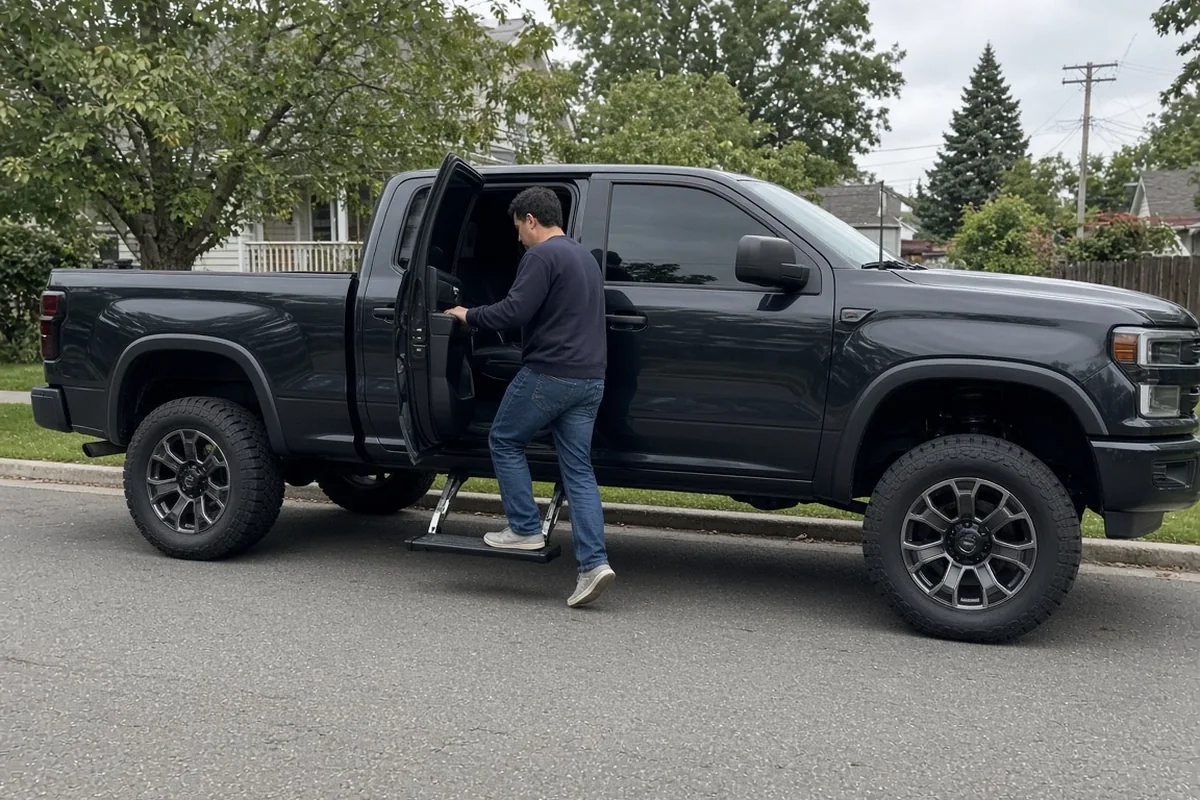
They are worth it when the truck is tall or lifted and you also want full ground clearance while driving. Because the board drops lower than a fixed step when deployed, the first step is easier, and because it tucks up when stowed, it does not hang below the rocker on the road or trail.
The costs are price, complexity and maintenance. Ford’s own owner information warns that in extreme climates ice can keep the boards from deploying, that you should not step on them until they have finished moving, and that hands should never go between an extended board and the vehicle [1]. Its maintenance guidance is to deploy the boards, wash the hinge arms with a car-wash wand, treat the bushings with penetrating lubricant and apply multi-purpose grease to the bushings and motor output shaft every six months [3]. If you drive in snow and road salt and will not clean the mechanism, a fixed step is the safer bet.
Which side step fits your truck and how you use it?
Pick the step by the person using it and the place you drive, not by looks alone. This decision table covers the most common situations.
| Your situation | Usually fits best | Why |
|---|---|---|
| Stock-height crew cab, family use, mostly pavement | Running boards | Widest stable step, simple, low upkeep |
| Lifted truck or tall 4×4, passengers struggle to climb in | Power steps | Lower first step plus clearance when stowed |
| Work truck, mud and job sites | Nerf bars (oval, wide pads) | Durable, shed dirt, cheap to replace |
| Regular off-road trails | Power steps or rock sliders | Fixed steps reduce clearance and get damaged |
| Heavy snow and salt, little time for maintenance | Nerf bars or running boards | No moving parts to freeze or jam |
| Need to reach the bed or roof rack | Wheel-to-wheel nerf bars or running boards | Longer standing surface |
| Tight budget, short-term ownership | Nerf bars or running boards | Lower cost, simple install |
Two quick tests help. First, have the shortest regular passenger try the climb with the current setup; if they need the grab handle and a big step, height matters more than looks. Second, think about your worst regular road: a deep rutted driveway or a snowbank at the curb will find a fixed board quickly.
What should you check for fitment and installation?
Fitment is model-specific. Match the step to the exact make, model, year range and cab length, because bracket positions change between generations and cab styles.
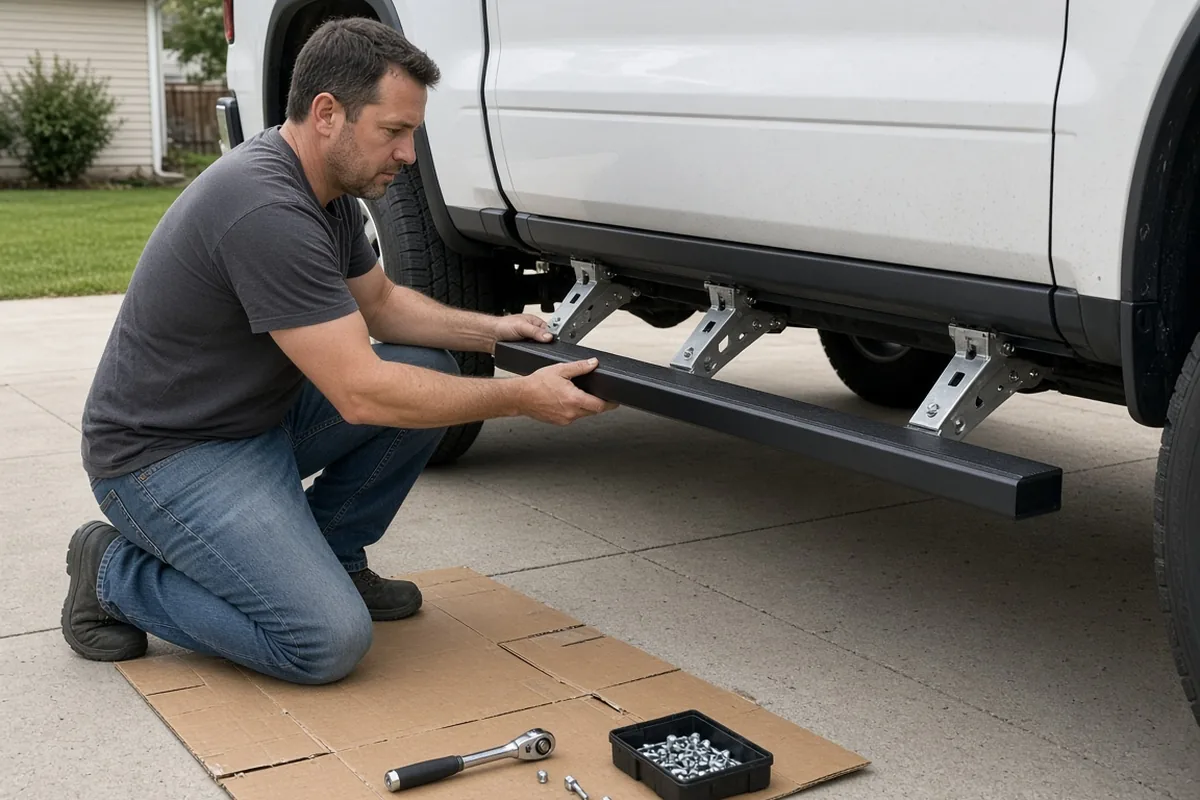
- Cab style and bed length. Regular, extended/double and crew cabs need different board lengths and bracket counts.
- Mounting points. Most quality kits use existing threaded holes or captured nuts in the cab mounts or frame. Ask whether any drilling is needed.
- Trim exceptions. Some trims are excluded. AMP Research, for example, lists its 2010–2021 Toyota 4Runner kit as not compatible with two specific trims [4].
- Wiring for power steps. Power kits include a controller and a harness that connects to the vehicle’s door signals. That same guide recommends professional installation and estimates 3 to 5 hours for that vehicle [4].
- Clearance to mud flaps, exhaust and fuel tank shields. Check the drawing against your truck’s underside, especially if it has aftermarket parts.
- Load rating. Check the per-side load rating on the product sheet against the heaviest person who will use it, with tools or gear.
- Torque and re-check. Torque all bolts to the kit’s values and re-check after the first few hundred miles.
Never jack the truck on running boards, power step arms or their brackets. Ford’s owner information specifically says not to use the boards, hinge assemblies, motors or underbody mounts as lifting points [1].
Which materials and finishes hold up best?
Aluminum resists rust and keeps weight down, while steel is stronger for its cost but depends on its coating. The finish matters as much as the base metal, especially where roads are salted.
- Extruded aluminum is common for running boards and power step boards. It does not rust, though it can corrode at scratches and dissimilar-metal contact points without proper isolation.
- Carbon or manganese steel tube is common for nerf bars. It is strong and affordable, but chips in the coating will rust if not touched up.
- Stainless steel resists corrosion well and suits polished looks, at a higher price.
- Powder coat and e-coat are the usual finishes on steel. A textured black powder coat hides scuffs; e-coat underneath improves coverage inside corners.
- Treads and pads are usually rubber or a thermoplastic elastomer. Check that they are mechanically locked or bonded, not just pressed on.
Typical production for these parts involves aluminum extrusion, or steel tube bending and welding, followed by surface treatment such as powder coating or e-coating, then bracket and, for power steps, motor assembly. Factories in this category usually check weld quality, coating adhesion and salt spray resistance, motor run cycles on power units, and bracket hole positions against the vehicle drawing.
What are the downsides and exceptions?
Every side step changes something about the truck, so weigh these before buying.
- Ground clearance. Fixed boards and bars hang below the rocker. On trails or rutted roads they get bent and can transfer impacts to the cab mounts.
- Getting dirty. A wide board collects mud and snow, which then ends up on your pants and the cab floor.
- Power step failures. Debris, ice and salt can cause noise, slow movement or a board stuck mid-travel; Ford’s guidance is to clean and grease the mechanism when this happens [3]. Most systems have a manual stow option for a failure on the road.
- Warranty and wiring. Electrical taps into the vehicle harness should follow the kit’s instructions. Ask your dealer how aftermarket wiring affects any vehicle warranty claims in that area.
- Short trucks and stock height. On a stock-height midsize truck, a step may add little; some drivers find it gets in the way of their calves when stepping out.
- Car wash and parking. Wider boards can sit close to curbs and car-wash guide rails. Check the overall width.
What should distributors and brands specify when sourcing side steps?
For distributors, importers and aftermarket brands, most returns on side steps come from fitment and finish problems, so the specification should lock down the vehicle list, brackets and coating before price is discussed.
- Vehicle application list by make, model, year range, cab style and excluded trims
- Product type and profile drawing (board depth, tube size and shape, length)
- Material and wall thickness; coating type and color; salt spray requirement
- Bracket design, mounting points used and whether drilling is required
- Load rating per side and how it is tested
- For power steps: motor and controller specification, harness connection method, manual stow method and run-cycle testing
- Hardware kit, instructions and torque values in the target market’s language
- Packaging that protects the finish during export, with carton labels and part numbers
Ask for a pre-production sample fitted to the target vehicle, and check that bracket holes line up without force. For power steps, run the sample through repeated door cycles and verify that the bounce-back function works.
Conclusion
Running boards, nerf bars and power steps solve the same problem in different ways. Running boards give the widest, most stable step and suit family trucks that stay mostly on pavement. Nerf bars trade some foot area for a lighter, tougher tube that handles mud and job sites well. Power steps combine a lower first step with full clearance on the road, at a higher price and with regular maintenance.
The right choice depends on who climbs in, how tall the truck is and where it is driven. A lifted truck used by the whole family points to power steps; a work truck that sees mud and salt points to nerf bars; a stock crew cab that rarely leaves the road is well served by running boards. Whatever you choose, match it to the exact cab and year, use the existing mounting points, and follow the maker’s guidance on load, wiring and maintenance.
Next step
Write down your truck’s make, model, year, cab style and trim, then use the decision table above to shortlist one type. Check the shortlisted product’s drawing for step height, clearance and mounting points before you order. You can also browse electric running boards and the wider truck accessories range, or see how a tonneau cover fits into a pickup setup.
Running boards, nerf bars and power steps are built in Yirox’s own production; only models outside our range are supplied by audited partner factories, and we say which applies before you order. For each program we check the vehicle list and bracket drawings with you before sampling, with low MOQ on selected items.
Sourcing side steps for a distribution or private label program? Send the specification items above through our sourcing solutions page.
Frequently asked questions
Are nerf bars the same as running boards?
No. Running boards are wide flat platforms, while nerf bars are narrower tubes with step pads. Both are fixed side steps, and some sellers use the names loosely.
Are power running boards worth it?
They are worth it on tall or lifted trucks where a lower step and full ground clearance both matter. If you drive in heavy snow and salt and will not clean and grease the hinges, a fixed step is simpler.
Are nerf bars the same as rock sliders?
No. Rock sliders mount to the frame and are built to support the truck on rocks. Nerf bars are steps and offer only limited body protection.
Do nerf bars rust?
Steel nerf bars can rust where the coating is chipped, so touch up damage promptly. Aluminum and stainless steel versions resist rust much better.
What are the downsides of running boards?
They reduce ground clearance, collect mud and snow, and can be bent on rough roads. They also make the truck slightly wider at the step.
Can you install power steps yourself?
Some owners do, but power kits include motors, a controller and a wiring harness. Manufacturers often recommend professional installation and estimate several hours of work.
References
[1] Ford Motor Company. “Power Running Boards: Using Power Running Boards.” Owner’s manual content. Warnings, jacking note, auto deploy and stow, bounce-back.
[2] Ford Motor Company. “Power Running Board Settings.” Owner’s manual content. Off, Auto and Out modes; stow above 3 mph (5 km/h).
[3] Ford Motor Company. “Power Running Boards: Troubleshooting and FAQ.” Owner’s manual content. Cleaning and six-month grease interval.
[4] AMP Research. “PowerStep Installation Guide, Toyota 4Runner 2010–2021, 77155-01A.” IM77155 rev 09.30.22.