



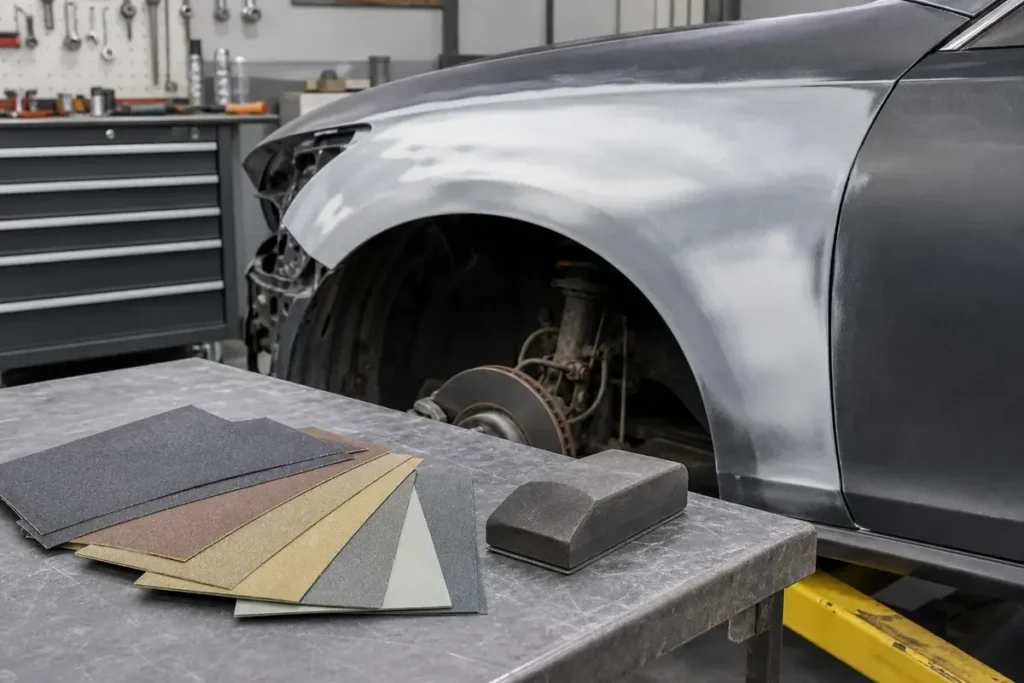
Automotive sandpaper is abrasive material designed for shaping, smoothing, feathering, preparing, and finishing vehicle surfaces before paint, primer, polishing, or repair. It is different from ordinary household sandpaper because auto body work needs controlled scratch patterns, flexible backings, wet-or-dry performance, and predictable results on metal, filler, primer, paint, and clear coat.
Choosing the wrong sandpaper can create deep scratches that show through paint, poor adhesion, uneven body filler, or extra rework. Choosing the right one makes the repair faster and safer: coarse grits remove material, medium grits shape and level, fine grits prepare primer and paint, and ultra-fine grits refine clear coat before polishing.
This guide explains what automotive sandpaper is, how grit types work, where different formats are used, and how to choose sandpaper for body filler, primer, paint prep, wet sanding, and final finishing.
Table of Contents
- What makes automotive sandpaper different from regular sandpaper?
- What grit types are used in auto body work?
- What forms of automotive sandpaper are available?
- Where is automotive sandpaper used on a vehicle?
- How do you choose automotive sandpaper for each repair stage?
- What mistakes should you avoid when sanding cars?
- What should buyers check before sourcing automotive sandpaper?
- Conclusion: Match the abrasive to the surface and the next step
- Frequently Asked Questions
- References
What makes automotive sandpaper different from regular sandpaper?
Automotive sandpaper is made for controlled surface preparation on paint systems, primers, fillers, plastics, and metals. Regular woodworking paper may cut too unevenly, clog too quickly, or leave scratch patterns that are hard to hide under automotive coatings.
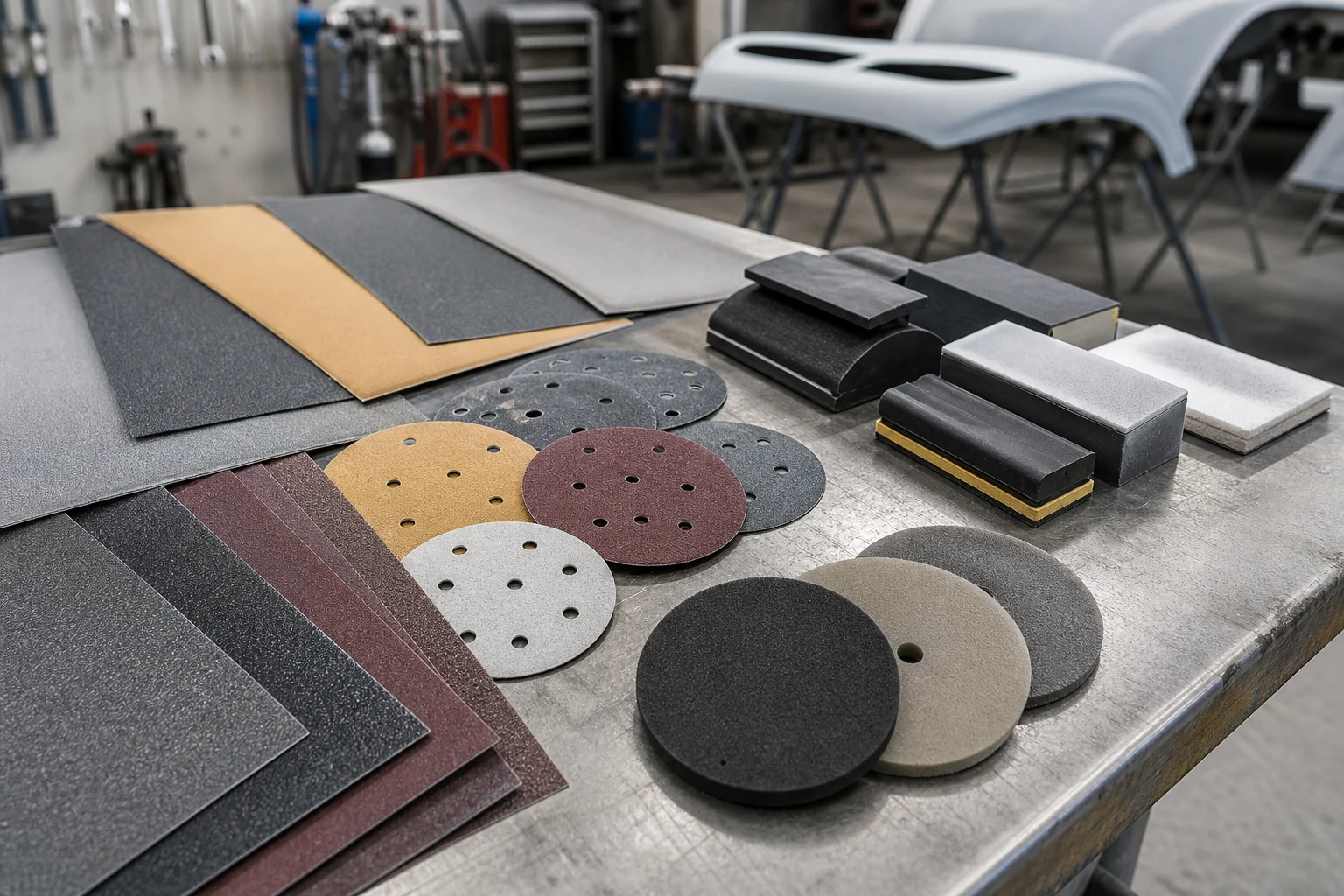
The difference starts with abrasive mineral and backing. Automotive abrasives often use aluminum oxide, silicon carbide, ceramic blends, or film-backed abrasive grains. The backing may be paper, cloth, film, foam, hook-and-loop disc material, or waterproof paper. Those choices affect flexibility, cut rate, tear resistance, clog resistance, and whether the product can be used wet.
Auto body work also depends on consistency. If one batch of P320 cuts like P240, a technician may leave scratches that primer cannot fill. If a finishing disc sheds grit or loads up too quickly, it can create pigtails under paint. This is why professional abrasives are judged by scratch consistency, not only how aggressive they feel in the hand.
For buyers building a repair or refinishing range, the related automotive sandpaper and abrasives category is the natural place to compare sheet, roll, disc, and wet/dry options.
What grit types are used in auto body work?
Auto body work uses a wide grit range, from very coarse material-removal grits to ultra-fine finishing grits. The lower the grit number, the more aggressive the scratch; the higher the number, the finer the scratch.
| Grit Range | Common Automotive Use | Risk If Misused |
|---|---|---|
| P40-P80 | Heavy stripping, shaping rough filler | Deep scratches, panel damage |
| P120-P180 | Body filler shaping, feathering rough edges | Visible scratches under primer |
| P220-P320 | Primer prep, old paint leveling | Poor adhesion if skipped or too smooth too soon |
| P400-P600 | Final primer sanding, paint prep | Sand-through on edges |
| P800-P1500 | Wet sanding paint, blending, nib removal | Slow cutting if the defect is too deep |
| P2000-P5000 | Clear coat refinement before polishing | Wasted time if earlier scratches remain |
The “P” matters. Many automotive abrasives follow FEPA P-grade sizing, while some markets use CAMI or other systems. The numbers look similar in daily speech, but exact particle-size standards can differ. For a deeper grit-by-grit breakdown, the related complete sandpaper grit guide is the next useful article in this series.
Professional sanding systems from major abrasive brands commonly separate material removal, filler shaping, primer sanding, paint preparation, and clear coat finishing because each step needs a different scratch pattern 1. Skipping too many grits can leave scratches that appear only after color or clear coat is applied.
What forms of automotive sandpaper are available?
Automotive sandpaper comes as sheets, rolls, discs, strips, belts, foam pads, sponge abrasives, and specialty wet/dry papers. The right form depends on whether the technician is sanding by hand, using a block, using a DA sander, reaching a curved area, or finishing clear coat.
Sheets are flexible and useful for hand sanding, small repair zones, wet sanding, and custom block sizes. Rolls are convenient in body shops because technicians can tear off the length they need. Discs are used with random orbital or dual-action sanders for faster leveling and more consistent scratch patterns on larger panels.
Foam-backed abrasives and interface pads help on curves, bumpers, edges, and contoured areas. They reduce hard pressure points, but they can also soften the cut too much if the repair needs flatness. A rigid block is better for leveling filler and primer on broad panels.
Wet/dry paper is built to hold together with water. It is common for clear coat correction, paint defect removal, and very fine finishing. Dry abrasive systems are faster for filler and primer, especially when paired with dust extraction.
Where is automotive sandpaper used on a vehicle?
Automotive sandpaper is used anywhere the surface must be leveled, shaped, cleaned, or prepared for coating. The most common areas are body filler repairs, primer surfacer, old paint, clear coat defects, bumper repairs, bare metal spots, and blend panels.
On body filler, coarse and medium grits shape the repair. The goal is not just smoothness; the repair must match the panel contour. On primer, sanding removes texture, guide coat lows, and small surface flaws before sealer or paint. On old paint, sanding creates mechanical adhesion for the next layer.
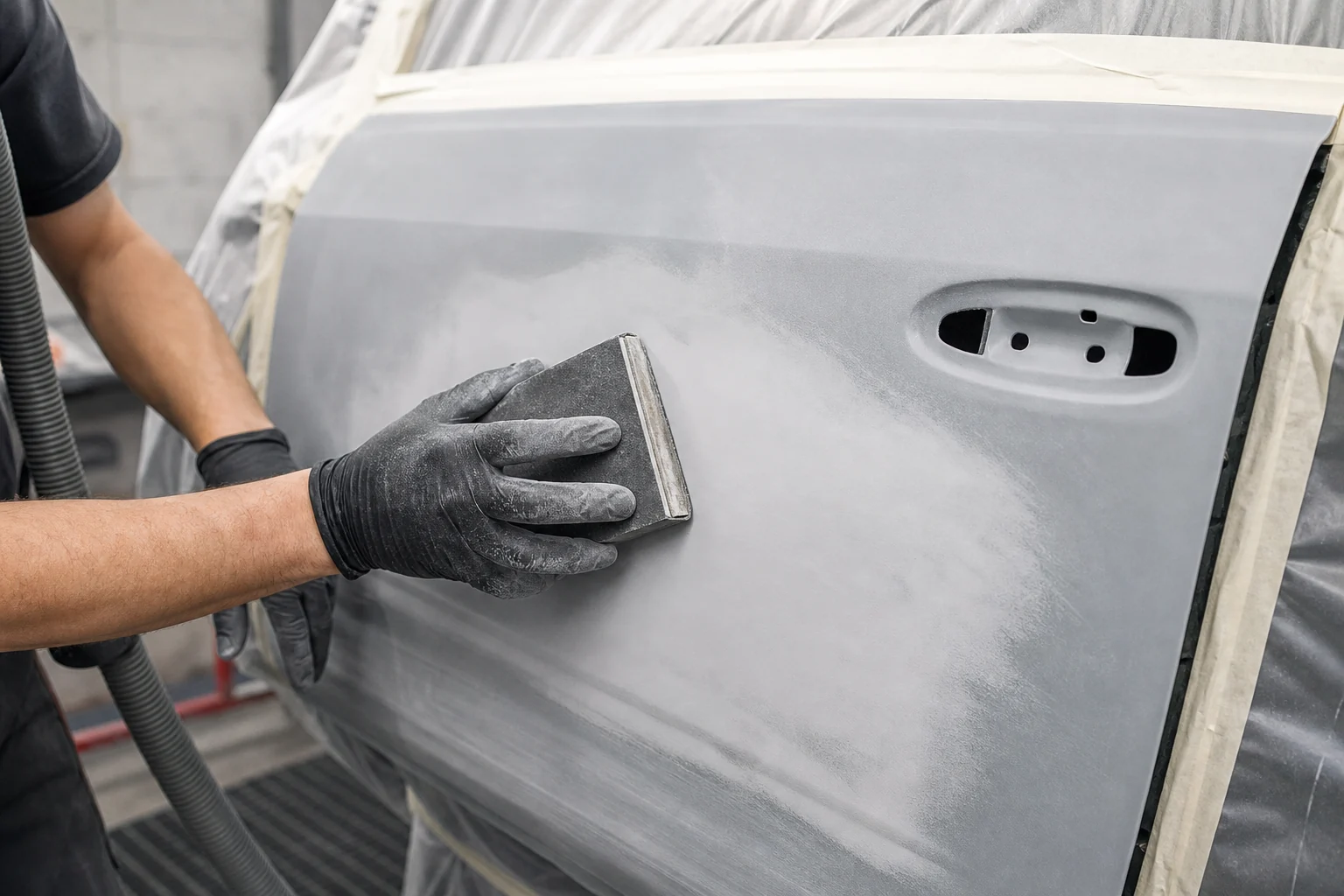
On clear coat, sandpaper becomes a finishing tool. Very fine wet sanding can remove dust nibs, orange peel, runs, or scratches before compounding and polishing. This is where the related wet sanding vs dry sanding guide matters, because the wrong method can burn edges, load the abrasive, or create avoidable dust.
Plastic parts need extra care. Bumpers and trim can heat up, smear, or gouge if the abrasive is too aggressive. Flexible abrasives and lighter pressure usually work better than a hard block on tight curves.
How do you choose automotive sandpaper for each repair stage?
Choose automotive sandpaper by starting with the surface, then the repair stage, then the next coating or finishing step. The grit should remove the current defect without creating scratches that the next step cannot remove.
- For stripping or heavy shaping: Use aggressive grits only where needed. Do not let P40 or P80 scratches spread into areas that will only receive thin primer.
- For filler leveling: Use a block and step down gradually. The goal is a flat repair, not just a smooth-feeling repair.
- For primer surfacer: Use guide coat and a medium-to-fine progression so low spots remain visible.
- For paint preparation: Follow the paint system’s recommended scratch range. Too coarse can show scratches; too fine can reduce adhesion.
- For clear coat correction: Use very fine wet sanding or finishing abrasives, then polish in stages.
The safest rule is to think one step ahead. If the next material is thick primer surfacer, it can fill more scratch than basecoat. If the next step is polishing clear coat, the sanding scratch must already be fine enough for compound to remove.
What mistakes should you avoid when sanding cars?
The biggest mistakes are starting too coarse, skipping too many grits, sanding without a block where flatness matters, ignoring edges, and treating all surfaces as if they need the same abrasive. These mistakes cause rework more often than the sandpaper itself.
Edges and body lines are especially vulnerable. Paint and clear coat are thinner there, and pressure concentrates quickly. A technician can sand through an edge long before the center of the panel looks finished.
Another mistake is using clogged abrasive. Loaded paper stops cutting cleanly and starts rubbing heat into the surface. It can also create random scratches or pigtails. Dust extraction, anti-clog coatings, proper pressure, and changing paper at the right time all help.
Dust is not just a cleanliness issue. OSHA’s autobody repair guidance treats sanding and refinishing as work that needs attention to dust, respiratory protection, ventilation, and safe handling 4. Wet sanding reduces airborne dust in some situations, but it creates slurry that still needs controlled cleanup.
What should buyers check before sourcing automotive sandpaper?
Buyers should check abrasive consistency, backing strength, hole pattern, hook-and-loop grip, wet/dry durability, packaging, labeling, and batch repeatability. A low unit price is not helpful if the abrasive cuts unevenly or fails during use.
For sample checks, compare the same grit across multiple sheets or discs. The scratch should look consistent. The backing should not tear easily. Hook-and-loop discs should stay attached without wobble. Wet/dry sheets should not curl, delaminate, or shed grit after soaking.
Packaging also matters. Abrasives can be damaged by moisture, crushed edges, poor carton strength, or mixed labeling. For distributors and accessory brands, Yirox Team typically reviews sample feel, grit consistency, backing, carton protection, label clarity, and whether the delivered batch matches the approved sample.
If the next step is building a fuller auto body accessory lineup, the broader Yirox product range helps place sandpaper beside related automotive categories, while the Yirox auto parts guides can support future customer education.
Conclusion: Match the abrasive to the surface and the next step
Automotive sandpaper is a precision repair material, not just rough paper. It shapes filler, levels primer, prepares paint, removes defects, and refines clear coat. The right product depends on grit, backing, format, abrasive mineral, sanding method, and the surface being repaired.
For technicians, the practical rule is simple: remove only what needs to be removed, keep the scratch pattern controlled, and never skip so far that the next step cannot clean up the previous scratch. For buyers, the rule is just as practical: evaluate consistency, durability, packaging, and real workshop performance before scaling an order.
Good sanding makes paint look better because it solves problems before the spray gun or polishing pad ever touches the panel.
Frequently Asked Questions
What grit sandpaper is best for automotive paint prep?
Many paint-prep jobs use the P400-P600 range, but the right grit depends on the coating system and whether the surface is primer, old paint, or a blend area. Always follow the paint manufacturer’s recommendation when available.
Can I use regular sandpaper on a car?
Regular sandpaper can damage automotive surfaces or leave inconsistent scratches. Automotive abrasives are safer because they are designed for paint, primer, filler, plastic, metal, wet sanding, and controlled finishing.
What is wet/dry automotive sandpaper?
Wet/dry automotive sandpaper is abrasive paper designed to work with or without water. It is commonly used for fine paint and clear coat sanding because water helps carry away residue and reduce clogging.
Is hand sanding better than machine sanding?
Hand sanding is better for edges, small areas, curved details, and final control. Machine sanding is faster and more consistent on larger panels when the correct disc, pad, speed, and dust extraction are used.
Why does sandpaper clog during auto body work?
Sandpaper clogs when paint, filler, primer, or clear coat residue packs between abrasive grains. Clogging is reduced by using the right grit, lighter pressure, dust extraction, anti-clog abrasive coatings, or wet sanding where appropriate.
References
[1] 3M. (2026). *Automotive Sanding and Abrasives Resources*.
[2] Mirka. (2026). *Automotive Refinishing Sanding Process Guidance*.
[3] Norton Abrasives. (2026). *Sandpaper Grit Chart and Abrasive Basics*.
[4] OSHA. (2026). *Autobody Repair and Refinishing Safety and Health Topics*.