



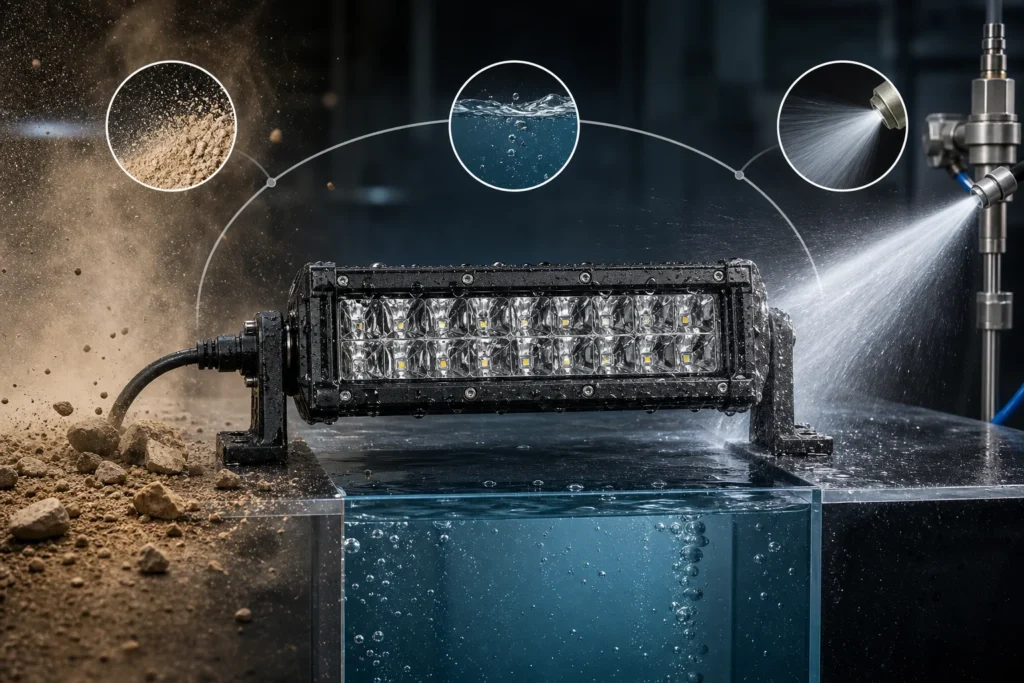
An IP rating for an LED light describes how its enclosure protects against access, solid particles, dust, and water under defined test conditions. IP67 is associated with dust-tight construction and temporary immersion, IP68 with continuous immersion under declared conditions, and IP69K with high-pressure, high-temperature spray for road-vehicle applications. They are different tests, not a simple “good, better, best” scale. 1 2
That distinction matters on a truck, work vehicle, agricultural machine, or off-road build. Rain, mud, a deep puddle, a long submersion, and a close-range pressure wash do not load an LED enclosure in the same way. The rating should therefore be matched to the exposure first, then checked against the complete lamp, connector, cable entry, mounting hardware, and installation method.
If the next question is which lamp shape or beam pattern fits the vehicle, the related guide to off-road LED light bars is the useful companion. Beam coverage solves a visibility problem; an IP rating solves an enclosure-exposure problem. Neither replaces the other.
Table of Contents
- What does the IP code mean on an LED light?
- What is the difference between IP67, IP68, and IP69K?
- Is IP69K better than IP68 for automotive LED lights?
- Which IP rating fits rain, mud, immersion, and pressure washing?
- What does an IP rating not prove?
- How should you verify an IP claim before buying?
- How should you install and maintain an IP-rated LED light?
- What should an automotive LED light RFQ include?
- Conclusion: match the IP test to the real exposure
- Frequently Asked Questions
- References
What does the IP code mean on an LED light?
The IP code is an enclosure classification, not a brightness rating and not a promise that an entire vehicle installation will remain waterproof forever. IEC 60529 defines the general IP Code for degrees of protection provided by electrical equipment enclosures; ISO 20653 applies the road-vehicle version to electrical equipment in vehicles. 1 2
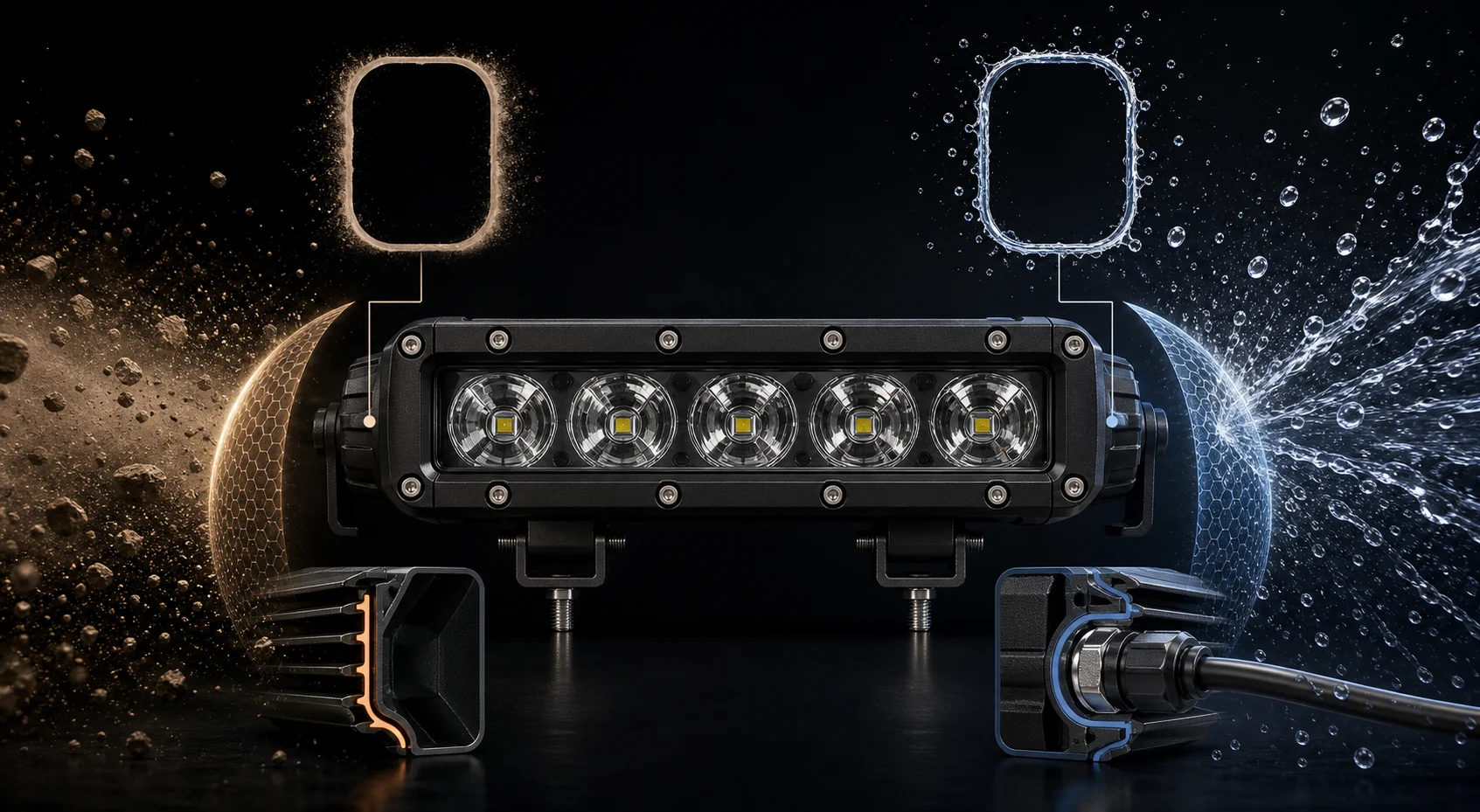
Read the code from left to right:
| Part of the mark | What it tells you | Example in an automotive LED light |
|---|---|---|
| IP | The enclosure protection code | It identifies the mark as an ingress-protection classification |
| First digit | Protection against access and solid foreign objects, including dust | 6 indicates the dust-tight level commonly requested for outdoor lamps |
| Second digit | Protection against water under a particular test | 7 and 8 relate to immersion; 9 relates to powerful spray in IEC 60529, while 9K is used in the road-vehicle framework |
| Additional letter or K | A supplementary code or special road-vehicle test condition | The exact code and standard should be shown in the test report, not inferred from a sales label |
The second part is where purchase mistakes happen because immersion and spray are different stresses. An X in a position, such as IPX7, means that position was not assigned a rating in the stated code; it should prompt the buyer to ask what was actually tested.
The K suffix also deserves care. ISO 20653 states that its IP codes follow IEC 60529 except where K codes describe special road-vehicle requirements not covered by IEC 60529. That is why a supplier should identify the standard and edition instead of treating IP69K as a decorative variation of IP68. 2
What is the difference between IP67, IP68, and IP69K?
IP67 and IP68 are immersion-oriented water tests, while IP69K is a high-pressure, high-temperature spray test associated with road-vehicle equipment. IP67 is commonly summarized as temporary immersion to 1 meter for 30 minutes under IEC 60529; IP68 uses continuous immersion under conditions specified by the manufacturer; IP69K requires the supplier to document the applicable road-vehicle spray test conditions. 1 2
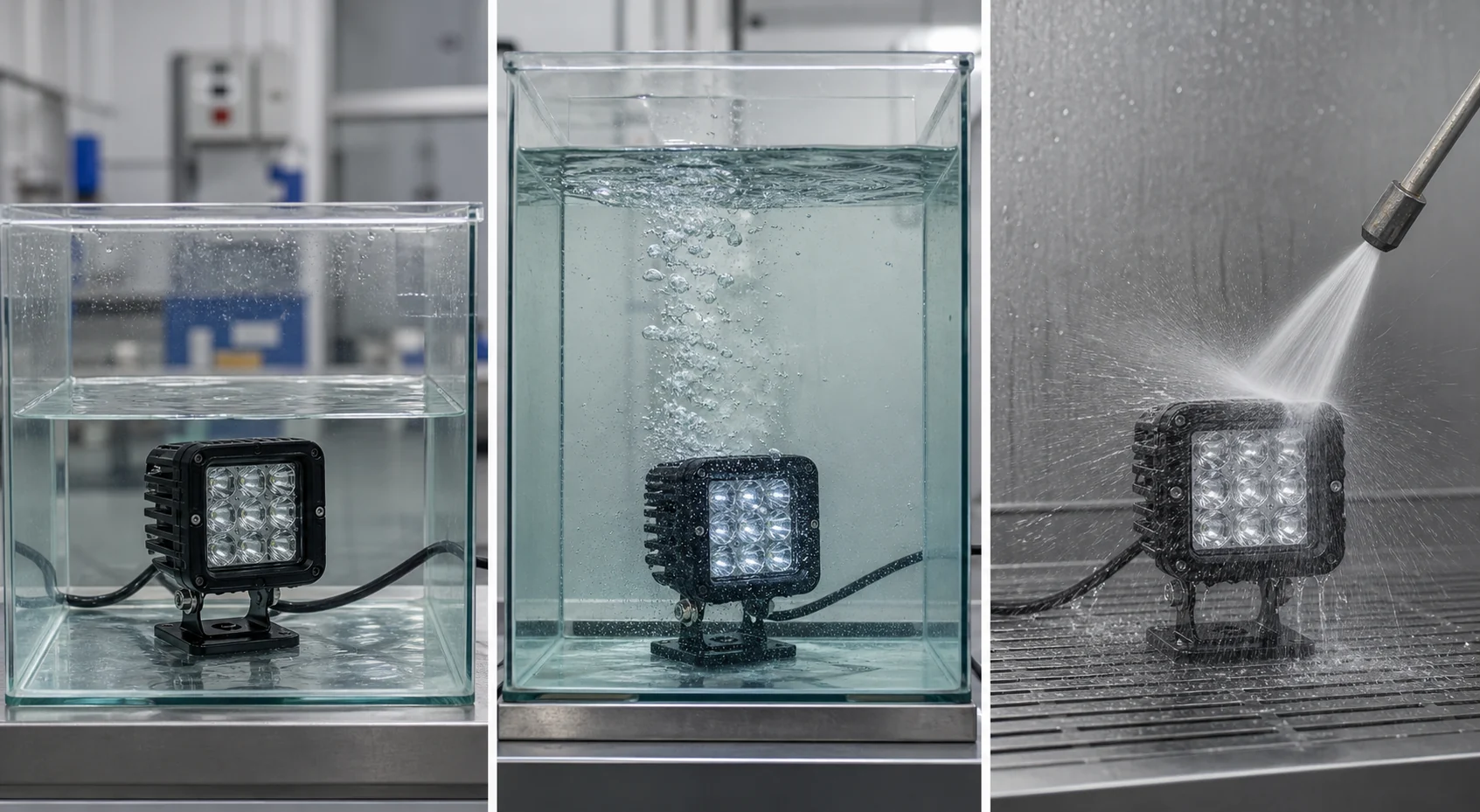
| Rating | Water exposure it addresses | Practical application | What the label does not prove |
|---|---|---|---|
| IP67 | Temporary immersion under the defined test condition | Outdoor auxiliary lamps exposed to rain, splash, mud, wet roads, and short water contact | Deeper or continuous submersion, hot close-range washdown, or long-term corrosion resistance |
| IP68 | Continuous immersion under a manufacturer-declared depth and duration | A low-mounted lamp or equipment with a known risk of deeper or longer water exposure | That every IP68 product was tested at the same depth or for the same time |
| IP69K | High-pressure, high-temperature water spray in the road-vehicle protection framework | Fleet, agricultural, industrial, or cleaning-intensive equipment exposed to close-range washdown | Continuous underwater use, unless a separate immersion rating is also documented |
What does IP67 mean for an LED light?
IP67 combines the highest common dust-protection digit with temporary immersion protection. It is often a sensible baseline for an outdoor light bar exposed to rain, splash, road spray, mud, and brief standing water. It does not prove deeper submersion, hot close-range washdown, unmated-connector protection, or a seal that has been damaged after installation.
What does IP68 mean for an LED light?
IP68 adds a continuous-immersion claim, but depth and duration are not universal. Two lamps may both carry IP68 and still have different declared conditions, so the product record should state depth, immersion time, orientation, and post-test result. “IP68 waterproof” with no such detail is not a meaningful comparison.
What does IP69K mean for an LED light?
IP69K is about concentrated spray, heat, and force when a lamp may face high-pressure hot water or aggressive washdown. ISO 20653 covers enclosure protection for electrical equipment on road vehicles and the tests used to confirm it. 2 It is not an unlimited “pressure-washer safe” promise: nozzle distance, temperature, pressure, flow, angles, exposure time, chemicals, seal condition, and installation still matter.
Is IP69K better than IP68 for automotive LED lights?
No. IP69K is not automatically better than IP68 because the two ratings test different water exposures. IP68 is the more relevant evidence for deeper or longer immersion; IP69K is the more relevant evidence for powerful hot spray. A lamp exposed to both risks may need documented combined ratings rather than one “highest” number.
This is the decision rule buyers can use:
| Real exposure | Evidence to prioritize | Why |
|---|---|---|
| Rain, road spray, and mud splash | IP67 or a stronger documented combination | The dominant risk is outdoor wetting and contamination, not continuous underwater use |
| Short puddle or creek exposure | IP67, with installation and cable-entry checks | Temporary immersion may fit, but the connector and harness still need protection |
| Repeated deep crossings or standing water | IP68 with declared depth and duration | Still water applies pressure over time, so an immersion declaration matters |
| Fleet, agriculture, or equipment washdown | IP69K with documented spray conditions | High-pressure hot spray attacks seams and cable exits differently from immersion |
| Both immersion and pressure washing | A combined IP67/IP69K or IP68/IP69K claim, if genuinely tested | One rating cannot be assumed to cover the other test path |
There is another naming issue: IP69 and IP69K are not interchangeable labels without checking the standard. IP69 is part of the IEC 60529 water-protection scale, while the K designation identifies special road-vehicle requirements in ISO 20653. A supplier that writes “IP69K certified” should be able to state the standard, edition, test boundary, and report reference. 1 2
The commercial implication is simple: build an exposure-led product ladder. A distributor can offer a practical outdoor option, an immersion-focused option where the market demands it, and a washdown-focused option where the use case justifies the cost. Over-specifying every lamp adds cost; under-specifying washdown creates returns.
Which IP rating fits rain, mud, immersion, and pressure washing?
Choose the rating from the lamp’s mounting location and cleaning routine, not from the largest number in a competitor’s title. A roof-mounted light, low bumper pod, agricultural work lamp, and fleet-wash vehicle have different exposure profiles even when all are sold as “off-road lighting.”
| Mounting or operating case | Starting point for the IP conversation | Questions that change the answer |
|---|---|---|
| Roof, grille, or roll-bar light bar | IP67 is often a practical baseline; IP68 may add margin when immersion is realistic | Does the lamp face mud packing, repeated crossings, or only normal weather? |
| Low bumper, underbody, or near-wheel lamp | Consider IP68 when standing water or deeper crossings are expected | How long can water remain around the lamp, and where is the cable exit located? |
| Agricultural or construction work light | IP67 to IP69K depending on mud, chemicals, and cleaning method | Is the light rinsed with a hose, a hot pressure washer, or a cleaning system? |
| Fleet vehicle cleaned at close range | Prioritize documented IP69K or a combined rating | What nozzle distance, temperature, pressure, and angles are permitted? |
| Marine-adjacent or winter-salt application | IP rating plus a separate corrosion/material review | Are the housing, fasteners, bracket, connector, and coating suitable for salt exposure? |
Use the selection process in four steps:
- Map the location: Record whether the lamp is above the roofline, behind the grille, below the bumper, inside an engine bay, or on exposed equipment. Location changes water paths and debris impact.
- Describe the water event: Separate rain, splash, temporary immersion, continuous immersion, and pressure washing. “Wet use” is not a test condition.
- Define the assembly and evidence: Include the lens, housing, end caps, cable gland, connector, cap, harness entry, and mount. Ask for the standard, edition, sample configuration, report number, declared conditions, and post-test result before publishing the claim.
If the beam decision is still open, compare spot, flood, and combo beam patterns separately. A narrow beam may improve distance visibility, while a flood pattern may improve near-field coverage; neither beam pattern changes the IP test result.
What does an IP rating not prove?
An IP rating is valuable because it narrows one specific risk: ingress and access under defined tests. It does not prove every durability, optical, electrical, legal, or vehicle-integration claim a buyer may care about. The standards describe enclosure protection and testing; the remaining risks need separate checks. 1 2
| Question a buyer may have | Why the IP mark is not enough | Additional evidence or check |
|---|---|---|
| Will it resist salt and chemicals? | Water exclusion is different from corrosion resistance and chemical compatibility | Material, coating, fastener, connector, and salt/chemical exposure requirements |
| Will it survive vibration and stone impact? | A water test does not reproduce every vehicle vibration or impact event | Vibration, impact, mounting, fastener, and bracket validation |
| Will the light stay cool? | IP code does not rate LED output, heat dissipation, driver behavior, or thermal derating | Operating voltage, current, thermal design, temperature range, and output test data |
| Is the beam right for the route? | IP code says nothing about optics, glare, beam distance, or coverage | Beam pattern, candela/lux data, mounting position, and aiming instructions |
| Is the connector waterproof? | The lamp body may be tested with a fully mated connector or without the harness | Connector part number, mating condition, cap requirement, cable gland, and strain relief |
| Is it legal on public roads? | Environmental protection is not a road-use approval or photometric compliance claim | The target market’s lighting, mounting, aiming, and auxiliary-lamp rules |
| Will the rating last for years? | Seal aging, UV, heat cycles, impact, modification, and poor installation can change performance | Materials, maintenance instructions, warranty terms, and controlled production checks |
The optics point is easy to miss. Buyers sometimes treat “IP69K” as a proxy for a premium lamp, then discover that the product has the wrong beam, excessive glare, an unrealistic lumen claim, or insufficient thermal control. For the output side, the related guide on how to read LED lumen claims is a better next step when the question is usable light on the road: IP rating protects the enclosure, while lumen and beam data describe the light output.
How should you verify an IP claim before buying?
Verify the claim as a chain of matching records: product label, controlled datasheet, test report, approved sample, and production batch. The objective is not to collect the biggest rating; it is to prove that the exact lamp a customer receives is the lamp that was tested.
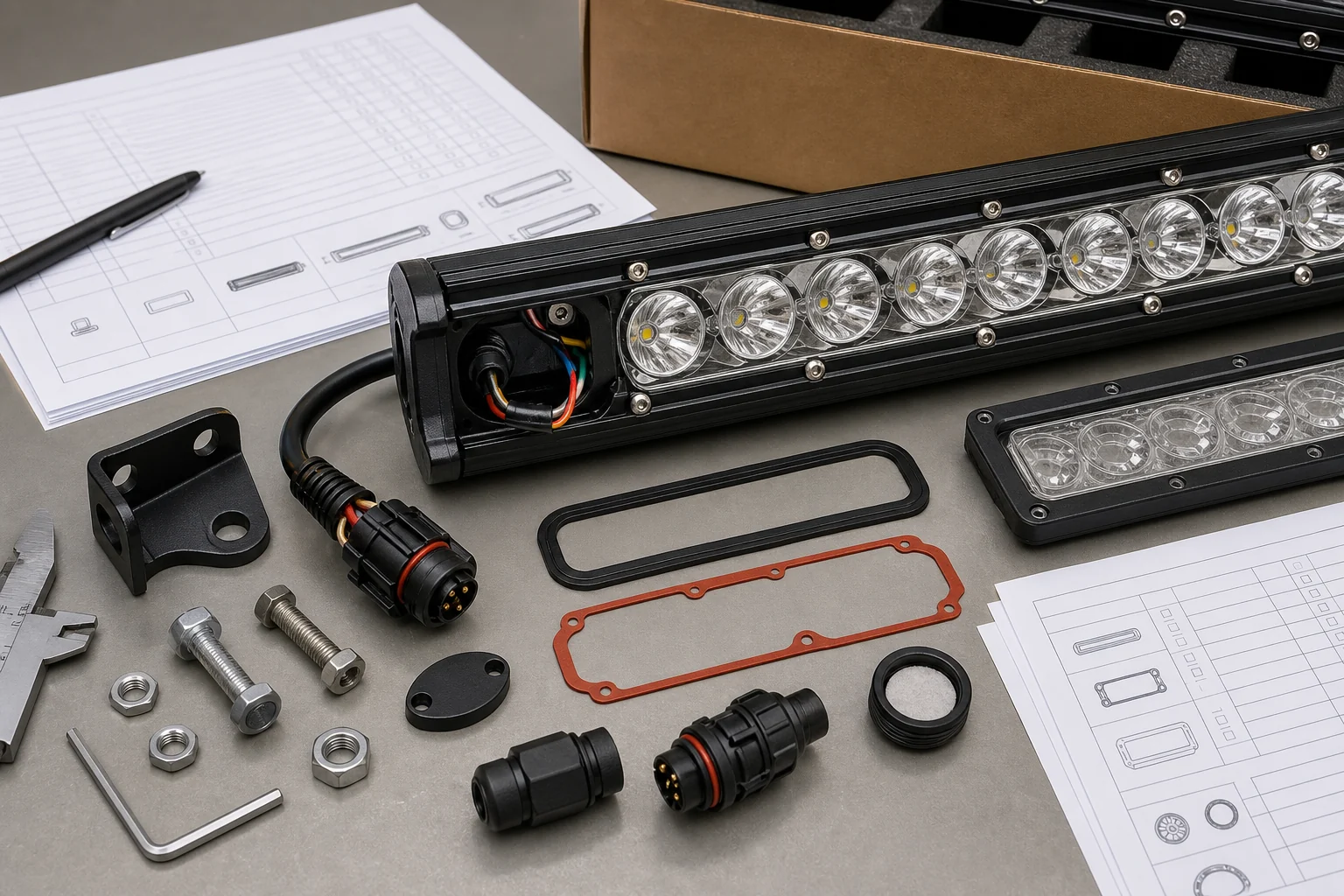
Use this evidence checklist when reviewing a supplier or approving a sample:
| Verification field | What to ask for | Red flag |
|---|---|---|
| Standard and edition | IEC 60529, ISO 20653, or another named standard and edition | “Tested to international standards” with no standard number |
| Product identity | Model, revision, drawing, label, and sample number | The report names a housing family but not the lamp revision |
| Test boundary | Complete assembled lamp, lens, end caps, cable, gland, connector, and cap state | Only a bare enclosure was tested while the listing describes a full kit |
| IP67 condition | Defined immersion method, orientation, duration, and post-test inspection | The listing adds “submersible” without explaining the test boundary |
| IP68 condition | Declared depth, duration, temperature, orientation, and post-test result | “IP68” appears with no depth or time |
| IP69K condition | Water temperature, pressure, flow, nozzle distance, spray angles, exposure time, and inspection result | A generic pressure-washer video replaces a controlled test record |
| Connector state | Whether protection applies only when fully mated, and whether a cap is required | The lamp is rated, but the supplied connector is unnamed |
| Failure inspection | Fogging, leakage, cable wicking, corrosion, cracking, and functional checks | “Passed” is stated without before/after evidence or acceptance criteria |
| Batch match | Approved sample, batch number, label artwork, and controlled datasheet | Production packaging or cable exit differs from the approved sample |
The test report should explain the post-test inspection. A lamp may remain on while moisture has entered, fogged the lens, or started corrosion; “still illuminated” is not the same as “no ingress.” An internal spray or immersion check can support incoming quality control, but it should be labelled as an internal check rather than independent certification.
Keep the evidence pack under revision control. If a lens, gasket, driver, cable gland, connector, bracket, coating, or label changes, the old IP record may no longer describe the saleable configuration.
How should you install and maintain an IP-rated LED light?
Installation preserves or destroys the enclosure’s tested boundary. Even a well-tested lamp can leak after a bracket modification, a damaged cable gland, a loose end-cap screw, an incompletely mated connector, or a drilled housing that was never resealed.
Before installation, check the following:
- Keep sealing surfaces clean: Do not clamp a gasket over grit, paint flakes, a cable, or a distorted edge.
- Protect the cable exit: Use the specified gland, strain relief, connector, bend radius, and routing so vibration is not transferred into the seal.
- Mate or cap connectors correctly: Many claims apply only when the plug and receptacle are fully mated; unused branches may need a sealing cap.
- Avoid casual enclosure modifications: A new hole, switch, vent, or fastener changes the tested boundary and needs its own sealing review.
- Mount and clean within product limits: Use the specified hardware, check heat and glare, and follow the manual for pressure-washer distance, temperature, chemicals, and spray direction.
- Inspect after impact or service: A cracked lens, loose end cap, bent bracket, damaged cable jacket, or missing cap creates a new ingress risk.
For the power and switching side, use the related LED light bar wiring harness guide. The harness, fuse, relay, switch, grounding point, and connector routing form part of the real vehicle installation even when only the lamp body carries the IP mark.
What should an automotive LED light RFQ include?
An RFQ should turn “waterproof LED light” into a measurable product and evidence request. That makes supplier quotations comparable and prevents a low price from hiding a missing test boundary.
Include these fields:
- Application and location: vehicle, market, environment, roof/grille/bumper/underbody position, mounting drawing, and clearance.
- Exposure and IP requirement: rain, mud, temporary or continuous immersion, hose spray, hot washdown, requested code, standard and edition, test boundary, and combined-rating need.
- Electrical and mechanical specification: voltage, operating range, current, connector, cable, dimensions, bracket, fasteners, vibration, lens, housing, coating, and thermal design.
- Optical and legal specification: spot, flood, combo, color temperature, usable output data, aiming limits, and any public-road restrictions.
- Quality and commercial evidence: report or internal-test identity, sample configuration, inspection criteria, batch traceability, change control, packaging, label/manual language, MOQ, lead time, replacement policy, and warranty.
For a distributor building a range, the most useful SKU structure is exposure-led rather than number-led. A standard outdoor lamp can be listed with clear IP67 evidence; a deeper-immersion model needs its declared IP68 condition; a washdown model needs IP69K evidence and cleaning limits. The off-road LED light bar range can then be evaluated alongside size, beam, mounting, electrical, and sealing requirements instead of rating alone.
When a supplier supports OEM or private-label work, ask for the evidence pack before the label artwork is finalized. That lets the team align the product name, datasheet, carton, manual, and online listing with the same tested configuration. Yirox’s practical value in this process is not a bigger number on the box; it is the ability to discuss sample configuration, sealing details, packaging, batch consistency, and the evidence needed for the target market.
Conclusion: match the IP test to the real exposure
IP67, IP68, and IP69K answer different questions. IP67 is a practical temporary-immersion baseline for many outdoor LED lights. IP68 is relevant when the product needs a declared continuous-immersion condition. IP69K is relevant when hot, high-pressure washdown is the real threat. None of the three should be treated as a lifetime guarantee for an unmodified vehicle installation.
The independent value of a useful IP-rating page is the decision path: identify the water event, choose the matching test, verify the complete assembly, check what the code does not cover, and keep the approved evidence tied to the production batch. That is how a buyer avoids paying for the wrong rating and how a distributor avoids promising more than the product record proves.
If you are comparing samples or preparing a private-label lighting program, request an IP evidence review and LED light sample with the vehicle application, mounting location, exposure, requested code, connector state, and target quantity. A focused request produces a more useful comparison than a generic “waterproof light” inquiry.
Frequently Asked Questions
What does IP stand for in LED lights?
IP is the code used to identify enclosure protection against access, solid foreign objects, dust, and water under defined test methods. It does not describe brightness, beam pattern, corrosion life, or road-use legality. 1
Is IP67 waterproof enough for an outdoor LED light?
IP67 is often suitable for rain, splash, mud, wet roads, and temporary immersion. It is not proof of unlimited underwater use or close-range hot pressure washing, and the connector and cable entry still need to match the exposure.
Is IP68 always better than IP67?
IP68 is better only when the application needs its declared continuous-immersion condition. Because depth and duration vary, compare the actual test conditions rather than the number alone.
Does IP69K mean an LED light can be submerged?
No. IP69K primarily addresses high-pressure, high-temperature spray in a road-vehicle test framework. It does not automatically prove continuous submersion; look for a documented combined rating when both risks exist. 2
Is IP69K the same as IP69?
Not without checking the standard and edition. IP69 is part of IEC 60529, while the K code identifies special road-vehicle requirements in ISO 20653. Ask for the exact standard named in the report. 1 2
Does the IP rating cover the LED light connector and wiring harness?
Not automatically. The claim may apply only to the lamp enclosure or when a named connector is fully mated. Confirm the cable gland, connector, cap requirement, harness entry, strain relief, routing, and test configuration.
What should I ask an LED light supplier about an IP rating?
Ask for the standard and edition, product revision, complete test boundary, IP68 depth and duration, IP69K spray parameters, report number, post-test inspection, connector state, and proof that the approved sample matches the production batch.
References
[1] International Electrotechnical Commission. “IEC 60529: Degrees of protection provided by enclosures (IP Code).” 2013.
[2] International Organization for Standardization. “ISO 20653:2023, Road vehicles — Degrees of protection (IP code).” 2023.